- Market Value (2025): USD 367.6 Mn
- Estimated Value (2026): USD 388.9 Mn
- Forecast Value (2036): USD 682.1 Mn
- CAGR (2026-2036): 5.8%
What is the Laboratory pH Electrodes Market forecast to be worth by 2036?
USD 388.9 million in 2026 to USD 682.1 million by 2036 at a 5.8% CAGR.
- The valuation of the laboratory pH electrodes market was USD 367.6 million in 2025, with routine testing in research laboratories, water treatment plants and pharmaceutical quality control units generating most purchases.
- Revenue will expand from USD 388.9 million in 2026 to USD 682.1 million by 2036 as laboratories replace worn sensors and equip new analytical lines.
- A 5.8% CAGR reflects steady replacement cycles combined with wider pH testing in drinking-water surveillance and drug release testing.
| Year | Basis | Market Value (USD million) |
|---|---|---|
| 2025 | Actual | 367.6 |
| 2026 | Estimate | 388.9 |
| 2036 | Forecast | 682.1 |
| CAGR 2026 to 2036 | Forecast period | 5.8% |
Source: Fact.MR analysis. Updated Nov 13, 2026
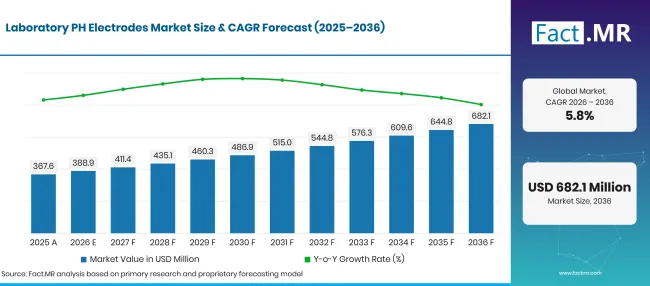
Laboratory Ph Electrodes Market Forecast Global | Source: Fact.MR
What are the defining numbers behind Laboratory pH Electrodes Market growth?
Between 2026 and 2036 the market will gain USD 293.2 million in new value, most of it from water testing, pharmaceutical quality control and research benches.
- Demand Drivers in the Market
- Expanding drinking-water coverage: Global access to safely managed drinking water reached 74% in 2024, and about 961 million people gained access between 2015 and 2024. Each new supply point adds sampling, and pH is one of the first parameters operators check after treatment.
- Tighter medicine quality assurance: WHO published the fifty-ninth report of its Expert Committee on Specifications for Pharmaceutical Preparations in June 2026, setting out updated guidance on quality control and good practices for medicines. Drug laboratories measure pH during formulation, stability work and batch release, so these standards keep electrodes on every quality control bench.
- Updated drinking-water guidance: The WHO Guidelines for drinking-water quality, fourth edition incorporating the first, second and third addenda, were issued on 17 June 2026. National regulators draw on this text when they set monitoring programs, which keeps pH testing routine in utility and public health laboratories.
- Food and beverage process checks: Dairy, juice, sauce and fermented food producers test acidity at several stages to confirm fermentation progress and shelf stability. Thick or protein-rich samples foul standard junctions quickly, which pushes plants toward sleeve or open-junction designs and shorter replacement intervals.
- Research and academic benches: Universities and institutes run pH measurements in chemistry, materials and life science projects with very different sample types. When response slows or readings drift, labs replace the electrode, creating a steady base of repeat orders.
- Key Segments Analyzed
- By Product Type: Glass Electrodes will hold 42.3% share in 2026, since a glass membrane gives a stable response across most aqueous samples used in general testing.
- By Application: Water and Wastewater Treatment will account for 35.8% of 2026 value, as plants check pH at intake, during dosing and before discharge.
- By End-User: Research Laboratories will capture 38.4% in 2026, given the variety of experiments that need a fresh, calibrated sensor.
- Analyst Opinion at Fact.MR
- Shambhu Nath Jha, Principal Consultant at Fact.MR, states, “A pH electrode is a consumable with a measurable working life, and laboratories now track that life through calibration slopes and offset records. Suppliers that pair each electrode with clear sample guidance and traceable test certificates will win the repeat order. Over the next ten years, demand will grow quickest where water surveillance and drug quality testing expand at the same time.”
- Strategic Implications
- Manufacturers should build electrode lines around specific sample problems, such as viscous foods, low ionic strength water and small biological volumes, and publish clear operating limits for each model.
- Distributors should list junction type, body material and connector details on every product page so laboratory buyers can match a replacement electrode to an existing meter without a support call.
- Water utilities and drug quality control managers should plan electrode replacement against calibration slope data, so worn sensors leave service before they cause a failed result.
- Investors should watch suppliers with strong consumable sales and service networks, since installed meters generate predictable electrode reorders over many years.
Germany leads the five profiled countries at 6.7%, helped by dense pharmaceutical and chemical testing and rising research spending. Brazil follows at 6.1%, where national drinking-water surveillance is widening the number of laboratories that test pH every week. The United States trails Brazil at 5.5%: its base is large and replacement driven, so percentage gains come more slowly. A mature utility testing regime keeps the United Kingdom at 4.9%, and Japan closes the list at 4.4%, reflecting a well-equipped laboratory base where most growth comes from upgrades.
How does the Laboratory pH Electrodes Market break down by segment?
Glass Electrodes will lead Product Type at 42.3%; Water and Wastewater Treatment will head Application at 35.8%; Research Laboratories will hold End-User at 38.4% in 2026.
Which Product Type leads?
Glass Electrodes take 42.3% of 2026 sales.
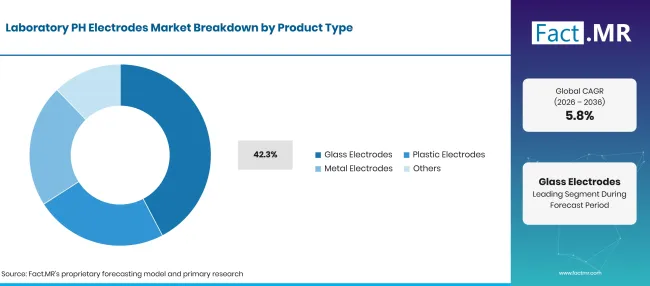
Laboratory Ph Electrodes Market Breakdown Product Type | Source: Fact.MR
| Product Type | Share (2026) |
|---|---|
| Glass Electrodes (Leading segment) | 42.3% |
| Other segments combined | 57.7%* |
| Total | 100.0% |
Source: Fact.MR analysis. Updated Nov 13, 2026
Most routine samples are aqueous, and a glass bulb with a gel or liquid reference covers them with good accuracy and quick response. That makes glass the default choice for buffer checks, teaching labs and general quality control. Laboratories also buy glass models in several shapes, from spear tips for semisolids to micro bulbs for vials, so one product family can serve many benches. Plastic electrodes appeal where breakage is a safety concern or where field and classroom use is rough. Metal electrodes, mostly antimony types, serve samples that attack glass, such as some fluoride-bearing solutions. The others category covers ISFET and specialty sensors for flat surfaces and very small volumes, and these niche designs often support premium pricing. Producers that sell ready-to-use laboratory test kits share many of the same lab buyers.
What supports Water and Wastewater Treatment within Application?
Water and Wastewater Treatment represents 35.8% of 2026 revenue.
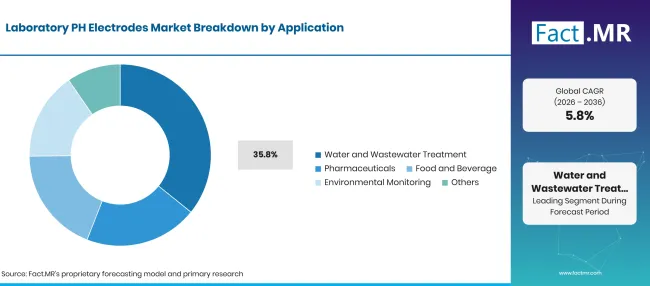
Laboratory Ph Electrodes Market Breakdown Application | Source: Fact.MR
| Application | Share (2026) |
|---|---|
| Water and Wastewater Treatment (Leading segment) | 35.8% |
| Other segments combined | 64.2%* |
| Total | 100.0% |
Source: Fact.MR analysis. Updated Nov 13, 2026
Treatment plants test pH before coagulation, after chemical dosing and at the outlet, and many repeat bench checks to confirm online readings. Water quality reporting has widened too: 124 countries reported on water quality in 2023, up from 72 in 2017. Every additional monitoring program adds sample volume for bench electrodes. Wastewater laboratories handle oily and solids-laden samples that shorten electrode life, which keeps reorder rates high. Plants that buy sludge treatment chemicals rely on pH data to set dose rates. Pharmaceuticals, food and beverage and environmental monitoring form the other application groups, each with its own sample challenges and electrode preferences.
How does End-User shape demand?
Research Laboratories account for 38.4% of 2026 value.
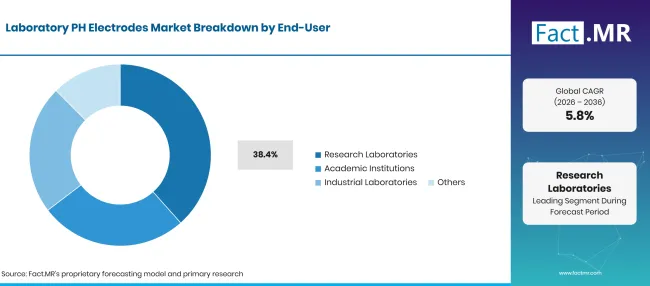
Laboratory Ph Electrodes Market Breakdown End User | Source: Fact.MR
| End-User | Share (2026) |
|---|---|
| Research Laboratories (Leading segment) | 38.4% |
| Other segments combined | 61.6%* |
| Total | 100.0% |
Source: Fact.MR analysis. Updated Nov 13, 2026
Research groups switch between buffers, cell media, soils and solvents in the same week, so they keep several electrode types on hand and replace them often. The UNESCO Institute for Statistics launched its 2025 survey of research and development statistics on 11 June 2025, collecting data directly from 124 Member States and Territories. Such tracking reflects how widely public research activity now spans. Academic institutions buy in volume for teaching labs, where rugged and low-cost models are common. Industrial laboratories in chemicals, coatings and clinical chemistry supply chains need documented performance for audits. The others group covers contract testing and government laboratories.
What is accelerating Laboratory pH Electrodes Market adoption, and what is holding it back?
Wider drinking-water surveillance, stricter medicine quality rules and steady research activity all add pH tests, and each electrode has a finite life. On the other side, calibration effort, junction clogging and the cost of frequent replacement weigh on small laboratories, especially where trained staff are scarce.
Drivers Impact Analysis
| DRIVER | (~) % IMPACT ON CAGR | GEOGRAPHIC RELEVANCE | IMPACT TIMELINE |
|---|---|---|---|
| Rising frequency of water-quality testing and treatment process monitoring | +1.5% | Global | Short term (<=2 years) |
| Increasing analytical testing across pharmaceutical and biotechnology laboratories | +1.2% | North America, Western Europe, East Asia | Medium term (2-4 years) |
| Expansion of food and beverage quality-control activities | +0.8% | Global | Medium term (2-4 years) |
| Greater research activity across academic and industrial laboratories | +0.5% | North America, Western Europe, South Asia & Pacific | Long term (>=4 years) |
Source: Fact.MR analysis. Updated Nov 13, 2026
Opportunity Impact Analysis
| OPPORTUNITY | (~) % IMPACT ON CAGR | GEOGRAPHIC RELEVANCE | IMPACT TIMELINE |
|---|---|---|---|
| Electrodes for specialized samples and demanding chemical conditions | +0.7% | Global | Medium term (2-4 years) |
| Expansion of water-quality monitoring and treatment infrastructure | +0.5% | Latin America, South Asia & Pacific, Middle East & Africa | Long term (>=4 years) |
| Durable electrodes with faster response and better measurement stability | +0.4% | North America, Western Europe, East Asia | Medium term (2-4 years) |
| Wider laboratory testing across pharmaceutical and food manufacturing | +0.2% | Global | Long term (>=4 years) |
Source: Fact.MR analysis. Updated Nov 13, 2026
Restraints Impact Analysis
| RESTRAINT | (~) % IMPACT ON CAGR | GEOGRAPHIC RELEVANCE | IMPACT TIMELINE |
|---|---|---|---|
| Electrode ageing, maintenance needs and recurring replacement costs | -0.4% | Global | Short term (<=2 years) |
| Sample compatibility limits and sensitivity to operating conditions | -0.3% | Global | Medium term (2-4 years) |
| Calibration requirements and limited technical skills in smaller laboratories | -0.1% | Emerging markets | Long term (>=4 years) |
Source: Fact.MR analysis. Updated Nov 13, 2026
Which countries are scaling the Laboratory pH Electrodes Market through 2036?
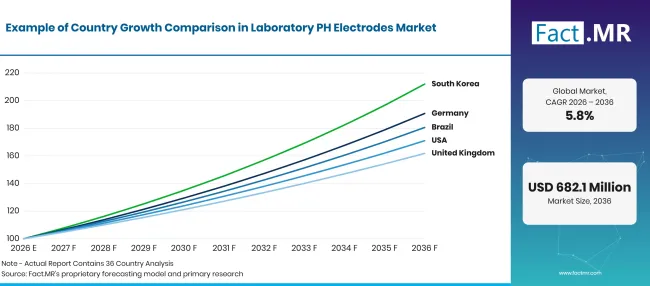
Laboratory Ph Electrodes Market Growth Index | Source: Fact.MR
| Country | CAGR (2026 to 2036) |
|---|---|
| Germany | 6.7% |
| Brazil | 6.1% |
| United States | 5.5% |
| United Kingdom | 4.9% |
| Japan | 4.4% |
Source: Fact.MR analysis. Updated Nov 13, 2026
What supports Germany’s adoption?
6.7% CAGR, driven by pharmaceutical production, chemical testing and growing research budgets.
German drug and chemical producers test pH in formulation, process control and release, and each site runs several benches. Research spending adds to that base: Germany spent about EUR 137.1 billion on R&D in 2024, up around 3.8 percent, with universities rising 4.7 percent to EUR 24.1 billion. New university and institute laboratories bring fresh meter and electrode orders, and contract labs serving the chemical sector keep reorder rates steady.
How is Brazil developing demand?
6.1% CAGR, backed by national drinking-water surveillance and a growing testing network.
The Ministry of Health runs SISAGUA, a national surveillance system whose open dataset of basic drinking-water parameters includes pH and was last updated on 4 November 2026. Municipal and state public health laboratories feed that system, which creates regular bench testing. Food processing, sugar and ethanol plants and a growing generic drug sector add further pH work, and buyers there often favor durable, easy-to-maintain models.
What is supporting United States adoption?
5.5% CAGR, as a large research and drug manufacturing base keeps replacing sensors.
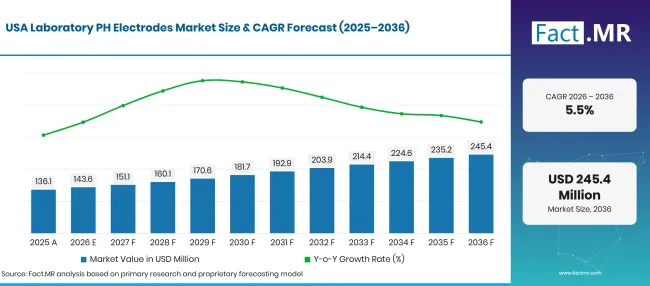
Laboratory Ph Electrodes Market Forecast Usa | Source: Fact.MR
U.S. research and development totaled USD 937 billion in 2023, and the 2024 estimate points to USD 993 billion. That spending supports thousands of academic, federal and corporate laboratories where pH checks are routine. Pharmaceutical quality control, food safety testing and environmental labs complete the demand base. Because so many meters are already installed, most revenue comes from replacement electrodes and upgrades to smart, digitally logged sensors.
How is the United Kingdom scaling demand?
4.9% CAGR, reflecting a mature utility testing regime and established drug laboratories.
Public water supplies in England complied with regulatory standards in 99.97% of tests in 2025, from over 3.5 million samples. Wales posted the same 99.97% rate across over 260,000 compliance tests. Holding that record takes constant sampling, and utility laboratories replace electrodes on fixed schedules. University research and pharmaceutical quality control add demand, though the mature testing base limits percentage growth.
How does Japan perform?
4.4% CAGR, owing to steady upgrades across a well-equipped research and industrial base.
Japan’s R&D expenditure reached 23.79 trillion yen in fiscal 2024, up 7.9 percent, and the country counted 912,800 researchers as of 31 March 2025. That base keeps pH testing routine in corporate, university and public laboratories. Domestic food and pharmaceutical producers set strict internal limits, so they value electrodes with stable readings and clear traceability. Growth comes mostly from upgrades and specialty sensors for difficult samples.
Who leads the Laboratory pH Electrodes Market?
Competition splits into three groups. Broad laboratory instrument suppliers, namely Thermo Fisher Scientific and Mettler-Toledo, sell electrodes alongside meters, titrators and balances, and their strength is the installed base that generates repeat orders.
Mettler-Toledo’s 2025 annual report highlights its NineFocus multi-parameter benchtop meter for pH and conductivity, a sign of how meter platforms anchor sensor sales, and the company reported broad-based growth by geography and product category in its fourth quarter 2025 results. Electrochemistry and sensor specialists, including Metrohm, HORIBA and Hamilton Company, compete on junction technology and sample-specific designs, from titration electrodes to clog-resistant probes for emulsions. Hanna Instruments and Xylem reach users through wide distribution and field-to-lab ranges suited to water testing. Over the forecast period, the winners will be the suppliers that prove electrode life and accuracy in each buyer’s own sample type and back that with fast technical support.
Which companies are the key providers?
Key companies in the Laboratory pH Electrodes Market include Thermo Fisher Scientific, Mettler-Toledo, Metrohm, Hanna Instruments, HORIBA, Hamilton Company and Xylem.
- Thermo Fisher Scientific
- Mettler-Toledo
- Metrohm
- Hanna Instruments
- HORIBA
- Hamilton Company
- Xylem
Bibliography
- Drinking Water Inspectorate. (2026, July 7). 7 July: Drinking Water Inspectorate: Chief Inspector’s Annual Report 2025 England.
- Drinking Water Inspectorate. (2026, July 9). 9 July: Drinking Water Inspectorate: Chief Inspector’s Annual Report 2025 Wales.
- Germany Trade & Invest. (2026, April 15). R&D Spending in Germany Increases by 3.8 Percent in 2024.
- Mettler-Toledo International Inc. (2026, February 5). Mettler-Toledo International Inc. Reports Fourth Quarter 2025 Results.
- Mettler-Toledo International Inc. (2026, February 6). Annual Report 2025.
- Ministério da Saúde, Brazil. (2026, November 4). SISAGUA: Vigilância Parâmetros Básicos.
- National Center for Science and Engineering Statistics. (2026, February 27). U.S. R&D Totaled $937 Billion in 2023; Estimate for 2024 Indicates Further Increase to $993 Billion.
- Statistics Bureau of Japan. (2026, January 28). News Bulletin January 28, 2026.
- UNESCO Institute for Statistics. (2025, June 11). Launch of the 2025 Survey of Research and Development (R&D) Statistics for SDG 9.5.
- United Nations Statistics Division. (2026, July 7). The Sustainable Development Goals Report 2026: Goal 6 Clean water and sanitation.
- World Health Organization. (2026, June 9). WHO Expert Committee on Specifications for Pharmaceutical Preparations: fifty-ninth report.
- World Health Organization. (2026, June 17). Guidelines for drinking-water quality: fourth edition incorporating the first, second and third addenda.
This Report Answers
- What the market was worth in 2025 and how its value will build from 2026 to 2036.
- Which product type, application and end-user lead revenue, and why buyers favor them.
- How water surveillance, drug quality rules and research spending shape electrode demand.
- Why Germany, Brazil, the United States, the United Kingdom and Japan grow at different rates.
- Where replacement cycles, calibration effort and sample problems limit purchases.
- Which suppliers compete in laboratory pH electrodes and on what basis.
What does the Laboratory pH Electrodes Market cover?
This study tracks pH-sensitive electrodes sold for laboratory use, whether combination or separate measuring and reference designs. Glass, plastic, metal and specialty constructions are all counted, along with models built for food, viscous, small-volume and aggressive samples.
Values reflect manufacturer revenue from electrode sales in USD million, across direct, distributor and online channels. Electrodes bundled with meters are counted at their electrode value.
What is included in the scope?
Benchtop and portable laboratory pH electrodes used with compatible meters and titrators.
Replacement and spare electrodes for research, academic, industrial and public health laboratories.
Electrodes used in water and wastewater laboratories, including those that support dosing of industrial cleaning chemicals and treatment reagents.
Food testing electrodes, including those used to check acidity in products that rely on natural food preservatives.
What is excluded from the scope?
Standalone pH meters, titrators and analyzers sold without an electrode.
Inline process pH sensors installed permanently in pipes or tanks, such as those on sludge dewatering equipment lines.
Conductivity, dissolved oxygen and non-pH ion-selective electrodes.
Buffer and calibration solutions, storage solutions, testing services and general lab consumables.
How Was the Analysis Built?
The analysis draws on 120+ sources, 35+ company portfolios, 25+ countries, and more than 20 industry interviews.
- Primary Research: Primary research includes discussions with manufacturers, service providers, technology developers, distributors, end users, and subject-matter experts. These conversations examine purchasing priorities, product adoption, operational challenges, approval requirements, competitive positioning, and the factors that influence wider market acceptance.
- Desk Research: Desk research covers government statistics, regulatory publications, company filings, trade data, technical studies, industry associations, standards, public policy, and other authoritative sources. Every source used in the analysis is documented in the bibliography.
- Market Sizing and Forecasting: Market estimates combine historical performance, demand indicators, pricing and volume trends, segment shares, company participation, country-level growth, adoption patterns, investment activity, and barriers to market expansion.
- Data Validation and Update Cycle: Findings are validated by comparing primary interviews with public data, company activity, regulatory changes, trade patterns, and industry developments. Regular updates review new product launches, capacity changes, partnerships, approvals, and shifts in commercial adoption.
Segmentation
What is the report’s scope and coverage?
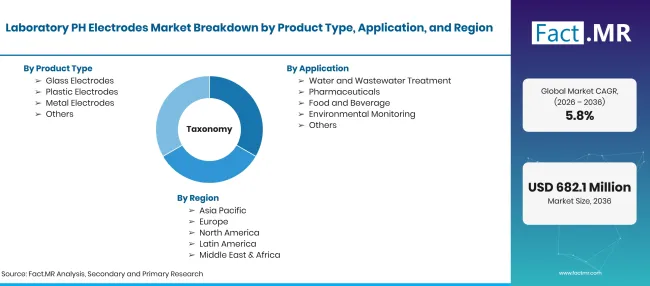
Laboratory Ph Electrodes Market Taxonomy | Source: Fact.MR
| Attribute | Details |
|---|---|
| Quantitative Units | USD million in 2026 to USD million by 2036 at CAGR |
| Market Definition | Laboratory pH electrodes used with compatible meters to measure the acidity or alkalinity of liquid and semisolid samples in research, industrial, pharmaceutical, food and beverage, water and environmental testing. |
| Product Type | Glass Electrodes; Plastic Electrodes; Metal Electrodes; Others |
| Application | Water and Wastewater Treatment; Pharmaceuticals; Food and Beverage; Environmental Monitoring; Others |
| End-User | Research Laboratories; Academic Institutions; Industrial Laboratories; Others |
| Distribution Channel | Direct Sales; Distributors; Online Sales |
| Regions Covered | North America; Latin America; Western Europe; Eastern Europe; East Asia; South Asia & Pacific; Middle East & Africa |
| Countries Covered | Germany; Brazil; United States; United Kingdom; Japan |
| Companies Profiled | Thermo Fisher Scientific; Mettler-Toledo; Metrohm; Hanna Instruments; HORIBA; Hamilton Company; Xylem |
| Forecast Period | 2026 to 2036 |
| Approach | Electrode sales built from laboratory testing volumes, replacement cycles and segment shares, checked against supplier portfolios and country testing programs. |
Source: Fact.MR analysis. Updated Nov 13, 2026
How is the market segmented?
-
By Product Type
- Glass Electrodes
- Plastic Electrodes
- Metal Electrodes
- Others
-
By Application
- Water and Wastewater Treatment
- Pharmaceuticals
- Food and Beverage
- Environmental Monitoring
- Others
-
By End-User
- Research Laboratories
- Academic Institutions
- Industrial Laboratories
- Others
-
By Distribution Channel
- Direct Sales
- Distributors
- Online Sales
-
By Region
- North America
- Latin America
- Western Europe
- Eastern Europe
- East Asia
- South Asia & Pacific
- Middle East & Africa
Frequently Asked Questions
How large is the laboratory pH electrodes market in 2026?
What growth rate will the laboratory pH electrodes market record?
Which product type leads?
Which application leads?
Which end-user leads?
Which country will grow quickest?
Who are the main companies?
What holds the market back?
Who worked on this report


Preview the report firsthand - request a free sample
Free SampleGet the brochure for pricing and purchase details
Download PDF