- Market Value (2025): USD 125.1 Mn
- Estimated Value (2026): USD 130.8 Mn
- Forecast Value (2036): USD 204.3 Mn
- CAGR (2026-2036): 4.6%
What is the Spiral Wirelink Belts Market forecast to be worth by 2036?
USD 130.8 million in 2026 to USD 204.3 million by 2036 at a 4.6% CAGR.
- Spiral wirelink belts revenue totalled USD 125.1 million in 2025, with most of that value tied to baking, cooling and drying lines in food processing and to heat treatment in metal and glass plants.
- Revenue will grow from USD 130.8 million in 2026 to USD 204.3 million by 2036 as processors add automated ovens and spiral coolers and retire worn belts on existing conveyors.
- A 4.6% CAGR reflects a replacement-heavy market in which new line installations add volume on top of a steady base of belt changeovers.
| Year | Basis | Market Value (USD million) |
|---|---|---|
| 2025 | Actual | 125.1 |
| 2026 | Estimate | 130.8 |
| 2036 | Forecast | 204.3 |
| CAGR 2026 to 2036 | Forecast period | 4.6% |
Source: Fact.MR analysis. Updated Nov 13, 2026
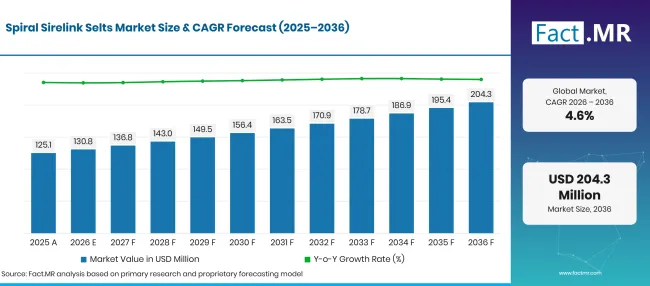
Spiral Sirelink Selts Market Forecast Global | Source: Fact.MR
What are the defining numbers behind Spiral Wirelink Belts Market growth?
The 2026 to 2036 period will add USD 73.5 million in new value, with most of the gain coming from food processing lines and thermal treatment upgrades.
- Demand Drivers in the Market
- Food plants are shifting manual handling onto conveyors that run through ovens, coolers and dryers without stopping. The U.S. Bureau of Labor Statistics counted about 297,000 food processing equipment worker jobs in 2025 and notes that some plants now use equipment that weighs and mixes ingredients automatically [1]. Each automated line needs belts that hold their pitch and tracking at speed.
- Machinery investment in Europe gives belt makers new projects to quote. German orders for machinery and equipment rose 11.5% month on month in December 2025, according to Destatis [2]. Spiral wirelink belts are often specified at the same time as the ovens, freezers and washers that carry them.
- Plants facing weak output tend to extend the life of existing lines through belt changes. German industrial production in July 2026 ran 3.4% below the same month a year earlier, unadjusted [3]. In that setting a new metal belt on an old conveyor costs far less than a full line rebuild.
- Heat treatment, annealing and roasting call for belts that stay flat and strong at temperatures that soften polymers. Stainless and alloy wire spirals can be wound to suit the load, mesh opening and heat profile of each furnace, which keeps metal belts in demand for these duties.
- Packaging lines use open metal belts to carry products through shrink tunnels and heat-sealing stations. The open weave lets hot air reach the film evenly and lets the belt cool quickly between cycles.
- Key Segments Analyzed
- By Product Type: Type A will hold 42.5% share in 2026, as its belt construction fits the widest range of oven, cooler and dryer layouts.
- By Application: Application 1 will account for 42.3% of 2026 revenue since it covers the continuous processing duties where belts are changed most often.
- By End-User: End-User 1 will represent 40.9% of 2026 value, given its steady spending on line uptime and hygiene.
- By Distribution Channel: Specialty Stores will capture 31.2% of 2026 sales owing to the fitting advice and stocked spare lengths they offer industrial buyers.
- Analyst Opinion at Fact.MR
- Shambhu Nath Jha, Principal Consultant at Fact.MR, states, “Buyers will judge spiral wirelink belts on wire grade, heat tolerance, mesh pitch and how cleanly they fit the drive and sprockets already installed. Belt makers that can wind application-specific spirals quickly and send engineers to support the changeover will win repeat orders from bakeries and meat plants. Over the forecast period, uptime and cleanability will weigh more heavily in purchase decisions than the list price of the belt itself.”
- Strategic Implications
- Manufacturers should publish clear data on wire grade, temperature limits, open area and load rating for each belt build so that engineers can compare options before a shutdown.
- Distributors should hold cut lengths, splice kits and common spiral pitches in regional stock, since most belt orders arrive with short lead times during planned maintenance.
- Food processors should specify belts by cleanability, drainage and heat profile, then record belt life by line to plan replacements ahead of failure.
- Investors should look for belt makers with in-house winding capacity and field service teams, because these assets turn one-off sales into recurring replacement business.
The United Kingdom leads the country set at 4.9%, as food and drink manufacturers keep investing in automated baking and chilled lines. The United States follows at 4.6%, where a deep base of meat, poultry and bakery plants creates steady belt turnover. Germany trails at 4.2%, held back by softer industrial output even though its machinery sector keeps ordering new thermal equipment. Brazil grows at 3.7%, with food production gains offset by slow overall industry. Japan closes the range at 3.3%, since its mature plants buy mostly replacement belts and focus capital on digital upgrades.
How does the Spiral Wirelink Belts Market break down by segment?
Type A will lead Product Type at 42.5%; Application 1 will head Application at 42.3%; End-User 1 will hold End-User at 40.9%; Specialty Stores will lead Distribution Channel at 31.2% in 2026.
Which Product Type leads?
Type A holds 42.5% of 2026 sales.
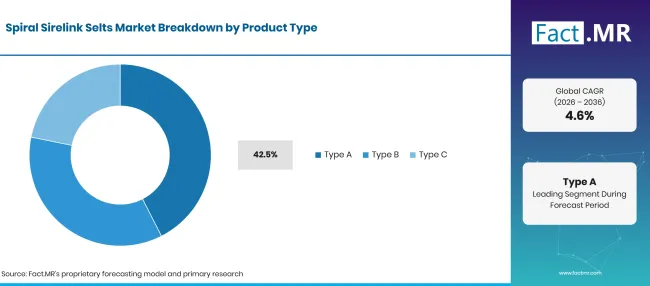
Spiral Sirelink Selts Market Breakdown Product Type | Source: Fact.MR
| Product Type | Share (2026) |
|---|---|
| Type A (Leading segment) | 42.5% |
| Other segments combined | 57.5%* |
| Total | 100.0% |
Source: Fact.MR analysis. Updated Nov 13, 2026
Engineers choose a belt construction by product weight, mesh opening and the curve or straight run of the conveyor. Type A covers the build that suits the most common oven, cooler and dryer layouts, so it is the default choice when a plant replaces a worn belt without redesigning the line. Corrugated, straight and compound wirelink constructions all appear across the product range. Type B and Type C serve narrower duties, such as heavier loads, tighter turns or special edge designs. Demand for these builds follows specific projects, and buyers often order them together with conveyor ovens or new spiral systems.
What supports Application 1 within Application?
Application 1 takes 42.3% of 2026 revenue.
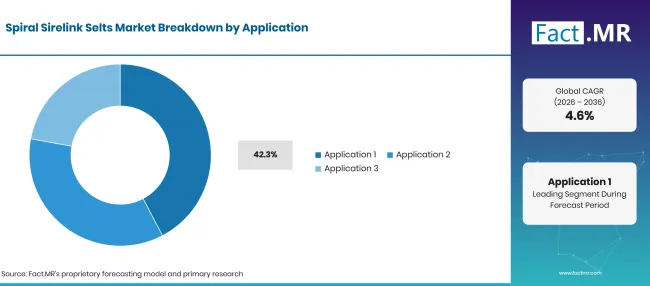
Spiral Sirelink Selts Market Breakdown Application | Source: Fact.MR
| Application | Share (2026) |
|---|---|
| Application 1 (Leading segment) | 42.3% |
| Other segments combined | 57.7%* |
| Total | 100.0% |
Source: Fact.MR analysis. Updated Nov 13, 2026
Continuous lines that bake, cool, dry or wash product all day wear belts faster than batch equipment. Food and beverage plants accounted for 16.8% of U.S. manufacturing sales in 2021, according to the USDA Economic Research Service [4], and much of that output passes over open metal belts at some stage. Application 2 and Application 3 add demand from thermal treatment, glass handling and packaging. Belts in these uses are often bought within wider conveyor system projects, so their purchase timing follows plant expansion plans.
How does End-User shape demand?
End-User 1 accounts for 40.9% of 2026 value.
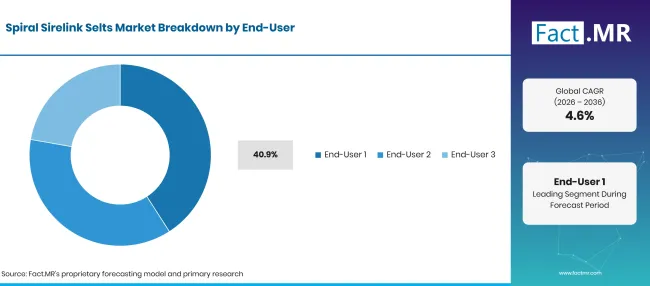
Spiral Sirelink Selts Market Breakdown End User | Source: Fact.MR
| End-User | Share (2026) |
|---|---|
| End-User 1 (Leading segment) | 40.9% |
| Other segments combined | 59.1%* |
| Total | 100.0% |
Source: Fact.MR analysis. Updated Nov 13, 2026
Hygiene rules and long shifts push food processors to replace belts on a fixed schedule. The U.S. Bureau of Labor Statistics shows animal slaughtering and processing employment growing from 556,400 in 2024 to 591,800 by 2034 [5], a sign of more spiral freezer and cooler capacity in meat and poultry plants. End-User 2 and End-User 3 include metalworking, glass and industrial manufacturing buyers. These users value belts that resist scale, heat distortion and abrasion, and they tend to order fewer but heavier belts per line.
How does Distribution Channel shape demand?
Specialty Stores capture 31.2% of 2026 sales.
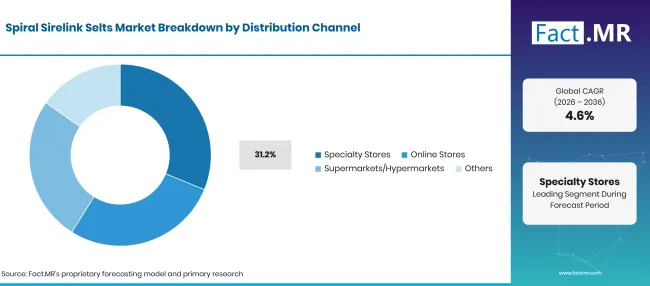
Spiral Sirelink Selts Market Breakdown Distribution Channel | Source: Fact.MR
| Distribution Channel | Share (2026) |
|---|---|
| Specialty Stores (Leading segment) | 31.2% |
| Other segments combined | 68.8%* |
| Total | 100.0% |
Source: Fact.MR analysis. Updated Nov 13, 2026
Industrial buyers rely on belting specialists that can measure an existing conveyor, recommend a spiral pitch and supply a splice on site. This hands-on service is hard to replace, which keeps specialty stores at the center of replacement orders. Online stores let engineers check specifications and reorder standard belts quickly. Supermarkets and hypermarkets play a minor role for industrial belts, and other channels include direct sales from belt makers to equipment builders. Many of these direct orders arrive bundled with packaging conveyors and thermal tunnels.
What is accelerating Spiral Wirelink Belts Market adoption, and what is holding it back?
Automation in food processing and steady machinery investment are adding new thermal lines that need open metal belts. Replacement demand on existing ovens and coolers gives the market a stable floor. Upfront cost, the need for exact fit with older drives and a shortage of skilled installers limit uptake among smaller plants, especially in emerging markets.
Drivers Impact Analysis
| DRIVER | (~) % IMPACT ON CAGR | GEOGRAPHIC RELEVANCE | IMPACT TIMELINE |
|---|---|---|---|
| Wider use of automated conveying in food and industrial plants | +1.4% | Global | Short term (<=2 years) |
| Expansion of food processing and industrial production capacity | +0.9% | Europe, North America, Asia Pacific | Medium term (2-4 years) |
| Demand for temperature-resistant metal belts in ovens and furnaces | +0.7% | Global | Medium term (2-4 years) |
| Replacement of worn belts on existing conveyors | +0.4% | Europe, North America, East Asia | Long term (>=4 years) |
Source: Fact.MR analysis. Updated Nov 13, 2026
Opportunity Impact Analysis
| OPPORTUNITY | (~) % IMPACT ON CAGR | GEOGRAPHIC RELEVANCE | IMPACT TIMELINE |
|---|---|---|---|
| Custom spiral builds for specialized industrial duties | +0.8% | Global | Medium term (2-4 years) |
| New automated bakery and food processing lines | +0.5% | Europe, North America, Asia Pacific | Medium term (2-4 years) |
| High-temperature conveying in heat treatment | +0.4% | Europe, Japan, North America | Long term (>=4 years) |
| Switching from conventional belts to durable metal designs | +0.2% | Global | Long term (>=4 years) |
Source: Fact.MR analysis. Updated Nov 13, 2026
Restraints Impact Analysis
| RESTRAINT | (~) % IMPACT ON CAGR | GEOGRAPHIC RELEVANCE | IMPACT TIMELINE |
|---|---|---|---|
| Higher initial cost of specialized metal belt systems | -0.4% | Global | Short term (<=2 years) |
| Maintenance needs and fit issues with existing conveyors | -0.2% | Global | Medium term (2-4 years) |
| Limited technical skills for belt selection and installation | -0.1% | Emerging markets | Long term (>=4 years) |
Source: Fact.MR analysis. Updated Nov 13, 2026
Which countries are scaling the Spiral Wirelink Belts Market through 2036?
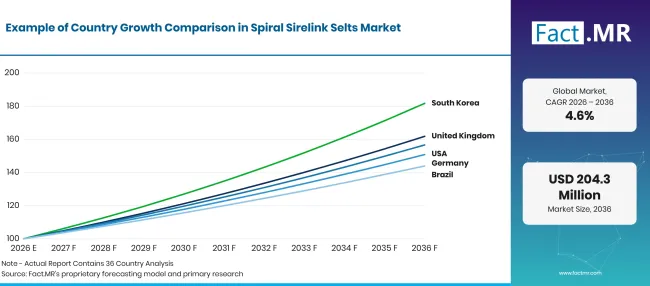
Spiral Sirelink Selts Market Growth Index | Source: Fact.MR
| Country | CAGR (2026 to 2036) |
|---|---|
| United Kingdom | 4.9% |
| United States | 4.6% |
| Germany | 4.2% |
| Brazil | 3.7% |
| Japan | 3.3% |
Source: Fact.MR analysis. Updated Nov 13, 2026
What is supporting United Kingdom adoption?
4.9% CAGR, driven by investment in automated baking and chilled food lines.
British food and drink manufacturers run large bakery, ready meal and snack lines that pass product through ovens, spiral coolers and freezers. Defra reports that food and drink manufacturing generated GBP 39.3 billion in gross value added in 2024, up 5.9% on 2023, and employed about 0.4 million people in Great Britain in 2025 [6]. Rising output on these lines will lift both new belt orders and the replacement cycle.
How is the United States scaling demand?
4.6% CAGR, backed by a broad base of meat, poultry and bakery plants.
The United States has 42,708 food and beverage processing establishments, according to USDA data for 2022, and the sector employed 1.7 million workers in 2021, about 15.4% of all manufacturing jobs [4]. Many of these plants run spiral freezers, proofers and cooling conveyors. Belt makers in the country also serve poultry and baking trade shows to reach these buyers directly.
What supports Germany’s growth?
4.2% CAGR, reflecting steady demand from machinery builders despite softer output.
German industry produced 1.1% less in 2025 than in 2024, and machinery and equipment output fell 2.6% over the year, according to Destatis [7]. Weak output slows new line projects. Even so, the country’s strong base of oven, furnace and food machinery builders keeps ordering metal belts for export equipment, and older plants will keep replacing belts to stretch the life of existing lines.
How is Brazil developing demand?
3.7% CAGR, helped by gains in food production.
Brazilian industrial output rose 0.6% in 2025, its third straight year of growth, and food products grew 1.5%, according to IBGE data reported by Agência Gov [8]. Meat, poultry and bakery exporters are adding cooling and freezing capacity to meet hygiene standards in export markets. High interest rates still limit how fast smaller processors can fund new lines, which keeps growth below the leading countries.
How does Japan perform?
3.3% CAGR, as mature plants focus on replacement and digital upgrades.
Japan’s industrial production index for December 2025 stood 2.6% above the same month of 2024 on an unadjusted basis, according to METI [9]. The government’s 2026 White Paper on Manufacturing Industries stresses AI, digital technology and economic security as priorities for manufacturers [10]. Plants that add sensors and automated inspection to existing lines will still need precise, heat-stable belts, though most purchases will be replacements.
Who leads the Spiral Wirelink Belts Market?
The market has two kinds of suppliers. The first group includes broad-line metal belt makers such as Ashworth, Wire Belt Company of America and Twentebelt, which offer spiral, turn-curve and straight-running belts for food plants worldwide and back them with field service. These firms compete on engineering depth and on reaching processors at trade events. Wire Belt Company of America listed IPPE, ASB BakingTECH and PACK EXPO among its 2026 shows [11], and in August 2026 it confirmed it would showcase its Eye-Flex and Compact-Grid belts at PACK EXPO International.
The second group consists of regional specialists such as Steinhaus GmbH, Esfo Metalbelts and DK Transportbaand ApS. They compete on custom builds, short lead times and close contact with bakeries, potato processors and heat treatment shops in Europe. Through 2036, the suppliers that pair fast custom winding with on-site installation support will win the bulk of replacement orders.
Which companies are the key providers?
Key companies in the Spiral Wirelink Belts Market include Ashworth, Wire Belt Company of America, Twentebelt, Steinhaus GmbH, Esfo Metalbelts and DK Transportbaand ApS.
- Ashworth
- Wire Belt Company of America
- Twentebelt
- Steinhaus GmbH
- Esfo Metalbelts
- DK Transportbaand ApS
Bibliography
- U.S. Bureau of Labor Statistics. (2026, September 14). Food Processing Equipment Workers: Occupational Outlook Handbook.
- Destatis, German Federal Statistical Office. (2026, February 5). New orders in manufacturing in December 2025: +7.8% on the previous month.
- Destatis, German Federal Statistical Office. (2026, September 4). Production index in industry.
- U.S. Department of Agriculture, Economic Research Service. (2025, January 5). Food and Beverage Manufacturing.
- U.S. Bureau of Labor Statistics. (2026, May 26). Producing the goods of the future: Job opportunities in manufacturing.
- Department for Environment, Food & Rural Affairs. (2026, July 29). Food statistics in your pocket.
- Destatis, German Federal Statistical Office. (2026, February 6). Production in December 2025: -1.9% on the previous month.
- Agência Gov, Government of Brazil. (2026, February 3). IBGE: indústria fecha 2025 com alta de 0,6% e tem terceiro ano seguido de crescimento.
- Ministry of Economy, Trade and Industry. (2026, February 16). Indices of Industrial Production: Revised Report for December 2025.
- Ministry of Economy, Trade and Industry. (2026, May 29). FY2025 Measures to Promote Manufacturing Technology (White Paper on Manufacturing Industries 2026) Released.
- Wire Belt Company of America. (2025, September 19). Visit Wire Belt at These 2026 Trade Shows.
- Wire Belt Company of America. (2026, August 11). Wire Belt Company of America to Showcase Conveyor and Belting Solutions at PACK EXPO International 2026.
This Report Answers
- What spiral wirelink belts will be worth in 2026 and 2036, and how much new value the period will add.
- Which product type, application, end-user and distribution channel will lead in 2026, and why buyers favor them.
- How food processing automation and machinery investment shape belt orders and replacement cycles.
- Why growth differs across the United Kingdom, the United States, Germany, Brazil and Japan.
- Which belt makers compete in the market and what separates broad-line suppliers from regional specialists.
- What cost, fit and skills barriers slow adoption in smaller plants.
What does the Spiral Wirelink Belts Market cover?
This study tracks spiral wirelink conveyor belts made from interlinked metal spirals and cross rods. The open, flexible structure lets air, steam and liquids pass through, which suits baking, cooling, drying, washing and pasteurizing lines as well as thermal treatment and packaging.
Value is counted at the belt level in USD million. Corrugated, straight and compound wirelink builds are all included, along with the wire grades and spiral pitches chosen for each operating temperature and load.
What is included in the scope?
Spiral wirelink belts sold for new conveyors and as replacements on existing lines.
Corrugated, straight and compound wirelink constructions in stainless and alloy wire.Belts for food processing, bakery, drying, cooling and pasteurizing lines, as well as heat treatment, metalworking, glass handling and packaging, including belts fitted to heat-recovery baking lines.Custom belt builds and splice components sold as part of a complete belt.
What is excluded from the scope?
Rubber, plastic and fabric conveyor belts, including the plastic and polymer belts covered under the open mesh conveyor belt category.
Conveyor motors, drives, rollers, frames and control panels sold on their own.Drive components such as conveyor sprockets when sold separately from the belt.Installation, maintenance, repair and other services.
How Was the Analysis Built?
The analysis draws on 120+ sources, 35+ company portfolios, 25+ countries, and more than 20 industry interviews.
- Primary Research: Primary research includes discussions with manufacturers, service providers, technology developers, distributors, end users, and subject-matter experts. These conversations examine purchasing priorities, product adoption, operational challenges, approval requirements, competitive positioning, and the factors that influence wider market acceptance.
- Desk Research: Desk research covers government statistics, regulatory publications, company filings, trade data, technical studies, industry associations, standards, public policy, and other authoritative sources. Every source used in the analysis is documented in the bibliography.
- Market Sizing and Forecasting: Market estimates combine historical performance, demand indicators, pricing and volume trends, segment shares, company participation, country-level growth, adoption patterns, investment activity, and barriers to market expansion.
- Data Validation and Update Cycle: Findings are validated by comparing primary interviews with public data, company activity, regulatory changes, trade patterns, and industry developments. Regular updates review new product launches, capacity changes, partnerships, approvals, and shifts in commercial adoption.
Segmentation
What is the report’s scope and coverage?
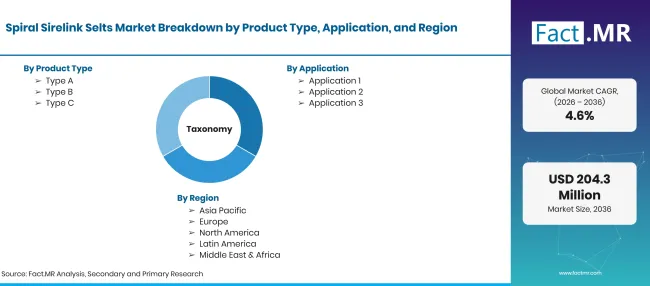
Spiral Sirelink Selts Market Taxonomy | Source: Fact.MR
| Attribute | Details |
|---|---|
| Quantitative Units | USD million |
| Market Definition | Metal conveyor belts built from interlinked wire spirals joined by cross rods, used to carry products through baking, cooling, drying, washing, heat treatment and packaging operations. |
| Product Type | Type A; Type B; Type C |
| Application | Application 1; Application 2; Application 3 |
| End-User | End-User 1; End-User 2; End-User 3 |
| Distribution Channel | Specialty Stores; Online Stores; Supermarkets/Hypermarkets; Others |
| Regions Covered | North America; Latin America; Western Europe; Eastern Europe; East Asia; South Asia & Pacific; Middle East & Africa |
| Countries Covered | United Kingdom; United States; Germany; Brazil; Japan |
| Companies Profiled | Ashworth; Wire Belt Company of America; Twentebelt; Steinhaus GmbH; Esfo Metalbelts; DK Transportbaand ApS |
| Forecast Period | 2026 to 2036 |
| Approach | Belt revenue built from product, application, end-user and channel splits, checked against food processing and industrial production activity in each country. |
Source: Fact.MR analysis. Updated Nov 13, 2026
How is the market segmented?
-
By Product Type
- Type A
- Type B
- Type C
-
By Application
- Application 1
- Application 2
- Application 3
-
By End-User
- End-User 1
- End-User 2
- End-User 3
-
By Distribution Channel
- Specialty Stores
- Online Stores
- Supermarkets/Hypermarkets
- Others
-
By Region
- North America
- Latin America
- Western Europe
- Eastern Europe
- East Asia
- South Asia & Pacific
- Middle East & Africa
Frequently Asked Questions
How large is the spiral wirelink belts market in 2026?
What growth rate will the spiral wirelink belts market record?
Which product type leads?
Which application leads?
Which end-user leads?
Which distribution channel leads?
Which country will grow quickest?
Who are the main companies?
What holds the market back?
Who worked on this report


Preview the report firsthand - request a free sample
Free SampleGet the brochure for pricing and purchase details
Download PDF