- Market Value (2025): USD 97.4 Bn
- Estimated Value (2026): USD 102.4 Bn
- Forecast Value (2036): USD 168.9 Bn
- CAGR (2026-2036): 5.1%
What is the Leather Tanning Market forecast to be worth by 2036?
USD 102.4 billion in 2026 to USD 168.9 billion by 2036 at a 5.1% CAGR.
- The leather tanning market surpassed a value of USD 97.4 billion in 2025.
- Market revenue is forecast to increase from USD 102.4 billion in 2026 to USD 168.9 billion by 2036 as footwear, upholstery and other manufacturers continue purchasing finished leather to defined specifications.
- The projected 5.1% CAGR between 2026 and 2036 reflects continued demand for consistent leather grades, alongside greater attention to processing quality and chemical control.
| Year | Basis | Market Value (USD billion) |
|---|---|---|
| 2025 | Actual | 97.4 |
| 2026 | Estimate | 102.4 |
| 2036 | Forecast | 168.9 |
| CAGR 2026 to 2036 | Forecast period | 5.1% |
Source: Fact.MR analysis. Updated Nov 10, 2026
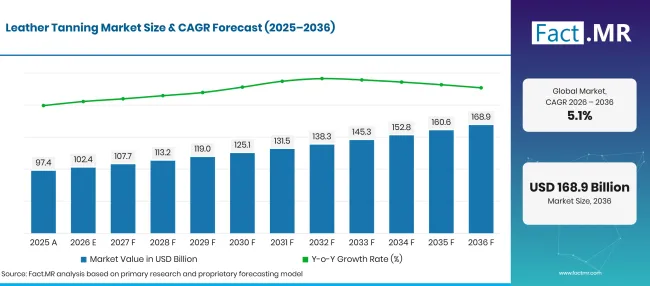
Leather Tanning Market Forecast Global | Source: Fact.MR
What are the defining numbers behind Leather Tanning Market growth?
Leather tanning is projected to add USD 66.5 billion between 2026 and 2036.
- Demand Drivers in the Market
- Footwear manufacturers need even thickness and predictable finishing so that leather panels cut cleanly and match across a production run.
- Furniture manufacturers assess leather for its surface feel, resistance to wear and ability to match across a seating collection. When a tannery keeps colour and texture consistent from one batch to the next, upholsterers can complete repeat orders with fewer material adjustments.
- Automotive trim makers impose detailed tests for abrasion and color transfer. A compliant supplier must document which treatments were used and demonstrate even leather quality across output lots.
- Tanneries located close to cattle-hide suppliers can coordinate raw-material arrivals with processing schedules, while export access helps them reach footwear and upholstery manufacturers abroad.
- Chemical controls are becoming an important part of tannery operations, particularly when finished leather is sold into regulated markets. Producers must track chromium chemistry and finishing treatments throughout processing so that buyers can check material suitability against their own product requirements.
- Key Segments Analyzed
- By Product Type: Chrome Tanned Leather is projected to account for 54.3% of 2026 value because it suits repeatable soft leather finishes across several established uses.
- By Application: Footwear is forecast to hold 38.2% of 2026 revenue since shoe producers buy substantial quantities of even upper leather.
- By Process: Tanning is estimated to represent 45.8% of process value as the stage that stabilizes hides before later finishing.
- By End-User: Commercial demand is projected to account for 48.3% of 2026 sales through finished-product making and business-to-business supply.
- Analyst Opinion at Fact.MR
- Shambhu Nath Jha, Principal Consultant at Fact.MR, states, “For a leather buyer, the important measure is how much usable, consistently finished material can be obtained from each batch of hides. Reliable grading and close control of tanning chemicals help manufacturers reduce cutting losses, while clear batch records make supplier approval and repeat ordering easier.”
- Strategic Implications
- Tannery managers can compare usable leather area and reject rates across batches to identify which processing stages are reducing material yield.
- Footwear brands benefit from agreeing on thickness, colour and surface tolerances before sampling, so factories receive leather they can cut and assemble consistently.
- Automotive material suppliers need to retain test results and chemical-treatment records for every approved grade, since vehicle interior programs depend on repeatable material performance.
- Exporters should compare processing, freight and finishing costs before choosing whether to sell hides as crust leather or invest in a fully finished product.
Germany is projected to register 6.0% CAGR to 2036 through technical leather grades. Brazil follows at 5.5% through export processing. The United States records 4.9% through specialist making, while the UK reaches 4.4% through custom finished leather. Japan advances at 3.9% through precise grading.
How does the Leather Tanning Market break down by segment?
Chrome Tanned Leather accounts for 54.3% of Product Type; Footwear holds 38.2% of Application; Tanning represents 45.8% of Process; Commercial accounts for 48.3% of End-User.
Which Product Type dominates?
Chrome Tanned Leather holds 54.3% of 2026 value.
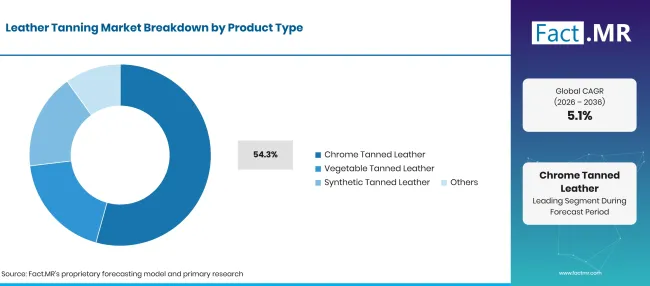
Leather Tanning Market Breakdown Product Type | Source: Fact.MR
| Product Type | Share (2026) |
|---|---|
| Chrome Tanned Leather (Leading segment) | 54.3% |
| Other segments combined | 45.7% |
| Total | 100.0% |
Source: Fact.MR analysis. Updated Nov 10, 2026
Chrome tanning remains widely used where makers need a supple surface and stable physical performance. Modern plants adjust tanning and retanning stages according to the intended finished product. Vegetable Tanned Leather serves buyers who prefer a firmer handle and characteristic ageing.
What leads the Application segment?
Footwear is projected to account for 38.2% of 2026 sales.
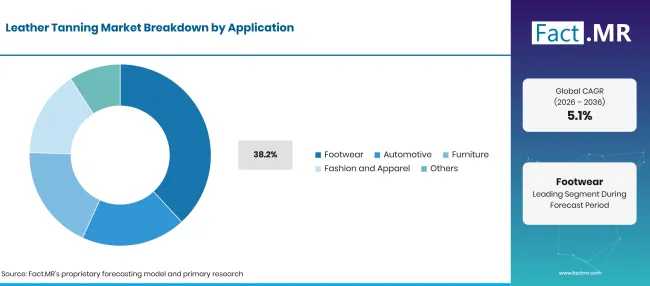
Leather Tanning Market Breakdown Application | Source: Fact.MR
| Application | Share (2026) |
|---|---|
| Footwear (Leading segment) | 38.2% |
| Other segments combined | 61.8% |
| Total | 100.0% |
Source: Fact.MR analysis. Updated Nov 10, 2026
Footwear makers need hides with consistent thickness and surface quality because irregular material increases cutting waste. Shoe uppers require even stretch and color, while automotive interiors have detailed wear and appearance specifications. Furniture leather must withstand repeated use. Fashion and apparel orders may depend on seasonal colors.
How does Process shape value?
Tanning accounts for 45.8% of 2026 process value.
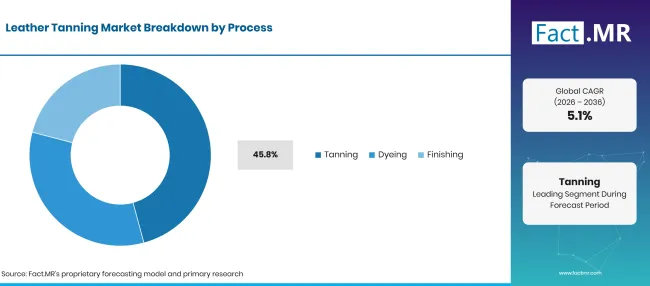
Leather Tanning Market Breakdown Process | Source: Fact.MR
| Process | Share (2026) |
|---|---|
| Tanning (Leading segment) | 45.8% |
| Other segments combined | 54.2% |
| Total | 100.0% |
Source: Fact.MR analysis. Updated Nov 10, 2026
Tanning changes the stability and usable life of a hide. It involves careful control of chemical penetration and washing before the material advances to subsequent treatments. Dyeing gives makers the requested color and helps with shade matching between deliveries. Finishing establishes surface texture and resistance to handling.
Which End-User accounts for the most value?
Commercial customers account for 48.3% of 2026 revenue.
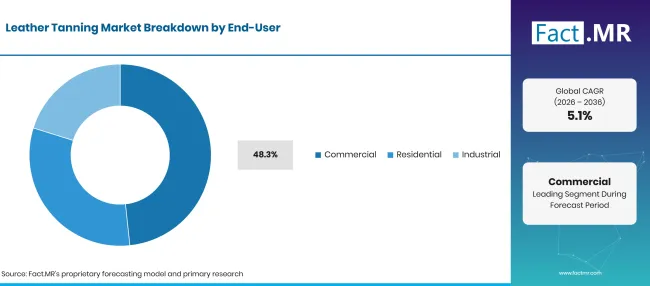
Leather Tanning Market Breakdown End User | Source: Fact.MR
| End-User | Share (2026) |
|---|---|
| Commercial (Leading segment) | 48.3% |
| Other segments combined | 51.7% |
| Total | 100.0% |
Source: Fact.MR analysis. Updated Nov 10, 2026
Commercial customers include factories and other business buyers that source finished or semi-finished leather for repeat output. Their orders are shaped by quality approval and output schedules. Residential uses relate mainly to leather furniture and similar household applications. Industrial customers use leather where specific wear or handling properties are required. These boundaries describe the end market for leather output and should not be confused with the tanning equipment buyer.
What is accelerating Leather Tanning Market adoption, and what is holding it back?
Repeat footwear orders and exports of finished leather support market activity, while wastewater treatment and variation in raw-hide quality influence operating costs.
Drivers Impact Analysis
| DRIVER | (~) % IMPACT ON CAGR | GEOGRAPHIC RELEVANCE | IMPACT TIMELINE |
|---|---|---|---|
| Footwear-grade batch consistency | +1.2% | Global | Medium term (2–4 years) |
| Finished-leather export trade | +1.0% | Brazil and Latin America | Medium term (2–4 years) |
| Automotive performance specifications | +0.8% | Germany, Japan and USA | Medium term (2–4 years) |
| Traceable chemical recipes | +0.6% | Europe and export markets | Medium term (2–4 years) |
| Furniture replacement and reupholstery | +0.4% | North America and Europe | Medium term (2–4 years) |
Source: Fact.MR analysis. Updated Nov 10, 2026
Opportunity Impact Analysis
| OPPORTUNITY | (~) % IMPACT ON CAGR | GEOGRAPHIC RELEVANCE | IMPACT TIMELINE |
|---|---|---|---|
| Higher-value crust and finished export sales | +0.8% | Brazil | Medium term (2–4 years) |
| Lower-waste tanning chemistry | +0.6% | Europe and Asia | Medium term (2–4 years) |
| Small-batch premium leather finishing | +0.5% | Germany, UK and Japan | Medium term (2–4 years) |
| Closer supply agreements with footwear manufacturers | +0.3% | Global | Medium term (2–4 years) |
Source: Fact.MR analysis. Updated Nov 10, 2026
Restraints Impact Analysis
| RESTRAINTS | (~) % IMPACT ON CAGR | GEOGRAPHIC RELEVANCE | IMPACT TIMELINE |
|---|---|---|---|
| Effluent treatment and compliance expenses | -0.8% | Global | Medium term (2–4 years) |
| Unpredictable hide grading and supply | -0.6% | Americas and Asia | Medium term (2–4 years) |
| Competition from non-leather materials | -0.5% | Europe, Japan and USA | Medium term (2–4 years) |
| Energy and finishing chemical cost increases | -0.4% | Global | Medium term (2–4 years) |
Source: Fact.MR analysis. Updated Nov 10, 2026
Which countries are scaling the Leather Tanning Market through 2036?
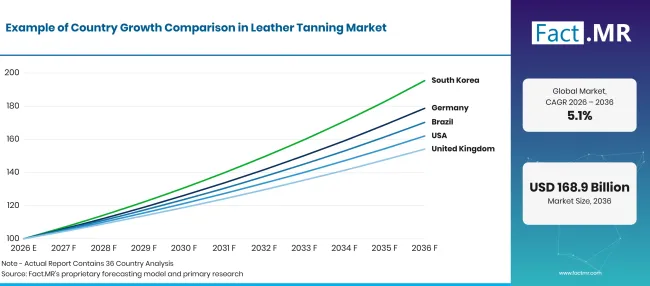
Leather Tanning Market Growth Index | Source: Fact.MR
| Country | CAGR (2026 to 2036) |
|---|---|
| Germany | 6.0% |
| Brazil | 5.5% |
| USA | 4.9% |
| UK | 4.4% |
| Japan | 3.9% |
Source: Fact.MR analysis. Updated Nov 10, 2026
What supports Germany’s leather tanning activity?
6.0% CAGR, linked to qualified leather for making.
German tanneries serve automotive interior and furniture producers that value repeatable surfaces. Destatis records 2025 making activity under WZ 15 for leather products and footwear [4]. Material records help vehicle suppliers maintain repeatable grades. Local leather processors serve specialist footwear needs as well.
How is Brazil developing its tanning export base?
5.5% CAGR, tied to processed-hide exports.
Brazil has an established cattle-hide supply that helps support local leather processing. The Centre for the Brazilian Tanning Industry reported USD 1.117 billion of leather exports during 2025 [2]. The Brazilian Leather programme promotes overseas business links and quality development.
What shapes tanning demand in the United States?
4.9% CAGR, supported by specialist making uses.
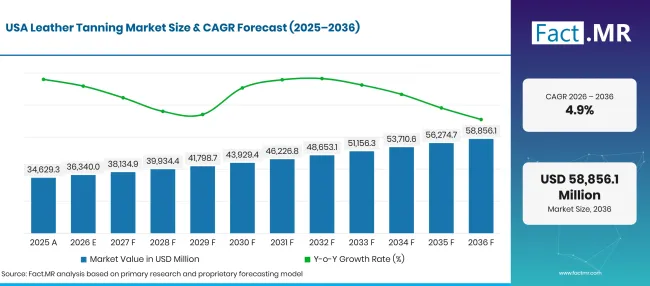
Leather Tanning Market Forecast Usa | Source: Fact.MR
American tanners serve specialist footwear and upholstery needs alongside a far wider overseas shoe supply chain. The Footwear Distributors and Retailers of America reported 2.015 billion imported pairs of footwear in 2025 [1]. Automotive interior customers require a stable surface finish across approved output lots.
How does the United Kingdom serve specialist leather buyers?
4.4% CAGR, influenced by high-specification leather products.
UK tanneries concentrate on specialist leather for upholstery and leather goods. The Office for National Statistics records output values for the leather and related-products category in its 2025 making data [5]. Leather UK reported that the total export value of the UK leather industry declined by 14.08% in 2025 compared with 2024 [6].
Why does Japan favour controlled tanning output?
3.9% CAGR, associated with precise footwear and leather grades.
Japanese footwear and leather-goods makers value precise cutting grades and an even finish. The Ministry of Economy, Trade and Industry published its 2025 leather footwear output series in June 2026 [7]. Careful leather inspection requires time and trained operators. Imported finished material competes with domestic processing, especially for standard grades.
Who leads the Leather Tanning Market?
Leather tanning is served by integrated hide processors and specialist mills whose strengths differ by finished grade. JBS Couros operates within JBS S.A.’s cattle-processing network and supplies leather for industrial customers. Its access to hides links tannery production to meat-processing operations.
Tata International supplies finished leather for footwear and other manufactured products. In its 2024–25 annual report, the company described customer development and improvements in tanning chemistry [3]. These examples show how hide availability and steady batch quality affect supplier selection. PrimeAsia Leather Corporation concentrates on footwear leather and has expanded its manufacturing base in Vietnam.
In March 2025, PrimeAsia stated that its expanded Vietnam tannery raised monthly capacity above 8 million square feet, taking its global capacity to 12.5 million square feet [8]. That expansion offers footwear manufacturers additional production coverage and a clearer view of available supply. ECCO Leather brings a footwear-maker perspective to leather development, while Horween Leather Company serves customers seeking distinct leather character and specialist finishes. European suppliers compete on different product requirements.
Gruppo Mastrotto S.p.A. Makes leather for furniture and vehicle interiors. HELLER-LEDER GmbH & Co. KG operates an integrated tannery in Germany and produces leather for automotive and furniture applications. Sadesa S.A. Supplies leather from its tanning operations for brands with repeat quality requirements.
ISA TanTec offers another specialised manufacturing base focused on leather processing and finishing. CPL Group Public Company Limited participates in Thailand’s leather supply chain. Its manufacturer standard examines chemical handling and wastewater management alongside traceability and operating controls [9].
Which companies are the key providers?
Key companies include Horween Leather Company; JBS S.A. / JBS Couros; ECCO Leather; HELLER-LEDER GmbH & Co. KG; Sadesa S.A.; Gruppo Mastrotto S.p.A.; PrimeAsia Leather Corporation; ISA TanTec; Tata International Limited; CPL Group Public Company Limited.
- Horween Leather Company
- JBS S.A. / JBS Couros
- ECCO Leather
- HELLER-LEDER GmbH & Co. KG
- Sadesa S.A.
- Gruppo Mastrotto S.p.A.
- PrimeAsia Leather Corporation
- ISA TanTec
- Tata International Limited
- CPL Group Public Company Limited
Bibliography
- [1] U.S. Census Bureau. (2026, September 3). Footwear manufacturing: 2024 Annual Integrated Economic Survey summary statistics, NAICS 316210.
- [2] Instituto Brasileiro de Geografia e Estatística. (2026). Quarterly Survey of Leather: 2025 annual results.
- [3] Tata International Limited. (2025). Annual Report 2024–25.
- [4] Statistisches Bundesamt (Destatis). (2026). Beschäftigte und Umsatz der Betriebe im Verarbeitenden Gewerbe: Deutschland, Jahre, Wirtschaftszweige (WZ2008), Table 42271-0002. GENESIS-Online.
- [5] Office for National Statistics. (2026, July 16). UKProdTO: 15 – Manufacture of leather and related products TOTAL (£m), Series JQ69.
- [6] Office for National Statistics. (2026). Index of Production: Manufacture of leather and related products.
- [7] Ministry of Internal Affairs and Communications, Japan. (2026, March 27). 2025 Annual Business Survey: Number of enterprises and sales by industry group – leather tanning, leather products and fur skins. e-Stat.
- [8] PrimeAsia Leather Corporation. (2025, March 8). Recognition Celebration for PrimeAsia Vietnam.
- [9] Instituto Brasileiro de Geografia e Estatística. (2026, May 19). Slaughter of cattle, pigs and hogs and chicken grows in Q1 2026.
This Report Addresses
- The report explains how chrome-tanned, vegetable-tanned and other leather types differ in processing characteristics, finishing requirements and downstream use.
- Application analysis shows how footwear, automotive, furniture, fashion and apparel buyers shape demand for specific leather grades and surface qualities.
- Process analysis compares tanning, dyeing and finishing stages and explains how chemical control, shade consistency and surface treatment affect the value of finished leather.
- Country analysis examines how hide availability, export activity, manufacturing requirements and specialist leather demand influence growth in Germany, Brazil, the USA, the UK and Japan.
- Competitive analysis reviews integrated hide processors and specialist tanneries, including their strengths in footwear leather, automotive grades, furniture applications, finishing quality and export supply.
What does the Leather Tanning Market cover?
Leather tanning covers commercial treatment of animal hides into stable manufacturing material. The scope covers semi-processed and finished output. Revenue concerns leather processing, not the retail value of shoes or furniture.
What is included in the scope?
Chrome and vegetable tanning processes are included alongside other named tanning methods.
Dyeing and finishing activities form part of the process dimension. Industrial sales to manufacturers and commercial buyers are included where they concern leather made from processed hides. Leather sold for footwear and upholstered products falls within the application boundary.
What is excluded from the scope?
Synthetic imitation leather without a tanned animal hide is outside the core leather definition.
Finished footwear sales, finished furniture sales and clothing retail revenue are excluded as separate downstream products. Standalone tanning chemicals and machinery are also outside the revenue count unless bundled within the leather-processing sale.
How Was the Analysis Built?
The analysis draws on 120+ sources, 35+ company portfolios, 25+ countries, and more than 20 industry interviews.
- Primary Research: Primary research includes discussions with manufacturers, service providers, technology developers, distributors, end users, and subject-matter experts. These conversations examine purchasing priorities, product adoption, operational challenges, approval requirements, competitive positioning, and the factors that influence wider market acceptance.
- Desk Research: Desk research covers government statistics, regulatory publications, company filings, trade data, technical studies, industry associations, standards, public policy, and other authoritative sources. Every source used in the analysis is documented in the bibliography.
- Market Sizing and Forecasting: Market estimates combine historical performance, demand indicators, pricing and volume trends, segment shares, company participation, country-level growth, adoption patterns, investment activity, and barriers to market expansion.
- Data Validation and Update Cycle: Findings are validated by comparing primary interviews with public data, company activity, regulatory changes, trade patterns, and industry developments. Regular updates review new product launches, capacity changes, partnerships, approvals, and shifts in commercial adoption.
Segmentation
What is the report’s scope and coverage?
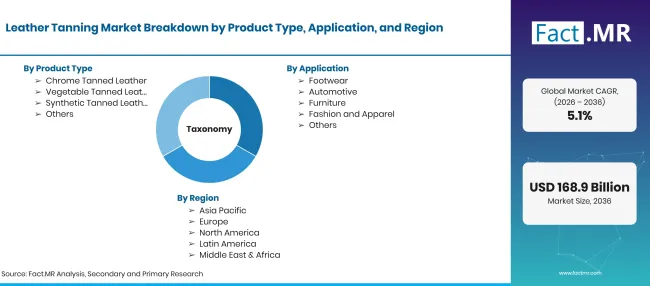
Leather Tanning Market Taxonomy | Source: Fact.MR
| Attribute | Details |
|---|---|
| Quantitative Units | USD billion |
| Market Definition | Processing raw animal hides and skins into stabilised leather including tanning and associated dyeing and finishing. |
| Product Type | Chrome Tanned Leather; Vegetable Tanned Leather; Synthetic Tanned Leather; Others |
| Application | Footwear; Automotive; Furniture; Fashion and Apparel; Others |
| Process | Tanning; Dyeing; Finishing |
| End-User | Commercial; Residential; Industrial |
| Regions Covered | North America; Latin America; Western Europe; Eastern Europe; East Asia; South Asia & Pacific; Middle East & Africa |
| Countries Covered | Germany; Brazil; USA; UK; Japan |
| Companies Profiled | Horween Leather Company; JBS S.A. / JBS Couros; ECCO Leather; HELLER-LEDER GmbH & Co. KG; Sadesa S.A.; Gruppo Mastrotto S.p.A.; PrimeAsia Leather Corporation; ISA TanTec; Tata International Limited; CPL Group Public Company Limited. |
| Forecast Period | 2026 to 2036 |
| Approach | End-use demand modelling using hide supply, yields, selling values, industry trade data and supplier assessments. |
Source: Fact.MR analysis. Updated Nov 10, 2026
How is the market segmented?
-
By Product Type
- Chrome Tanned Leather
- Vegetable Tanned Leather
- Synthetic Tanned Leather
- Others
-
By Application
- Footwear
- Automotive
- Furniture
- Fashion and Apparel
- Others
-
By Process
- Tanning
- Dyeing
- Finishing
-
By End-User
- Commercial
- Residential
- Industrial
-
By Region
- North America
- Latin America
- Western Europe
- Eastern Europe
- East Asia
- South Asia & Pacific
- Middle East & Africa
Frequently Asked Questions
How big is the leather tanning market in 2026?
What is the CAGR from 2026 to 2036?
Which product type leads leather tanning?
Which application contributes the most value?
Which process accounts for the largest share?
Which end-user category leads?
Which country has the highest forecast CAGR?
Which companies are profiled?
Who worked on this report


Preview the report firsthand - request a free sample
Free SampleGet the brochure for pricing and purchase details
Download PDF