Long-Term Offtake Agreements for PCR Material Market
Long-Term Offtake Agreements for PCR Material Market Size and Share Forecast Outlook 2026 to 2036
Long-term offtake agreements for pcr material market is projected to grow from USD 1.2 billion in 2026 to USD 4.9 billion by 2036, at a CAGR of 15.1%. Brand-recycler agreements will dominate with a 43.0% market share, while multi-year offtake contracts will lead the agreement type segment with a 48.0% share.
Long-Term Offtake Agreements for PCR Material Market Forecast and Outlook 2026 to 2036
The long-term offtake agreements for PCR material market is projected to reach USD 1.2 billion in 2026, growing to USD 4.9 billion by 2036, with a CAGR of 15.1%. These figures signal a strong shift towards stable, long-term partnerships in procurement, driven by growing confidence in the sustainability of PCR materials.
Key Takeaways from Long-Term Offtake Agreements for PCR Material Market
- Long-Term Offtake Agreements for PCR Material Market Value (2026): USD 1.2 billion
- Long-Term Offtake Agreements for PCR Material Market Forecast Value (2036): USD 4.9 billion
- Long-Term Offtake Agreements for PCR Material Market Forecast CAGR (2026-2036): 15.1%
- Leading Segment in Long-Term Offtake Agreements for PCR Material Market: Volume and price floors (52%)
- Key Growth Region in Long-Term Offtake Agreements for PCR Material Market: Asia Pacific
- Key Players in Long-Term Offtake Agreements for PCR Material Market: PepsiCo (PCR offtake), Nestlé, Mengniu, Kao Corporation, Unilever, Henkel, Alibaba Group, Asahi Group
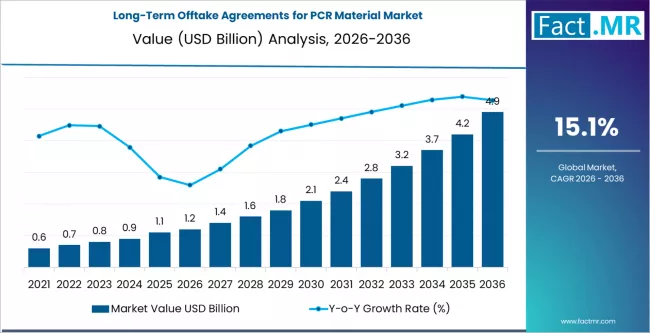
Increasing demand for such agreements reflects a strategic move by buyers to lock in favorable pricing and ensure supply reliability amidst fluctuating market conditions. Suppliers, in turn, are signaling a need for long-term commitments to justify large-scale investments in production capacity and innovation. The market's projected growth suggests a trend toward deeper integration between suppliers and buyers, with both parties focused on securing predictable outcomes while managing the risks of regulatory shifts and supply chain volatility. These agreements indicate a growing industry reliance on established partnerships to mitigate uncertainty and stabilize pricing structures over time.
Long-Term Offtake Agreements for PCR Material Market
| Metric | Value |
|---|---|
| Estimated Value in (2026E) | USD 1.2 billion |
| Forecast Value in (2036F) | USD 4.9 billion |
| Forecast CAGR (2026 to 2036) | 15.1% |
Category
| Category | Segments |
|---|---|
| End-use | Brand-recycler agreements; EU circular commitments; High-volume packaging; Long-term material security; Emerging PCR capacity; Regional circularity |
| Agreement Type | Multi-year offtake contracts; Strategic sourcing agreements; Forward purchase contracts; Partnership agreements; Others |
| Coverage | Volume and price floors; Certified PCR streams; PCR resin supply; Quality-locked PCR; Others |
| Structuring Mechanism | Indexed pricing and take-or-pay; ESG-linked contracts; Volume-indexed pricing; Long-term price stability; Others |
| Region | North America; Europe; Asia Pacific; Latin America; Middle East & Africa |
Segmental Analysis
What Is the Impact of Coverage on the Long-Term Offtake Agreements for PCR Material Market?
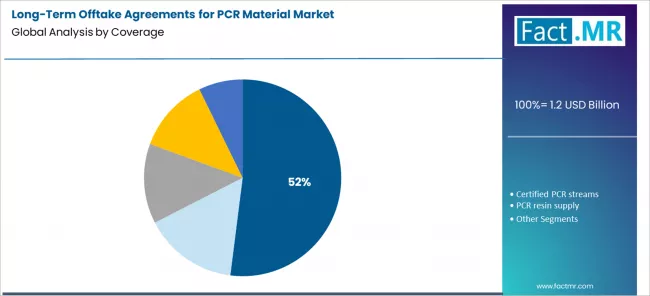
In the long-term offtake agreements for PCR material market, coverage plays a crucial role in ensuring the stability and security of supply. Volume and price floors lead the market with a 52% share, providing both buyers and sellers with predictable pricing and guaranteed supply quantities over extended periods. These agreements are designed to minimize market volatility and ensure that the demand for PCR materials is met with a stable supply. As companies increasingly focus on securing reliable, sustainable materials, volume and price floors will continue to be a key feature of long-term offtake agreements, ensuring long-term business continuity and sustainability goals.
How Does Structuring Mechanism Influence the Long-Term Offtake Agreements for PCR Material Market?
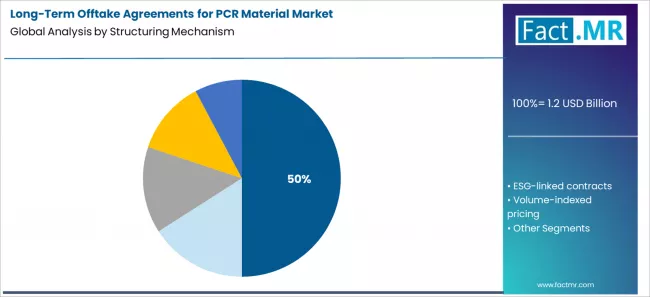
Structuring mechanism plays a significant role in determining the financial stability and flexibility of long-term offtake agreements, with indexed pricing and take-or-pay leading the market at a 50% share. This mechanism ensures that prices are adjusted based on market fluctuations, offering a flexible and responsive approach to pricing. Take-or-pay clauses further guarantee that the supplier receives compensation regardless of whether the agreed-upon volumes are taken, ensuring a stable revenue stream. As the market for PCR materials grows, these structuring mechanisms will remain critical in fostering trust and ensuring that both parties are incentivized to fulfill their commitments within the framework of long-term agreements.
What are the Principal Drivers, Constraints, and Evolving Dynamics of the LongTerm Offtake Agreements for PCR Material Market?
Growth in long term offtake agreements for post consumer recycled (PCR) material has been shaped by buyers’ need for supply stability and price predictability. Brand owners and converters negotiate extended contracts with recyclers to secure defined volumes of PCR resins, supporting planning and production continuity. Requirements to report recycled content in final products under regulatory frameworks influence demand for formal supply commitments. Forecasting and procurement practices that rely on stable material streams have reinforced interest in multi year agreements.
Constraints include variability in PCR feedstock availability that affects recyclers’ ability to deliver contracted volumes consistently. Price volatility in virgin resin markets can alter the relative attractiveness of PCR material agreements. Some recyclers and buyers seek flexible terms that adjust to feedstock yields and quality. Work to standardize contract frameworks and performance metrics is underway. Collaboration among brand owners, recyclers, and intermediaries aims to clarify obligations, align quality specifications, and reduce supply chain risk in PCR material procurement.
Analysis of the Long-Term Offtake Agreements for PCR Material Market by Key Country
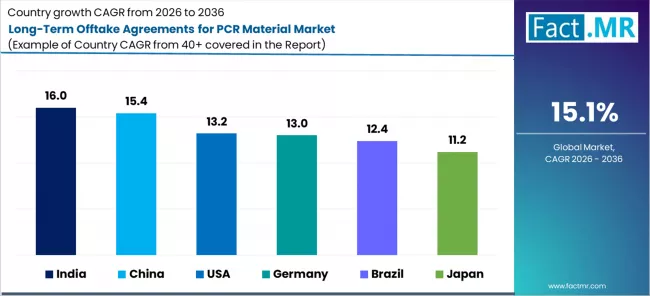
| Country | CAGR 2026 to 2036 |
|---|---|
| USA | 13.2% |
| Germany | 13% |
| China | 15.4% |
| Japan | 11.2% |
| India | 16% |
| Brazil | 12.4% |
The report covers an in-depth analysis of 40+ countries; top-performing countries are highlighted below.
What is the Growth Outlook for Long-Term Offtake Agreements for PCR Material in the USA?
USA’s long-term offtake agreements for PCR material market is projected to grow at a CAGR of 13.2% from 2026 to 2036. As the USA continues to focus on sustainability and circular economy initiatives, long-term agreements for PCR material supply are becoming increasingly important. These agreements ensure a steady supply of recycled materials, supporting both industry demand and environmental goals. With regulatory pressures on plastic waste management and growing consumer demand for eco-friendly products, the market for long-term offtake agreements for PCR material is set to expand.
How is the Long-Term Offtake Agreements for PCR Material Market Performing in Germany?
Germany’s long-term offtake agreements for PCR material market is expected to grow at a CAGR of 13% from 2026 to 2036. Germany's strong commitment to sustainability and circular economy principles is driving the demand for reliable, long-term agreements for PCR materials. These agreements support the recycling industry by ensuring a consistent supply of high-quality materials. With increasing regulatory requirements and consumer preference for recycled content, Germany’s market for long-term offtake agreements for PCR material will continue to grow as part of its broader environmental initiatives.
What is the Market Outlook for Long-Term Offtake Agreements for PCR Material in China?
China is projected to experience significant growth in the long-term offtake agreements for PCR material market, with a projected CAGR of 15.4% from 2026 to 2036. As China accelerates its recycling efforts and strengthens waste management policies, the need for long-term offtake agreements for PCR materials is increasing. These agreements ensure the steady supply of recycled content, which is essential as China focuses on reducing plastic waste and improving material recovery. With government support for sustainable practices and the growing recycling sector, China’s market for PCR material agreements is set for substantial growth.
What is the Growth Potential for Long-Term Offtake Agreements for PCR Material in India?
India’s long-term offtake agreements for PCR material market is forecast to grow at a robust CAGR of 16% from 2026 to 2036. As India’s recycling sector expands and the country adopts more sustainable practices, the demand for long-term offtake agreements for PCR materials is rising. These agreements help ensure a steady supply of recycled materials, which is crucial for meeting both industry demand and environmental goals. With government support for improving recycling infrastructure and increasing consumer awareness of sustainability, India’s market for long-term offtake agreements is poised for strong growth.
What is the Demand for Long-Term Offtake Agreements for PCR Material in Brazil?
Brazil’s long-term offtake agreements for PCR material market is set to grow at a CAGR of 12.4% from 2026 to 2036. With a growing focus on sustainability and waste management, Brazil is increasingly adopting long-term agreements for PCR materials. These agreements ensure that the recycling sector has access to a consistent supply of quality recycled materials, facilitating the country’s transition to a circular economy. Brazil’s commitment to reducing plastic waste and improving recycling practices will continue to support the demand for long-term offtake agreements in the coming years.
What is the Market Expansion Outlook for Long-Term Offtake Agreements for PCR Material in Japan?
Japan’s long-term offtake agreements for PCR material market is projected to grow at a CAGR of 11.2% from 2026 to 2036. Japan’s advanced recycling infrastructure and strong regulatory focus on sustainability are driving the demand for long-term agreements in the PCR material sector. These agreements provide security in supply, supporting the country’s efforts to reduce plastic waste and meet recycling targets. While Japan’s growth rate is slower compared to other regions, its ongoing commitment to sustainability and efficient waste management will continue to support steady demand for PCR material offtake agreements.
How is Competition Structured in the LongTerm Offtake Agreements for PCR Material Market?
Competition in the long term offtake agreements for PCR material market is defined by scale of demand, reliability of procurement, and integration with supply chain commitments. PepsiCo and Nestlé secure multi year contracts to guarantee stable streams of post consumer recycled material for packaging. Unilever and Henkel align offtake terms with internal sustainability targets to lock in prices and material quality. Mengniu and Asahi Group leverage regional procurement strategies to anchor supply from local recyclers.
Kao Corporation and Alibaba Group focus on digital platforms and partnerships that link manufacturers with PCR producers. Competitive differentiation arises from the breadth of contracted volumes, contract duration, and supplier diversification. Buyers assess counterparties based on delivery performance, transparency of material provenance, and alignment with regulatory and brand sustainability commitments.
Key Players of the Long-Term Offtake Agreements for PCR Material Market
- PepsiCo (PCR offtake)
- Nestlé
- Mengniu
- Kao Corporation
- Unilever
- Henkel
- Alibaba Group
- Asahi Group
Scope of the Report
| Items | Values |
|---|---|
| Quantitative Units (2026) | USD Billion |
| End-use | Brand-recycler agreements, EU circular commitments, High-volume packaging, Long-term material security, Emerging PCR capacity, Regional circularity |
| Agreement Type | Multi-year offtake contracts, Strategic sourcing agreements, Forward purchase contracts, Partnership agreements, Others |
| Coverage | Volume and price floors, Certified PCR streams, PCR resin supply, Quality-locked PCR, Others |
| Structuring Mechanism | Indexed pricing and take-or-pay, ESG-linked contracts, Volume-indexed pricing, Long-term price stability, Others |
| Regions Covered | North America, Europe, Asia Pacific, Latin America, Middle East & Africa |
| Countries Covered | United States, Canada, Mexico, Brazil, Germany, United Kingdom, France, Italy, Spain, China, Japan, South Korea, India, Australia & New Zealand |
| Key Companies Profiled | PepsiCo (PCR offtake), Nestlé, Mengniu, Kao Corporation, Unilever, Henkel, Alibaba Group, Asahi Group |
| Additional Attributes | Dollar revenue by end-use, agreement type, coverage, and structuring mechanism; regional demand trends, competitive landscape, technological advancements in long-term offtake agreements for PCR materials, and innovations in pricing mechanisms and partnership structures |
Long-Term Offtake Agreements for PCR Material Market Key Segments
-
End-use :
- Brand-recycler agreements
- EU circular commitments
- High-volume packaging
- Long-term material security
- Emerging PCR capacity
- Regional circularity
-
Agreement Type :
- Multi-year offtake contracts
- Strategic sourcing agreements
- Forward purchase contracts
- Partnership agreements
- Others
-
Coverage :
- Volume and price floors
- Certified PCR streams
- PCR resin supply
- Quality-locked PCR
- Others
-
Structuring Mechanism :
- Indexed pricing and take-or-pay
- ESG-linked contracts
- Volume-indexed pricing
- Long-term price stability
- Others
-
Region :
-
North America
- USA
- Canada
- Mexico
-
Europe
- Germany
- UK
- France
- Italy
- Spain
- Nordic Countries
- BENELUX
- Rest of Europe
-
Asia Pacific
- China
- Japan
- South Korea
- India
- Australia
- Rest of Asia Pacific
-
Latin America
- Brazil
- Argentina
- Rest of Latin America
-
Middle East and Africa
- Kingdom of Saudi Arabia
- United Arab Emirates
- South Africa
- Rest of Middle East and Africa
-
Other Regions
- Oceania
- Central Asia
- Other Markets
-
Bibliographies
- PepsiCo. (2025). Sustainability efforts and supply chain strategies for recycled content. PepsiCo.
- Nestlé. (2025). Nestlé’s approach to sustainable packaging and circular economy initiatives. Nestlé.
- Unilever. (2025). Unilever sustainability targets for recycled content and packaging. Unilever.
- Organisation for Economic Co-operation and Development. (2023). Market design and long-term contracting mechanisms for secondary raw materials. OECD Publishing.
- World Bank. (2023). Scaling circular economy finance: Long-term offtake agreements and risk mitigation for recycled materials. World Bank Group.
Table of Content
- Executive Summary
- Global Market Outlook
- Demand to side Trends
- Supply to side Trends
- Technology Roadmap Analysis
- Analysis and Recommendations
- Market Overview
- Market Coverage / Taxonomy
- Market Definition / Scope / Limitations
- Market Background
- Market Dynamics
- Drivers
- Restraints
- Opportunity
- Trends
- Scenario Forecast
- Demand in Optimistic Scenario
- Demand in Likely Scenario
- Demand in Conservative Scenario
- Opportunity Map Analysis
- Product Life Cycle Analysis
- Supply Chain Analysis
- Investment Feasibility Matrix
- Value Chain Analysis
- PESTLE and Porter’s Analysis
- Regulatory Landscape
- Regional Parent Market Outlook
- Production and Consumption Statistics
- Import and Export Statistics
- Market Dynamics
- Global Market Analysis 2021 to 2025 and Forecast, 2026 to 2036
- Historical Market Size Value (USD Million) Analysis, 2021 to 2025
- Current and Future Market Size Value (USD Million) Projections, 2026 to 2036
- Y to o to Y Growth Trend Analysis
- Absolute $ Opportunity Analysis
- Global Market Pricing Analysis 2021 to 2025 and Forecast 2026 to 2036
- Global Market Analysis 2021 to 2025 and Forecast 2026 to 2036, By End-use
- Introduction / Key Findings
- Historical Market Size Value (USD Million) Analysis By End-use, 2021 to 2025
- Current and Future Market Size Value (USD Million) Analysis and Forecast By End-use, 2026 to 2036
- Brand-recycler agreements
- EU circular commitments
- High-volume packaging
- Long-term material security
- Emerging PCR capacity
- Regional circularity
- Brand-recycler agreements
- Y to o to Y Growth Trend Analysis By End-use, 2021 to 2025
- Absolute $ Opportunity Analysis By End-use, 2026 to 2036
- Global Market Analysis 2021 to 2025 and Forecast 2026 to 2036, By Agreement Type
- Introduction / Key Findings
- Historical Market Size Value (USD Million) Analysis By Agreement Type, 2021 to 2025
- Current and Future Market Size Value (USD Million) Analysis and Forecast By Agreement Type, 2026 to 2036
- Multi-year offtake contracts
- Strategic sourcing agreements
- Forward purchase contracts
- Partnership agreements
- Others
- Multi-year offtake contracts
- Y to o to Y Growth Trend Analysis By Agreement Type, 2021 to 2025
- Absolute $ Opportunity Analysis By Agreement Type, 2026 to 2036
- Global Market Analysis 2021 to 2025 and Forecast 2026 to 2036, By Coverage
- Introduction / Key Findings
- Historical Market Size Value (USD Million) Analysis By Coverage, 2021 to 2025
- Current and Future Market Size Value (USD Million) Analysis and Forecast By Coverage, 2026 to 2036
- Volume and price floors
- Certified PCR streams
- PCR resin supply
- Quality-locked PCR
- Others
- Volume and price floors
- Y to o to Y Growth Trend Analysis By Coverage, 2021 to 2025
- Absolute $ Opportunity Analysis By Coverage, 2026 to 2036
- Global Market Analysis 2021 to 2025 and Forecast 2026 to 2036, By Structuring Mechanism
- Introduction / Key Findings
- Historical Market Size Value (USD Million) Analysis By Structuring Mechanism, 2021 to 2025
- Current and Future Market Size Value (USD Million) Analysis and Forecast By Structuring Mechanism, 2026 to 2036
- Indexed pricing and take-or-pay
- ESG-linked contracts
- Volume-indexed pricing
- Long-term price stability
- Others
- Indexed pricing and take-or-pay
- Y to o to Y Growth Trend Analysis By Structuring Mechanism, 2021 to 2025
- Absolute $ Opportunity Analysis By Structuring Mechanism, 2026 to 2036
- Global Market Analysis 2021 to 2025 and Forecast 2026 to 2036, By Region
- Introduction
- Historical Market Size Value (USD Million) Analysis By Region, 2021 to 2025
- Current Market Size Value (USD Million) Analysis and Forecast By Region, 2026 to 2036
- North America
- Latin America
- Western Europe
- Eastern Europe
- East Asia
- South Asia and Pacific
- Middle East & Africa
- Market Attractiveness Analysis By Region
- North America Market Analysis 2021 to 2025 and Forecast 2026 to 2036, By Country
- Historical Market Size Value (USD Million) Trend Analysis By Market Taxonomy, 2021 to 2025
- Market Size Value (USD Million) Forecast By Market Taxonomy, 2026 to 2036
- By Country
- USA
- Canada
- Mexico
- By End-use
- By Agreement Type
- By Coverage
- By Structuring Mechanism
- By Country
- Market Attractiveness Analysis
- By Country
- By End-use
- By Agreement Type
- By Coverage
- By Structuring Mechanism
- Key Takeaways
- Latin America Market Analysis 2021 to 2025 and Forecast 2026 to 2036, By Country
- Historical Market Size Value (USD Million) Trend Analysis By Market Taxonomy, 2021 to 2025
- Market Size Value (USD Million) Forecast By Market Taxonomy, 2026 to 2036
- By Country
- Brazil
- Chile
- Rest of Latin America
- By End-use
- By Agreement Type
- By Coverage
- By Structuring Mechanism
- By Country
- Market Attractiveness Analysis
- By Country
- By End-use
- By Agreement Type
- By Coverage
- By Structuring Mechanism
- Key Takeaways
- Western Europe Market Analysis 2021 to 2025 and Forecast 2026 to 2036, By Country
- Historical Market Size Value (USD Million) Trend Analysis By Market Taxonomy, 2021 to 2025
- Market Size Value (USD Million) Forecast By Market Taxonomy, 2026 to 2036
- By Country
- Germany
- UK
- Italy
- Spain
- France
- Nordic
- BENELUX
- Rest of Western Europe
- By End-use
- By Agreement Type
- By Coverage
- By Structuring Mechanism
- By Country
- Market Attractiveness Analysis
- By Country
- By End-use
- By Agreement Type
- By Coverage
- By Structuring Mechanism
- Key Takeaways
- Eastern Europe Market Analysis 2021 to 2025 and Forecast 2026 to 2036, By Country
- Historical Market Size Value (USD Million) Trend Analysis By Market Taxonomy, 2021 to 2025
- Market Size Value (USD Million) Forecast By Market Taxonomy, 2026 to 2036
- By Country
- Russia
- Poland
- Hungary
- Balkan & Baltic
- Rest of Eastern Europe
- By End-use
- By Agreement Type
- By Coverage
- By Structuring Mechanism
- By Country
- Market Attractiveness Analysis
- By Country
- By End-use
- By Agreement Type
- By Coverage
- By Structuring Mechanism
- Key Takeaways
- East Asia Market Analysis 2021 to 2025 and Forecast 2026 to 2036, By Country
- Historical Market Size Value (USD Million) Trend Analysis By Market Taxonomy, 2021 to 2025
- Market Size Value (USD Million) Forecast By Market Taxonomy, 2026 to 2036
- By Country
- China
- Japan
- South Korea
- By End-use
- By Agreement Type
- By Coverage
- By Structuring Mechanism
- By Country
- Market Attractiveness Analysis
- By Country
- By End-use
- By Agreement Type
- By Coverage
- By Structuring Mechanism
- Key Takeaways
- South Asia and Pacific Market Analysis 2021 to 2025 and Forecast 2026 to 2036, By Country
- Historical Market Size Value (USD Million) Trend Analysis By Market Taxonomy, 2021 to 2025
- Market Size Value (USD Million) Forecast By Market Taxonomy, 2026 to 2036
- By Country
- India
- ASEAN
- Australia & New Zealand
- Rest of South Asia and Pacific
- By End-use
- By Agreement Type
- By Coverage
- By Structuring Mechanism
- By Country
- Market Attractiveness Analysis
- By Country
- By End-use
- By Agreement Type
- By Coverage
- By Structuring Mechanism
- Key Takeaways
- Middle East & Africa Market Analysis 2021 to 2025 and Forecast 2026 to 2036, By Country
- Historical Market Size Value (USD Million) Trend Analysis By Market Taxonomy, 2021 to 2025
- Market Size Value (USD Million) Forecast By Market Taxonomy, 2026 to 2036
- By Country
- Kingdom of Saudi Arabia
- Other GCC Countries
- Turkiye
- South Africa
- Other African Union
- Rest of Middle East & Africa
- By End-use
- By Agreement Type
- By Coverage
- By Structuring Mechanism
- By Country
- Market Attractiveness Analysis
- By Country
- By End-use
- By Agreement Type
- By Coverage
- By Structuring Mechanism
- Key Takeaways
- Key Countries Market Analysis
- USA
- Pricing Analysis
- Market Share Analysis, 2025
- By End-use
- By Agreement Type
- By Coverage
- By Structuring Mechanism
- Canada
- Pricing Analysis
- Market Share Analysis, 2025
- By End-use
- By Agreement Type
- By Coverage
- By Structuring Mechanism
- Mexico
- Pricing Analysis
- Market Share Analysis, 2025
- By End-use
- By Agreement Type
- By Coverage
- By Structuring Mechanism
- Brazil
- Pricing Analysis
- Market Share Analysis, 2025
- By End-use
- By Agreement Type
- By Coverage
- By Structuring Mechanism
- Chile
- Pricing Analysis
- Market Share Analysis, 2025
- By End-use
- By Agreement Type
- By Coverage
- By Structuring Mechanism
- Germany
- Pricing Analysis
- Market Share Analysis, 2025
- By End-use
- By Agreement Type
- By Coverage
- By Structuring Mechanism
- UK
- Pricing Analysis
- Market Share Analysis, 2025
- By End-use
- By Agreement Type
- By Coverage
- By Structuring Mechanism
- Italy
- Pricing Analysis
- Market Share Analysis, 2025
- By End-use
- By Agreement Type
- By Coverage
- By Structuring Mechanism
- Spain
- Pricing Analysis
- Market Share Analysis, 2025
- By End-use
- By Agreement Type
- By Coverage
- By Structuring Mechanism
- France
- Pricing Analysis
- Market Share Analysis, 2025
- By End-use
- By Agreement Type
- By Coverage
- By Structuring Mechanism
- India
- Pricing Analysis
- Market Share Analysis, 2025
- By End-use
- By Agreement Type
- By Coverage
- By Structuring Mechanism
- ASEAN
- Pricing Analysis
- Market Share Analysis, 2025
- By End-use
- By Agreement Type
- By Coverage
- By Structuring Mechanism
- Australia & New Zealand
- Pricing Analysis
- Market Share Analysis, 2025
- By End-use
- By Agreement Type
- By Coverage
- By Structuring Mechanism
- China
- Pricing Analysis
- Market Share Analysis, 2025
- By End-use
- By Agreement Type
- By Coverage
- By Structuring Mechanism
- Japan
- Pricing Analysis
- Market Share Analysis, 2025
- By End-use
- By Agreement Type
- By Coverage
- By Structuring Mechanism
- South Korea
- Pricing Analysis
- Market Share Analysis, 2025
- By End-use
- By Agreement Type
- By Coverage
- By Structuring Mechanism
- Russia
- Pricing Analysis
- Market Share Analysis, 2025
- By End-use
- By Agreement Type
- By Coverage
- By Structuring Mechanism
- Poland
- Pricing Analysis
- Market Share Analysis, 2025
- By End-use
- By Agreement Type
- By Coverage
- By Structuring Mechanism
- Hungary
- Pricing Analysis
- Market Share Analysis, 2025
- By End-use
- By Agreement Type
- By Coverage
- By Structuring Mechanism
- Kingdom of Saudi Arabia
- Pricing Analysis
- Market Share Analysis, 2025
- By End-use
- By Agreement Type
- By Coverage
- By Structuring Mechanism
- Turkiye
- Pricing Analysis
- Market Share Analysis, 2025
- By End-use
- By Agreement Type
- By Coverage
- By Structuring Mechanism
- South Africa
- Pricing Analysis
- Market Share Analysis, 2025
- By End-use
- By Agreement Type
- By Coverage
- By Structuring Mechanism
- USA
- Market Structure Analysis
- Competition Dashboard
- Competition Benchmarking
- Market Share Analysis of Top Players
- By Regional
- By End-use
- By Agreement Type
- By Coverage
- By Structuring Mechanism
- Competition Analysis
- Competition Deep Dive
- PepsiCo (PCR offtake)
- Overview
- Product Portfolio
- Profitability by Market Segments (Product/Age /Sales Channel/Region)
- Sales Footprint
- Strategy Overview
- Marketing Strategy
- Product Strategy
- Channel Strategy
- Nestlé
- Mengniu
- Kao Corporation
- Unilever
- Henkel
- Alibaba Group
- Asahi Group
- PepsiCo (PCR offtake)
- Competition Deep Dive
- Assumptions & Acronyms Used
- Research Methodology
List Of Table
- Table 1: Global Market Value (USD Million) Forecast by Region, 2021 to 2036
- Table 2: Global Market Value (USD Million) Forecast by End-use, 2021 to 2036
- Table 3: Global Market Value (USD Million) Forecast by Agreement Type, 2021 to 2036
- Table 4: Global Market Value (USD Million) Forecast by Coverage, 2021 to 2036
- Table 5: Global Market Value (USD Million) Forecast by Structuring Mechanism, 2021 to 2036
- Table 6: North America Market Value (USD Million) Forecast by Country, 2021 to 2036
- Table 7: North America Market Value (USD Million) Forecast by End-use, 2021 to 2036
- Table 8: North America Market Value (USD Million) Forecast by Agreement Type, 2021 to 2036
- Table 9: North America Market Value (USD Million) Forecast by Coverage, 2021 to 2036
- Table 10: North America Market Value (USD Million) Forecast by Structuring Mechanism, 2021 to 2036
- Table 11: Latin America Market Value (USD Million) Forecast by Country, 2021 to 2036
- Table 12: Latin America Market Value (USD Million) Forecast by End-use, 2021 to 2036
- Table 13: Latin America Market Value (USD Million) Forecast by Agreement Type, 2021 to 2036
- Table 14: Latin America Market Value (USD Million) Forecast by Coverage, 2021 to 2036
- Table 15: Latin America Market Value (USD Million) Forecast by Structuring Mechanism, 2021 to 2036
- Table 16: Western Europe Market Value (USD Million) Forecast by Country, 2021 to 2036
- Table 17: Western Europe Market Value (USD Million) Forecast by End-use, 2021 to 2036
- Table 18: Western Europe Market Value (USD Million) Forecast by Agreement Type, 2021 to 2036
- Table 19: Western Europe Market Value (USD Million) Forecast by Coverage, 2021 to 2036
- Table 20: Western Europe Market Value (USD Million) Forecast by Structuring Mechanism, 2021 to 2036
- Table 21: Eastern Europe Market Value (USD Million) Forecast by Country, 2021 to 2036
- Table 22: Eastern Europe Market Value (USD Million) Forecast by End-use, 2021 to 2036
- Table 23: Eastern Europe Market Value (USD Million) Forecast by Agreement Type, 2021 to 2036
- Table 24: Eastern Europe Market Value (USD Million) Forecast by Coverage, 2021 to 2036
- Table 25: Eastern Europe Market Value (USD Million) Forecast by Structuring Mechanism, 2021 to 2036
- Table 26: East Asia Market Value (USD Million) Forecast by Country, 2021 to 2036
- Table 27: East Asia Market Value (USD Million) Forecast by End-use, 2021 to 2036
- Table 28: East Asia Market Value (USD Million) Forecast by Agreement Type, 2021 to 2036
- Table 29: East Asia Market Value (USD Million) Forecast by Coverage, 2021 to 2036
- Table 30: East Asia Market Value (USD Million) Forecast by Structuring Mechanism, 2021 to 2036
- Table 31: South Asia and Pacific Market Value (USD Million) Forecast by Country, 2021 to 2036
- Table 32: South Asia and Pacific Market Value (USD Million) Forecast by End-use, 2021 to 2036
- Table 33: South Asia and Pacific Market Value (USD Million) Forecast by Agreement Type, 2021 to 2036
- Table 34: South Asia and Pacific Market Value (USD Million) Forecast by Coverage, 2021 to 2036
- Table 35: South Asia and Pacific Market Value (USD Million) Forecast by Structuring Mechanism, 2021 to 2036
- Table 36: Middle East & Africa Market Value (USD Million) Forecast by Country, 2021 to 2036
- Table 37: Middle East & Africa Market Value (USD Million) Forecast by End-use, 2021 to 2036
- Table 38: Middle East & Africa Market Value (USD Million) Forecast by Agreement Type, 2021 to 2036
- Table 39: Middle East & Africa Market Value (USD Million) Forecast by Coverage, 2021 to 2036
- Table 40: Middle East & Africa Market Value (USD Million) Forecast by Structuring Mechanism, 2021 to 2036
List Of Figures
- Figure 1: Global Market Pricing Analysis
- Figure 2: Global Market Value (USD Million) Forecast 2021 to 2036
- Figure 3: Global Market Value Share and BPS Analysis by End-use, 2026 and 2036
- Figure 4: Global Market Y to o to Y Growth Comparison by End-use, 2026 to 2036
- Figure 5: Global Market Attractiveness Analysis by End-use
- Figure 6: Global Market Value Share and BPS Analysis by Agreement Type, 2026 and 2036
- Figure 7: Global Market Y to o to Y Growth Comparison by Agreement Type, 2026 to 2036
- Figure 8: Global Market Attractiveness Analysis by Agreement Type
- Figure 9: Global Market Value Share and BPS Analysis by Coverage, 2026 and 2036
- Figure 10: Global Market Y to o to Y Growth Comparison by Coverage, 2026 to 2036
- Figure 11: Global Market Attractiveness Analysis by Coverage
- Figure 12: Global Market Value Share and BPS Analysis by Structuring Mechanism, 2026 and 2036
- Figure 13: Global Market Y to o to Y Growth Comparison by Structuring Mechanism, 2026 to 2036
- Figure 14: Global Market Attractiveness Analysis by Structuring Mechanism
- Figure 15: Global Market Value (USD Million) Share and BPS Analysis by Region, 2026 and 2036
- Figure 16: Global Market Y to o to Y Growth Comparison by Region, 2026 to 2036
- Figure 17: Global Market Attractiveness Analysis by Region
- Figure 18: North America Market Incremental Dollar Opportunity, 2026 to 2036
- Figure 19: Latin America Market Incremental Dollar Opportunity, 2026 to 2036
- Figure 20: Western Europe Market Incremental Dollar Opportunity, 2026 to 2036
- Figure 21: Eastern Europe Market Incremental Dollar Opportunity, 2026 to 2036
- Figure 22: East Asia Market Incremental Dollar Opportunity, 2026 to 2036
- Figure 23: South Asia and Pacific Market Incremental Dollar Opportunity, 2026 to 2036
- Figure 24: Middle East & Africa Market Incremental Dollar Opportunity, 2026 to 2036
- Figure 25: North America Market Value Share and BPS Analysis by Country, 2026 and 2036
- Figure 26: North America Market Value Share and BPS Analysis by End-use, 2026 and 2036
- Figure 27: North America Market Y to o to Y Growth Comparison by End-use, 2026 to 2036
- Figure 28: North America Market Attractiveness Analysis by End-use
- Figure 29: North America Market Value Share and BPS Analysis by Agreement Type, 2026 and 2036
- Figure 30: North America Market Y to o to Y Growth Comparison by Agreement Type, 2026 to 2036
- Figure 31: North America Market Attractiveness Analysis by Agreement Type
- Figure 32: North America Market Value Share and BPS Analysis by Coverage, 2026 and 2036
- Figure 33: North America Market Y to o to Y Growth Comparison by Coverage, 2026 to 2036
- Figure 34: North America Market Attractiveness Analysis by Coverage
- Figure 35: North America Market Value Share and BPS Analysis by Structuring Mechanism, 2026 and 2036
- Figure 36: North America Market Y to o to Y Growth Comparison by Structuring Mechanism, 2026 to 2036
- Figure 37: North America Market Attractiveness Analysis by Structuring Mechanism
- Figure 38: Latin America Market Value Share and BPS Analysis by Country, 2026 and 2036
- Figure 39: Latin America Market Value Share and BPS Analysis by End-use, 2026 and 2036
- Figure 40: Latin America Market Y to o to Y Growth Comparison by End-use, 2026 to 2036
- Figure 41: Latin America Market Attractiveness Analysis by End-use
- Figure 42: Latin America Market Value Share and BPS Analysis by Agreement Type, 2026 and 2036
- Figure 43: Latin America Market Y to o to Y Growth Comparison by Agreement Type, 2026 to 2036
- Figure 44: Latin America Market Attractiveness Analysis by Agreement Type
- Figure 45: Latin America Market Value Share and BPS Analysis by Coverage, 2026 and 2036
- Figure 46: Latin America Market Y to o to Y Growth Comparison by Coverage, 2026 to 2036
- Figure 47: Latin America Market Attractiveness Analysis by Coverage
- Figure 48: Latin America Market Value Share and BPS Analysis by Structuring Mechanism, 2026 and 2036
- Figure 49: Latin America Market Y to o to Y Growth Comparison by Structuring Mechanism, 2026 to 2036
- Figure 50: Latin America Market Attractiveness Analysis by Structuring Mechanism
- Figure 51: Western Europe Market Value Share and BPS Analysis by Country, 2026 and 2036
- Figure 52: Western Europe Market Value Share and BPS Analysis by End-use, 2026 and 2036
- Figure 53: Western Europe Market Y to o to Y Growth Comparison by End-use, 2026 to 2036
- Figure 54: Western Europe Market Attractiveness Analysis by End-use
- Figure 55: Western Europe Market Value Share and BPS Analysis by Agreement Type, 2026 and 2036
- Figure 56: Western Europe Market Y to o to Y Growth Comparison by Agreement Type, 2026 to 2036
- Figure 57: Western Europe Market Attractiveness Analysis by Agreement Type
- Figure 58: Western Europe Market Value Share and BPS Analysis by Coverage, 2026 and 2036
- Figure 59: Western Europe Market Y to o to Y Growth Comparison by Coverage, 2026 to 2036
- Figure 60: Western Europe Market Attractiveness Analysis by Coverage
- Figure 61: Western Europe Market Value Share and BPS Analysis by Structuring Mechanism, 2026 and 2036
- Figure 62: Western Europe Market Y to o to Y Growth Comparison by Structuring Mechanism, 2026 to 2036
- Figure 63: Western Europe Market Attractiveness Analysis by Structuring Mechanism
- Figure 64: Eastern Europe Market Value Share and BPS Analysis by Country, 2026 and 2036
- Figure 65: Eastern Europe Market Value Share and BPS Analysis by End-use, 2026 and 2036
- Figure 66: Eastern Europe Market Y to o to Y Growth Comparison by End-use, 2026 to 2036
- Figure 67: Eastern Europe Market Attractiveness Analysis by End-use
- Figure 68: Eastern Europe Market Value Share and BPS Analysis by Agreement Type, 2026 and 2036
- Figure 69: Eastern Europe Market Y to o to Y Growth Comparison by Agreement Type, 2026 to 2036
- Figure 70: Eastern Europe Market Attractiveness Analysis by Agreement Type
- Figure 71: Eastern Europe Market Value Share and BPS Analysis by Coverage, 2026 and 2036
- Figure 72: Eastern Europe Market Y to o to Y Growth Comparison by Coverage, 2026 to 2036
- Figure 73: Eastern Europe Market Attractiveness Analysis by Coverage
- Figure 74: Eastern Europe Market Value Share and BPS Analysis by Structuring Mechanism, 2026 and 2036
- Figure 75: Eastern Europe Market Y to o to Y Growth Comparison by Structuring Mechanism, 2026 to 2036
- Figure 76: Eastern Europe Market Attractiveness Analysis by Structuring Mechanism
- Figure 77: East Asia Market Value Share and BPS Analysis by Country, 2026 and 2036
- Figure 78: East Asia Market Value Share and BPS Analysis by End-use, 2026 and 2036
- Figure 79: East Asia Market Y to o to Y Growth Comparison by End-use, 2026 to 2036
- Figure 80: East Asia Market Attractiveness Analysis by End-use
- Figure 81: East Asia Market Value Share and BPS Analysis by Agreement Type, 2026 and 2036
- Figure 82: East Asia Market Y to o to Y Growth Comparison by Agreement Type, 2026 to 2036
- Figure 83: East Asia Market Attractiveness Analysis by Agreement Type
- Figure 84: East Asia Market Value Share and BPS Analysis by Coverage, 2026 and 2036
- Figure 85: East Asia Market Y to o to Y Growth Comparison by Coverage, 2026 to 2036
- Figure 86: East Asia Market Attractiveness Analysis by Coverage
- Figure 87: East Asia Market Value Share and BPS Analysis by Structuring Mechanism, 2026 and 2036
- Figure 88: East Asia Market Y to o to Y Growth Comparison by Structuring Mechanism, 2026 to 2036
- Figure 89: East Asia Market Attractiveness Analysis by Structuring Mechanism
- Figure 90: South Asia and Pacific Market Value Share and BPS Analysis by Country, 2026 and 2036
- Figure 91: South Asia and Pacific Market Value Share and BPS Analysis by End-use, 2026 and 2036
- Figure 92: South Asia and Pacific Market Y to o to Y Growth Comparison by End-use, 2026 to 2036
- Figure 93: South Asia and Pacific Market Attractiveness Analysis by End-use
- Figure 94: South Asia and Pacific Market Value Share and BPS Analysis by Agreement Type, 2026 and 2036
- Figure 95: South Asia and Pacific Market Y to o to Y Growth Comparison by Agreement Type, 2026 to 2036
- Figure 96: South Asia and Pacific Market Attractiveness Analysis by Agreement Type
- Figure 97: South Asia and Pacific Market Value Share and BPS Analysis by Coverage, 2026 and 2036
- Figure 98: South Asia and Pacific Market Y to o to Y Growth Comparison by Coverage, 2026 to 2036
- Figure 99: South Asia and Pacific Market Attractiveness Analysis by Coverage
- Figure 100: South Asia and Pacific Market Value Share and BPS Analysis by Structuring Mechanism, 2026 and 2036
- Figure 101: South Asia and Pacific Market Y to o to Y Growth Comparison by Structuring Mechanism, 2026 to 2036
- Figure 102: South Asia and Pacific Market Attractiveness Analysis by Structuring Mechanism
- Figure 103: Middle East & Africa Market Value Share and BPS Analysis by Country, 2026 and 2036
- Figure 104: Middle East & Africa Market Value Share and BPS Analysis by End-use, 2026 and 2036
- Figure 105: Middle East & Africa Market Y to o to Y Growth Comparison by End-use, 2026 to 2036
- Figure 106: Middle East & Africa Market Attractiveness Analysis by End-use
- Figure 107: Middle East & Africa Market Value Share and BPS Analysis by Agreement Type, 2026 and 2036
- Figure 108: Middle East & Africa Market Y to o to Y Growth Comparison by Agreement Type, 2026 to 2036
- Figure 109: Middle East & Africa Market Attractiveness Analysis by Agreement Type
- Figure 110: Middle East & Africa Market Value Share and BPS Analysis by Coverage, 2026 and 2036
- Figure 111: Middle East & Africa Market Y to o to Y Growth Comparison by Coverage, 2026 to 2036
- Figure 112: Middle East & Africa Market Attractiveness Analysis by Coverage
- Figure 113: Middle East & Africa Market Value Share and BPS Analysis by Structuring Mechanism, 2026 and 2036
- Figure 114: Middle East & Africa Market Y to o to Y Growth Comparison by Structuring Mechanism, 2026 to 2036
- Figure 115: Middle East & Africa Market Attractiveness Analysis by Structuring Mechanism
- Figure 116: Global Market - Tier Structure Analysis
- Figure 117: Global Market - Company Share Analysis
- FAQs -
How big is the long-term offtake agreements for pcr material market in 2026?
The global long-term offtake agreements for pcr material market is estimated to be valued at USD 1.2 billion in 2026.
What will be the size of long-term offtake agreements for pcr material market in 2036?
The market size for the long-term offtake agreements for pcr material market is projected to reach USD 4.9 billion by 2036.
How much will be the long-term offtake agreements for pcr material market growth between 2026 and 2036?
The long-term offtake agreements for pcr material market is expected to grow at a 15.1% CAGR between 2026 and 2036.
What are the key product types in the long-term offtake agreements for pcr material market?
The key product types in long-term offtake agreements for pcr material market are brand-recycler agreements, eu circular commitments, high-volume packaging, long-term material security, emerging pcr capacity and regional circularity.
Which agreement type segment to contribute significant share in the long-term offtake agreements for pcr material market in 2026?
In terms of agreement type, multi-year offtake contracts segment to command 48.0% share in the long-term offtake agreements for pcr material market in 2026.