- Base Value(2026): 820.0 Mn
- Estimated Value(2026): 820.0 Mn
- Forecast Value (2036): 3040.0 Mn
- CAGR (2026 - 2036): 14.0%
Blockchain-Connected PCR Procurement Systems Market Forecast and Outlook 2026 to 2036
- The blockchain-connected PCR procurement systems market is likely to be USD 820 million in 2026 and is expected to reach USD 3,040 million by 2036, growing at a CAGR of 14%.
- Between 2026 and 2036, the market's cost structures and pricing control mechanisms will be pivotal in determining profitability, with key players focusing on value capture rather than volume sales.
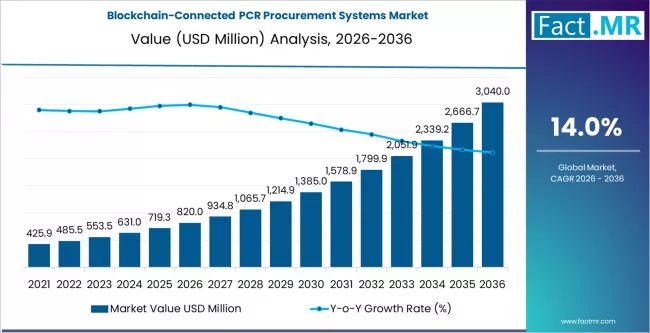
Blockchain Connected Pcr Procurement Systems Market Market Value Analysis | Source: Fact.MR
Summary of Blockchain-ConnectedPCRProcurement Systems Market
- Market Snapshot
- Globalblockchain-connectedPCRprocurement systems market revenue stood atUSD 820 million in 2026and is forecast to reachUSD 3,040 million by 2036.
- At a14.0%CAGRfrom 2026 to 2036, this market is set to expand~3.7x in value, addingUSD 2,220 million in absolute opportunity.
- Growth is being driven by increasing demand fortransparent, traceable, and verifiable procurement systemsfor post-consumer recycled (PCR) materials across circular supply chains.
- Blockchain-connected procurement systems are evolving intodigital trust infrastructure, enabling secure verification of recycled-content claims, supplier traceability, and compliance management across global packaging and materials ecosystems.
- Demand and Growth Drivers
- Rising regulatory pressure aroundPCRtraceability and recycled-content verificationis accelerating deployment ofblockchain-enabled procurement systems.
- Increasing corporate sustainability commitments andESGreporting requirements are driving adoption ofauditable and tamper-resistant procurement records.
- Growing concerns aroundgreenwashing and fraudulent recycled-content claimsare reinforcing demand for secure digital verification systems.
- Blockchainintegration enables:
- Enhanced supply-chain transparency
- Smart-contract automation
- Real-timePCRtracking
- Secure supplier authentication
- Expansion of circular economy frameworks and cross-border recycling ecosystems is further supporting market growth.
- Product and Segment View
- Permissionedblockchainplatforms hold 55% of technology share in 2026,emergingas the leading segment due to stronger data security, governance control, and enterprise compatibility.
- Blockchain-enabled procurement models account for 50% of procurement model share in 2026, positioning them as the dominant segment because of their ability to improve transparency and transaction efficiency.
- Key functionalities include:
- PCRsource authentication
- Supplier verification
- Smart contracts
- Material traceability
- Compliance auditing
- These systems are increasingly integrated across:
- Packaging supply chains
- Recycling ecosystems
- Consumer goods procurement
- Industrial materials sourcing
- Geography and Competitive Outlook
- Asia Pacificrepresentsthe leading growth region, supported by rapid digitalization, manufacturing expansion, and circular economy initiatives.
- India (16.2%CAGR), China (15.6%), USA (13.4%), Germany (13.0%), Brazil (12.2%), and Japan (11.0%)are key growth markets.
- Market expansion is closely tied to:
- Sustainability compliance regulations
- PCRverification requirements
- Digital supply-chain transformation
- Enterpriseblockchainadoption
- Key companies active in this market include:
Blockchain-ConnectedPCRProcurement Systems Market — At a Glance
| Attribute | Details |
|---|---|
| Market Value 2026 | USD 820 million |
| Market Value 2036 | USD 3,040 million |
| Absolute Dollar Opportunity 2026–2036 | USD 2,220 million |
| Total Growth 2026–2036 | 270.7% |
| CAGR2026–2036 | 14.0% |
| Growth Multiple | ~3.7x |
| Key Demand Theme | Increasing adoption ofblockchain-enabled procurement systems forPCRtraceability, compliance, and supply-chain transparency |
| Leading Segment by Technology (2026) | PermissionedBlockchain |
| Technology Segment Share (2026) | 55% |
| Leading Segment by Procurement Model (2026) | Blockchain-Enabled Procurement |
| Procurement Model Share (2026) | 50% |
| Key Growth Region | Asia Pacific |
| CountryCAGRs | India 16.2%, China 15.6%, USA 13.4%, Germany 13.0%, Brazil 12.2%, Japan 11.0% |
| Top Companies | IBM, SAP,Circularise,Recykal, Alibaba Cloud |
| Segmentation by Technology | PermissionedBlockchain, ConsortiumBlockchain, HybridBlockchain, Others |
| Segmentation by Procurement Model | Blockchain-Enabled Procurement, Smart Contract Procurement, Traceability Systems |
| Segmentation by Application | PCRVerification, Supplier Authentication, Material Traceability, Compliance Auditing |
| Segmentation by Region | North America, Latin America, Western Europe, Eastern Europe, East Asia, South Asia & Pacific, Middle East & Africa |
Source: Fact.MR analysis. Updated May 8, 2026
Price-setting strategies will increasingly rely on blockchain-enabled procurement models, allowing firms to streamline operations and ensure higher margins. The concentration of margins within specific technology providers, especially those controlling permissioned blockchains and smart-contract systems, will contribute significantly to shaping competitive advantage. As the market matures, those who manage to capture value through superior technology integration and data transparency will outperform rivals that rely solely on scaling operations. This shift will require businesses to adapt to evolving procurement needs, positioning themselves as leaders in value-driven procurement solutions.
Category
| Category | Segments |
|---|---|
| End-Use | Brand & OEM sourcing; EU compliant sourcing; High-volume trade; Precision procurement; Emerging PCR sourcing; Regional sourcing |
| Procurement Model | Blockchain-enabled procurement; Smart-contract procurement; Trade blockchain systems; Trusted ledgers; Others |
| Data Scope | Contracts, origin, quality; Certificates & audits; Transaction & origin data; Supplier verification; Others |
| Technology | Permissioned blockchain; DPP-aligned chains; Consortium blockchains; Secure blockchain; Others |
| Region | North America; Europe; Asia Pacific; Latin America; Middle East & Africa |
Source: Fact.MR analysis. Updated May 8, 2026
Segmental Analysis
What is the Impact of Procurement Model on the Blockchain-Connected PCR Procurement Systems Market?
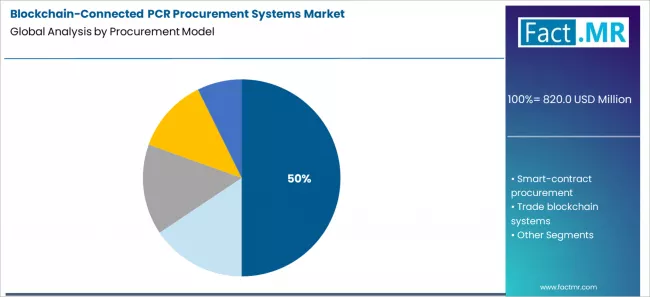
Blockchain Connected Pcr Procurement Systems Market Analysis By Procurement Model | Source: Fact.MR
In the blockchain-connected PCR procurement systems market, the procurement model plays a significant role in shaping the demand for technology solutions. The leading procurement model, blockchain-enabled procurement, commands a 50% share, reflecting its growing importance in the market. Blockchain technology enhances transparency, traceability, and efficiency in procurement processes, ensuring secure transactions across the supply chain. This model facilitates smoother interactions between suppliers and buyers, enabling real-time tracking of goods and services. As more companies adopt blockchain to streamline their procurement strategies, blockchain-enabled procurement is expected to drive growth, offering end-to-end visibility and reducing the risk of fraud in procurement processes.
How Does Technology Influence Blockchain-Connected PCR Procurement Systems?
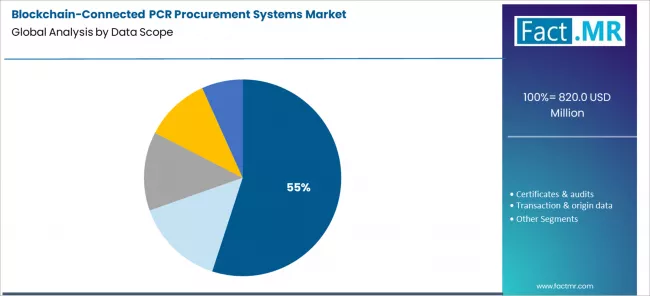
Blockchain Connected Pcr Procurement Systems Market Analysis By Data Scope | Source: Fact.MR
Technology, particularly in the form of blockchain, is a critical enabler in the blockchain-connected PCR procurement systems market. With permissioned blockchain leading the way at a 55% share, it provides secure, decentralized platforms for managing procurement data. This technology ensures that only authorized parties can access critical information, maintaining privacy while enabling transparency. Permissioned blockchains are becoming more attractive to businesses seeking to comply with data protection regulations while enjoying the benefits of blockchain. As companies seek to improve data security and reduce inefficiencies in procurement processes, the continued adoption of permissioned blockchain technology is expected to be a dominant factor in the market's evolution.
What are the Principal Drivers, Constraints, and Evolving Dynamics of the BlockchainConnected PCR Procurement Systems Market?
Blockchain connected PCR procurement systems have gained traction due to the need for secure, transparent transactions in clinical testing supply chains. The growing demand for verifying the authenticity of PCR kits and reagents has fueled the adoption of blockchain for traceability. Regulatory requirements for audit trails and the rising prevalence of counterfeit materials also contribute to this trend.
Challenges include the complexity of integrating blockchain with existing systems, especially for smaller labs with limited resources. Privacy concerns regarding shared ledgers and interoperability between different blockchain frameworks have slowed widespread adoption. Evolving dynamics focus on developing common standards, automating verification, and improving demand forecasting in PCR procurement systems.
Analysis of the Blockchain-Connected PCR Procurement Systems Market by Key Country
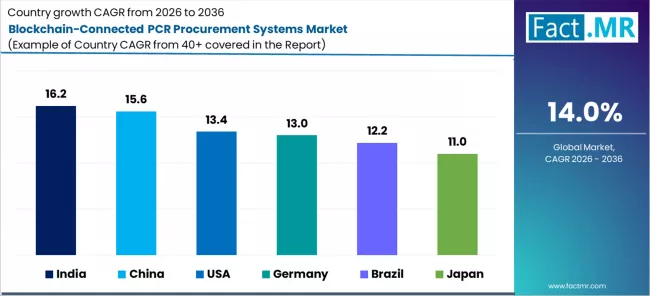
Blockchain Connected Pcr Procurement Systems Market Cagr Analysis By Country | Source: Fact.MR
| Country | CAGR (2026-2036) |
|---|---|
| USA | 13.4% |
| Germany | 13% |
| China | 15.6% |
| Japan | 11% |
| India | 16.2% |
| Brazil | 12.2% |
Source: Fact.MR analysis. Updated May 8, 2026
The report covers an in-depth analysis of 40+ countries; top-performing countries are highlighted below.
What is the Growth Outlook for the Blockchain-Connected PCR Procurement Systems Market in the USA?
The USA market for blockchain-connected PCR procurement systems is projected to grow at a CAGR of 13.4% from 2026 to 2036. Several factors contribute to this growth, such as an increasing demand for transparent and secure procurement processes within the healthcare sector. The country’s advanced healthcare infrastructure and focus on digital innovation in medical systems further support the adoption of blockchain technology. As organizations seek more efficient procurement methods, the integration of blockchain is expected to play a significant role in improving data accuracy and reducing operational inefficiencies.
What is the Growth Outlook for the Blockchain-Connected PCR Procurement Systems Market in Germany?
Germany's blockchain-connected PCR procurement systems market is expected to experience a steady CAGR of 13% from 2026 to 2036. The German healthcare sector’s focus on digitalization and efficiency boosts the adoption of blockchain for procurement systems. By improving the transparency and traceability of procurement processes, blockchain technology has the potential to streamline supply chains. As Germany continues to prioritize innovation in healthcare solutions, blockchain's role in enhancing data security and operational efficiency is anticipated to become more prominent, encouraging further market expansion.
What is the Growth Outlook for the Blockchain-Connected PCR Procurement Systems Market in China?
China is forecast to lead the growth in the blockchain-connected PCR procurement systems market, with a CAGR of 15.6% over the period of 2026-2036. The country’s ongoing push towards digital transformation in healthcare, combined with its large-scale adoption of emerging technologies, positions it as a key player in this market. Blockchain technology offers a robust solution for enhancing procurement transparency, reducing fraud, and optimizing the healthcare supply chain. As China continues to invest heavily in smart technologies, the market for blockchain-connected systems is expected to grow rapidly.
What is the Growth Outlook for the Blockchain-Connected PCR Procurement Systems Market in Japan?
Japan is projected to see moderate growth in the blockchain-connected PCR procurement systems market, with a CAGR of 11% from 2026 to 2036. The country's advanced healthcare system and its ongoing interest in enhancing efficiency and data security in procurement processes make blockchain a key area of focus. Although Japan is slower in adopting blockchain compared to some of its counterparts, its emphasis on technological solutions for healthcare will likely support steady growth. Blockchain’s ability to ensure secure transactions and improve procurement practices will continue to drive its integration within Japan’s healthcare industry.
What is the Growth Outlook for the Blockchain-Connected PCR Procurement Systems Market in India?
India's blockchain-connected PCR procurement systems market is expected to grow significantly, with a CAGR of 16.2% from 2026 to 2036. The healthcare sector in India is undergoing a digital transformation, with an increasing focus on transparency, data security, and supply chain efficiency. Blockchain technology is seen as a critical tool in addressing these issues by providing secure, traceable procurement processes. The government’s push for digital health records and the increasing need for efficient procurement systems are expected to contribute significantly to the rapid expansion of blockchain adoption in the healthcare supply chain.
What is the Growth Outlook for the Blockchain-Connected PCR Procurement Systems Market in Brazil?
Brazil’s blockchain-connected PCR procurement systems market is projected to grow at a CAGR of 12.2% from 2026 to 2036. The demand for blockchain technology in the healthcare industry is rising as organizations seek solutions to improve procurement transparency and security. Brazil's growing focus on healthcare reforms and the adoption of digital tools in public health systems contribute to the expanding market. Blockchain’s role in reducing procurement fraud and optimizing operations will help Brazil’s healthcare sector evolve and improve its efficiency, fueling the market’s continued growth.
Competitive Landscape in the Blockchain-Connected PCR Procurement Systems Market
The blockchain-connected PCR procurement systems market is defined by competition among companies offering varying levels of platform features, integration capabilities, and governance transparency. Key players aim to deliver robust systems for verifying and certifying post-consumer recycled material claims, ensuring traceability across supply chains. IBM Blockchain and Fujitsu are focused on delivering enterprise-grade platforms that integrate with existing procurement systems and facilitate seamless workflows. Their emphasis is on scalability and interoperability.
Circularise prioritizes permission-based systems that control data visibility, enhancing transparency while tracking material volumes. DNV leverages its established reputation for certification and conformity services to provide assurance through blockchain technology. VeChain and AntChain focus on public and consortium blockchain networks, emphasizing transparency and material provenance. Differentiation is achieved through the strength of governance models, regulatory acceptance, and ease of integration with existing supply chain and audit systems.
Key Players in the Blockchain-Connected PCR Procurement Systems Market
- IBM Blockchain
- Circularise
- AntChain
- Fujitsu
- DNV
- VeChain
Bibliography
- Department for Business and Trade. (2024). Digital supply chains and procurement reform: Data transparency, traceability, and trust in UK trade systems. UK Government.
- Organisation for Economic Co-operation and Development. (2023). Blockchain technologies for supply chain transparency and public procurement. OECD Publishing.
- World Economic Forum. (2023). Advancing trust and traceability in global supply chains using blockchain and distributed ledger technologies. World Economic Forum.
- United Nations Commission on International Trade Law. (2023). Legal and policy considerations for distributed ledger technologies in trade and procurement. UNCITRAL.
- Hugo, A. A., & Ngo, G. N. C. (2024). Private blockchain-based procurement and asset management system with QR code. arXiv preprint.
Segmentation
Scope of the Report
| Items | Values |
|---|---|
| Quantitative Units (2026) | USD Million |
| End-use | Brand & OEM sourcing, EU compliant sourcing, High-volume trade, Precision procurement, Emerging PCR sourcing |
| Procurement Model | Blockchain-enabled procurement, Smart-contract procurement, Trade blockchain systems, Trusted ledgers, Others |
| Data Scope | Contracts, origin, quality, Certificates & audits, Transaction & origin data, Supplier verification, Others |
| Technology | Permissioned blockchain, DPP-aligned chains, Consortium blockchains, Secure blockchain, Others |
| Regions Covered | North America, Europe, Asia Pacific, Latin America, Middle East & Africa |
| Countries Covered | India, China, Vietnam, Indonesia, Mexico, Brazil, U.S., Germany, and other countries |
| Key Companies Profiled | IBM Blockchain, Circularise, AntChain, Fujitsu, DNV, VeChain |
| Additional Attributes | Dollar revenue by purity grade, particle size, end use, sales channel, and region; regional demand trends, competitive landscape, technological advancements in materials technology, operational performance optimization initiatives, industrial enhancement programs, and premium materials development strategies |
Source: Fact.MR analysis. Updated May 8, 2026
Blockchain-Connected PCR Procurement Systems Market Key Segments
-
End-use :
- Brand & OEM sourcing
- EU compliant sourcing
- High-volume trade
- Precision procurement
- Emerging PCR sourcing
-
Procurement Model :
- Blockchain-enabled procurement
- Smart-contract procurement
- Trade blockchain systems
- Trusted ledgers
- Others
-
Data Scope :
- Contracts, origin, quality
- Certificates & audits
- Transaction & origin data
- Supplier verification
- Others
-
Technology :
- Permissioned blockchain
- DPP-aligned chains
- Consortium blockchains
- Secure blockchain
- Others
-
Region :
- North America
- U.S.
- Canada
- Mexico
- Europe
- Germany
- UK
- France
- Italy
- Spain
- Nordic Countries
- BENELUX
- Rest of Europe
- Asia Pacific
- China
- Japan
- South Korea
- India
- Australia
- Rest of Asia Pacific
- Latin America
- Brazil
- Argentina
- Rest of Latin America
- Middle East and Africa
- Kingdom of Saudi Arabia
- United Arab Emirates
- South Africa
- Rest of Middle East and Africa
- Other Regions
- Oceania
- Central Asia
- Other Markets
- North America
Frequently Asked Questions
How big is the blockchain-connected pcr procurement systems market in 2026?
What will be the size of blockchain-connected pcr procurement systems market in 2036?
How much will be the blockchain-connected pcr procurement systems market growth between 2026 and 2036?
What are the key product types in the blockchain-connected pcr procurement systems market?
Which procurement model segment to contribute significant share in the blockchain-connected pcr procurement systems market in 2026?
Who worked on this report


Preview the report firsthand - request a free sample
Free SampleGet the brochure for pricing and purchase details
Download PDF