- Market Value (2025): USD 410.9 Mn
- Estimated Value (2026): USD 468.0 Mn
- Forecast Value (2036): USD 1720.0 Mn
- CAGR (2026-2036): 13.9%
What is the Low-Emission Etch Tools Market forecast to be worth by 2036?
USD 468.0 million in 2026 to USD 1,720.0 million by 2036, at a 13.9% CAGR.
- The Low-Emission Etch Tools Market crossed a valuation of USD 410.9 million in 2025, supported by demand from Foundries serving Dielectric etch workflows that require reducing fluorinated-gas emissions and PFAS exposure without sacrificing selectivity, profile control or fab safety.
- Demand is projected to increase from USD 468.0 million in 2026 to USD 1,720.0 million by 2036.
- The market is forecast to record a 13.9% CAGR from 2026 to 2036 as the regulatory baseline, emissions and regulatory compliance and emissions and regulatory compliance remain central purchase reasons.
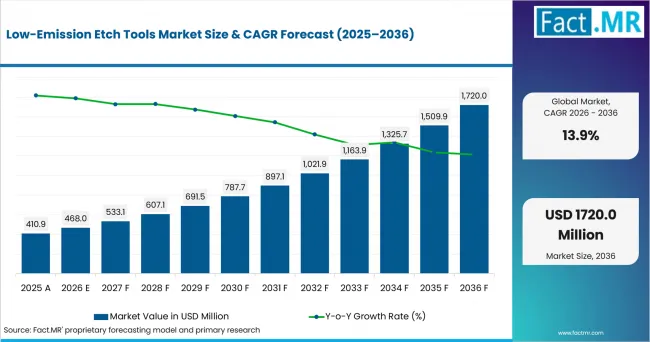
Low Emission Etch Tools Market Value Analysis | Source: Fact.MR
What are the defining numbers behind Low-Emission Etch Tools Market growth?
USD 1,252.0 million absolute opportunity is expected by 2036.
- Demand Drivers in the Market
- The regulatory baseline: Demand is directly set by a binding regulatory timeline: the EU F-gas Regulation (EU) 2024/573, effective March 2024, phases HFC quotas down to 60% of baseline in 2025, 45% in 2027, 24% in 2030, and 15% from 2036 en route to a full phase-out by 2050, while also banning export of equipment above roughly 1,000 GWP from 2025 and tightening leak-check and certification requirements. [5]
- Emissions and regulatory compliance: Demand is reinforced by the broader regulatory net around fluorinated chemistries: HFCs and PFCs used in plasma etch and chamber clean carry high GWP and long atmospheric lifetimes and are already regulated under Kyoto/Kigali and the US EPA-SIA voluntary PFC Reduction Partnership, with NF3 and SF6 also targeted, even as the emitted-to-used gas ratio fell substantially from 2000-2020 despite rising process-gas usage.
- Emissions and regulatory compliance: A structural gap is pulling demand toward abatement and low-GWP chemistry rather than substitution alone: non-PFAS alternatives simply do not exist for many etch/clean uses today, and proposed alternatives such as NF3-with-hydrocarbons or F2 create PFAS byproducts, fire risk from oxidizer-flammable mixes, and toxicity concerns - and since NF3 and SF6 themselves carry high GWP, there is no clean regulatory escape route. [5]
- Breakthrough: cryo HF chemistry: Fabs now have a proof point that emissions reduction and etch performance are not a trade-off: Tokyo Electron's cryogenic channel-hole etch uses HF gas to greatly reduce the partial pressure of conventional CF gas, cutting greenhouse-gas carbon footprint by 84% versus the first-generation cryogenic process, with trace PF3 gas catalyzing the HF-SiO2 reaction at low temperature. [1]
- Key Segments Analyzed
- By Emission Reduction Approach: Alternative etch chemistries are projected to hold 31.0% share in 2026, supported by a clear process advantage: Alternative process chemistry prevents high-global-warming-potential gases from entering the chamber in the first place, reducing the load on abatement and the risk of incomplete destruction. It can therefore improve emissions per wafer rather than only exhaust treatment efficiency.
- By Gas Chemistry: Low-GWP fluorocarbons are projected to hold 46.0% share in 2026, supported by a clear process advantage: Low-GWP fluorocarbons preserve fluorine-based dielectric etch mechanisms while reducing the climate impact of the emitted gas mix. They offer a nearer-term substitution path where fully fluorine-free chemistry cannot yet meet profile and selectivity requirements.
- By Etch Application: Dielectric etch is projected to hold 40.5% share in 2026, supported by a clear process advantage: Dielectric etch relies heavily on fluorocarbon chemistry to create sidewall passivation and oxide selectivity, so it represents the largest direct opportunity for lower-emission gas and plasma designs. Small gas-utilization improvements scale across many high-volume steps.
- By Compliance Driver: Corporate net-zero targets are projected to hold 38.0% share in 2026, supported by a clear process advantage: Corporate net-zero targets affect capital purchasing across regions and can impose supplier and fab metrics before a specific local ban takes effect. They also connect tool emissions to customer supply-chain reporting and cost-of-carbon decisions.
- By End User: Foundries are projected to hold 32.9% share in 2026, supported by a clear process advantage: Foundries operate a broad mix of advanced dielectric and conductor etches and report environmental performance to many customers. A lower-emission platform can therefore influence both operating cost and access to sustainability-sensitive business.
- Analyst Opinion at Fact.MR
- Shambhu Nath Jha, Sr. Consultant at Fact.MR, states, 'Buyers should evaluate the complete process sequence around reducing fluorinated-gas emissions and PFAS exposure without sacrificing selectivity, profile control or fab safety. Technical review should focus on repeatability, integration, defect control and production throughput rather than a single headline specification. Suppliers that connect tool performance to measurable yield and qualification results are likely to build trust faster.'
- Strategic Implications
- Fabs should compare verified emissions per wafer, abatement efficiency, by-product handling and process equivalence rather than relying on a low-GWP gas label alone.
- Equipment suppliers should document how their systems address the challenge of reducing fluorinated-gas emissions and PFAS exposure without sacrificing selectivity, profile control or fab safety across production-representative wafers, panels, dies or packages.
- Procurement teams should compare fluorinated-gas abatement, process emissions, etch selectivity, chamber uptime, integration with existing exhaust systems and verified compliance performance.
Taiwan is projected to record a 15.5% CAGR as leading foundry production, advanced packaging and a dense OSAT and substrate supply chain supports relevant capital spending; South Korea is projected to record a 15.2% CAGR as high-volume memory, HBM and vertically integrated semiconductor manufacturing supports relevant capital spending; USA is projected to record a 15.4% CAGR as leading-edge logic, high-performance computing, federally supported semiconductor R&D and a large domestic equipment base supports relevant capital spending; Japan is projected to record a 14.7% CAGR as semiconductor equipment, materials, inspection and memory-process expertise supports relevant capital spending; Germany is projected to record a 13.3% CAGR as precision equipment, materials engineering and automotive and power-semiconductor demand supports relevant capital spending; while Netherlands is projected to record a 13.5% CAGR as advanced semiconductor equipment and die-bonding development supports relevant capital spending through 2036.
How does the Low-Emission Etch Tools Market break down by segment?
Alternative etch chemistries leads Emission Reduction Approach with a 31.0% share, while Low-GWP fluorocarbons accounts for 46.0% of Gas Chemistry in 2026.
Why do Alternative etch chemistries lead Emission Reduction Approach?
Alternative etch chemistries are projected to account for 31.0% share in 2026.
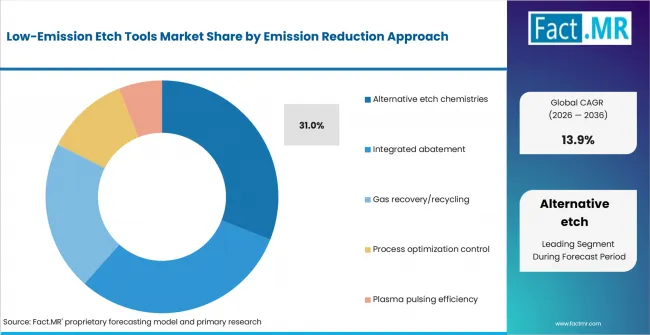
Low Emission Etch Tools Market Analysis By Emission Reduction Approach | Source: Fact.MR
Alternative process chemistry prevents high-global-warming-potential gases from entering the chamber in the first place, reducing the load on abatement and the risk of incomplete destruction. It can therefore improve emissions per wafer rather than only exhaust treatment efficiency. Integrated abatement remains necessary, but it treats the by-product after gas has already been purchased, delivered and partially used. Fluorinated chemistries in plasma etch/chamber clean are HFCs and PFCs with high GWP and long atmospheric lifetimes, already regulated under Kyoto/Kigali and the US EPA-SIA voluntary PFC Reduction Partnership; NF3 and SF6 are also targeted. Historical data: the emitted/used gas ratio fell substantially from 2000-2020 even as process-gas usage grew with device complexity. Buyers therefore tend to treat alternative etch chemistries as the practical choice when qualification must balance process capability, repeatability and production economics.
Why do Low-GWP fluorocarbons lead Gas Chemistry?
Low-GWP fluorocarbons are projected to account for 46.0% share in 2026.
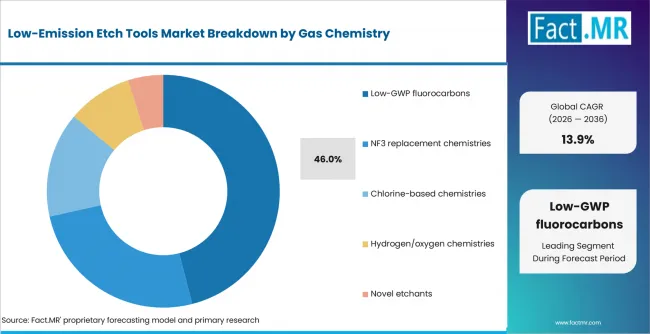
Low Emission Etch Tools Market Analysis By Gas Chemistry | Source: Fact.MR
Low-GWP fluorocarbons preserve fluorine-based dielectric etch mechanisms while reducing the climate impact of the emitted gas mix. They offer a nearer-term substitution path where fully fluorine-free chemistry cannot yet meet profile and selectivity requirements. NF3 replacement is important for chamber cleaning, but it addresses a narrower portion of the etch-tool emissions profile. TEL's cryogenic channel-hole etch uses HF gas, greatly reduc[ing] the partial pressure of conventional CF gas... carbon footprint from greenhouse gases can be reduced by 84% compared to the first-generation cryogenic process; PF3 trace gas catalyzes the HF-SiO2 reaction at low temperature. Buyers therefore tend to treat low-GWP fluorocarbons as the practical choice when qualification must balance process capability, repeatability and production economics.
Why does Dielectric etch lead Etch Application?
Dielectric etch is projected to account for 40.5% share in 2026.
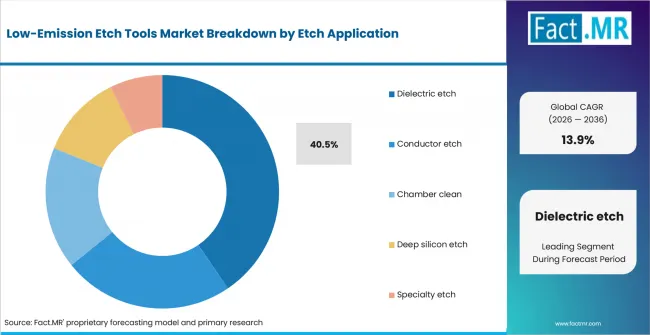
Low Emission Etch Tools Market Analysis By Etch Application | Source: Fact.MR
Dielectric etch relies heavily on fluorocarbon chemistry to create sidewall passivation and oxide selectivity, so it represents the largest direct opportunity for lower-emission gas and plasma designs. Small gas-utilization improvements scale across many high-volume steps. Conductor etch has its own hazardous chemistries, but fluorinated greenhouse-gas exposure is especially concentrated in dielectric processes. Currently non-PFAS alternatives simply do not exist for many etch/clean uses; proposed alternatives (NF3 with hydrocarbons, F2) create PFAS byproducts, fire risk (oxidizer + flammable mixes), toxicity concerns, and NF3/SF6 themselves carry high GWP under the F-gas regulation. Buyers therefore tend to treat dielectric etch as the practical choice when qualification must balance process capability, repeatability and production economics.
Why do Corporate net-zero targets lead Compliance Driver?
Corporate net-zero targets are projected to account for 38.0% share in 2026.
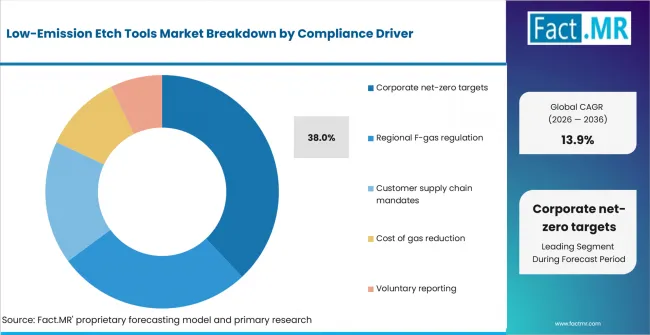
Low Emission Etch Tools Market Analysis By Compliance Driver | Source: Fact.MR
Corporate net-zero targets affect capital purchasing across regions and can impose supplier and fab metrics before a specific local ban takes effect. They also connect tool emissions to customer supply-chain reporting and cost-of-carbon decisions. Regional F-gas rules are legally binding but geographically uneven, whereas corporate targets can standardize requirements across a global fab network. EU F-gas Regulation (EU) 2024/573 (effective March 2024, replacing 517/2014): HFC quota phasedown to 60% of baseline in 2025, 45% in 2027, 24% in 2030, 15% from 2036, full phase-out by 2050; export bans on at least 1000-GWP equipment from 2025; tighter leak checks and certification. The proposed universal PFAS restriction (ECHA, updated dossier Aug 2025) grants semiconductor manufacturing a 12-year derogation + 18-month transition - while industry argues substitution is infeasible and time-unlimited derogations are the only viable option. [3] Buyers therefore tend to treat corporate net-zero targets as the practical choice when qualification must balance process capability, repeatability and production economics.
Why do Foundries lead End User?
Foundries are projected to account for 32.9% share in 2026.
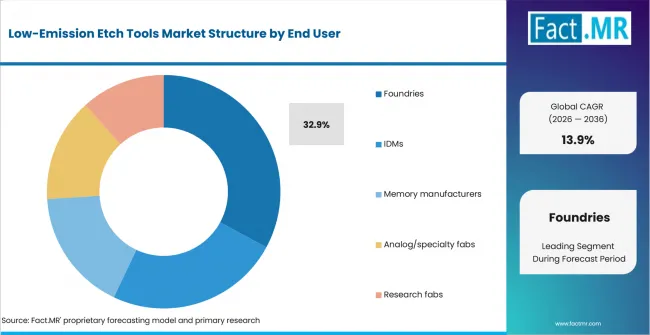
Low Emission Etch Tools Market Analysis By End User | Source: Fact.MR
Their leadership reflects the need to run high-volume wafer production across several device designs while keeping etch depth, profile control, and process repeatability consistent. Cryogenic NAND etchers help foundries form deep, narrow channel holes through hundreds of alternating dielectric layers with less bowing, tapering, and weak etch performance at the bottom. Foundries also evaluate equipment based on throughput, uptime, process stability, and compatibility with existing production lines. These requirements place foundries ahead of other end users in the Cryogenic NAND Etchers Market.
What is accelerating Low-Emission Etch Tools Market adoption, and what is holding it back?
The strongest accelerator is the regulatory baseline, while the main restraint is that substitutes can create new toxicity, fire or process-control risks, and many advanced etch steps still lack drop-in non-fluorinated chemistries.
Drivers Impact Analysis
| DRIVER | (~) % IMPACT ON CAGR | GEOGRAPHIC RELEVANCE | IMPACT TIMELINE |
|---|---|---|---|
| The regulatory baseline | +3.9% | Germany, Netherlands | Short term (<=2 years) |
| Emissions and regulatory compliance | +3.2% | USA | Medium term (2-4 years) |
| Emissions and regulatory compliance | +2.6% | Germany, Netherlands | Medium term (2-4 years) |
| Breakthrough: cryo HF chemistry | +2.1% | Global leading-edge fabs | Medium term (2-4 years) |
Source: Fact.MR analysis. Updated Jul 23, 2026
- The regulatory baseline: EU F-gas Regulation (EU) 2024/573 (effective March 2024, replacing 517/2014): HFC quota phasedown to 60% of baseline in 2025, 45% in 2027, 24% in 2030, 15% from 2036, full phase-out by 2050; export bans on at least 1000-GWP equipment from 2025; tighter leak checks and certification.
- Emissions and regulatory compliance: Currently non-PFAS alternatives simply do not exist for many etch/clean uses; proposed alternatives (NF3 with hydrocarbons, F2) create PFAS byproducts, fire risk (oxidizer + flammable mixes), toxicity concerns, and NF3/SF6 themselves carry high GWP under the F-gas regulation.
- Breakthrough: cryo HF chemistry: TEL's cryogenic channel-hole etch uses HF gas, greatly reduc[ing] the partial pressure of conventional CF gas... carbon footprint from greenhouse gases can be reduced by 84% compared to the first-generation cryogenic process; PF3 trace gas catalyzes the HF-SiO2 reaction at low temperature.
Opportunity Impact Analysis
| OPPORTUNITY | (~) % IMPACT ON CAGR | GEOGRAPHIC RELEVANCE | IMPACT TIMELINE |
|---|---|---|---|
| Chemistry-first decarbonization | +2.4% | Global leading-edge fabs | Medium term (2-4 years) |
| Abatement co-optimization | +1.8% | Global leading-edge fabs | Medium term (2-4 years) |
| Chamber-clean shift | +1.4% | Germany, Netherlands | Medium term (2-4 years) |
Source: Fact.MR analysis. Updated Jul 23, 2026
- Chemistry-first decarbonization: 84% GWP cut via HF-based cryo etch (TEL) and reduced environmental impact claims for third-gen cryo (Lam) - chemistry change, beyond abatement. [2]
- Abatement co-optimization: Point-of-use burn/wet or plasma abatement sized into new tools; gas-utilization improvements (pulsed plasma, confined reactors) reduce input gas per wafer.
- Chamber-clean shift: NF3 remote-plasma cleans replacing C2F6/CF4 where possible; F2-based cleans under evaluation (with safety caveats per SEMI Europe).
Restraints Impact Analysis
| RESTRAINT | (~) % IMPACT ON CAGR | GEOGRAPHIC RELEVANCE | IMPACT TIMELINE |
|---|---|---|---|
| Primary qualification constraint | -2.1% | Global leading-edge fabs | Medium term (2-4 years) |
| PFAS substitution feasibility | -1.7% | Global leading-edge fabs | Short term (<=2 years) |
| Alternative-chemistry safety trade-off | -1.3% | Global leading-edge fabs | Medium term (2-4 years) |
Source: Fact.MR analysis. Updated Jul 23, 2026
- Primary qualification constraint: Substitutes can create new toxicity, fire or process-control risks, and many advanced etch steps still lack drop-in non-fluorinated chemistries. [4]
- PFAS substitution feasibility: The proposed universal PFAS restriction (ECHA, updated dossier Aug 2025) grants semiconductor manufacturing a 12-year derogation + 18-month transition - while industry argues substitution is infeasible and time-unlimited derogations are the only viable option.
- Alternative-chemistry safety trade-off: Currently non-PFAS alternatives simply do not exist for many etch/clean uses; proposed alternatives (NF3 with hydrocarbons, F2) create PFAS byproducts, fire risk (oxidizer + flammable mixes), toxicity concerns, and NF3/SF6 themselves carry high GWP under the F-gas regulation.
Which countries are scaling Low-Emission Etch Tools Market fastest?
For Low Emission Etch Tools Market, South Korea's 15.2% CAGR reflects high-volume memory, HBM and vertically integrated semiconductor manufacturing.
- Countries differ less by the headline CAGR than by the type of semiconductor work creating demand for the Low-Emission Etch Tools Market.
- Taiwan demand is tied to fab abatement upgrades, foundry process changes and local supply integration, while USA demand reflects emissions policy, advanced-node investment and retrofit qualification.
- South Korea demand is linked to memory-fab abatement requirements, while Japan contributes process equipment, gas-handling technology and environmental-control expertise.
- Netherlands develops through advanced semiconductor equipment and die-bonding development, while Germany relies on precision equipment, materials engineering and automotive and power-semiconductor demand.
- Demand paths depend on local emission rules, fab retrofit cycles, abatement infrastructure, fluorinated-gas policy and semiconductor investment.
The analysis reviews six country markets within broader coverage of North America, Latin America, Europe, East Asia, South Asia & Oceania, and the Middle East & Africa.
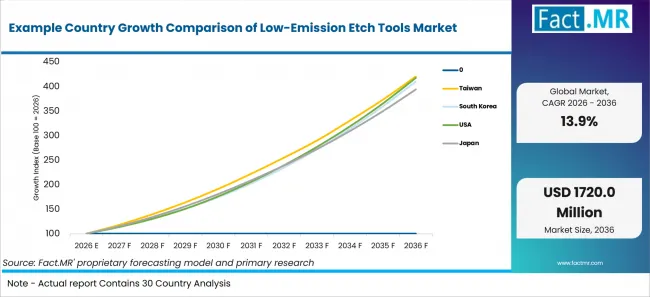
Example Country Growth Comparison Of Low Emission Etch Tools Market | Source: Fact.MR
| COUNTRY | CAGR, 2026 to 2036 |
|---|---|
| Taiwan | 15.5% |
| USA | 15.4% |
| South Korea | 15.2% |
| Japan | 14.7% |
| Netherlands | 13.5% |
| Germany | 13.3% |
Source: Fact.MR analysis. Updated Jul 23, 2026
What is driving Taiwan's growth through 2036?
15.5% CAGR, supported by leading foundry production, advanced packaging and a dense OSAT and substrate supply chain.
Aligned with Kigali; Korea reviewing its POPs Control Act; fabs setting supplier GWP requirements in procurement. This environment creates a clear qualification pathway for the Low-Emission Etch Tools Market because buyers must solve the problem of reducing fluorinated-gas emissions and PFAS exposure without sacrificing selectivity, profile control or fab safety at production scale.
What is driving USA's growth through 2036?
15.4% CAGR, supported by leading-edge logic, high-performance computing, federally supported semiconductor R&D and a large domestic equipment base.
Voluntary-partnership history + CERCLA remediation risk; state-level PFAS rules (e.g., Maine, Minnesota) add pressure. This environment creates a clear qualification pathway for the Low-Emission Etch Tools Market because buyers must solve the problem of reducing fluorinated-gas emissions and PFAS exposure without sacrificing selectivity, profile control or fab safety at production scale.
What is driving South Korea's growth through 2036?
15.2% CAGR, supported by high-volume memory, HBM and vertically integrated semiconductor manufacturing.
Fastest expansion path; high-volume memory, HBM growth and vertically integrated chip production remain the main drivers. This structure creates a strong demand base through 2036 because semiconductor manufacturers require advanced etch systems that support deeper structures, tighter profile control, higher throughput and stable performance across large-scale memory production.
What is driving Japan's growth through 2036?
14.7% CAGR, supported by semiconductor equipment, materials, inspection and memory-process expertise.
Strong equipment and materials base; inspection strength and memory-process expertise support steady growth. This environment creates a clear demand pathway through 2036 because semiconductor manufacturers require precise etch tools that work with advanced materials, maintain tight process control and meet the quality standards needed for complex memory and logic production.
What is driving Netherlands's growth through 2036?
13.5% CAGR, supported by advanced semiconductor equipment and die-bonding development.
Strictest trajectory; derogation fight ongoing; wastewater rules binding. This environment creates a clear qualification pathway for the Low-Emission Etch Tools Market because buyers must solve the problem of reducing fluorinated-gas emissions and PFAS exposure without sacrificing selectivity, profile control or fab safety at production scale.
What is driving Germany's growth through 2036?
13.3% CAGR, supported by precision equipment, materials engineering and automotive and power-semiconductor demand.
Who leads the Low-Emission Etch Tools Market?
Lam Research and Applied Materials lead the competitive landscape, followed by Tokyo Electron and Edwards Vacuum as the next tier of challengers.
Lam Research participates through etch, deposition, clean and advanced memory process integration, with relevance determined by its ability to address the challenge of reducing fluorinated-gas emissions and PFAS exposure without sacrificing selectivity, profile control or fab safety. Applied Materials participates through deposition, etch, materials engineering and integrated process modules, with relevance determined by its ability to address the challenge of reducing fluorinated-gas emissions and PFAS exposure without sacrificing selectivity, profile control or fab safety.
Ebara holds a more specialized role through vacuum, CMP and semiconductor process equipment, particularly where custom integration and service coverage affect qualification. Hitachi High-Tech holds a more specialized role through CD-SEM and semiconductor inspection, particularly where custom integration and service coverage affect qualification.
Competition is expected to center on repeatable process performance, integration with adjacent modules, installed-base service and documented capability to address the challenge of reducing fluorinated-gas emissions and PFAS exposure without sacrificing selectivity, profile control or fab safety. Buyers are likely to compare accuracy, defect prevention, throughput, recipe stability and the completeness of the delivered process cell.
Which companies are the key providers?
Key companies include Lam Research; Applied Materials; Tokyo Electron; Edwards Vacuum; Ebara; Hitachi High-Tech.
- Lam Research
- Applied Materials
- Tokyo Electron
- Edwards Vacuum
- Ebara
- Hitachi High-Tech
Bibliography
- [1] Tokyo Electron. (n.d.). Memory Channel Hole Etch Technology for 3D NAND with an 84% Reduction of Global Warming Potential.
- [2] Lam Research. (n.d.). Cryogenic Etching.
- [3] SEMI. (n.d.). Pfas Regulations Semiconductor.
- [4] Semiconductor Industry Association. (n.d.). Final Plasma Etch And Deposition White Paper.
- [5] Semiconductor Engineering. (n.d.). Cryogenic Etch A Key Enabler Of 3D Nand.
This Report Addresses
- The report provides strategic intelligence on Low-Emission Etch Tools Market across Emission Reduction Approach and Gas Chemistry choices that shape purchasing decisions.
- Segment analysis covers Alternative etch chemistries as the share leader within the 2026 market structure.
- Regional outlook evaluates Taiwan and South Korea alongside USA and Japan, while Germany and Netherlands complete the growth comparison.
- Competitive analysis profiles Lam Research and Applied Materials alongside Tokyo Electron and Edwards Vacuum, followed by additional active providers.
- Use-case assessment covers the categories and applications that shape demand in the Low-Emission Etch Tools Market across the forecast period.
What does the Low-Emission Etch Tools Market cover?
The market covers equipment and process systems configured to address the challenge of reducing fluorinated-gas emissions and PFAS exposure without sacrificing selectivity, profile control or fab safety.
Low-emission etch tools are plasma etch systems engineered to minimize greenhouse-gas and PFAS emissions: low-GWP process chemistries (HF-based cryo etch, NF3 optimization, F2 mixes), high gas-utilization reactor design, and integrated point-of-use abatement. The segment is defined by regulation, not device physics - its buyers must meet F-gas quotas, PFAS reporting, and net-zero commitments while keeping etch performance.
Commercial value includes low-emission etch chambers, gas-delivery and abatement interfaces, plasma control, exhaust monitoring, wafer handling and service integration. Finished devices and unrelated fabrication equipment are excluded.
What is included in the scope?
The scope includes systems used by foundries and the other end-user groups listed in the segmentation.
The market is segmented by Emission Reduction Approach, including Alternative etch chemistries, Integrated abatement, Gas recovery/recycling, Process optimization control, Plasma pulsing efficiency; Gas Chemistry, including Low-GWP fluorocarbons, NF3 replacement chemistries, Chlorine-based chemistries, Hydrogen/oxygen chemistries, Novel etchants; Etch Application, including Dielectric etch, Conductor etch, Chamber clean, Deep silicon etch, Specialty etch; Compliance Driver, including Corporate net-zero targets, Regional F-gas regulation, Customer supply chain mandates, Cost of gas reduction, Voluntary reporting; End User, including Foundries, IDMs, Memory manufacturers, Analog/specialty fabs, Research fabs.
Gas abatement, exhaust monitoring, wafer handling, chamber clean, plasma-control and service modules are counted only when part of the configured low-emission etch system.
What is excluded from the scope?
The scope excludes unrelated semiconductor equipment, standalone materials and components sold independently of the configured system.
It also excludes facility construction, cleanroom infrastructure, the value of processed wafers or packages, and adjacent process steps that are not part of the defined equipment category.
How Was the Analysis Built?
Fact.MR is of the opinion that this assessment combines structured market analysis with a review of public information and industry evidence relevant to the market.
- Market Assessment: The analysis considers demand patterns, supply conditions, segment mix, country activity, company participation, and adoption trends.
- Evidence Review: Public company disclosures, government and regulatory publications, trade information, technical literature, and industry records inform the assessment.
- Validation and Updates: Findings are cross-checked against available market indicators and reviewed when material market developments emerge.
Segmentation
What is the report's scope and coverage?
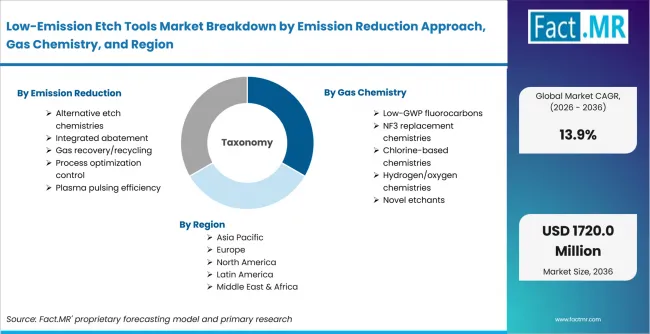
Low Emission Etch Tools Market Breakdown By Emission Reduction Approach, Gas Chemistry, And Region | Source: Fact.MR
| Attribute | Details |
|---|---|
| Quantitative Units | USD 468.0 million in 2026 to USD 1,720.0 million by 2036 at a 13.9% CAGR |
| Market Definition | Low-emission etch tools are plasma etch systems engineered to minimize greenhouse-gas and PFAS emissions: low-GWP process chemistries (HF-based cryo etch, NF3 optimization, F2 mixes), high gas-utilization reactor design, and integrated point-of-use abatement. The segment is defined by regulation, not device physics - its buyers must meet F-gas quotas, PFAS reporting, and net-zero commitments while keeping etch performance. |
| Emission Reduction Approach | Alternative etch chemistries; Integrated abatement; Gas recovery/recycling; Process optimization control; Plasma pulsing efficiency |
| Gas Chemistry | Low-GWP fluorocarbons; NF3 replacement chemistries; Chlorine-based chemistries; Hydrogen/oxygen chemistries; Novel etchants |
| Etch Application | Dielectric etch; Conductor etch; Chamber clean; Deep silicon etch; Specialty etch |
| Compliance Driver | Corporate net-zero targets; Regional F-gas regulation; Customer supply chain mandates; Cost of gas reduction; Voluntary reporting |
| End User | Foundries; IDMs; Memory manufacturers; Analog/specialty fabs; Research fabs |
| Regions Covered | North America; Latin America; Europe; East Asia; South Asia & Oceania; Middle East & Africa |
| Countries Covered | Taiwan; South Korea; USA; Japan; Germany; Netherlands |
| Key Companies Profiled | Lam Research; Applied Materials; Tokyo Electron; Edwards Vacuum; Ebara; Hitachi High-Tech |
| Forecast Period | 2026 to 2036 |
| Approach | Hybrid top-down and bottom-up approach using demand indicators across Emission Reduction Approach; Gas Chemistry; Etch Application; Compliance Driver; End User; country-level growth; company participation and adoption trends |
Source: Fact.MR analysis. Updated Jul 23, 2026
How is the market segmented?
-
By Emission Reduction Approach:
- Alternative etch chemistries
- Integrated abatement
- Gas recovery/recycling
- Process optimization control
- Plasma pulsing efficiency
-
By Gas Chemistry:
- Low-GWP fluorocarbons
- NF3 replacement chemistries
- Chlorine-based chemistries
- Hydrogen/oxygen chemistries
- Novel etchants
-
By Etch Application:
- Dielectric etch
- Conductor etch
- Chamber clean
- Deep silicon etch
- Specialty etch
-
By Compliance Driver:
- Corporate net-zero targets
- Regional F-gas regulation
- Customer supply chain mandates
- Cost of gas reduction
- Voluntary reporting
-
By End User:
- Foundries
- IDMs
- Memory manufacturers
- Analog/specialty fabs
- Research fabs
-
By Region:
- North America
- Latin America
- Europe
- East Asia
- South Asia & Oceania
- Middle East & Africa
Frequently Asked Questions
Which Emission Reduction Approach leads the Low-Emission Etch Tools Market?
Which Gas Chemistry leads the Low-Emission Etch Tools Market?
Which Etch Application leads the Low-Emission Etch Tools Market?
Which Compliance Driver leads the Low-Emission Etch Tools Market?
Which End User leads the Low-Emission Etch Tools Market?
What CAGR is projected for Taiwan in the Low-Emission Etch Tools Market?
What CAGR is projected for USA in the Low-Emission Etch Tools Market?
What CAGR is projected for South Korea in the Low-Emission Etch Tools Market?
What CAGR is projected for Japan in the Low-Emission Etch Tools Market?
What CAGR is projected for Netherlands in the Low-Emission Etch Tools Market?
What CAGR is projected for Germany in the Low-Emission Etch Tools Market?
What is the primary driver of the Low-Emission Etch Tools Market?
What is the main restraint in the Low-Emission Etch Tools Market?
Who worked on this report


Preview the report firsthand - request a free sample
Free SampleGet the brochure for pricing and purchase details
Download PDF