Low-GWP Blowing Agents and Foam Additives Market
Low-GWP Blowing Agents and Foam Additives Market Size and Share Forecast Outlook 2026 to 2036
Low-GWP blowing agents and foam additives market is projected to grow from USD 0.7 billion in 2026 to USD 1.9 billion by 2036, at a CAGR of 9.9%. HFOs will dominate with a 42.0% market share, while surfactants & wetting agents will lead the foam additive function segment with a 28.0% share.
Low-GWP Blowing Agents and Foam Additives Market Forecast and Outlook 2026 to 2036
The global low-GWP blowing agents and foam additives market is projected to reach USD 1.91 billion by 2036. The market is valued at USD 0.74 billion in 2026 and is set to rise at a CAGR of 9.9% during the assessment period.
By blowing agent, HFOs hold a dominant 42% share. Surfactants & wetting agents represent the leading foam additive function at 28%, while polyurethane (PU) rigid & flexible foams are the primary polymer at 48.00%. Building insulation & construction is the leading end-use, accounting for 38.0% market share.
Key Takeaways from the Low-GWP Blowing Agents and Foam Additives Market
- Market Value for 2026: USD 0.74 Billion
- Market Value for 2036: USD 1.91 Billion
- Forecast CAGR (2026-2036): 9.9%
- Leading Blowing Agent Share (2026): HFOs (42%)
- Leading Foam Additive Function Share (2026): Surfactants & Wetting Agents (28%)
- Leading Polymer Share (2026): Polyurethane (PU) (48.00%)
- Leading End-Use Share (2026): Building Insulation & Construction (38.0%)
- Key Players in the Market: Honeywell, The Chemours Companies, Daikin Chemical, Arkema, Linde Air Liquide, Solvay
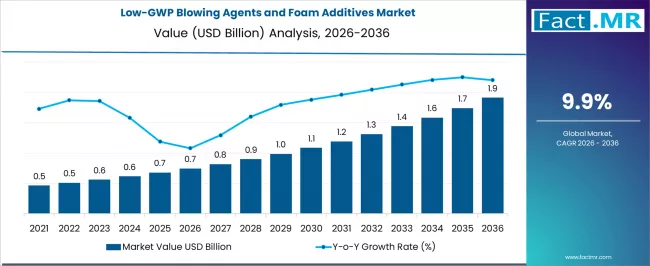
Defining trends involve the accelerated global regulatory phase-down of high-GWP hydrofluorocarbons (HFCs), driving a rapid transition to next-generation hydrofluoroolefins (HFOs), hydrocarbons, and hybrid systems. Innovation is rapidly advancing in HFO formulations with ultra-low GWP and improved solubility, alongside synergistic additive packages that optimize cell structure and thermal performance in water-blown or low-GWP systems. Integration of these new blowing agents with existing foam manufacturing equipment and polymer chemistries is critical for a cost-effective transition.
Regulatory frameworks, including the Kigali Amendment to the Montreal Protocol, EU F-Gas Regulation, and EPA SNAP rules, are the unequivocal primary market drivers. Building energy codes and corporate sustainability goals further propel demand, positioning low-GWP solutions as essential for compliance across insulation, appliance, and automotive applications.
Low-GWP Blowing Agents and Foam Additives Market
| Metric | Value |
|---|---|
| Market Value (2026) | USD 0.74 Billion |
| Market Forecast Value (2036) | USD 1.91 Billion |
| Forecast CAGR (2026-2036) | 9.9% |
Category
| Category | Segments |
|---|---|
| Blowing Agent | HFOs, HFO and HFC transitional blends, Hydrocarbon physical agents, Carbon Dioxide & Nitrogen, Water-blown & water-reactive systems, Novel low-toxicity solvents, Specialty gas & carrier blends |
| Foam Additive Function | Surfactants & wetting agents, Catalysts, Stabilizers & cell-structure modifiers, Flame-retardant additive packages (low-halogen), Processing aids & extenders (compatibilizers), Specialty performance additives (thermal, acoustic enhancers) |
| Polymer | Polyurethane (PU) rigid & flexible foams, Polystyrene (EPS & XPS), Polyolefin & PE foams, Specialty foams (phenolic, PET foams, elastomers), Other & composite foams |
| End-Use | Building insulation & construction (roof/wall), Refrigeration & cold-chain (appliance panels), Automotive (seating, thermal/battery insulation), Packaging & protective foams, Footwear, sports, specialty industrial |
| Region | North America, Latin America, Western Europe, Eastern Europe, East Asia, South Asia & Pacific, MEA |
Segmental Analysis
By Blowing Agent, Which Technology is the Direct, High-Performance Replacement for HFCs?
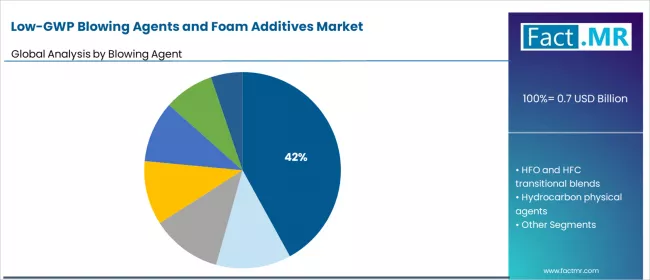
HFOs lead the segment with a commanding 42% share. This dominance is due to their status as the primary, engineered drop-in or near drop-in replacements for high-GWP HFCs like HFC-245fa and HFC-134a. HFOs offer ultra-low GWP (often <1), non-flammability in many formulations, and excellent thermal insulation properties, making them the preferred solution for meeting stringent regulations in rigid PU foam for appliances and construction, despite their higher cost.
By Foam Additive Function, Which Components are Critical for Managing the Foaming Process with New Blowing Agents?
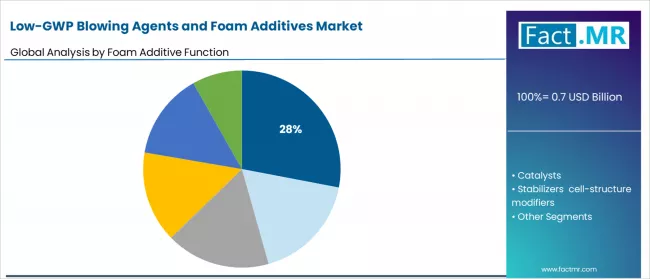
Surfactants & wetting agents command the largest additive function share at 28%. The shift to next-generation blowing agents (HFOs, hydrocarbons, CO2) drastically changes the foaming dynamics. New surfactant chemistries are essential to stabilize the cell structure, ensure uniform cell size, prevent collapse, and achieve proper flow within molds. Their role is foundational in translating the theoretical performance of a low-GWP blowing agent into a commercially viable, high-quality foam.
By Polymer, Which Foam Family is the Largest Consumer and Faces the Most Regulatory Pressure?
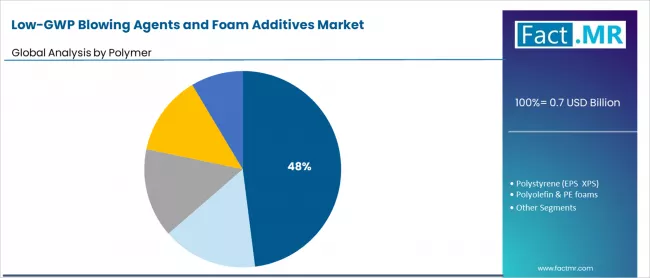
Polyurethane (PU) rigid & flexible foams are the leading polymer at 48.00%. PU foams are the largest-volume application for blowing agents, used ubiquitously in insulation, appliances, and automotive. The sector is under intense regulatory pressure due to the historically high-GWP agents used. The complexity of reformulating PU chemistry—balancing blowing agent, polyol, surfactant, and catalyst—for new low-GWP systems creates immense, sustained demand for integrated solutions, making it the core battleground for market share.
By End-Use, Which Sector Combines High Regulatory Pull with Massive Volume Demand?
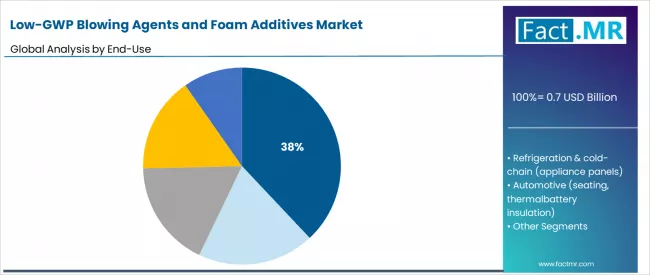
Building insulation & construction represents the dominant end-use at 38.0%. This sector is driven by a powerful combination of tightening building energy codes (demanding higher insulation R-values) and the direct regulation of blowing agent GWP. The volume of foam used in walls, roofs, and panels is enormous, and the long service life of buildings makes the choice of a future-proof, compliant blowing agent system a critical, long-term decision for manufacturers and builders alike.
What are the Drivers, Restraints, and Key Trends of the Low-GWP Blowing Agents and Foam Additives Market?
Market growth is overwhelmingly driven by the global implementation of the Kigali Amendment and regional F-gas regulations, which mandate the phasedown of high-GWP HFCs. Energy efficiency standards for buildings and appliances simultaneously increase demand for high-performance insulation, which low-GWP agents can provide. Corporate sustainability commitments from major OEMs in automotive and consumer goods also accelerate the shift.
A significant restraint is the higher cost of most next-generation blowing agents (especially HFOs) compared to the HFCs they replace. The flammability of some alternatives (hydrocarbons like cyclopentane) requires costly modifications to manufacturing plants. Technical challenges in achieving identical foam properties (e.g., density, k-factor, dimensional stability) with new agent/additive systems can slow adoption. The complexity of the regulatory landscape across different regions also creates market uncertainty.
Key trends include the development of "mildly flammable" (A2L) HFO blends that balance GWP, performance, and safety. There is a strong focus on hybrid systems combining physical blowing agents with water (CO2 co-blowing). The market is seeing increased integration of flame retardants designed for hydrocarbon-blown foams. Furthermore, the circular economy is driving research into blowing agent recovery from foam and the use of recycled or bio-based polyols compatible with low-GWP systems.
Analysis of the Low-GWP Blowing Agents and Foam Additives Market by Key Countries
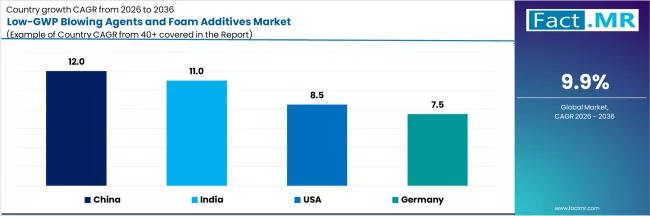
| Country | CAGR (2026-2036) |
|---|---|
| China | 12.00% |
| India | 11.00% |
| USA | 8.50% |
| Germany | 7.50% |
| South Korea | 8.00% |
How does China's Manufacturing Dominance and Phasedown Schedule Drive Market Leadership?
China leads with a 12.00% CAGR, driven by its role as the world's largest manufacturer of foam-based products (appliances, construction panels) and its commitment to the Kigali Amendment. The national HFC phasedown schedule is creating massive, centralized demand for alternatives. Domestic production of key HFOs and additives is scaling rapidly to supply both local industry and global supply chains, making China the epicenter of volume transition.
Why is India's Rapid Construction and Appliance Market Growth a Key Driver?
India's 11.00% growth is fueled by booming construction activity under stricter energy codes and one of the world's fastest-growing markets for refrigerators and air conditioners. India's phasedown schedule, while later than some regions, is driving early adoption to avoid future bottlenecks. The cost sensitivity of the market also favors hydrocarbon (cyclopentane) and water-blown technologies, particularly in construction and packaging foams.
What Role does the USA's Regulatory Certainty and Innovation Ecosystem Play?
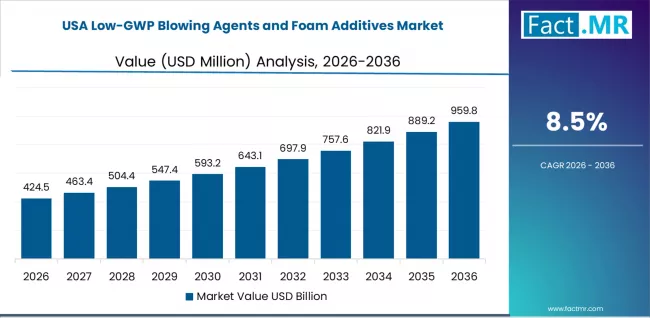
The USA's 8.50% growth is underpinned by a clear regulatory pathway (SNAP rules) and a strong innovation ecosystem. American chemical companies are leaders in HFO technology. The mature construction and appliance industries are proactively transitioning to secure long-term supply and comply with both federal and often stricter state regulations (e.g., California), driving demand for a wide range of low-GWP solutions.
How does Germany's Engineering and Green Building Leadership Influence the Market?
Germany's 7.50% growth reflects its engineering leadership in high-performance insulation systems and its role at the forefront of the ambitious EU F-Gas Regulation. German manufacturers of premium appliances and building components demand the most advanced, environmentally compliant solutions. The focus is on ultra-low GWP options that also deliver superior insulating value (low k-factor) to meet Passive House and other stringent green building standards.
What Factors Underpin South Korea's Appliance OEM and Chemical Industry Strength?
South Korea's 8.00% growth is anchored in the global strength of its appliance OEMs (e.g., refrigerators) and its advanced chemical industry. Korean companies are major consumers of blowing agents and are leaders in adopting new technologies to meet global regulatory standards for their exported products. This drives a sophisticated domestic market for high-purity, performance-optimized HFO blends and associated additive packages.
Competitive Landscape of the Low-GWP Blowing Agents and Foam Additives Market
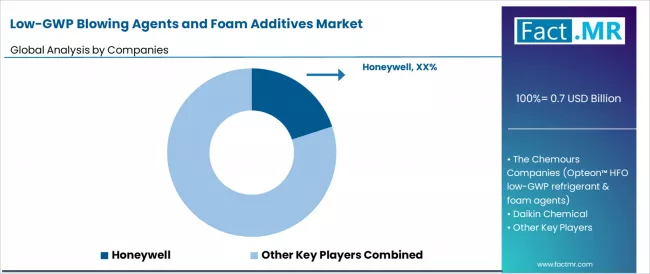
The competitive landscape is highly concentrated among a few global chemical giants with patented fluorochemical technologies, competing with broad-line chemical suppliers and gas companies. The big three fluorochemical producers, Honeywell, The Chemours Companies, and Daikin Chemical, dominate the HFO segment, competing fiercely on molecule performance, IP portfolios, and securing regulatory approvals globally.
Companies like Arkema and Solvay compete with a range of solutions including HFOs, hydrocarbons, and specialty additives. Industrial gas suppliers like Linde Air Liquide are key players in CO2 and nitrogen-based blowing systems. Competition revolves around forming strategic alliances with polyol and foam system houses, providing comprehensive technical support for reformulation, and offering a portfolio of solutions (HFOs, hydrocarbons, blends) to meet diverse regional and application-specific needs.
Key Players in the Low-GWP Blowing Agents and Foam Additives Market
- Honeywell
- The Chemours Companies (Opteon™ HFO low-GWP refrigerant & foam agents)
- Daikin Chemical
- Arkema (Forane® low-GWP solutions)
- Linde Air Liquide & industrial gas suppliers (supply & blends)
- Solvay
Scope of Report
| Items | Values |
|---|---|
| Quantitative Units | USD Billion |
| Blowing Agent | HFOs, HFO/HFC blends, Hydrocarbons, CO2 & Nitrogen, Water-blown, Novel solvents, Specialty blends |
| Foam Additive Function | Surfactants, Catalysts, Stabilizers, Flame-retardant packages, Processing aids, Specialty additives |
| Polymer | PU, PS, Polyolefin, Specialty foams, Other |
| End-Use | Building insulation & construction (roof/wall), Refrigeration & cold-chain (appliance panels), Automotive (seating, thermal/battery insulation), Packaging & protective foams, Footwear, sports, specialty industrial |
| Key Countries | China, India, USA, Germany, South Korea |
| Key Companies | Honeywell, Chemours, Daikin, Arkema, Linde, Solvay |
| Additional Analysis | Analysis of GWP reduction efficacy, insulation performance (k-factor), flammability classification (ASHRAE 34), compatibility with existing manufacturing infrastructure, total cost of reformulation, and regulatory timeline alignment across key regions. |
Low-GWP Blowing Agents and Foam Additives Market by Segments
-
Blowing Agent :
- HFOs
- HFO and HFC transitional blends
- Hydrocarbon physical agents
- Carbon Dioxide & Nitrogen
- Water-blown & water-reactive systems
- Novel low-toxicity solvents
- Specialty gas & carrier blends
-
Foam Additive Function :
- Surfactants & wetting agents
- Catalysts
- Stabilizers & cell-structure modifiers
- Flame-retardant additive packages (low-halogen)
- Processing aids & extenders (compatibilizers)
- Specialty performance additives (thermal, acoustic enhancers)
-
Polymer :
- Polyurethane (PU) rigid & flexible foams
- Polystyrene (EPS & XPS)
- Polyolefin & PE foams
- Specialty foams (phenolic, PET foams, elastomers)
- Other composite foams
-
End-Use :
- Building insulation & construction (roof/wall)
- Refrigeration & cold-chain (appliance panels)
- Automotive (seating, thermal/battery insulation)
- Packaging & protective foams
- Footwear, sports, specialty industrial
-
Region :
-
North America
- USA
- Canada
-
Latin America
- Brazil
- Mexico
- Rest of Latin America
-
Western Europe
- Germany
- Italy
- France
- Spain
- UK
- BENELUX
- Rest of Western Europe
-
Eastern Europe
- Poland
- Turkey
- Rest of Eastern Europe
-
East Asia
- China
- South Korea
- Japan
- Rest of East Asia
-
South Asia & Pacific
- India
- ASEAN
- Australia
- Rest of South Asia & Pacific
-
MEA
- GCC Countries
- South Africa
- Rest of MEA
-
Table of Content
- Executive Summary
- Global Market Outlook
- Demand to side Trends
- Supply to side Trends
- Technology Roadmap Analysis
- Analysis and Recommendations
- Market Overview
- Market Coverage / Taxonomy
- Market Definition / Scope / Limitations
- Market Background
- Market Dynamics
- Drivers
- Restraints
- Opportunity
- Trends
- Scenario Forecast
- Demand in Optimistic Scenario
- Demand in Likely Scenario
- Demand in Conservative Scenario
- Opportunity Map Analysis
- Product Life Cycle Analysis
- Supply Chain Analysis
- Investment Feasibility Matrix
- Value Chain Analysis
- PESTLE and Porter’s Analysis
- Regulatory Landscape
- Regional Parent Market Outlook
- Production and Consumption Statistics
- Import and Export Statistics
- Market Dynamics
- Global Market Analysis 2021 to 2025 and Forecast, 2026 to 2036
- Historical Market Size Value (USD Million) Analysis, 2021 to 2025
- Current and Future Market Size Value (USD Million) Projections, 2026 to 2036
- Y to o to Y Growth Trend Analysis
- Absolute $ Opportunity Analysis
- Global Market Pricing Analysis 2021 to 2025 and Forecast 2026 to 2036
- Global Market Analysis 2021 to 2025 and Forecast 2026 to 2036, By Blowing Agent
- Introduction / Key Findings
- Historical Market Size Value (USD Million) Analysis By Blowing Agent, 2021 to 2025
- Current and Future Market Size Value (USD Million) Analysis and Forecast By Blowing Agent, 2026 to 2036
- HFOs
- HFO and HFC transitional blends
- Hydrocarbon physical agents
- Carbon Dioxide & Nitrogen
- Water-blown & water-reactive systems
- Novel low-toxicity solvents
- Specialty gas & carrier blends
- HFOs
- Y to o to Y Growth Trend Analysis By Blowing Agent, 2021 to 2025
- Absolute $ Opportunity Analysis By Blowing Agent, 2026 to 2036
- Global Market Analysis 2021 to 2025 and Forecast 2026 to 2036, By Foam Additive Function
- Introduction / Key Findings
- Historical Market Size Value (USD Million) Analysis By Foam Additive Function, 2021 to 2025
- Current and Future Market Size Value (USD Million) Analysis and Forecast By Foam Additive Function, 2026 to 2036
- Surfactants & wetting agents
- Catalysts
- Stabilizers cell-structure modifiers
- Flame-retardant additive packages (low-halogen)
- Processing aids & extenders (compatibilizers)
- Specialty performance additives (thermal, acoustic enhancers)
- Surfactants & wetting agents
- Y to o to Y Growth Trend Analysis By Foam Additive Function, 2021 to 2025
- Absolute $ Opportunity Analysis By Foam Additive Function, 2026 to 2036
- Global Market Analysis 2021 to 2025 and Forecast 2026 to 2036, By Polymer
- Introduction / Key Findings
- Historical Market Size Value (USD Million) Analysis By Polymer, 2021 to 2025
- Current and Future Market Size Value (USD Million) Analysis and Forecast By Polymer, 2026 to 2036
- Polyurethane (PU) rigid & flexible foams
- Polystyrene (EPS XPS)
- Polyolefin & PE foams
- Specialty foams (phenolic, PET foams, elastomers)
- Other composite foams
- Polyurethane (PU) rigid & flexible foams
- Y to o to Y Growth Trend Analysis By Polymer, 2021 to 2025
- Absolute $ Opportunity Analysis By Polymer, 2026 to 2036
- Global Market Analysis 2021 to 2025 and Forecast 2026 to 2036, By End-Use
- Introduction / Key Findings
- Historical Market Size Value (USD Million) Analysis By End-Use, 2021 to 2025
- Current and Future Market Size Value (USD Million) Analysis and Forecast By End-Use, 2026 to 2036
- Building insulation & construction (roofwall)
- Refrigeration & cold-chain (appliance panels)
- Automotive (seating, thermalbattery insulation)
- Packaging & protective foams
- Footwear, sports, specialty industrial
- Building insulation & construction (roofwall)
- Y to o to Y Growth Trend Analysis By End-Use, 2021 to 2025
- Absolute $ Opportunity Analysis By End-Use, 2026 to 2036
- Global Market Analysis 2021 to 2025 and Forecast 2026 to 2036, By Region
- Introduction
- Historical Market Size Value (USD Million) Analysis By Region, 2021 to 2025
- Current Market Size Value (USD Million) Analysis and Forecast By Region, 2026 to 2036
- North America
- Latin America
- Western Europe
- Eastern Europe
- East Asia
- South Asia and Pacific
- Middle East & Africa
- Market Attractiveness Analysis By Region
- North America Market Analysis 2021 to 2025 and Forecast 2026 to 2036, By Country
- Historical Market Size Value (USD Million) Trend Analysis By Market Taxonomy, 2021 to 2025
- Market Size Value (USD Million) Forecast By Market Taxonomy, 2026 to 2036
- By Country
- USA
- Canada
- Mexico
- By Blowing Agent
- By Foam Additive Function
- By Polymer
- By End-Use
- By Country
- Market Attractiveness Analysis
- By Country
- By Blowing Agent
- By Foam Additive Function
- By Polymer
- By End-Use
- Key Takeaways
- Latin America Market Analysis 2021 to 2025 and Forecast 2026 to 2036, By Country
- Historical Market Size Value (USD Million) Trend Analysis By Market Taxonomy, 2021 to 2025
- Market Size Value (USD Million) Forecast By Market Taxonomy, 2026 to 2036
- By Country
- Brazil
- Chile
- Rest of Latin America
- By Blowing Agent
- By Foam Additive Function
- By Polymer
- By End-Use
- By Country
- Market Attractiveness Analysis
- By Country
- By Blowing Agent
- By Foam Additive Function
- By Polymer
- By End-Use
- Key Takeaways
- Western Europe Market Analysis 2021 to 2025 and Forecast 2026 to 2036, By Country
- Historical Market Size Value (USD Million) Trend Analysis By Market Taxonomy, 2021 to 2025
- Market Size Value (USD Million) Forecast By Market Taxonomy, 2026 to 2036
- By Country
- Germany
- UK
- Italy
- Spain
- France
- Nordic
- BENELUX
- Rest of Western Europe
- By Blowing Agent
- By Foam Additive Function
- By Polymer
- By End-Use
- By Country
- Market Attractiveness Analysis
- By Country
- By Blowing Agent
- By Foam Additive Function
- By Polymer
- By End-Use
- Key Takeaways
- Eastern Europe Market Analysis 2021 to 2025 and Forecast 2026 to 2036, By Country
- Historical Market Size Value (USD Million) Trend Analysis By Market Taxonomy, 2021 to 2025
- Market Size Value (USD Million) Forecast By Market Taxonomy, 2026 to 2036
- By Country
- Russia
- Poland
- Hungary
- Balkan & Baltic
- Rest of Eastern Europe
- By Blowing Agent
- By Foam Additive Function
- By Polymer
- By End-Use
- By Country
- Market Attractiveness Analysis
- By Country
- By Blowing Agent
- By Foam Additive Function
- By Polymer
- By End-Use
- Key Takeaways
- East Asia Market Analysis 2021 to 2025 and Forecast 2026 to 2036, By Country
- Historical Market Size Value (USD Million) Trend Analysis By Market Taxonomy, 2021 to 2025
- Market Size Value (USD Million) Forecast By Market Taxonomy, 2026 to 2036
- By Country
- China
- Japan
- South Korea
- By Blowing Agent
- By Foam Additive Function
- By Polymer
- By End-Use
- By Country
- Market Attractiveness Analysis
- By Country
- By Blowing Agent
- By Foam Additive Function
- By Polymer
- By End-Use
- Key Takeaways
- South Asia and Pacific Market Analysis 2021 to 2025 and Forecast 2026 to 2036, By Country
- Historical Market Size Value (USD Million) Trend Analysis By Market Taxonomy, 2021 to 2025
- Market Size Value (USD Million) Forecast By Market Taxonomy, 2026 to 2036
- By Country
- India
- ASEAN
- Australia & New Zealand
- Rest of South Asia and Pacific
- By Blowing Agent
- By Foam Additive Function
- By Polymer
- By End-Use
- By Country
- Market Attractiveness Analysis
- By Country
- By Blowing Agent
- By Foam Additive Function
- By Polymer
- By End-Use
- Key Takeaways
- Middle East & Africa Market Analysis 2021 to 2025 and Forecast 2026 to 2036, By Country
- Historical Market Size Value (USD Million) Trend Analysis By Market Taxonomy, 2021 to 2025
- Market Size Value (USD Million) Forecast By Market Taxonomy, 2026 to 2036
- By Country
- Kingdom of Saudi Arabia
- Other GCC Countries
- Turkiye
- South Africa
- Other African Union
- Rest of Middle East & Africa
- By Blowing Agent
- By Foam Additive Function
- By Polymer
- By End-Use
- By Country
- Market Attractiveness Analysis
- By Country
- By Blowing Agent
- By Foam Additive Function
- By Polymer
- By End-Use
- Key Takeaways
- Key Countries Market Analysis
- USA
- Pricing Analysis
- Market Share Analysis, 2025
- By Blowing Agent
- By Foam Additive Function
- By Polymer
- By End-Use
- Canada
- Pricing Analysis
- Market Share Analysis, 2025
- By Blowing Agent
- By Foam Additive Function
- By Polymer
- By End-Use
- Mexico
- Pricing Analysis
- Market Share Analysis, 2025
- By Blowing Agent
- By Foam Additive Function
- By Polymer
- By End-Use
- Brazil
- Pricing Analysis
- Market Share Analysis, 2025
- By Blowing Agent
- By Foam Additive Function
- By Polymer
- By End-Use
- Chile
- Pricing Analysis
- Market Share Analysis, 2025
- By Blowing Agent
- By Foam Additive Function
- By Polymer
- By End-Use
- Germany
- Pricing Analysis
- Market Share Analysis, 2025
- By Blowing Agent
- By Foam Additive Function
- By Polymer
- By End-Use
- UK
- Pricing Analysis
- Market Share Analysis, 2025
- By Blowing Agent
- By Foam Additive Function
- By Polymer
- By End-Use
- Italy
- Pricing Analysis
- Market Share Analysis, 2025
- By Blowing Agent
- By Foam Additive Function
- By Polymer
- By End-Use
- Spain
- Pricing Analysis
- Market Share Analysis, 2025
- By Blowing Agent
- By Foam Additive Function
- By Polymer
- By End-Use
- France
- Pricing Analysis
- Market Share Analysis, 2025
- By Blowing Agent
- By Foam Additive Function
- By Polymer
- By End-Use
- India
- Pricing Analysis
- Market Share Analysis, 2025
- By Blowing Agent
- By Foam Additive Function
- By Polymer
- By End-Use
- ASEAN
- Pricing Analysis
- Market Share Analysis, 2025
- By Blowing Agent
- By Foam Additive Function
- By Polymer
- By End-Use
- Australia & New Zealand
- Pricing Analysis
- Market Share Analysis, 2025
- By Blowing Agent
- By Foam Additive Function
- By Polymer
- By End-Use
- China
- Pricing Analysis
- Market Share Analysis, 2025
- By Blowing Agent
- By Foam Additive Function
- By Polymer
- By End-Use
- Japan
- Pricing Analysis
- Market Share Analysis, 2025
- By Blowing Agent
- By Foam Additive Function
- By Polymer
- By End-Use
- South Korea
- Pricing Analysis
- Market Share Analysis, 2025
- By Blowing Agent
- By Foam Additive Function
- By Polymer
- By End-Use
- Russia
- Pricing Analysis
- Market Share Analysis, 2025
- By Blowing Agent
- By Foam Additive Function
- By Polymer
- By End-Use
- Poland
- Pricing Analysis
- Market Share Analysis, 2025
- By Blowing Agent
- By Foam Additive Function
- By Polymer
- By End-Use
- Hungary
- Pricing Analysis
- Market Share Analysis, 2025
- By Blowing Agent
- By Foam Additive Function
- By Polymer
- By End-Use
- Kingdom of Saudi Arabia
- Pricing Analysis
- Market Share Analysis, 2025
- By Blowing Agent
- By Foam Additive Function
- By Polymer
- By End-Use
- Turkiye
- Pricing Analysis
- Market Share Analysis, 2025
- By Blowing Agent
- By Foam Additive Function
- By Polymer
- By End-Use
- South Africa
- Pricing Analysis
- Market Share Analysis, 2025
- By Blowing Agent
- By Foam Additive Function
- By Polymer
- By End-Use
- USA
- Market Structure Analysis
- Competition Dashboard
- Competition Benchmarking
- Market Share Analysis of Top Players
- By Regional
- By Blowing Agent
- By Foam Additive Function
- By Polymer
- By End-Use
- Competition Analysis
- Competition Deep Dive
- Honeywell
- Overview
- Product Portfolio
- Profitability by Market Segments (Product/Age /Sales Channel/Region)
- Sales Footprint
- Strategy Overview
- Marketing Strategy
- Product Strategy
- Channel Strategy
- The Chemours Companies (Opteon™ HFO low-GWP refrigerant & foam agents)
- Daikin Chemical
- Arkema (Forane® low-GWP solutions)
- Linde Air Liquide industrial gas suppliers (supply & blends)
- Solvay
- Honeywell
- Competition Deep Dive
- Assumptions & Acronyms Used
- Research Methodology
List Of Table
- Table 1: Global Market Value (USD Million) Forecast by Region, 2021 to 2036
- Table 2: Global Market Value (USD Million) Forecast by Blowing Agent, 2021 to 2036
- Table 3: Global Market Value (USD Million) Forecast by Foam Additive Function, 2021 to 2036
- Table 4: Global Market Value (USD Million) Forecast by Polymer, 2021 to 2036
- Table 5: Global Market Value (USD Million) Forecast by End-Use, 2021 to 2036
- Table 6: North America Market Value (USD Million) Forecast by Country, 2021 to 2036
- Table 7: North America Market Value (USD Million) Forecast by Blowing Agent, 2021 to 2036
- Table 8: North America Market Value (USD Million) Forecast by Foam Additive Function, 2021 to 2036
- Table 9: North America Market Value (USD Million) Forecast by Polymer, 2021 to 2036
- Table 10: North America Market Value (USD Million) Forecast by End-Use, 2021 to 2036
- Table 11: Latin America Market Value (USD Million) Forecast by Country, 2021 to 2036
- Table 12: Latin America Market Value (USD Million) Forecast by Blowing Agent, 2021 to 2036
- Table 13: Latin America Market Value (USD Million) Forecast by Foam Additive Function, 2021 to 2036
- Table 14: Latin America Market Value (USD Million) Forecast by Polymer, 2021 to 2036
- Table 15: Latin America Market Value (USD Million) Forecast by End-Use, 2021 to 2036
- Table 16: Western Europe Market Value (USD Million) Forecast by Country, 2021 to 2036
- Table 17: Western Europe Market Value (USD Million) Forecast by Blowing Agent, 2021 to 2036
- Table 18: Western Europe Market Value (USD Million) Forecast by Foam Additive Function, 2021 to 2036
- Table 19: Western Europe Market Value (USD Million) Forecast by Polymer, 2021 to 2036
- Table 20: Western Europe Market Value (USD Million) Forecast by End-Use, 2021 to 2036
- Table 21: Eastern Europe Market Value (USD Million) Forecast by Country, 2021 to 2036
- Table 22: Eastern Europe Market Value (USD Million) Forecast by Blowing Agent, 2021 to 2036
- Table 23: Eastern Europe Market Value (USD Million) Forecast by Foam Additive Function, 2021 to 2036
- Table 24: Eastern Europe Market Value (USD Million) Forecast by Polymer, 2021 to 2036
- Table 25: Eastern Europe Market Value (USD Million) Forecast by End-Use, 2021 to 2036
- Table 26: East Asia Market Value (USD Million) Forecast by Country, 2021 to 2036
- Table 27: East Asia Market Value (USD Million) Forecast by Blowing Agent, 2021 to 2036
- Table 28: East Asia Market Value (USD Million) Forecast by Foam Additive Function, 2021 to 2036
- Table 29: East Asia Market Value (USD Million) Forecast by Polymer, 2021 to 2036
- Table 30: East Asia Market Value (USD Million) Forecast by End-Use, 2021 to 2036
- Table 31: South Asia and Pacific Market Value (USD Million) Forecast by Country, 2021 to 2036
- Table 32: South Asia and Pacific Market Value (USD Million) Forecast by Blowing Agent, 2021 to 2036
- Table 33: South Asia and Pacific Market Value (USD Million) Forecast by Foam Additive Function, 2021 to 2036
- Table 34: South Asia and Pacific Market Value (USD Million) Forecast by Polymer, 2021 to 2036
- Table 35: South Asia and Pacific Market Value (USD Million) Forecast by End-Use, 2021 to 2036
- Table 36: Middle East & Africa Market Value (USD Million) Forecast by Country, 2021 to 2036
- Table 37: Middle East & Africa Market Value (USD Million) Forecast by Blowing Agent, 2021 to 2036
- Table 38: Middle East & Africa Market Value (USD Million) Forecast by Foam Additive Function, 2021 to 2036
- Table 39: Middle East & Africa Market Value (USD Million) Forecast by Polymer, 2021 to 2036
- Table 40: Middle East & Africa Market Value (USD Million) Forecast by End-Use, 2021 to 2036
List Of Figures
- Figure 1: Global Market Pricing Analysis
- Figure 2: Global Market Value (USD Million) Forecast 2021 to 2036
- Figure 3: Global Market Value Share and BPS Analysis by Blowing Agent, 2026 and 2036
- Figure 4: Global Market Y to o to Y Growth Comparison by Blowing Agent, 2026 to 2036
- Figure 5: Global Market Attractiveness Analysis by Blowing Agent
- Figure 6: Global Market Value Share and BPS Analysis by Foam Additive Function, 2026 and 2036
- Figure 7: Global Market Y to o to Y Growth Comparison by Foam Additive Function, 2026 to 2036
- Figure 8: Global Market Attractiveness Analysis by Foam Additive Function
- Figure 9: Global Market Value Share and BPS Analysis by Polymer, 2026 and 2036
- Figure 10: Global Market Y to o to Y Growth Comparison by Polymer, 2026 to 2036
- Figure 11: Global Market Attractiveness Analysis by Polymer
- Figure 12: Global Market Value Share and BPS Analysis by End-Use, 2026 and 2036
- Figure 13: Global Market Y to o to Y Growth Comparison by End-Use, 2026 to 2036
- Figure 14: Global Market Attractiveness Analysis by End-Use
- Figure 15: Global Market Value (USD Million) Share and BPS Analysis by Region, 2026 and 2036
- Figure 16: Global Market Y to o to Y Growth Comparison by Region, 2026 to 2036
- Figure 17: Global Market Attractiveness Analysis by Region
- Figure 18: North America Market Incremental Dollar Opportunity, 2026 to 2036
- Figure 19: Latin America Market Incremental Dollar Opportunity, 2026 to 2036
- Figure 20: Western Europe Market Incremental Dollar Opportunity, 2026 to 2036
- Figure 21: Eastern Europe Market Incremental Dollar Opportunity, 2026 to 2036
- Figure 22: East Asia Market Incremental Dollar Opportunity, 2026 to 2036
- Figure 23: South Asia and Pacific Market Incremental Dollar Opportunity, 2026 to 2036
- Figure 24: Middle East & Africa Market Incremental Dollar Opportunity, 2026 to 2036
- Figure 25: North America Market Value Share and BPS Analysis by Country, 2026 and 2036
- Figure 26: North America Market Value Share and BPS Analysis by Blowing Agent, 2026 and 2036
- Figure 27: North America Market Y to o to Y Growth Comparison by Blowing Agent, 2026 to 2036
- Figure 28: North America Market Attractiveness Analysis by Blowing Agent
- Figure 29: North America Market Value Share and BPS Analysis by Foam Additive Function, 2026 and 2036
- Figure 30: North America Market Y to o to Y Growth Comparison by Foam Additive Function, 2026 to 2036
- Figure 31: North America Market Attractiveness Analysis by Foam Additive Function
- Figure 32: North America Market Value Share and BPS Analysis by Polymer, 2026 and 2036
- Figure 33: North America Market Y to o to Y Growth Comparison by Polymer, 2026 to 2036
- Figure 34: North America Market Attractiveness Analysis by Polymer
- Figure 35: North America Market Value Share and BPS Analysis by End-Use, 2026 and 2036
- Figure 36: North America Market Y to o to Y Growth Comparison by End-Use, 2026 to 2036
- Figure 37: North America Market Attractiveness Analysis by End-Use
- Figure 38: Latin America Market Value Share and BPS Analysis by Country, 2026 and 2036
- Figure 39: Latin America Market Value Share and BPS Analysis by Blowing Agent, 2026 and 2036
- Figure 40: Latin America Market Y to o to Y Growth Comparison by Blowing Agent, 2026 to 2036
- Figure 41: Latin America Market Attractiveness Analysis by Blowing Agent
- Figure 42: Latin America Market Value Share and BPS Analysis by Foam Additive Function, 2026 and 2036
- Figure 43: Latin America Market Y to o to Y Growth Comparison by Foam Additive Function, 2026 to 2036
- Figure 44: Latin America Market Attractiveness Analysis by Foam Additive Function
- Figure 45: Latin America Market Value Share and BPS Analysis by Polymer, 2026 and 2036
- Figure 46: Latin America Market Y to o to Y Growth Comparison by Polymer, 2026 to 2036
- Figure 47: Latin America Market Attractiveness Analysis by Polymer
- Figure 48: Latin America Market Value Share and BPS Analysis by End-Use, 2026 and 2036
- Figure 49: Latin America Market Y to o to Y Growth Comparison by End-Use, 2026 to 2036
- Figure 50: Latin America Market Attractiveness Analysis by End-Use
- Figure 51: Western Europe Market Value Share and BPS Analysis by Country, 2026 and 2036
- Figure 52: Western Europe Market Value Share and BPS Analysis by Blowing Agent, 2026 and 2036
- Figure 53: Western Europe Market Y to o to Y Growth Comparison by Blowing Agent, 2026 to 2036
- Figure 54: Western Europe Market Attractiveness Analysis by Blowing Agent
- Figure 55: Western Europe Market Value Share and BPS Analysis by Foam Additive Function, 2026 and 2036
- Figure 56: Western Europe Market Y to o to Y Growth Comparison by Foam Additive Function, 2026 to 2036
- Figure 57: Western Europe Market Attractiveness Analysis by Foam Additive Function
- Figure 58: Western Europe Market Value Share and BPS Analysis by Polymer, 2026 and 2036
- Figure 59: Western Europe Market Y to o to Y Growth Comparison by Polymer, 2026 to 2036
- Figure 60: Western Europe Market Attractiveness Analysis by Polymer
- Figure 61: Western Europe Market Value Share and BPS Analysis by End-Use, 2026 and 2036
- Figure 62: Western Europe Market Y to o to Y Growth Comparison by End-Use, 2026 to 2036
- Figure 63: Western Europe Market Attractiveness Analysis by End-Use
- Figure 64: Eastern Europe Market Value Share and BPS Analysis by Country, 2026 and 2036
- Figure 65: Eastern Europe Market Value Share and BPS Analysis by Blowing Agent, 2026 and 2036
- Figure 66: Eastern Europe Market Y to o to Y Growth Comparison by Blowing Agent, 2026 to 2036
- Figure 67: Eastern Europe Market Attractiveness Analysis by Blowing Agent
- Figure 68: Eastern Europe Market Value Share and BPS Analysis by Foam Additive Function, 2026 and 2036
- Figure 69: Eastern Europe Market Y to o to Y Growth Comparison by Foam Additive Function, 2026 to 2036
- Figure 70: Eastern Europe Market Attractiveness Analysis by Foam Additive Function
- Figure 71: Eastern Europe Market Value Share and BPS Analysis by Polymer, 2026 and 2036
- Figure 72: Eastern Europe Market Y to o to Y Growth Comparison by Polymer, 2026 to 2036
- Figure 73: Eastern Europe Market Attractiveness Analysis by Polymer
- Figure 74: Eastern Europe Market Value Share and BPS Analysis by End-Use, 2026 and 2036
- Figure 75: Eastern Europe Market Y to o to Y Growth Comparison by End-Use, 2026 to 2036
- Figure 76: Eastern Europe Market Attractiveness Analysis by End-Use
- Figure 77: East Asia Market Value Share and BPS Analysis by Country, 2026 and 2036
- Figure 78: East Asia Market Value Share and BPS Analysis by Blowing Agent, 2026 and 2036
- Figure 79: East Asia Market Y to o to Y Growth Comparison by Blowing Agent, 2026 to 2036
- Figure 80: East Asia Market Attractiveness Analysis by Blowing Agent
- Figure 81: East Asia Market Value Share and BPS Analysis by Foam Additive Function, 2026 and 2036
- Figure 82: East Asia Market Y to o to Y Growth Comparison by Foam Additive Function, 2026 to 2036
- Figure 83: East Asia Market Attractiveness Analysis by Foam Additive Function
- Figure 84: East Asia Market Value Share and BPS Analysis by Polymer, 2026 and 2036
- Figure 85: East Asia Market Y to o to Y Growth Comparison by Polymer, 2026 to 2036
- Figure 86: East Asia Market Attractiveness Analysis by Polymer
- Figure 87: East Asia Market Value Share and BPS Analysis by End-Use, 2026 and 2036
- Figure 88: East Asia Market Y to o to Y Growth Comparison by End-Use, 2026 to 2036
- Figure 89: East Asia Market Attractiveness Analysis by End-Use
- Figure 90: South Asia and Pacific Market Value Share and BPS Analysis by Country, 2026 and 2036
- Figure 91: South Asia and Pacific Market Value Share and BPS Analysis by Blowing Agent, 2026 and 2036
- Figure 92: South Asia and Pacific Market Y to o to Y Growth Comparison by Blowing Agent, 2026 to 2036
- Figure 93: South Asia and Pacific Market Attractiveness Analysis by Blowing Agent
- Figure 94: South Asia and Pacific Market Value Share and BPS Analysis by Foam Additive Function, 2026 and 2036
- Figure 95: South Asia and Pacific Market Y to o to Y Growth Comparison by Foam Additive Function, 2026 to 2036
- Figure 96: South Asia and Pacific Market Attractiveness Analysis by Foam Additive Function
- Figure 97: South Asia and Pacific Market Value Share and BPS Analysis by Polymer, 2026 and 2036
- Figure 98: South Asia and Pacific Market Y to o to Y Growth Comparison by Polymer, 2026 to 2036
- Figure 99: South Asia and Pacific Market Attractiveness Analysis by Polymer
- Figure 100: South Asia and Pacific Market Value Share and BPS Analysis by End-Use, 2026 and 2036
- Figure 101: South Asia and Pacific Market Y to o to Y Growth Comparison by End-Use, 2026 to 2036
- Figure 102: South Asia and Pacific Market Attractiveness Analysis by End-Use
- Figure 103: Middle East & Africa Market Value Share and BPS Analysis by Country, 2026 and 2036
- Figure 104: Middle East & Africa Market Value Share and BPS Analysis by Blowing Agent, 2026 and 2036
- Figure 105: Middle East & Africa Market Y to o to Y Growth Comparison by Blowing Agent, 2026 to 2036
- Figure 106: Middle East & Africa Market Attractiveness Analysis by Blowing Agent
- Figure 107: Middle East & Africa Market Value Share and BPS Analysis by Foam Additive Function, 2026 and 2036
- Figure 108: Middle East & Africa Market Y to o to Y Growth Comparison by Foam Additive Function, 2026 to 2036
- Figure 109: Middle East & Africa Market Attractiveness Analysis by Foam Additive Function
- Figure 110: Middle East & Africa Market Value Share and BPS Analysis by Polymer, 2026 and 2036
- Figure 111: Middle East & Africa Market Y to o to Y Growth Comparison by Polymer, 2026 to 2036
- Figure 112: Middle East & Africa Market Attractiveness Analysis by Polymer
- Figure 113: Middle East & Africa Market Value Share and BPS Analysis by End-Use, 2026 and 2036
- Figure 114: Middle East & Africa Market Y to o to Y Growth Comparison by End-Use, 2026 to 2036
- Figure 115: Middle East & Africa Market Attractiveness Analysis by End-Use
- Figure 116: Global Market - Tier Structure Analysis
- Figure 117: Global Market - Company Share Analysis
- FAQs -
How big is the low-GWP blowing agents and foam additives market in 2026?
The global low-GWP blowing agents and foam additives market is estimated to be valued at USD 0.7 billion in 2026.
What will be the size of low-GWP blowing agents and foam additives market in 2036?
The market size for the low-GWP blowing agents and foam additives market is projected to reach USD 1.9 billion by 2036.
How much will be the low-GWP blowing agents and foam additives market growth between 2026 and 2036?
The low-GWP blowing agents and foam additives market is expected to grow at a 9.9% CAGR between 2026 and 2036.
What are the key product types in the low-GWP blowing agents and foam additives market?
The key product types in low-GWP blowing agents and foam additives market are hfos , hfo and hfc transitional blends , hydrocarbon physical agents, carbon dioxide & nitrogen, water-blown & water-reactive systems, novel low-toxicity solvents and specialty gas & carrier blends.
Which foam additive function segment to contribute significant share in the low-GWP blowing agents and foam additives market in 2026?
In terms of foam additive function, surfactants & wetting agents segment to command 28.0% share in the low-GWP blowing agents and foam additives market in 2026.