Machine Condition Monitoring Market (2026 - 2036)

Machine Condition Monitoring Market is segmented by Monitoring Technique (Vibration Monitoring, Thermography, Oil Analysis, Corrosion Monitoring, Motor Current Analysis, and Ultrasound Emission Monitoring), by Component (Hardware and Software), by Monitoring Process (Online and Portable) and Region. Forecast for 2026 to 2036.

Core Findings

    Machine Condition Monitoring Market Forecast and Outlook 2026 to 2036

    In 2025, the machine condition monitoring market was valued at USD 3.7 billion. Based on Fact.MR analysis, demand for machine condition monitoring systems is estimated to grow to USD 3.9 billion in 2026 and USD 8.2 billion by 2036. Fact.MR projects a CAGR of 7.7% during the forecast period.

    The absolute dollar growth from 2026 to 2036 represents an incremental gain of USD 4.3 billion, a transformational expansion that reflects the industrial sector's structural shift from periodic manual inspection toward continuous AI-assisted predictive maintenance across manufacturing, energy, oil and gas, and process industry asset bases. Growth is sustained by the measurable return on investment of condition monitoring systems, where documented reductions in unplanned downtime of 30 to 50 percent and maintenance cost savings of 10 to 25 percent create compelling internal business cases that accelerate technology adoption across both greenfield facility builds and brownfield retrofit programs.

    As Castro said, “B&K Vibro has a proud legacy as pioneers in condition monitoring and machine protection, delivering innovative solutions that optimize asset uptime and performance while safeguarding people, infrastructure, and machinery. With a robust foundation built on integrity, teamwork, and ambition, we are committed to giving every machine a voice, providing actionable insights that boost productivity and support a sustainable society”.

    Growth rates differ between fast-industrializing economies and mature manufacturing markets. China leads at 8.8% CAGR, driven by Made in China 2025 and strong Industry 4.0 investment across automotive, chemical, and electronics sectors, where online condition monitoring is standard in new builds. India follows at 8.3%, supported by the Production Linked Incentive scheme accelerating greenfield manufacturing in electronics, pharmaceuticals, and automotive industries requiring OEM-grade monitoring systems. The United States records 7.5%, fueled by reshoring and wider adoption of reliability-centered maintenance across energy, chemical, and aerospace sectors. Germany posts 7.3%, reflecting precision manufacturing concentration and ISO-based maintenance standards. Brazil records 6.4%, supported by oil and gas expansion and adoption in mining, pulp and paper, and food processing. Mature European markets primarily generate upgrade demand due to high penetration and long replacement cycles.
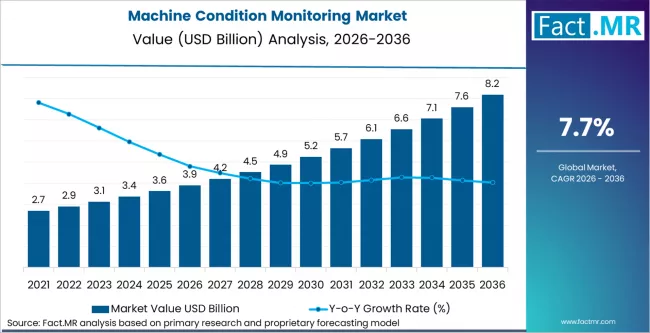
    Machine Condition Monitoring Market Market Value Analysis

    Market Definition

    The machine condition monitoring market includes sensors, data acquisition systems, analytics software, and related services used to detect early equipment deterioration. Techniques include vibration analysis, thermography, oil analysis, corrosion monitoring, motor current analysis, and ultrasound detection. Key end uses span manufacturing, power generation, oil and gas, aerospace, and process industries, focused on preventing unplanned downtime through predictive maintenance.

    Market Inclusions

    The report provides global and regional forecasts from 2026 to 2036 by monitoring technique, component, and process type. It assesses AI and machine learning integration, industrial IoT connectivity, hardware versus software pricing models, vendor competition, and adoption across major industrial sectors.

    Market Exclusions

    The scope excludes general IoT platforms not dedicated to machine health, quality control systems unrelated to equipment condition, standalone SCADA/DCS systems without analytics, safety monitoring solutions, and manual tools used only for commissioning rather than ongoing predictive maintenance.

    Research Methodology

    • Primary Research: Primary research included structured interviews with plant reliability engineers, maintenance directors, procurement managers at industrial service providers, and product and sales leaders at major condition monitoring vendors across China, India, the United States, Germany, and Brazil.
    • Desk Research: Desk research incorporated ISO 13373 and ISO 17359 standards, national smart manufacturing program publications, and corporate disclosures from leading condition monitoring companies.
    • Market-Sizing and Forecasting: Market sizing used a hybrid top-down and bottom-up approach, combining industrial asset base estimates by sector and geography with average system value per monitoring point, validated against disclosed vendor revenues and industrial maintenance spending benchmarks.
    • Data Validation and Update Cycle: Outputs were cross-validated against predictive maintenance and condition monitoring segment revenues from leading vendors and reconciled with industrial digitalization investment data, updated annually to reflect product launches and major contract awards.

    Machine Condition Monitoring Market Summary

    • Market Definition
      • The machine condition monitoring market encompasses vibration, thermography, oil analysis, corrosion monitoring, motor current analysis, and ultrasound detection systems deployed through online and portable processes to support predictive and reliability-centered maintenance across global industrial sectors.
    • Demand Drivers
      • China’s Made in China 2025 strategy and related smart factory programs are accelerating adoption of online multi-parameter condition monitoring in automotive, chemical, and electronics facilities.
      • U.S. industrial unplanned downtime, estimated at USD 50 billion annually, is accelerating investment in AI-enabled predictive maintenance platforms across heavy manufacturing and process industries.
      • ISO 13373 and ISO 17359 standards are increasingly embedded in procurement and maintenance specifications across European and North American manufacturing sectors.
    • Key Segments Analyzed
      • By monitoring technique, vibration monitoring leads with 36.3% share due to its broad applicability across rotating machinery.
      • By component, hardware accounts for 49% share, reflecting the essential sensor and data acquisition infrastructure required in all deployments.
      • By monitoring process, online continuous monitoring holds 59.8% share, driven by demand for real-time monitoring of critical production assets.
    • Analyst Opinion at FACT.MR
      • Shambhu Nath Jha, Principal Consultant at Fact.MR, opines, 'CXOs will find this report essential for understanding how the convergence of AI-enabled analytics, industrial IoT connectivity, and reliability-centered maintenance standards is transforming machine condition monitoring from a specialty instrumentation purchase into a strategic operational technology investment that defines production uptime competitiveness, and which monitoring technique, component, process, and geographic segments.
    • Strategic Implications / Executive Takeaways
      • Condition monitoring hardware vendors should accelerate development of edge-enabled sensors with built-in signal processing and basic anomaly detection. Industrial demand is shifting toward intelligent sensors that reduce bandwidth use and deliver faster fault alerts on critical rotating assets.
      • Industrial maintenance service providers should structure offerings as reliability-as-a-service contracts with performance-based pricing linked to uptime gains and cost reduction. Operators prefer outcome-based models managed as operating expense rather than capital investment.
      • Condition monitoring software vendors should prioritize seamless integration with major SCADA, ERP, and computerized maintenance management systems. Integration capability is a primary buying criterion and a key barrier to enterprise-scale adoption.
    • Methodology
      • Market sizing combined industrial asset monitoring point volumes by sector and geography with average system values, validated against disclosed condition monitoring revenues from leading vendors.
      • Segment analysis incorporated ISO 13373 and ISO 17359 adoption rates, industrial maintenance spending benchmarks, and plant reliability survey data.
      • Country forecasts were validated using smart manufacturing investment data, facility expansion announcements, and system contract awards across China, India, the United States, Germany, and Brazil.

    Segmental Analysis

    Machine Condition Monitoring Market Analysis by Monitoring Technique
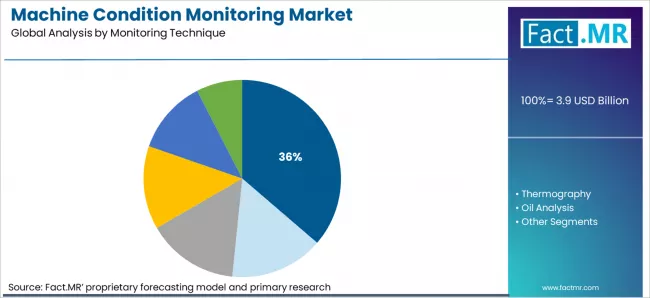
    Machine Condition Monitoring Market Analysis By Monitoring Technique

    Based on FACT.MR estimates, vibration monitoring is projected to hold 36.3% share in 2026. It remains dominant because it applies across the widest range of rotating equipment including pumps, compressors, motors, gearboxes, fans, and turbines. Vibration analysis detects bearing wear, misalignment, imbalance, looseness, and gear damage at early stages, delivering measurable cost savings and downtime reduction.

    • SKF Rotating Equipment Investment: SKF disclosed expansion of its rotating equipment health monitoring services, citing rising deployment of wireless vibration sensor networks across manufacturing facilities. [5]
    • Emerson Wireless Sensing Technology: Emerson expanded its industrial IoT condition monitoring platform, including wireless vibration sensing solutions for brownfield oil and gas and chemical installations where wired retrofits are expensive. [6]
    • Thermography and Oil Analysis Adoption: Thermography and oil analysis are among the fastest-growing techniques. Adoption is driven by improved infrared camera economics and automated oil debris sensors integrated into centralized lubrication systems at large manufacturing and wind energy sites. [7]

    Machine Condition Monitoring Market Analysis by Component
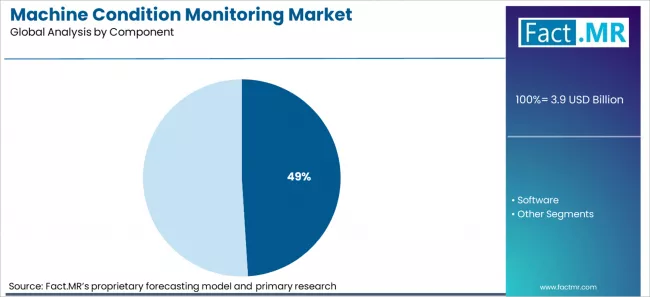
    Machine Condition Monitoring Market Analysis By Component

    Hardware is projected to hold 49% share in 2026. Every deployment requires physical sensors, data acquisition, and signal conditioning infrastructure. Wireless IoT sensor networks, multi-parameter sensors, and rugged edge devices continue to sustain hardware revenue, even as software grows faster proportionally.

    • Honeywell Industrial IoT Platform: Honeywell expanded its industrial IoT and analytics platform, integrating hardware data acquisition with cloud-based predictive analytics across oil and gas, aerospace, and industrial facilities. [8]
    • Schaeffler Condition Monitoring Integration: Schaeffler expanded its wireless condition monitoring systems targeting small and mid-sized manufacturers seeking low-complexity deployment. [9]
    • Software Subscription Revenue Growth: Software revenue is growing faster than hardware due to cloud-based analytics subscriptions. Operators increasingly pay recurring fees for AI-enabled fault prognosis and reporting rather than one-time licenses, shifting vendors toward recurring revenue models. [4]

    Drivers, Restraints, and Opportunities

    Fact.MR analysis indicates the machine condition monitoring market has reached USD 3.7 billion through proven maintenance cost savings and uptime improvements in oil and gas, power generation, and aerospace. These early adopters generated documented ROI evidence that supported broader adoption in sectors with slower technology cycles.

    Competitive differentiation is shifting from hardware precision to software analytics and service integration. Historically, competition focused on sensor accuracy and durability, where established instrumentation vendors held advantage. The integration of machine learning, cloud analytics, and industrial IoT connectivity is moving value creation toward software and data services.

    • ISO Standards Adoption Cascade: Adoption of ISO 13373 vibration standards and ISO 17359 guidelines in supply contracts, maintenance agreements, and insurance terms is creating compliance-driven demand for certified monitoring systems. [1]
    • India Smart Manufacturing Investment Surge: India’s Production Linked Incentive scheme has committed over USD 26 billion across electronics, pharmaceuticals, automotive, and specialty chemicals. New greenfield facilities are being built with Industry 4.0 infrastructure, where online condition monitoring is specified as standard to meet export quality and operational performance benchmarks. [3]

    Regional Analysis

    The machine condition monitoring market is analyzed across North America, Europe, Asia Pacific, Latin America, and Middle East and Africa. Regional demand patterns reflect the maturity of industrial digitalization investment, the concentration of heavy manufacturing, energy, and process industry asset bases requiring predictive maintenance, the pace of smart manufacturing program implementation in national industrial strategies, and the depth of reliability engineering skills and standards adoption across industrial maintenance organizations. The full report offers detailed market attractiveness analysis comparing industrial asset density, technology adoption stage, and competitive intensity by region.
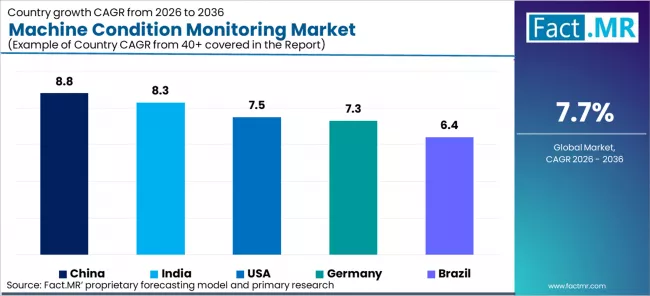
    Machine Condition Monitoring Market Cagr Analysis By Country

    Country CAGR%
    China 8.8%
    India 8.3%
    United States 7.5%
    Germany 7.3%
    Brazil 6.4%

    Source: Fact.MR (FACT.MR) analysis, based on proprietary forecasting model and primary research

    Asia Pacific Machine Condition Monitoring Market Analysis

    Asia Pacific is the primary volume growth region for machine condition monitoring. Growth is led by China’s large-scale smart manufacturing programs and India’s expanding greenfield industrial base under the Production Linked Incentive scheme. Global vendors compete through established automation and rotating equipment relationships, while regional players gain share with cost-effective wireless IoT solutions tailored to local manufacturing needs.

    • China: Demand in China is projected to grow at 8.8% CAGR through 2036. Growth is driven by national and provincial smart manufacturing programs that embed Industry 4.0 standards into factory certification frameworks. Equipment health monitoring is increasingly defined as a qualification requirement for smart factory status. Large automotive and electronics manufacturers are specifying online vibration and multi-parameter monitoring as standard infrastructure in new facilities.
    • India: Demand in India is projected to grow at 8.3% CAGR through 2036. Growth is supported by over USD 26 billion in Production Linked Incentive investments across electronics, pharmaceuticals, automotive, and specialty chemicals. New export-oriented facilities are integrating condition monitoring to meet global quality and preventive maintenance standards. National productivity guidelines also promote reliability-centered maintenance, reinforcing adoption.
    • Brazil: Demand in Brazil is projected to grow at 6.4% CAGR through 2036. Growth is concentrated in oil and gas, mining, pulp and paper, and food processing. High maintenance costs and remote asset locations increase the value of predictive monitoring. Ongoing digital transformation programs in the energy sector are supporting demand for online condition monitoring systems.

    FACT.MR’s Asia Pacific analysis covers China, India, Japan, South Korea, and ASEAN markets. It assesses smart manufacturing investment trends, industrial IoT adoption, and competitive positioning of domestic and international vendors.

    Europe Machine Condition Monitoring Market Analysis

    Europe is a technology and standards leadership region for machine condition monitoring. ISO 13373 and ISO 17359 frameworks originated here and continue to shape global best practice. The region’s precision engineering, automotive, and process industries deploy advanced multi-parameter continuous monitoring systems. Long-term reliability service contracts provide revenue stability for established vendors.

    • Germany: Demand in Germany is projected to grow at 7.3% CAGR through 2036. Growth reflects continued digital upgrades under the Industrie 4.0 program. Condition monitoring is embedded in manufacturing competitiveness assessments and digital factory integration standards. Adoption is expanding among small and mid-sized precision manufacturers through wireless and simplified deployment systems.

    FACT.MR’s Europe analysis includes Germany, the United Kingdom, France, the Netherlands, and Nordic markets. It evaluates Industrie 4.0 impacts, ISO compliance trends, sector-level demand, and vendor competition by country.

    North America Machine Condition Monitoring Market Analysis
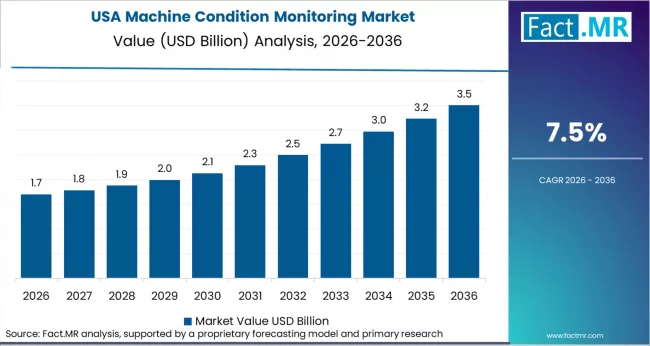
    Machine Condition Monitoring Market Country Value Analysis

    North America is a mature yet innovation-driven market for machine condition monitoring. Adoption is supported by strong industrial automation penetration, advanced maintenance practices, and regulatory focus on operational safety and asset reliability. The region’s energy, aerospace, chemical, and advanced manufacturing sectors deploy enterprise-scale predictive maintenance platforms integrated with digital operations systems.

    • United States: Demand in the United States is projected to grow at 7.5% CAGR through 2036. Growth is driven by reshoring investment and strong executive focus on reducing industrial downtime. Predictive maintenance is recognized as both a cost reduction and energy efficiency strategy. Enterprise-wide monitoring deployments across energy, chemical, and aerospace sectors are supporting sustained demand.

    FACT.MR’s North America analysis includes the United States and Canada. It evaluates reshoring impacts, energy sector digitalization trends, predictive maintenance adoption rates, and competitive positioning of major condition monitoring system providers across the region.

    Competitive Aligners for Market Players
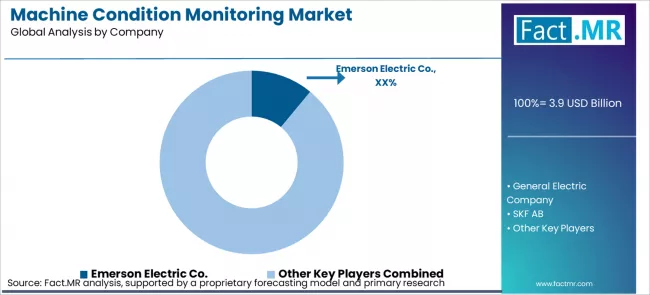
    Machine Condition Monitoring Market Analysis By Company

    The global machine condition monitoring market is moderately concentrated at the top tier, with Emerson Electric, Honeywell, SKF, General Electric, and Schaeffler together accounting for roughly 45–55% of total revenue. Below this level, many specialist hardware vendors, independent analytics providers, and regional system integrators compete on specific technique expertise, industry focus, or geographic depth. The key competitive shift is from sensor precision to the strength of AI-enabled analytics integration, cloud connectivity, and service contract capabilities that drive overall system value and long-term customer retention.

    Vendors with deep sector expertise and integrated hardware-software-service portfolios hold structural advantages. Emerson Electric benefits from its automation platform presence, integrating condition monitoring data directly into control and asset management systems, reducing integration friction for customers. Baker Hughes’s Bently Nevada business holds a strong position in critical rotating equipment monitoring in power generation and oil and gas, with an installed base of protection systems that are costly to replace. Large industrial operators often select multiple platform vendors aligned with specific asset classes while using competitive pricing pressure at renewal. Multi-year reliability service contracts tied to uptime improvement are becoming standard, favoring vendors with operational data history and performance guarantees.

    Recent Development

    • In 2025, Waites Sensor Technologies, Inc. introduced PiezoNode™, a quad-channel ultra-rugged condition monitoring device designed for predictive maintenance in harsh industrial environments. The product aims to improve fault detection and reliability in heavy-duty asset monitoring applications.
    • In 2025, Toshiba Energy Systems & Solutions Corporation announced it would install its EtaPRO™ AI-driven condition monitoring and predictive analytics system at 165 power plants in India. The deployment is intended to enhance operational efficiency and stability across thermal power assets.

    Key Players

    • Emerson Electric Co.
    • General Electric Company
    • SKF AB
    • Honeywell International Inc.
    • Schaeffler AG
    • Rockwell Automation Inc.
    • National Instruments Corporation
    • Parker Hannifin Corporation
    • Dewesoft d.o.o.
    • Advanced Technology Services Inc.
    • Crystal Instruments Corporation
    • Baker Hughes Company

    Scope of Report

    Items Values
    Quantitative Units USD 3.9 billion (2026) to USD 8.2 billion (2036), at a CAGR of 7.7%
    Market Definition The machine condition monitoring market covers vibration monitoring, thermography, oil analysis, corrosion monitoring, motor current analysis, and ultrasound emission monitoring systems deployed as hardware and software solutions via online continuous and portable measurement processes across industrial manufacturing, energy, oil and gas, aerospace, and process industry end-users.
    By Monitoring Technique Vibration Monitoring, Thermography, Oil Analysis, Corrosion Monitoring, Motor Current Analysis, Ultrasound Emission Monitoring
    By Component Hardware, Software
    By Monitoring Process Online, Portable
    Regions Covered Asia Pacific, Europe, North America, Latin America, Middle East & Africa
    Countries Covered China, Japan, South Korea, Australia & New Zealand, India, ASEAN, Rest of Asia Pacific, Norway, Germany, United Kingdom, France, Spain, Netherlands, Nordics, Rest of Europe, United States, Canada, Mexico, Brazil, Chile, Ecuador, Rest of Latin America, Kingdom of Saudi Arabia, United Arab Emirates, South Africa, Turkey, Rest of Middle East & Africa
    Key Companies Profiled Emerson Electric Co., General Electric Company, SKF AB, Honeywell International Inc., Schaeffler AG, Rockwell Automation Inc., National Instruments Corporation, Parker Hannifin Corporation, Dewesoft d.o.o., Advanced Technology Services Inc., Crystal Instruments Corporation, Baker Hughes Company
    Forecast Period 2026 to 2036
    Approach Hybrid top-down and bottom-up market modeling validated through primary interviews with reliability engineers, maintenance directors, plant managers, and condition monitoring system integrators across manufacturing, oil and gas, power generation, and process industries, supported by ISO maintenance standard publications, national industrial productivity program data, and corporate product and investment disclosures from leading condition monitoring suppliers.

    Machine Condition Monitoring Market by Segment

    • By Monitoring Technique :

      • Vibration Monitoring
      • Thermography
      • Oil Analysis
      • Corrosion Monitoring
      • Motor Current Analysis
      • Ultrasound Emission Monitoring
    • By Component :

      • Hardware
      • Software
    • By Monitoring Process :

      • Online
      • Portable
    • Region :

      • Asia Pacific
        • China
        • Japan
        • South Korea
        • Australia & New Zealand
        • India
        • ASEAN
        • Rest of Asia Pacific
      • Europe
        • Norway
        • Germany
        • United Kingdom
        • France
        • Spain
        • Netherlands
        • Nordics
        • Rest of Europe
      • North America
        • United States
        • Canada
        • Mexico
      • Latin America
        • Brazil
        • Chile
        • Ecuador
        • Rest of Latin America
      • Middle East & Africa
        • Kingdom of Saudi Arabia
        • United Arab Emirates
        • South Africa
        • Turkey
        • Rest of Middle East & Africa

    Bibliography

    • [1] International Organization for Standardization, ISO 13373-1 Condition Monitoring and Diagnostics of Machines, Vibration Condition Monitoring, Part 1: General Procedures, updated 2022.
    • [2] International Organization for Standardization, ISO 17359 Condition Monitoring and Diagnostics of Machines: General Guidelines, fourth edition, 2018.
    • [3] Ministry of Heavy Industries of India, Production Linked Incentive Scheme Overview and Sector Allocation, updated 2023.
    • [4] Baker Hughes Company, Annual Report 2023, February 2024.
    • [5] SKF AB, Annual Report 2023, March 2024.
    • [6] Emerson Electric Co., Annual Report Fiscal Year 2023, November 2023.
    • [7] U.S. Department of Energy, Advanced Manufacturing Office: Reducing Energy Intensity Through Predictive Maintenance, 2022.
    • [8] Honeywell International Inc., Annual Report 2023, February 2024.
    • [9] Schaeffler AG, Annual Report 2023, March 2024.

    This Report Addresses

    • Market intelligence for strategic planning with analysis of machine condition monitoring market evolution from periodic manual inspection programs toward AI-enabled online continuous monitoring platforms integrated with industrial IoT, digital twin, and reliability-centered maintenance management systems across manufacturing, energy, oil and gas, and process industry sectors globally.
    • Market size and forecast showing global valuation of USD 3.9 billion in 2026 and projected USD 8.2 billion by 2036 at a CAGR of 7.7%.
    • Growth opportunity mapping across AI-enabled vibration fault prognosis platforms for rotating equipment, wireless IoT sensor network deployment for brownfield industrial facility retrofits, and software analytics subscription models targeting reliability-as-a-service contract revenue in manufacturing and energy sector enterprise accounts.
    • Segment and regional forecasts covering all major countries with monitoring technique, component, and monitoring process breakdowns including manufacturing, oil and gas, power generation, aerospace, and process industry sector condition monitoring demand analysis.
    • Competition strategy assessment of leading condition monitoring system vendors including hardware platform breadth, AI analytics capability, industrial IoT connectivity, enterprise service contract penetration, and recurring software revenue share for Emerson Electric, SKF, Honeywell, Schaeffler, and Baker Hughes.
    • Regulatory and standards compliance tracking of ISO 13373 vibration condition monitoring standard series adoption, ISO 17359 general guidelines implementation in industrial procurement and insurance requirements, smart manufacturing certification program condition monitoring specifications in China, India, and Germany, and U.S. DOE advanced manufacturing productivity program guidance.
    • Technology adoption analysis covering machine learning fault signature library development, edge-computing-enabled intelligent sensor platform advances, cloud-based multi-site condition monitoring analytics architecture, digital twin asset model integration for predictive maintenance prognosis, and industrial IoT protocol standardization impacts on condition monitoring system interoperability.
    • Report delivery in Excel, PowerPoint, and PDF formats with fully validated data, primary research evidence, and verified regulatory and company source documentation.

    Table of Content

    1. Executive Summary
      • Global Market Outlook
      • Demand to side Trends
      • Supply to side Trends
      • Technology Roadmap Analysis
      • Analysis and Recommendations
    2. Market Overview
      • Market Coverage / Taxonomy
      • Market Definition / Scope / Limitations
    3. Research Methodology
      • Chapter Orientation
      • Analytical Lens and Working Hypotheses
        • Market Structure, Signals, and Trend Drivers
        • Benchmarking and Cross-market Comparability
        • Market Sizing, Forecasting, and Opportunity Mapping
      • Research Design and Evidence Framework
        • Desk Research Programme (Secondary Evidence)
          • Company Annual and Sustainability Reports
          • Peer-reviewed Journals and Academic Literature
          • Corporate Websites, Product Literature, and Technical Notes
          • Earnings Decks and Investor Briefings
          • Statutory Filings and Regulatory Disclosures
          • Technical White Papers and Standards Notes
          • Trade Journals, Industry Magazines, and Analyst Briefs
          • Conference Proceedings, Webinars, and Seminar Materials
          • Government Statistics Portals and Public Data Releases
          • Press Releases and Reputable Media Coverage
          • Specialist Newsletters and Curated Briefings
          • Sector Databases and Reference Repositories
          • FMR Internal Proprietary Databases and Historical Market Datasets
          • Subscription Datasets and Paid Sources
          • Social Channels, Communities, and Digital Listening Inputs
          • Additional Desk Sources
        • Expert Input and Fieldwork (Primary Evidence)
          • Primary Modes
            • Qualitative Interviews and Expert Elicitation
            • Quantitative Surveys and Structured Data Capture
            • Blended Approach
          • Why Primary Evidence is Used
          • Field Techniques
            • Interviews
            • Surveys
            • Focus Groups
            • Observational and In-context Research
            • Social and Community Interactions
          • Stakeholder Universe Engaged
            • C-suite Leaders
            • Board Members
            • Presidents and Vice Presidents
            • R&D and Innovation Heads
            • Technical Specialists
            • Domain Subject-matter Experts
            • Scientists
            • Physicians and Other Healthcare Professionals
          • Governance, Ethics, and Data Stewardship
            • Research Ethics
            • Data Integrity and Handling
        • Tooling, Models, and Reference Databases
      • Data Engineering and Model Build
        • Data Acquisition and Ingestion
        • Cleaning, Normalisation, and Verification
        • Synthesis, Triangulation, and Analysis
      • Quality Assurance and Audit Trail
    4. Market Background
      • Market Dynamics
        • Drivers
        • Restraints
        • Opportunity
        • Trends
      • Scenario Forecast
        • Demand in Optimistic Scenario
        • Demand in Likely Scenario
        • Demand in Conservative Scenario
      • Opportunity Map Analysis
      • Product Life Cycle Analysis
      • Supply Chain Analysis
      • Investment Feasibility Matrix
      • Value Chain Analysis
      • PESTLE and Porter’s Analysis
      • Regulatory Landscape
      • Regional Parent Market Outlook
      • Production and Consumption Statistics
      • Import and Export Statistics
    5. Global Market Analysis 2021 to 2025 and Forecast, 2026 to 2036
      • Historical Market Size Value (USD Million) Analysis, 2021 to 2025
      • Current and Future Market Size Value (USD Million) Projections, 2026 to 2036
        • Y to o to Y Growth Trend Analysis
        • Absolute $ Opportunity Analysis
    6. Global Market Pricing Analysis 2021 to 2025 and Forecast 2026 to 2036
    7. Global Market Analysis 2021 to 2025 and Forecast 2026 to 2036, By Monitoring Technique
      • Introduction / Key Findings
      • Historical Market Size Value (USD Million) Analysis By Monitoring Technique , 2021 to 2025
      • Current and Future Market Size Value (USD Million) Analysis and Forecast By Monitoring Technique , 2026 to 2036
        • Vibration Monitoring
        • Thermography
        • Oil Analysis
        • Corrosion Monitoring
        • Motor Current Analysis
        • Ultrasound Emission Monitoring
      • Y to o to Y Growth Trend Analysis By Monitoring Technique , 2021 to 2025
      • Absolute $ Opportunity Analysis By Monitoring Technique , 2026 to 2036
    8. Global Market Analysis 2021 to 2025 and Forecast 2026 to 2036, By Component
      • Introduction / Key Findings
      • Historical Market Size Value (USD Million) Analysis By Component, 2021 to 2025
      • Current and Future Market Size Value (USD Million) Analysis and Forecast By Component, 2026 to 2036
        • Hardware
        • Software
      • Y to o to Y Growth Trend Analysis By Component, 2021 to 2025
      • Absolute $ Opportunity Analysis By Component, 2026 to 2036
    9. Global Market Analysis 2021 to 2025 and Forecast 2026 to 2036, By Monitoring Process
      • Introduction / Key Findings
      • Historical Market Size Value (USD Million) Analysis By Monitoring Process, 2021 to 2025
      • Current and Future Market Size Value (USD Million) Analysis and Forecast By Monitoring Process, 2026 to 2036
        • Online
        • Portable
      • Y to o to Y Growth Trend Analysis By Monitoring Process, 2021 to 2025
      • Absolute $ Opportunity Analysis By Monitoring Process, 2026 to 2036
    10. Global Market Analysis 2021 to 2025 and Forecast 2026 to 2036, By Region
      • Introduction
      • Historical Market Size Value (USD Million) Analysis By Region, 2021 to 2025
      • Current Market Size Value (USD Million) Analysis and Forecast By Region, 2026 to 2036
        • North America
        • Latin America
        • Western Europe
        • Eastern Europe
        • East Asia
        • South Asia and Pacific
        • Middle East & Africa
      • Market Attractiveness Analysis By Region
    11. North America Market Analysis 2021 to 2025 and Forecast 2026 to 2036, By Country
      • Historical Market Size Value (USD Million) Trend Analysis By Market Taxonomy, 2021 to 2025
      • Market Size Value (USD Million) Forecast By Market Taxonomy, 2026 to 2036
        • By Country
          • USA
          • Canada
          • Mexico
        • By Monitoring Technique
        • By Component
        • By Monitoring Process
      • Market Attractiveness Analysis
        • By Country
        • By Monitoring Technique
        • By Component
        • By Monitoring Process
      • Key Takeaways
    12. Latin America Market Analysis 2021 to 2025 and Forecast 2026 to 2036, By Country
      • Historical Market Size Value (USD Million) Trend Analysis By Market Taxonomy, 2021 to 2025
      • Market Size Value (USD Million) Forecast By Market Taxonomy, 2026 to 2036
        • By Country
          • Brazil
          • Chile
          • Rest of Latin America
        • By Monitoring Technique
        • By Component
        • By Monitoring Process
      • Market Attractiveness Analysis
        • By Country
        • By Monitoring Technique
        • By Component
        • By Monitoring Process
      • Key Takeaways
    13. Western Europe Market Analysis 2021 to 2025 and Forecast 2026 to 2036, By Country
      • Historical Market Size Value (USD Million) Trend Analysis By Market Taxonomy, 2021 to 2025
      • Market Size Value (USD Million) Forecast By Market Taxonomy, 2026 to 2036
        • By Country
          • Germany
          • UK
          • Italy
          • Spain
          • France
          • Nordic
          • BENELUX
          • Rest of Western Europe
        • By Monitoring Technique
        • By Component
        • By Monitoring Process
      • Market Attractiveness Analysis
        • By Country
        • By Monitoring Technique
        • By Component
        • By Monitoring Process
      • Key Takeaways
    14. Eastern Europe Market Analysis 2021 to 2025 and Forecast 2026 to 2036, By Country
      • Historical Market Size Value (USD Million) Trend Analysis By Market Taxonomy, 2021 to 2025
      • Market Size Value (USD Million) Forecast By Market Taxonomy, 2026 to 2036
        • By Country
          • Russia
          • Poland
          • Hungary
          • Balkan & Baltic
          • Rest of Eastern Europe
        • By Monitoring Technique
        • By Component
        • By Monitoring Process
      • Market Attractiveness Analysis
        • By Country
        • By Monitoring Technique
        • By Component
        • By Monitoring Process
      • Key Takeaways
    15. East Asia Market Analysis 2021 to 2025 and Forecast 2026 to 2036, By Country
      • Historical Market Size Value (USD Million) Trend Analysis By Market Taxonomy, 2021 to 2025
      • Market Size Value (USD Million) Forecast By Market Taxonomy, 2026 to 2036
        • By Country
          • China
          • Japan
          • South Korea
        • By Monitoring Technique
        • By Component
        • By Monitoring Process
      • Market Attractiveness Analysis
        • By Country
        • By Monitoring Technique
        • By Component
        • By Monitoring Process
      • Key Takeaways
    16. South Asia and Pacific Market Analysis 2021 to 2025 and Forecast 2026 to 2036, By Country
      • Historical Market Size Value (USD Million) Trend Analysis By Market Taxonomy, 2021 to 2025
      • Market Size Value (USD Million) Forecast By Market Taxonomy, 2026 to 2036
        • By Country
          • India
          • ASEAN
          • Australia & New Zealand
          • Rest of South Asia and Pacific
        • By Monitoring Technique
        • By Component
        • By Monitoring Process
      • Market Attractiveness Analysis
        • By Country
        • By Monitoring Technique
        • By Component
        • By Monitoring Process
      • Key Takeaways
    17. Middle East & Africa Market Analysis 2021 to 2025 and Forecast 2026 to 2036, By Country
      • Historical Market Size Value (USD Million) Trend Analysis By Market Taxonomy, 2021 to 2025
      • Market Size Value (USD Million) Forecast By Market Taxonomy, 2026 to 2036
        • By Country
          • Kingdom of Saudi Arabia
          • Other GCC Countries
          • Turkiye
          • South Africa
          • Other African Union
          • Rest of Middle East & Africa
        • By Monitoring Technique
        • By Component
        • By Monitoring Process
      • Market Attractiveness Analysis
        • By Country
        • By Monitoring Technique
        • By Component
        • By Monitoring Process
      • Key Takeaways
    18. Key Countries Market Analysis
      • USA
        • Pricing Analysis
        • Market Share Analysis, 2025
          • By Monitoring Technique
          • By Component
          • By Monitoring Process
      • Canada
        • Pricing Analysis
        • Market Share Analysis, 2025
          • By Monitoring Technique
          • By Component
          • By Monitoring Process
      • Mexico
        • Pricing Analysis
        • Market Share Analysis, 2025
          • By Monitoring Technique
          • By Component
          • By Monitoring Process
      • Brazil
        • Pricing Analysis
        • Market Share Analysis, 2025
          • By Monitoring Technique
          • By Component
          • By Monitoring Process
      • Chile
        • Pricing Analysis
        • Market Share Analysis, 2025
          • By Monitoring Technique
          • By Component
          • By Monitoring Process
      • Germany
        • Pricing Analysis
        • Market Share Analysis, 2025
          • By Monitoring Technique
          • By Component
          • By Monitoring Process
      • UK
        • Pricing Analysis
        • Market Share Analysis, 2025
          • By Monitoring Technique
          • By Component
          • By Monitoring Process
      • Italy
        • Pricing Analysis
        • Market Share Analysis, 2025
          • By Monitoring Technique
          • By Component
          • By Monitoring Process
      • Spain
        • Pricing Analysis
        • Market Share Analysis, 2025
          • By Monitoring Technique
          • By Component
          • By Monitoring Process
      • France
        • Pricing Analysis
        • Market Share Analysis, 2025
          • By Monitoring Technique
          • By Component
          • By Monitoring Process
      • India
        • Pricing Analysis
        • Market Share Analysis, 2025
          • By Monitoring Technique
          • By Component
          • By Monitoring Process
      • ASEAN
        • Pricing Analysis
        • Market Share Analysis, 2025
          • By Monitoring Technique
          • By Component
          • By Monitoring Process
      • Australia & New Zealand
        • Pricing Analysis
        • Market Share Analysis, 2025
          • By Monitoring Technique
          • By Component
          • By Monitoring Process
      • China
        • Pricing Analysis
        • Market Share Analysis, 2025
          • By Monitoring Technique
          • By Component
          • By Monitoring Process
      • Japan
        • Pricing Analysis
        • Market Share Analysis, 2025
          • By Monitoring Technique
          • By Component
          • By Monitoring Process
      • South Korea
        • Pricing Analysis
        • Market Share Analysis, 2025
          • By Monitoring Technique
          • By Component
          • By Monitoring Process
      • Russia
        • Pricing Analysis
        • Market Share Analysis, 2025
          • By Monitoring Technique
          • By Component
          • By Monitoring Process
      • Poland
        • Pricing Analysis
        • Market Share Analysis, 2025
          • By Monitoring Technique
          • By Component
          • By Monitoring Process
      • Hungary
        • Pricing Analysis
        • Market Share Analysis, 2025
          • By Monitoring Technique
          • By Component
          • By Monitoring Process
      • Kingdom of Saudi Arabia
        • Pricing Analysis
        • Market Share Analysis, 2025
          • By Monitoring Technique
          • By Component
          • By Monitoring Process
      • Turkiye
        • Pricing Analysis
        • Market Share Analysis, 2025
          • By Monitoring Technique
          • By Component
          • By Monitoring Process
      • South Africa
        • Pricing Analysis
        • Market Share Analysis, 2025
          • By Monitoring Technique
          • By Component
          • By Monitoring Process
    19. Market Structure Analysis
      • Competition Dashboard
      • Competition Benchmarking
      • Market Share Analysis of Top Players
        • By Regional
        • By Monitoring Technique
        • By Component
        • By Monitoring Process
    20. Competition Analysis
      • Competition Deep Dive
        • Emerson Electric Co.
          • Overview
          • Product Portfolio
          • Profitability by Market Segments (Product/Age /Sales Channel/Region)
          • Sales Footprint
          • Strategy Overview
            • Marketing Strategy
            • Product Strategy
            • Channel Strategy
        • General Electric Company
        • SKF AB
        • Honeywell International Inc.
        • Schaeffler AG
        • Rockwell Automation Inc.
        • National Instruments Corporation
        • Parker Hannifin Corporation
        • Dewesoft d.o.o.
        • Advanced Technology Services Inc.
        • Crystal Instruments Corporation
        • Baker Hughes Company
    21. Assumptions & Acronyms Used

    List Of Table

    • Table 1: Global Market Value (USD Million) Forecast by Region, 2021 to 2036
    • Table 2: Global Market Value (USD Million) Forecast by Monitoring Technique, 2021 to 2036
    • Table 3: Global Market Value (USD Million) Forecast by Component, 2021 to 2036
    • Table 4: Global Market Value (USD Million) Forecast by Monitoring Process, 2021 to 2036
    • Table 5: North America Market Value (USD Million) Forecast by Country, 2021 to 2036
    • Table 6: North America Market Value (USD Million) Forecast by Monitoring Technique, 2021 to 2036
    • Table 7: North America Market Value (USD Million) Forecast by Component, 2021 to 2036
    • Table 8: North America Market Value (USD Million) Forecast by Monitoring Process, 2021 to 2036
    • Table 9: Latin America Market Value (USD Million) Forecast by Country, 2021 to 2036
    • Table 10: Latin America Market Value (USD Million) Forecast by Monitoring Technique, 2021 to 2036
    • Table 11: Latin America Market Value (USD Million) Forecast by Component, 2021 to 2036
    • Table 12: Latin America Market Value (USD Million) Forecast by Monitoring Process, 2021 to 2036
    • Table 13: Western Europe Market Value (USD Million) Forecast by Country, 2021 to 2036
    • Table 14: Western Europe Market Value (USD Million) Forecast by Monitoring Technique, 2021 to 2036
    • Table 15: Western Europe Market Value (USD Million) Forecast by Component, 2021 to 2036
    • Table 16: Western Europe Market Value (USD Million) Forecast by Monitoring Process, 2021 to 2036
    • Table 17: Eastern Europe Market Value (USD Million) Forecast by Country, 2021 to 2036
    • Table 18: Eastern Europe Market Value (USD Million) Forecast by Monitoring Technique, 2021 to 2036
    • Table 19: Eastern Europe Market Value (USD Million) Forecast by Component, 2021 to 2036
    • Table 20: Eastern Europe Market Value (USD Million) Forecast by Monitoring Process, 2021 to 2036
    • Table 21: East Asia Market Value (USD Million) Forecast by Country, 2021 to 2036
    • Table 22: East Asia Market Value (USD Million) Forecast by Monitoring Technique, 2021 to 2036
    • Table 23: East Asia Market Value (USD Million) Forecast by Component, 2021 to 2036
    • Table 24: East Asia Market Value (USD Million) Forecast by Monitoring Process, 2021 to 2036
    • Table 25: South Asia and Pacific Market Value (USD Million) Forecast by Country, 2021 to 2036
    • Table 26: South Asia and Pacific Market Value (USD Million) Forecast by Monitoring Technique, 2021 to 2036
    • Table 27: South Asia and Pacific Market Value (USD Million) Forecast by Component, 2021 to 2036
    • Table 28: South Asia and Pacific Market Value (USD Million) Forecast by Monitoring Process, 2021 to 2036
    • Table 29: Middle East & Africa Market Value (USD Million) Forecast by Country, 2021 to 2036
    • Table 30: Middle East & Africa Market Value (USD Million) Forecast by Monitoring Technique, 2021 to 2036
    • Table 31: Middle East & Africa Market Value (USD Million) Forecast by Component, 2021 to 2036
    • Table 32: Middle East & Africa Market Value (USD Million) Forecast by Monitoring Process, 2021 to 2036

    List Of Figures

    • Figure 1: Global Market Pricing Analysis
    • Figure 2: Global Market Value (USD Million) Forecast 2021 to 2036
    • Figure 3: Global Market Value Share and BPS Analysis by Monitoring Technique, 2026 and 2036
    • Figure 4: Global Market Y to o to Y Growth Comparison by Monitoring Technique, 2026 to 2036
    • Figure 5: Global Market Attractiveness Analysis by Monitoring Technique
    • Figure 6: Global Market Value Share and BPS Analysis by Component, 2026 and 2036
    • Figure 7: Global Market Y to o to Y Growth Comparison by Component, 2026 to 2036
    • Figure 8: Global Market Attractiveness Analysis by Component
    • Figure 9: Global Market Value Share and BPS Analysis by Monitoring Process, 2026 and 2036
    • Figure 10: Global Market Y to o to Y Growth Comparison by Monitoring Process, 2026 to 2036
    • Figure 11: Global Market Attractiveness Analysis by Monitoring Process
    • Figure 12: Global Market Value (USD Million) Share and BPS Analysis by Region, 2026 and 2036
    • Figure 13: Global Market Y to o to Y Growth Comparison by Region, 2026 to 2036
    • Figure 14: Global Market Attractiveness Analysis by Region
    • Figure 15: North America Market Incremental Dollar Opportunity, 2026 to 2036
    • Figure 16: Latin America Market Incremental Dollar Opportunity, 2026 to 2036
    • Figure 17: Western Europe Market Incremental Dollar Opportunity, 2026 to 2036
    • Figure 18: Eastern Europe Market Incremental Dollar Opportunity, 2026 to 2036
    • Figure 19: East Asia Market Incremental Dollar Opportunity, 2026 to 2036
    • Figure 20: South Asia and Pacific Market Incremental Dollar Opportunity, 2026 to 2036
    • Figure 21: Middle East & Africa Market Incremental Dollar Opportunity, 2026 to 2036
    • Figure 22: North America Market Value Share and BPS Analysis by Country, 2026 and 2036
    • Figure 23: North America Market Value Share and BPS Analysis by Monitoring Technique, 2026 and 2036
    • Figure 24: North America Market Y to o to Y Growth Comparison by Monitoring Technique, 2026 to 2036
    • Figure 25: North America Market Attractiveness Analysis by Monitoring Technique
    • Figure 26: North America Market Value Share and BPS Analysis by Component, 2026 and 2036
    • Figure 27: North America Market Y to o to Y Growth Comparison by Component, 2026 to 2036
    • Figure 28: North America Market Attractiveness Analysis by Component
    • Figure 29: North America Market Value Share and BPS Analysis by Monitoring Process, 2026 and 2036
    • Figure 30: North America Market Y to o to Y Growth Comparison by Monitoring Process, 2026 to 2036
    • Figure 31: North America Market Attractiveness Analysis by Monitoring Process
    • Figure 32: Latin America Market Value Share and BPS Analysis by Country, 2026 and 2036
    • Figure 33: Latin America Market Value Share and BPS Analysis by Monitoring Technique, 2026 and 2036
    • Figure 34: Latin America Market Y to o to Y Growth Comparison by Monitoring Technique, 2026 to 2036
    • Figure 35: Latin America Market Attractiveness Analysis by Monitoring Technique
    • Figure 36: Latin America Market Value Share and BPS Analysis by Component, 2026 and 2036
    • Figure 37: Latin America Market Y to o to Y Growth Comparison by Component, 2026 to 2036
    • Figure 38: Latin America Market Attractiveness Analysis by Component
    • Figure 39: Latin America Market Value Share and BPS Analysis by Monitoring Process, 2026 and 2036
    • Figure 40: Latin America Market Y to o to Y Growth Comparison by Monitoring Process, 2026 to 2036
    • Figure 41: Latin America Market Attractiveness Analysis by Monitoring Process
    • Figure 42: Western Europe Market Value Share and BPS Analysis by Country, 2026 and 2036
    • Figure 43: Western Europe Market Value Share and BPS Analysis by Monitoring Technique, 2026 and 2036
    • Figure 44: Western Europe Market Y to o to Y Growth Comparison by Monitoring Technique, 2026 to 2036
    • Figure 45: Western Europe Market Attractiveness Analysis by Monitoring Technique
    • Figure 46: Western Europe Market Value Share and BPS Analysis by Component, 2026 and 2036
    • Figure 47: Western Europe Market Y to o to Y Growth Comparison by Component, 2026 to 2036
    • Figure 48: Western Europe Market Attractiveness Analysis by Component
    • Figure 49: Western Europe Market Value Share and BPS Analysis by Monitoring Process, 2026 and 2036
    • Figure 50: Western Europe Market Y to o to Y Growth Comparison by Monitoring Process, 2026 to 2036
    • Figure 51: Western Europe Market Attractiveness Analysis by Monitoring Process
    • Figure 52: Eastern Europe Market Value Share and BPS Analysis by Country, 2026 and 2036
    • Figure 53: Eastern Europe Market Value Share and BPS Analysis by Monitoring Technique, 2026 and 2036
    • Figure 54: Eastern Europe Market Y to o to Y Growth Comparison by Monitoring Technique, 2026 to 2036
    • Figure 55: Eastern Europe Market Attractiveness Analysis by Monitoring Technique
    • Figure 56: Eastern Europe Market Value Share and BPS Analysis by Component, 2026 and 2036
    • Figure 57: Eastern Europe Market Y to o to Y Growth Comparison by Component, 2026 to 2036
    • Figure 58: Eastern Europe Market Attractiveness Analysis by Component
    • Figure 59: Eastern Europe Market Value Share and BPS Analysis by Monitoring Process, 2026 and 2036
    • Figure 60: Eastern Europe Market Y to o to Y Growth Comparison by Monitoring Process, 2026 to 2036
    • Figure 61: Eastern Europe Market Attractiveness Analysis by Monitoring Process
    • Figure 62: East Asia Market Value Share and BPS Analysis by Country, 2026 and 2036
    • Figure 63: East Asia Market Value Share and BPS Analysis by Monitoring Technique, 2026 and 2036
    • Figure 64: East Asia Market Y to o to Y Growth Comparison by Monitoring Technique, 2026 to 2036
    • Figure 65: East Asia Market Attractiveness Analysis by Monitoring Technique
    • Figure 66: East Asia Market Value Share and BPS Analysis by Component, 2026 and 2036
    • Figure 67: East Asia Market Y to o to Y Growth Comparison by Component, 2026 to 2036
    • Figure 68: East Asia Market Attractiveness Analysis by Component
    • Figure 69: East Asia Market Value Share and BPS Analysis by Monitoring Process, 2026 and 2036
    • Figure 70: East Asia Market Y to o to Y Growth Comparison by Monitoring Process, 2026 to 2036
    • Figure 71: East Asia Market Attractiveness Analysis by Monitoring Process
    • Figure 72: South Asia and Pacific Market Value Share and BPS Analysis by Country, 2026 and 2036
    • Figure 73: South Asia and Pacific Market Value Share and BPS Analysis by Monitoring Technique, 2026 and 2036
    • Figure 74: South Asia and Pacific Market Y to o to Y Growth Comparison by Monitoring Technique, 2026 to 2036
    • Figure 75: South Asia and Pacific Market Attractiveness Analysis by Monitoring Technique
    • Figure 76: South Asia and Pacific Market Value Share and BPS Analysis by Component, 2026 and 2036
    • Figure 77: South Asia and Pacific Market Y to o to Y Growth Comparison by Component, 2026 to 2036
    • Figure 78: South Asia and Pacific Market Attractiveness Analysis by Component
    • Figure 79: South Asia and Pacific Market Value Share and BPS Analysis by Monitoring Process, 2026 and 2036
    • Figure 80: South Asia and Pacific Market Y to o to Y Growth Comparison by Monitoring Process, 2026 to 2036
    • Figure 81: South Asia and Pacific Market Attractiveness Analysis by Monitoring Process
    • Figure 82: Middle East & Africa Market Value Share and BPS Analysis by Country, 2026 and 2036
    • Figure 83: Middle East & Africa Market Value Share and BPS Analysis by Monitoring Technique, 2026 and 2036
    • Figure 84: Middle East & Africa Market Y to o to Y Growth Comparison by Monitoring Technique, 2026 to 2036
    • Figure 85: Middle East & Africa Market Attractiveness Analysis by Monitoring Technique
    • Figure 86: Middle East & Africa Market Value Share and BPS Analysis by Component, 2026 and 2036
    • Figure 87: Middle East & Africa Market Y to o to Y Growth Comparison by Component, 2026 to 2036
    • Figure 88: Middle East & Africa Market Attractiveness Analysis by Component
    • Figure 89: Middle East & Africa Market Value Share and BPS Analysis by Monitoring Process, 2026 and 2036
    • Figure 90: Middle East & Africa Market Y to o to Y Growth Comparison by Monitoring Process, 2026 to 2036
    • Figure 91: Middle East & Africa Market Attractiveness Analysis by Monitoring Process
    • Figure 92: Global Market - Tier Structure Analysis
    • Figure 93: Global Market - Company Share Analysis

    - FAQs -

    How large is the machine condition monitoring market in 2025?

    The machine condition monitoring market was valued at USD 3.7 billion in 2025.

    What will the market size be in 2026?

    The market is estimated to grow to USD 3.9 billion in 2026.

    What is the projected market size by 2036?

    The market is projected to reach USD 8.2 billion by 2036.

    What is the expected CAGR for the forecast period 2026 to 2036?

    Fact.MR projects a CAGR of 7.7% from 2026 to 2036.

    Which Monitoring Technique segment holds the largest share?

    Vibration monitoring accounts for 36.3% share in 2026.

    Which Component segment holds the largest share?

    Hardware holds 49% component share in 2026.

    Which Monitoring Process segment dominates in 2026?

    Online continuous monitoring holds 59.8% share in 2026.

    Which country shows the fastest CAGR?

    China projects the fastest country-level CAGR at 8.8% through 2036.

    What is the absolute dollar growth from 2026 to 2036?

    The absolute dollar growth from 2026 to 2036 represents an incremental gain of USD 4.3 billion.

    Machine Condition Monitoring Market