- Base Value(2025): 6.1 Bn
- Estimated Value(2026): 6.5 Bn
- Forecast Value (2036): 11.9 Bn
- CAGR (2026 - 2036): 6.7%
Machine Safety Market Forecast and Outlook By Fact.MR
In 2025, the machine safety market was valued at USD 6.1 billion. Based on Fact MR analysis, demand for machine safety systems is estimated to grow to USD 6.5 billion in 2026 and USD 11.9 billion by 2036. FMR projects a CAGR of 6.7% during the forecast period.
The absolute dollar growth from 2026 to 2036 is USD 5.4 billion. This expansion reflects steady, incremental growth as industrial facilities continue integrating safety components into automated production environments. Demand is primarily shaped by regulatory compliance requirements for workplace safety, increasing deployment of automated machinery, and modernization of factory infrastructure. Manufacturers across automotive, packaging, and heavy industrial sectors continue upgrading equipment with safety relays, light curtains, and emergency stop systems. Growth pace remains moderated by capital expenditure cycles in manufacturing industries, the high cost of retrofitting legacy machinery, and variations in safety compliance enforcement across industrial regions.
The United States records the fastest expansion with a projected CAGR of 9.5%, supported by strong regulatory enforcement and continued investment in automated manufacturing systems. South Korea follows with a CAGR of 9.3%, reflecting extensive adoption of robotics and advanced factory automation across electronics and automotive production. The United Kingdom shows a CAGR of 9.0% as industrial operators upgrade machinery to comply with strict workplace safety regulations. Japan records the slowest growth at 5.0%, reflecting a mature manufacturing base where safety equipment demand is largely tied to equipment replacement cycles rather than new installations. Mature industrial markets such as Japan and parts of Western Europe generate significant replacement demand as factories modernize existing production lines. High retrofitting costs and long industrial equipment life cycles act as structural constraints in these established markets.
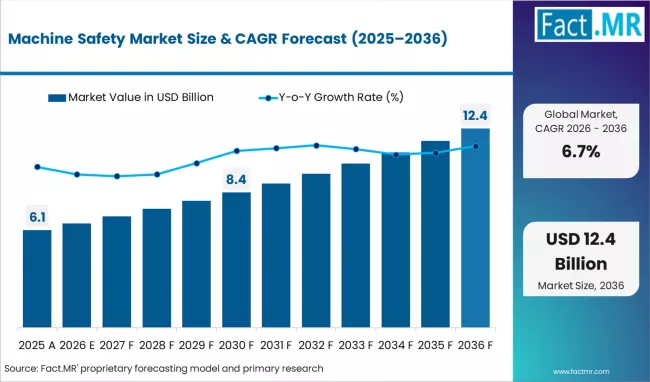
Machine Safety Market Market Value Analysis | Source: Fact.MR
Machine Safety Market
| Metric | Details |
|---|---|
| Industry Size (2026E) | USD 6.5 billion |
| Industry Value (2036F) | USD 11.9 billion |
| CAGR (2026 to 2036) | 6.7% |
Source: Fact.MR analysis. Updated Mar 16, 2026
Machine Safety Market Definition
The Machine Safety Market covers equipment and systems designed to prevent accidents and injuries during the operation of industrial machinery. These products monitor machine activity and stop or restrict operation when unsafe conditions occur. Common machine safety solutions include safety sensors, light curtains, safety switches, emergency stop devices, and safety controllers. They are installed in manufacturing lines, automated equipment, and heavy industrial systems to protect workers and maintain safe operating conditions. The primary function of machine safety technology is to reduce workplace hazards and ensure compliance with industrial safety standards across manufacturing and processing industries.
Market Inclusions
This report covers global and regional market sizes for machine safety systems with forecast analysis for the study period. The market is segmented by product type such as safety sensors, safety switches, safety controllers, light curtains, and emergency stop devices. Application segments include manufacturing plants, industrial automation systems, packaging equipment, and process industries. End users include automotive, electronics, metal processing, and food processing sectors. The report also examines pricing patterns, supply structures, and selected trade flow analysis across major industrial regions.
Market Exclusions
The report excludes general workplace safety equipment such as helmets, gloves, protective clothing, and fire protection systems. Security surveillance systems used for facility monitoring are also excluded. The scope does not include complete industrial machinery or production equipment, focusing only on safety components designed to control machine operation. Occupational training programs, safety consulting services, and non industrial safety products fall outside the defined market scope.
Research Methodology
- Primary Research: Interviews were conducted with industrial equipment manufacturers, safety system suppliers, automation engineers, and plant safety managers.
- Desk Research: Public information was gathered from industrial safety standards publications, company reports, regulatory documents, and trade statistics.
- Market-Sizing and Forecasting: A hybrid model combining bottom up product revenue analysis with top down industrial demand assessment was applied.
- Data Validation and Update Cycle: Findings were cross verified using multiple data sources and expert inputs, with periodic updates conducted as new industry data becomes available.
Summary of the Machine Safety Market
- Market Definition
- The market comprises industrial safety systems and components designed to prevent accidents and injuries during the operation of automated machinery. These systems monitor machine activity and interrupt operations when unsafe conditions are detected across manufacturing and processing environments.
- Demand Drivers
- Increasing deployment of automated machinery and robotic production lines across manufacturing industries.
- Regulatory requirements for workplace safety that mandate installation of safety sensors, interlock switches, and emergency stop systems.
- Modernization of factory infrastructure and industrial automation systems requiring integrated safety controls.
- Expansion of electric vehicle production and automated assembly operations within automotive manufacturing facilities.
- Key Segments Analyzed
- Industry: Automotive represents about 25% share due to extensive use of robotic assembly systems and automated production lines.
- Component: Presence sensing safety sensors account for roughly 22% share supported by widespread use in automated manufacturing environments.
- Industrial Application: Packaging, electronics manufacturing, and pharmaceutical production represent key sectors integrating machine safety technologies.
- Geography: The United States records the fastest expansion supported by strong regulatory enforcement and automation investments.
- Analyst Opinion at Fact MR
- Shambhu Nath Jha, Principal Consultant, Fact MR, opines, "In this updated edition of the Machine Safety Market report, industry participants will observe that market demand remains closely linked to the pace of industrial automation and regulatory safety compliance within manufacturing facilities. As production systems become increasingly automated, safety technologies such as sensors, light curtains, and programmable safety controllers are integrated directly into machine control systems. Companies that provide safety certified automation platforms and strong engineering support capabilities will retain advantages in large scale industrial deployments."
- Strategic Implications or Executive Takeaways
- Expand development of integrated safety systems compatible with automated manufacturing equipment and robotics platforms.
- Strengthen compliance with international safety standards governing industrial machinery and control systems.
- Develop modular safety components that support retrofitting of legacy manufacturing equipment.
- Build partnerships with industrial automation providers to integrate safety technologies within complete production systems.
- Methodology
- Primary interviews conducted with industrial equipment manufacturers, safety system suppliers, automation engineers, and plant safety managers.
- Desk research based on industrial safety standards publications, company reports, regulatory documents, and trade statistics.
- Market sizing developed through a hybrid approach combining bottom up product revenue assessment and top down industrial demand analysis.
- Findings validated through multiple industry data sources and expert consultations following Fact MR internal modeling standards.
Segmental Analysis
Machine Safety Market Analysis by Industry
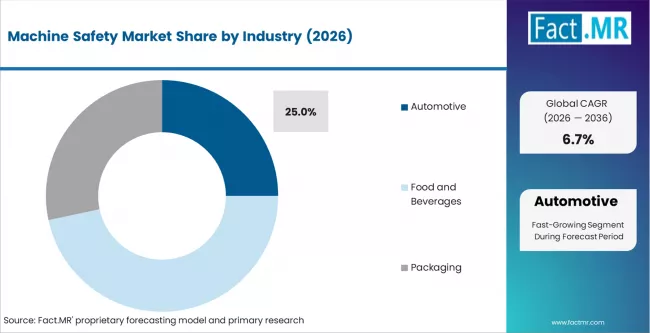
Machine Safety Market Analysis By Industry | Source: Fact.MR
- Market Overview: The automotive industry is projected to account for around 25% share of the machine safety market by 2026. High levels of automation in vehicle manufacturing facilities have increased the deployment of safety systems designed to protect workers operating near robotic assembly lines and automated machinery. Automotive production plants integrate machine safety solutions such as emergency stop systems, safety light curtains, and interlock switches to comply with industrial safety regulations and reduce workplace accidents. The expansion of electric vehicle manufacturing and automated assembly operations continues to strengthen the requirement for machine safety systems within automotive production environments.
- Demand Drivers:
- Automated Production Lines: Automotive assembly plants rely on robotic welding, painting, and component assembly systems that require integrated safety devices to prevent worker exposure to hazardous operations.
- Regulatory Compliance Requirements: Industrial safety regulations require manufacturers to implement machine guarding and protective systems that reduce the risk of workplace injuries within manufacturing facilities.
- Electric Vehicle Manufacturing Expansion: Growth in electric vehicle production facilities has increased the installation of advanced automated systems, which require integrated machine safety technologies.
Machine Safety Market Analysis by Component
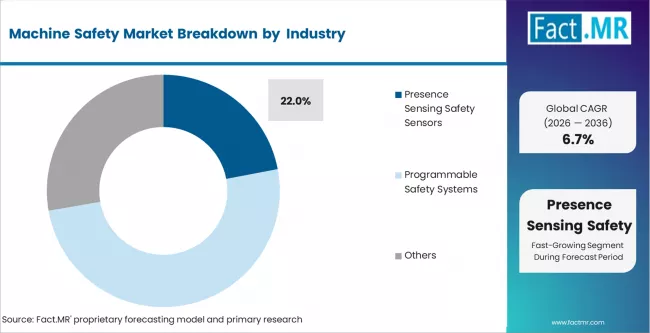
Machine Safety Market Analysis By Component | Source: Fact.MR
- Market Overview: Presence sensing safety sensors are expected to represent about 22% share of the machine safety market by 2026. These sensors detect the presence of workers or objects near hazardous machine areas and automatically trigger safety responses such as stopping machinery or disabling operations. Presence sensing safety sensors are widely used in manufacturing lines, robotic workstations, and automated material handling systems. Their ability to provide real time detection and rapid response supports their widespread deployment across industrial automation environments.
- Demand Drivers:
- Worker Protection in Automated Facilities: Presence sensing sensors detect human movement near machinery and activate protective shutdown mechanisms to reduce accident risks.
- Integration with Industrial Automation: Modern manufacturing systems incorporate presence sensing technologies to maintain safe interaction between workers and automated equipment.
- Adoption in Robotic Workstations: Robotic production cells deploy presence sensing safety sensors to ensure operational safety during assembly, welding, and material handling processes.
Machine Safety Market Drivers, Restraints, and Opportunities
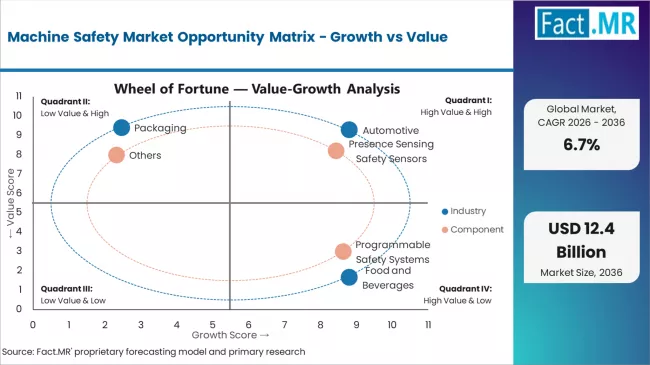
Machine Safety Market Opportunity Matrix Growth Vs Value | Source: Fact.MR
Fact MR analysis indicates that the machine safety market developed alongside industrial automation and factory mechanization where equipment risks required engineered protection systems. Early safety solutions focused on mechanical guards and emergency stop switches designed to prevent operator injury during equipment operation. The current market valuation reflects the integration of electronic safety controls, light curtains, interlock systems, and programmable safety controllers across automated production lines. Demand persists because industrial facilities rely on safety-certified equipment to reduce workplace accidents and maintain operational compliance within regulated manufacturing environments.
A structural shift is occurring as conventional mechanical safety barriers gradually lose share to intelligent safety systems integrated with automated production equipment. Basic protective guards remain widely used in smaller manufacturing facilities where cost constraints limit adoption of advanced safety electronics. Higher-value safety systems combine sensors, programmable logic controllers, and diagnostic software capable of monitoring equipment status in real time. These integrated systems carry higher installation and certification costs even when deployment volumes remain limited to complex automated production environments. The pricing premium associated with intelligent safety platforms contributes to steady market value growth.
- Industrial Automation Safety: Manufacturing facilities increasingly deploy light curtains, safety scanners, and programmable safety controllers to support automated production equipment.
- Workplace Safety Regulation: Standards such as ISO 13849 for safety-related control systems and the European Machinery Directive 2006/42/EC require validated machine safety mechanisms in industrial equipment design.
- Europe Manufacturing Compliance: Germany, Italy, and other European manufacturing economies maintain strict equipment safety certification practices that sustain demand for machine safety systems across industrial production facilities.
Regional Analysis
The market analysis covers key global regions, including North America, East Asia, and Western Europe. It is segmented geographically, with specific market dynamics for each region. The full report provides a detailed market attractiveness analysis.
.webp "Top Country Growth Comparison Machine Safety Market Cagr (2026 2036)")
Top Country Growth Comparison Machine Safety Market Cagr (2026 2036) | Source: Fact.MR
| Country | CAGR (2026-2036) |
|---|---|
| USA | 9.5% |
| United Kingdom | 9.0% |
| Japan | 5.0% |
| South Korea | 9.3% |
Source: Fact.MR analysis. Updated Mar 16, 2026
Source: Fact MR (FMR) analysis, based on proprietary forecasting model and primary research
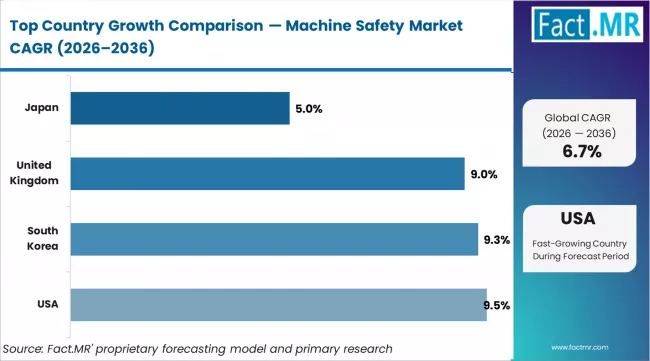
Machine Safety Market Cagr Analysis By Country | Source: Fact.MR
North America
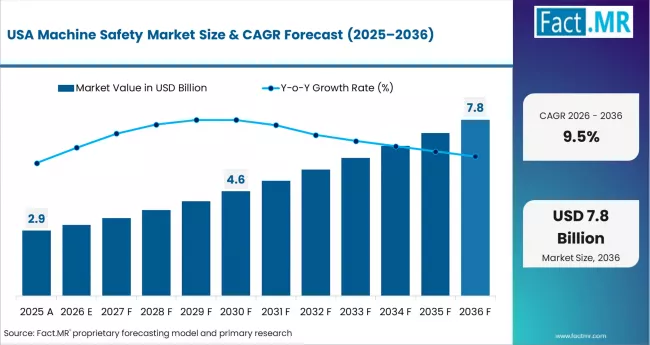
Machine Safety Market Country Value Analysis | Source: Fact.MR
The USA represents a major market supported by industrial automation adoption, manufacturing safety standards, and increasing deployment of machine safety systems. Key companies include Rockwell Automation, Honeywell International Inc., and Emerson Electric Co..
- USA: Demand for machine safety solutions in the U.S. is projected to rise at 9.5% CAGR through 2036. Growth is supported by workplace safety regulations enforced by the Occupational Safety and Health Administration (04-2025) and deployment of industrial safety automation systems by Rockwell Automation (08-2025).
Western Europe
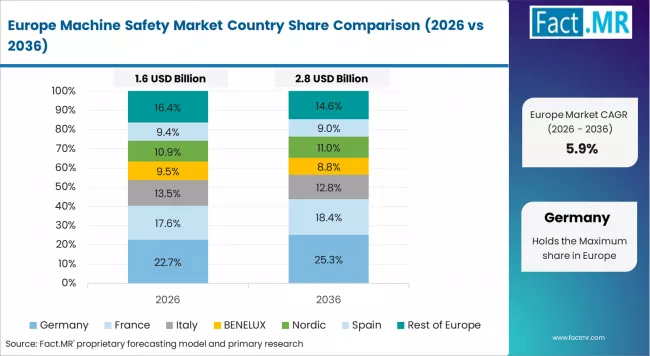
Machine Safety Market Europe Country Market Share Analysis, 2026 & 2036 | Source: Fact.MR
The United Kingdom represents an important market supported by industrial safety regulations, factory automation, and risk management programs.
- United Kingdom: Demand for machine safety solutions in the UK is projected to rise at 9.0% CAGR through 2036. Growth is supported by industrial safety compliance requirements promoted by the Health and Safety Executive (03-2025) and automation safety system deployments by Schneider Electric (07-2025).
East Asia
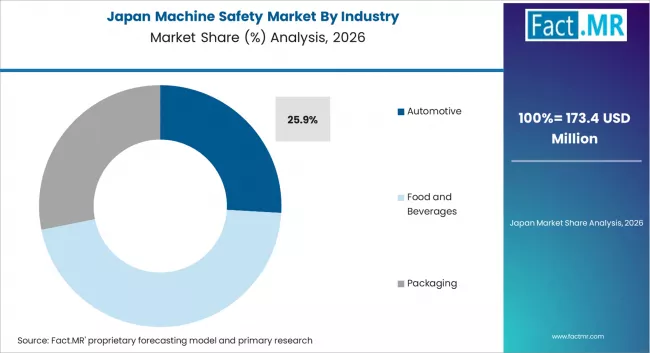
Machine Safety Market Japan Market Share Analysis By Industry | Source: Fact.MR
Japan and South Korea represent key markets supported by robotics adoption, manufacturing automation, and industrial safety technologies.
- Japan: Demand for machine safety solutions in Japan is projected to rise at 5.0% CAGR through 2036. Growth is supported by industrial robotics safety guidelines issued by the Ministry of Economy, Trade and Industry (02-2025) and factory automation safety systems deployed by Omron Corporation (06-2025).
- South Korea: Demand for machine safety solutions in South Korea is projected to rise at 9.3% CAGR through 2036. Growth is supported by manufacturing safety modernization initiatives promoted by the Ministry of Trade, Industry and Energy (03-2025) and deployment of industrial automation safety technologies by LS Electric (08-2025).
Fact MR's analysis of the machine safety market in North America, East Asia, and Western Europe consists of country-wise assessments that include the USA, the United Kingdom, Japan, and South Korea. Readers can find detailed trends, regulatory updates, and company-specific investments shaping market growth in these countries.
Competitive Structure and Buyer Dynamics in the Machine Safety Market
Machine Safety Market Analysis By Company | Source: Fact.MR
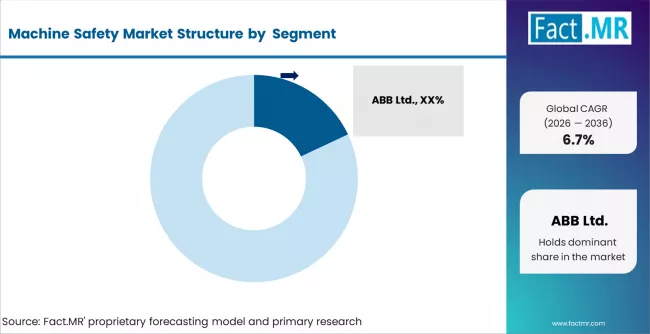
The competitive structure of the Machine Safety Market is moderately concentrated, with a group of global automation and industrial technology companies controlling a significant portion of total market revenue. Major participants including ABB Ltd., Emerson Electric Co., Honeywell International Inc., Schneider Electric SE, Rockwell Automation, Inc., Siemens AG, and General Electric Company maintain strong positions through extensive industrial automation portfolios and global distribution networks. These companies supply safety controllers, sensors, safety relays, and machine monitoring systems used across manufacturing, energy, and process industries. Specialized automation firms such as Omron Corporation, Keyence Corporation, and Yokogawa Electric Corporation compete through high precision sensing technologies and factory automation solutions. Competition in the market is primarily influenced by product reliability, compliance with industrial safety standards, and integration capability with existing automation infrastructure. Engineering support, system compatibility, and lifecycle service capabilities also play an important role in supplier selection among industrial operators.
Several companies maintain structural advantages through integrated automation platforms and long established relationships with large industrial customers. Firms such as Siemens AG, ABB Ltd., Schneider Electric SE, and Rockwell Automation, Inc. benefit from vertically integrated automation ecosystems that combine control systems, industrial software, and safety equipment. This integration supports seamless deployment within complex manufacturing environments. Companies with global service networks and engineering expertise maintain stronger engagement with large industrial clients. Industrial buyers typically reduce supplier dependency by qualifying multiple automation vendors and maintaining competitive procurement processes. Long term equipment contracts and framework agreements are commonly used to manage procurement across facilities. This purchasing structure moderates supplier pricing leverage, although companies offering specialized safety technologies or integrated automation platforms may retain moderate pricing influence within specific industrial applications.
Key Players of the Machine Safety Market
- ABB Ltd.
- Emerson Electric Co.
- General Electric Company
- Honeywell International Inc.
- Schneider Electric SE
- Rockwell Automation, Inc.
- Siemens AG
- Yokogawa Electric Corporation
- Omron Corporation
- Keyence Corporation
Report Scope
Machine Safety Market Breakdown By Industry, Component, And Region | Source: Fact.MR
| Metric | Value |
|---|---|
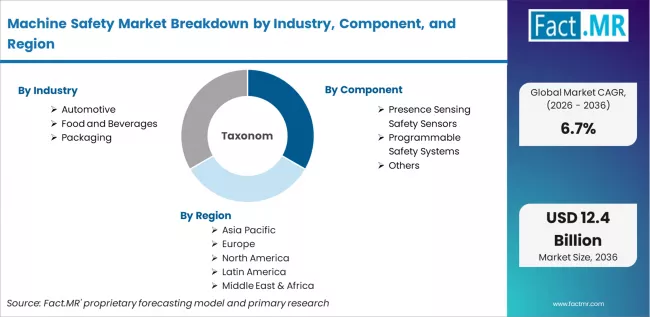
| Quantitative Units | USD 6.5 billion (2026) to USD 11.9 billion (2036), at a CAGR of 6.7% |
| Market Definition | The machine safety market includes production and deployment of industrial safety systems and components designed to protect personnel and equipment by monitoring machine operations and preventing hazardous events in industrial environments. |
| Component Segmentation | Presence Sensing Safety Sensors, Safety Interlock Switches (Electromechanical, Hinged Pin, Limit, Non-Contact, Tongue, Trapped Key), Programmable Safety Systems, Safety Modules, Emergency Stop Controls, Others |
| Industry Coverage | Automotive, Food & Beverages, Packaging, Material Processing, Pharmaceuticals, Electronics & Semiconductors, Others |
| Key Companies Profiled | ABB Ltd., Emerson Electric Co., General Electric Company, Honeywell International Inc., Schneider Electric SE, Rockwell Automation, Inc., Siemens AG, Yokogawa Electric Corporation, Omron Corporation, Keyence Corporation |
| Forecast Period | 2026 to 2036 |
| Approach | Hybrid top-down and bottom-up market modeling validated through interviews with industrial safety equipment manufacturers and system integrators, supported by production benchmarking, regulatory compliance analysis, and adoption trends across manufacturing sectors. |
Source: Fact.MR analysis. Updated Mar 16, 2026
Bibliographies
- [1] Occupational Safety and Health Administration. (2025). Workplace safety regulations for industrial machinery.
- [2] Health and Safety Executive, UK. (2025). Industrial safety compliance requirements.
- [3] Ministry of Economy, Trade and Industry, Japan. (2025). Industrial robotics safety guidelines.
- [4] Ministry of Trade, Industry and Energy, South Korea. (2025). Manufacturing safety modernization initiatives.
- [5] Rockwell Automation. (2025). Industrial safety automation systems.
- [6] Schneider Electric. (2025). Automation safety system deployments.
- [7] Omron Corporation. (2025). Factory automation safety systems.
- [8] LS Electric. (2025). Industrial automation safety technologies.
- [9] ISO. (2023). ISO 13849: Safety of machinery - Safety-related parts of control systems.
This Report Addresses
- Market size estimation and revenue forecasts for the Machine Safety Market from 2026 to 2036, supported by industrial automation deployment benchmarks and equipment safety compliance data.
- Growth opportunity mapping across presence sensing safety sensors, safety interlock switches, programmable safety systems, safety modules, and emergency stop control devices used in industrial machinery protection.
- Segment and regional revenue forecasts covering automotive, food and beverages, packaging, material processing, pharmaceuticals, and electronics manufacturing industries across major industrial regions.
- Competition strategy assessment including automation platform integration, safety system certification capability, and industrial control system compatibility benchmarking among leading safety equipment suppliers.
- Regulatory and standards impact analysis covering industrial safety frameworks such as ISO 13849 and the European Machinery Directive governing machine protection systems in manufacturing environments.
- Market report delivery in PDF, Excel, PPT, and interactive dashboard formats designed for industrial automation strategy planning, equipment procurement analysis, and manufacturing risk management.
- Supply chain vulnerability assessments identifying sensor component sourcing dependencies, automation controller manufacturing concentration, and regional industrial equipment supply risks affecting machine safety system deployment.
Segmentation
Machine Safety Market Key Segments
-
Component :
- Presence Sensing Safety Sensors
- Safety Interlock Switches
- Electromechanical
- Hinged Pin
- Limit
- Non-Contact
- Tongue
- Trapped Key
- Programmable Safety Systems
- Safety Modules
- Emergency Stop Controls
- Others
-
Industry :
- Automotive
- Food and Beverages
- Packaging
- Material Processing
- Pharmaceuticals
- Electronics and Semiconductors
- Others
-
Region :
- North America
- USA
- Canada
- Mexico
- Europe
- Germany
- UK
- France
- Italy
- Spain
- Nordic Countries
- BENELUX
- Rest of Europe
- Asia Pacific
- China
- Japan
- South Korea
- India
- Australia
- Rest of Asia Pacific
- Latin America
- Brazil
- Argentina
- Rest of Latin America
- Middle East and Africa
- Kingdom of Saudi Arabia
- United Arab Emirates
- South Africa
- Rest of Middle East and Africa
- Other Regions
- Oceania
- Central Asia
- Other Markets
- North America
Frequently Asked Questions
How large is the demand for Machine Safety solutions in the global market in 2026?
What will be the market size of Machine Safety solutions in the global market by 2036?
What is the expected demand growth for Machine Safety solutions in the global market between 2026 and 2036?
Which Industry Segment is poised to lead global demand by 2026?
Which Company is Identified as a Leading Participant in the Machine Safety Market?
What is Driving Machine Safety Demand in the United States?
What is the United States Growth Outlook in this Report?
What Factors Support Machine Safety Adoption in the United Kingdom?
What is the United Kingdom Growth Outlook in this Report?
Why is Japan an Important Market for Machine Safety Systems?
What is the Japan Growth Outlook in this Report?
Why is South Korea an Important Market for Machine Safety Solutions?
What is the South Korea Growth Outlook in this Report?
What are Machine Safety Systems and What are They Mainly Used For?
What does Machine Safety Market Mean in this Report?
What is Included in the Scope of this Machine Safety Market Report?
What is Excluded from the Scope of this Report?
What does Market Forecast Mean on this Page?
How is the Machine Safety Market Forecast Developed in this Report?
Who worked on this report


Preview the report firsthand - request a free sample
Free SampleGet the brochure for pricing and purchase details
Download PDF