- Market Value (2025): USD 417.8 Bn
- Estimated Value (2026): USD 445.0 Bn
- Forecast Value (2036): USD 1150 Bn
- CAGR (2026-2036): 10.0%
What is the machine customer enablement services market forecast to be worth by 2036?
- The machine customer enablement services market surpassed a valuation of USD 0.5 billion in 2025. Demand is expected to increase from USD 0.8 billion in 2026 to USD 40.0 billion by 2036.
- The market is forecast to record 47.9% CAGR during 2026 to 2036 as online merchants prepare for AI shopping agents and agentic checkout flows.
- Machine customers are becoming a new commerce interface as AI agents start to search and initiate purchases for users. These signals support demand for services that prepare merchants for agent-led discovery and transaction support.
- Businesses will also need cleaner product data and better fraud controls so AI-led purchases can move through commerce systems with less friction.
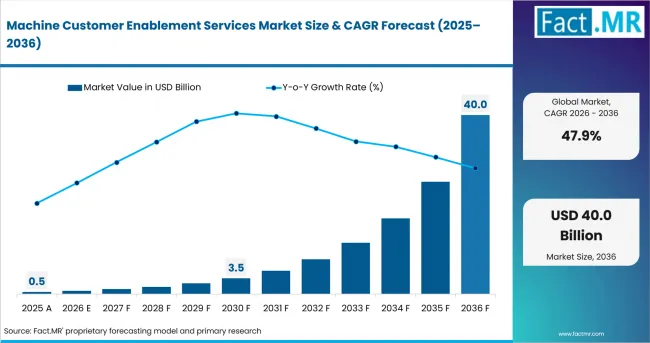
Machine Customer Enablement Services Market Value Analysis | Source: Fact.MR
Summary of machine customer enablement services market
- Demand Drivers in the Market
- Machine Customer Growth: Gartner states that CEOs expect machine customers to account for 20% or more of company revenue by 2030.
- Agent Payment Rails: Secure AI-agent payment systems are supporting safer transaction enablement. This helps merchants manage permission and payment control.
- Merchant Readiness: Agentic commerce tools and business guidance are becoming more common. This supports demand for product data cleanup and agent-led customer support.
- Key Segments Analyzed
- By Service Type: Machine-readable catalog optimization is expected to hold 34.0% share in 2026 because brands must make products understandable to AI agents.
- By Commerce Capability: Agentic checkout is likely to lead as merchants need AI-ready cart and checkout flows. The segment is expected to account for 31.0% share in 2026 because checkout is the point at which machine intent turns into revenue.
- By Customer Type: Online merchants are projected to capture 58.0% share in 2026 because digital sellers face early agent-discovery pressure.
- By Delivery Model: Platform-native integration is expected to lead because merchants prefer services tied to existing commerce stacks. The segment is anticipated to hold 43.0% share in 2026 because merchants want faster implementation with lower system disruption.
- By End Use: Retail & e-commerce is expected to represent 46.0% share in 2026 because AI shopping agents first affect online product discovery.
- By Geography: The United States is projected to grow at 51.0% CAGR through 2036 as payment networks and commerce platforms build agent-ready systems.
- Analyst Opinion at Fact.MR
- Shambhu Nath Jha, Senior Analyst at Fact.MR, states, “Machine customer enablement will become a new commerce readiness layer. Brands will need to make catalogs readable to agents and checkout flows safe for delegated purchases. The strongest service demand will come from merchants that want AI agents to find and complete transactions without breaking existing commerce operations.”
- Strategic Implications
- Catalog Readiness: Merchants should improve structured product data so AI agents can interpret offers correctly.
- Checkout Control: Payment teams need permission rules and spend limits for agent-led purchases.
- Agent Visibility: Commerce leaders should track AI-agent traffic and conversion separately from human traffic.
| Metric | Details |
|---|---|
| Market Size in 2026 | USD 0.8 billion |
| Market Forecast in 2036 | USD 40.0 billion |
| CAGR 2026 to 2036 | 47.9% |
Source: Fact.MR analysis. Updated Jun 19, 2026
The United States is projected to record 51.0% CAGR through 2036 as payment networks and large merchants test agent-ready commerce. The United Kingdom is likely to post 50.2% CAGR as digital merchants adopt AI shopping and payment enablement services. South Korea is set to advance at 49.4% CAGR because online commerce firms can move quickly into agent-led shopping. Germany is forecast at 48.0% CAGR as B2B sellers and retailers improve structured product data. Japan is expected to register 47.1% CAGR as brands adopt controlled agentic commerce workflows.
How does the machine customer enablement services market break down by segment?
Machine Customer Enablement Services Market Analysis by Service Type
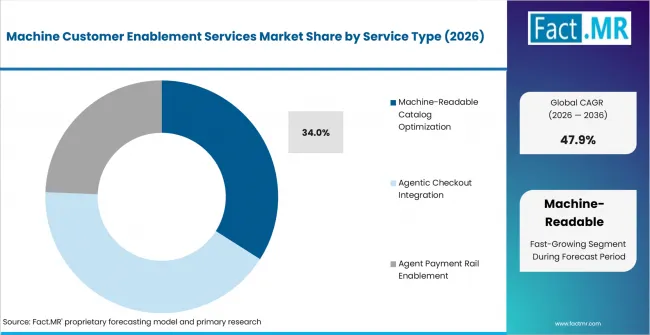
Machine Customer Enablement Services Market Analysis By Service Type | Source: Fact.MR
Machine-readable catalog optimization is expected to hold 34.0% share in 2026 because AI agents need structured product data before they can compare offers. Agentic checkout integration supports cart creation and delegated purchase flows. Agent payment rail enablement connects merchants with approved payment credentials. Bot-to-bot negotiation setup will grow in B2B commerce. Agent analytics helps brands track machine-led discovery and conversion.
- Catalog Readiness: Structured product data helps AI agents compare offers and select suitable products.
- Checkout Integration: Agentic checkout services connect carts and payment flows.
- Agent Analytics: Tracking services help merchants identify machine-led traffic and sales outcomes.
Machine Customer Enablement Services Market Analysis by Commerce Capability
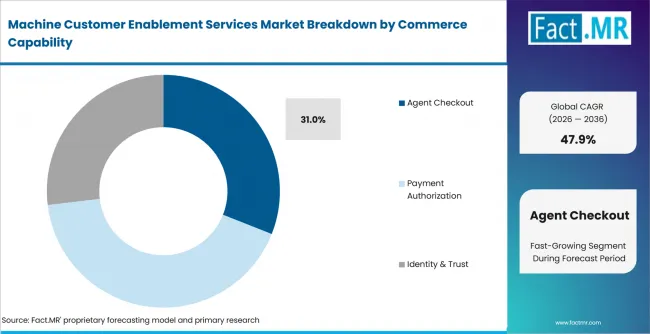
Machine Customer Enablement Services Market Analysis By Commerce Capability | Source: Fact.MR
Agentic checkout leads as merchants need AI-ready cart and checkout flows. Product discovery services improve how agents read catalog feeds and product pages. The segment is likely to account for 31.0% share in 2026 because checkout is the main point of agent-to-merchant conversion. Payment authorization services support delegated spending and fraud controls. Identity and trust services help merchants separate valid agents from harmful automated traffic.
- Agent Checkout: Checkout enablement helps AI agents create carts and complete approved purchases.
- Payment Authorization: Permission controls support safe delegated payments for users and businesses.
- Identity Trust: Agent identity services help merchants accept valid agent traffic.
Machine Customer Enablement Services Market Analysis by Customer Type
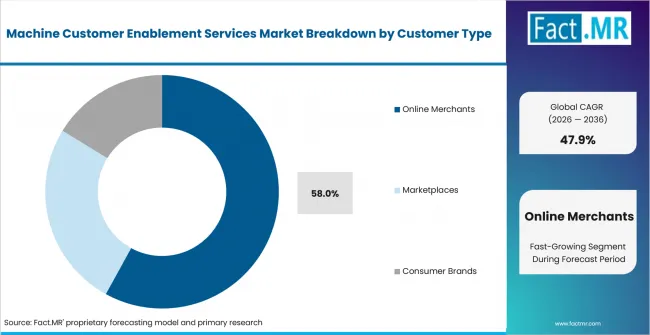
Machine Customer Enablement Services Market Analysis By Customer Type | Source: Fact.MR
Online merchants are projected to capture 58.0% share in 2026 because digital sellers face early agent-discovery pressure. Marketplaces need standardized product data and checkout handoffs. Consumer brands need agent-readable product information and brand rules. B2B sellers need structured catalogs for machine-to-machine purchasing. Digital service providers need agent identity and payment flows for API and subscription purchases.
- Online Merchants: Digital sellers need agent-readable catalogs and payment-ready checkout.
- Marketplaces: Marketplaces need standard feeds so agents can compare sellers correctly.
- B2B Sellers: Business sellers need machine-readable pricing and contract rules.
Machine Customer Enablement Services Market Analysis by Delivery Model
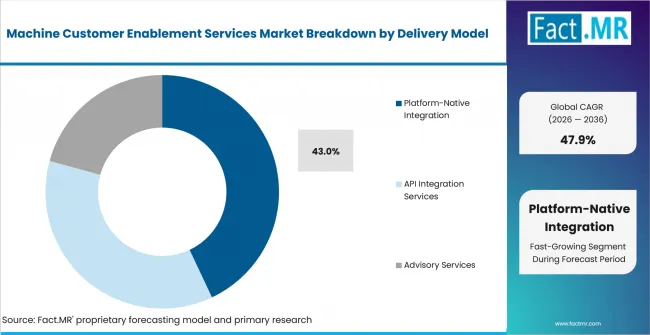
Machine Customer Enablement Services Market Analysis By Delivery Model | Source: Fact.MR
Platform-native integration leads because merchants prefer services that work inside existing commerce systems. API integration services connect agent payment rails with product and order systems. The segment is anticipated to hold 43.0% share in 2026 because platform-linked work reduces setup friction for merchants. Advisory services support readiness reviews and operating rules. Managed enablement helps smaller merchants keep catalogs updated.
- Platform Integration: Merchants prefer services that work inside their current commerce systems.
- API Services: API integration connects agent payment rails with product and order systems.
- Testing Support: Testing services check agent discovery and payment handoff.
Machine Customer Enablement Services Market Analysis by End Use

Machine Customer Enablement Services Market Analysis By End Use | Source: Fact.MR
Retail & e-commerce is expected to represent 46.0% share in 2026 because AI shopping agents first affect online product discovery. Travel and hospitality will adopt through booking agents and itinerary tools. Financial services will use controlled agent payments and authenticated workflows. Digital services will use agents for subscription and API purchases.
- Retail Commerce: Retailers need agent-readable product data and safe delegated checkout.
- Travel Booking: Travel firms can support agents that compare and reserve trips.
- Digital Services: Software and API sellers need agent identity and automated payment flows.
What is accelerating machine customer enablement services adoption, and what is holding it back?
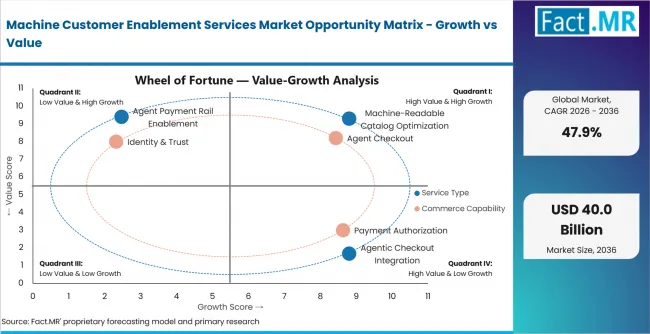
Machine Customer Enablement Services Market Opportunity Matrix Growth Vs Value | Source: Fact.MR
The main driver is the rise of machine customers and agentic commerce. Mastercard launched Agent Pay in 2025 to support agentic payments. This signal shows why merchants need enablement services that prepare product data and checkout flows for AI-led transactions. Demand is also supported by the need for permission controls and clear purchase authorization. Merchants will need better product feeds so AI agents can compare items accurately. Service providers can also help brands manage returns and customer support for agent-led purchases.
Trust and system readiness can slow adoption. Merchants must confirm that an AI agent is safe before allowing it to shop or pay. Payment systems also need clear rules for user approval and dispute handling. Many merchants still have uneven product data across sales channels. Smaller businesses may move slowly because catalog updates and checkout integration need extra technical work.
Opportunities in the Machine Customer Enablement Services Market
- Agent-Readable Catalogs: Service providers can improve product feeds and offer data.
- Agentic Checkout: Integration firms can connect carts and payment rails.
- Machine Traffic Analytics: Commerce teams can track agent-driven discovery and conversion.
Which countries are scaling machine customer enablement services demand fastest?
Based on regional analysis, the machine customer enablement services market is segmented into North America, Western Europe, East Asia and other regions.
.webp "Top Country Growth Comparison Machine Customer Enablement Services Market Cagr (2026 2036)")
Top Country Growth Comparison Machine Customer Enablement Services Market Cagr (2026 2036) | Source: Fact.MR
| Country | CAGR 2026 to 2036 |
|---|---|
| United States | 51.0% |
| United Kingdom | 50.2% |
| South Korea | 49.4% |
| Germany | 48.0% |
| Japan | 47.1% |
Source: Fact.MR analysis. Updated Jun 19, 2026
Source: Fact.MR directional estimate and primary research model
North America Machine Customer Enablement Services Market Analysis
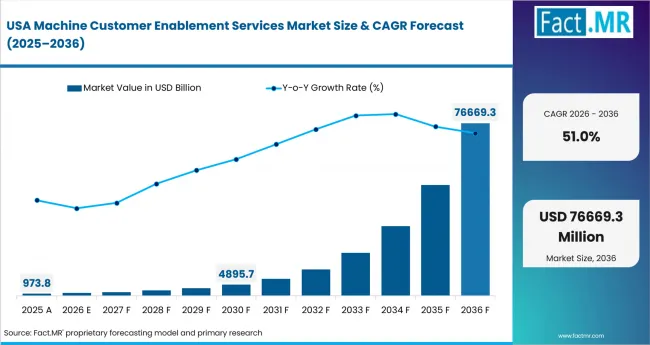
Machine Customer Enablement Services Market Country Value Analysis | Source: Fact.MR
North America demand is led by the United States. Payment-network innovation and large online merchant activity make the region an early market for agentic commerce services. Retailers and software sellers are preparing product data and payment permissions for AI agents.
- United States: The United States is projected to record 51.0% CAGR through 2036 as payment networks and online merchants build agent-ready systems. Visa Inc.show that payment rails are moving into AI-agent shopping. Growth will favor service providers that improve product data and payment authorization for AI shopping agents.
Western Europe Machine Customer Enablement Services Market Analysis
Western Europe demand is led by the United Kingdom and Germany. Merchants are expected to adopt controlled agentic commerce tools with stronger attention to payments and brand representation.
- United Kingdom: Digital merchants in the United Kingdom are preparing for AI-agent-led shopping. UK merchants need services that improve catalog readability and support delegated checkout. The United Kingdom is likely to post 50.2% CAGR through 2036 as payment readiness becomes important for agent-led commerce. PayPal’s agentic commerce services support AI-driven shopping through agent-ready payments and merchant tools. Growth will favor providers that combine commerce integration with fraud review and dispute handling. Retailers will adopt first because AI search can quickly influence product discovery.
- Germany: German B2B sellers and retailers are improving machine-readable commerce systems. Firms will require clear data structure and operating control before supporting agent-led transactions. Germany is set to advance at 48.0% CAGR through 2036 because machine customer enablement services can help sellers prepare catalogs for automated comparison and repeat buying. Payment-network tools will support controlled agent checkout. Adoption will be careful because merchants need strong documentation and internal approval.
East Asia Machine Customer Enablement Services Market Analysis
East Asia demand is supported by South Korea and Japan. Online commerce is advanced in both countries, but adoption style will differ. South Korea will move quickly through digital sellers. Japan will adopt through controlled enterprise programs.
- South Korea: South Korea is set to record 49.4% CAGR through 2036 as digital merchants and service platforms test AI shopping workflows. Consumers are already comfortable with mobile commerce, which gives agentic commerce a strong base. Merchants will need machine-readable catalogs and payment authorization rules. Service providers can support brands that want to appear correctly in AI shopping journeys.
- Japan:Japanese brands are preparing cautiously for AI shopping agents. Retailers and service providers will focus on product-data accuracy and safe payment handoff. Japan is expected to register 47.1% CAGR through 2036 because merchants will adopt agentic commerce after controlled trials. Platform-native enablement will be preferred because it limits operational disruption. Agentic checkout will gain traction after firms test discovery and cart-building functions.
Who leads the machine customer enablement services market landscape?
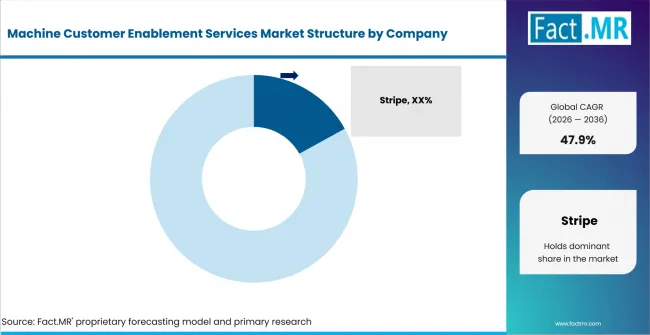
Machine Customer Enablement Services Market Analysis By Company | Source: Fact.MR
The machine customer enablement services market includes payment networks and commerce infrastructure companies. Stripe supports the market through agentic commerce payment infrastructure and guidance for agent-initiated transactions. Visa Inc. helps enable secure AI-initiated payments through permission-led controls. Mastercard Incorporated supports agentic payments through secure authorization and agentic tokens. PayPal supports merchant readiness through agentic commerce services and agent-ready payment capabilities.
Competition is centered on payment trust and merchant ease of adoption. Stripe and Shopify compete through merchant-side enablement. Visa and Mastercard compete through agent payment infrastructure and network trust. PayPal competes through merchant reach and agent-ready payment services. Skyfire competes through agent identity and payment infrastructure. Providers with stronger integration depth will be better placed to convert merchants into agent-ready sellers.
Supplier strength will come from secure delegated commerce over the forecast period. Merchants will need to know which agents are valid, which payment credentials are approved and which product data is being used. Service providers that connect catalogs and payment authorization will gain recurring demand. Agent analytics will become important as brands measure machine-led product discovery.
Which companies are the key players?
- Stripe
- Visa Inc.
- Mastercard Incorporated
- PayPal
- Skyfire
- Shopify
Bibliography
- Gartner. (n.d.). Machine customers are a trillion-dollar opportunity.
- Mastercard. (2025, April 29). Mastercard unveils Agent Pay, pioneering agentic payments technology to power commerce in the age of AI.
- Visa. (2025, April 30). Find and buy with AI: Visa unveils new era of commerce.
- PayPal Holdings, Inc. (2025, October 28). PayPal launches agentic commerce services to power AI-driven shopping.
- Stripe. (n.d.). Guide to agentic commerce.
This Report Addresses
- Strategic intelligence on machine customer enablement services across service type, commerce capability and delivery model.
- Forecast mapping from USD 0.8 billion in 2026 to USD 40.0 billion by 2036.
- Segment analysis covering machine-readable catalogs, agentic checkout, online merchants and platform-native integration.
- Regional outlook covering the United States, United Kingdom, South Korea, Germany and Japan.
- Competitive analysis of Stripe, Visa Inc., Mastercard Incorporated, PayPal, Skyfire and Shopify.
- Service opportunity review across catalog readiness, payment authorization and agent analytics.
- Adoption review across retail, travel, financial services, digital services and B2B commerce.
- Verified catalyst review based on machine customer growth and agent payment infrastructure launches.
What does the machine customer enablement services market cover?
The machine customer enablement services market covers services that help brands and digital sellers prepare for AI shopping agents. These services make product catalogs machine-readable and support bot-to-bot negotiation. The market focuses on services used to make existing commerce systems usable by autonomous AI purchasing agents.
Machine Customer Enablement Services Market Inclusions
The scope includes catalog structuring and agent commerce testing. It includes services for online merchants and B2B sellers. Platform-native integration and managed enablement services are included.
Machine Customer Enablement Services Market Exclusions
The scope excludes general e-commerce platform subscriptions sold without enablement services. It excludes traditional SEO services that do not support machine-readable agent access. It excludes payment processing without agent commerce capability. It also excludes chatbot marketing services that do not support discovery or transaction readiness.
Machine Customer Enablement Services Market Research Methodology
- Primary Research:
- Primary research includes discussions with commerce technology leaders and digital transformation consultants. Platform and payment-network activity was reviewed separately.
- Desk Research:
- Desk research reviews agentic commerce product announcements and merchant readiness guidance. Public product pages from listed companies support validation.
- Market-Sizing and Forecasting:
- Market estimates are developed through agentic commerce adoption signals and regional validation.
- Data Validation and Update Cycle:
- Forecasts are checked through provider activity and official catalyst tracking.
Segmentation
What is the report’s scope and coverage?
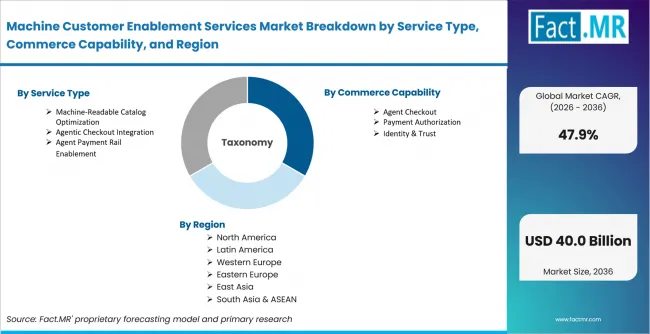
Machine Customer Enablement Services Market Breakdown By Service Type, Commerce Capability, And Region | Source: Fact.MR
| Attribute | Details |
|---|---|
| Quantitative Units | USD 0.8 billion in 2026 to USD 40.0 billion by 2036 at 47.9% CAGR |
| Market Definition | Services that prepare brands and merchants to sell to AI shopping agents and machine customers |
| Service Type | Machine-Readable Catalog Optimization, Agentic Checkout Integration, Agent Payment Rail Enablement, Bot-to-Bot Negotiation Setup, Agent Analytics & Attribution |
| Commerce Capability | Product Discovery, Agent Checkout, Payment Authorization, Identity & Trust, Post-Purchase Orchestration |
| Customer Type | Online Merchants, Marketplaces, Consumer Brands, B2B Sellers, Digital Service Providers |
| Delivery Model | Platform-Native Integration, API Integration Services, Advisory Services, Managed Enablement, Testing & Certification Support |
| End Use | Retail & E-commerce, Travel & Hospitality, Financial Services, Digital Services, B2B Commerce |
| Regions Covered | North America, Western Europe, East Asia, Other Regions |
| Countries Covered | United States, United Kingdom, South Korea, Germany, Japan |
| Key Companies Profiled | Stripe, Visa Inc., Mastercard Incorporated, PayPal, Skyfire and Shopify |
| Forecast Period | 2026 to 2036 |
| Approach | Hybrid top-down and bottom-up approach using agentic commerce activity, merchant readiness demand, payment-rail adoption and regional validation |
Source: Fact.MR analysis. Updated Jun 19, 2026
How is the market segmented?
-
By Service Type:
- Machine-Readable Catalog Optimization
- Agentic Checkout Integration
- Agent Payment Rail Enablement
- Bot-to-Bot Negotiation Setup
- Agent Analytics & Attribution
-
By Commerce Capability:
- Product Discovery
- Agent Checkout
- Payment Authorization
- Identity & Trust
- Post-Purchase Orchestration
-
By Customer Type:
- Online Merchants
- Marketplaces
- Consumer Brands
- B2B Sellers
- Digital Service Providers
-
By Delivery Model:
- Platform-Native Integration
- API Integration Services
- Advisory Services
- Managed Enablement
- Testing & Certification Support
-
By End Use:
- Retail & E-commerce
- Travel & Hospitality
- Financial Services
- Digital Services
- B2B Commerce
-
By Region:
- North America
- United States
- Canada
- Western Europe
- United Kingdom
- Germany
- France
- Netherlands
- Spain
- East Asia
- Japan
- South Korea
- China
- Other Regions
- Latin America
- Middle East and Africa
- North America
Frequently Asked Questions
What is the Machine Customer Enablement Services Market size in 2026?
What will the Machine Customer Enablement Services Market be worth by 2036?
What CAGR is projected for the Machine Customer Enablement Services Market?
Which service type leads the market?
Which country grows fastest in the market?
How does the United Kingdom perform in this market?
How does South Korea perform in this market?
How does Germany perform in this market?
How does Japan perform in this market?
What restrains the market?
How many providers are estimated in this market?
Who worked on this report


Preview the report firsthand - request a free sample
Free SampleGet the brochure for pricing and purchase details
Download PDF