- Base Value(2025): 1.1 Bn
- Forecast Value (2036): 32.5 Bn
- CAGR (2036): 36.0%
Deepfake Fraud Defense Services Market Size, Market Forecast and Outlook by Fact.MR
- The deepfake fraud defense services market was valued at USD 1.1 billion in 2025.
- Demand is expected to increase from USD 1.5 billion in 2026 to USD 32.5 billion by 2036.
- The market is forecast to record 36.0% CAGR from 2026 to 2036 as financial institutions and enterprises strengthen defenses against AI-generated voice and video fraud.
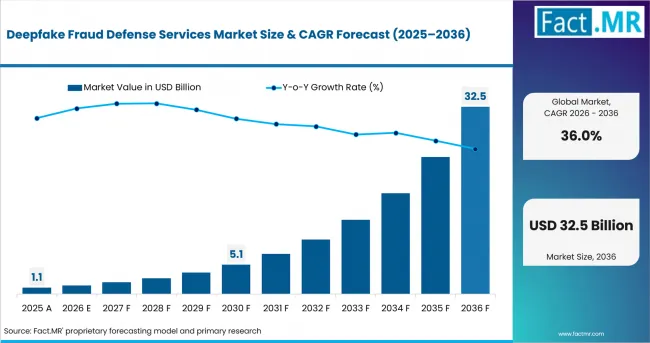
Deepfake Fraud Defense Services Market Value Analysis | Source: Fact.MR
Summary of Deepfake Fraud Defense Services Market
- Demand Drivers in the Market
- AI-Enabled Fraud Growth: Deepfake fraud is becoming harder to detect as synthetic voice and fake video calls improve. This supports demand for defense services that can verify identity during high-risk interactions.
- Contact Center Risk: Call centers face rising exposure from voice cloning and impersonation attempts. Fraud defense tools help teams detect suspicious audio patterns before account access or payment approval.
- Financial Institution Protection: Banks and payment firms need stronger checks against synthetic identities and fake customer instructions. Deepfake detection services can support authentication and fraud review workflows.
- Key Segments Analyzed
- By Service Type: Managed deepfake detection is expected to hold 34.0% share in 2026 because enterprises need recurring review.
- By Fraud Vector: Voice clone fraud leads due to call-center exposure. Video deepfake fraud follows through meeting impersonation. Voice clone fraud is likely to account for 32.0% share in 2026 because voice remains a high-trust channel.
- By Deployment Point: Call centers are projected to capture 36.0% share in 2026 because attackers can scale synthetic calls quickly.
- By Customer Type: Banks and insurers lead due to payment exposure. Fintechs follow through onboarding risk. Banks and insurers are anticipated to hold 42.0% share in 2026 because deepfake fraud can affect regulated client workflows.
- By Delivery Model: Managed detection & response is expected to represent 38.0% share in 2026 because deepfake threats require live review.
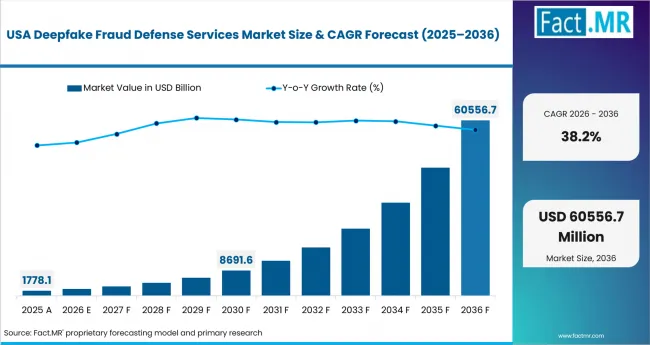
- By Geography: The United States is projected to grow at 38.2% CAGR through 2036 as AI fraud becomes a board-level risk.
- Analyst Opinion at Fact.MR
- Shambhu Nath Jha, Senior Analyst at Fact.MR, states, “Deepfake fraud defense will become part of enterprise identity security. Banks cannot rely on voice trust alone. The strongest demand will come from firms that need to verify who is speaking before money moves.”
- Strategic Implications
- Call Verification: Banks should add deepfake checks to high-risk voice workflows.
- Meeting Controls: Enterprises should verify executive identity before payment approvals.
- KYC Defense: Onboarding teams should test deepfake resistance before expanding remote verification.
| Metric | Details |
|---|---|
| Market Size in 2026 | USD 1.5 billion |
| Market Forecast in 2036 | USD 32.5 billion |
| CAGR 2026 to 2036 | 36.0% |
Source: Fact.MR analysis. Updated Jun 18, 2026
The United States is projected to record 38.2% CAGR through 2036 as banks and large enterprises adopt managed deepfake defense. The United Kingdom is likely to post 37.3% CAGR as financial institutions strengthen video and voice verification. Germany is set to advance at 36.4% CAGR due to enterprise identity-risk programs. South Korea is forecast at 35.7% CAGR as digital banks and call-center operators face synthetic caller risk. Japan is expected to register 34.9% CAGR as financial institutions adopt cautious fraud-defense services.
Segmental Analysis
Deepfake Fraud Defense Services Market Analysis by Service Type
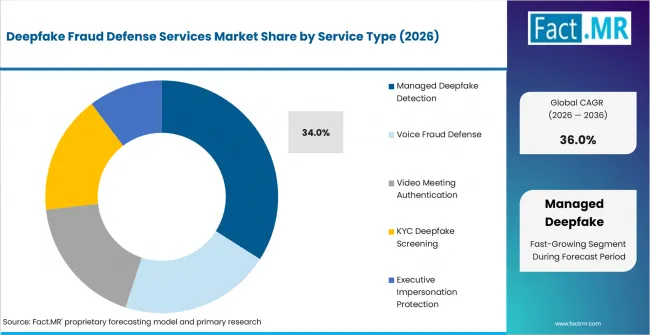
Deepfake Fraud Defense Services Market Analysis By Service Type | Source: Fact.MR
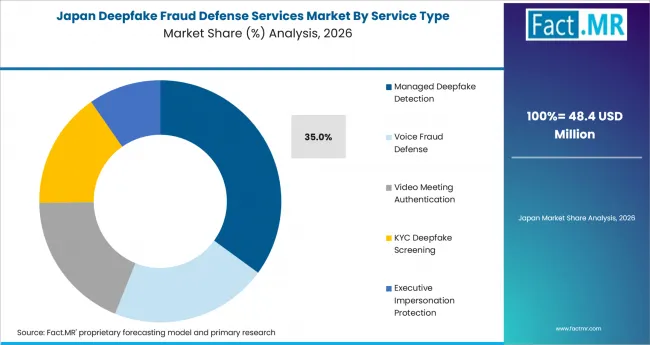
Managed deepfake detection is expected to hold 34.0% share in 2026 because enterprises need recurring review across calls and video sessions. Voice fraud defense protects call-center workflows. Video meeting authentication supports high-risk approvals. KYC screening blocks synthetic faces during onboarding. Executive impersonation protection supports payment and treasury teams.
- Managed Detection: Recurring review helps fraud teams respond to synthetic media attacks.
- Voice Defense: Voice checks help call centers identify cloned callers.
- Meeting Authentication: Video verification protects high-risk executive approvals.
Deepfake Fraud Defense Services Market Analysis by Fraud Vector
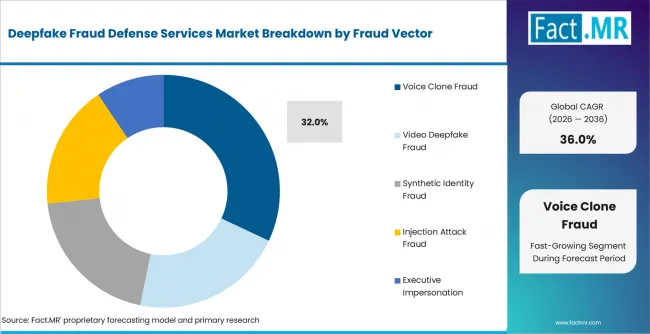
Deepfake Fraud Defense Services Market Analysis By Fraud Vector | Source: Fact.MR
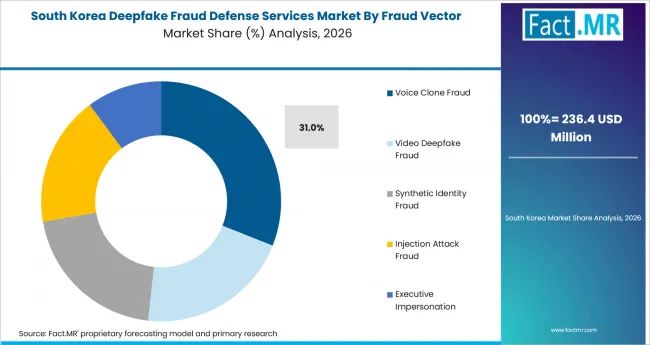
Voice clone fraud leads because attackers can reach call centers at scale. Video deepfake fraud is rising in executive impersonation. Voice clone fraud is likely to account for 32.0% share in 2026 because callers can use urgency and familiarity to bypass staff judgement. Synthetic identity fraud affects remote onboarding. Injection attacks target biometric verification systems.
- Voice Clone Fraud: Synthetic callers can imitate clients or executives in real time.
- Video Deepfakes: Fake video meetings can support payment redirection scams.
- Synthetic Identity: Fraudsters use AI faces to pass weak onboarding checks.
Deepfake Fraud Defense Services Market Analysis by Deployment Point
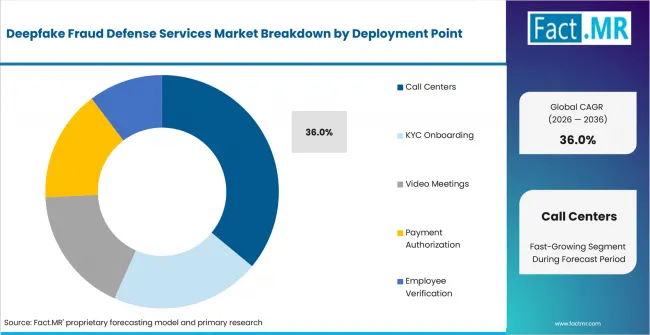
Deepfake Fraud Defense Services Market Analysis By Deployment Point | Source: Fact.MR
Call centers are projected to capture 36.0% share in 2026 because phone channels are exposed to voice cloning. KYC onboarding follows as deepfakes target remote identity checks. Video meetings create risk in finance and treasury functions. Payment authorization workflows need identity confirmation before release. Employee verification protects workforce access.
- Call Centers: Phone teams need real-time checks before account actions.
- KYC Onboarding: Identity teams need deepfake screening during remote verification.
- Payment Approval: Treasury teams need proof before acting on urgent requests.
Deepfake Fraud Defense Services Market Analysis by Customer Type
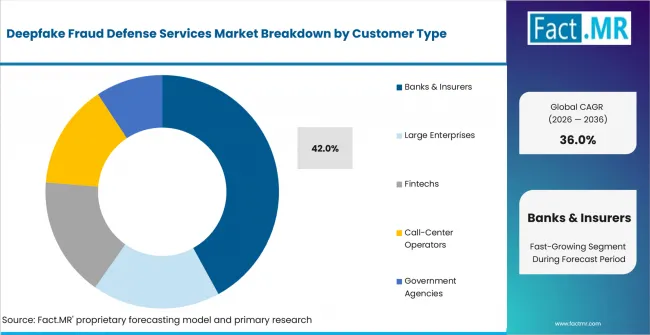
Deepfake Fraud Defense Services Market Analysis By Customer Type | Source: Fact.MR
Banks and insurers lead because fraud losses can move quickly through payment and claims systems. Fintechs follow because remote onboarding is central to growth. Banks and insurers are anticipated to hold 42.0% share in 2026 because deepfake fraud can affect regulated client workflows. Large enterprises adopt services for executive impersonation defense. Call-center operators need synthetic caller controls.
- Banks & Insurers: Financial firms need stronger checks for client and payment workflows.
- Fintechs: Digital finance firms need deepfake-resistant onboarding.
- Enterprises: Corporate teams need defense against CEO fraud and video impersonation.
Deepfake Fraud Defense Services Market Analysis by Delivery Model
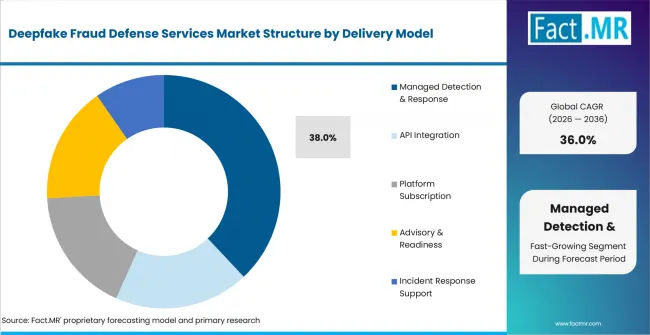
Deepfake Fraud Defense Services Market Analysis By Delivery Model | Source: Fact.MR
Managed detection & response is expected to represent 38.0% share in 2026 because deepfake threats require live review and rapid escalation. API integration supports detection inside call-center and KYC systems. Platform subscriptions suit firms with internal fraud teams. Advisory services help define risk rules. Incident response support helps after a confirmed impersonation attempt.
- Managed Response: Service teams help review alerts and support escalation.
- API Integration: APIs place detection inside existing fraud workflows.
- Incident Support: Response services help firms review losses after an attack.
Deepfake Fraud Defense Services Market Drivers, Restraints, and Opportunities
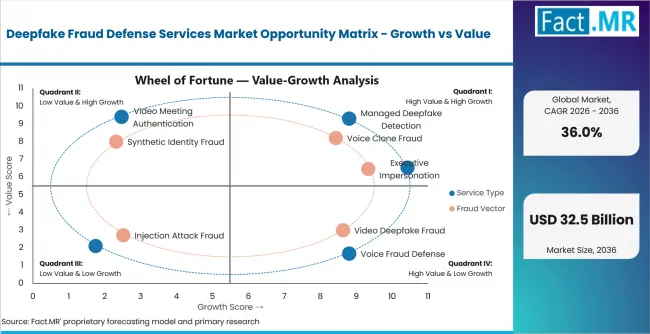
Deepfake Fraud Defense Services Market Opportunity Matrix Growth Vs Value | Source: Fact.MR
Deepfake fraud defense services are gaining demand as AI-enabled fraud becomes harder to detect across voice and identity workflows. Contact centers face higher risk from voice cloning and impersonation attempts. Banks and payment firms need stronger checks against synthetic identities and fake customer instructions. Enterprises also need tools that can verify people during video meetings, remote onboarding and digital approvals.
The main restraint is false confidence in older identity controls. Standard voice authentication and visual checks can miss synthetic media. Fraud teams also need human escalation rules because detection results may not always be clear. Smaller firms may delay adoption due to integration cost.
Opportunities in the Deepfake Fraud Defense Services Market
- Call-Center Protection: Providers can add voice-clone checks to high-risk calls.
- KYC Screening: Identity teams can use deepfake checks during onboarding.
- Executive Defense: Enterprises can verify leaders before payment approvals.
Regional Analysis
Based on regional analysis, the deepfake fraud defense services market is segmented into North America, Western Europe, East Asia and other regions.
.webp "Top Country Growth Comparison Deepfake Fraud Defense Services Market Cagr (2026 2036)")
Top Country Growth Comparison Deepfake Fraud Defense Services Market Cagr (2026 2036) | Source: Fact.MR
| Country | CAGR 2026 to 2036 |
|---|---|
| United States | 38.2% |
| United Kingdom | 37.3% |
| Germany | 36.4% |
| South Korea | 35.7% |
| Japan | 34.9% |
Source: Fact.MR analysis. Updated Jun 18, 2026
Source: Fact.MR analysis, based on proprietary forecasting model and primary research.
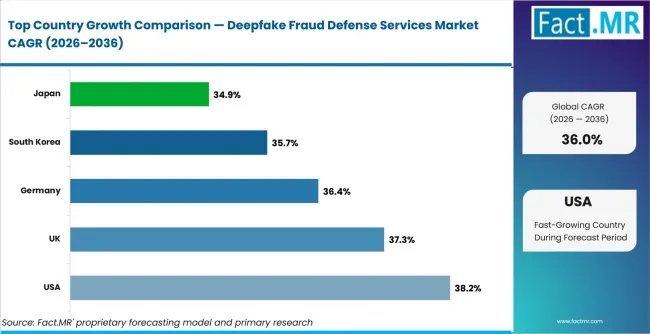
Deepfake Fraud Defense Services Market Cagr Analysis By Country | Source: Fact.MR
North America Deepfake Fraud Defense Services Market Analysis
Deepfake Fraud Defense Services Market Country Value Analysis | Source: Fact.MR
North America demand is led by the United States. Financial institutions and large enterprises are moving deepfake defense into fraud operations. Call-center risk and executive impersonation are the main adoption triggers.
- United States: The United States is projected to record 38.2% CAGR through 2036 as AI-enabled fraud becomes a board-level risk. Reality Defender supports enterprise deepfake detection across critical communications. Growth will favor providers that can connect real-time alerts with fraud operations and incident escalation.
Western Europe Deepfake Fraud Defense Services Market Analysis
Deepfake Fraud Defense Services Market Europe Country Market Share Analysis, 2026 & 2036 | Source: Fact.MR
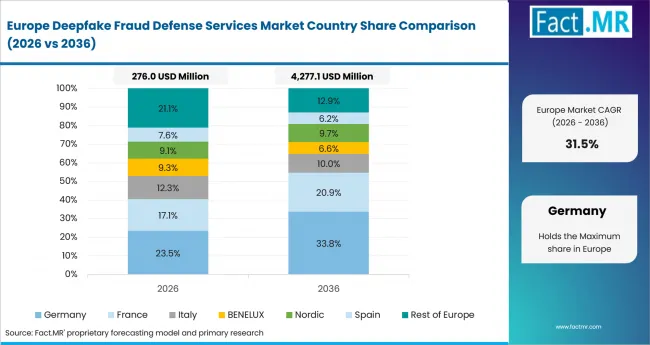
Western Europe demand is led by the United Kingdom and Germany. Banks will adopt services to protect call centers and remote onboarding. Large enterprises will focus on executive impersonation.
- United Kingdom: UK banks and insurers are strengthening fraud controls as AI-generated impersonation becomes more realistic. GOV.UK stated on March 26, 2026 that banking and insurance institutions require deepfake detection to combat sophisticated fraud, identity theft, voice cloning and synthetic identity fraud [2]. The United Kingdom is likely to post 37.3% CAGR through 2036 because financial firms need managed defense for customer interactions. Call centers need real-time synthetic voice checks to reduce fraud risk across authentication and customer service workflows.
- Germany: Germany is set to advance at 36.4% CAGR through 2036 as banks and insurers invest in secure identity controls. Enterprises will focus on deepfake video risk in payment approval and supplier fraud. KYC teams will also review onboarding defenses against injection attacks. German adoption will move carefully because firms need clear audit records.
East Asia Deepfake Fraud Defense Services Market Analysis
Deepfake Fraud Defense Services Market South Korea Market Share Analysis By Fraud Vector | Source: Fact.MR
East Asia demand is supported by South Korea and Japan. Digital banking and mobile services create a strong base for identity fraud defense. Enterprises also face video impersonation risk in supplier payments.
- South Korea: South Korea is forecast at 35.7% CAGR through 2036 as digital banks and call-center operators face synthetic caller risk. Remote financial services create a wide attack surface. KYC teams will need deepfake-resistant checks as onboarding shifts further into mobile channels.
- Japan: Japanese financial institutions are adopting fraud-defense services carefully. Banks will test deepfake detection in call centers and video workflows before broader rollout. Japan is expected to register 34.9% CAGR through 2036 as regulated firms strengthen identity assurance. iProov’s 2026 update highlights enterprise demand for human presence assurance at scale [3]. Growth will favor providers that support strong verification records and low-friction user experience.
Deepfake Fraud Defense Services Market Japan Market Share Analysis By Service Type | Source: Fact.MR
Competitive Aligners for Market Suppliers
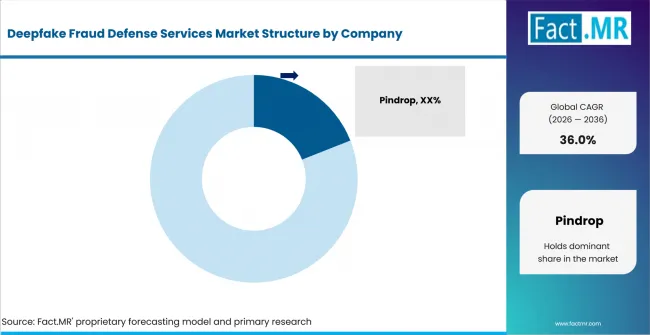
Deepfake Fraud Defense Services Market Analysis By Company | Source: Fact.MR
The deepfake fraud defense services market includes voice security firms and enterprise detection providers. The Verge reported on April 16, 2026 that Reality Defender, Pindrop and GetReal represent a growing deepfake detection industry focused largely on preventing corporate fraud [4]. Pindrop supports voice-focused deepfake defense. Reality Defender supports enterprise detection workflows. GetReal supports deepfake detection for synthetic and manipulated media.
Competition is centered on detection accuracy and workflow integration. Pindrop is positioned around voice and call-center defense. Reality Defender is positioned around multimodal deepfake detection. iProov is positioned around liveness and human presence assurance. Sumsub is positioned around KYC and fraud-prevention workflows. Daon and GetReal Labs strengthen the market through biometric identity and forensic media review.
Supplier strength through 2036 will come from managed response and integration depth. Detection alone is not enough for banks. Fraud teams need alerts that fit existing risk systems. Providers that support call-center workflows and KYC operations will gain stronger demand.
Key Companies in Deepfake Fraud Defense Services Market
- Pindrop
- Reality Defender
- iProov
- Sumsub
- Daon
- GetReal Labs
Bibliography
- [1] Lalchand, S., Srinivas, V., Maggiore, B., & Henderson, J. (2024, May 29). Generative AI is expected to magnify the risk of deepfakes and other fraud in banking. Deloitte Insights.
- [2] Department for Science, Innovation & Technology. (2026, March 26). Deepfake detection technology. GOV.UK.
- [3] iProov. (2026, March 4). iProov scales to over 1 million daily transactions as deepfakes redefine the enterprise attack surface.
- [4] Del Valle, G. (2026, April 16). The only way to fight deepfakes is by making deepfakes. The Verge.
This Report Addresses
- Strategic intelligence on deepfake fraud defense services across service type, fraud vector and delivery model.
- Forecast mapping from USD 1.5 billion in 2026 to USD 32.5 billion by 2036.
- Segment analysis covering managed detection, voice clone fraud, call centers and banks.
- Regional outlook covering the United States, United Kingdom, Germany, South Korea and Japan.
- Competitive analysis of Pindrop, Reality Defender, iProov, Sumsub, Daon and GetReal Labs.
- Service opportunity review across call-center defense, KYC screening and executive impersonation protection.
- Adoption review across banks, insurers, fintechs and large enterprises.
- Verified catalyst review based on Deloitte’s AI fraud-loss forecast and the Arup deepfake incident.
Deepfake Fraud Defense Services Market Definition
The deepfake fraud defense services market covers managed services that protect banks and enterprises from synthetic voice and video impersonation. These services detect deepfake media in calls and executive communications. The market focuses on service-led fraud defense rather than generic deepfake detection software.
Deepfake Fraud Defense Services Market Inclusions
The scope includes voice-clone fraud defense and executive impersonation protection. It includes managed monitoring and incident support. Banks and large enterprises are included.
Deepfake Fraud Defense Services Market Exclusions
The scope excludes basic media moderation with no fraud-defense function. It excludes consumer deepfake detection apps. It excludes generic biometric software that does not address synthetic media fraud. It also excludes cyber awareness training unless it is tied to deepfake fraud response.
Deepfake Fraud Defense Services Market Research Methodology
- Primary Research:
- Primary research includes discussions with fraud leaders and call-center security specialists. Banking technology and KYC operations teams were reviewed separately.
- Desk Research:
- Desk research reviews deepfake fraud reports and company product pages. Provider activity across listed companies supports validation.
- Market-Sizing and Forecasting:
- Market estimates are developed through fraud-loss signals and provider activity.
- Data Validation and Update Cycle:
- Forecasts are checked through provider updates and official catalyst tracking.
Segmentation
Scope of the Report
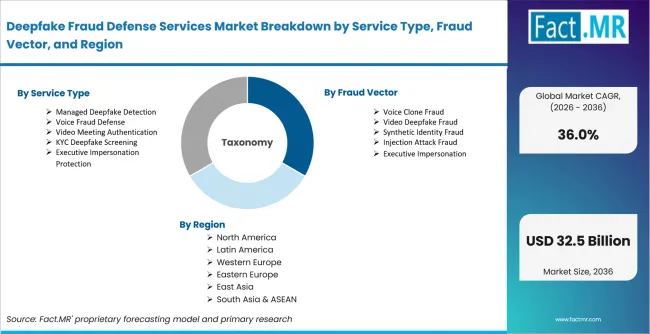
Deepfake Fraud Defense Services Market Breakdown By Service Type, Fraud Vector, And Region | Source: Fact.MR
| Attribute | Details |
|---|---|
| Quantitative Units | USD 1.5 billion in 2026 to USD 32.5 billion by 2036 at 36.0% CAGR |
| Market Definition | Managed services protecting banks and enterprises from voice-clone and video deepfake fraud |
| Service Type | Managed Deepfake Detection / Voice Fraud Defense / Video Meeting Authentication / KYC Deepfake Screening / Executive Impersonation Protection |
| Fraud Vector | Voice Clone Fraud / Video Deepfake Fraud / Synthetic Identity Fraud / Injection Attack Fraud / Executive Impersonation |
| Deployment Point | Call Centers / KYC Onboarding / Video Meetings / Payment Authorization / Employee Verification |
| Customer Type | Banks & Insurers / Large Enterprises / Fintechs / Call-Center Operators / Government Agencies |
| Delivery Model | Managed Detection & Response / API Integration / Platform Subscription / Advisory & Readiness / Incident Response Support |
| Regions Covered | North America / Western Europe / East Asia / Other Regions |
| Countries Covered | United States / United Kingdom / Germany / South Korea / Japan |
| Key Companies Profiled | Pindrop, Reality Defender, iProov, Sumsub, Daon and GetReal Labs |
| Forecast Period | 2026 to 2036 |
| Approach | Hybrid top-down and bottom-up approach using AI fraud exposure, financial institution adoption, call-center risk and provider activity |
Source: Fact.MR analysis. Updated Jun 18, 2026
Deepfake Fraud Defense Services Market Analysis by Segments
-
By Service Type:
- Managed Deepfake Detection
- Voice Fraud Defense
- Video Meeting Authentication
- KYC Deepfake Screening
- Executive Impersonation Protection
-
By Fraud Vector:
- Voice Clone Fraud
- Video Deepfake Fraud
- Synthetic Identity Fraud
- Injection Attack Fraud
- Executive Impersonation
-
By Deployment Point:
- Call Centers
- KYC Onboarding
- Video Meetings
- Payment Authorization
- Employee Verification
-
By Customer Type:
- Banks & Insurers
- Large Enterprises
- Fintechs
- Call-Center Operators
- Government Agencies
-
By Delivery Model:
- Managed Detection & Response
- API Integration
- Platform Subscription
- Advisory & Readiness
- Incident Response Support
-
By Region:
- North America
- United States
- Canada
- Western Europe
- United Kingdom
- Germany
- France
- Netherlands
- Spain
- East Asia
- Japan
- South Korea
- China
- Other Regions
- Latin America
- Middle East and Africa
- North America
Frequently Asked Questions
What is the Deepfake Fraud Defense Services Market size in 2026?
What will the Deepfake Fraud Defense Services Market be worth by 2036?
What CAGR is projected for the Deepfake Fraud Defense Services Market?
Which service type leads the market?
Which country grows fastest in the market?
How does the United Kingdom perform in this market?
How does Germany perform in this market?
How does South Korea perform in this market?
How does Japan perform in this market?
What are deepfake fraud defense services?
Why do banks need deepfake fraud defense services?
What restrains the market?
What is the main opportunity in this market?
Who worked on this report


Preview the report firsthand - request a free sample
Free SampleGet the brochure for pricing and purchase details
Download PDF