B2B E-Commerce Delivery and Appointment Scheduling Platforms Market Size, Share, Growth and Forecast (2026 - 2036)

The B2B E-Commerce Delivery and Appointment Scheduling Platforms Market is segmented by Component (Software and Services), Deployment (Cloud and On-Premise), Scheduling Type (Delivery Appointment Scheduling, Dock Scheduling, Pickup Scheduling, Slot Booking, and Route-Linked Scheduling), Enterprise Size (Large Enterprises and SMEs), End Use (Industrial Distribution, Food & Beverage, Consumer Goods, Automotive, Healthcare, and Others), and Region. Forecast for 2026 to 2036.

Fact.MR analysis indicates that the B2B e-commerce delivery and appointment scheduling platforms market is experiencing a promise-versus-capacity dynamic. B2B sellers now face stronger pressure to offer buyer-friendly delivery windows, predictable appointments, and cleaner handoff coordination across warehouses, docks, carriers, and customer sites.

B2B E-Commerce Delivery and Appointment Scheduling Platforms Market Forecast By Fact.MR

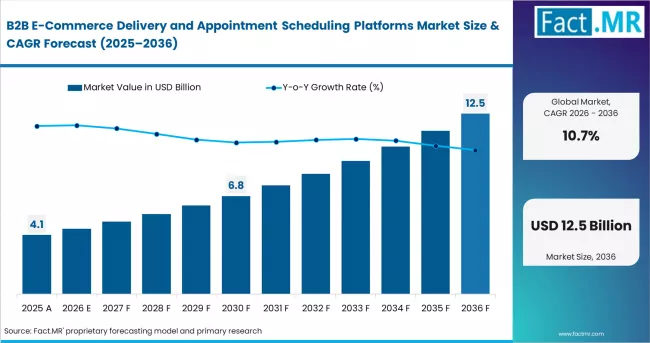
In 2025, the B2B e-commerce delivery and appointment scheduling platforms market was valued at USD 3.7 billion. Based on Fact.MR analysis, demand for B2B e-commerce delivery and appointment scheduling platforms is estimated to grow to USD 4.1 billion in 2026 and USD 11.3 billion by 2036. Fact.MR projects a CAGR of 10.7% during the forecast period.
B2b E Commerce Delivery And Appointment Scheduling Platforms Market Market Value Analysis

Metric Details
Industry Size (2026) USD 4.1 billion
Industry Value (2036) USD 11.3 billion
CAGR (2026 to 2036) 10.7%

Summary of B2B E-Commerce Delivery and Appointment Scheduling Platforms Market

  • Market Definition
    • The market includes platforms that coordinate delivery appointments, pickup windows, dock slots, and receiving schedules for B2B e-commerce and distribution operations.
  • Demand Drivers
    • B2B ecommerce continues to expand digitally even when total B2B sales are comparatively flat, which increases pressure on fulfillment coordination.
    • Warehouses and customer sites need cleaner dock and slot management because labor and equipment planning now depend more heavily on predictable arrivals.
    • Pickup and delivery milestones increasingly feed visibility, ETA planning, and downstream operations, which raises the value of structured appointment workflows. [2]
  • Key Segments Analyzed
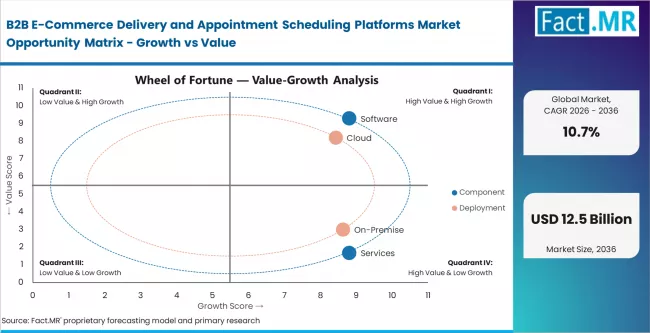
    • By Component, Software is expected to hold 71.3% share in 2026, supported by the central role of slot logic, workflow rules, and capacity orchestration.
    • By Deployment, Cloud is projected to account for 67.8% share in 2026 because scheduling environments change frequently across partners, sites, and networks.
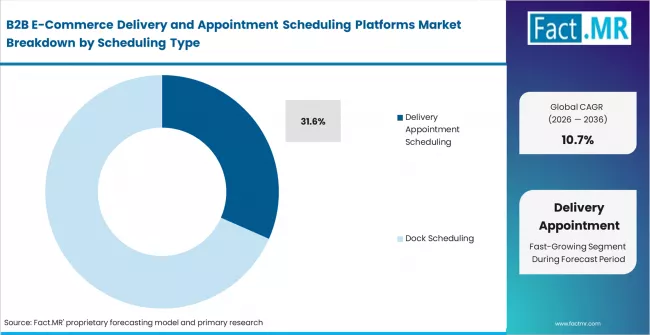
    • By Scheduling Type, Delivery Appointment Scheduling is likely to capture 31.6% share in 2026 due to its direct role in coordinating customer handoff and receiving capacity.
  • Analyst Opinion at Fact.MR
    • Shambhu Nath Jha, Senior Analyst at Fact.MR, states, that buyers do not adopt these platforms because booking a delivery slot is complicated on its own. They adopt them because poor scheduling disrupts much larger commercial workflows. A missed receiving window can ripple through labor planning, carrier detention, inventory availability, and customer trust. The strongest platforms therefore compete on coordination quality and exception control rather than on booking convenience alone.
  • Strategic Implications
    • B2B sellers should treat delivery scheduling as a service and capacity discipline, not only as a warehouse admin task.
    • Platform buyers need tighter integration between order, transportation, and dock workflows before they pursue more appointment promises.
    • Vendors that connect delivery appointments, pickup scheduling, and dock-capacity logic are better positioned than suppliers focused on isolated scheduling steps.
  • Methodology
    • Focus on decision-makers responsible for appointment control, warehouse throughput, and B2B fulfillment service levels.
    • Uses current B2B ecommerce and logistics-platform sources rather than generalized software-market figures.
    • Connects digital B2B order growth with appointment-intensive distribution workflows and scheduling software penetration.
    • Cross-checks against current scheduling features, release updates, and operational use cases in logistics networks.

The market is projected to generate USD 7.2 billion in absolute opportunity between 2026 and 2036. Growth remains strong because B2B commerce is becoming more service-sensitive at the fulfillment stage. Buyers increasingly expect delivery coordination that fits receiving hours, dock constraints, labor planning, and site-specific rules. That pushes sellers and distributors to digitize appointment booking, dock calendars, pickup scheduling, and route-linked timing rather than handling them manually.

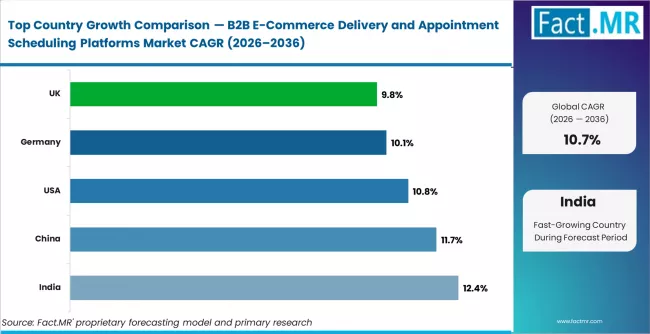
India leads with a projected CAGR of 12.4% through 2036, driven by rapid growth in digital B2B commerce and increasing need for structured delivery scheduling and dock coordination across expanding logistics networks. China follows at 11.7%, supported by large-scale distribution activity and rising adoption of digitized scheduling and partner coordination workflows. The United States records 10.8%, with growth anchored in mature B2B e-commerce volumes and strong reliance on appointment-driven warehouse and delivery operations. Germany grows at 10.1%, driven by industrial and distribution-heavy environments that require disciplined dock and delivery scheduling. The United Kingdom expands at 9.8%, supported by increasing demand for predictable B2B receiving and delivery timing.

B2B E-Commerce Delivery and Appointment Scheduling Platforms Market Drivers, Restraints, and Opportunities
B2b E Commerce Delivery And Appointment Scheduling Platforms Market Opportunity Matrix Growth Vs Value

A key driver is the continued growth of digital B2B buying. Digital Commerce 360’s 2026 forecast shows U.S. B2B ecommerce rising 13% in 2025 to USD 2.93 trillion even while total B2B sales were nearly flat. That matters because digital growth does not stop at online order placement. It creates more pressure to coordinate fulfillment timing cleanly, especially when buyers expect faster, more transparent delivery experiences. The more digital the order flow becomes, the harder it is to rely on manual scheduling and fragmented communication.

The main restraint is process fragmentation. Appointment scheduling often sits between order systems, transportation planning, warehouse operations, and customer receiving rules. A platform can be technically sound and still underperform when partner data is inconsistent, site rules are not standardized, or carriers are outside the workflow. This is why adoption depends not just on software demand but on operational discipline and integration maturity.

Opportunities in the B2B E-Commerce Delivery and Appointment Scheduling Platforms Market

  • Dock-network digitization: Continued product development in SAP’s business-network scheduling and logistics stack shows room for broader digitization of dock and gate workflows. [4]
  • Pickup-linked visibility: Project44’s pickup-event framework highlights how appointment accuracy feeds visibility, ETA reliability, and downstream resource planning.
  • Integrated logistics orchestration: Oracle’s broader logistics positioning supports opportunity for vendors that connect scheduling with transportation, distribution, and fulfillment processes rather than treating appointments as stand-alone tasks. [5]

Regional Analysis

Based on the regional analysis, the B2B E-Commerce Delivery and Appointment Scheduling Platforms Market is segmented into North America, Europe, Asia Pacific, Latin America, and Middle East & Africa across 40 plus countries.

Top Country Growth Comparison B2b E Commerce Delivery And Appointment Scheduling Platforms Market Cagr (2026 2036)

Country CAGR (2026 to 2036)
India 12.4%
China 11.7%
United States 10.8%
Germany 10.1%
United Kingdom 9.8%

Source: Fact.MR analysis, based on proprietary forecasting model and primary research.
B2b E Commerce Delivery And Appointment Scheduling Platforms Market Cagr Analysis By Country

North America B2B E-Commerce Delivery and Appointment Scheduling Platforms Market Analysis
B2b E Commerce Delivery And Appointment Scheduling Platforms Market Country Value Analysis

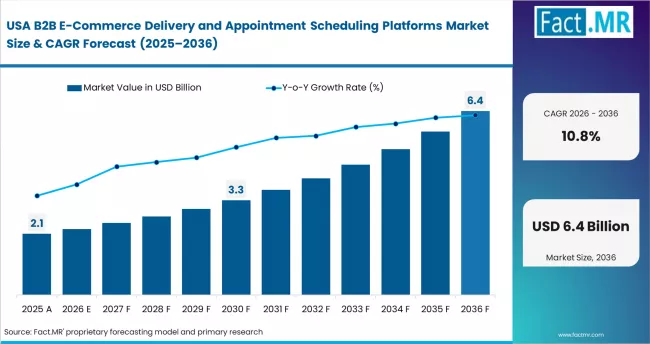
North America remains the largest revenue base in this market because digital B2B commerce is already substantial and distribution networks are mature enough to feel the pressure of scheduling inefficiency directly. The United States anchors regional demand through its scale in B2B digital sales and its heavy dependence on appointment-driven warehouse and customer-site delivery. That combination keeps scheduling platforms relevant as both a service and productivity tool.

  • United States: The U.S. market is projected to grow at 10.8% CAGR, reflecting the scale of digital B2B transactions and increasing reliance on structured appointment workflows. Businesses are adopting scheduling platforms to manage dock congestion, improve delivery predictability, and enhance coordination between trading partners. As fulfillment complexity increases, these platforms play a central role in maintaining operational efficiency and service reliability.

Europe B2B E-Commerce Delivery and Appointment Scheduling Platforms Market Analysis
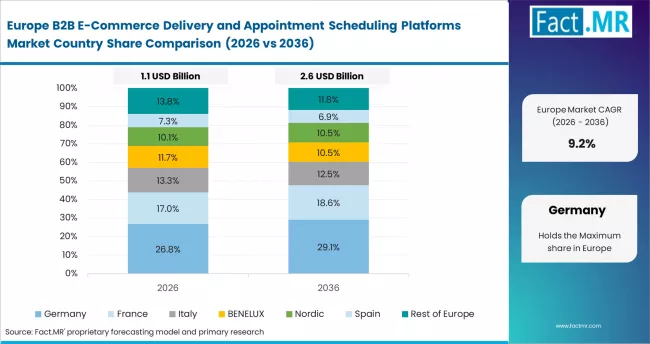
B2b E Commerce Delivery And Appointment Scheduling Platforms Market Europe Country Market Share Analysis, 2026 & 2036

Europe remains a strong modernization market because logistics environments there often place high value on dock efficiency, appointment discipline, and workflow standardization across trading partners. Germany and the United Kingdom lead in this study because both markets combine strong industrial and distribution activity with enterprise demand for cleaner coordination between inbound and outbound movements.

  • Germany: Germany is projected to grow at 10.1% CAGR, supported by its industrial base and distribution-heavy operations. Companies rely on structured appointment scheduling to manage high volumes of inbound and outbound shipments while maintaining efficiency in warehouse operations.
  • United Kingdom: The UK is expected to advance at 9.8% CAGR, driven by increasing digitization of commercial workflows and the need for predictable delivery and receiving schedules. Businesses are investing in platforms that improve coordination across supply chain partners and reduce operational bottlenecks.

Asia Pacific B2B E-Commerce Delivery and Appointment Scheduling Platforms Market Analysis

Asia Pacific is the fastest-growing region in this study because digital commerce adoption, warehouse modernization, and logistics-software penetration are all rising from a lower base in several major markets. India and China stand out because both combine large B2B trade flows with growing operational need for more disciplined scheduling, pickup coordination, and dock visibility across expanding supply chain networks.

  • India: Demand for B2B e-commerce delivery and appointment scheduling platforms in India is projected to grow at 12.4% CAGR, driven by rising digital order volumes and expanding warehouse infrastructure. Businesses are adopting these platforms to manage slot booking, reduce congestion, and improve coordination between suppliers and distribution centers. Growth is further supported by increasing focus on logistics efficiency and supply chain transparency.
  • China: The China market is expected to expand at 11.7% CAGR, reflecting large-scale distribution activity and maturing logistics workflows. Companies are increasingly adopting digital scheduling tools to manage complex supply chains, improve dock utilization, and enhance coordination across multiple partners. High transaction volumes and rapid delivery expectations further reinforce the need for advanced scheduling solutions.

Competitive Aligners for Market Players
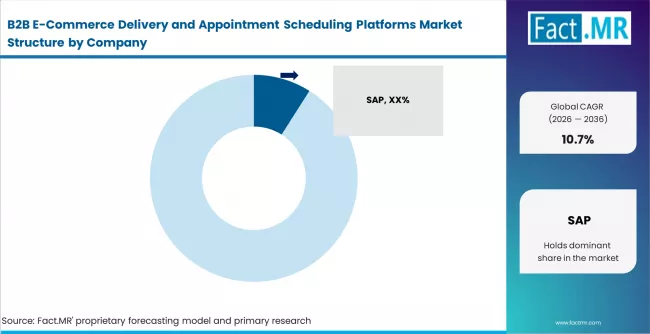
B2b E Commerce Delivery And Appointment Scheduling Platforms Market Analysis By Company

The market remains moderately concentrated, with enterprise platforms such as SAP, Oracle, Blue Yonder, Salesforce, e2open, and project44 active across scheduling, transportation, and coordination workflows. Competition is no longer centered on basic calendar functionality. Platform value is increasingly defined by how effectively systems align partner access, dock capacity, pickup scheduling, and operational exceptions within a single, usable process environment. Current positioning from SAP around dock appointment workflows and Oracle’s broader logistics platforms reflects this shift toward integrated execution.

Buyers are becoming more selective in how they evaluate solutions. The distinction between simple appointment booking tools and platforms that improve execution reliability is becoming more pronounced. Systems that only enable slot booking offer limited operational impact if they do not address downstream constraints such as dock congestion, labor planning, or shipment prioritization.

Decision-making is now tied to measurable outcomes. Throughput improvement, reduced vehicle waiting time, better resource planning, and fewer fulfillment disruptions are key performance indicators influencing platform selection. Buyers are prioritizing solutions that connect scheduling decisions with real-time operational conditions, ensuring that appointment systems contribute directly to logistics efficiency rather than functioning as isolated tools.

Key Players in B2B E-Commerce Delivery and Appointment Scheduling Platforms Market

  • SAP
  • Oracle
  • Blue Yonder
  • Salesforce
  • e2open
  • project44
  • Descartes Systems Group

Bibliography

  • [1] Digital Commerce 360. B2B Ecommerce Market Forecast Report.
  • [2] Project44. What is a pickup event in supply chain management?
  • [3] SAP Help Portal. SAP Dock Appointment Scheduling.
  • [4] SAP Community. SAP Business Network for Logistics - Dock Appointment Scheduling: announcing
  • [5] Oracle. Warehouse Management - Logistics.

This Report Addresses

  • Strategic outlook for B2B e-commerce delivery and appointment scheduling platform demand.
  • Forecast trajectory from USD 4.1 billion in 2026 to USD 11.3 billion by 2036.
  • Why delivery appointments, pickup windows, and dock scheduling have become core B2B fulfillment workflows.
  • Segment analysis by component, deployment, scheduling type, enterprise size, and end use.
  • Regional demand patterns across North America, Europe, Asia Pacific, and Latin America.
  • Competitive positioning of logistics, supply chain, and scheduling platform providers.
  • The role of dock capacity, partner coordination, and visibility in market expansion.
  • Why the category is moving from manual coordination toward structured, networked scheduling execution.

B2B E-Commerce Delivery and Appointment Scheduling Platforms Market Definition

The market covers software platforms and related services used to schedule, coordinate, manage, and optimize delivery appointments, pickup windows, dock time slots, and receiving schedules in B2B e-commerce and distribution operations. These platforms help shippers, distributors, warehouses, carriers, and customer receiving sites align order timing with capacity, labor, and transport execution.

B2B E-Commerce Delivery and Appointment Scheduling Platforms Market Inclusions

Market scope includes delivery appointment scheduling, dock appointment scheduling, carrier self-booking, pickup-window management, slot optimization, gate processing support, schedule-change management, and the related services required to integrate these workflows into B2B order management, warehouse operations, and transportation systems. It covers solutions used in both shipper-controlled and network-based scheduling environments.

B2B E-Commerce Delivery and Appointment Scheduling Platforms Market Exclusions

The scope excludes generic calendar tools that lack logistics workflow logic, standard transportation management platforms sold without appointment scheduling functionality, and e-commerce storefront software that does not manage receiving, pickup, or dock-slot coordination. It also excludes pure route-optimization tools that operate after the appointment has already been fixed.

B2B E-Commerce Delivery and Appointment Scheduling Platforms Market Research Methodology

  • Primary Research
    • Interviews with warehouse operations heads, transportation managers, B2B ecommerce leaders, dock supervisors, supply chain IT architects, and carrier coordination teams.
  • Desk Research
    • Review of Digital Commerce 360 B2B ecommerce data, SAP logistics documentation, Oracle logistics product material, and current appointment-management and pickup-event resources from supply chain software vendors.
  • Market-Sizing and Forecasting
    • Hybrid model based on B2B ecommerce growth, dock- and appointment-intensive distribution activity, software penetration in scheduling workflows, and value capture across software and services.
  • Data Validation and Update Cycle
    • Validation against current product capabilities, current release evidence in scheduling functionality, and the operational need for digital coordination at warehouses and customer receiving sites. [1]

Segmental Analysis

B2B E-Commerce Delivery and Appointment Scheduling Platforms Market Analysis by Component
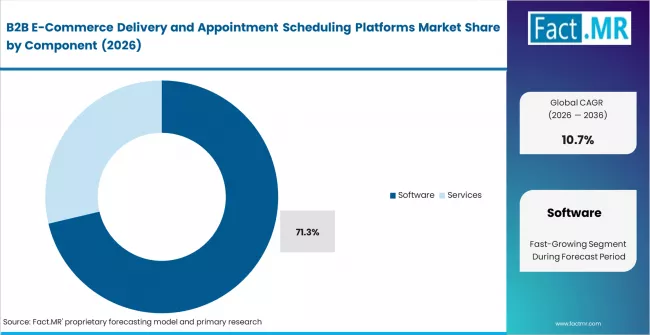
B2b E Commerce Delivery And Appointment Scheduling Platforms Market Analysis By Component

Software is expected to account for 71.3% share in 2026 as the core value in this market sits inside scheduling logic, partner workflows, rule handling, and capacity visibility rather than in deployment services alone. A useful platform does more than present open slots. It enforces dock constraints, aligns appointment duration with cargo needs, supports self-booking or planner-controlled flows, and handles schedule changes without constant manual intervention. SAP’s current logistics materials explicitly include dock appointment scheduling and gate processing, while its 2025 updates show continued refinement around self-booking and timeslot behavior. That supports software as the main value layer, while services remain important for integration and process redesign. [3]

  • Workflow control: Software captures the value because capacity rules, booking permissions, and exception handling all depend on system logic.
  • Partner coordination: Platforms must support communication across shippers, carriers, warehouses, and receiving locations rather than within one site alone.
  • Repeatability: Once configured well, software can govern many sites and trading partners more efficiently than manual scheduling can.

B2B E-Commerce Delivery and Appointment Scheduling Platforms Market Analysis by Deployment
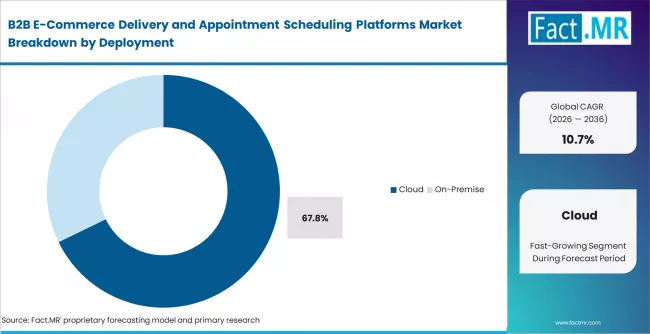
B2b E Commerce Delivery And Appointment Scheduling Platforms Market Analysis By Deployment

Cloud deployment is projected to account for 67.8% share over the assessment period. Growth is driven by the need to frequently update appointment rules, dock capacity, user roles, and partner access across distributed logistics networks. Cloud platforms enable centralized control with real-time coordination across sites, carriers, and customers. SAP and Oracle are aligning their logistics solutions with this model, supporting shared scheduling workflows. Adoption is accelerating as organizations prioritize scalability, faster configuration, and improved collaboration across increasingly complex supply chain environments.

  • Network reach: Cloud deployment supports multi-party scheduling more naturally than isolated site-level systems.
  • Update speed: Scheduling rules can be changed more quickly when the platform is continuously delivered and centrally managed.
  • Scalability: Growing partner networks and site counts favor deployment models that can expand without repeated local rebuilds.

B2B E-Commerce Delivery and Appointment Scheduling Platforms Market Analysis by Scheduling Type
B2b E Commerce Delivery And Appointment Scheduling Platforms Market Analysis By Scheduling Type

Delivery Appointment Scheduling is likely to account for 31.6% share in 2026, as the commercial pressure in B2B delivery is usually visible at the receiving point. A buyer may accept digital ordering, though service still breaks if the delivery cannot be timed to dock availability, labor readiness, or site rules. SAP’s help documentation directly describes dock appointment scheduling for loading and unloading vehicles and for managing workload at loading points. That makes delivery appointment scheduling the clearest operational anchor in this market, while pickup and dock booking remain closely linked adjacent functions.

  • Receiving alignment: Delivery scheduling matters because customers and warehouses need inbound timing that matches labor and dock readiness.
  • Service credibility: Better appointments reduce failed handoffs, waiting time, and reactive rescheduling.
  • Operational flow: The segment leads because delivery timing affects downstream unloading, putaway, and customer service performance.

Scope of the Report
B2b E Commerce Delivery And Appointment Scheduling Platforms Market Breakdown By Component, Deployment, And Region

Attribute Details
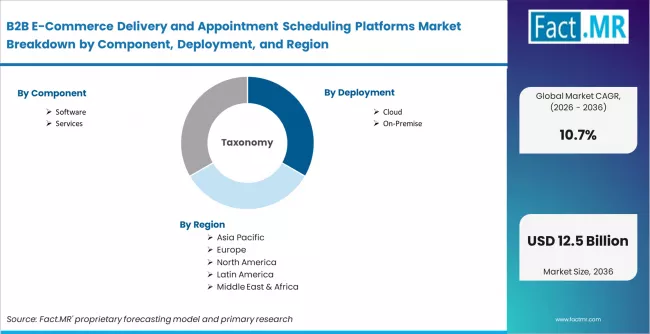
Quantitative Units USD 4.1 billion (2026) to USD 11.3 billion (2036), at a CAGR of 10.7%
Market Definition Platforms and related services used to schedule delivery appointments, pickup windows, dock slots, and receiving schedules in B2B e-commerce and distribution environments
Component Segmentation Software, Services
Deployment Segmentation Cloud, On-Premise
Scheduling Type Segmentation Delivery Appointment Scheduling, Dock Scheduling, Pickup Scheduling, Slot Booking, Route-Linked Scheduling
Enterprise Size Segmentation Large Enterprises, SMEs
End Use Segmentation Industrial Distribution, Food & Beverage, Consumer Goods, Automotive, Healthcare, Others
Regions Covered North America, Europe, Asia Pacific, Latin America, Middle East & Africa
Countries Covered India, China, United States, Germany, United Kingdom, Australia, Brazil, and 40+ countries
Key Companies Profiled SAP, Oracle, Blue Yonder, Salesforce, e2open, project44, Descartes Systems Group
Forecast Period 2026 to 2036
Approach Hybrid sizing based on B2B ecommerce growth, appointment-intensive distribution workflows, and software penetration across delivery and dock coordination environments

B2B E-Commerce Delivery and Appointment Scheduling Platforms Market by Segments

  • By Component:

    • Software
    • Services
  • By Deployment:

    • Cloud
    • On-Premise
  • By Scheduling Type:

    • Delivery Appointment Scheduling
    • Dock Scheduling
    • Pickup Scheduling
    • Slot Booking
    • Route-Linked Scheduling
  • By Enterprise Size:

    • Large Enterprises
    • SMEs
  • By End Use:

    • Industrial Distribution
    • Food & Beverage
    • Consumer Goods
    • Automotive
    • Healthcare
    • Others
  • By Region:

    • North America
      • United States
      • Canada
      • Mexico
    • Latin America
      • Brazil
      • Argentina
      • Chile
      • Rest of Latin America
    • Europe
      • Germany
      • United Kingdom
      • France
      • Italy
      • Spain
      • Rest of Europe
    • Asia Pacific
      • India
      • China
      • Japan
      • Australia
      • ASEAN
      • Rest of Asia Pacific
    • Middle East and Africa
      • Kingdom of Saudi Arabia
      • Other GCC Countries
      • Turkey
      • South Africa
      • Rest of Middle East and Africa

- Frequently Asked Questions -

How large is the B2B e-commerce delivery and appointment scheduling platforms market in 2025?

The market was valued at USD 3.7 billion in 2025.

What will the market size be in 2026?

Fact.MR estimates the market at USD 4.1 billion in 2026.

What is the projected market size by 2036?

The market is projected to reach USD 11.3 billion by 2036.

What is the expected CAGR from 2026 to 2036?

Fact.MR projects a 10.7% CAGR during the forecast period.

Which component segment is poised to lead the market?

Software is expected to lead with 71.3% share in 2026.

Which scheduling type holds the largest share?

Delivery Appointment Scheduling is projected to account for 31.6% share in 2026.

Which deployment segment dominates the market?

Cloud is likely to hold 67.8% share in 2026.

Which end-use segment leads the market?

Industrial Distribution is estimated to represent 22.8% share in 2026.

Which country shows the fastest growth?

India leads this study at 12.4% CAGR through 2036.

What is driving demand in this market?

Demand is driven by continued digital growth in B2B buying, stronger need for dock and receiving coordination, and wider pressure to replace manual appointment management with structured scheduling workflows.

What is the key challenge in this market?

The main challenge is process fragmentation across order systems, transportation plans, warehouse operations, and customer receiving rules, which can limit the value of scheduling platforms if operational discipline is weak.

Table of Content

  1. Executive Summary
    • Global Market Outlook
    • Demand to side Trends
    • Supply to side Trends
    • Technology Roadmap Analysis
    • Analysis and Recommendations
  2. Market Overview
    • Market Coverage / Taxonomy
    • Market Definition / Scope / Limitations
  3. Research Methodology
    • Chapter Orientation
    • Analytical Lens and Working Hypotheses
      • Market Structure, Signals, and Trend Drivers
      • Benchmarking and Cross-market Comparability
      • Market Sizing, Forecasting, and Opportunity Mapping
  4. Research Design and Evidence Framework
    • Desk Research Programme (Secondary Evidence)
      • Company Annual and Sustainability Reports
      • Peer-reviewed Journals and Academic Literature
      • Corporate Websites, Product Literature, and Technical Notes
      • Earnings Decks and Investor Briefings
      • Statutory Filings and Regulatory Disclosures
      • Technical White Papers and Standards Notes
      • Trade Journals, Industry Magazines, and Analyst Briefs
      • Conference Proceedings, Webinars, and Seminar Materials
      • Government Statistics Portals and Public Data Releases
      • Press Releases and Reputable Media Coverage
      • Specialist Newsletters and Curated Briefings
      • Expert Input and Fieldwork (Primary Evidence)
        • Primary Modes
          • Qualitative Interviews and Expert Elicitation
          • Quantitative Surveys and Structured Data Capture
          • Blended Approach
        • Why Primary Evidence is Used
        • Field Techniques
          • Interviews
          • Surveys
          • Focus Groups
          • Observational and In-context Research
          • Social and Community Interactions
        • Stakeholder Universe Engaged
          • C-suite Leaders
          • Board Members
          • Presidents and Vice Presidents
          • R&D and Innovation Heads
          • Technical Specialists
          • Domain Subject-matter Experts
          • Scientists
          • Physicians and Other Healthcare Professionals
        • Governance, Ethics, and Data Stewardship
          • Research Ethics
          • Data Integrity and Handling
      • Tooling, Models, and Reference Databases
  5. Data Engineering and Model Build
    • Data Acquisition and Ingestion
    • Cleaning, Normalisation, and Verification
    • Synthesis, Triangulation, and Analysis
    • Quality Assurance and Audit Trail
    • Market Background
      • Market Dynamics
        • Drivers
        • Restraints
        • Opportunity
        • Trends
      • Scenario Forecast
        • Demand in Optimistic Scenario
        • Demand in Likely Scenario
        • Demand in Conservative Scenario
      • Opportunity Map Analysis
      • Product Life Cycle Analysis
      • Supply Chain Analysis
      • Investment Feasibility Matrix
      • Value Chain Analysis
      • PESTLE and Porter’s Analysis
      • Regulatory Landscape
      • Regional Parent Market Outlook
      • Production and Consumption Statistics
      • Import and Export Statistics
  6. Global Market Analysis 2021 to 2025 and Forecast, 2026 to 2036
    • Historical Market Size Value (USD Million) Analysis, 2021 to 2025
    • Current and Future Market Size Value (USD Million) Projections, 2026 to 2036
      • Y to o to Y Growth Trend Analysis
      • Absolute $ Opportunity Analysis
  7. Global Market Pricing Analysis 2021 to 2025 and Forecast 2026 to 2036
  8. Global Market Analysis 2021 to 2025 and Forecast 2026 to 2036, By Component
    • Introduction / Key Findings
    • Historical Market Size Value (USD Million) Analysis By Component , 2021 to 2025
    • Current and Future Market Size Value (USD Million) Analysis and Forecast By Component , 2026 to 2036
      • Software
      • Services
    • Y to o to Y Growth Trend Analysis By Component , 2021 to 2025
    • Absolute $ Opportunity Analysis By Component , 2026 to 2036
  9. Global Market Analysis 2021 to 2025 and Forecast 2026 to 2036, By Deployment
    • Introduction / Key Findings
    • Historical Market Size Value (USD Million) Analysis By Deployment, 2021 to 2025
    • Current and Future Market Size Value (USD Million) Analysis and Forecast By Deployment, 2026 to 2036
      • Cloud
      • On-Premise
    • Y to o to Y Growth Trend Analysis By Deployment, 2021 to 2025
    • Absolute $ Opportunity Analysis By Deployment, 2026 to 2036
  10. Global Market Analysis 2021 to 2025 and Forecast 2026 to 2036, By Scheduling Type
    • Introduction / Key Findings
    • Historical Market Size Value (USD Million) Analysis By Scheduling Type, 2021 to 2025
    • Current and Future Market Size Value (USD Million) Analysis and Forecast By Scheduling Type, 2026 to 2036
      • Delivery Appointment Scheduling
      • Dock Scheduling
      • Pickup Scheduling
      • Slot Booking
      • Route-Linked Scheduling
    • Y to o to Y Growth Trend Analysis By Scheduling Type, 2021 to 2025
    • Absolute $ Opportunity Analysis By Scheduling Type, 2026 to 2036
  11. Global Market Analysis 2021 to 2025 and Forecast 2026 to 2036, By Region
    • Introduction
    • Historical Market Size Value (USD Million) Analysis By Region, 2021 to 2025
    • Current Market Size Value (USD Million) Analysis and Forecast By Region, 2026 to 2036
      • North America
      • Latin America
      • Western Europe
      • Eastern Europe
      • East Asia
      • South Asia and Pacific
      • Middle East & Africa
  12. Market Attractiveness Analysis By Region
  13. North America Market Analysis 2021 to 2025 and Forecast 2026 to 2036, By Country
    • Historical Market Size Value (USD Million) Trend Analysis By Market Taxonomy, 2021 to 2025
    • Market Size Value (USD Million) Forecast By Market Taxonomy, 2026 to 2036
      • By Country
        • USA
        • Canada
        • Mexico
      • By Component
      • By Deployment
      • By Scheduling Type
    • Market Attractiveness Analysis
      • By Country
      • By Component
      • By Deployment
      • By Scheduling Type
    • Key Takeaways
  14. Latin America Market Analysis 2021 to 2025 and Forecast 2026 to 2036, By Country
    • Historical Market Size Value (USD Million) Trend Analysis By Market Taxonomy, 2021 to 2025
    • Market Size Value (USD Million) Forecast By Market Taxonomy, 2026 to 2036
      • By Country
        • Brazil
        • Chile
        • Rest of Latin America
      • By Component
      • By Deployment
      • By Scheduling Type
    • Market Attractiveness Analysis
      • By Country
      • By Component
      • By Deployment
      • By Scheduling Type
    • Key Takeaways
  15. Western Europe Market Analysis 2021 to 2025 and Forecast 2026 to 2036, By Country
    • Historical Market Size Value (USD Million) Trend Analysis By Market Taxonomy, 2021 to 2025
    • Market Size Value (USD Million) Forecast By Market Taxonomy, 2026 to 2036
      • By Country
        • Germany
        • UK
        • Italy
        • Spain
        • France
        • Nordic
        • BENELUX
        • Rest of Western Europe
      • By Component
      • By Deployment
      • By Scheduling Type
    • Market Attractiveness Analysis
      • By Country
      • By Component
      • By Deployment
      • By Scheduling Type
    • Key Takeaways
  16. Eastern Europe Market Analysis 2021 to 2025 and Forecast 2026 to 2036, By Country
    • Historical Market Size Value (USD Million) Trend Analysis By Market Taxonomy, 2021 to 2025
    • Market Size Value (USD Million) Forecast By Market Taxonomy, 2026 to 2036
      • By Country
        • Russia
        • Poland
        • Hungary
        • Balkan & Baltic
        • Rest of Eastern Europe
      • By Component
      • By Deployment
      • By Scheduling Type
    • Market Attractiveness Analysis
      • By Country
      • By Component
      • By Deployment
      • By Scheduling Type
    • Key Takeaways
  17. East Asia Market Analysis 2021 to 2025 and Forecast 2026 to 2036, By Country
    • Historical Market Size Value (USD Million) Trend Analysis By Market Taxonomy, 2021 to 2025
    • Market Size Value (USD Million) Forecast By Market Taxonomy, 2026 to 2036
      • By Country
        • China
        • Japan
        • South Korea
      • By Component
      • By Deployment
      • By Scheduling Type
    • Market Attractiveness Analysis
      • By Country
      • By Component
      • By Deployment
      • By Scheduling Type
    • Key Takeaways
  18. South Asia and Pacific Market Analysis 2021 to 2025 and Forecast 2026 to 2036, By Country
    • Historical Market Size Value (USD Million) Trend Analysis By Market Taxonomy, 2021 to 2025
    • Market Size Value (USD Million) Forecast By Market Taxonomy, 2026 to 2036
      • By Country
        • India
        • ASEAN
        • Australia & New Zealand
        • Rest of South Asia and Pacific
      • By Component
      • By Deployment
      • By Scheduling Type
    • Market Attractiveness Analysis
      • By Country
      • By Component
      • By Deployment
      • By Scheduling Type
    • Key Takeaways
  19. Middle East & Africa Market Analysis 2021 to 2025 and Forecast 2026 to 2036, By Country
    • Historical Market Size Value (USD Million) Trend Analysis By Market Taxonomy, 2021 to 2025
    • Market Size Value (USD Million) Forecast By Market Taxonomy, 2026 to 2036
      • By Country
        • Kingdom of Saudi Arabia
        • Other GCC Countries
        • Turkiye
        • South Africa
        • Other African Union
        • Rest of Middle East & Africa
      • By Component
      • By Deployment
      • By Scheduling Type
    • Market Attractiveness Analysis
      • By Country
      • By Component
      • By Deployment
      • By Scheduling Type
    • Key Takeaways
  20. Key Countries Market Analysis
    • USA
      • Pricing Analysis
      • Market Share Analysis, 2025
        • By Component
        • By Deployment
        • By Scheduling Type
    • Canada
      • Pricing Analysis
      • Market Share Analysis, 2025
        • By Component
        • By Deployment
        • By Scheduling Type
    • Mexico
      • Pricing Analysis
      • Market Share Analysis, 2025
        • By Component
        • By Deployment
        • By Scheduling Type
    • Brazil
      • Pricing Analysis
      • Market Share Analysis, 2025
        • By Component
        • By Deployment
        • By Scheduling Type
    • Chile
      • Pricing Analysis
      • Market Share Analysis, 2025
        • By Component
        • By Deployment
        • By Scheduling Type
    • Germany
      • Pricing Analysis
      • Market Share Analysis, 2025
        • By Component
        • By Deployment
        • By Scheduling Type
    • UK
      • Pricing Analysis
      • Market Share Analysis, 2025
        • By Component
        • By Deployment
        • By Scheduling Type
    • Italy
      • Pricing Analysis
      • Market Share Analysis, 2025
        • By Component
        • By Deployment
        • By Scheduling Type
    • Spain
      • Pricing Analysis
      • Market Share Analysis, 2025
        • By Component
        • By Deployment
        • By Scheduling Type
    • France
      • Pricing Analysis
      • Market Share Analysis, 2025
        • By Component
        • By Deployment
        • By Scheduling Type
    • India
      • Pricing Analysis
      • Market Share Analysis, 2025
        • By Component
        • By Deployment
        • By Scheduling Type
    • ASEAN
      • Pricing Analysis
      • Market Share Analysis, 2025
        • By Component
        • By Deployment
        • By Scheduling Type
    • Australia & New Zealand
      • Pricing Analysis
      • Market Share Analysis, 2025
        • By Component
        • By Deployment
        • By Scheduling Type
    • China
      • Pricing Analysis
      • Market Share Analysis, 2025
        • By Component
        • By Deployment
        • By Scheduling Type
    • Japan
      • Pricing Analysis
      • Market Share Analysis, 2025
        • By Component
        • By Deployment
        • By Scheduling Type
    • South Korea
      • Pricing Analysis
      • Market Share Analysis, 2025
        • By Component
        • By Deployment
        • By Scheduling Type
    • Russia
      • Pricing Analysis
      • Market Share Analysis, 2025
        • By Component
        • By Deployment
        • By Scheduling Type
    • Poland
      • Pricing Analysis
      • Market Share Analysis, 2025
        • By Component
        • By Deployment
        • By Scheduling Type
    • Hungary
      • Pricing Analysis
      • Market Share Analysis, 2025
        • By Component
        • By Deployment
        • By Scheduling Type
    • Kingdom of Saudi Arabia
      • Pricing Analysis
      • Market Share Analysis, 2025
        • By Component
        • By Deployment
        • By Scheduling Type
    • Turkiye
      • Pricing Analysis
      • Market Share Analysis, 2025
        • By Component
        • By Deployment
        • By Scheduling Type
    • South Africa
      • Pricing Analysis
      • Market Share Analysis, 2025
        • By Component
        • By Deployment
        • By Scheduling Type
  21. Market Structure Analysis
    • Competition Dashboard
    • Competition Benchmarking
    • Market Share Analysis of Top Players
      • By Regional
      • By Component
      • By Deployment
      • By Scheduling Type
  22. Competition Analysis
    • Competition Deep Dive
      • SAP
        • Overview
        • Product Portfolio
        • Profitability by Market Segments (Product/Age /Sales Channel/Region)
        • Sales Footprint
        • Strategy Overview
          • Marketing Strategy
          • Product Strategy
          • Channel Strategy
      • Oracle
      • Blue Yonder
      • Salesforce
      • e2open
      • project44
      • Descartes Systems Group
  23. Assumptions & Acronyms Used

List Of Table

  • Table 1: Global Market Value (USD Million) Forecast by Region, 2021 to 2036
  • Table 2: Global Market Value (USD Million) Forecast by Component, 2021 to 2036
  • Table 3: Global Market Value (USD Million) Forecast by Deployment, 2021 to 2036
  • Table 4: Global Market Value (USD Million) Forecast by Scheduling Type, 2021 to 2036
  • Table 5: North America Market Value (USD Million) Forecast by Country, 2021 to 2036
  • Table 6: North America Market Value (USD Million) Forecast by Component, 2021 to 2036
  • Table 7: North America Market Value (USD Million) Forecast by Deployment, 2021 to 2036
  • Table 8: North America Market Value (USD Million) Forecast by Scheduling Type, 2021 to 2036
  • Table 9: Latin America Market Value (USD Million) Forecast by Country, 2021 to 2036
  • Table 10: Latin America Market Value (USD Million) Forecast by Component, 2021 to 2036
  • Table 11: Latin America Market Value (USD Million) Forecast by Deployment, 2021 to 2036
  • Table 12: Latin America Market Value (USD Million) Forecast by Scheduling Type, 2021 to 2036
  • Table 13: Western Europe Market Value (USD Million) Forecast by Country, 2021 to 2036
  • Table 14: Western Europe Market Value (USD Million) Forecast by Component, 2021 to 2036
  • Table 15: Western Europe Market Value (USD Million) Forecast by Deployment, 2021 to 2036
  • Table 16: Western Europe Market Value (USD Million) Forecast by Scheduling Type, 2021 to 2036
  • Table 17: Eastern Europe Market Value (USD Million) Forecast by Country, 2021 to 2036
  • Table 18: Eastern Europe Market Value (USD Million) Forecast by Component, 2021 to 2036
  • Table 19: Eastern Europe Market Value (USD Million) Forecast by Deployment, 2021 to 2036
  • Table 20: Eastern Europe Market Value (USD Million) Forecast by Scheduling Type, 2021 to 2036
  • Table 21: East Asia Market Value (USD Million) Forecast by Country, 2021 to 2036
  • Table 22: East Asia Market Value (USD Million) Forecast by Component, 2021 to 2036
  • Table 23: East Asia Market Value (USD Million) Forecast by Deployment, 2021 to 2036
  • Table 24: East Asia Market Value (USD Million) Forecast by Scheduling Type, 2021 to 2036
  • Table 25: South Asia and Pacific Market Value (USD Million) Forecast by Country, 2021 to 2036
  • Table 26: South Asia and Pacific Market Value (USD Million) Forecast by Component, 2021 to 2036
  • Table 27: South Asia and Pacific Market Value (USD Million) Forecast by Deployment, 2021 to 2036
  • Table 28: South Asia and Pacific Market Value (USD Million) Forecast by Scheduling Type, 2021 to 2036
  • Table 29: Middle East & Africa Market Value (USD Million) Forecast by Country, 2021 to 2036
  • Table 30: Middle East & Africa Market Value (USD Million) Forecast by Component, 2021 to 2036
  • Table 31: Middle East & Africa Market Value (USD Million) Forecast by Deployment, 2021 to 2036
  • Table 32: Middle East & Africa Market Value (USD Million) Forecast by Scheduling Type, 2021 to 2036

List Of Figures

  • Figure 1: Global Market Pricing Analysis
  • Figure 2: Global Market Value (USD Million) Forecast 2021-2036
  • Figure 3: Global Market Value Share and BPS Analysis by Component, 2026 and 2036
  • Figure 4: Global Market Y-o-Y Growth Comparison by Component, 2026 to 2036
  • Figure 5: Global Market Attractiveness Analysis by Component
  • Figure 6: Global Market Value Share and BPS Analysis by Deployment, 2026 and 2036
  • Figure 7: Global Market Y-o-Y Growth Comparison by Deployment, 2026 to 2036
  • Figure 8: Global Market Attractiveness Analysis by Deployment
  • Figure 9: Global Market Value Share and BPS Analysis by Scheduling Type, 2026 and 2036
  • Figure 10: Global Market Y-o-Y Growth Comparison by Scheduling Type, 2026 to 2036
  • Figure 11: Global Market Attractiveness Analysis by Scheduling Type
  • Figure 12: Global Market Value (USD Million) Share and BPS Analysis by Region, 2026 and 2036
  • Figure 13: Global Market Y-o-Y Growth Comparison by Region, 2026 to 2036
  • Figure 14: Global Market Attractiveness Analysis by Region
  • Figure 15: North America Market Incremental Dollar Opportunity, 2026 to 2036
  • Figure 16: Latin America Market Incremental Dollar Opportunity, 2026 to 2036
  • Figure 17: Western Europe Market Incremental Dollar Opportunity, 2026 to 2036
  • Figure 18: Eastern Europe Market Incremental Dollar Opportunity, 2026 to 2036
  • Figure 19: East Asia Market Incremental Dollar Opportunity, 2026 to 2036
  • Figure 20: South Asia and Pacific Market Incremental Dollar Opportunity, 2026 to 2036
  • Figure 21: Middle East & Africa Market Incremental Dollar Opportunity, 2026 to 2036
  • Figure 22: North America Market Value Share and BPS Analysis by Country, 2026 and 2036
  • Figure 23: North America Market Value Share and BPS Analysis by Component, 2026 and 2036
  • Figure 24: North America Market Y-o-Y Growth Comparison by Component, 2026 to 2036
  • Figure 25: North America Market Attractiveness Analysis by Component
  • Figure 26: North America Market Value Share and BPS Analysis by Deployment, 2026 and 2036
  • Figure 27: North America Market Y-o-Y Growth Comparison by Deployment, 2026 to 2036
  • Figure 28: North America Market Attractiveness Analysis by Deployment
  • Figure 29: North America Market Value Share and BPS Analysis by Scheduling Type, 2026 and 2036
  • Figure 30: North America Market Y-o-Y Growth Comparison by Scheduling Type, 2026 to 2036
  • Figure 31: North America Market Attractiveness Analysis by Scheduling Type
  • Figure 32: Latin America Market Value Share and BPS Analysis by Country, 2026 and 2036
  • Figure 33: Latin America Market Value Share and BPS Analysis by Component, 2026 and 2036
  • Figure 34: Latin America Market Y-o-Y Growth Comparison by Component, 2026 to 2036
  • Figure 35: Latin America Market Attractiveness Analysis by Component
  • Figure 36: Latin America Market Value Share and BPS Analysis by Deployment, 2026 and 2036
  • Figure 37: Latin America Market Y-o-Y Growth Comparison by Deployment, 2026 to 2036
  • Figure 38: Latin America Market Attractiveness Analysis by Deployment
  • Figure 39: Latin America Market Value Share and BPS Analysis by Scheduling Type, 2026 and 2036
  • Figure 40: Latin America Market Y-o-Y Growth Comparison by Scheduling Type, 2026 to 2036
  • Figure 41: Latin America Market Attractiveness Analysis by Scheduling Type
  • Figure 42: Western Europe Market Value Share and BPS Analysis by Country, 2026 and 2036
  • Figure 43: Western Europe Market Value Share and BPS Analysis by Component, 2026 and 2036
  • Figure 44: Western Europe Market Y-o-Y Growth Comparison by Component, 2026 to 2036
  • Figure 45: Western Europe Market Attractiveness Analysis by Component
  • Figure 46: Western Europe Market Value Share and BPS Analysis by Deployment, 2026 and 2036
  • Figure 47: Western Europe Market Y-o-Y Growth Comparison by Deployment, 2026 to 2036
  • Figure 48: Western Europe Market Attractiveness Analysis by Deployment
  • Figure 49: Western Europe Market Value Share and BPS Analysis by Scheduling Type, 2026 and 2036
  • Figure 50: Western Europe Market Y-o-Y Growth Comparison by Scheduling Type, 2026 to 2036
  • Figure 51: Western Europe Market Attractiveness Analysis by Scheduling Type
  • Figure 52: Eastern Europe Market Value Share and BPS Analysis by Country, 2026 and 2036
  • Figure 53: Eastern Europe Market Value Share and BPS Analysis by Component, 2026 and 2036
  • Figure 54: Eastern Europe Market Y-o-Y Growth Comparison by Component, 2026 to 2036
  • Figure 55: Eastern Europe Market Attractiveness Analysis by Component
  • Figure 56: Eastern Europe Market Value Share and BPS Analysis by Deployment, 2026 and 2036
  • Figure 57: Eastern Europe Market Y-o-Y Growth Comparison by Deployment, 2026 to 2036
  • Figure 58: Eastern Europe Market Attractiveness Analysis by Deployment
  • Figure 59: Eastern Europe Market Value Share and BPS Analysis by Scheduling Type, 2026 and 2036
  • Figure 60: Eastern Europe Market Y-o-Y Growth Comparison by Scheduling Type, 2026 to 2036
  • Figure 61: Eastern Europe Market Attractiveness Analysis by Scheduling Type
  • Figure 62: East Asia Market Value Share and BPS Analysis by Country, 2026 and 2036
  • Figure 63: East Asia Market Value Share and BPS Analysis by Component, 2026 and 2036
  • Figure 64: East Asia Market Y-o-Y Growth Comparison by Component, 2026 to 2036
  • Figure 65: East Asia Market Attractiveness Analysis by Component
  • Figure 66: East Asia Market Value Share and BPS Analysis by Deployment, 2026 and 2036
  • Figure 67: East Asia Market Y-o-Y Growth Comparison by Deployment, 2026 to 2036
  • Figure 68: East Asia Market Attractiveness Analysis by Deployment
  • Figure 69: East Asia Market Value Share and BPS Analysis by Scheduling Type, 2026 and 2036
  • Figure 70: East Asia Market Y-o-Y Growth Comparison by Scheduling Type, 2026 to 2036
  • Figure 71: East Asia Market Attractiveness Analysis by Scheduling Type
  • Figure 72: South Asia and Pacific Market Value Share and BPS Analysis by Country, 2026 and 2036
  • Figure 73: South Asia and Pacific Market Value Share and BPS Analysis by Component, 2026 and 2036
  • Figure 74: South Asia and Pacific Market Y-o-Y Growth Comparison by Component, 2026 to 2036
  • Figure 75: South Asia and Pacific Market Attractiveness Analysis by Component
  • Figure 76: South Asia and Pacific Market Value Share and BPS Analysis by Deployment, 2026 and 2036
  • Figure 77: South Asia and Pacific Market Y-o-Y Growth Comparison by Deployment, 2026 to 2036
  • Figure 78: South Asia and Pacific Market Attractiveness Analysis by Deployment
  • Figure 79: South Asia and Pacific Market Value Share and BPS Analysis by Scheduling Type, 2026 and 2036
  • Figure 80: South Asia and Pacific Market Y-o-Y Growth Comparison by Scheduling Type, 2026 to 2036
  • Figure 81: South Asia and Pacific Market Attractiveness Analysis by Scheduling Type
  • Figure 82: Middle East & Africa Market Value Share and BPS Analysis by Country, 2026 and 2036
  • Figure 83: Middle East & Africa Market Value Share and BPS Analysis by Component, 2026 and 2036
  • Figure 84: Middle East & Africa Market Y-o-Y Growth Comparison by Component, 2026 to 2036
  • Figure 85: Middle East & Africa Market Attractiveness Analysis by Component
  • Figure 86: Middle East & Africa Market Value Share and BPS Analysis by Deployment, 2026 and 2036
  • Figure 87: Middle East & Africa Market Y-o-Y Growth Comparison by Deployment, 2026 to 2036
  • Figure 88: Middle East & Africa Market Attractiveness Analysis by Deployment
  • Figure 89: Middle East & Africa Market Value Share and BPS Analysis by Scheduling Type, 2026 and 2036
  • Figure 90: Middle East & Africa Market Y-o-Y Growth Comparison by Scheduling Type, 2026 to 2036
  • Figure 91: Middle East & Africa Market Attractiveness Analysis by Scheduling Type
  • Figure 92: Global Market - Tier Structure Analysis
  • Figure 93: Global Market - Company Share Analysis

B2B E-Commerce Delivery and Appointment Scheduling Platforms Market