- Market Value (2025): USD 13.2 Bn
- Estimated Value (2026): USD 14.2 Bn
- Forecast Value (2036): USD 29.7 Bn
- CAGR (2026-2036): 7.6%
What is the Management of Hair Loss Market forecast to be worth by 2036?
USD 14.2 billion in 2026 to USD 29.7 billion by 2036 at a 7.6% CAGR.
- The valuation of the management of hair loss market was USD 13.2 billion in 2025, with daily minoxidil and finasteride regimens supplying most of the repeat revenue.
- Spending will expand from USD 14.2 billion in 2026 to USD 29.7 billion in 2036 as more patients pair medication with transplant surgery or clinic-based procedures.
- Hair loss treatment revenue will log a 7.6% CAGR from 2026 to 2036, since prescription JAK inhibitors add a high-value autoimmune segment to a long-established cosmetic one.
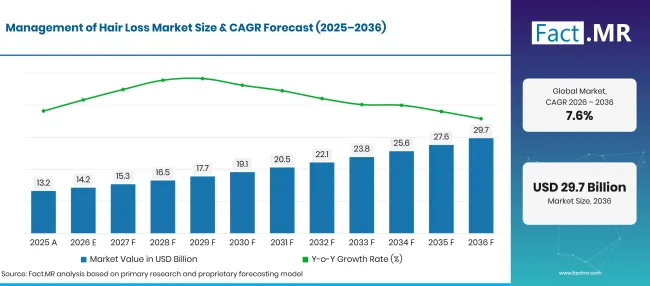
Management Of Hair Loss Market Forecast Global | Source: Fact.MR
| Year | Basis | Market Value (USD billion) |
|---|---|---|
| 2025 | Actual | 13.2 |
| 2026 | Estimate | 14.2 |
| 2036 | Forecast | 29.7 |
| CAGR 2026 to 2036 | Forecast period | 7.6% |
Source: Fact.MR analysis. Updated Oct 26, 2026
What are the defining numbers behind Management of Hair Loss Market growth?
The market will gain USD 15.5 billion between 2026 and 2036, led by medications and procedures delivered in dermatology clinics.
- Demand Drivers in the Market
- Finasteride use for male pattern baldness is deep and long running. The European Medicines Agency’s 2025 review of finasteride and dutasteride identified 313 EudraVigilance cases of suicidal ideation linked to finasteride and confirmed that the benefits of these medicines still outweigh their risks [1]. Tighter warnings push patients toward supervised care, where a doctor reviews mood and sexual side effects before renewing a prescription.
- Alopecia areata treatment now reaches younger patients. In September 2026, Eli Lilly announced that the FDA approved Olumiant for patients aged 12 and older with severe alopecia areata, noting that as many as 2% of people develop the disease in their lifetime [2]. Pediatric labels widen the pool of patients who can receive a daily oral therapy.
- Men in their twenties and thirties start treatment earlier than past generations did. Online consultations and subscription refills make it simple to begin minoxidil or finasteride at the first sign of thinning.
- Hair transplant surgery has become a planned purchase for many middle-income patients. Follicular unit extraction leaves no linear scar, which makes the procedure easier to choose and to repeat.
- Women seek help for thinning linked to menopause, pregnancy and stress. Topical minoxidil, oral supplements and clinic sessions are now marketed to female patients through dedicated product lines.
- Key Segments Analyzed
- By Treatment Type: Medications will hold 38.4% share in 2026, as topical minoxidil and oral finasteride remain the first step a doctor or pharmacist suggests.
- By Gender: Male will account for 67.8% share in 2026, given that androgenetic alopecia appears earlier and spreads further in men.
- By Distribution Channel: Dermatology Clinics will capture 36.5% share in 2026 through diagnosis, prescriptions and procedures delivered under one roof.
- Analyst Opinion at Fact.MR
- Shambhu Nath Jha, Principal Consultant at Fact.MR, states, “Hair loss care has split into two businesses: a mass cosmetic routine built on minoxidil and finasteride, and a specialist autoimmune practice built on JAK inhibitors. Safety reviews of finasteride will steer more patients toward a supervising clinician, which favors clinics and regulated telehealth services. Suppliers that link medication, procedures and follow-up visits will keep patients longer than those selling a single product.”
- Strategic Implications
- Drug makers should build long-term safety evidence and adolescent data for their alopecia areata therapies, since payers will judge them on durability of regrowth and infection risk.
- Dermatology clinics should package diagnosis, medication and platelet-rich plasma or laser sessions into treatment plans that patients can follow for a full year.
- Telehealth providers should screen for mood and sexual side effects at every refill, given that regulators in Europe and the United Kingdom now expect prescribers to discuss these risks.
- Consumer health brands should create distinct female ranges with clear dosing guidance, because women now form a growing share of first-time buyers.
Germany will grow at 8.7% CAGR, where clinic-supervised finasteride use and an older male population support steady spending. Brazil follows at 8.0%, with a large aesthetic surgery base and rising demand for transplants. In the United States, a 7.2% pace reflects wide telehealth access alongside new pediatric JAK inhibitor labels. The United Kingdom will advance at 6.5% as safety warnings shift patients toward guided care. Japan trails the group at 5.7%, supported by an older population that buys hair growth tonics and clinic services.
How does the Management of Hair Loss Market break down by segment?
Medications will lead Treatment Type at 38.4%; Male will top Gender at 67.8%; Dermatology Clinics will head Distribution Channel at 36.5%.
Which Treatment Type dominates?
Medications make up 38.4% of 2026 sales.
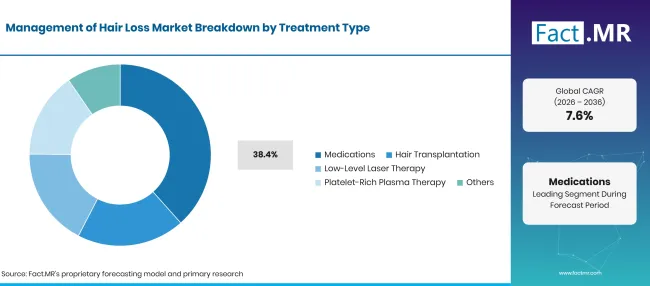
Management Of Hair Loss Market Breakdown Treatment Type | Source: Fact.MR
| Treatment Type | Share (2026) |
|---|---|
| Medications (Leading segment) | 38.4% |
| Other segments combined | 61.6%* |
| Total | 100.0% |
Source: Fact.MR analysis. Updated Oct 26, 2026
Hair loss medication is usually the first thing a patient tries, because it is low cost and needs no procedure. Topical minoxidil is sold over the counter, oral finasteride needs a prescription, and both must be taken daily to hold results. Patients with alopecia areata use oral JAK inhibitors, which carry far higher prices per year than pattern loss drugs and belong to the wider field of inflammatory skin disease treatments. Exposure to finasteride is extensive. EMA estimated cumulative use at about 270 million patient-years for finasteride, covering both the 1 mg hair loss dose and the 5 mg prostate dose [1]. Hair transplant procedures move follicles from the back of the scalp to thinning areas, and low-level laser caps offer a home option. Clinics draw blood for platelet-rich plasma injections that are repeated every few months.
What leads the Gender segment?
Male patients represent 67.8% of 2026 sales.
| Gender | Share (2026) |
|---|---|
| Male (Leading segment) | 67.8% |
| Other segments combined | 32.2%* |
| Total | 100.0% |
Source: Fact.MR analysis. Updated Oct 26, 2026
Androgenetic alopecia in men follows a clear pattern, starting at the temples and crown, and many men act on it in their twenties. That early start means more years of treatment per patient, and men are the main buyers of transplant surgery. Female pattern hair loss shows as diffuse thinning along the part line and often surfaces after menopause or pregnancy. Women cannot use finasteride in most cases, so they rely on topical minoxidil, spironolactone prescribed off label and dermatological hair products such as serums and ampoules.
How does Distribution Channel shape demand?
Dermatology Clinics generate 36.5% of 2026 sales.
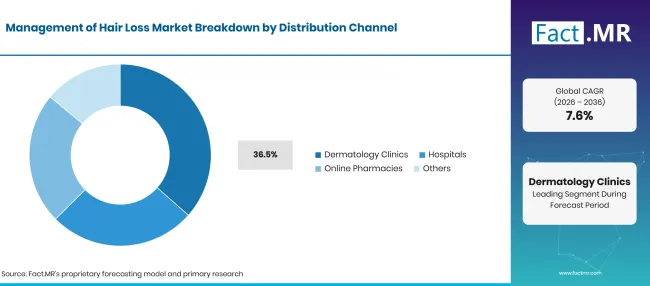
Management Of Hair Loss Market Breakdown Distribution Channel | Source: Fact.MR
| Distribution Channel | Share (2026) |
|---|---|
| Dermatology Clinics (Leading segment) | 36.5% |
| Other segments combined | 63.5%* |
| Total | 100.0% |
Source: Fact.MR analysis. Updated Oct 26, 2026
Dermatologists confirm the diagnosis with a scalp exam and dermoscopy, then prescribe and deliver treatment in the same visit. Clinics earn revenue from consultations, procedure fees and medication, which raises spend per patient. Hospitals treat complex autoimmune cases and perform some transplant surgery. Online pharmacies and telehealth platforms sell minoxidil and finasteride subscriptions, sometimes as compounded blends. The FDA stated in April 2025 that there is currently no FDA-approved topical formulation of finasteride [3]. Many buyers add hair, skin and nail supplements to the same online order.
What is accelerating Management of Hair Loss Market adoption, and what is holding it back?
Adoption will gain from earlier treatment by young men, new JAK inhibitor labels for adolescents and easy access through telehealth. Stronger finasteride warnings, high JAK inhibitor prices and the need for lifelong use will slow uptake.
Drivers Impact Analysis
| DRIVER | (~) % IMPACT ON CAGR | GEOGRAPHIC RELEVANCE | IMPACT TIMELINE |
|---|---|---|---|
| Early treatment of male pattern hair loss with minoxidil and finasteride | +1.6% | North America, Western Europe, Latin America | Short term (<= 2 years) |
| Oral JAK inhibitors for severe alopecia areata, including adolescents | +1.3% | North America, Western Europe, East Asia | Medium term (2-4 years) |
| Growth of hair transplant surgery using follicular unit extraction | +1.1% | Latin America, Western Europe, Middle East & Africa | Medium term (2-4 years) |
| Telehealth subscriptions for hair loss prescriptions | +0.9% | North America, Western Europe | Short term (<= 2 years) |
| Rising treatment demand among women | +0.6% | Global | Long term (>= 4 years) |
Source: Fact.MR analysis. Updated Oct 26, 2026
Opportunity Impact Analysis
| OPPORTUNITY | (~) % IMPACT ON CAGR | GEOGRAPHIC RELEVANCE | IMPACT TIMELINE |
|---|---|---|---|
| Combined plans that pair medication with platelet-rich plasma or laser sessions | +0.8% | North America, Western Europe, Latin America | Medium term (2-4 years) |
| Female-specific hair loss ranges and prescriptions | +0.7% | Global | Medium term (2-4 years) |
| Reimbursement for JAK inhibitors in severe alopecia areata | +0.5% | Western Europe, East Asia | Long term (>= 4 years) |
Source: Fact.MR analysis. Updated Oct 26, 2026
Restraints Impact Analysis
| RESTRAINT | (~) % IMPACT ON CAGR | GEOGRAPHIC RELEVANCE | IMPACT TIMELINE |
|---|---|---|---|
| Finasteride safety warnings on mood and sexual side effects | -0.6% | Western Europe, North America | Short term (<= 2 years) |
| High annual cost of JAK inhibitors and limited payer coverage | -0.5% | Global | Medium term (2-4 years) |
| Loss of results when daily treatment stops | -0.4% | Global | Long term (>= 4 years) |
Source: Fact.MR analysis. Updated Oct 26, 2026
Which countries are scaling the Management of Hair Loss Market through 2036?
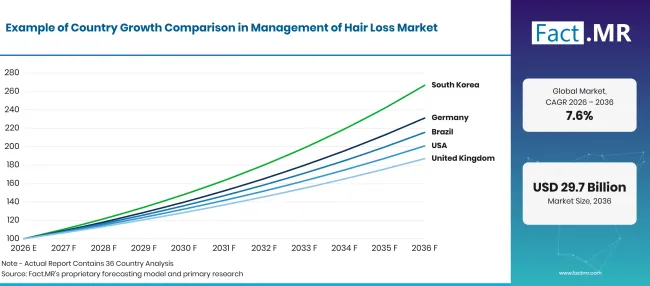
Management Of Hair Loss Market Growth Index | Source: Fact.MR
| Country | CAGR (2026 to 2036) |
|---|---|
| Germany | 8.7% |
| Brazil | 8.0% |
| United States | 7.2% |
| United Kingdom | 6.5% |
| Japan | 5.7% |
Source: Fact.MR analysis. Updated Oct 26, 2026
What supports Germany’s adoption?
8.7% CAGR, driven by clinic-supervised prescribing and an aging male population.
In Germany, hair loss treatment is shaped by pharmacy-based advice and close regulatory oversight. In September 2025, the German Medical Association’s drug commission published a Rote-Hand-Brief, issued by manufacturers in coordination with EMA and BfArM, announcing a patient card in packs of finasteride 1 mg [4]. Destatis reported that people aged 60 and older made up 31% of the population at the end of 2025 [5]. Alpecin and other domestic brands sell caffeine shampoos through drugstores and pharmacies.
How is Brazil scaling demand?
8.0% CAGR, backed by a large aesthetic surgery sector and growing transplant volumes.
Brazil combines a strong beauty culture with a dense network of plastic surgeons and dermatologists. IBGE reported that people aged 60 and older accounted for 16.6% of the population in 2025, up from 11.3% in 2012 [6]. Patients from abroad travel to São Paulo and other cities for transplant surgery, and compounding pharmacies supply topical minoxidil blends.
What supports United States adoption?
7.2% CAGR, helped by telehealth prescribing and new JAK inhibitor labels.
American patients can start hair loss treatment online within a day, often through subscription services. The FDA received 32 adverse event reports linked to compounded topical finasteride from 2019 through 2024, which led to a public alert in April 2025 [3]. The Census Bureau reported that Americans aged 65 and older rose to 61.2 million in 2024, up 13.0% since 2020 [7]. NCHS put male life expectancy at 76.5 years in 2024 [8]. Three oral JAK inhibitors are approved for severe alopecia areata, and dermatologists manage most of these patients.
How is the United Kingdom developing demand?
6.5% CAGR, as tighter safety rules move patients toward guided care.
UK patients mostly buy minoxidil in pharmacies and obtain finasteride through private prescribers. In May 2026, the MHRA strengthened warnings for finasteride 1 mg, stating that sexual dysfunction may contribute to mood disorders [9]. The Office for National Statistics estimated the UK population at 69.5 million in mid-2025, with the number of people aged 65 and over in England up 2.0% in a year [10].
How does Japan perform?
5.7% CAGR, reflecting a mature market of hair growth tonics and private clinics.
Japanese consumers buy hair growth tonics as quasi-drugs in pharmacies, while private clinics prescribe finasteride and dutasteride. The Statistics Bureau reported 36.19 million people aged 65 and over in September 2025, equal to 29.4% of the population [11]. The Ministry of Health, Labour and Welfare put male life expectancy at 81.35 years in its 2025 abridged life table [12].
Who leads the Management of Hair Loss Market?
Competition falls into three groups. Consumer health brands own the over-the-counter shelf: Kenvue sells Rogaine minoxidil foam and solution for men and women, Dr. Kurt Wolff markets Alpecin caffeine shampoos, and L’Oréal offers Vichy Dercos Aminexil anti hair loss treatments. Organon supplies Propecia, the original finasteride brand.
Specialty pharma companies compete in alopecia areata. Eli Lilly gained FDA approval for Olumiant in patients aged 12 and older in September 2026 [2], Pfizer markets Litfulo for the same age group, and Sun Pharma launched Leqselvi in the United States during the quarter ended September 2025 [13]. Hims & Hers sells prescription and over-the-counter hair loss treatments online, including finasteride and minoxidil blends. Proof of long-term safety, adolescent labels and the ability to keep patients on therapy for years will decide which suppliers gain ground.
Which companies are the key providers?
Key companies include Kenvue Inc. (Rogaine); Organon & Co. (Propecia); L’Oréal S.A. (Vichy Dercos); Dr. Kurt Wolff GmbH & Co. KG (Alpecin); Eli Lilly and Company; Pfizer Inc.; Sun Pharmaceutical Industries Ltd.; and Hims & Hers Health, Inc.
- Kenvue Inc. (Rogaine)
- Organon & Co. (Propecia)
- L’Oréal S.A. (Vichy Dercos)
- Dr. Kurt Wolff GmbH & Co. KG (Alpecin)
- Eli Lilly and Company
- Pfizer Inc.
- Sun Pharmaceutical Industries Ltd.
- Hims & Hers Health, Inc.
Bibliography
- [1] European Medicines Agency. (2025, September 19). Finasteride- and dutasteride-containing medicinal products - referral.
- [2] Eli Lilly and Company. (2026, September 25). FDA approves Lilly’s Olumiant (baricitinib) for pediatric patients 12 years of age and older with severe alopecia areata.
- [3] U.S. Food and Drug Administration. (2025, April 22). FDA alerts health care providers, compounders and consumers of potential risks associated with compounded topical finasteride products.
- [4] Arzneimittelkommission der deutschen Ärzteschaft. (2025, September 15). Rote-Hand-Brief zu Finasterid, Dutasterid: Neue Maßnahmen zur Minimierung des Risikos für Suizidgedanken [Dear Healthcare Professional letter on finasteride and dutasteride: new measures to minimise the risk of suicidal thoughts].
- [5] Statistisches Bundesamt (Destatis). (2026, June 16). Bevölkerung Deutschlands sinkt im Jahr 2025 um 0,1 % [Germany’s population fell by 0.1% in 2025].
- [6] Instituto Brasileiro de Geografia e Estatística (IBGE). (2026). Características gerais dos domicílios e dos moradores 2025 [General characteristics of households and residents 2025].
- [7] U.S. Census Bureau. (2025, June 26). Older Adults Outnumber Children in 11 States and Nearly Half of U.S. Counties.
- [8] National Center for Health Statistics. (2026, January 29). Mortality in the United States, 2024.
- [9] Medicines and Healthcare products Regulatory Agency. (2026, May 11). MHRA strengthens safety warnings for finasteride and dutasteride.
- [10] Office for National Statistics. (2026, October 1). Population estimates for the UK, England, Wales, Scotland and Northern Ireland: mid-2025.
- [11] Statistics Bureau of Japan. (2025, September 14).[Statistical Topics No. 146: Japan’s elderly from a statistical view].
- [12] Ministry of Health, Labour and Welfare, Japan. (2026, July 24).[Summary of the 2025 abridged life table].
- [13] Sun Pharmaceutical Industries Ltd. (2025, November 5). Sun Pharma reports Q2FY26 results.
This Report Answers
- How much will patients spend on hair loss medications, transplants, laser and platelet-rich plasma therapy each year to 2036?
- Why do medications, male patients and dermatology clinics hold the top position in each segment?
- In which of the five countries will hair loss treatment spending grow ahead of the others, and what local factors explain the gap?
- Which consumer health brands, drug makers and telehealth providers compete for hair loss patients?
- How will finasteride safety reviews and new JAK inhibitor labels change the way patients are treated?
What does the Management of Hair Loss Market cover?
This study counts as hair loss management any treatment a patient pays for to stop shedding or regrow hair. Drugs for pattern hair loss and alopecia areata are counted with surgical and device-based care.
Value is tracked at the point of sale to the patient, whether in a clinic, a hospital or an online pharmacy. Male and female patients are measured separately, since their causes and treatment choices differ.
What is included in the scope?
Topical and oral minoxidil, finasteride, dutasteride used for hair loss and oral JAK inhibitors for alopecia areata are in scope. Follicular unit extraction and follicular unit transplantation are counted as hair transplantation.
Low-level laser caps, combs and in-clinic laser sessions fall under laser therapy. Platelet-rich plasma injections given for scalp hair loss are included, as are telehealth consultations bundled with men’s grooming and personal care subscriptions when they deliver a hair loss prescription.
What is excluded from the scope?
Wigs, hairpieces, hair fibers and cosmetic shampoos with no hair loss claim are excluded. Treatment of hair loss caused by chemotherapy is outside the scope unless a listed therapy is used.
Finasteride and dutasteride sold for benign prostatic hyperplasia are excluded. Uses of JAK inhibitors in rheumatoid arthritis or atopic dermatitis also fall outside the revenue count.
How Was the Analysis Built?
The analysis draws on 120+ sources, 35+ company portfolios, 25+ countries, and more than 20 industry interviews.
- Primary Research: Primary research includes discussions with manufacturers, service providers, technology developers, distributors, end users, and subject-matter experts. These conversations examine purchasing priorities, product adoption, operational challenges, approval requirements, competitive positioning, and the factors that influence wider market acceptance.
- Desk Research: Desk research covers government statistics, regulatory publications, company filings, trade data, technical studies, industry associations, standards, public policy, and other authoritative sources. Every source used in the analysis is documented in the bibliography.
- Market Sizing and Forecasting: Market estimates combine historical performance, demand indicators, pricing and volume trends, segment shares, company participation, country-level growth, adoption patterns, investment activity, and barriers to market expansion.
- Data Validation and Update Cycle: Findings are validated by comparing primary interviews with public data, company activity, regulatory changes, trade patterns, and industry developments. Regular updates review new product launches, capacity changes, partnerships, approvals, and shifts in commercial adoption.
Segmentation
What is the report’s scope and coverage?
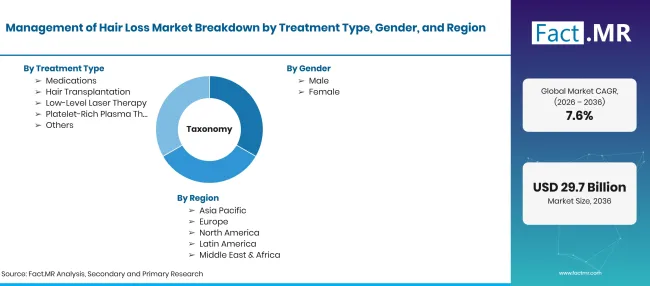
Management Of Hair Loss Market Taxonomy | Source: Fact.MR
| Attribute | Details |
|---|---|
| Quantitative Units | USD billion |
| Market Definition | Products and services used to treat or slow hair loss, including medications, hair transplantation, low-level laser therapy and platelet-rich plasma therapy. Revenue covers sales to patients through clinics, hospitals and pharmacies. |
| Treatment Type | Medications; Hair Transplantation; Low-Level Laser Therapy; Platelet-Rich Plasma Therapy; Others |
| Gender | Male; Female |
| Distribution Channel | Dermatology Clinics; Hospitals; Online Pharmacies; Others |
| Regions Covered | North America; Latin America; Western Europe; Eastern Europe; East Asia; South Asia & Pacific; Middle East & Africa |
| Countries Covered | Germany; Brazil; United States; United Kingdom; Japan |
| Companies Profiled | Kenvue Inc. (Rogaine); Organon & Co. (Propecia); L’Oréal S.A. (Vichy Dercos); Dr. Kurt Wolff GmbH & Co. KG (Alpecin); Eli Lilly and Company; Pfizer Inc.; Sun Pharmaceutical Industries Ltd.; Hims & Hers Health, Inc. |
| Forecast Period | 2026 to 2036 |
| Approach | Hybrid top-down and bottom-up approach using treated patient counts; prescription and over-the-counter volumes; procedure numbers and prices; channel split; and supplier portfolio review. |
Source: Fact.MR analysis. Updated Oct 26, 2026
How is the market segmented?
-
By Treatment Type
- Medications
- Hair Transplantation
- Low-Level Laser Therapy
- Platelet-Rich Plasma Therapy
- Others
-
By Gender
- Male
- Female
-
By Distribution Channel
- Dermatology Clinics
- Hospitals
- Online Pharmacies
- Others
-
By Region
- North America
- Latin America
- Western Europe
- Eastern Europe
- East Asia
- South Asia & Pacific
- Middle East & Africa
Frequently Asked Questions
How big is the management of hair loss market in 2026?
What is the CAGR of the management of hair loss market from 2026 to 2036?
Which treatment type leads the management of hair loss market?
Which gender leads the management of hair loss market?
Which distribution channel leads the management of hair loss market?
Which country will grow the most in the management of hair loss market?
Who are the main companies in the management of hair loss market?
Who worked on this report


Preview the report firsthand - request a free sample
Free SampleGet the brochure for pricing and purchase details
Download PDF