- Base Value(2025): 164.7 Mn
- Estimated Value(2026): 182.5 Mn
- Forecast Value (2036): 612.4 Mn
- CAGR (2026 - 2036): 12.9%
Maritime Methane Slip Monitoring Systems Market Forecast and Outlook By Fact.MR
In 2025, the maritime methane slip monitoring systems market was valued at USD 164.7 million. Based on Fact MR analysis, demand for maritime methane slip monitoring systems is estimated to grow to USD 182.5 million in 2026 and USD 612.4 million by 2036. FMR projects a CAGR of 12.9% during the forecast period.
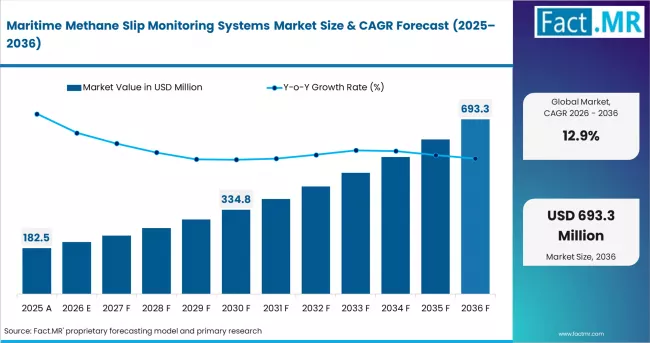
Maritime Methane Slip Monitoring Systems Market Market Value Analysis | Source: Fact.MR
Maritime Methane Slip Monitoring Systems Market
| Metric | Details |
|---|---|
| Industry Size (2026E) | USD 182.5 million |
| Industry Value (2036F) | USD 612.4 million |
| CAGR (2026 to 2036) | 12.9% |
Source: Fact.MR analysis. Updated Apr 21, 2026
Summary of the Maritime Methane Slip Monitoring Systems Market
- Market Definition
- The market comprises sensing and analytical technologies designed to detect and quantify unburned methane emissions released from LNG fueled marine engines, exhaust systems, and fuel handling infrastructure, supporting regulatory compliance, combustion efficiency optimization, and greenhouse gas emission measurement across commercial shipping operations.
- Demand Drivers
- Increasing adoption of LNG fueled marine propulsion systems requiring continuous methane slip measurement capability.
- Rising regulatory requirements for greenhouse gas intensity reporting across maritime transport operations.
- Growing integration of onboard emission monitoring technologies supporting verification of combustion efficiency performance.
- Expansion of dual fuel engine installations requiring measurement of methane emissions across variable load conditions.
- Increasing requirement for real time gas sensing systems supporting compliance with maritime decarbonization frameworks.
- Rising deployment of environmental monitoring instrumentation supporting measurement of non carbon dioxide greenhouse gas emissions.
- Key Segments Analyzed
- Installation: Onboard fixed systems lead with 46% share supported by continuous exhaust gas measurement requirements.
- Application: LNG engines account for 39% share due to need for monitoring unburned methane during combustion processes.
- Technology Role: Laser spectroscopy and infrared sensing enable accurate detection of methane concentration across exhaust gas streams.
- Monitoring Scope: Emission measurement systems support evaluation of engine tuning parameters influencing fuel efficiency.
- Geography: Asia Pacific and Europe demonstrate strong adoption supported by expansion of LNG powered vessel fleets.
- Analyst Opinion at Fact MR
- Shambhu Nath Jha, Principal Consultant, Fact MR, opines, 'In this updated edition of the Maritime Methane Slip Monitoring Systems Market report, emission measurement capability becomes an integral component of LNG propulsion optimization and maritime environmental compliance strategies through 2036.'
- Strategic Implications or Executive Takeaways
- Invest in high precision gas sensing technologies supporting continuous measurement of methane concentration across marine exhaust systems.
- Strengthen integration capability supporting compatibility with LNG engine control architecture and vessel monitoring platforms.
- Expand onboard fixed monitoring solutions supporting real time emission data acquisition across maritime propulsion environments.
- Improve calibration accuracy supporting reliable methane quantification across varying engine load conditions.
- Focus on compliance aligned monitoring platforms supporting greenhouse gas intensity reporting across shipping operations.
- Enhance collaboration with marine engine manufacturers supporting optimized integration of emission measurement technologies.
- Methodology
- Primary interviews conducted with marine equipment manufacturers, ship operators, and emission monitoring technology providers.
- Benchmarked against LNG vessel deployment indicators influencing adoption of methane measurement systems.
- Evaluated regulatory frameworks supporting implementation of greenhouse gas monitoring technologies across maritime transport infrastructure.
- Hybrid modeling applied combining top down maritime decarbonization investment assessment with bottom up onboard sensor installation benchmarking.
- Validation conducted using shipbuilding activity indicators and emission compliance monitoring deployment data across LNG powered fleets.
- Peer review applied using Fact MR analytical frameworks linking maritime environmental regulation with methane emission monitoring technology adoption patterns.
A CAGR of 12.9% indicates transformational expansion as LNG-powered vessels adopt methane slip measurement for emissions compliance and fuel efficiency optimization. Growth is supported by tightening maritime decarbonization rules, while constraints persist from sensor calibration complexity, retrofit costs, and integration with onboard engine control and reporting systems.
China leads with a projected CAGR of 13.8%, supported by expansion of LNG-powered vessel fleets requiring emission monitoring instrumentation. South Korea follows with a CAGR of 13.5%, driven by increasing integration of exhaust gas monitoring systems across shipbuilding and marine engineering operations. Japan records a CAGR of 13.3%, reflecting steady deployment of gas emission sensing technologies across maritime propulsion efficiency optimization programs. The United Kingdom shows a CAGR of 13.1%, supported by consistent adoption of environmental compliance monitoring equipment across commercial shipping operations. Germany records the slowest growth at 13.0%, reflecting a relatively mature marine instrumentation ecosystem tied to replacement demand within established maritime emissions monitoring infrastructure.
Segmental Analysis
Maritime Methane Slip Monitoring Systems Market Analysis by Installation
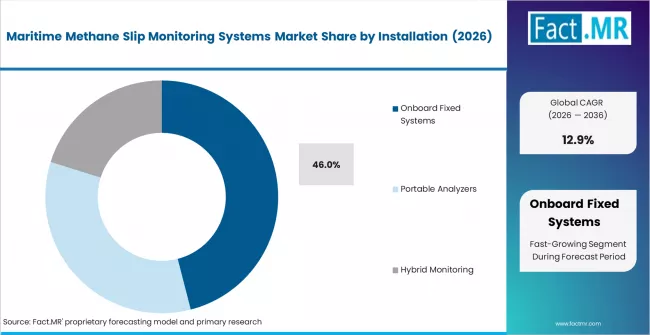
Maritime Methane Slip Monitoring Systems Market Analysis By Installation | Source: Fact.MR
- Market Overview: Based on Fact MR assessment, onboard fixed systems are projected to account for 46% share of the maritime methane slip monitoring systems market in 2026. Fixed installation monitoring equipment is integrated within exhaust pathways of marine propulsion systems requiring continuous measurement of unburned methane concentration across LNG powered vessels. Sensor modules are positioned along exhaust gas lines enabling real time detection of methane slip generated during incomplete combustion processes. Installation configuration supports stable data acquisition enabling evaluation of engine combustion efficiency across marine propulsion systems requiring compliance with emission measurement protocols applied across LNG fueled maritime transport operations.
- Demand Drivers:
- Continuous Emission Monitoring Requirements: Fixed onboard systems support real time measurement of methane concentration across exhaust gas streams generated by LNG engines.
- Engine Performance Evaluation Parameters: Methane slip monitoring supports analysis of combustion efficiency influencing fuel utilization performance.
- Installation Stability Needs: Fixed monitoring systems demonstrate compatibility with marine exhaust infrastructure requiring durable sensor integration across vessel propulsion environments.
Maritime Methane Slip Monitoring Systems Market Analysis by Application
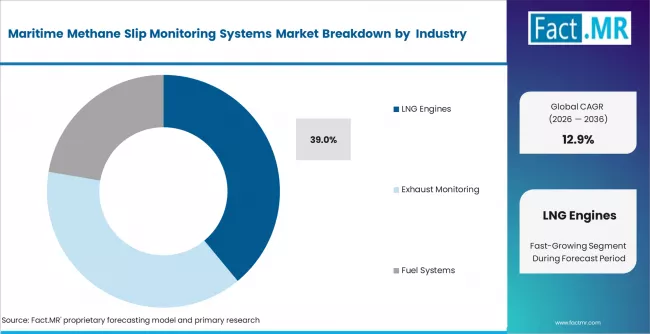
Maritime Methane Slip Monitoring Systems Market Analysis By Application | Source: Fact.MR
- Market Overview: LNG engines are estimated to hold 39% share of the maritime methane slip monitoring systems market in 2026, supported by utilization of natural gas fueled propulsion systems requiring measurement of unburned methane emissions across marine transport operations. Methane slip monitoring systems are deployed to quantify methane concentration released during dual fuel and pure gas engine operation requiring controlled emission assessment performance. Sensor integration supports evaluation of engine tuning parameters influencing combustion completeness across marine propulsion systems requiring optimization of fuel efficiency and emission control performance.
- Demand Drivers:
- Combustion Monitoring Requirements: Methane slip detection supports measurement of unburned methane levels across LNG fueled marine engines.
- Emission Performance Parameters: Monitoring systems enable evaluation of exhaust gas composition influencing engine operational efficiency.
- Fuel Utilization Needs: Measurement of methane slip supports optimization of combustion conditions across marine propulsion systems operating on liquefied natural gas fuel.
Key Dynamics
Maritime Methane Slip Monitoring Systems Market Drivers, Restraints, and Opportunities
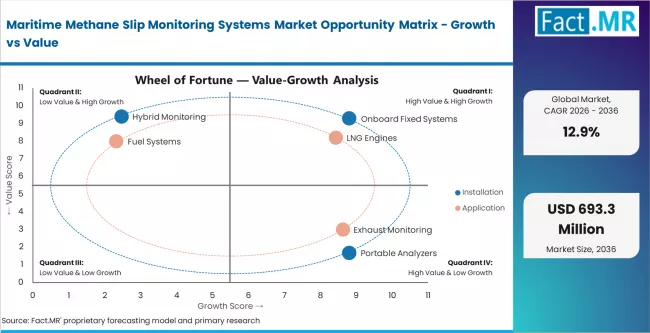
Maritime Methane Slip Monitoring Systems Market Opportunity Matrix Growth Vs Value | Source: Fact.MR
FMR analysts observe that historical demand for methane slip monitoring systems has emerged from the maritime sector’s transition toward liquefied natural gas fueled propulsion, where incomplete combustion releases unburned methane into the atmosphere. The current market size reflects an early growth compliance-driven segment shaped by decarbonization targets requiring accurate measurement of greenhouse gas intensity beyond carbon dioxide alone. Structural reality indicates a transitional regulatory market because LNG adoption expanded as a lower sulphur marine fuel option, yet methane slip reduces lifecycle emission benefits and creates the need for continuous emissions verification technologies. Methane slip can represent a significant share of total vessel greenhouse gas emissions, increasing pressure on shipowners to quantify real engine performance.
The present structural shift reflects declining reliance on default emission factors as ship operators increasingly deploy onboard sensing, exhaust analytics, and engine load monitoring platforms to document actual methane slip values. Higher system cost associated with precision gas analyzers and data logging integration is offset by potential compliance cost reduction under emerging emissions pricing frameworks. Value growth is driven by regulatory verification requirements rather than large hardware volumes, as monitoring capability becomes embedded within broader maritime emissions management architecture.
- FuelEU Compliance Measurement: FuelEU Maritime Regulation and EU MRV frameworks require reporting of methane emissions intensity, supporting deployment of onboard methane monitoring instrumentation.
- LNG Engine Transition: Increased adoption of dual-fuel marine engines expands demand for measurement systems capable of quantifying methane slip across variable engine load conditions.
- Europe Regulatory Lead: European shipping operators demonstrate early adoption due to integration of methane emissions within EU ETS and lifecycle greenhouse gas accounting frameworks.
Regional Analysis
The Maritime Methane Slip Monitoring Systems Market is assessed across Asia Pacific and Europe, segmented by country-level demand in LNG vessel emission monitoring, onboard gas detection sensors, exhaust methane quantification systems, and maritime environmental compliance instrumentation. Regional demand reflects tightening marine emission norms and adoption of methane measurement technologies in LNG-powered fleets. The full report offers market attractiveness analysis.
.webp "Top Country Growth Comparison Maritime Methane Slip Monitoring Systems Market Cagr (2026 2036)")
Top Country Growth Comparison Maritime Methane Slip Monitoring Systems Market Cagr (2026 2036) | Source: Fact.MR
CAGR Table
| Country | CAGR (2026–2036) |
|---|---|
| China | 13.8% |
| South Korea | 13.5% |
| Japan | 13.3% |
| United Kingdom | 13.1% |
| Germany | 13.0% |
Source: Fact.MR analysis. Updated Apr 21, 2026
Source: Fact MR analysis, based on proprietary forecasting model and primary research
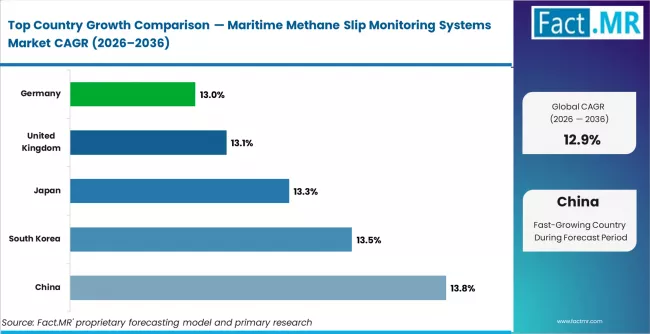
Maritime Methane Slip Monitoring Systems Market Cagr Analysis By Country | Source: Fact.MR
Asia Pacific
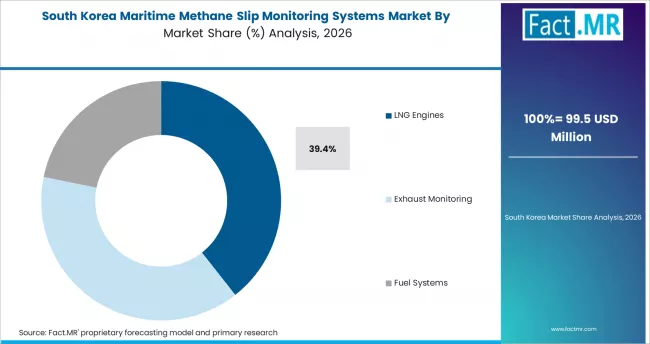
Maritime Methane Slip Monitoring Systems Market South Korea Market Share Analysis By Application | Source: Fact.MR
Asia Pacific functions as the LNG vessel technology deployment hub, supported by expansion of gas-fueled shipping fleets and adoption of onboard emission monitoring systems. Wärtsilä Corporation strengthens marine emission measurement capability. HORIBA Ltd. expands gas analysis instrumentation portfolio. Hyundai Heavy Industries Co., Ltd. supports LNG propulsion system integration technologies.
- China: China is projected to record 13.8% CAGR in maritime methane slip monitoring systems through 2036. Marine emission reduction action plan update (Ministry of Transport, March 2024) supports methane monitoring adoption in LNG-powered vessels. Wärtsilä Corporation expanded onboard gas analysis system integration capability (June 2023).
- South Korea: Growth of maritime methane slip monitoring systems in South Korea is forecast at 13.5% CAGR through 2036. Green Ship-K programme update (Ministry of Oceans and Fisheries, February 2024) supports emission monitoring technology integration. Hyundai Heavy Industries Co., Ltd. expanded LNG vessel emission control engineering capability (July 2023).
- Japan: Japan is expected to observe 13.3% CAGR in maritime methane slip monitoring systems through 2036. Maritime decarbonization roadmap update (Ministry of Land, Infrastructure, Transport and Tourism, January 2024) supports onboard methane measurement deployment. HORIBA Ltd. expanded gas analyzer engineering capability for marine applications (May 2023).
Europe
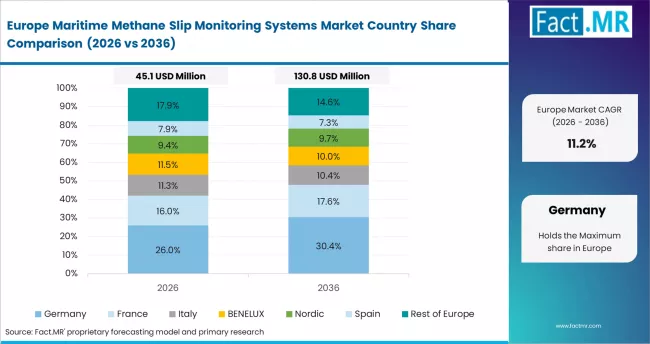
Maritime Methane Slip Monitoring Systems Market Europe Country Market Share Analysis, 2026 & 2036 | Source: Fact.MR
Europe operates as the maritime emission compliance benchmark, supported by structured marine environmental regulations and adoption of advanced exhaust monitoring technologies. ABB Ltd. strengthens onboard emission analytics capability. Siemens Energy AG expands marine environmental monitoring platforms. Gasmet Technologies Oy supports gas measurement instrumentation innovation.
- United Kingdom: Adoption of maritime methane slip monitoring systems in United Kingdom is expected to expand at 13.1% CAGR through 2036. UK Maritime Decarbonisation Strategy update (Department for Transport, March 2024) supports methane emission monitoring adoption in LNG vessels. ABB Ltd. expanded onboard emission analytics integration capability (August 2023).
- Germany: Germany is anticipated to observe 13.0% CAGR in maritime methane slip monitoring systems through 2036. EU Fit for 55 maritime emission compliance update (Federal Ministry for Digital and Transport, October 2023) supports methane measurement instrumentation deployment. Siemens Energy AG expanded marine emission monitoring engineering capability (April 2023).
Fact MR's analysis of maritime methane slip monitoring systems market in global regions consists of country-wise assessment that includes China, South Korea, Japan, United Kingdom, and Germany. Readers can find LNG vessel emission monitoring trends, maritime environmental compliance developments, onboard gas sensing technology adoption signals, and competitive positioning across key markets.
Competitive Landscape
Competitive Structure and Buyer Dynamics in the Maritime Methane Slip Monitoring Systems Market
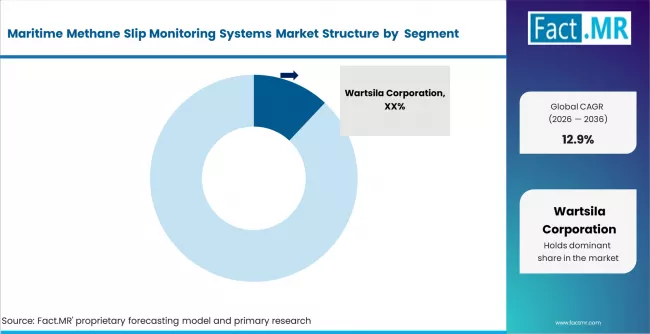
Maritime Methane Slip Monitoring Systems Market Analysis By Company | Source: Fact.MR
The competitive structure of the Maritime Methane Slip Monitoring Systems Market is moderately concentrated, with marine technology providers and industrial emissions monitoring companies controlling a significant share of deployment solutions. Companies such as Wärtsilä Corporation, ABB Ltd., Siemens AG, Honeywell International Inc., Kongsberg Gruppen ASA, Horiba Ltd., and Emsys Maritime Ltd. maintain strong positions through expertise in marine engine analytics and emissions measurement technologies. Additional participants including Explicit ApS and Sensors Inc. contribute through specialized gas sensing equipment and onboard emissions monitoring solutions. Competition is primarily influenced by measurement accuracy, sensor durability, system integration capability, and compliance with maritime environmental regulations.
Several companies maintain structural advantages through established relationships with shipbuilders and marine engine manufacturers requiring emissions monitoring compliance. Firms such as Wärtsilä Corporation and Kongsberg Gruppen ASA benefit from integrated vessel performance management platforms supporting continuous emissions measurement. ABB Ltd. and Siemens AG maintain advantages through industrial automation expertise enabling data integration with ship control systems. Maritime operators often adopt multi vendor sourcing strategies to reduce dependence on a single monitoring technology provider and ensure operational reliability. Procurement decisions evaluate suppliers based on sensor precision, regulatory certification, and long term service capability, moderating supplier pricing leverage across maritime emissions monitoring applications.
Key Players of the Maritime Methane Slip Monitoring Systems Market
- Wartsila Corporation
- Emsys Maritime Ltd.
- ABB Ltd.
- Siemens AG
- Honeywell International Inc.
- Kongsberg Gruppen ASA
- Explicit ApS
- Horiba Ltd.
- Sensors Inc.
Bibliographies
- [1] European Commission. (2023, October). Fit for 55 maritime emission compliance update. European Commission.
- [2] Ministry of Land Infrastructure Transport and Tourism. (2024, January). Maritime decarbonization roadmap update. Government of Japan.
- [3] Ministry of Oceans and Fisheries. (2024, February). Green Ship K programme update. Government of South Korea.
- [4] Ministry of Transport. (2024, March). Marine emission reduction action plan update. Government of China.
- [5] Department for Transport. (2024, March). UK maritime decarbonisation strategy update. UK Government.
- [6] Federal Ministry for Digital and Transport. (2023, October). EU Fit for 55 maritime emission compliance update. Government of Germany.
- [7] Wärtsilä Corporation. (2023, June). Onboard gas analysis system integration capability expansion. Wärtsilä Corporation.
This Report Addresses
- Market size forecasts for 2026 to 2036 based on adoption of methane emission measurement technologies across LNG fueled maritime propulsion systems.
- Opportunity mapping across flame ionization detection, laser spectroscopy, infrared sensing, and gas chromatography measurement technologies supporting methane slip quantification.
- Segment and regional forecasts covering LNG engines, exhaust monitoring, fuel system measurement, and leak detection applications across marine emission control environments.
- Competition benchmarking based on detection sensitivity accuracy, calibration stability, sensor durability characteristics, and compatibility with onboard engine monitoring and reporting systems.
- Regulatory assessment covering maritime decarbonization frameworks influencing deployment of methane emission measurement technologies across LNG powered vessels.
- Report delivery in PDF, Excel, PPT, and dashboard formats supporting shipbuilders, marine engine manufacturers, emission monitoring providers, and maritime compliance specialists.
- Technology risk evaluation covering sensor calibration complexity, installation cost sensitivity, integration with vessel control architecture, and measurement variability across dynamic marine operating conditions.
Maritime Methane Slip Monitoring Systems Market Definition
The Maritime Methane Slip Monitoring Systems Market includes sensing, measurement, and analytics technologies used to detect and quantify unburned methane emissions released from LNG fueled marine engines, fuel systems, and exhaust streams, supporting regulatory compliance, emissions reporting, and optimization of combustion efficiency in commercial shipping operations.
Maritime Methane Slip Monitoring Systems Market Inclusions
The report includes global and regional market size estimates, forecast analysis, and segmentation by monitoring technology, sensor type, measurement method, application area, vessel type, pricing structure, and integration with maritime emissions management and environmental compliance systems.
Maritime Methane Slip Monitoring Systems Market Exclusions
The scope excludes general marine emission monitoring systems not designed to measure methane slip, LNG fuel storage equipment, exhaust aftertreatment systems without measurement capability, and maritime environmental software not directly linked to onboard methane detection hardware.
Maritime Methane Slip Monitoring Systems Market Research Methodology
- Primary Research: Interviews were conducted with marine engine manufacturers, emissions monitoring technology providers, ship operators, classification societies, and environmental compliance specialists.
- Desk Research: Public sources included maritime emission regulations, engine technology documentation, classification society guidelines, and research studies on methane emissions measurement in LNG fueled vessels.
- Market-Sizing and Forecasting: A hybrid model combining top-down maritime decarbonization investment assessment and bottom-up analysis of methane monitoring system deployment across LNG powered fleets was applied.
- Data Validation and Update Cycle: Outputs were validated through cross comparison of regulatory data, expert consultation, and periodic monitoring of emission compliance developments and onboard measurement adoption trends.
Segmentation
Report Scope
Maritime Methane Slip Monitoring Systems Market Breakdown By Installation, Application, And Region | Source: Fact.MR
| Metric | Value |
|---|---|
| Quantitative Units | USD 182.5 million (2026) to USD 612.4 million (2036), at a CAGR of 12.9% |
| Market Definition | The maritime methane slip monitoring systems market includes emission measurement technologies designed to quantify unburned methane released from LNG fueled marine engines and associated fuel handling systems to support regulatory compliance and environmental performance monitoring. |
| Technology Segmentation | Flame ionization detection, Laser spectroscopy, Infrared sensing, Gas chromatography |
| Application Segmentation | LNG engines, Exhaust monitoring, Fuel systems, Leak detection |
| Installation Segmentation | Onboard fixed systems, Portable analyzers, Hybrid monitoring |
| Regions Covered | North America, Latin America, Europe, East Asia, South Asia, Oceania, Middle East and Africa |
| Countries Covered | United States, Canada, Norway, Germany, France, United Kingdom, Netherlands, Denmark, China, Japan, South Korea, Singapore, India, Australia, United Arab Emirates, Brazil, Mexico, South Africa, and 40+ countries |
| Key Companies Profiled | Wartsila Corporation, Emsys Maritime Ltd., ABB Ltd., Siemens AG, Honeywell International Inc., Kongsberg Gruppen ASA, Explicit ApS, Horiba Ltd., Sensors Inc. |
| Forecast Period | 2026 to 2036 |
| Approach | Hybrid top-down and bottom-up market estimation based on LNG fueled vessel adoption trends, maritime emission regulation benchmarking, onboard gas sensing technology deployment rates, environmental compliance monitoring demand, and validation through primary interviews with marine equipment manufacturers, emission monitoring technology providers, and ship operators. |
Source: Fact.MR analysis. Updated Apr 21, 2026
Maritime Methane Slip Monitoring Systems Market Key Segments
-
Technology:
- Flame Ionization Detection
- Laser Spectroscopy
- Infrared Sensing
- Gas Chromatography
-
Application:
- LNG Engines
- Exhaust Monitoring
- Fuel Systems
- Leak Detection
-
Installation:
- Onboard Fixed Systems
- Portable Analyzers
- Hybrid Monitoring
-
Region:
- North America
- USA
- Canada
- Mexico
- Europe
- Germany
- UK
- France
- Italy
- Spain
- Nordic Countries
- BENELUX
- Rest of Europe
- Asia Pacific
- China
- Japan
- South Korea
- India
- Australia
- Rest of Asia Pacific
- Latin America
- Brazil
- Argentina
- Rest of Latin America
- Middle East and Africa
- Kingdom of Saudi Arabia
- United Arab Emirates
- South Africa
- Rest of Middle East and Africa
- Other Regions
- Oceania
- Central Asia
- Other Markets
- North America
Frequently Asked Questions
How large is the demand for Maritime Methane Slip Monitoring Systems in the global market in 2026?
What will be the market size of Maritime Methane Slip Monitoring Systems in the global market by 2036?
What is the expected demand growth for Maritime Methane Slip Monitoring Systems in the global market between 2026 and 2036?
Which company is identified as a leading provider in the Maritime Methane Slip Monitoring Systems market?
Which installation type is projected to dominate methane slip monitoring system deployment by 2026?
Why are onboard methane slip monitoring systems widely used in maritime propulsion environments?
What is driving demand for maritime methane slip monitoring systems in China?
What is the growth outlook for the Maritime Methane Slip Monitoring Systems market in China?
Why is South Korea an important market for maritime emission monitoring technologies?
What is the growth outlook for the Maritime Methane Slip Monitoring Systems market in South Korea?
How is demand for methane slip monitoring systems evolving in Japan maritime sector?
What is the growth outlook for the Maritime Methane Slip Monitoring Systems market in Japan?
What is the growth outlook for the Maritime Methane Slip Monitoring Systems market in the United Kingdom?
How is the Maritime Methane Slip Monitoring Systems market positioned in Germany?
What is the growth outlook for the Maritime Methane Slip Monitoring Systems market in Germany?
What are maritime methane slip monitoring systems and what are they mainly used for?
What does the Maritime Methane Slip Monitoring Systems market include in this report?
What applications are included in the scope of the Maritime Methane Slip Monitoring Systems market?
What is excluded from the scope of the Maritime Methane Slip Monitoring Systems market report?
What does market forecast mean in the Maritime Methane Slip Monitoring Systems market report?
How is the Maritime Methane Slip Monitoring Systems market forecast developed in this report?
What does primary validation indicate in the Maritime Methane Slip Monitoring Systems market analysis?
Who worked on this report


Preview the report firsthand - request a free sample
Free SampleGet the brochure for pricing and purchase details
Download PDF