- Market Value (2025): USD 2.2 Bn
- Estimated Value (2026): USD 2.3 Bn
- Forecast Value (2036): USD 3.8 Bn
- CAGR (2026-2036): 4.9%
What is the Marshmallow Market forecast to be worth by 2036?
USD 2.3 billion in 2026 to USD 3.8 billion by 2036 at a 4.9% CAGR.
- As per Fact.MR analysis, the marshmallow market reached USD 2.2 billion in 2025.
- Demand is projected to increase from USD 2.3 billion in 2026 to USD 3.8 billion by 2036.
- The marshmallow market is forecast to record 4.9% CAGR from 2026 to 2036.
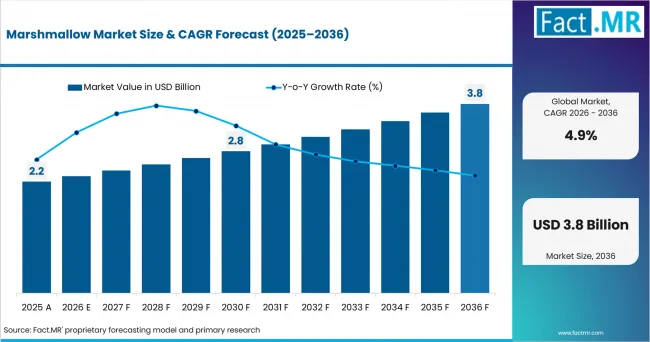
Marshmallow Market Value Analysis | Source: Fact.MR
What are the defining numbers behind Marshmallow Market growth?
An absolute opportunity of USD 1.5 billion is expected between 2026 and 2036.
- Demand Drivers in the Market
- Lower sweetener costs are easing input pressure for marshmallow makers, since sugar and glucose syrup make up most of a mallow’s weight. The Food and Agriculture Organization reported in January 2026 that its Sugar Price Index averaged 17.0% below the previous year across 2025, its lowest annual value since 2020. Cheaper sugar gives confectioners room to fund new flavors and seasonal shapes without lifting shelf prices.
- Camping and outdoor trips keep s’mores and campfire roasting in regular use across North America. The U.S. National Park Service recorded more than 323 million recreation visits and more than 13.0 million overnight stays in 2025. Giant roasting mallows and s’mores kits are expected to draw on this outdoor base each spring and summer.
- Seasonal gifting creates short and intense sales windows for shaped and colored marshmallows. Easter chicks and Halloween ghost shapes let brands refresh the shelf several times a year without building new lines. Limited editions are anticipated to keep repeat purchases high among families with children.
- Plant-based and religious dietary needs are widening the buyer base beyond pork gelatin. Carrageenan and starch setting systems allow confectioners to offer vegan mallows with a similar bite. Halal and kosher positioning is projected to open more shelf space in Turkey and parts of Western Europe.
- Key Segments Analyzed
- By Product Type: Flavored Marshmallows are expected to hold 48.2% share in 2026 since fruit, dessert and brand-collaboration flavors give shoppers more reasons to buy than plain white packs.
- By Application: Confectionery is projected to account for 42.1% share in 2026, supported by direct eating, seasonal novelties and chocolate-coated mallow formats.
- By Sales Channel: Supermarkets/Hypermarkets are anticipated to capture 49.9% share in 2026 owing to seasonal aisle space and multi-pack pricing that suit planned grocery trips.
- Analyst Opinion at Fact.MR
- Shambhu Nath Jha, Principal Consultant at Fact.MR, states, “Marshmallows are a low-cost treat, yet shelf space is won through flavor rotation and holiday timing. Brands that refresh shapes and colors for Easter, summer and winter are expected to keep grocery velocity high. Gelatin-free and reduced-sugar lines are anticipated to widen the buyer base as long as their texture and toasting performance match classic mallows.”
- Strategic Implications
- Confectioners should build flavor calendars around Easter, summer camping and winter cocoa seasons, since limited editions help reset shelf space several times a year.
- Ingredient suppliers should develop gelatin-free setting systems that hold shape over a flame, given that toasting performance decides repeat purchase for vegan mallows.
- Retailers should place mini marshmallows beside baking and hot-cocoa items so impulse purchases link to recipe occasions.
Turkey leads at 6.2% CAGR, supported by export-oriented sugar confectionery production. The United States follows at 5.8% on the back of s’mores, home baking and seasonal gifting. Belgium records 5.3% through confectionery plants that supply coated and vegan mallows. Spain posts 4.6% where supermarkets handle most household food purchases. Germany reaches 4.2% as non-cocoa sweets gain a price edge over chocolate, while the United Kingdom closes at 3.6% with household confectionery purchases holding near prior-year levels.
How does the Marshmallow Market break down by segment?
Flavored Marshmallows lead Product Type at 48.2%; Confectionery leads Application at 42.1%; Supermarkets/Hypermarkets lead Sales Channel at 49.9%.
Which Product Type dominates?
Flavored Marshmallows are expected to hold 48.2% share in 2026.
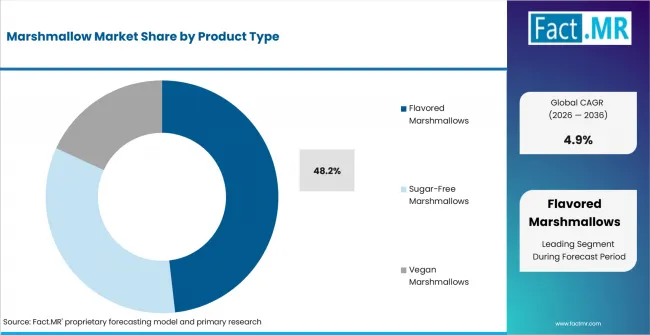
Marshmallow Market Analysis By Product Type | Source: Fact.MR
Flavored mallows will lead a new color or taste gives shoppers a fresh reason to pick up a bag. Fruit swirls and strawberry profiles turn a basic sweet into a seasonal treat.
Sugar-free marshmallows use polyols and high-intensity sweeteners, and makers borrow know-how from sugar-free gummy bases to keep chew and volume. The U.S. Food and Drug Administration proposed in January 2025 a front-of-package Nutrition Info box that would rate added sugars as Low, Med or High. Vegan marshmallows replace gelatin with carrageenan or starch and draw shoppers who avoid animal ingredients.
What leads the Application segment?
Confectionery is projected to account for 42.1% share in 2026.
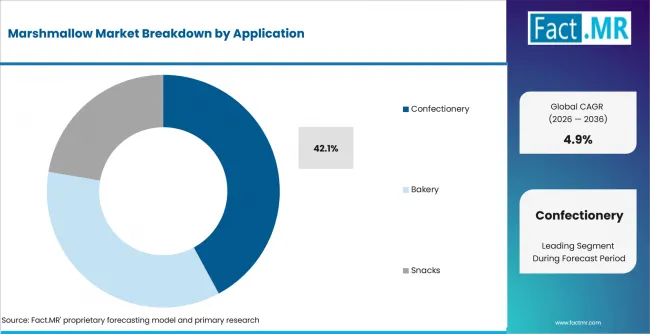
Marshmallow Market Analysis By Application | Source: Fact.MR
Confectionery will capture highest sales of marshmallow during the forecast period as most marshmallows are eaten straight from the bag or in chocolate-coated formats. Seasonal novelties such as chicks and bunnies fall in this group. Mallow teacakes and dipped pieces add value per unit for producers of broader confectionery products.
Bakery use covers cookie fillings, cupcakes and crispy rice bars, where mini mallows melt into a binding layer. Home bakers often buy mallows next to bakery premixes for quick desserts. Snack makers use dehydrated marshmallow bits as inclusions in trail mixes and breakfast cereal blends.
How does Sales Channel shape demand?
Supermarkets/Hypermarkets are anticipated to capture 49.9% share in 2026.
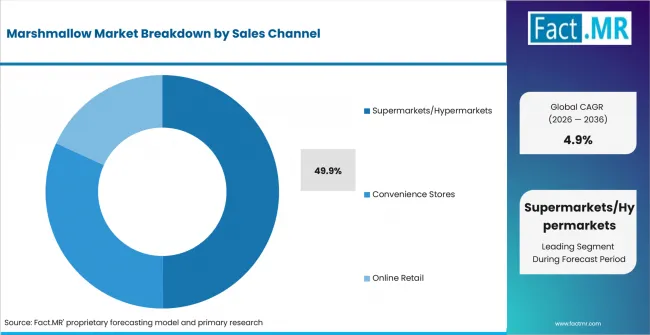
Marshmallow Market Analysis By Sales Channel | Source: Fact.MR
Supermarkets and hypermarkets lead owing to seasonal aisle space and baking displays that place marshmallows next to chocolate and graham crackers. Large stores carry multi-packs and private-label bags that suit planned family shopping.
Online retail gives vegan and specialty brands national reach without shelf slots in each chain. Eurostat reported that 78% of EU internet users bought goods or services online in 2025. Convenience stores lean on single-serve snack packs and grab-and-go s’mores bars for impulse buys near checkout.
What is accelerating Marshmallow Market adoption, and what is holding it back?
Demand is expected to rise through flavor rotation, seasonal gifting and lower sugar input costs. Growth is constrained by sugar-reduction policy, gelatin sourcing concerns and the cost of replacing synthetic colors.
Drivers Impact Analysis
| DRIVER | (~) % IMPACT ON CAGR | GEOGRAPHIC RELEVANCE | IMPACT TIMELINE |
|---|---|---|---|
| Seasonal and limited-edition flavor launches | +1.2% | North America, Western Europe | Short term (<= 2 years) |
| Lower sugar input costs after the 2025 price decline | +1.0% | Global | Short term (<= 2 years) |
| S’mores, camping and outdoor recreation | +0.8% | North America | Medium term (2-4 years) |
| Home baking and dessert inclusions | +0.6% | North America, Western Europe | Medium term (2-4 years) |
| Halal and gelatin-free product access | +0.4% | Middle East & Africa, Western Europe | Long term (>= 4 years) |
Opportunity Impact Analysis
| OPPORTUNITY | (~) % IMPACT ON CAGR | GEOGRAPHIC RELEVANCE | IMPACT TIMELINE |
|---|---|---|---|
| Vegan and carrageenan-set marshmallows | +0.9% | Western Europe, North America | Medium term (2-4 years) |
| Reduced-sugar and polyol-based formats | +0.7% | North America, Western Europe | Long term (>= 4 years) |
| Brand collaboration flavors and co-branded bakery items | +0.6% | North America | Short term (<= 2 years) |
| Export-oriented private label from Turkey | +0.4% | Middle East & Africa, Eastern Europe | Medium term (2-4 years) |
Restraints Impact Analysis
| RESTRAINT | (~) % IMPACT ON CAGR | GEOGRAPHIC RELEVANCE | IMPACT TIMELINE |
|---|---|---|---|
| Sugar-reduction policy and front-of-pack labelling | -0.7% | North America, Western Europe | Medium term (2-4 years) |
| Synthetic color reformulation costs | -0.5% | North America | Short term (<= 2 years) |
| Gelatin sourcing and dietary restrictions | -0.4% | Global | Long term (>= 4 years) |
| Seasonal demand swings and inventory risk | -0.3% | Global | Short term (<= 2 years) |
Which countries are scaling the Marshmallow Market through 2036?
- The country comparison spans 2.6 percentage points between Turkey at 6.2% and the United Kingdom at 3.6%.
- Turkey remains 0.4 percentage point above the United States through export-focused sugar confectionery plants and a growing domestic sugar base.
- The United States remains 0.5 percentage point above Belgium as s’mores, home baking and seasonal gifting sustain household use.
- Belgium remains 0.7 percentage point above Spain, supported by confectionery plants that make coated and vegan mallows for export.
- Spain remains 0.4 percentage point above Germany given that supermarkets concentrate household food purchases and seasonal displays.
- Germany remains 0.6 percentage point above the United Kingdom owing to a price advantage for non-cocoa sweets over chocolate.
- The United Kingdom closes the displayed range with household confectionery purchases holding close to prior-year levels.
Comparable CAGRs create different entry conditions, since export capacity, retail structure and sugar policy vary by country. Full report coverage includes North America, Latin America, Western Europe, Eastern Europe, East Asia, South Asia & Pacific, Middle East & Africa.
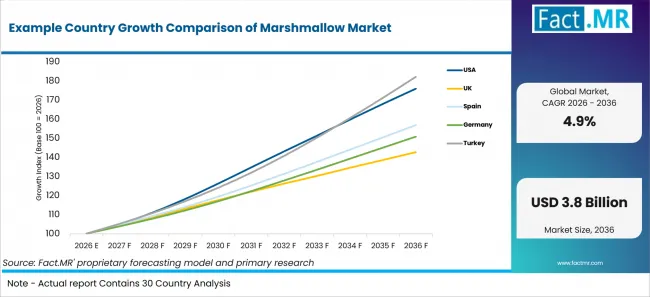
Example Country Growth Comparison Of Marshmallow Market | Source: Fact.MR
| Country | CAGR (2026-2036) |
|---|---|
| Turkey | 6.2% |
| United States | 5.8% |
| Belgium | 5.3% |
| Spain | 4.6% |
| Germany | 4.2% |
| United Kingdom | 3.6% |
What supports Turkey adoption?
6.2% CAGR, supported by export-oriented sugar confectionery production.
Turkish confectioners ship sugar sweets to Iraq, the United States and Europe, and many plants add aerated products such as marshmallows to that export base. The Ministry of Trade reported that Turkey exported non-cocoa sugar confectionery worth about USD 901.9 million in 2025. On the input side, the USDA Foreign Agricultural Service forecast Turkish centrifugal sugar production at 3.1 million metric tons for MY 2026/27. Steady local sugar supply is expected to help producers keep export pricing competitive.
How is the United States scaling demand?
5.8% CAGR, driven by s’mores, home baking and seasonal gifting.
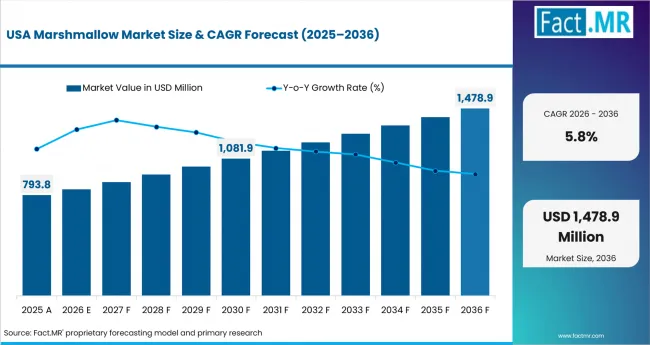
Marshmallow Market Country Value Analysis | Source: Fact.MR
U.S. shoppers buy marshmallows for campfire s’mores and holiday cocoa, which spreads sales across the calendar. USDA’s Economic Research Service projected 2025/26 U.S. sugar deliveries for food and beverage use at 12.385 million short tons, raw value. ERS also forecasts retail prices for sugar and sweets to rise 6.6% in 2026. Brands are expected to lean on value multi-packs and private label to protect volume while shelf prices move higher.
What supports Belgium’s growth?
5.3% CAGR, backed by confectionery manufacturing for export.
Belgium pairs a deep chocolate industry with confectionery plants that produce coated and gelatin-free mallows for export. Freedom Confectionery, a UK vegan brand, makes its gelatin-free marshmallows in a BRC-accredited facility in Belgium. The Federal Public Service Economy reported in February 2026 that processed food inflation reached 2.9% in 2025, with chocolate prices still rising. Higher cocoa costs are anticipated to steer Belgian producers toward mallow-heavy formats that use less chocolate per piece.
How is Spain developing demand?
4.6% CAGR, supported by supermarket-led food retail.
Spanish shoppers know marshmallows as nubes, sold in twists and party-size bags for children’s celebrations. The Ministry of Agriculture, Fisheries and Food reported that supermarkets held 68.2% of household food purchases in 2025, while online channels held about 2%. Seasonal displays for Christmas and Carnival are forecast to support impulse volume in large stores.
What is supporting Germany’s adoption?
4.2% CAGR, supported by a price advantage for non-cocoa sweets.
German shoppers find foam sugar products such as Schaumzucker competing with gummies and chocolate in a mature sweets aisle. Destatis reported that consumer prices for chocolate rose 21.8% in October 2025 from a year earlier. Producer prices for sweets excluding cocoa products fell 2.4% over the same period. That gap is estimated to help marshmallows and foam sweets win shoppers who trade down from chocolate gifts.
How does the United Kingdom perform?
3.6% CAGR, shaped by steady household confectionery purchases.
UK demand leans on toasting mallows, chocolate-coated teacakes and baking minis, with gelatin-free lines offered beside classic packs. Defra’s Family Food survey recorded confectionery purchases of 127 grams per person per week in FYE 2025, compared with 126 grams a year earlier. Flat volumes point to value growth from premium flavors and vegan formats.
Who leads the Marshmallow Market?
Just Born Inc. makes PEEPS marshmallow chicks and bunnies at its home base in Bethlehem, Pennsylvania. In January 2026, the company unveiled its 2026 Easter lineup with new flavored chicks such as Pop-Tarts Frosted Strawberry, Chili Lime Mango and SunnyD. Two months later, Just Born announced a collaboration lineup that included Hostess PEEPS cupcakes with marshmallow creme filling, extending the brand into bakery.
Doumak Inc. produces Campfire marshmallows, including Giant Roasters, mini fruit marshmallows and seasonal Ghoster Roasters. Its range is positioned as free from artificial colors, including blue dye. The Kraft Heinz Company markets Jet-Puffed marshmallows in mini, shaped and flavored formats and sells marshmallow creme. In June 2025, Kraft Heinz committed to remove FD&C colors from its U.S. portfolio before the end of 2027 and stopped launching new U.S. products with those colors.
Haribo GmbH and Co. KG sells Chamallows in Europe, including pink and white mallows suited to toasting and chocolate fondue. Chicago Vegan Foods makes Dandies, a gelatin-free marshmallow made without corn syrup or artificial colors. Freedom Confectionery produces carrageenan-set vegan mallows and chocolate-coated mallow bites. Competition centers on flavor rotation and seasonal timing.
Which companies are the key providers?
Key companies include Just Born Inc.; Doumak Inc.; The Kraft Heinz Company; Haribo GmbH and Co. KG; Chicago Vegan Foods (Dandies); and Freedom Confectionery.
- Just Born Inc.
- Doumak Inc.
- The Kraft Heinz Company
- Haribo GmbH and Co. KG
- Chicago Vegan Foods (Dandies)
- Freedom Confectionery
Bibliography
- Food and Agriculture Organization of the United Nations. (2026, January 9). FAO Food Price Index dips in December despite higher world cereal quotations.
- U.S. National Park Service. (2026, March 13). Public Interest in National Parks Remains Strong as Visits Top 323 Million in 2025.
- U.S. Food and Drug Administration. (2025, January 14). FDA Issues Proposed Rule on Front-of-Package Nutrition Labeling.
- Eurostat. (2026, February). E-commerce statistics for individuals.
- Republic of Türkiye Ministry of Trade. (2026). Şeker ve Çikolata Mamulleri [Sugar and Chocolate Products].
- U.S. Department of Agriculture, Foreign Agricultural Service. (2026, April 21). Türkiye: Sugar Annual.
- U.S. Department of Agriculture, Economic Research Service. (2026, June 17). Sugar and Sweeteners Outlook: June 2026.
- U.S. Department of Agriculture, Economic Research Service. (2026, September 25). Food Price Outlook: Summary Findings.
- Federal Public Service Economy. (2026, February 17). Baisse généralisée de l’inflation en Belgique en 2025 [General decline in inflation in Belgium in 2025].
- Ministry of Agriculture, Fisheries and Food. (2026, July 30). El consumo alimentario crece por primera vez en cinco años y roza los 30.800 millones de kilos [Food consumption grows for the first time in five years and nears 30,800 million kilos].
- Federal Statistical Office of Germany. (2025, November 26). Süßigkeiten zum Advent: Teils deutliche Preissteigerungen [Sweets for Advent: Partly significant price increases].
- Department for Environment, Food and Rural Affairs. (2026, September). Family Food FYE 2025.
- The Kraft Heinz Company. (2025, June 17). Kraft Heinz Commits to Remove FD&C Colors From Its U.S. Portfolio Before the End of 2027 and Will Not Launch New Products in the U.S. With FD&C Colors, Effective Immediately.
- Just Born. (2026, January 13). Let the Easter Fun Begin! PEEPS® Unveils Its 2026 Lineup.
- Just Born. (2026, March 3). PEEPS® Brand Unveils 2026 Collaboration Lineup to Sweeten the Spring Season.
This Report Answers
- The report explains how marshmallows are sold by product type and application. It also covers the sales channels that carry them to shoppers.
- Segment analysis identifies the subsegment that leads each segment and the shelf factors behind its 2026 share.
- Country analysis compares the six listed countries through export, retail and sugar-price mechanisms.
- Competitive analysis reviews active marshmallow producers across seasonal novelties and toasting mallows. It also covers gelatin-free and vegan ranges.
- Ingredient analysis assesses how gelatin, carrageenan and sweetener choices affect texture and labelling.
What does the Marshmallow Market cover?
The Marshmallow Market covers aerated sugar confections sold in regular, mini and jumbo sizes. Shaped and flavored pieces are included. It includes sugar-free marshmallows made with polyols and vegan marshmallows set with carrageenan or starch.
The assessment tracks marshmallows eaten as confectionery and used in bakery and snack products. Demand is measured across grocery, convenience and online channels.
What is included in the scope?
The scope includes branded and private-label marshmallows in bags, tubs, seasonal shapes and s’mores kits. It covers marshmallow creme and dehydrated marshmallow bits when sold as marshmallow products. Ingredient context includes rapid-set gelatin used in classic mallows.
Plant-based ranges draw on pectin-carrageenan texture systems to replace animal gelatin. Chocolate-coated mallow pieces and teacakes are included, with coatings that often rely on heat-stable coating fats for warm-weather shelves.
What is excluded from the scope?
The scope excludes gummies, jelly sweets and nougat that do not use an aerated marshmallow base. Hot-cocoa mixes and cereals are excluded as finished products, although the marshmallow pieces sold into them are counted.
General candy and chocolate manufacturing outside mallow lines is excluded. Packaged U.S. snack foods such as chips and pretzels also fall outside the revenue boundary.
How Was the Analysis Built?
The analysis draws on 120+ sources, 35+ company portfolios, 25+ countries, and more than 20 industry interviews.
- Primary Research: Primary research includes discussions with manufacturers, service providers, technology developers, distributors, end users, and subject-matter experts. These conversations examine purchasing priorities, product adoption, operational challenges, approval requirements, competitive positioning, and the factors that influence wider market acceptance.
- Desk Research: Desk research covers government statistics, regulatory publications, company filings, trade data, technical studies, industry associations, standards, public policy, and other authoritative sources. Every source used in the analysis is documented in the bibliography.
- Market Sizing and Forecasting: Market estimates combine historical performance, demand indicators, pricing and volume trends, segment shares, company participation, country-level growth, adoption patterns, investment activity, and barriers to market expansion.
- Data Validation and Update Cycle: Findings are validated by comparing primary interviews with public data, company activity, regulatory changes, trade patterns, and industry developments. Regular updates review new product launches, capacity changes, partnerships, approvals, and shifts in commercial adoption.
What is the report’s scope and coverage?
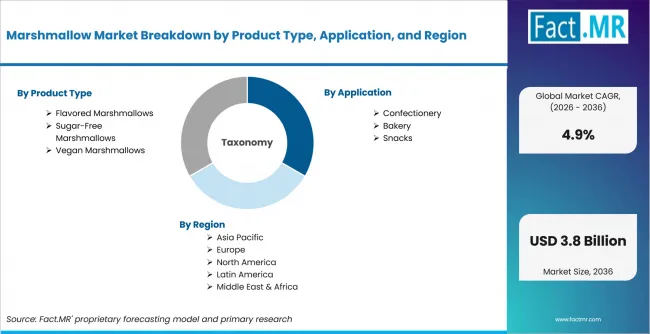
Marshmallow Market Breakdown By Product Type, Application, And Region | Source: Fact.MR
| Attribute | Details |
|---|---|
| Quantitative Units | USD billion |
| Market Definition | Aerated sugar confections made from sugar, glucose syrup and a whipping or setting agent such as gelatin, carrageenan or starch, sold as regular, mini, shaped, flavored, sugar-free and vegan marshmallows. The scope covers retail packs and marshmallows used as ingredients in confectionery, bakery and snack products. |
| Product Type | Flavored Marshmallows; Sugar-Free Marshmallows; Vegan Marshmallows |
| Application | Confectionery; Bakery; Snacks |
| Sales Channel | Supermarkets/Hypermarkets; Convenience Stores; Online Retail |
| Regions Covered | North America; Latin America; Western Europe; Eastern Europe; East Asia; South Asia & Pacific; Middle East & Africa |
| Countries Covered | Turkey; United States; Belgium; Spain; Germany; United Kingdom |
| Key Companies Profiled | Just Born Inc.; Doumak Inc.; The Kraft Heinz Company; Haribo GmbH and Co. KG; Chicago Vegan Foods; Freedom Confectionery |
| Forecast Period | 2026 to 2036 |
| Approach | Hybrid top-down and bottom-up approach using marshmallow retail volumes; flavor and format mix; ingredient use in bakery and snacks; channel shares; country growth; and producer portfolio review. |
How is the market segmented?
-
By Product Type:
- Flavored Marshmallows
- Sugar-Free Marshmallows
- Vegan Marshmallows
-
By Application:
- Confectionery
- Bakery
- Snacks
-
By Sales Channel:
- Supermarkets/Hypermarkets
- Convenience Stores
- Online Retail
-
By Region:
- North America
- Latin America
- Western Europe
- Eastern Europe
- East Asia
- South Asia & Pacific
- Middle East & Africa