- Market Value (2025): USD 2.0 Bn
- Estimated Value (2026): USD 2.2 Bn
- Forecast Value (2036): USD 6.1 Bn
- CAGR (2026-2036): 10.7%
What is the Protein Fat-Mimic Systems Market forecast to be worth by 2036?
USD 2.2 billion in 2026 to USD 6.1 billion by 2036 at a 10.7% CAGR.
- The Clean Mouthfeel Lubricants Market was valued at USD 2.0 billion in 2025.
- Demand is set to increase from USD 2.2 billion in 2026 to USD 6.1 billion by 2036.
- The market is forecast to record a 10.7% CAGR from 2026 to 2036.
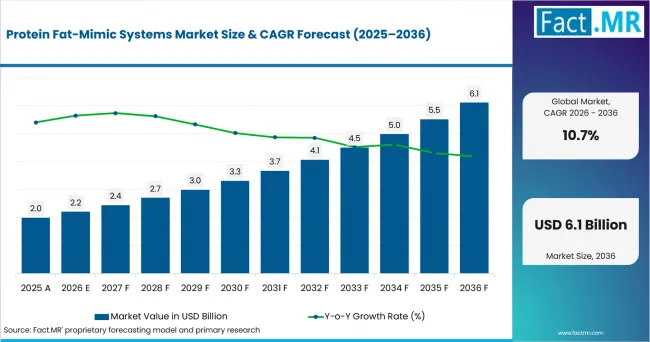
Protein Fat Mimic Systems Market Value Analysis | Source: Fact.MR
What are the defining numbers behind Protein Fat-Mimic Systems Market growth?
An absolute opportunity of USD 3.9 billion is expected between 2026 and 2036.
- Demand Drivers in the Market
- Dairy product developers need fat-reduction systems that preserve a smooth feel when lower fat changes mouthfeel. USDA NASS reported in April 2026 that U.S. whey protein concentrate output reached 502 million pounds in 2025. That base supports whey protein concentrate routes used in protein-led texture work.
- Sauce and dressing food teams need stable body at lower fat levels. Protein-polysaccharide structures help manage water binding and mouthfeel together. This approach gives formulators a clearer route to preserve thickness as the original fat phase is reduced.
- Plant-based product teams need smoother texture in protein-rich mixes because some protein systems produce coarse mouthfeel. Protein microgels change particle behavior and can build a creamier matrix while keeping protein content central to the mix.
- Nutrition brands need dense protein delivery with controlled richness. These systems can add body and lasting mouthfeel while the mix keeps a protein-led nutrition profile and a measured fat level.
- Key Segments Analyzed
- By Fat-Mimic Architecture: Microparticulated whey is expected to hold 34.0% share in 2026 because small protein particles can support smoothness in reduced-fat dairy systems.
- By Sensory Target: Creaminess is projected to account for 30.0% share in 2026 since fat reduction is most visible when a product loses smooth coating action.
- By Replacement Level: <20% fat replacement is forecast to capture 37.0% share in 2026 owing to lower recipe risk and easier adjustment inside established formulations.
- By Food Matrix: Dairy is expected to represent 33.0% share in 2026. Its position is supported by established whey and casein use in cultured products and desserts.
- Analyst Opinion at Fact.MR
- Shambhu Nath Jha, Principal Consultant at Fact.MR, states, “these protein systems work best when texture tests start with the food itself. A direct fat swap rarely solves every texture need. The market is forecast to favor systems that give a steady smooth feel at practical fat-cut levels. Food teams are likely to value suppliers that pair protein skill with tests under real heat and shear.”
- Strategic Implications
- Dairy suppliers should document how particle size and protein source affect a smooth feel after fat cut. Work around protein inputs can help food teams compare texture behavior across dairy matrices.
- Plant-protein developers should pair texture design with flavor management. This is because smoother structure leaves some texture weaknesses unresolved in protein-rich foods.
- Food makers should test fat-cut levels in stages. As a result, viscosity and smoothness can be adjusted before a full mix change reaches market scale.
- use laboratories should compare performance under the heat and shear settings used by customers. Protein networks can respond differently across process lines, so practical testing should mirror the intended food matrix.
The UK is forecast to post an 11.5% CAGR through 2036, backed by its large food sector base. Japan is set to advance at 11.2% as food firms manage texture under higher food prices. The USA is set to record 10.9% as a large food sector workforce helps mix work. Germany is set to reach 10.6% as ready-meal output expands use volume. France is set to post 10.3% as food food plant maintains a broad mix base.
How does the Protein Fat-Mimic Systems Market break down by segment?
Microparticulated whey is expected to lead Fat-Mimic Architecture at 34.0% share in 2026; while Dairy leads Food Matrix at 33.0% share.
Which Fat-Mimic Architecture dominates?
Microparticulated whey is expected to hold 34.0% share in 2026.
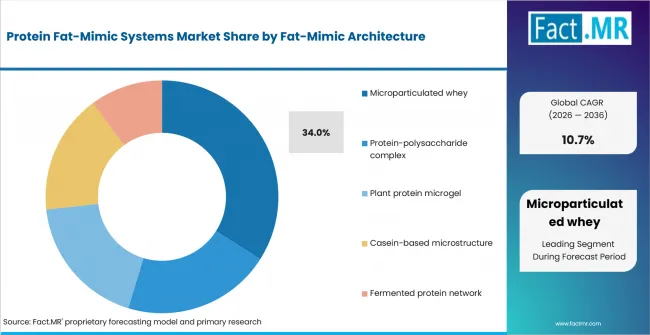
Protein Fat Mimic Systems Market Analysis By Fat Mimic Architecture | Source: Fact.MR
Microparticulated whey is set to lead because fine protein particles can imitate part of the smoothness normally created by fat. Protein-polysaccharide complexes give a second route by combining protein structure with water management. Plant protein microgels are useful in dairy alternatives where food teams need smoother particle action. Casein-based microstructures remain closely aligned with dairy systems, while fermented protein networks widen the design set for newer mixes. USDA NASS reported U.S. whey protein concentrate output of 502 million pounds in 2025, up 2.1% from 2024.
What leads the Sensory Target segment?
Creaminess is projected to account for 30.0% share in 2026.
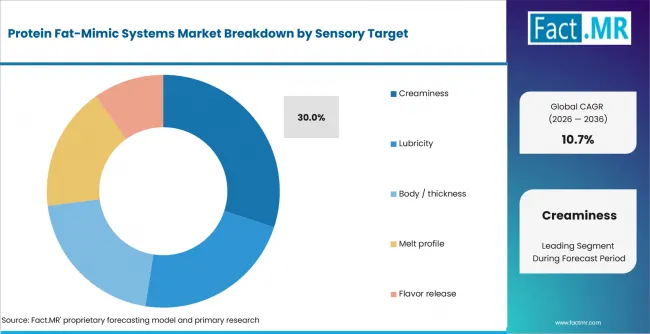
Protein Fat Mimic Systems Market Analysis By Sensory Target | Source: Fact.MR
Creaminess is forecast to lead because it is one of the first texture traits affected by fat reduction. Lubricity describes how smoothly food moves across the mouth. Body and thickness matter when a lower-fat mix feels weak. Melt profile matters in heated foods, while flavor release must stay balanced.
How does Replacement Level shape demand?
<20% fat cut is forecast to capture 37.0% share in 2026.
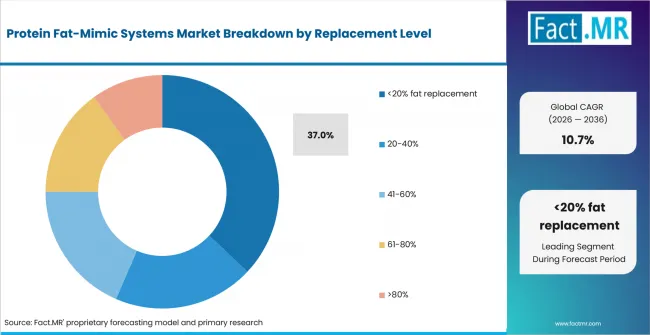
Protein Fat Mimic Systems Market Analysis By Replacement Level | Source: Fact.MR
The <20% fat-cut band is forecast to lead. This is because modest fat cut gives food teams more room to preserve taste and texture. The 20-40% band requires closer control of body as the original fat phase shrinks. At 41-60%, protein structure carries a larger share of the texture task. The 61-80% and >80% bands require tighter control of flavor release and process stability.
What supports Dairy within Food Matrix?
Dairy is set to represent 33.0% share in 2026.
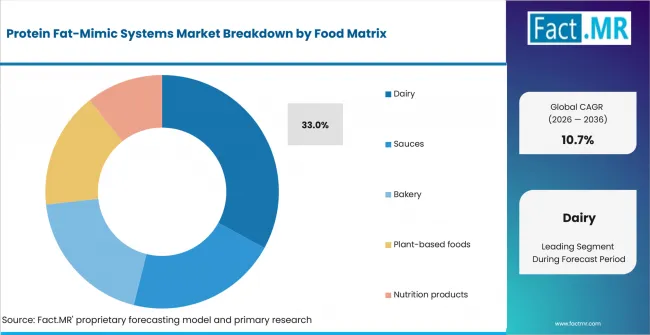
Protein Fat Mimic Systems Market Analysis By Food Matrix | Source: Fact.MR
Dairy is set to lead because whey and casein already function within familiar milk-based matrices. Sauces need systems that preserve body across heating and storage. Bakery uses require careful balance between tenderness and protein structure. Plant-based foods need control of graininess, while nutrition foods place more emphasis on protein density. Arla Foods Ingredients launched its Maximum Yield, No Acid Whey concept in May 2025 using Nutrilac HighYield milk proteins.
What is accelerating Protein Fat-Mimic Systems Market adoption, and what is holding it back?
taste-and-feel retention drives use; mix sensitivity restrains wider fat-cut levels.
Drivers Impact Review
| Driver | (~) % Impact on CAGR | Geographic Relevance | Impact Timeline |
|---|---|---|---|
| Reduced-fat formulation without sensory loss | +1.8% | North America, Europe | Short term (<= 2 years) |
| Protein-rich dairy and nutrition reformulation | +1.4% | North America, Europe, East Asia | Medium term (2-4 years) |
| Texture correction in plant-based foods | +1.1% | Europe, North America, East Asia | Medium term (2-4 years) |
| Broader whey and specialty-protein functionality | +0.8% | North America, Europe | Long term (>= 4 years) |
Source: Fact.MR analysis. Updated Sep 25, 2026
Opportunity Impact Review
| Opportunity | (~) % Impact on CAGR | Geographic Relevance | Impact Timeline |
|---|---|---|---|
| Microparticulated whey in lower-fat dairy | +1.2% | USA, UK, France | Short term (<= 2 years) |
| Protein microgels in plant-based foods | +0.9% | Europe, Japan, USA | Medium term (2-4 years) |
| Fermented protein networks for texture design | +0.7% | Germany, UK, USA | Long term (>= 4 years) |
Source: Fact.MR analysis. Updated Sep 25, 2026
Restraints Impact Review
| Restraint | (~) % Impact on CAGR | Geographic Relevance | Impact Timeline |
|---|---|---|---|
| Sensory imbalance at higher replacement levels | -0.6% | Global | Short term (<= 2 years) |
| Heat, shear and pH sensitivity | -0.5% | Global | Medium term (2-4 years) |
| Protein-source and allergen constraints | -0.3% | North America, Europe, East Asia | Long term (>= 4 years) |
Source: Fact.MR analysis. Updated Sep 25, 2026
Which countries are scaling the Protein Fat-Mimic Systems Market through 2036?
- The country comparison spans 1.2 points and forms a narrow growth range across the 2026 to 2036 forecast period.
- The UK remains at 11.5% CAGR as food sector scale creates repeated mix work across dairy, prepared foods and sauces.
- Japan follows at 11.2% CAGR as food firms manage texture while food prices remain elevated.
- The USA reaches 10.9% CAGR as a large food sector base helps continued mix and input work.
- Germany records 10.6% CAGR as ready-meal output widens the use base for texture-focused systems.
- France closes the displayed range at 10.3% CAGR as food food plant gives a broad base for dairy and prepared-food mix.
Comparable CAGRs can still lead to different entry conditions because dairy scale and product mix vary by country. The report covers all major regions listed in the scope table.
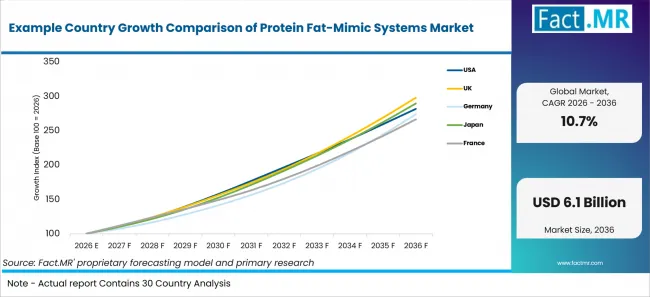
Example Country Growth Comparison Of Protein Fat Mimic Systems Market | Source: Fact.MR
| Country | CAGR (2026-2036) |
|---|---|
| United Kingdom | 11.5% |
| Japan | 11.2% |
| United States | 10.9% |
| Germany | 10.6% |
| France | 10.3% |
Source: Fact.MR analysis. Updated Sep 25, 2026
What supports USA adoption?
10.9% CAGR, backed by a large food sector base.
The U.S. food sector gives a broad base for texture-focused work across dairy and prepared foods. The Federal Reserve reported in May 2026 that capacity utilization for food, beverage, and tobacco products reached 78.0% in April 2026. That scale supports continued food-mix work where protein systems can be tested for smooth feel and body.
How is the United Kingdom scaling demand?
11.5% CAGR, backed by food sector scale and prepared-food work.
The UK combines a large food base with a sizeable prepared-food channel. The Office for National Statistics said in July 2026 that food made up 22.9% of UK manufacturers’ product sales in 2025. This mix creates repeat work where food teams can use protein systems to manage a smooth feel and body at lower fat levels.
What supports Germany’s adoption?
10.6% CAGR, backed by prepared-food output and food-mix work.
Germany has a large prepared-food base that gives texture systems several market uses. Destatis said in January 2026 that Germany produced 1.7 million tonnes of ready meals in 2024. That output helps food-mix work where protein structures can help manage body and a smooth feel across sauces and convenience foods.
How does Japan perform?
11.2% CAGR, backed by food reformulation under higher price pressure.
Japanese food firms are working in a market where texture goals must be balanced with higher food prices. The Statistics Bureau of Japan said in January 2026 that food prices rose 6.8% in 2025. This setting helps careful food-mix work where these systems are tested for eating quality and input efficiency.
What is supporting France’s adoption?
10.3% CAGR, backed by a broad food sector base.
France offers a broad food base for protein texture systems. INSEE reported in July 2026 that the production value of food, beverage and tobacco manufacturing reached EUR 207 billion in 2025. That scale helps work across dairy and prepared foods where protein systems can help manage a smooth feel and body during fat cut.
Who leads the Protein Fat-Mimic Systems Market?
MicroLub, Tate & Lyle, Leprino Nutrition, IFF, FrieslandCampina Ingredients, and Arla Foods Ingredients form the profiled provider group. Their relevance centers on protein and texture capabilities that can support smoothness, lubrication, body, thickness, and other fat-like sensory functions in food formulations.
Arla Foods Ingredients has a clear connection to dairy-protein functionality. Its Maximum Yield, No Acid Whey concept uses Nutrilac HighYield milk proteins, linking its portfolio with dairy systems where protein structure and texture performance are important during formulation work.
MicroLub, Tate & Lyle, Leprino Nutrition, IFF, and FrieslandCampina Ingredients broaden the competitive set across protein and texture applications. Supplier selection is likely to depend on how well a system performs within the intended food matrix, since dairy, sauces, bakery, plant-based foods, and nutrition products place different demands on texture and processing behavior.
Competition therefore centers on sensory performance, protein functionality, process tolerance, and application fit. Food teams are likely to favor suppliers that can support practical testing under the heat, shear, and formulation conditions used in the finished product rather than relying on a simple one-for-one fat replacement approach.
Which companies are the key providers?
Key firms include MicroLub; Tate & Lyle; Leprino Nutrition; IFF; FrieslandCampina Ingredients; and Arla Foods Ingredients.
- MicroLub
- Tate & Lyle
- Leprino Nutrition
- IFF
- FrieslandCampina Ingredients
- Arla Foods Ingredients
Bibliography
- U.S. Department of Agriculture, National Agricultural Statistics Service. (2026, April 24). Dairy products 2025 summary.
- Board of Governors of the Federal Reserve System. (2026, May 15). Industrial production and capacity utilization—G.17: Table 7. Capacity utilization.
- Office for National Statistics. (2026, July 24). UK manufacturers’ sales by product: 2025.
- Statistisches Bundesamt (Destatis). (2026, January 14). Produktion von Fertiggerichten binnen fünf Jahren mengenmäßig um 25,6 % gestiegen [Production of ready meals increased by 25.6% in volume within five years].
- Statistics Bureau of Japan. (2026, January 23). Japan 2025.
- Institut national de la statistique et des études économiques. (2026, July 21). Indicateurs macroéconomiques de l’industrie manufacturière : Données annuelles de 2010 à 2025.
- Arla Foods Ingredients. (2025, May 14). Arla Foods Ingredients targets acid whey elimination with high-yield solution.
This Report Answers
- The report explains where protein-based fat mimics are used across type and sensory target. It also covers fat-cut level and food matrix, together with regional demand.
- Segment review identifies why microparticulated whey, smooth feel, <20% fat reduction and dairy hold the 2026 shares.
- Country review compares the CAGRs for the United Kingdom, Japan, United States, Germany and France and links them to current official evidence.
- Competitive review covers MicroLub, Tate & Lyle, Leprino Nutrition, IFF, FrieslandCampina Ingredients and Arla Foods Ingredients across protein and texture skills.
- Use review examines how smoothness, thickness, melt action and flavor release influence mix decisions when fat is reduced.
What does the Protein Fat-Mimic Systems Market cover?
The Protein Fat-Mimic Systems Market covers protein-based structures used to reproduce selected texture and physical roles of fat in food mixes. It includes fine whey particles and protein-polysaccharide complexes. Plant protein microgels, casein-based microstructures and fermented protein networks are included when texture is their functional purpose.
Demand is assessed across dairy, sauces, bakery, plant-based foods and nutrition products. Protein supply and mix context are considered only where they clarify input availability and use fit for protein fat-mimic systems.
What is included in the scope?
The scope includes protein inputs or structured protein systems when their functional purpose includes smooth feel, lubrication, body, thickness or melt control. It covers dairy and plant-protein approaches used specifically to reproduce fat-like sensory functions.
The analysis includes partial fat reduction from below 20% through above 80%. Fat-cut level is treated as a mix choice that changes the amount of texture work required from the protein system.
What is excluded from the scope?
The scope excludes standard oils, shortenings and fat blends sold for standard fat functions. Standalone starches, gums, fibers and emulsifiers also fall outside the boundary when sold only as standard texturants. General protein inputs remain outside the scope when fortification is their sole function.
Finished low-fat foods fall outside the market boundary when the finished product itself is the item being valued. The review follows the protein system performing the fat-like sensory function across dairy, sauces, bakery, plant-based foods and nutrition products.
How Was the Analysis Built?
The analysis draws on 120+ sources, 35+ company portfolios, 25+ countries, and more than 20 industry interviews.
- Primary Research: Primary research includes discussions with manufacturers, service providers, technology developers, distributors, end users, and subject-matter experts. These conversations examine purchasing priorities, product adoption, operational challenges, approval requirements, competitive positioning, and the factors that influence wider market acceptance.
- Desk Research: Desk research covers government statistics, regulatory publications, company filings, trade data, technical studies, industry associations, standards, public policy, and other authoritative sources. Every source used in the analysis is documented in the bibliography.
- Market Sizing and Forecasting: Market estimates combine historical performance, demand indicators, pricing and volume trends, segment shares, company participation, country-level growth, adoption patterns, investment activity, and barriers to market expansion.
- Data Validation and Update Cycle: Findings are validated by comparing primary interviews with public data, company activity, regulatory changes, trade patterns, and industry developments. Regular updates review new product launches, capacity changes, partnerships, approvals, and shifts in commercial adoption.
Segmentation
What is the report’s scope and coverage?
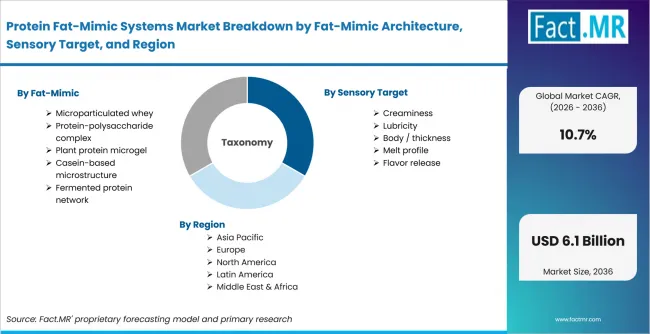
Protein Fat Mimic Systems Market Breakdown By Fat Mimic Architecture, Sensory Target, And Region | Source: Fact.MR
| Attribute | Details |
|---|---|
| Quantitative Units | USD billion |
| Market Definition | Protein-based ingredient systems engineered to reproduce selected fat functions such as creaminess, lubrication, body and melt behavior in foods where fat is partially replaced. |
| Fat-Mimic Architecture | Microparticulated whey; Protein-polysaccharide complex; Plant protein microgel; Casein-based microstructure; Fermented protein network |
| Sensory Target | Creaminess; Lubricity; Body / thickness; Melt profile; Flavor release |
| Replacement Level | <20% fat replacement; 20-40%; 41-60%; 61-80%; >80% |
| Food Matrix | Dairy; Sauces; Bakery; Plant-based foods; Nutrition products |
| Regions Covered | North America; Latin America; Western Europe; Eastern Europe; East Asia; South Asia & Pacific; Middle East & Africa |
| Countries Covered | United States; United Kingdom; Germany; Japan; France |
| Key Companies Profiled | MicroLub; Tate & Lyle; Leprino Nutrition; IFF; FrieslandCampina Ingredients; Arla Foods Ingredients |
| Forecast Period | 2026 to 2036 |
| Approach | Hybrid top-down and bottom-up review using food-manufacturing activity, dairy and protein processing indicators, segment shares, country growth, provider portfolios and application evidence. |
Source: Fact.MR analysis. Updated Sep 25, 2026
How is the market segmented?
-
By Fat-Mimic Architecture:
- Microparticulated whey
- Protein-polysaccharide complex
- Plant protein microgel
- Casein-based microstructure
- Fermented protein network
-
By Sensory Target:
- smooth feel
- Lubricity
- Body / thickness
- Melt profile
- Flavor release
-
By Replacement Level:
- <20% fat reduction
- 20-40%
- 41-60%
- 61-80%
- >80%
-
By Food Matrix:
- Dairy
- Sauces
- Bakery
- Plant-based foods
- Nutrition products
-
By Region:
- North America
- Latin America
- Western Europe
- Eastern Europe
- East Asia
- South Asia & Pacific
- Middle East & Africa
Frequently Asked Questions
How big is the protein fat-mimic systems market in 2026?
What is the CAGR of the protein fat-mimic systems market from 2026 to 2036?
Which fat-mimic architecture leads the protein fat-mimic systems market?
Which food matrix leads the protein fat-mimic systems market?
Who are the companies profiled in the protein fat-mimic systems market?
Who worked on this report


Preview the report firsthand - request a free sample
Free SampleGet the brochure for pricing and purchase details
Download PDF