- Base Value(2025): 115.2 Bn
- Estimated Value(2025): 115.2 Bn
- Forecast Value (2035): 152.8 Bn
- CAGR (2025 - 2035): 2.9%
Demand for Snacks in USA 2025 to 2035
The snacks industry in USA is projected to grow from USD 115.2 billion in 2025 to approximately USD 152.8 billion by 2035, expanding at a compound annual growth rate (CAGR) of 2.9% between 2025 and 2035. Growth is fueled by deeply ingrained snacking culture, the proliferation of occasion-based consumption, and relentless innovation across better for you and indulgent segments. The market is characterized by a high degree of fragmentation and competition, with consumers simultaneously demanding convenience, flavor adventure, and alignment with personal health values.
Growth persists despite inflationary pressures, as snacks represent an affordable treat and a scalable solution for bUSAy American lifestyles. Manufacturers are responding through sophisticated segmentation, leveraging data analytics for targeted product development and investing in operational efficiency to protect margins. The West and Midwest regions serve as particularly dynamic arenas for trend adoption and competitive battles.
Quick Stats for USA Snacks Industry
- USA Snacks Sales Value (2025): USD 115.2 billion
- USA Snacks Forecast Value (2035): USD 152.8 billion
- USA Snacks Forecast CAGR: 2.9%
- Leading Product Type: Savory Snacks (38.5%)
- Leading Distribution Channel: Mass Merchandisers & Supermarkets (52.7%)
- Key Growth Regions: West, Southwest, North, Midwest
- Regional Leadership: The West holds a leading position in value demand
- Key Players in USA Snacks Industry: PepsiCo (Frito-Lay), Mondelēz International, Kellanova, The Hershey Company, General Mills, Utz Brands, Inc., Campbell Soup Company (Snyder's-Lance), KIND LLC, JM Smucker Company (Uncrustables), Quest Nutrition.
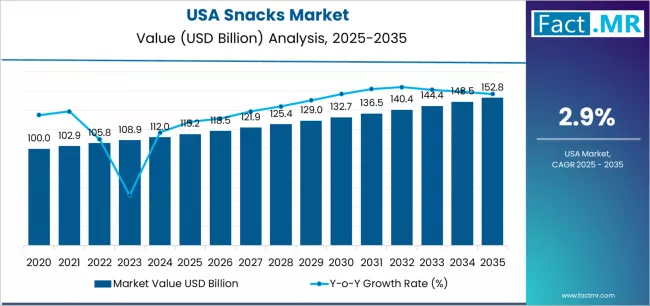
Usa Snacks Market Market Value Analysis | Source: Fact.MR
The savory snacks segment, including potato chips, tortilla chips, and meat snacks, is projected to account for 38.5% of market demand by value in 2025. Its dominance is anchored in perennial popularity, constant flavor and format innovation, and strong penetration across all retail and foodservice channels. The segment benefits from strong brand equities and its role as a staple for social gatherings, solo indulgence, and on the go consumption.
The mass merchandisers and supermarkets channel is expected to hold 52.7% of market demand in 2025. This channel maintains critical volume through one stop shop convenience, promotional frequency, and the strategic USAe of shelf space to manage a vast assortment that caters to diverse hoUSAehold needs. It remains the primary battleground for securing mainstream America's pantry share.
From 2030 to 2035, demand is forecast to grow from USD 132.5 billion to USD 152.8 billion, adding USD 20.3 billion. This latter period will be defined by the acceleration of personalization, with AI driven offerings and direct to consumer models gaining scale. The integration of functional ingredients targeting mental well being, sleep, and energy will blur lines with the supplement category. Sustainability and ethical sourcing will evolve from differentiating claims to baseline expectations, fundamentally reshaping procurement and packaging strategies nationwide.
The USA snacks industry is navigating a period of value driven growth, balancing inflationary consumer sensitivity with demand for premium experiences. The market's future hinges on mastering portfolio diversification across price points, doubling down on supply chain agility, and authentically connecting brand narratives to evolving consumer identities around health, sustainability, and community.
USA Snacks Industry Key Takeaways
| Metric | Value |
|---|---|
| USA Snacks Sales Value (2025) | USD 115.2 billion |
| USA Snacks Forecast Value (2035) | USD 152.8 billion |
| USA Snacks Forecast CAGR (2025-2035) | 2.9% |
Source: Fact.MR analysis. Updated Dec 4, 2025
Why is the USA Snacks Industry Growing?
American consumers have fully embraced snacking as a primary mode of consumption, driving demand for products that fulfill needs ranging from fuel and function to comfort and celebration. This behavioral shift necessitates an ever expanding array of products tailored to specific dayparts, dietary philosophies, and mood states, placing a premium on manufacturer agility and consumer insight.
Brands are competing on multiple fronts: mitigating input cost inflation, navigating clean label and "free-from" demands, and investing in packaging that communicates brand purpose and reduces environmental impact. The regulatory environment, including evolving FDA labeling guidelines and state level policies on recycling and ingredient transparency, adds layers of complexity. Success hinges on the ability to leverage scale for efficiency while fostering an innovative, consumer centric culture that can rapidly respond to local and regional taste trends.
Segmental Analysis
The USA snacks industry is a multifaceted ecosystem best understood through a detailed segmentation of its product types and distribution pathways. This segmentation is not merely a descriptive exercise but an analytical framework that reveals the underlying engines of growth, profit pools, and competitive intensity. By dissecting the market into core product categories, savory snacks, sweet snacks, and better-for-you alternatives—and key distribution channels, stakeholders can identify where consumer loyalty is strongest, where innovation is most disruptive, and where margin pressure is most acute. This granular view is essential for navigating a market where a single consumer may purchase a premium organic chip, a classic candy bar, and a functional nutrition bar through three different retailers in the same week.
Analyzing the interplay between product segments and distribution channels uncovers critical strategic insights. The fate of a new product is often determined not jUSAt by its formulation, but by its route to market. A novel better-for-you snack may find its initial audience through a direct-to-consumer website or a specialty retailer before fighting for shelf space in a mass merchandiser.
Conversely, the economics of traditional savory snacks are inextricably linked to their dominance in the convenience store channel. This section provides a dual-lens analysis, exploring the dominant product categories that define consumer demand and the evolving retail channels that serve as the critical battlegrounds for market access and share.
Why Do Savory Snacks Maintain a Leading Market Share?
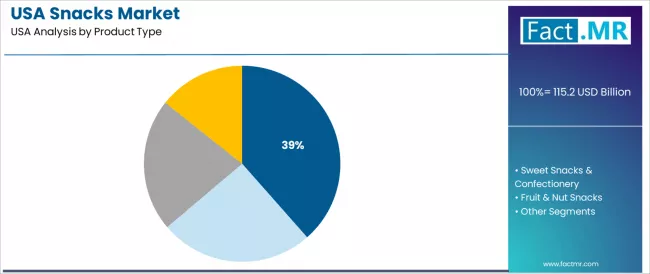
Usa Snacks Market Analysis By Product Type | Source: Fact.MR
The savory snacks segment, commanding a 38.5% share, is the cornerstone of the industry, a position sustained by deep cultural integration, relentless innovation, and exceptional versatility. Its dominance begins with irreplaceable consumption occasions, from individual indulgence and lunchbox staples to social gatherings and sports viewing, embedding products like potato chips, tortilla chips, and pretzels into the fabric of daily American life. This is not a passive market; it is driven by a continuous innovation cycle where flavor exploration acts as a primary growth lever.
Limited-edition collaborations, globally inspired tastes such as Thai Chili and Truffle Parmesan, and premium ingredient stories (e.g., avocado oil, Himalayan salt) create constant novelty that drives trial and disrupts routine purchasing, ensuring the category remains dynamic and top-of-mind. Beyond flavor, the segment’s resilience is fortified by its strategic segmentation across price points and consumer needs. The market simultaneously supports value-focused private label brands, mass-market power brands with immense advertising clout, and premium craft brands emphasizing artisanal production and clean labels.
This allows the category to capture spending across economic cycles. Furthermore, savvy manufacturers have adeptly navigated health trends by expanding sub-categories like popped, baked, and vegetable-based chips, offering perceived better-for-you options without asking consumers to abandon the savory snack experience entirely. This innovation extends to packaging, with resealable bags for freshness and portion-controlled packs for on-the-go convenience, directly addressing evolving consumption patterns.
The economic structure of the savory segment also reinforces its leadership. High-volume production, extensive contract farming for key ingredients like potatoes and corn, and optimized logistics networks create significant economies of scale for incumbent players. This scale creates a barrier to entry and supports the marketing budgets necessary to maintain brand equity.
However, this scale also makes the segment a prime target for retailer private-label programs, which exert continuous downward pressure on margins. Consequently, while volume is immense, competition is perhaps the fiercest here, requiring players to balance brand investment, operational excellence, and constant renovation to defend and grow their position within this foundational category.
Why is the Omnichannel Strategy Critical for Distribution and Market Reach?
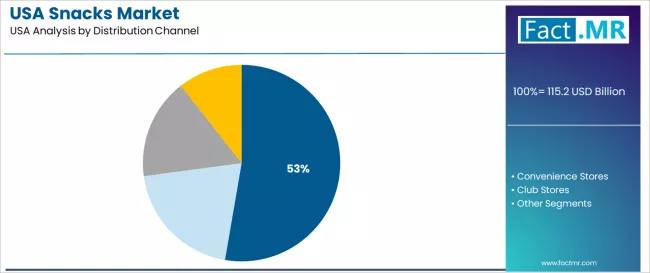
Usa Snacks Market Analysis By Distribution Channel | Source: Fact.MR
The distribution landscape for snacks has evolved from a linear supply chain into a complex, consumer-centric omnichannel ecosystem, where the mass merchandiser channel's 52.7% volume share tells only part of the story. Success now hinges on a brand’s ability to execute a distinct yet cohesive strategy across each unique channel, recognizing that each serves a different mission for the shopper.
The club store channel is driven by bulk purchasing for household replenishment, the convenience store channel caters to immediate consumption and impulse buys, and the online channel facilitates subscription, discovery of niche brands, and pantry loading often motivated by promotional deals. A one-size-fits-all approach fails; winning requires tailored pack sizes, assortments, and promotional tactics aligned with each channel's specific mission and economics.
The rise of e-commerce and direct-to-consumer (DTC) models has fundamentally altered the channel dynamic, making omnichannel capability not an advantage but a prerequisite. Online platforms are not just another sales outlet; they are vital research hubs where consumers compare ingredients, read reviews, and discover new products.
For emerging brands, a DTC site is a launchpad, allowing them to build a community, gather first-party data, and prove concept viability before seeking scarce brick-and-mortar shelf space. For established brands, a robust online presence is essential for defense, protecting against share erosion to digital natives and enabling deeper consumer engagement through subscription models that promise recurring revenue and higher lifetime value.
This omnichannel reality has dramatically shifted power dynamics and required new operational competencies. Retailers demand channel-exclusive products or flavors, while consumers expect seamless experiences like buying online for in-store pickup. This forces manufacturers to invest in sophisticated demand forecasting, flexible packaging lines, and integrated data systems to manage complexity.
The channel strategy also directly influences brand perception; a product found in a specialty grocer like Whole Foods carries a different cachet than the same product in a discount dollar store. Therefore, strategic channel selection and management is a core component of brand positioning, requiring careful planning to ensure availability aligns with the brand’s aspirational image and target demographic, making omnichannel mastery a primary competitive battlefield.
What are the Drivers, Restraints and Trends in the Snacks Industry in USA?
The trajectory of the USA snacks industry is governed by a powerful confluence of enduring consumer drivers, formidable structural restraints, and transformative macro trends. Understanding this interplay is critical for separating cyclical fluctuations from secular shifts.
The industry is being pulled forward by deep-seated changes in how Americans eat and live, while simultaneously being constrained by economic realities and regulatory frameworks. Navigating this environment requires distinguishing between fleeting fads and durable trends that will reshape the competitive landscape over the coming decade.
This analysis examines the core forces at play: the drivers that create market expansion and premiumization opportunities; the restraints that pressure margins and stifle innovation; and the key trends that signal where the industry is heading. These elements do not operate in isolation.
For instance, the driver of health and wellness directly confronts the restraint of commodity cost inflation when formulating cleaner-label products with more expensive ingredients. Similarly, the trend of digital engagement is reshaping how brands overcome the restraint of consumer skepticism. The following sections delve into these dynamics, providing a framework for anticipating challenges and capitalizing on the structural shifts defining the future of snacking.
Permeation of Health and Wellness into Everyday Indulgence
Health-consciousness has evolved from a restrictive diet mentality to a holistic, integrated demand for better-for-you options across all food categories, including snacks. This is no longer a niche segment but a mainstream filter influencing most purchases. The driver manifests not as a rejection of indulgence, but as a demand for healthier indulgence snacks that deliver on taste while offering functional benefits, cleaner labels, or specific dietary alignments like plant-based, keto, or gluten-free.
This has led to the proliferation of products boasting added protein, probiotics, fiber, and nutrients derived from recognizable whole foods like chickpeas, lentils, and ancient grains. The success of this driver is evident in the rapid growth of categories like meat snacks (high protein), popcorn (perceived as a lighter whole grain), and fruit/vegetable chips, which allow consumers to snack without a sense of nutritional compromise.
Demand for Experiential and Global Flavors as Culinary Exploration
American palates have become increasingly adventurous, turning the snack aisle into a destination for culinary exploration and sensory adventure. This driver is fueled by globalization, travel, and the influence of food media, leading consumers to seek bold, authentic, and globally inspired flavors. Snacks provide a low-risk, affordable avenue to taste flavors from around the world, from Korean Gochujang and Japanese Yuzu to Mexican Elote and Indian Tikka Masala.
This trend supports premium pricing for limited-edition or collaboration-based products and drives significant social media buzz, as consumers share their discoveries. For manufacturers, it necessitates a robust and agile innovation pipeline, often involving partnerships with chefs or cultural consultants, and creates a lifecycle where constant novelty is required to maintain consumer engagement and shelf space against a backdrop of flavorful competitors.
Intense Cost and Margin Pressure from a Consolidated Retail Landscape
The industry operates under persistent and severe margin compression, caught between volatile input costs and the formidable bargaining power of a highly consolidated retail sector. Costs for ingredients, packaging, labor, and transportation are subject to significant inflation and fluctuation, squeezing profitability from one side.
From the other, a handful of massive retailers wield immense power, demanding lower costs, higher promotional allowances, and exclusive products, making it difficult for manufacturers to pass cost increases through to the shelf price.
This restraint is particularly challenging for mid-sized brands lacking the scale of giants like PepsiCo or Mondelēz. It often leads to difficult choices: reformulating with cheaper ingredients (risking brand equity), reducing package size, or absorbing the cost and sacrificing margin, each with significant potential consequences for consumer trust and long-term brand health.
Regulatory Complexity and the Burden of HFSS Legislation
Beyond federal FDA regulations, the snack industry faces a growing patchwork of state and local legislation, with the most impactful being restrictions on High Fat, Sugar, and Sodium (HFSS) products. These regulations, which limit the promotion and placement of such products in stores, fundamentally disrupt decades of proven marketing and merchandising strategies.
Compliance is not just a matter of relocating products; it often necessitates expensive and technically challenging reformulation to meet nutritional criteria without sacrificing taste, a process that can take years and millions in R&D. This regulatory environment creates a high barrier for innovation, as new products must be designed within strict nutritional guardrails from the outset, and it disproportionately burdens smaller companies that lack the resources for extensive nutritional science and legal compliance teams.
The Blurring of Category and Occasion Boundaries
The traditional, rigid definitions of snack categories are dissolving, leading to unprecedented competition from non-traditional players. Protein bars now compete with candy bars; refrigerated snack kits compete with deli sandwiches; savory puff snacks compete with crackers. This blurring is driven by consumer demand for multipurpose products that can serve as a quick meal, a post-workout refuel, or a mindful treat. It forces companies to think beyond their historical category silos and consider a wider, more diverse set of competitors.
For example, a brand like uncrustables (pre-made peanut butter and jelly sandwiches) competes not only with other snacks but with the entire "easy kids' lunch" occasion. This trend demands innovation that creates hybrid products and requires marketing that educates consumers on new USAge occasions, ultimately expanding the total addressable market while intensifying cross-category competition.
Analysis of USA Snacks Industry by Key Regions

Usa Snacks Market Cagr Analysis By Country | Source: Fact.MR
| Region | CAGR (2025 to 2035) |
|---|---|
| West | 3.3% |
| Southwest | 3.0% |
| North | 2.7% |
| Midwest | 2.6% |
Source: Fact.MR analysis. Updated Dec 4, 2025
The USA snacks is a collection of distinct regional economies, each with unique demographic profiles, cultural tastes, and competitive retail landscapes that shape local demand patterns. A national strategy, while efficient, risks missing significant opportunities and threats that vary from coast to coast. Regional analysis is therefore not an academic exercise but a commercial imperative, revealing where specific product categories are over- or under-indexing, which retail channels dominate, and what local consumer values must be reflected in marketing. Growth rates, flavor preferences, and price sensitivity can differ markedly between regions, influenced by factors such as ethnic diversity, median income, climate, and population density.
Understanding these geographic nuances allows for precise strategic execution. A premium, globally inspired snack might find its initial success in the cosmopolitan and trend-forward markets of the West, while a value-focused, family-sized pack of a classic brand may drive volume in the heartland. Furthermore, regional competitors often hold strong loyalties that national brands must deliberately overcome. This section provides a detailed analysis of four key regions, the West, Southwest, North, and Midwest—mapping their distinct growth trajectories, primary demand drivers, and the strategic implications for snack manufacturers aiming to build a dominant national presence through localized insight and execution.
What Strategic Advantages Position the West as the Leading Growth Region?

Usa Snacks Market Country Value Analysis | Source: Fact.MR
The West, with a leading CAGR of 3.3%, serves as the nation's primary innovation incubator and trendsetter. This region is characterized by exceptionally high health and environmental consciousness, cultural diversity, and above-average disposable income, particularly in major metropolitan areas like Los Angeles, San Francisco, and Seattle. Consumers here are early adopters, driving rapid uptake of plant-based snacks, products with clean-label and organic credentials, and brands with strong sustainability narratives. The West is the epicenter of the better-for-you movement, where snacks are often evaluated as much for their ingredient deck and ethical sourcing as for their taste, forcing brands to lead with transparency and mission-driven storytelling to win loyalty.
The retail environment in the West is equally sophisticated, featuring a high density of premium grocery chains (e.g., Whole Foods, Erewhon), specialty natural food stores, and a robust direct-to-consumer ecosystem fueled by the region's tech culture. This channel mix supports higher price points and provides a launch platform for niche brands before they attempt national expansion. Flavor preferences are adventurous and globally influenced, reflecting the region's demographic diversity, with Asian and Latin American flavors performing exceptionally well. For manufacturers, success in the West requires a commitment to premium quality, investment in R&D for innovative formats and ingredients, and marketing that authentically communicates a brand's health and sustainability values, as consumers in this region are highly discerning and skeptical of greenwashing.
How do Demographic Trends Fuel Growth and Flavor Innovation in the Southwest?
The Southwest is forecast to grow at 3.0%, fueled by powerful demographic trends, a climate conducive to active, outdoor lifestyles, and a vibrant culinary culture. The region's rapidly growing and young Hispanic population is a primary engine, creating sustained demand for authentic and innovative Hispanic-inspired snacks. This goes beyond tortilla chips to include spicy candies, fruit-based snacks with chili (tajín), and authentic renditions of traditional recipes. The flavor profile is bold, embracing heat and complexity, making the Southwest a critical test market for savory and spicy innovations that have the potential to cross over into the mainstream national palate.
Beyond demographic influence, the Southwest's lifestyle drives demand for portable, energy-sustaining snacks suitable for hiking, sports, and on-the-go activities. This supports strong sales in categories like meat jerky, trail mixes, and nutrition bars. The retail landscape is competitive, with strong showings from value-oriented mass merchandisers serving large families, as well as convenience stores capturing fuel and snack traffic. For brands, winning in the Southwest means mastering a balance: offering authentic, flavor-forward products that resonate with the core demographic, while also providing value and convenience for the active, family-oriented consumer. Tailoring marketing to highlight vibrant flavors, community, and vitality is key to connecting with this dynamic regional market.
What Factors Underpin Steady Demand and Brand Loyalty in the North?
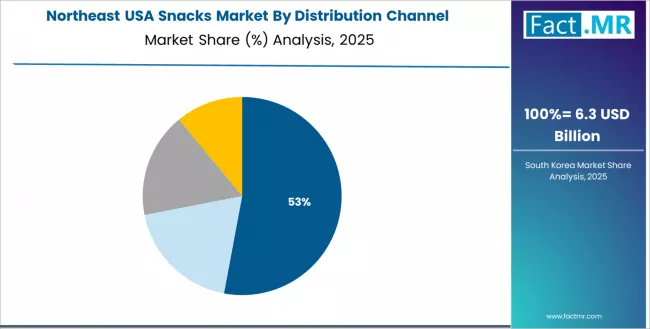
Usa Snacks Market Northeast Market Share Analysis By Distribution Channel | Source: Fact.MR
The North, with a CAGR of 2.7%, represents a high-volume, affluent, and densely populated market defined by fast-paced urban centers and distinct suburban cultures. Consumers in major hubs like New York, Boston, and Chicago are time-pressed and convenience-driven, supporting strong sales in single-serve formats, on-the-go snacks, and premium convenience offerings found in urban delis, drugstores, and quick-service restaurants. There is a parallel demand for premium, artisanal products among affluent suburbanites, who frequent high-end grocery stores and value quality ingredients and gourmet positioning. This duality requires a segmented portfolio approach from national brands.
The Northern consumer is highly educated and influenced by media trends, leading to quicker adoption of certain health trends (e.g., keto, gluten-free) than the national average. However, this is balanced by a deep-seated loyalty to iconic regional and national brand names that provide a sense of familiarity and quality. The competitive landscape is intense, with every major manufacturer fighting for visibility in a crowded retail environment. Success here depends on superior execution: flawless in-store presence, impactful branding that cuts through the noise, and innovation that taps into the urban need for convenience and the suburban desire for sophisticated indulgence. Marketing mustbe sharp, culturally relevant, and often digitally savvy to reach the region's connected consumers.
How Does the Midwest's Pragmatic Culture Shape its Stable Market Profile?
The Midwest demonstrates steady growth at a CAGR of 2.6%, anchored in a pragmatic, value-conscious, and brand-loyal consumer base. This region is the heartland of mainstream America, where purchasing decisions are heavily influenced by familiarity, price, and trust built over time. Consumers show strong allegiance to legacy national brands and retailer private labels, with a focus on getting the most product for their dollar. Club stores (Costco, Sam's Club) and mass merchandisers (Walmart, Target) are dominant channels, driving volume through large, family-sized packages and promoting a stock-up shopping mentality that favors established pantry staples.
While adoption of the latest premium health trends is more measured than in coastal regions, there is consistent and growing demand for better-for-you options that deliver clear, understandable value, such as protein-packed snacks or fruit and nut mixes. Flavor preferences tend toward classic, hearty, and familiar profiles, though there is openness to innovation that feels accessible rather than exotic. For manufacturers, the Midwest is a volume-driven profit center where operational efficiency, strong retailer relationships, and maintaining the core integrity of flagship brands are paramount. Marketing that emphasizes reliability, family, straightforward value, and trust resonates deeply, making it a critical region for sustaining the volume foundation of any national brand.
Competitive Landscape and Recommendations for Market Players
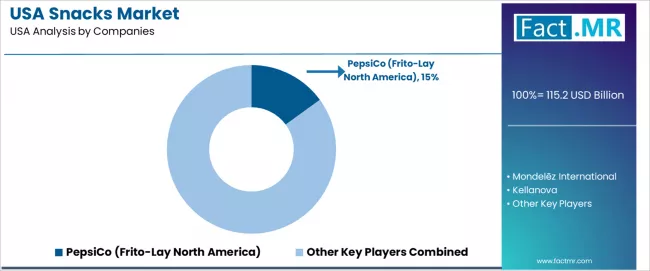
Usa Snacks Market Analysis By Company | Source: Fact.MR
The USA snacks industry is an arena of relentless competition, defined by the colossal scale of global food conglomerates, the potent nostalgia of heritage brands, the agile disruption of venture-backed startups, and the ever-encroaching quality and value of retailer private labels. This landscape is not static but is constantly reshaped by mergers, acquisitions, and the relentless churn of innovation.
Competition plays out across multiple dimensions: for ownership of key consumption occasions, for superiority in supply chain efficiency and cost management, for breakthrough product innovation that captures consumer imagination, and for mastery of the fragmented modern media landscape to build brand relevance. In this environment, scale provides significant advantages in procurement, manufacturing, and shelf presence, but agility and authentic consumer connection are the weapons of choice for challenger brands seeking to carve out defensible niches.
PepsiCo's Frito-Lay division stands as the undisputed titan of savory snacks, competing through an unmatched portfolio of billion-dollar brands (Lay's, Doritos, Cheetos), a distribution network that reaches virtually every storefront in America, and a marketing budget that ensures cultural ubiquity. Its strategy is one of fortress defense combined with targeted innovation, using its scale to blanket the market while launching limited-time flavors and acquiring emerging brands (e.g., Bare Snacks) to address specific trends.
The Hershey Company and Mondelez International dominate the sweet snack and confectionery landscape, competing on deep emotional brand equity, consistent product quality, and massive seasonal and thematic marketing campaigns that drive impulse purchases. Their challenge is navigating the health and wellness shift, leading to significant investments in reformulation (reduced sugar) and the expansion of their portfolios into adjacent better-for-you categories, sometimes through acquisition.
The competitive field is intensely pressured by the rapid ascent of retailer private labels. Chains like Costco (Kirkland Signature), Kroger, and Aldi have invested heavily in developing premium-quality store brands that mimic the taste and packaging of national leaders at a 20-30% lower price point. These programs benefit from built-in consumer trust in the retailer, prime shelf placement, and the absence of slotting fees, making them a dual customer and formidable competitor to branded manufacturers. Their growth forces national brands to continuously demonstrate superior value through innovation, brand storytelling, and proven consumer preference to justify their price premium and maintain allocated shelf space.
A vibrant ecosystem of small and mid-sized independents, such as KIND Snacks, SkinnyPop, and LesserEvil, competes by championing specific attributes like simple ingredients, ethical sourcing, or specific dietary alignments. These brands often originate online or in natural food channels, building loyal followings through mission-driven marketing before expanding into mainstream retail. Their success forces incumbents to act, leading to a steady stream of acquisitions such as Hershey's acquisition of SkinnyPop's parent that allow giants to buy innovation and consumer credibility. This dynamic makes the competitive landscape a cycle of disruption and consolidation, where today's agile startup can become tomorrow's integrated brand within a conglomerate's portfolio.
The digital revolution has added another layer of complexity, making digital marketing and direct-to-consumer (DTC) capability a core competitive competency. Brands that master social media engagement, influencer partnerships, and DTC e-commerce can build formidable awareness and loyalty outside of traditional retail gatekeepers. This allows them to test products with real-time feedback, gather valuable first-party consumer data, and create subscription revenue models. The competitive battleground has thus expanded from the physical store shelf to the smartphone screen, requiring all players, regardless of size, to develop sophisticated digital marketing and data analytics capabilities to stay relevant in the consumer's consideration set.
Recommendations for Market Players
- Pursue Strategic Portfolio Diversification: Companies must actively manage a dual portfolio strategy. This involves protecting and modernizing core power brands that deliver volume and profit, while simultaneously investing in or acquiring emerging brands that capture new consumer segments, dietary trends, and premium price points. This creates a hedge against market shifts and allows for cross portfolio innovation, ensuring the business is not overly reliant on categories vulnerable to disruption or regulatory pressure.
- Accelerate Digital and Direct to Consumer Capabilities: Building first party data assets is no longer optional. Players should invest in direct to consumer channels, not merely as a sales outlet, but as a vital source of real time consumer insight, a laboratory for product testing, and a platform for building community. Leveraging this data to personalize marketing, inform R&D, and optimize omnichannel assortments will be a key differentiator, allowing brands to move faster and build deeper loyalty than reliance on third party retail data alone.
- Embed Operational Resilience and Agility: Given persistent cost and supply chain volatility, leading players must invest in manufacturing flexibility, multi sourcing for key ingredients, and advanced demand forecasting. Building resilience might involve nearshoring certain production, forming strategic supplier partnerships, and leveraging AI for predictive logistics. This operational backbone is critical for maintaining service levels, protecting margins, and ensuring the ability to rapidly scale successful innovations.
- Champion Authentic Sustainability and ESG Narratives: Sustainability commitments must move beyond marketing to become operational imperatives with clear accountability. This includes tangible progress in sustainable sourcing, measurable reductions in packaging waste and carbon footprint, and transparent reporting. Players that authentically integrate these values into their supply chain and corporate practices will build trust and align with the growing segment of values driven consumers, particularly in trend leading regions.
- Hyper Localize Regional Marketing and Assortment Strategies: A one size fits all national strategy will miss significant opportunities. Winning requires a nuanced understanding of regional taste preferences, demographic shifts, and retail landscapes. Companies should tailor flavor offerings, pack sizes, and marketing campaigns to resonate with consumers in the West versus the Midwest or Southwest. Empowering regional sales and marketing teams with data and decision-making authority can unlock growth by ensuring the right product is in the right place for the local consumer.
Key Players in USA Snacks Industry
- PepsiCo (Frito-Lay North America)
- Mondelēz International
- Kellanova
- The Hershey Company
- General Mills
- Utz Brands, Inc.
- Campbell Soup Company (Snyder's-Lance, Pepperidge Farm)
- KIND LLC
- The JM Smucker Company (Uncrustables, Jif)
- Quest Nutrition
- Tyson Foods (Hillshire Snacks)
- Lakeview Farms Inc.
Segmentation
Scope of the Report
| Item | Value / Coverage |
|---|---|
| Quantitative Units | Revenue in USD Billion |
| Market Valuation (2025) | USD 115.2 Billion |
| Market Valuation (2035) | USD 152.8 Billion |
| Forecast Period | 2025-2035 |
| Product Type Segmentation | Savory Snacks, Sweet Snacks & Confectionery, Fruit & Nut Snacks, Health & Wellness Snacks |
| Distribution Channel Segmentation | Mass Merchandisers & Supermarkets, Convenience Stores, Club Stores, Online Retail |
| Regions Covered | West, Southwest, North, Midwest |
| Key Companies Profiled | PepsiCo, Mondelēz, Kellanova, Hershey, General Mills, Utz Brands, Campbell Soup, KIND |
| Additional Attributes | Analysis by product and distribution channel; regional growth analysis; competitive landscape; impact of inflation and health trends; private label competition analysis. |
Source: Fact.MR analysis. Updated Dec 4, 2025
USA Snacks Industry by Segments
-
Product Type:
- Savory Snacks
- Sweet Snacks & Confectionery
- Fruit & Nut Snacks
- Health & Wellness Snacks
-
Distribution Channel:
- Mass Merchandisers & Supermarkets
- Convenience Stores
- Club Stores
- Online Retail
-
Region:
- West
- Southwest
- North
- Midwest
Frequently Asked Questions
How big is the demand for snacks in USA in 2025?
What will be the size of snacks in USA in 2035?
How much will be the demand for snacks in USA growth between 2025 and 2035?
What are the key product types in the snacks in USA?
Which distribution channel segment is expected to contribute significant share in the snacks in USA in 2025?
Who worked on this report


Preview the report firsthand - request a free sample
Free SampleGet the brochure for pricing and purchase details
Download PDF