- Market Value (2025): USD 892.8 Mn
- Estimated Value (2026): USD 961.0 Mn
- Forecast Value (2036): USD 2006.6 Mn
- CAGR (2026-2036): 7.6%
What is the Matrix-Embedded Wicking Additives Market forecast to be worth by 2036?
USD 961.0 million in 2026 to USD 2006.6 million by 2036 at a 7.6% CAGR.
- The Matrix-Embedded Wicking Additives Market was valued at USD 892.8 million in 2025.
- Demand is projected to increase from USD 961.0 million in 2026 to USD 2006.6 million by 2036.
- The market is forecast to record 7.6% CAGR from 2026 to 2036 as converters seek built-in wetting performance in nonwovens, fibers, and films.
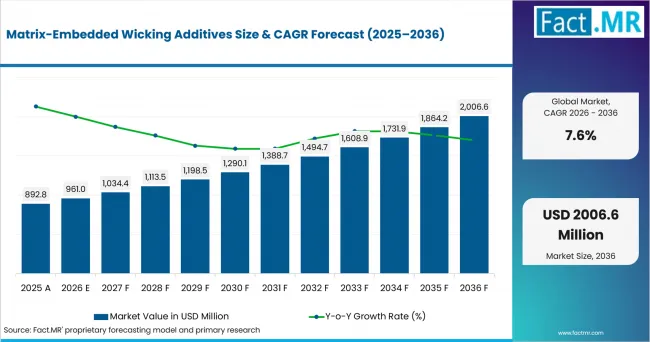
Matrix Embedded Wicking Additives Value Analysis | Source: Fact.MR
What are the defining numbers behind Matrix-Embedded Wicking Additives Market growth?
An absolute opportunity of USD 1045.6 million is expected between 2026 and 2036.
- Demand Drivers in the Market
- Nonwoven producers need controlled surface energy without a separate finishing step. In June 2026, the U.S. Bureau of Economic Analysis reported USD 19.0 billion of 2025 new direct investment in plastics and rubber products manufacturing.
- Medical and hygiene converters need repeatable fluid transport in thin polymer structures. Built-in modifiers are relevant where wetting speed and low extractables are reviewed together during material qualification.
- Fiber processors need additive systems compatible with PP, PE, PET, and PA processing windows. Pellet and masterbatch formats simplify dosing while spinning lines preserve throughput and filament quality.
- Industrial textile and film users need stable functionality after converting. Permanent or reactive hydrophilic systems are differentiated by retained surface behavior after storage and handling.
- Polymer compounders need documented formulation control. Supplier selection depends on carrier compatibility and migration behavior alongside evidence for durable wetting performance.
- Key Segments Analyzed
- By Matrix-Embedded Additive Type: Migratory surfactant masterbatch is expected to hold 34.0% share in 2026 owing to straightforward dosing in established compounding and fiber-processing lines.
- By Host Polymer: PP is projected to account for 39.0% share in 2026 since spunbond and meltblown applications provide a broad processing base for in-matrix surface modification.
- By Application: Nonwovens are anticipated to capture 37.0% share in 2026.
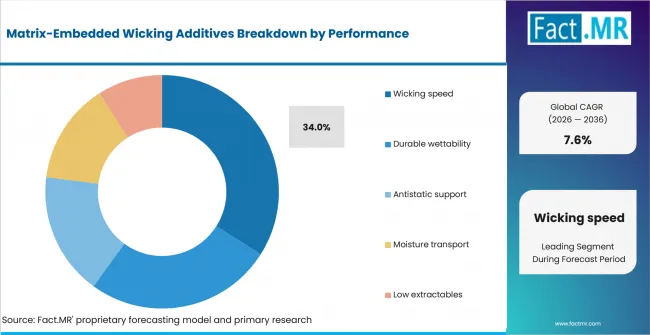
- By Performance: Wicking speed is estimated to represent 34.0% share in 2026 since fast initial wetting provides a direct performance measure in fluid-management structures.
- Analyst Opinion at Fact.MR
- Shambhu Nath Jha, Principal Consultant at Fact.MR, states, “The commercial distinction is whether surface behavior is created inside the polymer or added later. Demand is expected to favor systems that combine processing compatibility with measurable wetting performance. Suppliers should document migration and durability alongside initial liquid-transfer results.”
- Strategic Implications
- Additive producers can strengthen technical documentation by publishing polymer-specific dosing windows and test conditions. This gives converters a clearer basis for comparing performance across PP, PE, PET and PA while accounting for differences in resin behavior.
- Nonwoven qualification benefits from wetting-speed testing after aging and converting. Aging data help determine whether migratory additives remain within the required performance window through downstream processing and storage.
- Medical-material qualification requires fluid-management data to be assessed alongside barrier and cleanliness performance. A combined testing package gives manufacturers a clearer view of how the material behaves under finished-application conditions and expected exposure.
- Compounders need clear separation between permanent modifiers and migratory surfactant systems. Their different durability and migration profiles lead to distinct qualification routes for finished products.
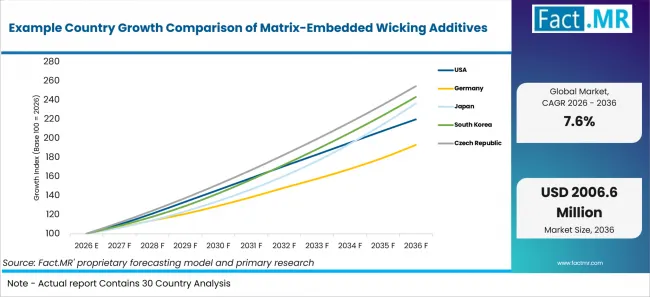
Czech Republic is forecast to record 9.8% CAGR through 2036 as plastics output supports local compounding. South Korea is anticipated to post 9.3% through manufacturing activity. Japan is estimated at 9.0% owing to its plastics-processing base. The USA is projected at 8.2% through a large conversion base. Germany is forecast at 6.8% through specialty-material capability.
How does the Matrix-Embedded Wicking Additives Market break down by segment?
PP leads Host Polymer at 39.0% share in 2026; Nonwovens lead Application at 37.0% share.
Which Matrix-Embedded Additive Type leads?
Migratory surfactant masterbatch is expected to hold 34.0% share in 2026.
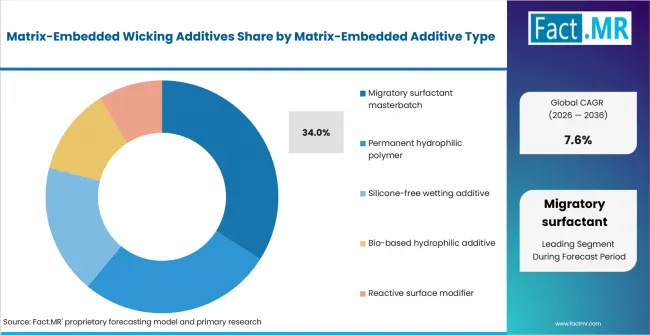
Matrix Embedded Wicking Additives Analysis By Matrix Embedded Additive Type | Source: Fact.MR
Migratory surfactant masterbatch leads because it fits established masterbatch dosing and melt-processing workflows. The active chemistry can move toward the polymer surface and improve liquid spreading. Permanent hydrophilic polymers address longer-lived behavior, while reactive surface modifiers offer stronger anchoring where migration control is central to qualification.
What leads the Host Polymer segment?
PP is projected to account for 39.0% share in 2026.
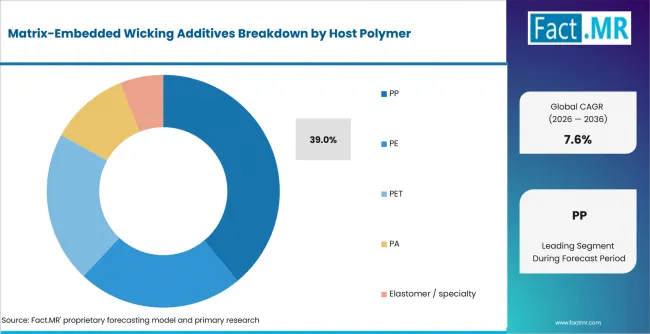
Matrix Embedded Wicking Additives Analysis By Host Polymer | Source: Fact.MR
PP leads because it is widely used in spunbond and meltblown structures that require controlled surface behavior. PE provides a second polyolefin platform. PET and PA need additive packages matched to different melt temperatures and polarity. Specialty hosts extend demand into flexible and engineered systems.
How does Application shape demand?
Nonwovens are anticipated to capture 37.0% share in 2026.
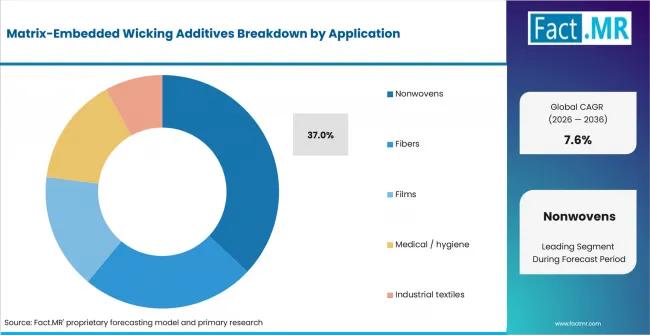
Matrix Embedded Wicking Additives Analysis By Application | Source: Fact.MR
Nonwovens lead because thin webs expose substantial surface area and often require controlled liquid interaction. Fibers need similar wetting functionality while preserving spinning stability. Films use surface modifiers for liquid spreading or static control. Medical and hygiene applications add stricter cleanliness and extractables requirements.
What supports Wicking speed within Performance?
Wicking speed is estimated to represent 34.0% share in 2026.
Matrix Embedded Wicking Additives Analysis By Performance | Source: Fact.MR
Wicking speed leads because it directly measures how quickly liquid moves into a porous or fibrous structure. Durable wettability becomes more relevant after storage or repeated exposure. Antistatic support and moisture transport cover adjacent functional needs, while low extractables shape medical and laboratory qualification.
What is accelerating Matrix-Embedded Wicking Additives Market adoption, and what is holding it back?
Integrated wetting performance supports adoption; migration control and formulation qualification restrain it.
Drivers Impact Analysis
| DRIVER | (~) % IMPACT ON CAGR | GEOGRAPHIC RELEVANCE | IMPACT TIMELINE |
|---|---|---|---|
| Shift from post-treatment to in-matrix functionality | +1.5% | Global | Short term (<= 2 years) |
| Nonwoven and hygiene fluid-management requirements | +1.2% | North America, Europe, East Asia | Medium term (2-4 years) |
| Polyolefin masterbatch processing compatibility | +0.9% | Global | Short term (<= 2 years) |
| Low-extractables and sterilization-sensitive uses | +0.6% | USA, Japan, South Korea | Long term (>= 4 years) |
Opportunity Impact Analysis
| OPPORTUNITY | (~) % IMPACT ON CAGR | GEOGRAPHIC RELEVANCE | IMPACT TIMELINE |
|---|---|---|---|
| Permanent hydrophilic systems for durable wettability | +1.1% | Global | Medium term (2-4 years) |
| Medical and hygiene nonwoven qualification | +0.8% | USA, Germany, Japan | Medium term (2-4 years) |
| Bio-based and silicone-free additive platforms | +0.6% | Europe, East Asia | Long term (>= 4 years) |
Restraints Impact Analysis
| RESTRAINT | (~) % IMPACT ON CAGR | GEOGRAPHIC RELEVANCE | IMPACT TIMELINE |
|---|---|---|---|
| Migration and extractables risk | -0.6% | Global | Short term (<= 2 years) |
| Polymer-specific reformulation requirements | -0.5% | Global | Medium term (2-4 years) |
| Input-cost and industrial-cycle pressure | -0.4% | Europe, East Asia | Medium term (2-4 years) |
Which countries are scaling the Matrix-Embedded Wicking Additives Market through 2036?
- The country comparison spans 3.0 percentage points from Czech Republic at 9.8% to Germany at 6.8% through 2036.
- Czech Republic remains 0.5 percentage point above South Korea as plastics production and industrial orders support local converting activity.
- South Korea remains 0.3 percentage point above Japan as manufacturing activity supports specialty polymer and medical-material demand.
- Japan remains 0.8 percentage point above the USA through an established plastics-processing base and tightly controlled material specifications.
- The USA remains 1.4 percentage points above Germany as domestic plastics investment and nonwoven applications support additive qualification.
Comparable CAGRs create different entry conditions because polymer mix, application qualification, and manufacturing intensity vary by country. Full report coverage includes North America, Latin America, Western Europe, Eastern Europe, East Asia, South Asia & Pacific, and Middle East & Africa.
Example Country Growth Comparison Of Matrix Embedded Wicking Additives | Source: Fact.MR
| Country | CAGR (2026-2036) |
|---|---|
| Czech Republic | 9.8% |
| South Korea | 9.3% |
| Japan | 9.0% |
| USA | 8.2% |
| Germany | 6.8% |
How is Czech Republic scaling demand?
9.8% CAGR through 2036, led by plastics output and industrial orders.
Czech converters operate within a manufacturing base that includes rubber and plastic products. The Czech Statistical Office reported in February 2026 that industrial production increased 3.8% year on year in December 2025. Czech Republic is forecast to record 9.8% CAGR through 2036. Adoption is expected to favor additive systems that fit existing polymer-processing lines without adding a separate finishing stage.
How is South Korea scaling demand?
9.3% CAGR through 2036, backed by manufacturing activity and specialty material use.
South Korea combines large-scale manufacturing with medical and electronics supply chains that use controlled polymer performance. The Ministry of Finance and Economy reported on January 30, 2026 that total industrial production increased 1.8% year on year in December 2025. South Korea is anticipated to post 9.3% CAGR through 2036. Suppliers are expected to compete on finished-system evidence for fluid transport and low extractables.
How is Japan developing demand?
9.0% CAGR through 2036, driven by plastics processing and precise material specifications.
Japan’s conversion base gives functional additives a route through nonwovens, fibers, and specialty films. METI reported in February 2026 that industrial production increased 2.2% month on month in January and listed plastic products as the second-largest positive contributor. Japan is estimated to record 9.0% CAGR through 2036. Polymer-specific data remains central because PP, PET, and PA require different formulation choices.
What supports USA adoption?
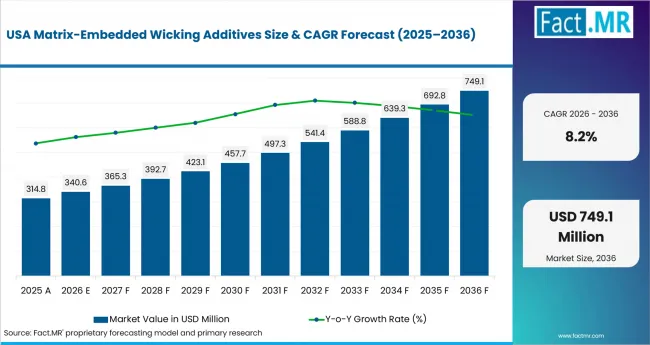
8.2% CAGR through 2036, shaped by a large plastics-processing workforce and nonwoven applications.
Matrix Embedded Wicking Additives Country Value Analysis | Source: Fact.MR
U.S. demand spans hygiene nonwovens, medical materials, films, and technical fibers. The U.S. Bureau of Labor Statistics reported seasonally adjusted employment of 690.5 thousand workers in plastics and rubber products manufacturing in May 2026. The USA is projected to record 8.2% CAGR through 2036. Masterbatch formats are expected to benefit where they fit established dosing systems and deliver repeatable wetting behavior.
What supports Germany adoption?
6.8% CAGR through 2036, supported by specialty-material capability and measured formulation performance.
Germany’s specialty-chemical and technical-textile base supports formulation work across wetting and surface-modifier systems. Destatis reported on February 6, 2026 that overall production in Germany was 1.1% lower in 2025 than in 2024 after adjustment for calendar effects. Germany is forecast to record 6.8% CAGR through 2036. Suppliers are expected to progress where measured performance supports long industrial and medical qualification cycles.
Who leads the Matrix-Embedded Wicking Additives Market?
Avient and Techmer PM provide direct nonwoven and surface-modifier capability, while Americhem, and Croda broaden the formulation set.
Techmer PM is directly relevant through TechSurf® melt-blendable additives that impart hydrophilicity to polyolefin fibers and nonwoven fabrics. Avient contributes functional nonwoven masterbatch capability through Cesa™ Fiber Additives and MagIQ™ Nonwoven Electret Additives, with Cesa technologies including hydrophilic solutions for nonwoven applications and MagIQ additives providing electret functionality in meltblown polypropylene.
Croda contributes adjacent hydrophilic finishing technology through Cirrasol PP842, a durable hydrophilic fibre finish designed particularly for polyolefin nonwovens.
Competitive differentiation includes compatibility with the target polymer and manufacturing process, consistent additive distribution or dosage, durability of the required surface or functional response, and technical and regulatory documentation supporting qualification.
Which companies are the key providers?
Key providers include Avient and Techmer PM are key providers. Americhem and Croda complete the company set.
- Avient
- Americhem
- Croda
- Techmer PM
Bibliography
- U.S. Bureau of Economic Analysis. (2026, June 10). New foreign direct investment in the United States, 2025.
- U.S. Food and Drug Administration. (2025, December 22). Recognized consensus standards: Medical devices (Recognition List 065) [Database].
- Techmer PM. (2025, December 9). Techmer PM joins Formerra’s portfolio in North America.
- Czech Statistical Office. (2026, February 6). Industry - December 2025.
- Ministry of Finance and Economy, Republic of Korea. (2026, January 30). Current status of industrial activities, December 2025.
- Ministry of Economy, Trade and Industry. (2026, February 27). Indices of industrial production.
- Federal Statistical Office (Destatis). (2026, February 6). Production in December 2025: -1.9% on the previous month.
- Avient Corporation. (2025, February 5). Improving the performance of protective face masks.
This Report Answers
- The report explains where matrix-embedded wetting additives are used across additive type, host polymer, application, and performance requirements.
- Segment analysis identifies migratory surfactant masterbatch, PP, nonwovens, and wicking speed as the supplied leading subsegments for 2026.
- Country analysis covers the USA, Germany, Japan, South Korea, and Czech Republic.
- Competitive analysis reviews Avient, Americhem, Croda, and Techmer PM across relevant polymer-additive and surface-modifier capabilities.
- Application analysis separates nonwovens and fibers from films, medical or hygiene uses, and industrial textiles so the wetting mechanism remains tied to an end-use need.
- Performance analysis distinguishes fast initial wicking from durable wettability, antistatic support, moisture transport, and low-extractables requirements.
- Official manufacturing and price evidence is used to test country conditions without changing the supplied market forecast or segment shares.
What does the Matrix-Embedded Wicking Additives Market cover?
Matrix-integrated additives that change polymer-surface interaction with liquids across nonwovens, fibers, films, and specialty polymer applications.
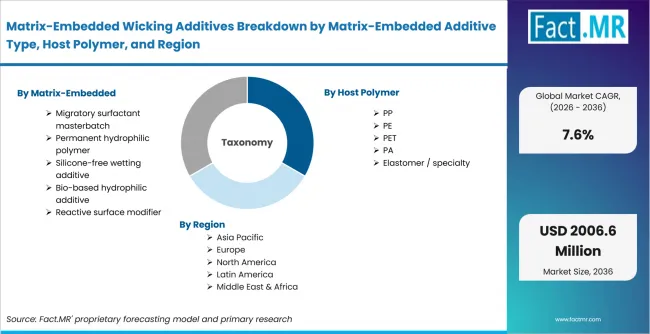
The market covers functional additives introduced into the polymer before the final article is formed. Included chemistries are migratory surfactant masterbatches, permanent hydrophilic polymers, silicone-free wetting additives, bio-based hydrophilic additives, and reactive surface modifiers. Their purpose is to change liquid spreading, moisture movement, static behavior, or extractables performance.
The scope differs from topical wetting treatments because the functional package is carried inside the polymer matrix or reacted into the material. Post-applied coatings remain outside the core boundary unless they form part of a directly comparable hybrid system.
What is included in the scope?
Matrix-embedded additive systems used in polymer conversion where wetting, wicking, moisture transport, antistatic support, or low extractables are specified.
Coverage includes additive and polymer-modifier systems used with PP, PE, PET, PA, and specialty elastomers. Applications include nonwovens, fibers, films, medical or hygiene materials, and industrial textiles. Adjacent category context includes additive masterbatch, nonwoven fabrics, medical nonwoven disposables, and anti-static polymer compounds. These adjacent categories help define the polymer-processing and end-use boundaries around matrix-embedded wicking additives.
What is excluded from the scope?
Stand-alone topical finishes and unrelated bulk polymer additives are outside the core scope.
The scope covers matrix-integrated wetting and surface-control functionality. Conventional post-applied coatings, general colorants, fillers, flame retardants, and unrelated processing aids remain outside this boundary.
How Was the Analysis Built?
The analysis draws on 120+ sources, 35+ company portfolios, 25+ countries, and more than 20 industry interviews.
- Primary Research: Primary research includes discussions with manufacturers, service providers, technology developers, distributors, end users, and subject-matter experts. These conversations examine purchasing priorities, product adoption, operational challenges, approval requirements, competitive positioning, and the factors that influence wider market acceptance.
- Desk Research: Desk research covers government statistics, regulatory publications, company filings, trade data, technical studies, industry associations, standards, public policy, and other authoritative sources. Every source used in the analysis is documented in the bibliography.
- Market Sizing and Forecasting: Market estimates combine historical performance, demand indicators, pricing and volume trends, segment shares, company participation, country-level growth, adoption patterns, investment activity, and barriers to market expansion.
- Data Validation and Update Cycle: Findings are validated by comparing primary interviews with public data, company activity, regulatory changes, trade patterns, and industry developments. Regular updates review new product launches, capacity changes, partnerships, approvals, and shifts in commercial adoption.
What is the report’s scope and coverage?
Matrix Embedded Wicking Additives Breakdown By Matrix Embedded Additive Type, Host Polymer, And Region | Source: Fact.MR
| Attribute | Details |
|---|---|
| Quantitative Units | USD Million |
| Market Definition | Additives incorporated into a polymer matrix to modify surface wetting, liquid spreading, moisture transport, or related fluid-management behavior without relying only on a post-applied coating. |
| Matrix-Embedded Additive Type | Migratory surfactant masterbatch; Permanent hydrophilic polymer; Silicone-free wetting additive; Bio-based hydrophilic additive; Reactive surface modifier |
| Host Polymer | PP; PE; PET; PA; Elastomer / specialty |
| Application | Nonwovens; Fibers; Films; Medical / hygiene; Industrial textiles |
| Performance | Wicking speed; Durable wettability; Antistatic support; Moisture transport; Low extractables |
| Regions Covered | North America; Latin America; Western Europe; Eastern Europe; East Asia; South Asia & Pacific; Middle East & Africa |
| Countries Covered | USA; Germany; Japan; South Korea; Czech Republic |
| Key Companies Profiled | Avient; Americhem; Croda; Techmer PM |
| Forecast Period | 2026 to 2036 |
| Approach | Hybrid top-down and bottom-up review using polymer-processing activity, nonwoven and fiber applications, supplier portfolios, official manufacturing indicators, and country conditions. |
How is the market segmented?
-
By Matrix-Embedded Additive Type
- Migratory surfactant masterbatch
- Permanent hydrophilic polymer
- Silicone-free wetting additive
- Bio-based hydrophilic additive
- Reactive surface modifier
-
By Host Polymer
- PP
- PE
- PET
- PA
- Elastomer / specialty
-
By Application
- Nonwovens
- Fibers
- Films
- Medical / hygiene
- Industrial textiles
-
By Performance
- Wicking speed
- Durable wettability
- Antistatic support
- Moisture transport
- Low extractables
-
By Region
- North America
- Latin America
- Western Europe
- Eastern Europe
- East Asia
- South Asia & Pacific
- Middle East & Africa