- Market Value (2025): USD 11.0 Bn
- Estimated Value (2026): USD 12.4 Bn
- Forecast Value (2036): USD 39.6 Bn
- CAGR (2026-2036): 12.3%
What is the Media and Entertainment Enterprise Content Management ECM Market forecast to be worth by 2036?
USD 12.4 billion in 2026 to USD 39.6 billion by 2036, at 12.3% CAGR.
- The Media and Entertainment Enterprise Content Management ECM Market reached USD 11.0 billion in 2025.
- Demand is projected to increase from USD 12.4 billion in 2026 to USD 39.6 billion by 2036.
- The market is forecast to record a 12.3% CAGR from 2026 to 2036 as media enterprises replace shared drives, disconnected archives, and single-purpose repositories with governed platforms for digital assets, workflows, records, and collaboration.
- Purchasing decisions are expected to favor providers that connect rich-media handling, metadata, version control, rights information, approval evidence, lifecycle policies, and enterprise integration instead of offering storage capacity as the principal value proposition.
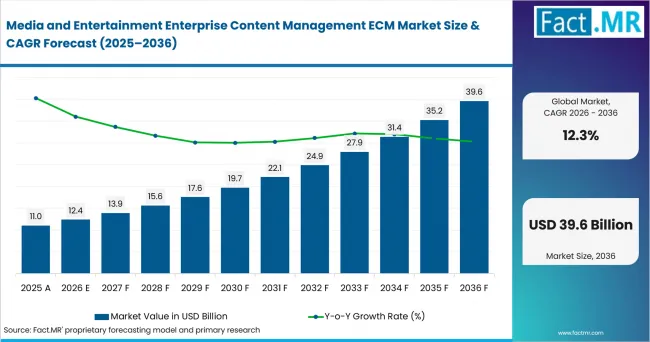
Media And Entertainment Enterprise Content Management Ecm Market Value Analysis | Source: Fact.MR
What are the defining numbers behind Media and Entertainment Enterprise Content Management ECM Market growth?
USD 27.2 billion absolute opportunity by 2036, led by Software, Cloud-Based deployment, Digital Asset Management, Broadcasting & Television, and Large Enterprises.
- Demand Drivers in the Market
- Broadcast and production teams need a reliable asset identity across original footage, project files, edit versions, captions, artwork, audio, promos, and release packages because the same program can generate hundreds of derivatives before and after publication.
- Distributed employees, freelancers, post-production partners, agencies, and regional offices need controlled review and approval workflows that reduce duplicate transfers while preserving a clear record of who changed, approved, or released each asset.
- Publishers and media owners need metadata, rights dates, territories, languages, talent restrictions, and channel rules connected with the file so reuse decisions can be made without relying on separate spreadsheets or staff memory.
- Content leaders need long-term preservation, records controls, security, and provenance information because archives now contain commercial masters, contractual evidence, news material, brand assets, and content produced or modified with artificial intelligence tools.
- Key Segments Analyzed
- By Component: Software is expected to hold 66% share in 2026 supported by content management platforms and digital asset management systems that remain in daily use after implementation work is completed.
- By Deployment: Cloud-Based is projected to account for 73% share in 2026 owing to public and hybrid cloud delivery that supports distributed access, elastic processing, and centralized upgrades.
- By Application: Digital Asset Management is anticipated to capture 34% share in 2026 as media libraries and brand asset repositories become the control point for discovery, reuse, and approved distribution.
- By End User: Broadcasting & Television is estimated to represent 31% share in 2026 because TV networks and streaming studios manage continuous ingest, editorial, compliance, promotional, and archive workflows.
- By Enterprise Size: Large Enterprises are forecast to account for 68% share in 2026 driven by global media companies and studio networks with extensive catalogs, user populations, partner ecosystems, and integration requirements.
- Analyst Opinion at Fact.MR
- Shambhu Nath Jha, Principal Consultant at Fact.MR, states: "Media enterprises do not create value by moving a disorganized archive into a larger repository. They create value when every master, version, approval, right, and distribution action can be understood inside the operating workflow. Fact.MR is of the opinion that providers will win strategic programs when they combine rich-media performance with metadata discipline, open integration, lifecycle control, and practical migration support rather than asking creative teams to work around a generic document system."
- Strategic Implications
- Media owners should define asset classes, identifiers, metadata ownership, rights fields, preservation rules, and approved release states before migrating content because a platform cannot correct ambiguous governance after files have been moved.
- Technology teams should separate high-resolution masters, active production files, collaboration copies, delivery renditions, and preservation records so storage tiering and access policy follow commercial value instead of file extension alone.
- Procurement teams should price connectors, migration, media processing, data transfer, support, and archive retrieval alongside software subscriptions because operating cost is shaped by the complete content path rather than the repository license.
- Smaller production and publishing companies should use modular cloud services where possible but retain tested export routes, portable metadata, and clear termination terms so short deployment cycles do not create long-term lock-in.
How does the Media and Entertainment Enterprise Content Management ECM Market break down by segment?
Software leads at 66%, Cloud-Based deployment leads at 73%, Digital Asset Management leads at 34%, Broadcasting & Television leads at 31%, and Large Enterprises lead at 68% in 2026.
Why does Software lead Component?
Software holds 66% share in 2026.
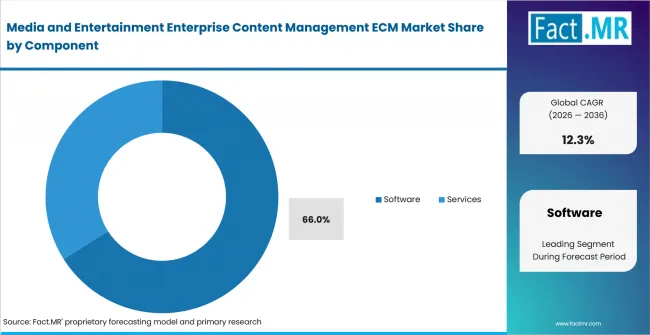
Media And Entertainment Enterprise Content Management Ecm Market Analysis By Component | Source: Fact.MR
Software is expected to hold 66% share in 2026 because content management platforms and digital asset management systems remain embedded in daily ingest, search, workflow, archive, and publishing activity. A media enterprise may use the platform for years after the initial migration, which gives recurring licenses, cloud subscriptions, modules, storage policies, and platform administration a larger value base than one-time project work. Services remain commercially important because implementation teams must map repositories, repair metadata, connect editing and publishing tools, test permissions, and train users. Consulting and support become especially important when a company is consolidating several inherited catalogs or replacing a highly customized legacy system. Buyers therefore evaluate software and services as one operating program even though software leads the defined component structure.
Why does Cloud-Based lead Deployment?
Cloud-Based deployment holds 73% share in 2026.
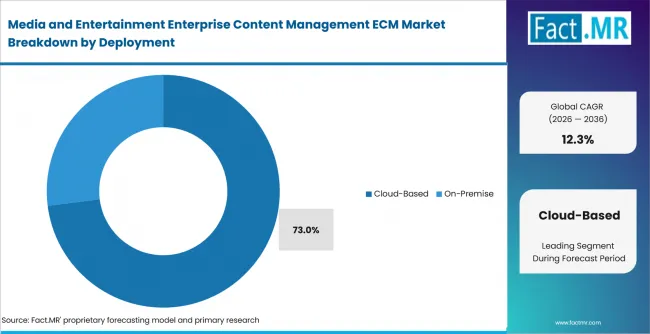
Media And Entertainment Enterprise Content Management Ecm Market Analysis By Deployment | Source: Fact.MR
Cloud-Based deployment is projected to account for 73% share in 2026 because public and hybrid cloud environments give distributed teams a common control layer without requiring every production office, agency, or freelancer to connect to the same physical facility. Cloud services also support centralized upgrades, elastic transcoding, temporary project capacity, remote review, and API access across regions. Hybrid Cloud is particularly relevant when an enterprise keeps high-resolution masters, edit storage, or regulated archives in controlled infrastructure while placing proxies, collaboration copies, and workflow services in the cloud. On-Premise deployment remains important for private data centers and enterprise infrastructure where latency, large file movement, contractual restrictions, or existing broadcast systems make local operation preferable. The commercial choice is therefore less about cloud versus local storage and more about where each content class should reside and how reliably it can move.
Why does Digital Asset Management lead Application?
Digital Asset Management is projected to hold 34% share in 2026.
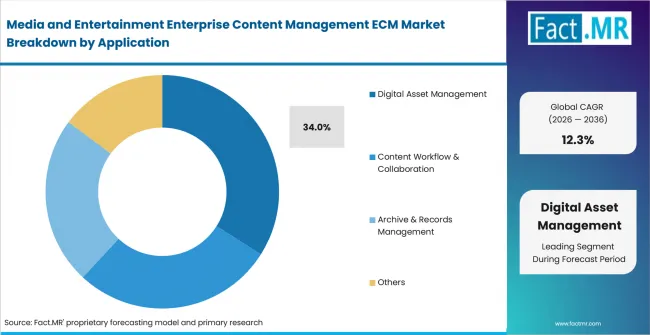
Media And Entertainment Enterprise Content Management Ecm Market Analysis By Application | Source: Fact.MR
Digital Asset Management is anticipated to capture 34% share in 2026 because media libraries and brand asset repositories provide the most direct answer to file discovery, version control, reuse, and approved distribution. A useful DAM does more than hold video, audio, images, documents, and creative source files. It links each asset with identifiers, descriptive metadata, rights status, relationships, renditions, owners, and channel-ready versions. Content Workflow & Collaboration follows where editorial teams need structured review, annotation, approval, and handoff. Archive & Records Management serves digital preservation and compliance evidence across valuable catalogs and corporate records. Other applications, including metadata management, content analytics, and rights management, often connect with the DAM rather than operating as fully separate purchases. Buyers increasingly judge the application on whether it can keep asset meaning intact as content moves from creation to release and long-term reuse.
Why does Broadcasting & Television lead End User?
Broadcasting & Television holds 31% share in 2026.
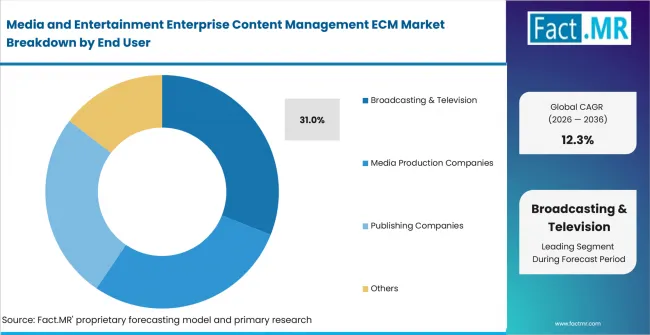
Media And Entertainment Enterprise Content Management Ecm Market Analysis By End User | Source: Fact.MR
Broadcasting & Television is estimated to represent 31% share in 2026 because TV networks and streaming studios manage continuous flows of live, near-live, episodic, promotional, compliance, and archive content. A single program can require source footage, graphics, audio mixes, subtitles, legal clearances, transmission versions, clips, stills, and platform-specific packages, all under time pressure. ECM systems help separate work in progress from approved material and give operations teams a consistent path from ingest to release. Media Production Companies have project-centered requirements across film studios and production houses, while Publishing Companies place more weight on editorial workflow, page assets, digital editions, and records. OTT Platforms, advertising agencies, and gaming companies also create substantial demand, but their repositories, release cycles, and rights models differ. Broadcasting leads because content volume and operational continuity make repository and workflow failure immediately visible.
Why do Large Enterprises lead Enterprise Size?
Large Enterprises account for 68% share in 2026.
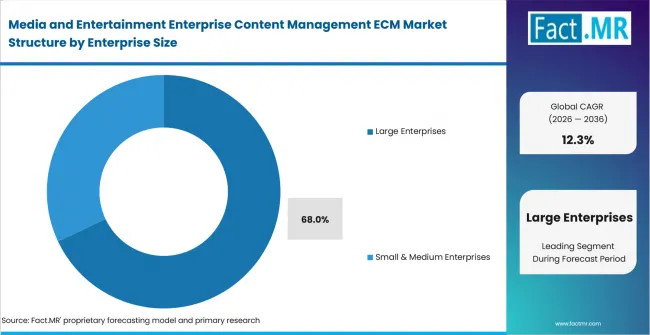
Media And Entertainment Enterprise Content Management Ecm Market Analysis By Enterprise Size | Source: Fact.MR
Large Enterprises are forecast to account for 68% share in 2026 because global media companies and studio networks manage larger catalogs, more users, several brands, multiple territories, and a wider set of production and distribution systems. Their content platforms must support complex permissions, identity management, audit evidence, metadata standards, integrations, disaster recovery, and service commitments across business units. They also have more inherited repositories after acquisitions, reorganizations, and long-running technology programs, which increases migration and consolidation spending. Small & Medium Enterprises, including independent production houses and regional media companies, favor faster cloud deployment and simpler administration, but they often purchase less storage, fewer connectors, and narrower workflow coverage. The large-enterprise segment therefore leads not only because of headcount but because each organization must coordinate more assets, rights, partners, and release routes under formal governance.
What is accelerating Media and Entertainment Enterprise Content Management ECM Market adoption, and what is holding it back?
Content proliferation, distributed production, archive modernization, and rights-aware reuse support adoption, while migration debt, integration cost, security requirements, and user resistance restrain program execution.
Drivers Impact Analysis
| DRIVER | COMMERCIAL EFFECT | GEOGRAPHIC RELEVANCE | IMPACT TIMELINE |
|---|---|---|---|
| Rising volumes of video, audio, images, project files, and derivatives | Expands demand for controlled repositories, automated metadata, version history, and search across active and archived content | Global, with major broadcasting, streaming, publishing, and production centers | Current forecast period |
| Distributed production, review, and approval | Increases use of cloud collaboration, proxy workflows, secure external sharing, and auditable approvals | North America, Europe, Asia Pacific, and cross-border production networks | Current forecast period |
| Multichannel reuse, localization, and regional release management | Raises the value of rights metadata, rendition control, language tracking, and channel-specific delivery packages | Global media groups and export-oriented content markets | Medium term |
| Archive modernization and digital preservation | Creates migration demand as enterprises move from tapes, shared drives, and unsupported repositories into managed lifecycle platforms | Mature broadcast, studio, publishing, and cultural archives | Medium term |
| Content provenance and artificial intelligence governance | Adds demand for source history, modification evidence, policy controls, and interoperable authenticity metadata | News, publishing, advertising, brand media, and regulated enterprise communications | Medium to long term |
Source: Fact.MR analysis. Updated Aug 5, 2026
- Content proliferation: High-resolution acquisition, multiple edits, localization, social clips, thumbnails, captions, and platform renditions increase the number of files attached to one commercial title. The operational problem is not only storage growth. Teams must identify which version is current, which source it came from, who can use it, and which outputs have already been released. Platforms that automate media analysis while preserving human ownership of metadata can reduce search time without allowing machine-generated tags to become unreviewed business truth.
- Distributed production and governance: Remote collaboration has increased the number of external contributors who need temporary, controlled access to content. A successful platform gives editors, producers, legal reviewers, marketers, and distribution teams different views of the same asset while preserving a traceable approval chain. The C2PA Specifications 2.4 provide an open framework for recording the source and history of digital media, which gives ECM and DAM buyers another reason to consider how provenance data can survive movement among tools and repositories.
Opportunity Impact Analysis
| OPPORTUNITY | COMMERCIAL EFFECT | GEOGRAPHIC RELEVANCE | IMPACT TIMELINE |
|---|---|---|---|
| AI-assisted metadata, transcription, and semantic search with human review | Improves discovery and reuse of large audiovisual libraries while reducing manual description work | Global, especially large broadcast, studio, and publishing archives | Current to medium term |
| Cloud archive tiering and policy-based lifecycle management | Connects active collaboration with lower-cost preservation and controlled retrieval of older content | North America, Europe, Australia, Japan, and enterprise media hubs | Medium term |
| Rights, contract, and talent metadata integration | Helps teams decide where, when, and how an asset may be reused before a campaign or release is committed | Global content owners and cross-border distributors | Medium term |
| Packaged workflows for independent producers and regional media companies | Extends governed content operations to buyers that cannot fund long customization programs | Canada, Australia, UK, South Korea, and regional production markets | Medium to long term |
Source: Fact.MR analysis. Updated Aug 5, 2026
- AI-assisted library operations: Speech-to-text, object and face recognition, language detection, duplicate identification, and semantic search can make old footage and image collections more usable. The strongest opportunity is not fully automatic cataloging. It is a controlled workflow in which machines propose metadata, librarians or content owners review sensitive fields, and the approved record remains linked to the source asset and later renditions. Providers that expose confidence, model provenance, correction history, and exportable metadata can address both productivity and governance requirements.
- Rights-aware reuse: Media organizations frequently know that a file exists but cannot quickly determine whether it is cleared for a new territory, channel, language, campaign, or time period. Connecting rights and contract data with asset records can shorten the path from discovery to legal approval. The opportunity is strongest where a platform can trigger renewal alerts, block expired material, and show the difference between an owned master, a licensed element, and a derivative created for one limited release.
Restraints Impact Analysis
| RESTRAINT | COMMERCIAL EFFECT | GEOGRAPHIC RELEVANCE | IMPACT TIMELINE |
|---|---|---|---|
| Legacy migration, duplicate files, and inconsistent taxonomy | Raises discovery, cleanup, mapping, and validation cost before users receive a dependable new repository | Global, with greatest pressure in long-established media enterprises | Current forecast period |
| Integration, media processing, and data-transfer expense | Can make the total operating cost materially higher than the software subscription or license alone | Cloud and hybrid deployments with large video libraries | Current to medium term |
| Security, data residency, and partner-access requirements | Slows deployment when buyers cannot align external collaboration with identity, encryption, audit, and location policies | Europe, Japan, large global enterprises, and regulated content owners | Medium term |
| Workflow change and low user adoption | Reduces metadata quality and drives employees back to shared drives, email attachments, and ungoverned transfer tools | Global creative and editorial teams | Medium to long term |
Source: Fact.MR analysis. Updated Aug 5, 2026
- Migration and taxonomy debt: A legacy repository often contains duplicates, missing ownership, inconsistent titles, obsolete project folders, unsupported formats, and rights information stored elsewhere. Moving everything without classification reproduces the same problem on a new platform, while cleaning every item before migration can delay the program indefinitely. Buyers need a risk-based migration plan that prioritizes active and high-value content, preserves chain of custody, and defines how uncertain records will be reviewed after cutover.
- Operating cost and adoption: Large media files create storage, transcoding, preview, retrieval, and transfer costs that are not visible in a basic seat price. At the same time, users avoid systems that require too many fields or slow down urgent editorial work. Programs can fail from either direction: weak controls produce an unreliable archive, while excessive controls push work outside the platform. Procurement and governance teams must test representative production files, external collaborator workflows, recovery time, and user effort before committing to enterprise rollout.
Which countries are scaling Media and Entertainment Enterprise Content Management ECM Market fastest?
South Korea 13.34%, USA 12.75%, Canada 12.39%, UK 12.12%, Australia 12.06%, Germany 11.89%, and Japan 11.54% through 2036.
Regional analysis covers North America, Europe, Asia Pacific, Central & South America, and the Middle East & Africa. Country commentary below focuses on the seven profiled markets and the media-production, distribution, archive, and enterprise-technology conditions that shape ECM purchasing in each one.
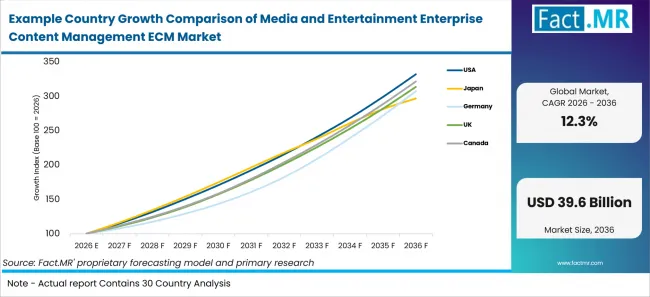
Example Country Growth Comparison Of Media And Entertainment Enterprise Content Management Ecm Market | Source: Fact.MR
| COUNTRY | CAGR (2026-2036) |
|---|---|
| South Korea | 13.34% |
| USA | 12.8% |
| Canada | 12.39% |
| UK | 12.12% |
| Australia | 12.06% |
| Germany | 11.89% |
| Japan | 11.54% |
Source: Fact.MR analysis. Updated Aug 5, 2026
What is driving South Korea's growth through 2036?
13.34% CAGR through 2036.
South Korea records the highest country CAGR in this analysis because broadcasting, streaming, music, gaming, and screen production operate within a content economy that is designed for rapid domestic release and international reuse. The Korea Creative Content Agency supports planning, production, distribution, overseas expansion, business growth, talent, and research and development, which creates institutional depth around the full content lifecycle. Media companies therefore need repositories that can manage Korean and international metadata, high-volume audiovisual assets, subtitles, promotional variants, talent and territorial information, and partner access. Demand is projected to expand at 13.34% CAGR through 2036.
How is the USA scaling Media and Entertainment Enterprise Content Management ECM demand?
12.8% CAGR through 2036.
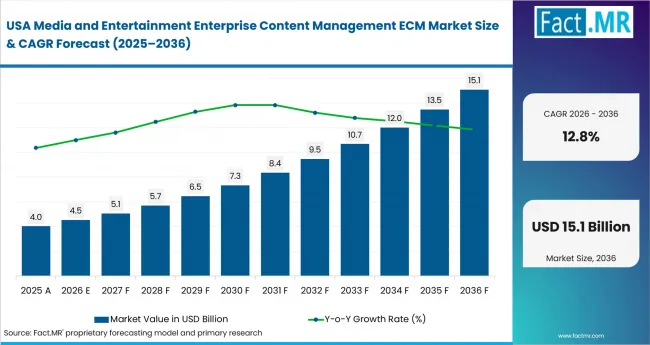
Media And Entertainment Enterprise Content Management Ecm Market Country Value Analysis | Source: Fact.MR
The USA combines major studio, broadcast, publishing, advertising, sports, music, and gaming operations with a large base of enterprise software and cloud services. In April 2025, the U.S. Bureau of Economic Analysis reported that arts and cultural economic activity accounted for USD 1.17 trillion, or 4.2% of GDP, in 2023. That broad production base creates complex content estates across California, New York, and other production centers, where masters, contracts, project files, promotional assets, and corporate records may sit in separate systems. The market is expected to post 12.75% CAGR through 2036.
What supports Canada's outlook?
12.39% CAGR through 2036.
Canada has a substantial film, television, and video production base alongside post-production, visual effects, animation, broadcasting, and bilingual publishing. Statistics Canada reported USD 10.4 billion in operating revenue for film, television, and video production in 2023. It also reported USD 2.8 billion in post-production operating revenue, up 34.4% from 2021, with visual effects and animation accounting for much of the increase. These workflows generate large source files, frequent revisions, vendor handoffs, and reusable libraries that must be controlled across provinces and international partners. Demand is anticipated to advance at 12.39% CAGR through 2036.
How is the UK developing Media and Entertainment Enterprise Content Management ECM demand?
12.12% CAGR through 2036.
The UK has an established combination of public-service and commercial broadcasting, independent production, publishing, advertising, music, and online video. Ofcom reported in July 2026 that the UK commercial television and online video market reached GBP 18.4 billion in 2025, while 70% of households had at least one subscription video-on-demand service in the first quarter of 2026. These audience and revenue shifts require media owners to prepare the same program for linear schedules, broadcaster video-on-demand, streaming, clips, social promotion, and archive reuse. The market is forecast to record 12.12% CAGR through 2036.
What is shaping Australia's growth?
12.06% CAGR through 2036.
Australia combines national broadcasters, commercial networks, streaming services, screen production, advertising, publishing, and a geographically distributed creative workforce. The Australian Communications and Media Authority reported that 91% of Australian adults used an online video service in a typical week during 2025. Its review of Australian content on major subscription services also identified 3,919 Australian titles and 11,881 hours at 30 June 2025. This volume has to be stored with accurate titles, versions, captions, promotional material, rights, and availability information across local and international channels. Demand is estimated to grow at 12.06% CAGR through 2036.
How is Germany scaling Media and Entertainment Enterprise Content Management ECM adoption?
11.89% CAGR through 2036.
Germany combines public and commercial broadcasting, film production, publishing, music, advertising, and regional creative industries with formal expectations around data protection, documentation, and operational control. The Federal Ministry for Economic Affairs and Climate Action published its Monitoring Report on the Cultural and Creative Industries 2024 in January 2025, reinforcing the economic significance of the wider creative sector and the need to understand its distinct business models. The market is projected to expand at 11.89% CAGR through 2036.
What underpins Japan's outlook?
11.54% CAGR through 2036, attributable to long-lived media catalogs, cloud and artificial intelligence modernization, and demand for reliable Japanese-language metadata.
Japan has established television, publishing, animation, film, music, advertising, and gaming industries with valuable catalogs that may remain commercially active for decades. The Ministry of Internal Affairs and Communications released the 2025 White Paper on Information and Communications in Japan in July 2025, with attention to digital ecosystems, cloud, artificial intelligence, and communications infrastructure as foundations for wider economic activity. For media enterprises, modernization requires more than uploading old files. It requires Japanese titles and names, rights history, relationships among episodes and derivatives, preservation of original formats, and careful integration with long-running systems. Demand is expected to post 11.54% CAGR through 2036.
Who leads the Media and Entertainment Enterprise Content Management ECM Market?
Adobe Inc. is an active provider, while OpenText and Microsoft provide broad enterprise content foundations and Hyland, Box, IBM, Oracle, Aprimo, MediaValet, and Bynder compete through distinct repository, workflow, cloud, and digital asset management positions.
Adobe Inc. holds the competitive position and competes through Adobe Experience Manager Assets, a digital asset management platform designed to ingest, organize, govern, find, transform, and activate rich media across channels. Its role is strengthened where media and marketing teams already use Adobe creative, experience, and workflow products, because files can move from creation toward review, governance, and distribution without losing asset context. OpenText Corporation brings enterprise digital asset management and broader content services for large mixed-format libraries, metadata, rights, governance, and global user access. Microsoft Corporation competes through SharePoint and Microsoft 365 content services, which are often already present for collaboration, document management, records, and internal workflows. These providers are evaluated on whether their broad platforms can meet video scale and media-specific metadata requirements without creating parallel repositories.
Hyland Software, Inc. uses the Nuxeo platform for API-first content services and complex digital asset management environments with extensive libraries, compound assets, metadata structures, and integration needs. Box, Inc. positions its cloud content platform around secure collaboration, shared workspaces, workflows, content portals, and digital asset libraries, which is relevant for production companies coordinating employees and external partners. IBM Corporation offers FileNet Content Manager and related content services for governed repositories, process automation, and enterprise application integration. Oracle Corporation uses WebCenter Content for document, records, digital asset, and lifecycle management across cloud and on-premise environments. Their opportunities are strongest when a media buyer needs content governance connected with wider enterprise applications rather than a stand-alone creative library.
Aprimo LLC concentrates on digital asset management and content operations, including metadata, approvals, lifecycle governance, marketing work, and multichannel distribution. MediaValet Inc. focuses on cloud digital asset management for distributed teams, video libraries, search, collaboration, and brand governance. Bynder B.V. positions its platform as a system of record for digital content with asset workflow, brand portals, integrations, and controlled activation. Competition through 2036 is expected to center on migration credibility, video performance, metadata flexibility, external collaboration, rights-aware governance, artificial intelligence oversight, and open integration. Fact.MR opines that market roles will remain differentiated: broad ECM providers will compete on enterprise control and application reach, while specialist DAM providers will compete on creative usability, asset discovery, and faster deployment.
Which companies are the key providers?
Adobe Inc. is the active provider. OpenText, Microsoft, Hyland, Box, IBM, Oracle, Aprimo, MediaValet, and Bynder are also profiled within the profiled provider group.
- Adobe Inc.
- OpenText Corporation
- Microsoft Corporation
- Hyland Software, Inc.
- Box, Inc.
- IBM Corporation
- Oracle Corporation
- Aprimo LLC
- MediaValet Inc.
- Bynder B.V.
- Others
Bibliography
- Adobe. (2025, December 19). Adobe Experience Manager Assets. Adobe Inc.
- Aprimo. (2026). Aprimo Agentic Digital Asset Management. Aprimo LLC.
- Australian Communications and Media Authority. (2026, March 5). How we watch and listen to content. Australian Government.
- Australian Communications and Media Authority. (2025). Trends and developments in viewing and listening 2024-25. Australian Government.
- Box. (2026). Secure Digital Asset Library Software. Box, Inc.
- Bynder. (2026). Enterprise Digital Asset Management Solution. Bynder B.V.
- Coalition for Content Provenance and Authenticity. (2026). C2PA Specifications 2.4. C2PA.
- Federal Ministry for Economic Affairs and Climate Action. (2025, January 14). Monitoring Report on the Cultural and Creative Industries 2024. Government of Germany.
- Hyland. (2026). Digital asset management software capabilities with Hyland Nuxeo. Hyland Software, Inc.
- IBM. (2026). IBM FileNet Content Manager. IBM Corporation.
- Korea Creative Content Agency. (2026). Korea Creative Content Agency overview and functions. Government of the Republic of Korea.
- MediaValet. (2026). Digital Asset Management and Video Asset Management resources. MediaValet Inc.
- Microsoft. (2024, July 15). Modernizing Enterprise Content Management with Microsoft Content Services. Microsoft Corporation.
- Ministry of Internal Affairs and Communications. (2025, July 8). 2025 White Paper on Information and Communications in Japan. Government of Japan.
- Ofcom. (2026, July 29). Media Nations 2026: UK Report. Office of Communications.
- OpenText. (2026). Digital Asset Management Software for the Enterprise. OpenText Corporation.
- Oracle. (2026). Oracle WebCenter Content. Oracle Corporation.
- Statistics Canada. (2024, October 9). Film, television and video post-production, 2023. Government of Canada.
- Statistics Canada. (2025, March 17). Film, television and video production, 2023. Government of Canada.
- U.S. Bureau of Economic Analysis. (2025, April). Arts and Cultural Production Satellite Account, U.S. and States, 2023. U.S. Department of Commerce.
This Report Answers
- The report provides strategic intelligence on media and entertainment enterprise content management across Component and Deployment choices that shape repository architecture, implementation scope, and operating cost.
- Segment analysis covers Software and Cloud-Based deployment as the share leaders within the 2026 market structure.
- Application and user analysis evaluates Digital Asset Management and Broadcasting & Television while discussing alternative categories qualitatively.
- Enterprise-size assessment compares Large Enterprises with Small & Medium Enterprises across catalog scale, integration burden, governance, and procurement needs.
- Regional outlook evaluates USA, Japan, Germany, UK, Canada, Australia, and South Korea using the country growth rates presented in this report.
- Competitive analysis evaluates Adobe Inc. and reviews the remaining profiled providers and explains their market roles without ranking them.
What does the Media and Entertainment Enterprise Content Management ECM Market cover?
Software and related services used by media and entertainment enterprises to manage the controlled lifecycle of digital assets, business content, workflows, records, and archives.
The Media and Entertainment Enterprise Content Management ECM Market covers content management platforms, digital asset management systems, workflow and collaboration functions, archive and records management, and related metadata, analytics, rights, and compliance capabilities when they are purchased for a defined media or entertainment enterprise workflow. Included content can span video, audio, images, design files, scripts, editorial documents, publishing assets, captions, promotional material, contracts, project records, and other digital files that require managed identity, access, history, and lifecycle control.
The market differs from general cloud storage, broadcast hardware, editing software, and consumer media services because commercial value must be tied to enterprise content management. A storage service is counted only when it is bundled into or directly supports the qualifying ECM platform. A creative tool, media asset management appliance, archive system, or enterprise collaboration product is included only to the extent that its purchased function falls within the defined Component, Deployment, Application, End User, and Enterprise Size boundary.
What is included in the scope?
Qualifying software subscriptions, licenses, implementation, integration, consulting, and support that manage content and records across the defined media and entertainment segmentation.
The scope includes Software across Content Management Platforms and Digital Asset Management, and Services across Implementation & Integration and Consulting & Support. It includes Cloud-Based delivery through Public Cloud and Hybrid Cloud, and On-Premise deployment through Private Data Centers and Enterprise Infrastructure. Application coverage includes Media Libraries, Brand Asset Management, Content Approval, Editorial Workflow, Digital Preservation, Content Compliance, Metadata Management, Content Analytics, and Rights Management. End-user coverage spans TV Networks, Streaming Studios, Film Studios, Content Production Houses, Digital Publishers, Print Publishers, OTT Platforms, Advertising Agencies, and Gaming Companies. Commercial value from migration, configuration, connectors, media processing, platform administration, and managed support is included when it directly serves the qualifying ECM deployment.
What is excluded from the scope?
Consumer content subscriptions, production hardware, standalone creative tools, general-purpose infrastructure, and the commercial value of media titles are outside the core market boundary.
The scope excludes cinema tickets, broadcast advertising, publishing sales, music subscriptions, game sales, streaming subscriptions, licensing revenue for media titles, and the value of content itself. It excludes cameras, microphones, studio equipment, storage arrays, network equipment, content delivery networks, internet connectivity, and general cloud infrastructure when they are sold without a qualifying ECM function. Standalone video editing, audio editing, design, rendering, animation, newsroom, scheduling, playout, and publishing applications are excluded unless their ECM component is separately purchased and falls within the defined segmentation. Custom software development is counted only when the delivered work implements or extends a qualifying media and entertainment ECM platform.
How Was the Analysis Built?
120+ sources, 40+ company and platform portfolios, 25+ countries, and 20+ interviews.
- Primary Research: Primary research includes interviews with broadcasters, studio and production teams, publishers, digital asset managers, archivists, content operations leaders, information governance specialists, enterprise architects, security teams, procurement managers, system integrators, cloud providers, post-production partners, and software vendors. Discussions test asset volumes, repository use, metadata practice, workflow bottlenecks, rights information, archive policy, external collaboration, deployment preference, integration effort, migration cost, user adoption, support requirements, and the conditions that move a project from departmental use to enterprise rollout.
- Desk Research: The analysis combines primary interviews with structured review of public company disclosures, official statistics, regulatory material, and sector publications. Forecast interpretation considers market conditions, adoption requirements, competitive positioning, and regional operating context.
- Market Sizing and Forecasting: Market sizing combines the 2026 and 2036 values presented in this report with software subscriptions, licenses, implementation and integration, consulting and support, cloud and on-premise deployment, application adoption, end-user purchasing, enterprise size, media asset volumes, archive modernization, content workflow activity, and country growth rates. Forecasting also considers migration cycles, storage and processing attachment, distributed production, multichannel reuse, rights and metadata requirements, artificial intelligence-assisted discovery, and the movement from disconnected repositories toward governed enterprise content platforms.
- Data Validation and Update Cycle: The analysis combines primary interviews with structured review of public company disclosures, official statistics, regulatory material, and sector publications. Forecast interpretation considers market conditions, adoption requirements, competitive positioning, and regional operating context.
Segmentation
What is the report's scope and coverage?
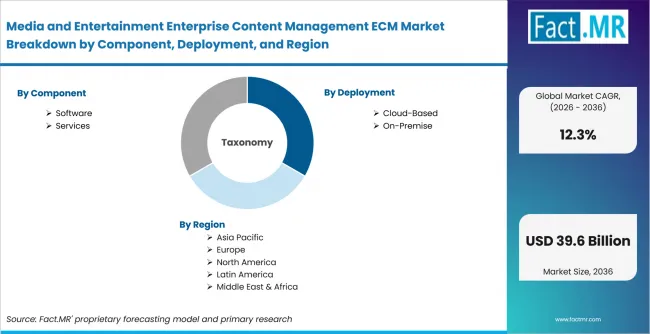
Media And Entertainment Enterprise Content Management Ecm Market Breakdown By Component, Deployment, And Region | Source: Fact.MR
| Attribute | Details |
|---|---|
| Quantitative Units | USD Billion |
| Market Definition | Enterprise content management software and related services used by media and entertainment organizations to ingest, organize, collaborate on, preserve, govern, find, and distribute digital content and records |
| Component | Software; Services |
| Deployment | Cloud-Based; On-Premise |
| Application | Digital Asset Management; Content Workflow & Collaboration; Archive & Records Management; Others |
| End User | Broadcasting & Television; Media Production Companies; Publishing Companies; Others |
| Enterprise Size | Large Enterprises; Small & Medium Enterprises |
| Regions Covered | North America; Europe; Asia Pacific; Central & South America; Middle East & Africa |
| Countries Covered | USA; Japan; Germany; UK; Canada; Australia; South Korea |
| Key Companies Profiled | Adobe Inc.; OpenText Corporation; Microsoft Corporation; Hyland Software, Inc.; Box, Inc.; IBM Corporation; Oracle Corporation; Aprimo LLC; MediaValet Inc.; Bynder B.V.; Others |
| Forecast Period | 2026 to 2036 |
| Approach | Hybrid top-down and bottom-up assessment using enterprise software and service spending; media asset volumes; cloud and on-premise deployment; application adoption; end-user workflows; enterprise size; country growth rates; provider portfolios; implementation and migration activity |
Source: Fact.MR analysis. Updated Aug 5, 2026
How is the market segmented?
-
By Component:
- Software
- Content Management Platforms
- Digital Asset Management
- Services
- Implementation & Integration
- Consulting & Support
- Software
-
By Deployment:
- Cloud-Based
- Public Cloud
- Hybrid Cloud
- On-Premise
- Private Data Centers
- Enterprise Infrastructure
- Cloud-Based
-
By Application:
- Digital Asset Management
- Media Libraries
- Brand Asset Management
- Content Workflow & Collaboration
- Content Approval
- Editorial Workflow
- Archive & Records Management
- Digital Preservation
- Content Compliance
- Others
- Metadata Management
- Content Analytics
- Rights Management
- Digital Asset Management
-
By End User:
- Broadcasting & Television
- TV Networks
- Streaming Studios
- Media Production Companies
- Film Studios
- Content Production Houses
- Publishing Companies
- Digital Publishers
- Print Publishers
- Others
- OTT Platforms
- Advertising Agencies
- Gaming Companies
- Broadcasting & Television
-
By Enterprise Size:
- Large Enterprises
- Global Media Companies
- Studio Networks
- Small & Medium Enterprises
- Independent Production Houses
- Regional Media Companies
- Large Enterprises
-
By Region:
- North America
- Latin America
- Western Europe
- Eastern Europe
- East Asia
- South Asia and Pacific
- Middle East & Africa
Frequently Asked Questions
Which Component leads the Media and Entertainment Enterprise Content Management ECM Market?
Which Deployment leads the market?
Which Application leads the market?
Which End User leads the market?
Which Enterprise Size leads the market?
Which companies are active in the market?
Which country records the highest CAGR?
How does the USA perform in the market?
How does Canada perform in the market?
How does the UK perform in the market?
How does Australia perform in the market?
How does Germany perform in the market?
How does Japan perform in the market?
What is the primary driver in the market?
What is the main restraint in the market?
Why is Software important?
Why does Cloud-Based deployment lead?
Why does Digital Asset Management lead?
Why do broadcasters and television organizations dominate demand?
Why do Large Enterprises dominate demand?
Who worked on this report


Preview the report firsthand - request a free sample
Free SampleGet the brochure for pricing and purchase details
Download PDF