- Market Value (2025): USD 1.5 Bn
- Estimated Value (2026): USD 1.6 Bn
- Forecast Value (2036): USD 3.2 Bn
- CAGR (2026-2036): 6.9%
What is the Melt-Fracture Reducing Silicone Aids Market forecast to be worth by 2036?
USD 1.6 billion in 2026 to USD 3.2 billion by 2036 at a 6.9% CAGR.
- The Melt-Fracture Reducing Silicone Aids Market reached USD 1.5 billion in 2025.
- Demand is projected to increase from USD 1.6 billion in 2026 to USD 3.2 billion by 2036.
- The market is forecast to record a 6.9% CAGR from 2026 to 2036 as film converters and compounders seek smoother extrusion at practical line speeds.
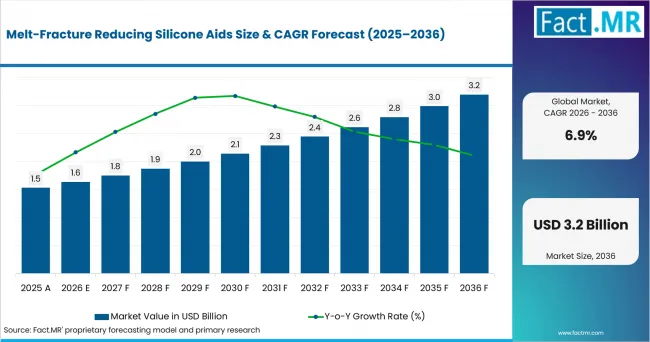
Melt Fracture Reducing Silicone Aids Value Analysis | Source: Fact.MR
What are the defining numbers behind Melt-Fracture Reducing Silicone Aids Market growth?
An absolute opportunity of USD 1.5 billion is expected between 2026 and 2036.
- Demand Drivers in the Market
- Film converters need stable die flow because sharkskin can cut usable film output. The defect is visible at the surface. A process aid can help the melt move more evenly through the die. Operators can then compare dose with film quality.
- Polyethylene compounders value aids that lower die pressure and friction at useful line speeds. Lower pressure can reduce load on the extrusion step. Film appearance must also stay steady. Processors can compare pressure, haze and surface finish during trials.
- Packaging producers are giving more attention to non-fluorinated routes. In January 2025, the U.S. Food and Drug Administration said 35 PFAS food-contact notifications were no longer effective.
- Profile and pipe processors use low-dose aids to improve surface finish and die condition. Thick sections can keep load on the die. A suitable aid can help the melt pass with less drag. Plants can track surface marks and cleaning time together.
- Key Segments Analyzed
- By Processing Aid Chemistry: Silicone masterbatch is expected to hold 34.0% share in 2026. Pellet dosing supports easy use in polyolefin extrusion lines.
- By Processing Function: Melt-fracture reduction is projected to account for 31.0% share in 2026. Film processors can judge this function directly from surface quality.
- By Polymer Substrate: Polyethylene is anticipated to capture 36.0% share in 2026. It is widely used in blown film and other high-output extrusion uses.
- By Application: Blown film is estimated to represent 29.0% share in 2026. Producers closely track die pressure, haze and surface defects in thin-film runs.
- Analyst Opinion at Fact.MR
- Shambhu Nath Jha, Principal Consultant at Fact.MR, states, “The commercial test for these aids is direct: processors want a smoother melt and a cleaner die while keeping existing line hardware. Silicone masterbatches are expected to gain relevance where converters shift from fluorinated process aids or push polyethylene lines harder. Suppliers that pair resin fit with low-dose performance data and food-contact documentation are better placed for film uses.”
- Strategic Implications
- Additive producers should publish dosing ranges for each target resin. Clear ranges make plant trials easier to plan. They let converters compare melt-fracture control at the same line settings. They also reduce errors from a poor dose.
- Film converters should check die pressure and film haze together. Lower pressure matters only when film optics stay in range. Trial plans should keep the resin grade and line speed fixed where practical. This makes the aid easier to assess.
- Compounders should match the carrier resin to the target polymer. A close match helps the silicone phase spread through the melt. It can also support steady feeding at low dose. Trials should confirm surface finish before routine use.
France is forecast at 7.5% CAGR through 2036. Packaging recycling and a large converting base support the outlook. The USA is also projected at 7.5%, with plastics investment supporting extrusion. China is forecast at 7.3% as rubber and plastics output grows. Germany is projected at 7.3% as recycling keeps resin consistency in focus. Japan is forecast at 6.2% with steady plastics output and recycling rules.
How does the Melt-Fracture Reducing Silicone Aids Market break down by segment?
Silicone masterbatch leads chemistry at 34.0%. Polyethylene leads polymer substrate at 36.0%.
Which Processing Aid Chemistry leads?
Silicone masterbatch is expected to hold 34.0% share in 2026.
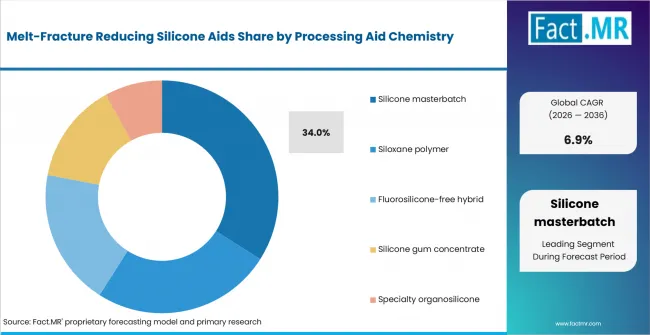
Melt Fracture Reducing Silicone Aids Analysis By Processing Aid Chemistry | Source: Fact.MR
Silicone masterbatch is expected to lead because pellet dosing fits common compounding and extrusion systems. The carrier helps processors feed silicone at a controlled rate. Siloxane polymer grades can reduce friction in the melt. Fluorosilicone-free hybrids serve lines that seek non-fluorinated PPA routes. Silicone gum concentrates provide a higher active silicone level. Specialty organosilicones serve narrower resin needs. Each route still needs good dispersion and a dose that suits the host polymer.
What leads the Processing Function segment?
Melt-fracture reduction is projected to account for 31.0% share in 2026.
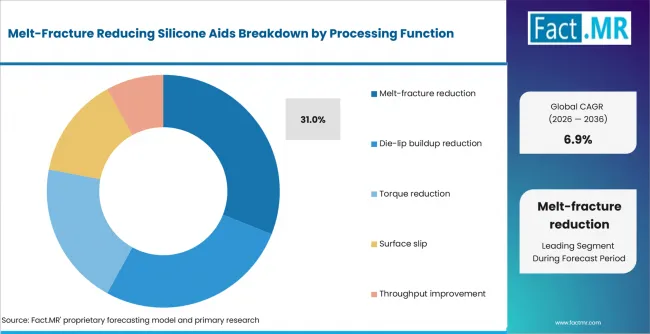
Melt Fracture Reducing Silicone Aids Analysis By Processing Function | Source: Fact.MR
Melt-fracture reduction is projected to lead because the defect is visible on the finished surface. It often appears when shear rises near the die wall. Silicone aids can reduce drag at that point. Die-lip control also matters on long film runs. Torque reduction is useful in filled compounds. Surface slip can help later handling. Throughput gains matter when speed rises without harming surface quality.
How does Polymer Substrate shape demand?
Polyethylene is anticipated to lead with 36.0% share in 2026.
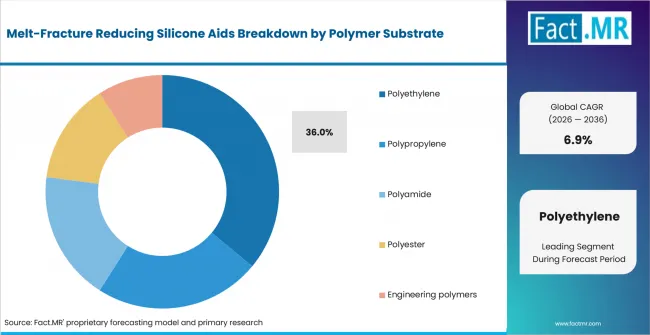
Melt Fracture Reducing Silicone Aids Analysis By Polymer Substrate | Source: Fact.MR
Polyethylene is anticipated to lead because blown-film lines combine high output with strict surface needs. The resin is widely used in film conversion. This makes die pressure and sharkskin easy to compare in trials. Polypropylene uses silicone aids when friction or deposits affect run stability. Polyamide needs closer resin-fit checks because it is more polar than polyolefins. Polyester and engineering polymers form smaller use cases. Their main needs are flow, surface finish and steady extrusion.
What supports Blown Film within Application?
Blown film is estimated to represent 29.0% share in 2026.
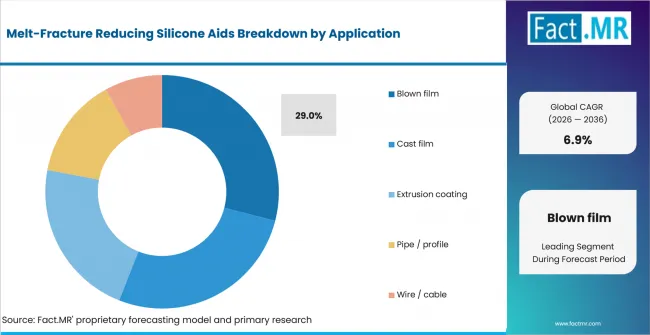
Melt Fracture Reducing Silicone Aids Analysis By Application | Source: Fact.MR
Blown film leads because the process runs continuously and shows surface defects during production. Die pressure can be tracked in the same run. Cast film uses a different cooling step but still needs smooth die flow. Extrusion coating needs even melt delivery across a wide opening. Pipe and profile lines focus on surface marks and die deposits. Wire and cable grades place more weight on torque when filler levels are high. In January 2026, the Federal Reserve reported 73.2% capacity utilization for U.S. plastics and rubber products in December 2025.
What is accelerating Melt-Fracture Reducing Silicone Aids Market adoption, and what is holding it back?
Extrusion-quality needs support adoption, while resin fit and qualification work can slow use.
Drivers Impact Analysis
| DRIVER | (~) % IMPACT ON CAGR | GEOGRAPHIC RELEVANCE | IMPACT TIMELINE |
|---|---|---|---|
| Surface-defect control in film extrusion | +1.2% | Global | Short term (<= 2 years) |
| Shift toward non-fluorinated processing aids | +1.0% | North America, Europe | Medium term (2-4 years) |
| Higher extrusion throughput requirements | +0.8% | Global | Medium term (2-4 years) |
| Processing of recycled and variable feedstocks | +0.6% | Europe, North America, East Asia | Long term (>= 4 years) |
Opportunity Impact Analysis
| OPPORTUNITY | (~) % IMPACT ON CAGR | GEOGRAPHIC RELEVANCE | IMPACT TIMELINE |
|---|---|---|---|
| Silicone PPA in polyethylene packaging film | +0.8% | Global | Short term (<= 2 years) |
| Carrier-matched masterbatches for recycled PE | +0.6% | Europe, North America | Medium term (2-4 years) |
| Low-dose aids for pipe and profile extrusion | +0.4% | Europe, East Asia | Medium term (2-4 years) |
Restraints Impact Analysis
| RESTRAINT | (~) % IMPACT ON CAGR | GEOGRAPHIC RELEVANCE | IMPACT TIMELINE |
|---|---|---|---|
| Resin-specific compatibility and dosing limits | -0.5% | Global | Short term (<= 2 years) |
| Qualification time for food-contact film | -0.4% | North America, Europe | Medium term (2-4 years) |
| Cost pressure in commodity polyolefin conversion | -0.3% | Global | Medium term (2-4 years) |
Which countries are scaling the Melt-Fracture Reducing Silicone Aids Market through 2036?
- The country comparison spans 1.3 percentage points and forms three practical growth bands across the forecast period.
- France and the USA both record 7.5% CAGR, with France supported by packaging recycling and film conversion, while the USA benefits from plastics investment and a broad extrusion-processing base.
- The USA remains 0.2 percentage point above China as plastics-processing investment supports film extrusion and wider use of silicone processing aids.
- China and Germany both record 7.3% CAGR, with China supported by rubber and plastics manufacturing growth and Germany by packaging recycling and the need to manage changing extrusion feedstocks.
- Germany remains 1.1 percentage points above Japan as recycled-polyethylene use and feedstock variation increase attention to die pressure, surface finish and line stability.
- Japan closes the displayed range through steady plastics production, established recycling rules and continued demand for resin-compatible extrusion aids.
Comparable CAGRs can create different entry conditions due to plastics-processing activity, packaging recycling, resin consistency, extrusion performance requirements and feedstock variation. Full report coverage includes North America, Latin America, Western Europe, Eastern Europe, East Asia, South Asia & Pacific, Middle East & Africa.
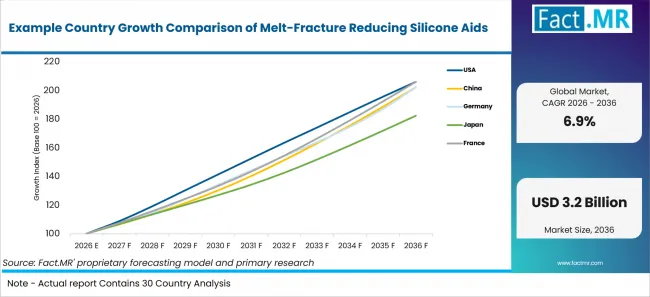
Example Country Growth Comparison Of Melt Fracture Reducing Silicone Aids | Source: Fact.MR
| Country | CAGR (2026-2036) |
|---|---|
| France | 7.5% |
| USA | 7.5% |
| China | 7.3% |
| Germany | 7.3% |
| Japan | 6.2% |
Why is France gaining traction in melt-fracture reducing silicone aids?
7.5% CAGR, supported by packaging recycling and film conversion.
France has a large packaging stream and active recycling. ADEME reported in April 2026 that about 4,893 kt of household packaging and graphic papers were sorted for recycling in 2024. For extrusion plants, the effect on silicone-aid demand depends on the type and share of recycled polymer used. Trials can compare dose, die pressure and finished-film quality as resin blends change.
How is the USA creating demand for silicone processing aids?
7.5% CAGR, backed by plastics investment and film processing.
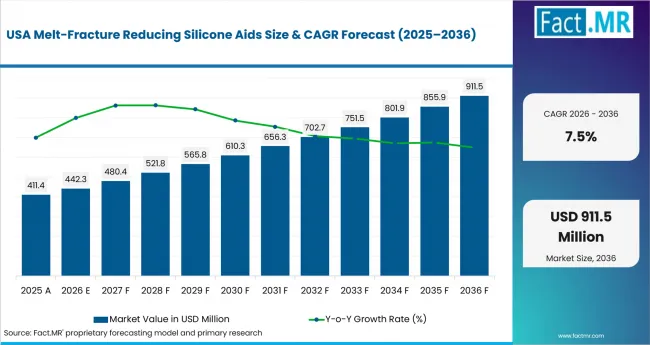
Melt Fracture Reducing Silicone Aids Country Value Analysis | Source: Fact.MR
The United States has a broad plastics-processing base. The U.S. Bureau of Economic Analysis reported USD 19.0 billion in expenditures for new foreign direct investment in plastics and rubber products manufacturing in 2025. Film converters can use process aids when melt fracture or die pressure limits line speed. Silicone masterbatches fit standard pellet handling and dry-blend systems. Trials should confirm clear gains in film quality, die condition and line stability.
Why is China expanding its use of silicone extrusion aids?
7.3% CAGR, shaped by growth in rubber and plastics manufacturing.
China has a large film and compounding base. The National Bureau of Statistics reported in January 2026 that value added for rubber and plastic products manufacturing increased 5.4% in 2025. Plants can test silicone aids at low dose against pressure and surface targets. A good carrier match can also support stable feeding and dispersion during scale-up.
How is Germany’s recycling base shaping market demand?
7.3% CAGR, led by packaging recycling and control of changing feedstocks.
Germany has mature plastics conversion and a large recycling system. The German Environment Agency and Central Agency Packaging Register reported that around 5.5 million tonnes of packaging waste collected by Germany’s dual systems were recovered in 2024. This shows the scale of packaging recycling. Where recycled polyethylene enters extrusion blends, plants can test silicone aids against die pressure, surface finish and line stability. Clear trial records also help compare resin lots.
What is driving Japan’s use of melt-fracture reducing silicone aids?
6.2% CAGR, driven by steady plastics output and recycling rules.
Japan has an established plastics-processing base across film and other extrusion uses. METI data show a 2025 plastic-products production index of 98.0, with 2020 equal to 100. The index was 0.1% above 2024. This gives context for a broadly stable processing environment. Producers can test resin fit, print behavior and seal performance before routine use.
Who leads the Melt-Fracture Reducing Silicone Aids Market?
Dow supplies DOWSIL™ 5-1050 PPA for blown and stretch film applications. Dow documents reduced melt fracture, die-lip buildup, and die pressure among its key processing benefits. Evonik serves related film and extrusion applications through TEGO® PPA 51-1 and TEGO® PPA 51-7. These organo-modified siloxane processing aids are designed to control sharkskin and die-drool buildup and improve surface performance in film and other extrusion processes.
Momentive offers PEarlene™ masterbatches containing ultra-high-molecular-weight polysiloxanes for polymer compounding and extrusion. DuPont supplies MULTIBASE™ silicone-based processing aids and masterbatches. Across its MULTIBASE portfolio, DuPont documents benefits including lower die pressure and extruder torque, increased throughput, reduced die buildup, and melt-fracture control.
Supplier differentiation is expected to reflect polymer compatibility, effective dosage, processing stability, surface-quality performance, and technical support during application trials.
Which companies are the key providers?
Companies profiled include Dow; Chengdu SILIKE Technology; Polytrend New Material; Momentive; Evonik; and DuPont.
- Dow
- Chengdu SILIKE Technology
- Polytrend New Material
- Momentive
- Evonik
- DuPont
Bibliography
- U.S. Food and Drug Administration. (2025, January 3). FDA determines authorization for 35 food contact notifications related to PFAS are no longer effective.
- Board of Governors of the Federal Reserve System. (2026, January 16). Industrial production and capacity utilization—G.17: Table 7. Capacity utilization.
- U.S. Bureau of Economic Analysis. (2026, June 10). New foreign direct investment in the United States, 2025.
- National Bureau of Statistics of China. (2026, January 20). Industrial production operation in December 2025.
- German Environment Agency, & Central Agency Packaging Register. (2026, January 27). Facts against myths: Packaging waste recycling in Germany is working.
- Ministry of Economy, Trade and Industry. (2026, April 30). Indices of industrial production: Preliminary report for March 2026.
- ADEME. (2026, April 7). Emballages ménagers et papiers graphiques : données 2024 [Household packaging and graphic papers: Data 2024].
- Directorate-General for Environment. (2026, August 11). New EU packaging rules start to apply, including restrictions on PFAS in food-contact packaging. European Commission.
- Dow. (2025, September 23). Dow unveils an alternative to fluoropolymer-based polymer processing aids for film packaging.
This Report Answers
- The report explains where melt-fracture reducing silicone aids are used across Processing Aid Chemistry, Processing Function, Polymer Substrate, and Application. It also covers regional demand across thermoplastic extrusion environments.
- Segment analysis identifies the leading subsegments and explains why processors prioritize silicone masterbatches, melt-fracture reduction, polyethylene substrates, and blown-film applications.
- Country analysis examines the USA, China, Germany, Japan, and France together with plastics-processing activity, recycling conditions, resin consistency, and extrusion-performance requirements that shape silicone-aid demand.
- Competitive analysis reviews current providers across silicone processing aids, organo-modified siloxanes, silicone masterbatches, and related polymer-processing technologies used to control die pressure, melt fracture, die buildup, and extrusion instability.
- Application analysis assesses how resin compatibility, dosage, die pressure, surface finish, haze, torque, throughput, and processing stability influence additive selection across blown film, cast film, extrusion coating, pipe, profile, wire, and cable applications.
What does the Melt-Fracture Reducing Silicone Aids Market cover?
The market covers silicone and siloxane additives used in thermoplastic extrusion. They help improve die flow and reduce surface defects. Related areas include extrusion aids, melt fracture eliminators and halogen-free process aids. This report focuses on silicone chemistry.
The scope includes silicone masterbatches, siloxanes and organosilicones. They are used in polyethylene, polypropylene and other resins. Related context includes masterbatch materials, polyolefin resins and polyolefin compounds. Carrier choice and polymer fit affect how the aid spreads.
What is included in the scope?
The scope includes pelletized silicone masterbatches, silicone gum concentrates and siloxane aids. They enter the market when they target melt fracture, die buildup, torque or throughput. Related context includes bio polymer processing aids, PCR-compatible masterbatches and recycled-content performance modifiers when feedstock changes how the melt runs.
What is excluded from the scope?
General lubricants, slip additives and mold-release products are outside the market unless extrusion is their stated use. Fluoropolymer-only PPAs, base resins, finished film and extrusion equipment are also outside the count. Polymer reactive-extrusion additives are used only as related context.
How Was the Analysis Built?
The analysis draws on 120+ sources, 35+ company portfolios, 25+ countries, and more than 20 industry interviews.
- Primary Research: Primary research includes discussions with manufacturers, service providers, technology developers, distributors, end users, and subject-matter experts. These conversations examine purchasing priorities, product adoption, operational challenges, approval requirements, competitive positioning, and the factors that influence wider market acceptance.
- Desk Research: Desk research covers government statistics, regulatory publications, company filings, trade data, technical studies, industry associations, standards, public policy, and other authoritative sources. Every source used in the analysis is documented in the bibliography.
- Market Sizing and Forecasting: Market estimates combine historical performance, demand indicators, pricing and volume trends, segment shares, company participation, country-level growth, adoption patterns, investment activity, and barriers to market expansion.
- Data Validation and Update Cycle: Findings are validated by comparing primary interviews with public data, company activity, regulatory changes, trade patterns, and industry developments. Regular updates review new product launches, capacity changes, partnerships, approvals, and shifts in commercial adoption.
What is the report’s scope and coverage?
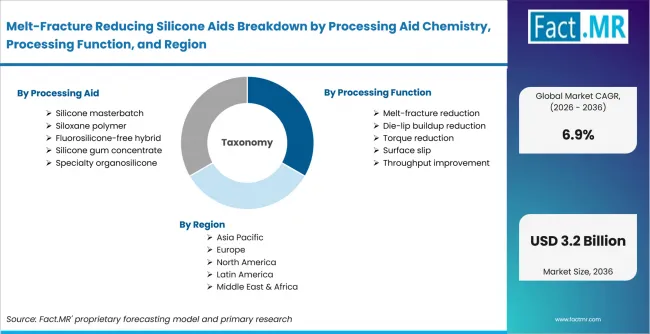
Melt Fracture Reducing Silicone Aids Breakdown By Processing Aid Chemistry, Processing Function, And Region | Source: Fact.MR
| Attribute | Details |
|---|---|
| Quantitative Units | USD billion |
| Market Definition | Silicone and siloxane-based polymer processing aids used to reduce melt fracture, die-lip buildup, friction, torque or related extrusion instability in thermoplastic processing. |
| Processing Aid Chemistry | Silicone masterbatch; Siloxane polymer; Fluorosilicone-free hybrid; Silicone gum concentrate; Specialty organosilicone |
| Processing Function | Melt-fracture reduction; Die-lip buildup reduction; Torque reduction; Surface slip; Throughput improvement |
| Polymer Substrate | Polyethylene; Polypropylene; Polyamide; Polyester; Engineering polymers |
| Application | Blown film; Cast film; Extrusion coating; Pipe / profile; Wire / cable |
| Regions Covered | North America; Latin America; Western Europe; Eastern Europe; East Asia; South Asia & Pacific; Middle East & Africa |
| Countries Covered | USA; China; Germany; Japan; France |
| Key Companies Profiled | Dow; Chengdu SILIKE Technology; Polytrend New Material; Momentive; Evonik; DuPont |
| Forecast Period | 2026 to 2036 |
| Approach | Hybrid top-down and bottom-up approach using plastics-processing activity, extrusion applications, chemistry fit, polymer-substrate mix, country indicators and provider portfolio review. |
How is the market segmented?
-
By Processing Aid Chemistry:
- Silicone masterbatch
- Siloxane polymer
- Fluorosilicone-free hybrid
- Silicone gum concentrate
- Specialty organosilicone
-
By Processing Function:
- Melt-fracture reduction
- Die-lip buildup reduction
- Torque reduction
- Surface slip
- Throughput improvement
-
By Polymer Substrate:
- Polyethylene
- Polypropylene
- Polyamide
- Polyester
- Engineering polymers
-
By Application:
- Blown film
- Cast film
- Extrusion coating
- Pipe / profile
- Wire / cable
-
By Region:
- North America
- Latin America
- Western Europe
- Eastern Europe
- East Asia
- South Asia & Pacific
- Middle East & Africa