- Market Value (2025): USD 1.3 Bn
- Estimated Value (2026): USD 1.4 Bn
- Forecast Value (2036): USD 2.8 Bn
- CAGR (2026-2036): 6.7%
What is the Polymer Reactive-Extrusion Additives Market forecast to be worth by 2036?
USD 2.8 billion by 2036.
- The polymer reactive-extrusion additives market reached USD 1.3 billion in 2025.
- Demand is anticipated to rise from USD 1.4 billion in 2026 to USD 2.8 billion by 2036.
- Growth is forecast at 6.7% CAGR over the 2026-2036 period.
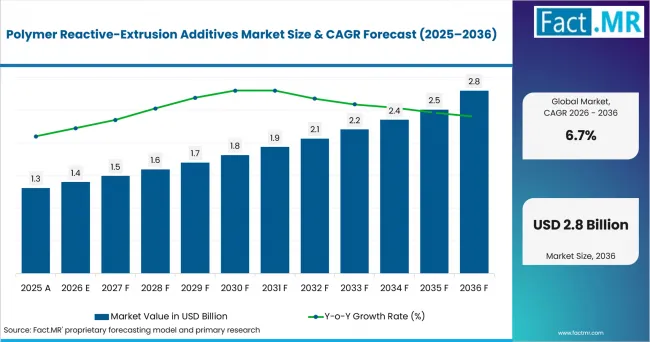
Polymer Reactive Extrusion Additives Market Value Analysis | Source: Fact.MR
What are the defining numbers behind Polymer Reactive-Extrusion Additives Market growth?
- Market Defination
- The forecast creates USD 1.3 billion in absolute opportunity from 2026 to 2036.
- Compatibilisers account for 31.0% of Additive Function in 2026, equivalent to USD 4.4 billion.
- Polyolefins represent 34.0% of Base Polymer in 2026.
- Automotive holds 29.0% of Application in 2026.
- Liquid formulations make up 41.0% of Form in 2026.
- Compounders represent 57.0% of End-Use in 2026.
- Demand Drivers in the Market
- The EU's 2026 vehicle-circularity regulation introduces phased recycled-plastic requirements for new vehicles. As recycled content rises, compounders need compatibilisers and coupling agents that help recovered polymers meet part-performance requirements.
- The Packaging and Packaging Waste Regulation now applies across the EU and introduces recycled-content requirements for plastic packaging. Reactive extrusion helps converters manage mixed streams and barrier-material carryover as recycled polyolefin content increases.
- Automotive lightweighting keeps filled and reinforced polyolefin compounds relevant. Maleic-anhydride-grafted coupling chemistry can improve bonding between a non-polar polymer matrix and polar reinforcement, supporting repeat additive demand in qualified compounds.
- Bioplastics and recycled blends widen the base-polymer mix. Polyester or polyamide combinations with polyolefins can require reactive compatibilisation to stabilize phase morphology during extrusion.
- Repeated thermal processing can reduce molecular weight and melt strength in some recycled streams. Chain extenders and grafting agents give compounders a route to rebuild rheology during extrusion instead of adding a separate reaction stage.
- Key Segments Analyzed
- By Additive Function: Compatibilisers account for 31.0% of the market in 2026, supported by their role in improving interfaces within immiscible and recycled polymer blends.
- By Base Polymer: Polyolefins represent 34.0% in 2026 because their compounding scale and non-polar chemistry create recurring use cases for grafted or coupling additives.
- By Application: Automotive holds 29.0% in 2026 as recycled-content compounds must retain part-level performance through demanding qualification cycles.
- By Form: Liquid formulations make up 41.0% in 2026, supported by direct metering when additive dosage and reaction timing require close control.
- By End-Use: Compounders represent 57.0% in 2026 because they set the formulation, control extrusion conditions and purchase the reactive package before downstream conversion.
- Analyst Opinion at Fact.MR
- Shambhu Nath Jha, Principal Consultant at Fact.MR, states, "Reactive extrusion lets compounders repair an interface or rebuild a chain without adding a separate reaction step. Recycled blends create a clear use case, but the operating window can be narrow. An additive that improves impact strength in one polyolefin mix may alter melt flow or color in another, so suppliers need polymer-specific evidence and disciplined dosing guidance."
- Strategic Implications
- Compounders can reduce formulation complexity by qualifying a smaller set of reactive additives across clearly defined polymer families instead of treating one multifunctional chemistry as interchangeable across all streams.
- The PPWR and the EU's new vehicle-circularity rules increase the commercial value of additives that allow higher recycled content without losing processing stability or part performance.
- Bioplastic blends create a separate opportunity for reactive chemistries that improve adhesion between incompatible phases without forcing a change in the base resin system.
- Automotive qualification favors coupling agents with documented performance in filled or reinforced polyolefins because approval depends on repeatable mechanical properties after recycled content is introduced.
- Retrofit dosing systems give processors a lower-capital path to add chain extenders or grafting agents on existing extrusion lines, provided residence time and metering can be controlled.
How does the Polymer Reactive-Extrusion Additives Market break down by segment?
Why does the Compatibilisers category lead Additive Function?
Compatibilisers account for 31.0% of Additive Function in 2026.
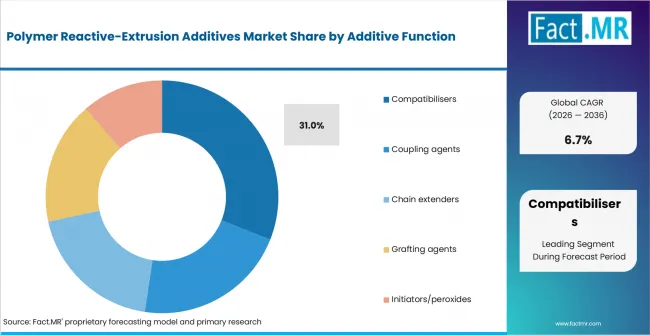
Polymer Reactive Extrusion Additives Market Analysis By Additive Function | Source: Fact.MR
Compatibilisers reduce interfacial weakness when polymers that do not naturally mix are processed together. In recycled blends, better phase adhesion can improve impact behavior and help stabilize properties across variable feedstock.
Selection remains polymer-specific because the functional group must interact with the intended phases under the available temperature and residence time. Coupling agents have a related role, but are often chosen for polymer-to-filler interfaces rather than polymer-to-polymer blends.
Why does the Polyolefins category lead Base Polymer?
Polyolefins represent 34.0% of Base Polymer in 2026.
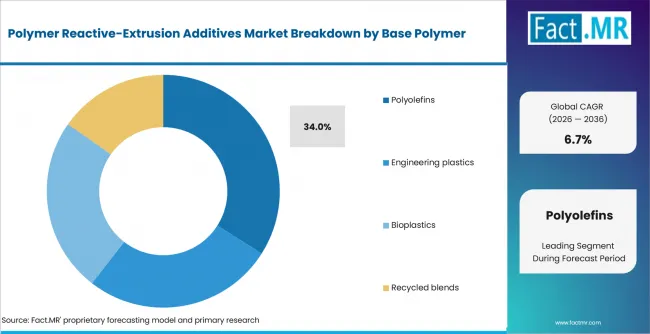
Polymer Reactive Extrusion Additives Market Analysis By Base Polymer | Source: Fact.MR
Polyethylene and polypropylene account for substantial compounding and recycling volume, and their nonpolar character creates compatibility challenges with polar polymers or fillers. Grafted and reactive additives are therefore used across many modified polyolefin formulations.
Engineering plastics can support higher additive value per batch, but their use is more specialized. Polyolefin demand is distributed across packaging, automotive, construction and consumer compounds, widening the addressable formulation base.
Why does the Automotive category lead Application?
Automotive holds 29.0% of Application in 2026.
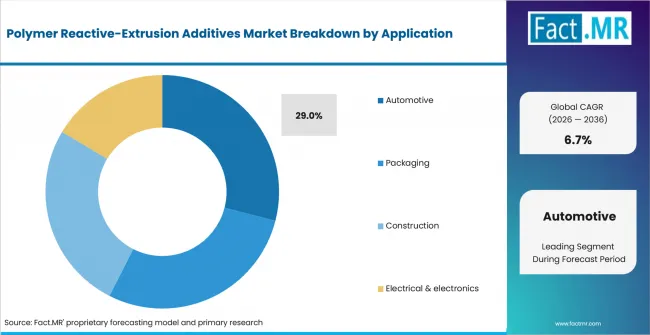
Polymer Reactive Extrusion Additives Market Analysis By Application | Source: Fact.MR
Automotive compounds must maintain impact, stiffness, heat resistance and surface quality while meeting part-specific processing requirements. Recycled-content targets add another source of feedstock variation that reactive additives can help manage.
Qualification cycles are demanding because a formulation change can affect molding behavior and long-term part performance. Once approved, however, the compound can move through stable vehicle programs and support repeat additive demand.
Why does the Liquid category lead Form?
Liquid formulations make up 41.0% of Form in 2026.
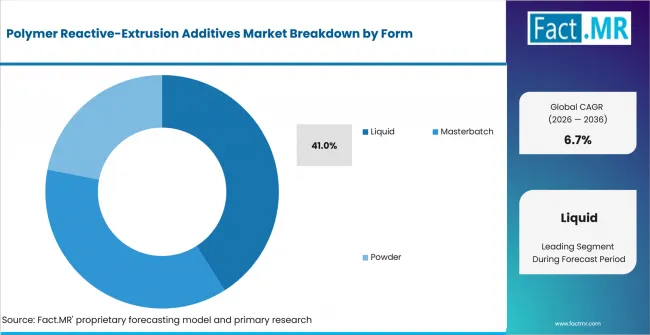
Polymer Reactive Extrusion Additives Market Analysis By Form | Source: Fact.MR
Liquid additives can be metered directly into the extruder and adjusted as feedstock or throughput changes. This supports controlled reaction when the effective dosage range is narrow.
Masterbatch forms are easier to store and handle, while powders can provide high active content. Liquid use therefore depends on accurate pumps, suitable injection points and disciplined process control at the compounding line.
Why does the Compounders category lead End-Use?
Compounders represent 57.0% of End-Use in 2026.
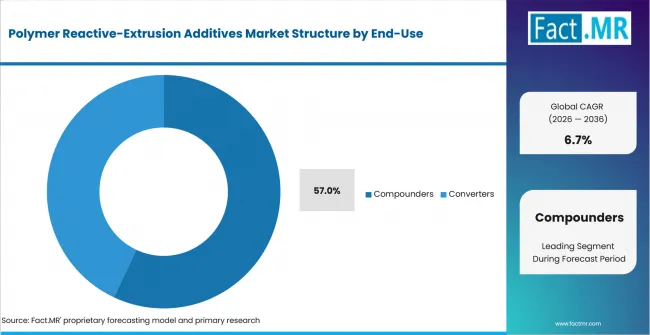
Polymer Reactive Extrusion Additives Market Analysis By End Use | Source: Fact.MR
Compounders choose the polymer blend, additive package and extrusion conditions, then validate the resulting pellet properties. They are therefore the main direct buyer for chemistries intended to react inside the extruder.
Converters often purchase a finished compound and focus on molding or forming the part. Direct additive demand from converters is more likely when they operate their own compounding step or manage a tightly integrated formulation.
What is accelerating Polymer Reactive-Extrusion Additives Market adoption, and what is holding it back?
Adoption is being driven by recycled-content rules and the need to recover performance in mixed polymer streams, while formulation sensitivity and tighter process-control requirements can limit use on less controlled extrusion lines.
Drivers Impact Analysis
| Driver | (~) % Impact on CAGR | Geographic Relevance | Impact Timeline |
|---|---|---|---|
| EU packaging and vehicle circularity rules raising recycled-content requirements | +0.9% | Europe | Near term |
| Automotive lightweighting and filled-polyolefin demand requiring coupling agents | +0.7% | Global | Mid term |
| Growth of bioplastics and multi-resin blends needing reactive compatibilisers | +0.6% | Europe, Asia-Pacific | Mid term |
| Chain extenders and grafting agents restoring recycled-stream melt strength | +0.5% | Global | Long term |
Source: Fact.MR analysis. Updated Aug 20, 2026
Opportunity Impact Analysis
| Opportunity | (~) % Impact on CAGR | Geographic Relevance | Impact Timeline |
|---|---|---|---|
| Multifunctional reactive additives serving compatibilizing, coupling and chain-extending roles | +0.7% | Global | Mid term |
| Bio-compatible grafting chemistries for bioplastic blends | +0.6% | Europe, North America | Long term |
| Reactive-additive dosing retrofits on existing compounding extrusion lines | +0.5% | Asia-Pacific, Europe | Mid term |
Source: Fact.MR analysis. Updated Aug 20, 2026
Restraints Impact Analysis
| Restraint | (~) % Impact on CAGR | Geographic Relevance | Impact Timeline |
|---|---|---|---|
| Higher formulation cost and process-control complexity versus conventional non-reactive additives | -0.5% | Asia-Pacific, Latin America | Near term |
| Reaction sensitivity and residence-time control constraints limiting use on fast-running film lines | -0.4% | Global | Mid term |
| Scarcity of qualified reactive-additive formulators in emerging compounding regions | -0.3% | Asia-Pacific, Middle East and Africa | Long term |
Source: Fact.MR analysis. Updated Aug 20, 2026
Which countries are scaling the Polymer Reactive-Extrusion Additives Market through 2036?
- Italy: EU packaging and vehicle circularity rules increase the need for recycled-content compounds that retain processing consistency. Italy's compounding and recycling base therefore supports demand for compatibilisers and chain-repair chemistries in export-oriented materials.
- United States: State recycled-content requirements and brand-owner targets are increasing the use of recovered resin in packaging, while automotive compounders continue to qualify filled polyolefin systems. Reactive additives help manage variability when recycled material enters established formulations.
- Germany: Automotive and engineering-plastics supply chains create a demanding qualification environment for recycled compounds. Reactive extrusion is relevant where compounders need to restore interface strength or melt behavior without changing the complete material platform.
- Japan: Japan's Plastic Resource Circulation framework supports wider material recovery, while precision manufacturing puts tight limits on property variation. This favors reactive additives that stabilize recycled or immiscible blends under controlled processing.
- South Korea: Circular-economy policy is increasing pressure to reduce virgin-plastic use and improve recycling. The country's integrated chemical and manufacturing base supports reactive additives in recycled compounds serving electronics and automotive applications.
- Netherlands: Dutch circular-economy policy targets wider reuse and recycling of plastics. Compounders serving EU packaging markets can use compatibilisers and chain extenders to upgrade variable recycled streams for higher-value applications.
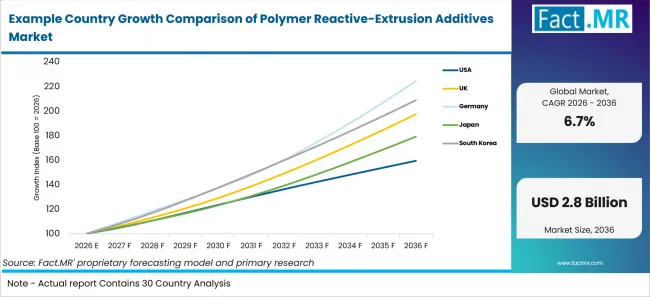
Example Country Growth Comparison Of Polymer Reactive Extrusion Additives Market | Source: Fact.MR
| Country | CAGR (2026-2036) |
|---|---|
| Italy | 7.0% |
| United States | 8.1% |
| Germany | 7.5% |
| Japan | 6.4% |
| South Korea | 8.5% |
| Netherlands | 7.5% |
Source: Fact.MR analysis. Updated Aug 20, 2026
What is driving Italy's growth through 2036?
Italy is anticipated to expand at 7.0% CAGR through 2036.
Italian compounders serving packaging and automotive customers must manage recycled-content requirements without destabilizing melt flow or part performance. Compatibilisers and coupling agents are therefore used where mixed resin streams or filled polyolefins would otherwise lose consistency during extrusion.
What is driving growth in the United States through 2036?
The United States is set to grow at 8.1% CAGR over the 2026-2036 forecast period.
State-level recycled-content measures and corporate packaging targets are increasing the amount of recovered polymer entering U.S. compounding lines. Reactive-additive dosing helps processors control impact performance and melt behavior when feedstock quality varies between recycled lots.
What is driving Germany's growth through 2036?
Germany is expected to advance at 7.5% CAGR through 2036.
Germany's automotive supply chain puts recycled compounds through demanding qualification. Grafted coupling chemistry is relevant where compounders need to preserve reinforcement bonding and processing stability as recycled polyolefins enter established material specifications.
What is driving Japan's growth through 2036?
Japan is likely to grow at 6.4% CAGR over the forecast period.
Japan's Plastic Resource Circulation framework increases attention to recovered materials, while electronics and automotive applications require tight property control. Reactive additives support recycled or immiscible blends where phase stability and melt behavior must remain consistent through precision processing.
What is driving South Korea's growth through 2036?
South Korea is set to expand at 8.5% CAGR through 2036.
South Korea's chemical and compounding base serves electronics and automotive manufacturing that increasingly needs recycled-content materials with predictable performance. Policy measures aimed at plastic reduction and recycling support additive demand where reclaimed resin must be stabilized or compatibilised before conversion.
What is driving growth in the Netherlands through 2036?
The Netherlands is anticipated to grow at 7.5% CAGR from 2026 to 2036.
The Netherlands' circular-economy programme keeps plastics reuse and recycling visible in industrial investment. Compounders supplying EU packaging applications can use chain extenders or compatibilisers to upgrade variable recycled streams before they move into higher-value formulations.
Who leads the Polymer Reactive-Extrusion Additives Market?
BASF SE, Dow Inc. and Clariant AG fit where recycled-polymer compounding connects with compatibilisation and property recovery. Dow adds direct relevance through RETAIN™ 3000, which promotes compatibility between polyolefins and polar polymers, while BASF positions its plastic-additive portfolio around mechanical-recycling support.
The supplier base combines diversified chemical groups with polymer-additive specialists. BASF SE, Dow Inc. and Clariant AG serve compounders through functional additives and compatibilisation solutions used in recycled or mixed polymer systems.
Evonik Industries AG supports mechanical recycling through its TEGO Cycle portfolio, including compatibilisation solutions used during compounding. Arkema supplies Lotader reactive terpolymers and Orevac grafted polyolefins for mixed polymer streams, while SONGWON Industrial Co., Ltd. participates through additive systems used to protect recycled resins during processing.
Supplier selection depends on polymer pairing, reaction window, dosing format and qualification evidence. Compounders also compare food-contact or automotive documentation and the quality of technical support during extrusion trials, because a chemistry that performs in one resin mix may not transfer directly to another.
Which companies are the key providers?
Key Companies includes BASF SE; Dow Inc.; Clariant AG; Evonik Industries AG; Arkema; SONGWON Industrial Co., Ltd.
- BASF SE
- Dow Inc.
- Clariant AG
- Evonik Industries AG
- Arkema
- SONGWON Industrial Co., Ltd.
Bibliography
- European Commission. (2026). Packaging waste: Packaging and Packaging Waste Regulation 2025/40. European Commission.
- Council of the European Union. (2026). Council greenlights rules for a more circular automotive sector. Council of the European Union.
- U.S. Environmental Protection Agency. (2024). National Strategy to Prevent Plastic Pollution. U.S. Environmental Protection Agency.
- Ministry of the Environment, Japan. (2022). Plastic Resource Circulation Act. Government of Japan.
- Ministry of Environment, Republic of Korea. (2026). Land and Waste: Circular economy and plastic recycling policy. Government of the Republic of Korea.
- Government of the Netherlands. (2023). National Circular Economy Programme 2023-2030. Government of the Netherlands.
- OECD. (2022). Global Plastics Outlook: Policy Scenarios to 2060. OECD Publishing.
- BASF SE. (2026). Plastic Additives. BASF.
- Dow Inc. (2026). RETAIN 3000 Polymer Modifier. Dow.
- Clariant AG. (2026). Plastics Converting and Recycling. Clariant.
- Evonik Industries AG. (2023). TEGO Cycle additives portfolio to transform plastic waste into valuable plastics. Evonik.
- Arkema. (2026). Creating Sustainable Solutions for Plastics Recycling. Arkema.
- SONGWON Industrial Co., Ltd. (2025). SONGWON presents its sustainability-driven progress at K 2025. SONGWON.
This Report Answers
- The report examines reactive-extrusion additives by function, polymer family, application, physical form and customer type.
- It explains how compatibilisers differ from coupling agents, chain extenders and grafting chemistries during melt processing.
- Country analysis connects demand with recycling policy, compounding activity and downstream automotive or packaging requirements.
- Competitive analysis compares chemistry breadth, polymer-specific technical support and dosing formats.
- The scope excludes conventional stabilizers or fillers when they do not create a reactive change during extrusion.
What does the Polymer Reactive-Extrusion Additives Market cover?
The market covers reactive-extrusion additives that react in situ during melt compounding, including compatibilisers, coupling agents, chain extenders, grafting agents and initiators/peroxides used to modify recycled, immiscible or filled polymer streams.
Coverage spans Polyolefins, Engineering plastics, Bioplastics and Recycled blends, with applications in Automotive, Packaging, Construction and Electrical & electronics.
What is included in the scope?
The scope includes compatibiliser, coupling, chain-extender, grafting and initiator/peroxide chemistries supplied in Liquid, Masterbatch and Powder forms for extrusion compounding or converter use.
Included applications cover recycled-content compounds, blended biopolymers and filled or reinforced polyolefins where the additive is intended to create a reactive change during extrusion.
What is excluded from the scope?
Non-reactive lubricants, antioxidants and colorants are excluded when they do not create a reactive change in the polymer or interface during extrusion.
Extrusion machinery, screw or barrel hardware and standalone masterbatch manufacturing services are outside the market unless the reactive additive itself is part of the commercial supply.
How Was the Analysis Built?
The analysis starts with the reactive-function boundary, separating additives that change polymer chains or interfaces during extrusion from conventional stabilizers, fillers and processing aids.
- Primary Research: Interviews focus on compounders, recycling technologists and formulation teams that set dosage, reaction conditions and acceptance criteria for recycled or blended polymers.
- Secondary Research: EU circular-plastics rules, national recycling policy and official supplier literature are used to test where reactive additives enter the compounding workflow.
- Market Sizing and Forecasting: Demand is modeled from compound production, base-polymer mix, additive function, delivery form and purchasing by Compounders or Converters.
- Validation and Updates: Segment totals and company scope are checked against the reactive-function boundary so conventional antioxidants, pigments and inert fillers do not enter the estimate.
Segmentation
What is the report's scope and coverage?
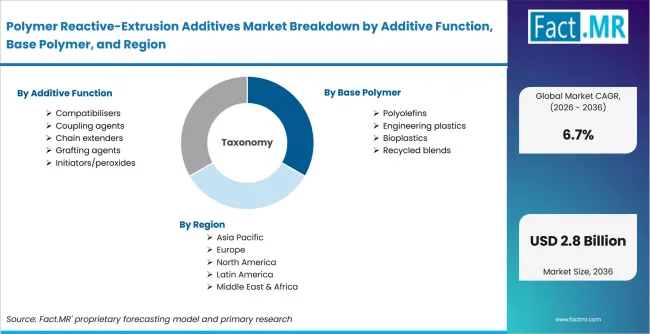
Polymer Reactive Extrusion Additives Market Breakdown By Additive Function, Base Polymer, And Region | Source: Fact.MR
| Attribute | Details |
|---|---|
| Quantitative Units | USD Millions |
| Market Definition | Compatibilisers, coupling agents, chain extenders, grafting agents and initiators/peroxides dosed during extrusion to alter polymer structure or interfacial behavior in-line. |
| Segments Covered | Additive Function; Base Polymer; Application; Form; End-Use |
| Regions Covered | North America; Latin America; Europe; East Asia; South Asia and Oceania; Middle East and Africa |
| Countries Covered | Italy; United States; Germany; Japan; South Korea; Netherlands |
| Key Companies Profiled | BASF SE; Dow Inc.; Clariant AG; Evonik Industries AG; Arkema; SONGWON Industrial Co., Ltd. |
| Forecast Period | 2026 to 2036 |
| Base Year | 2025 |
| Market Value, 2026 | USD 1,450 million |
| Market Value, 2036 | USD 2,773 million |
| CAGR, 2026-2036 | 6.7% |
| Absolute Opportunity | USD 1,323 million |
| Approach | Demand is modeled from compound production, base-polymer mix, additive function, delivery form and purchasing by compounders or converters. |
Source: Fact.MR analysis. Updated Aug 20, 2026
How is the market segmented?
-
By Additive Function:
- Compatibilisers
- Coupling agents
- Chain extenders
- Grafting agents
- Initiators/peroxides
-
By Base Polymer:
- Polyolefins
- Engineering plastics
- Bioplastics
- Recycled blends
-
By Application:
- Automotive
- Packaging
- Construction
- Electrical & electronics
-
By Form:
- Liquid
- Masterbatch
- Powder
-
By End-Use:
- Compounders
- Converters
Frequently Asked Questions
What is the Polymer Reactive-Extrusion Additives Market value in 2026?
At what CAGR is the market projected to grow?
What is the projected market value by 2036?
Which Additive Function category has the leading share?
Which Base Polymer category has the leading share?
Which Application category has the leading share?
Which Form category has the leading share?
Which End-Use category has the leading share?
What CAGR is projected for South Korea?
What is the primary demand driver?
What is the main restraint?
Which companies are assessed?
Who worked on this report


Preview the report firsthand - request a free sample
Free SampleGet the brochure for pricing and purchase details
Download PDF