- Market Value (2025): USD 545.0 Mn
- Estimated Value (2026): USD 644.0 Mn
- Forecast Value (2036): USD 3416.6 Mn
- CAGR (2026-2036): 18.2%
What is the Thickness-Reducing Graphene Compounds Market forecast to be worth by 2036?
USD 644.0 million in 2026 to USD 3416.6 million by 2036 at an 18.2% CAGR.
- The Thickness-Reducing Graphene Compounds Market reached USD 545.0 million in 2025.
- Demand is projected to increase from USD 644.0 million in 2026 to USD 3416.6 million by 2036.
- The market is forecast to record 18.2% CAGR from 2026 to 2036 as film converters, compounders and molded-part engineers qualify graphene at practical let-down ratios.
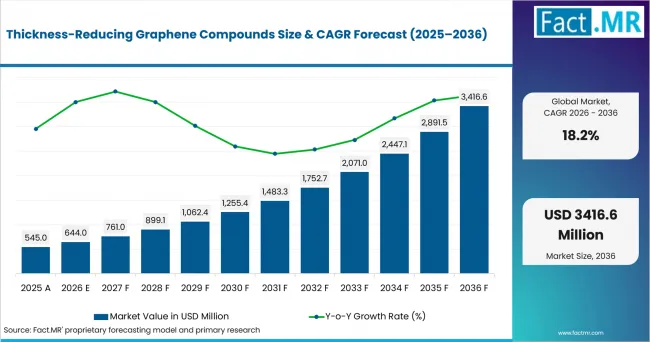
Thickness Reducing Graphene Compounds Value Analysis | Source: Fact.MR
What are the defining numbers behind Thickness-Reducing Graphene Compounds Market growth?
USD 2772.6 million absolute opportunity between 2026 and 2036.
- Demand Drivers in the Market
- Flexible-film converters need higher tensile and puncture performance at lower gauge. The U.S. Bureau of Economic Analysis reported in June 2026 that new foreign direct investment in U.S. plastics and rubber products manufacturing reached USD 19.0 billion in 2025.
- Polymer compounders need graphene formats that disperse through familiar extrusion equipment, so reinforcement can be tested without replacing the base PE, PP, PA or polyester processing route.
- Pack designers need resin savings that work with recycled content. A stronger graphene blend can help when recycled resin changes from one batch to the next.
- Car part makers need lighter parts that keep their shape and strength. Graphene-black hybrids and treated graphene grades give them more ways to tune stiffness and ESD behavior.
- Key Segments Analyzed
- By Graphene Form: Graphene nanoplatelets are expected to hold 40.0% share in 2026 because plate-like reinforcement can strengthen polymer matrices at relatively low loading.
- By Host Polymer: PE is projected to account for 36.0% share in 2026, supported by its large role in flexible-film extrusion and downgauging programs.
- By Downgauging Performance Target: Tensile / puncture strength is anticipated to capture 39.0% share in 2026. Film makers need proof that a thinner film can pass filling, shipping and use tests.
- By Application: Flexible film is estimated to represent 40.0% share in 2026. Even a small cut in gauge can lower resin use across long film runs.
- Analyst Opinion at Fact.MR
- Shambhu Nath Jha, Principal Consultant at Fact.MR, states, “The main test is simple: can graphene cut resin use and keep the film or part strong? Film makers check tensile, puncture, barrier and line results before a thinner design moves ahead. Suppliers need steady graphene quality, a suitable carrier resin and clear trial data before a blend reaches repeat use.”
- Strategic Implications
- Graphene producers should publish resin-specific loading ranges and mix guidance instead of broad strength claims.
- Compounders should compare gauge reduction with the full cost of graphene, carrier resin and line changes. A clear cost per roll or part helps customers judge whether lower resin use pays for the added graphene.
Austria is forecast to record 19.8% CAGR through 2036 as pack rules and lighter vehicle parts support resin-saving blends. South Korea is anticipated to post 18.7% CAGR as car output supports new compound tests. The USA is projected at 17.9%, the UK at 16.8%, and Germany at 16.0% through 2036.
How does the Thickness-Reducing Graphene Compounds Market break down by segment?
Graphene nanoplatelets lead Graphene Form at 40.0%; Flexible film leads Application at 40.0%.
Which Graphene Form leads?
Graphene nanoplatelets are expected to hold 40.0% share in 2026.
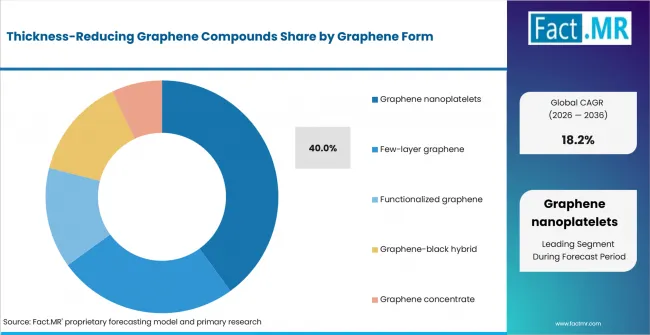
Thickness Reducing Graphene Compounds Analysis By Graphene Form | Source: Fact.MR
Graphene nanoplatelets give compounders a practical form that is easy to dose and mix. Their flat shape can raise strength and make gas paths through film less direct. Few-layer and treated graphene suit blends that need tighter bond control. Graphene-black hybrids add an ESD route. Concentrates are easier to feed on standard lines and reduce loose powder handling.
What leads the Host Polymer segment?
PE is projected to account for 36.0% share in 2026.
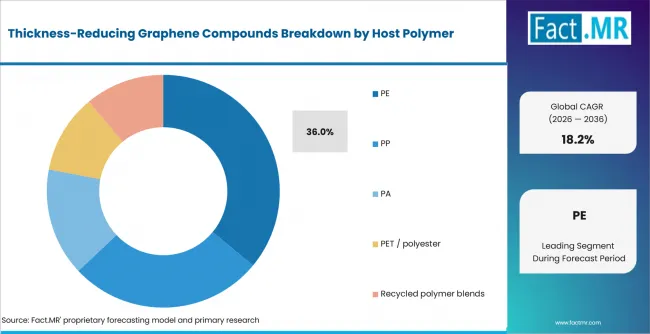
Thickness Reducing Graphene Compounds Analysis By Host Polymer | Source: Fact.MR
PE leads because film plants use large resin volumes and already dose masterbatch on the line. A graphene concentrate can enter familiar blown-film or cast-film processes. PP follows where parts need more stiffness and heat resistance. PA suits parts that need added strength or heat control. PET / polyester and recycled blends widen the range of resins that suppliers can tune.
Directa Plus lists graphene masterbatches for PA, PES, and LLDPE polymer systems. Its product page identifies film extrusion, injection molding, and extrusion molding as target processing routes.
How does Downgauging Performance Target shape demand?
Tensile / puncture strength is anticipated to capture 39.0% share in 2026.
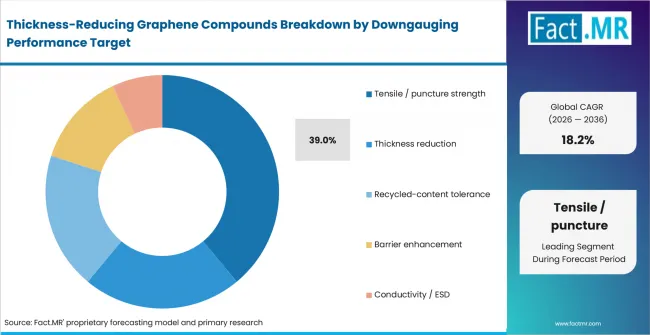
Thickness Reducing Graphene Compounds Analysis By Downgauging Performance Target | Source: Fact.MR
Tensile and puncture strength lead because a thinner film still has to survive making, filling and shipping. Thickness reduction is the main goal, yet the film needs a safe strength margin. Recycled-content tolerance helps when resin quality varies. Barrier enhancement matters for packs that need gas or moisture control. Conductivity / ESD serves films and molded parts that need set electrical behavior.
What supports Flexible film within Application?
Flexible film is estimated to represent 40.0% share in 2026.
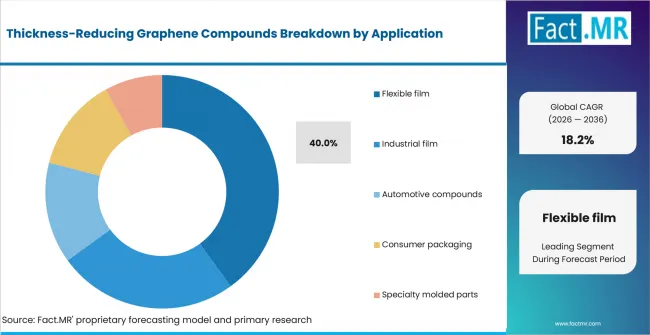
Thickness Reducing Graphene Compounds Analysis By Application | Source: Fact.MR
Flexible film gives graphene blends a clear resin-saving use. A small cut in gauge can lower resin use across long runs. Industrial film follows where tear and puncture strength affect handling. Car compounds use graphene when lower part mass adds value. Consumer packaging links thinner structures with circular goals. Specialty molded parts add uses for strength, heat flow or ESD control.
HydroGraph reported in March 2026 that customer programs achieved 30% lightweighting in plastics using Fractal Graphene™. The result illustrates the potential to reduce polymer use in lightweight plastic components where mechanical performance can be maintained.
What is accelerating Thickness-Reducing Graphene Compounds Market adoption, and what is holding it back?
Material reduction and recycled-resin performance support adoption; dispersion control and qualification cost restrain it.
Drivers Impact Analysis
| DRIVER | (~) % IMPACT ON CAGR | GEOGRAPHIC RELEVANCE | IMPACT TIMELINE |
|---|---|---|---|
| Flexible-film downgauging economics | +2.1% | Global | Short term (<= 2 years) |
| Recycled-resin performance recovery | +1.6% | Europe, North America | Medium term (2-4 years) |
| Automotive lightweighting | +1.2% | USA, Germany, South Korea, Austria | Medium term (2-4 years) |
| Barrier and ESD multifunctionality | +0.8% | Global | Long term (>= 4 years) |
Source: Fact.MR analysis. Updated Sep 23, 2026
Opportunity Impact Analysis
| OPPORTUNITY | (~) % IMPACT ON CAGR | GEOGRAPHIC RELEVANCE | IMPACT TIMELINE |
|---|---|---|---|
| PE film masterbatch qualification | +1.3% | Global | Short term (<= 2 years) |
| Recycled-content film formulations | +1.0% | Europe, UK | Medium term (2-4 years) |
| Automotive PP and PA compounds | +0.9% | South Korea, Germany, USA | Medium term (2-4 years) |
Source: Fact.MR analysis. Updated Sep 23, 2026
Restraints Impact Analysis
| RESTRAINT | (~) % IMPACT ON CAGR | GEOGRAPHIC RELEVANCE | IMPACT TIMELINE |
|---|---|---|---|
| Graphene dispersion variability | -0.8% | Global | Short term (<= 2 years) |
| Converter qualification cost | -0.6% | Global | Medium term (2-4 years) |
| Recyclability and additive documentation | -0.4% | Europe, UK | Long term (>= 4 years) |
Source: Fact.MR analysis. Updated Sep 23, 2026
Which countries are scaling the Thickness-Reducing Graphene Compounds Market through 2036?
- The country comparison spans 3.8 percentage points across the five profiled markets.
- Austria records 19.8% CAGR, supported by circular packaging activity and vehicle lightweighting.
- South Korea follows at 18.7% as automotive production supports qualification of lighter polymer compounds
- The USA reaches 17.9% through its large plastics conversion base and film downgauging programs.
- The UK posts 16.8% as recycled-content economics increase the value of maintaining strength at lower gauge.
- Germany records 16.0% as packaging recycling activity and industrial polymer processing support material-efficiency programs.
Similar CAGRs can still lead to different market paths because each country has its own film, resin and part-making base. Full coverage includes North America, Latin America, Western Europe, Eastern Europe, East Asia, South Asia & Pacific, Middle East & Africa.
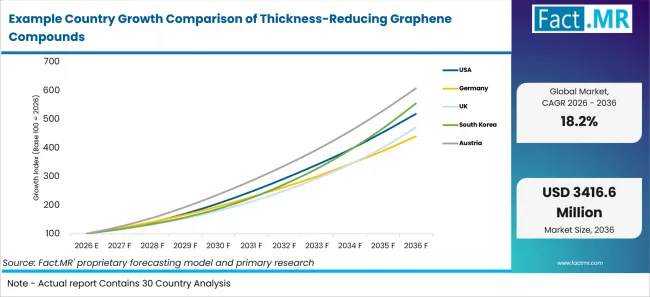
Example Country Growth Comparison Of Thickness Reducing Graphene Compounds | Source: Fact.MR
| Country | CAGR (2026-2036) |
|---|---|
| USA | 17.9% |
| Germany | 16.0% |
| UK | 16.8% |
| South Korea | 18.7% |
| Austria | 19.8% |
Source: Fact.MR analysis. Updated Sep 23, 2026
What supports USA adoption?
17.9% CAGR, supported by a large plastics conversion base and material-efficiency programs.
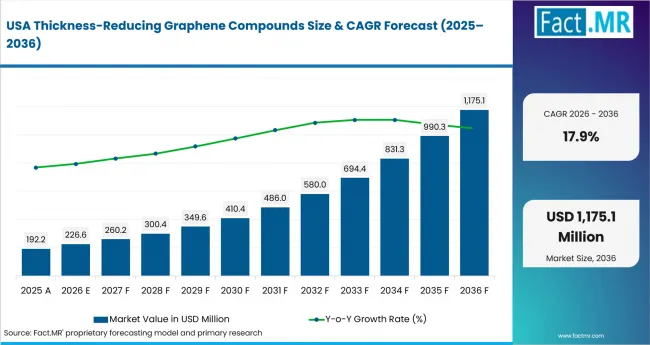
Thickness Reducing Graphene Compounds Country Value Analysis | Source: Fact.MR
The U.S. Census Bureau reported in March 2026 that plastics and rubber product shipments reached USD 25,101 million in January 2026. This production scale gives compounders and film converters a broad base for graphene trials. PE films offer a practical route because graphene masterbatches can enter familiar extrusion systems while tensile and puncture tests confirm the lower-gauge design.
How is Germany developing demand?
16.0% CAGR, shaped by packaging recycling activity and industrial polymer processing.
The German Environment Agency and the Central Agency Packaging Register reported in January 2026 that around 5.5 million tonnes of packaging waste collected by the dual systems were recovered in 2024. That scale keeps material efficiency central to packaging design. Graphene compounds fit this direction when they help PE, PP or polyester structures reach target strength with less polymer.
What supports the United Kingdom’s growth?
16.8% CAGR, supported by recycled-content packaging economics.
HM Revenue & Customs reported in August 2026 that 1.506 million tonnes of plastic packaging declared for 2025 to 2026 contained at least 30% recycled plastic. Higher recycled content can make mechanical consistency more important for converters. Graphene masterbatches give film producers a route to test tensile and puncture retention while reducing gauge in PE-based structures.
How is South Korea developing demand?
18.7% CAGR, supported by automotive production and lightweight polymer use.
The Ministry of Trade, Industry and Resources reported in January 2026 that South Korea produced 4.1 million automobiles in 2025. That manufacturing base gives automotive compounders a clear setting for lightweight PP and PA formulations. Graphene can be evaluated where stiffness, thermal response or conductivity must be preserved as part mass falls.
How does Austria perform?
19.8% CAGR, supported by vehicle electrification and circular packaging activity.
Statistics Austria reported in January 2026 that 60,651 new battery-electric passenger cars were registered in 2025. The shift to electric cars keeps part weight in focus. This supports trials of lighter resin blends for car parts. Austria also has pack uses where PE and PET blends can add graphene to keep strength as resin use falls.
Who leads the Thickness-Reducing Graphene Compounds Market?
NanoXplore and Techmer PM are directly active in film-focused graphene masterbatch development. NanoXplore contributes graphene technology, while Techmer PM provides polymer compounding, dispersion, and film-application expertise. Their joint GrapheneBlack xGnP™ Masterbatch is designed for high-performance plastic films, with in-house blown-film capability supporting formulation trials and real-world process validation. Supplier differentiation is expected to reflect graphene dispersion, polymer compatibility, repeatable processing performance, and demonstrated film-property improvements.
Directa Plus supplies graphene masterbatches based on PA, PES, and LLDPE polymer systems and lists film extrusion as a target processing route. Haydale supplies functionalised graphene for thermoplastics through its HDPlas® technology, with documented improvements in mechanical properties and thermal conductivity while maintaining polymer processability.
HydroGraph stated in November 2025 that Fractal Graphene™ can reinforce thermoplastics at ultra-low loadings and support lightweighting. Across the profiled set, supplier differentiation is expected to depend on dispersion quality, host-polymer compatibility, effective loading, repeatable line performance, and evidence of material or weight reduction in application trials.
Which companies are the key providers?
Companies profiled include NanoXplore; Techmer PM; Directa Plus; Haydale; and HydroGraph.
- NanoXplore
- Techmer PM
- Directa Plus
- Haydale
- HydroGraph
Bibliography
- U.S. Bureau of Economic Analysis. (2026, June 10). New foreign direct investment in the United States, 2025.
- U.S. Census Bureau. (2026, March 18). Monthly full report on manufacturers’ shipments, inventories and orders: January 2026.
- German Environment Agency. (2026, March 5). Verpackungsabfälle [Packaging waste].
- German Environment Agency, & Central Agency Packaging Register. (2026, January 27). Facts against myths: Packaging waste recycling in Germany is working.
- HM Revenue & Customs. (2026, August 27). Plastic Packaging Tax (PPT) statistics commentary.
- Ministry of Trade, Industry and Resources. (2026, January 20). 2025 auto industry takeaways.
- Statistics Austria. (2026, January 14). More new car registrations than at any time since 2019 in 2025.
- NanoXplore Inc. (2026, June 15). NanoXplore and Techmer PM launch revolutionary GrapheneBlack xGnP™ Masterbatch for high-performance plastic films.
- HydroGraph Clean Power Inc. (2026, March 17). Real customer results: What Fractal Graphene-enhanced materials are actually delivering.
- HydroGraph Clean Power Inc. (2025, November 19). Revolutionizing material efficiency: How Fractal Graphene-enhanced polymers are enabling new frontiers in lightweighting.
This Report Answers
- The report explains the market across graphene form, host polymer, performance target and application.
- Segment analysis identifies the leading subsegments and the reasoning behind downgauging programs.
- Country analysis examines the five listed markets and their qualification conditions.
- Competitive analysis reviews the supplied providers and their polymer capabilities.
- Application analysis assesses how mechanical, barrier and ESD requirements influence material selection.
What does the Thickness-Reducing Graphene Compounds Market cover?
The market covers graphene-enhanced compounds, concentrates and masterbatches used to reduce film gauge or molded-part material while maintaining target performance. It includes the supplied graphene forms across PE, PP, PA, PET / polyester and recycled polymer blends.
Uses include flexible film, industrial film, automotive compounds, consumer packaging and specialty molded parts. The scope follows the stated targets and focuses on graphene blends used to cut film gauge or part weight.
What is included in the scope?
The scope includes graphene additives and resin blends used in film lines or molding. Masterbatch routes are included when graphene dose links to clear strength, barrier or ESD targets and a stated goal to use less resin.
The graphene-form dimension aligns with graphene nanoplatelets used in polymer reinforcement. Melt-processing context connects with polymer reactive-extrusion additives when additives are introduced during compounding.
What is excluded from the scope?
The scope is limited to graphene used within polymer compounds for material reduction. Battery, cement, textile and standalone electronics applications fall outside this compound-level boundary. Conventional carbon-black compounds and neat resins are outside the defined market as well.
Upstream material context connects with graphene materials across graphene supply and application development. Polyolefin host-polymer context connects with polyolefin compounds across PE and PP compounding applications.
How Was the Analysis Built?
The analysis draws on 120+ sources, 35+ company portfolios, 25+ countries, and more than 20 industry interviews.
- Primary Research: Primary research includes discussions with manufacturers, service providers, technology developers, distributors, end users, and subject-matter experts. These conversations examine purchasing priorities, product adoption, operational challenges, approval requirements, competitive positioning, and the factors that influence wider market acceptance.
- Desk Research: Desk research covers government statistics, regulatory publications, company filings, trade data, technical studies, industry associations, standards, public policy, and other authoritative sources. Every source used in the analysis is documented in the bibliography.
- Market Sizing and Forecasting: Market estimates combine historical performance, demand indicators, pricing and volume trends, segment shares, company participation, country-level growth, adoption patterns, investment activity, and barriers to market expansion.
- Data Validation and Update Cycle: Findings are validated by comparing primary interviews with public data, company activity, regulatory changes, trade patterns, and industry developments. Regular updates review new product launches, capacity changes, partnerships, approvals, and shifts in commercial adoption.
Segmentation
What is the report’s scope and coverage?
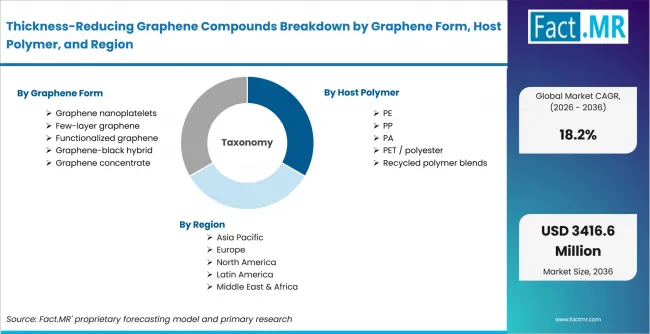
Thickness Reducing Graphene Compounds Breakdown By Graphene Form, Host Polymer, And Region | Source: Fact.MR
| Attribute | Details |
|---|---|
| Quantitative Units | USD million |
| Market Definition | Graphene-enhanced polymer compounds and masterbatches designed to improve mechanical, barrier or electrical performance so films or molded parts can use less polymer while maintaining target specifications. |
| Graphene Form | Graphene nanoplatelets; Few-layer graphene; Functionalized graphene; Graphene-black hybrid; Graphene concentrate |
| Host Polymer | PE; PP; PA; PET / polyester; Recycled polymer blends |
| Downgauging Performance Target | Tensile / puncture strength; Thickness reduction; Recycled-content tolerance; Barrier enhancement; Conductivity / ESD |
| Application | Flexible film; Industrial film; Automotive compounds; Consumer packaging; Specialty molded parts |
| Regions Covered | North America; Latin America; Western Europe; Eastern Europe; East Asia; South Asia & Pacific; Middle East & Africa |
| Countries Covered | USA; Germany; UK; South Korea; Austria |
| Key Companies Profiled | NanoXplore; Techmer PM; Directa Plus; Haydale; HydroGraph |
| Forecast Period | 2026 to 2036 |
| Approach | Hybrid top-down and bottom-up assessment using polymer-conversion demand, graphene loading economics, application qualification, segment shares, country growth and provider portfolio review. |
Source: Fact.MR analysis. Updated Sep 23, 2026
How is the market segmented?
-
By Graphene Form:
- Graphene nanoplatelets
- Few-layer graphene
- Functionalized graphene
- Graphene-black hybrid
- Graphene concentrate
-
By Host Polymer:
- PE
- PP
- PA
- PET / polyester
- Recycled polymer blends
-
By Downgauging Performance Target:
- Tensile / puncture strength
- Thickness reduction
- Recycled-content tolerance
- Barrier enhancement
- Conductivity / ESD
-
By Application:
- Flexible film
- Industrial film
- Automotive compounds
- Consumer packaging
- Specialty molded parts
-
By Region:
- North America
- Latin America
- Western Europe
- Eastern Europe
- East Asia
- South Asia & Pacific
- Middle East & Africa
Frequently Asked Questions
How big is the thickness-reducing graphene compounds market in 2026?
What is the CAGR of the thickness-reducing graphene compounds market from 2026 to 2036?
Which graphene form leads the thickness-reducing graphene compounds market?
Which host polymer leads the thickness-reducing graphene compounds market?
Who are the leading companies in the thickness-reducing graphene compounds market?
Who worked on this report


Preview the report firsthand - request a free sample
Free SampleGet the brochure for pricing and purchase details
Download PDF