- Base Value(2025): 1.10 Bn
- Estimated Value(2026): 1.16 Bn
- Forecast Value (2036): 2.00 Bn
- CAGR (2026 - 2036): 5.6%
Metallic Glass Market Size, Market Forecast and Outlook By Fact.MR
The metallic glass market was valued at USD 1.10 billion in 2025, projected to reach USD 1.16 billion in 2026, and is forecast to expand to USD 2.00 billion by 2036 at a 5.6% CAGR. is transitioning from a materials science novelty into a precision manufacturing input, where the amorphous alloy's combination of high hardness, elastic limit, and corrosion resistance is displacing conventional crystalline metals in miniaturized electronics casings, surgical instruments, and high-performance sports equipment components.
The absolute dollar expansion between 2026 and 2036 amounts to approximately USD 0.84 billion. Growth reflects widening commercial adoption of bulk metallic glass (BMG) in consumer electronics, medical devices, and defence applications where the material's unique mechanical properties justify its cost premium over conventional alloys. Limited production capacity and the technical difficulty of scaling up die casting to larger part sizes act as the primary supply constraints.
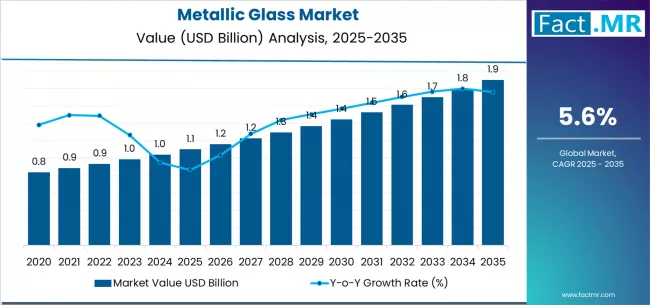
Metallic Glass Market Market Value Analysis | Source: Fact.MR
Metallic Glass Market Key Takeaways
| Metric | Details |
|---|---|
| Industry Size (2026) | USD 1.16 billion |
| Industry Value (2036) | USD 2.00 billion |
| CAGR (2026 to 2036) | 5.6% |
Source: Fact.MR analysis. Updated Mar 25, 2026
Product design engineers at major consumer electronics OEMs are qualifying metallic glass alloys for hinge mechanisms, SIM card trays, and precision watch casings. The amorphous structure delivers hardness values exceeding 500 HV with zero grain boundary corrosion susceptibility, enabling thinner component cross-sections that reduce device weight without sacrificing durability.
All major regional markets reflect differentiated growth parameters. India sets the pace at 7.5% CAGR. China registers at 6.8% CAGR. Brazil registers at 5.4% CAGR. Germany registers at 5.2% CAGR. Europe registers at 5.2% CAGR. USA registers at 5.0% CAGR.
Summary of Metallic Glass Market
- Metallic Glass Market Definition
- Metallic glass, also known as amorphous metal, is a solid metallic alloy with a disordered, non-crystalline atomic structure produced by rapid cooling of molten alloy at rates exceeding 1,000 degrees Celsius per second. This amorphous structure imparts properties not achievable in crystalline metals: twice the elastic limit of steel, high hardness (500 to 600 HV), excellent corrosion resistance, and near-perfect surface finish from casting.
- Demand Drivers in the Market
- Consumer electronics miniaturization: Apple Inc.
- Surgical instrument precision: Metallic glass scalpel blades maintain edge sharpness 5x longer than conventional stainless steel surgical blades due to the absence of grain boundaries that initiate dulling.
- Aerospace fastener and component adoption: The U.S.
- Key Segments Analyzed in the Fact.MR Report
- Bulk Metallic Glass material type: 60.0% share in 2026.
- Electronics application: 60.0% share in 2026.
- India: 7.5% compound growth through 2036.
- Analyst Opinion at Fact.MR
- The central challenge is scale. Metallic glass requires rapid cooling to prevent crystallization, limiting component size to approximately 10 to 15 mm thickness for most alloy systems. Die casting cycle times are 30% to 50% longer than conventional zinc or aluminium die casting. Production costs per kilogram are 5x to 10x higher than stainless steel.
- Strategic Implications / Executive Takeaways
- Procurement teams must establish multi-year supply agreements with qualified producers to secure allocation ahead of anticipated demand increases.
- Product development resources should prioritize formulations that meet tightening regulatory specifications in key import markets.
- Regional expansion strategies must account for divergent growth rates and regulatory environments across major consuming nations.
Imperatives for Stakeholders in Metallic Glass Market
Design for performance, not just cost
- Offer comprehensive material packages: metallic glass + processing equipment + application engineering + technical support + quality validation.
- Preconfigured manufacturing solutions: forming processes, quality control procedures, performance testing, and digital material records for optimal results.
Application engineering readiness
- Real-time performance monitoring, material characterization capabilities, and smart manufacturing integration (process control, quality tracking, performance optimization).
Performance-based approach
- Material validation studies, application-specific testing, performance optimization integration, and comprehensive technical documentation.
Value-based pricing models
- Clear material pricing + transparent service tiers (engineering support, processing assistance, performance guarantees); subscriptions for technical services and application development.
Segmental Analysis
The market segments by material type into bulk metallic glass, sheet/thin film, and other forms, representing the evolution from basic materials to sophisticated manufacturing solutions for comprehensive industrial applications optimization.
The application segmentation divides the market into electronics, medical devices, sports/consumer goods, and aerospace/defense sectors, reflecting distinct requirements for material performance, processing capability, and application standards.
The segmentation structure reveals technology progression from standard materials toward advanced metallic glass systems with enhanced performance and processing capabilities, while application diversity spans from electronics manufacturing to aerospace operations requiring precise material solutions.
By Type, the Bulk Metallic Glass Segment Accounts for Dominant Market Share
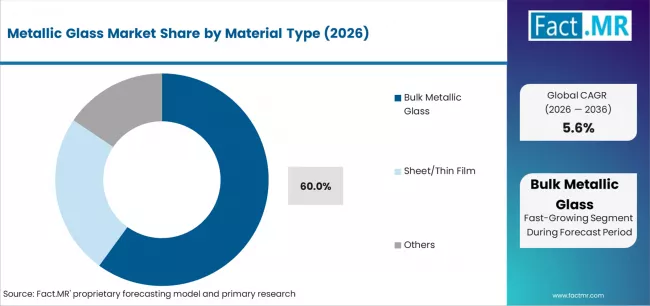
Metallic Glass Market Analysis By Material Type | Source: Fact.MR
Bulk metallic glass systems command the leading position in the metallic glass market with 60% market share through advanced material features, including superior mechanical properties, operational reliability, and manufacturing optimization that enable industrial facilities to achieve optimal performance outcomes across diverse electronics and aerospace environments.
The segment benefits from manufacturer preference for reliable material systems that provide consistent performance characteristics, reduced processing complexity, and application effectiveness optimization without requiring significant infrastructure modifications. Advanced design features enable precise forming capabilities, enhanced durability, and integration with existing manufacturing equipment, where material performance and processing reliability represent critical application requirements.
Bulk metallic glass systems differentiate through proven material reliability, consistent performance characteristics, and integration with advanced manufacturing systems that enhance application effectiveness while maintaining optimal quality standards suitable for diverse electronics and industrial applications.
Key market characteristics:
- Advanced material designs with optimized composition configuration and processing efficiency capabilities
- Enhanced performance effectiveness, enabling superior strength-to-weight ratios with consistent material properties
- Manufacturing compatibility, including automated processing systems, quality integration, and application optimization for industrial operations
Sheet/Thin Film Materials Show Specialized Growth
Sheet/thin film materials maintain a 25% market position in the metallic glass market due to their specialized processing properties and coating application advantages. These materials appeal to facilities requiring precise surface treatments with enhanced performance characteristics for electronics applications. Market growth is driven by electronics expansion, emphasizing reliable coating solutions and performance effectiveness through optimized thin film designs.
Other Forms Demonstrate Supporting Growth
Other forms capture 15% market share through specialized material requirements in research applications, custom manufacturing, and emerging technology applications. These facilities demand innovative material systems capable of handling diverse processing needs while providing effective performance capabilities and manufacturing flexibility.
By Application, the Electronics Segment Shows Fastest Growth
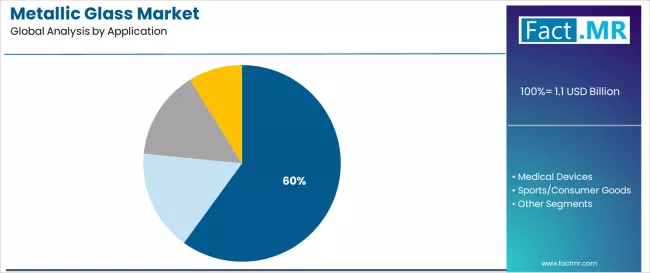
Metallic Glass Market Analysis By Application | Source: Fact.MR
Electronics applications demonstrate the highest growth rate in the metallic glass market, accumulating a share of 60%, due to widespread adoption of advanced materials and increasing focus on miniaturization optimization, performance efficiency, and device reliability applications that maximize electronic performance while maintaining material standards.
Electronics operators prioritize material reliability, processing precision, and integration with existing manufacturing infrastructure that enables coordinated production operations across multiple device categories. The segment benefits from substantial technology investment and modernization programs that emphasize the acquisition of advanced materials for performance optimization and manufacturing excellence applications.
Technology expansion programs incorporate metallic glass as standard materials for electronics operations, while device miniaturization growth increases demand for high-performance materials that comply with performance standards and minimize processing complexity.
Application dynamics include:
- Strong growth in consumer electronics and advanced devices requiring high-performance materials
- Increasing adoption in performance optimization and manufacturing efficiency applications for electronics manufacturers
- Rising integration with precision manufacturing systems for material optimization and quality assurance
Medical Device Applications Maintain Clinical Demand
Medical device applications capture market share through specialized material requirements in biomedical implants, surgical instruments, and medical equipment applications. These facilities demand biocompatible materials capable of operating with stringent quality requirements while providing effective performance access and regulatory compliance capabilities.
Sports/Consumer Goods Show Market Growth
Sports/consumer goods applications account for market share, including sporting equipment, luxury goods, and consumer products requiring enhanced performance materials for application optimization and product differentiation.
Aerospace/Defense Applications Show High-Performance Leadership
Aerospace/defense applications account for market share, including aircraft components, defense systems, and specialized equipment requiring maximum performance capabilities for operational optimization and mission effectiveness.
What are the Drivers, Restraints, and Key Trends of the Metallic Glass Market?
| Category | Factor | Impact | Why It Matters |
|---|---|---|---|
| Driver | Electronics miniaturization & performance requirements (advanced devices, IoT growth) | ★★★★★ | Increasing device complexity creates consistent demand for high-performance materials with superior properties and reliability across electronics applications. |
| Driver | Advanced manufacturing techniques & processing capabilities | ★★★★★ | Transforms precision materials from "specialized" to "essential"; providers offering advanced processing and manufacturing integration gain competitive advantage. |
| Driver | Medical device innovation & biocompatible materials | ★★★★☆ | Medical applications need high-performance biocompatible materials; demand for specialized, regulatory-compliant systems expanding addressable market. |
| Restraint | High material costs & processing complexity | ★★★★☆ | Cost-conscious manufacturers delay adoption; increases price sensitivity and slows advanced material adoption in price-sensitive applications. |
| Restraint | Limited processing knowledge & technical expertise | ★★★☆☆ | Advanced materials require specialized processing knowledge and equipment, limiting adoption speed and increasing implementation complexity. |
| Trend | Additive manufacturing integration & 3D printing | ★★★★★ | Real-time manufacturing capabilities, custom geometries, and processing flexibility transform operations; additive compatibility and processing become core value propositions. |
| Trend | Application-specific customization & engineered solutions | ★★★★☆ | Custom material properties for specific applications; tailored compositions and processing drive competition toward specialization solutions. |
Source: Fact.MR analysis. Updated Mar 25, 2026
Analysis of the Metallic Glass Market by Key Country
The metallic glass market demonstrates varied regional dynamics with growth leaders including India (7.5% growth rate) and China (6.8% growth rate) driving expansion through industrial modernization initiatives and advanced manufacturing development.
Steady performers encompass United States (5.0% growth rate), Germany (5.2% growth rate), and developed regions, benefiting from established technology systems and advanced materials adoption. Emerging markets feature Brazil (5.4% growth rate) and developing regions, where industrial initiatives and manufacturing modernization support consistent growth patterns.
Regional synthesis reveals Asian markets leading adoption through industrial expansion and technology development, while North American countries maintain steady expansion supported by advanced materials technology advancement and manufacturing requirements. European markets show moderate growth driven by industrial applications and technology integration trends.
.webp "Top Country Growth Comparison Metallic Glass Market Cagr (2026 2036)")
Top Country Growth Comparison Metallic Glass Market Cagr (2026 2036) | Source: Fact.MR
| Region/Country | 2026-2036 Growth | How to win | What to watch out |
|---|---|---|---|
| India | 7.5% | Focus on cost-effective material solutions | Manufacturing infrastructure gaps; technical expertise |
| China | 6.8% | Lead with advanced processing systems | Technology transfer restrictions; local competition |
| United States | 5.0% | Provide comprehensive engineering support | Material costs; processing complexity |
| Germany | 5.2% | Offer premium precision materials | Over-engineering; lengthy qualification processes |
| Brazil | 5.4% | Value-oriented material models | Import duties; technology access |
| Europe | 5.2% | Push advanced manufacturing integration | Technical barriers; market fragmentation |
Source: Fact.MR analysis. Updated Mar 25, 2026
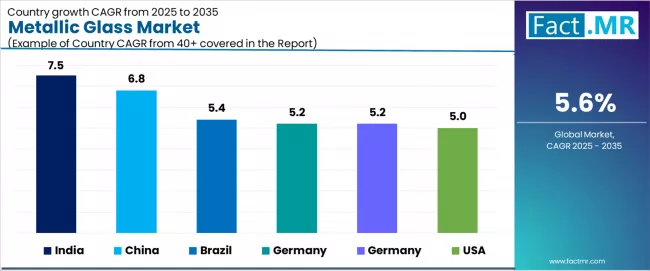
Metallic Glass Market Cagr Analysis By Country | Source: Fact.MR
India Drives Fastest Market Growth
India establishes fastest market growth through aggressive industrial modernization programs and comprehensive advanced materials development, integrating metallic glass as standard components in electronics manufacturing and industrial applications installations.
The country's 7.5% growth rate reflects government initiatives promoting industrial advancement and technology capability development that mandate the use of advanced materials in manufacturing and technology facilities.
Growth concentrates in major industrial centers, including Bangalore, Chennai, and Pune, where technology development showcases integrated material systems that appeal to manufacturers seeking advanced performance optimization capabilities and application excellence applications.
Indian manufacturers are developing cost-effective material solutions that combine domestic processing advantages with advanced performance features, including enhanced strength systems and improved processing capabilities.
Distribution channels through industrial suppliers and technology service distributors expand market access, while government support for industrial development supports adoption across diverse manufacturing and technology segments.
Strategic Market Indicators:
- Manufacturing facilities leading adoption with 72% deployment rate in electronics manufacturing and advanced materials sectors
- Government industrial programs providing substantial funding for domestic technology development
- Local manufacturers capturing 32% market share through competitive pricing and localized technical support
- Export market development for cost-effective material solutions targeting emerging industrial markets
China Emerges as High-Growth Market
In Beijing, Shanghai, and Shenzhen, manufacturing facilities and technology centers are implementing advanced metallic glass as standard materials for electronics production and industrial applications, driven by increasing government industrial investment and manufacturing modernization programs that emphasize the importance of material performance.
The market holds a 6.8% growth rate, supported by government industrial initiatives and technology infrastructure development programs that promote advanced materials for manufacturing and technology facilities. Chinese operators are adopting material systems that provide consistent performance characteristics and quality monitoring features, particularly appealing in industrial regions where manufacturing efficiency and material standards represent critical operational requirements.
Market expansion benefits from growing manufacturing capabilities and international technology partnerships that enable domestic production of advanced materials for manufacturing and technology applications. Technology adoption follows patterns established in industrial equipment, where reliability and performance drive procurement decisions and operational deployment.
Market Intelligence Brief:
- Manufacturing and technology segments are driving initial adoption with 54% annual growth in material procurement
- Industrial modernization programs emphasizing material systems for manufacturing efficiency and product performance
- Local manufacturers partnering with international providers for technology development
- Manufacturing facilities implementing material systems for performance optimization and industrial excellence
United States Maintains Market Leadership
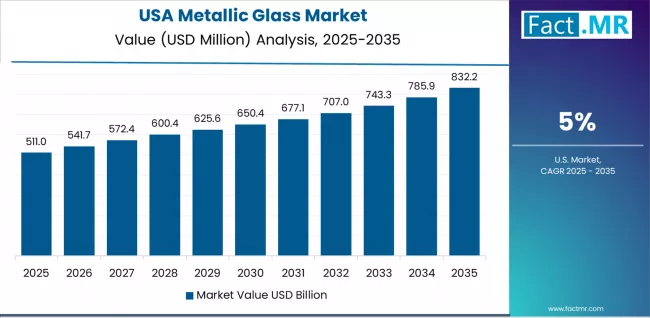
Metallic Glass Market Country Value Analysis | Source: Fact.MR
United States establishes market leadership through comprehensive technology programs and advanced manufacturing infrastructure development, integrating metallic glass across manufacturing and technology applications. The country's 5.0% growth rate reflects established industrial relationships and mature materials technology adoption that supports widespread use of advanced materials in manufacturing and technology facilities. Growth concentrates in major technology centers, including California, Texas, and Michigan, where materials technology showcases mature material deployment that appeals to manufacturers seeking proven performance capabilities and operational efficiency applications.
American equipment providers leverage established distribution networks and comprehensive service capabilities, including engineering support programs and technical services that create customer relationships and operational advantages. The market benefits from mature industry standards and manufacturing requirements that mandate materials use while supporting technology advancement and performance optimization.
Market Intelligence Brief:
- Manufacturing and technology facilities maintaining 87% adoption rate with mature material deployment
- Established industry standards providing consistent demand for materials technology advancement
- Industrial networks capturing 71% market share through technical expertise and performance effectiveness
- Technology integration programs expanding material capabilities in manufacturing scenarios
Germany Shows Technology Leadership
Germany's advanced materials technology market demonstrates sophisticated metallic glass deployment with documented performance effectiveness in manufacturing applications and industrial facilities through integration with existing technology systems and manufacturing infrastructure. The country leverages engineering expertise in materials technology and manufacturing systems integration to maintain a 5.2% growth rate.
Industrial centers, including Bavaria, North Rhine-Westphalia, and Baden-Württemberg, showcase premium installations where material systems integrate with comprehensive manufacturing platforms and facility management systems to optimize production operations and performance effectiveness.
German manufacturers prioritize material precision and EU compliance in materials equipment development, creating demand for premium systems with advanced features, including manufacturing monitoring integration and automated processing systems.
The market benefits from established materials technology infrastructure and a willingness to invest in advanced manufacturing technologies that provide long-term performance benefits and compliance with international industrial standards.
Market Intelligence Brief:
- Engineering focuses on EU standardization and quality compliance, driving premium segment growth
- Materials technology partnerships providing 22% faster development cycles
- Technology collaboration between German manufacturers and international industrial companies
- Facility training programs expanding material system integration in manufacturing scenarios
Brazil Shows Strong Regional Leadership
Brazil's market expansion benefits from diverse industrial demand, including manufacturing modernization in São Paulo and Rio Grande do Sul, industrial facility upgrades, and government industrial programs that increasingly incorporate materials solutions for manufacturing optimization applications.
The country maintains a 5.4% growth rate, driven by rising industrial activity and increasing recognition of materials technology benefits, including effective performance enhancement and improved manufacturing outcomes.
Market dynamics focus on cost-effective materials solutions that balance advanced performance characteristics with affordability considerations important to Brazilian industrial operators. Growing industrial development creates continued demand for modern materials in new facility infrastructure and manufacturing modernization projects.
Strategic Market Considerations:
- Manufacturing and technology segments leading growth with focus on performance optimization and industrial excellence applications
- Regional industrial requirements driving a diverse product portfolio from basic materials to advanced systems
- Import dependency challenges offset by potential local production partnerships with international manufacturers
- Government industrial initiatives beginning to influence procurement standards and performance requirements
Europe Market Split by Country
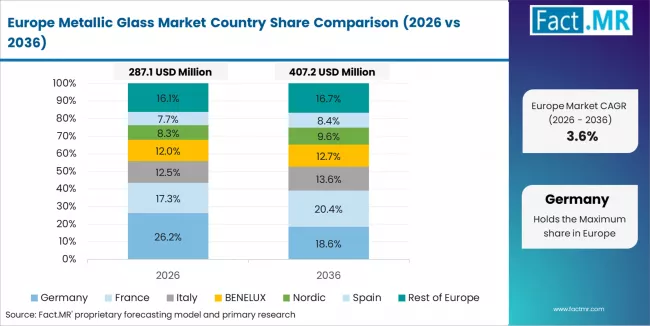
Metallic Glass Market Europe Country Market Share Analysis, 2026 & 2036 | Source: Fact.MR
The European metallic glass market is projected to grow from USD 0.9 billion in 2026 to USD 1.6 billion by 2036, registering a CAGR of 5.2% over the forecast period. Germany is expected to maintain its leadership position with a 21.5% market share in 2026, supported by advanced materials technology infrastructure and major manufacturing centers.
France follows with a 17.2% share in 2026, driven by comprehensive industrial programs and materials technology development initiatives. United Kingdom holds a 16.1% share, supported by specialized technology applications and manufacturing excellence requirements.
Italy commands a 14.0% share, while Spain accounts for 11.8% in 2026. The Rest of Europe region is anticipated to gain momentum, holding 19.4% in 2026, increasing slightly to 19.6% by 2036, attributed to rising industrial adoption in Nordic countries and emerging manufacturing facilities implementing technology modernization programs.
Competitive Landscape of the Metallic Glass Market
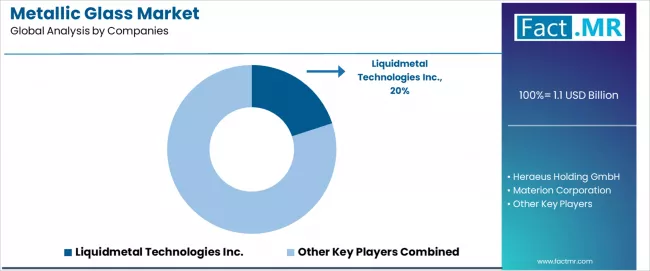
Metallic Glass Market Analysis By Company | Source: Fact.MR
- Structure: ~10-15 credible players; top 3-5 hold ~60-70% by revenue.
- Leadership is maintained through: technical expertise, application engineering, and technology innovation (performance + processing + application development).
- What's commoditizing: basic material compositions and standard processing techniques.
- Margin Opportunities: application engineering services, custom development, and integration into manufacturing workflows (processing equipment, quality systems).
| Stakeholder | What they actually control | Typical strengths | Typical blind spots |
|---|---|---|---|
| Global platforms | Distribution reach, comprehensive material portfolios, technical networks | Broad availability, proven material effectiveness, multi-region support | Technology refresh cycles; customer application dependency |
| Technology innovators | R&D capabilities; advanced material systems; clean processing interfaces | Latest features first; attractive ROI on performance enhancement | Service density outside core regions; customization complexity |
| Regional specialists | Local manufacturing compliance, fast delivery, nearby technical support | "Close to customer" support; pragmatic pricing; local regulations | Technology gaps; talent retention in service |
| Service-focused ecosystems | Application engineering, processing support, quality assurance | Lowest application failures; comprehensive customer support | Service costs if overpromised; technology obsolescence |
| Application specialists | Industry-specific solutions, custom development, research collaboration | Win specialized applications; flexible material solutions | Scalability limitations; narrow market focus |
Source: Fact.MR analysis. Updated Mar 25, 2026
Key Players in the Metallic Glass Market
- Liquidmetal Technologies Inc.
- Heraeus Holding GmbH
- Materion Corporation
- Hitachi Metals Ltd.
- Vitreloy Technologies LLC
- Glassimetal Technology Inc.
- Dongguan Yihao Metal Materials Co., Ltd.
- Amorphous Technologies International
- Exmet AB
- Inductotherm Group
- NanoAmor Inc.
- China Amorphous Alloy Co., Ltd.
- Advanced Science Materials LLC
- LAM Research Corporation
- EonCoat LLC
Bibliography
- Liquidmetal Technologies Inc. (2024). Annual report: Amorphous alloy product portfolio and licensing revenue. Liquidmetal.
- Heraeus Holding GmbH. (2024). Amorphous metals product catalogue: Precision components. Heraeus.
- Materion Corporation. (2024). Advanced materials: Metallic glass alloy specifications. Materion.
- U.S. DARPA. (2024). Structural Amorphous Metals programme: Summary report. Defense Advanced Research Projects Agency.
- Samsung Electronics. (2024). Patent filing: Amorphous alloy hinge mechanism for foldable devices. Samsung.
- Hitachi Metals Ltd. (2024). Technical specifications: Iron-based amorphous alloy materials. Hitachi Metals.
This bibliography is provided for reader reference. The full Fact.MR report contains the complete reference list with primary research documentation.
This Report Addresses
- Market sizing and quantitative forecast metrics detailing the precise expenditure dedicated to metallic glass across major industrial sectors through 2036.
- Segmentation analysis mapping the adoption patterns of specific material type categories and evaluating the technical and economic factors driving segment share distribution.
- Regional deployment intelligence comparing growth trajectories across Asia Pacific, North America, Europe, Latin America, and Middle East and Africa.
- Regulatory compliance assessment analyzing how evolving standards and policies affect product specifications and market access in key consuming regions.
- Competitive posture evaluation tracking the positioning of leading producers and the structural factors determining competitive advantage.
- Capital investment strategic guidance defining the procurement and capacity planning considerations for industry participants.
- Supply chain risk analysis identifying the specific feedstock, logistics, and regulatory variables that constrain market expansion.
- Custom data delivery formats encompassing interactive dashboards, raw Excel datasets, and PDF narrative reports.
Metallic Glass Market Definition
Metallic glass, also known as amorphous metal, is a solid metallic alloy with a disordered, non-crystalline atomic structure produced by rapid cooling of molten alloy at rates exceeding 1,000 degrees Celsius per second. This amorphous structure imparts properties not achievable in crystalline metals: twice the elastic limit of steel, high hardness (500 to 600 HV), excellent corrosion resistance, and near-perfect surface finish from casting. Commercial compositions include zirconium-based (Vitreloy), copper-based, iron-based, and palladium-based alloy systems.
Metallic Glass Market Inclusions
Market scope covers global and regional revenue for metallic glass across bulk metallic glass, sheet/thin film, and other material forms. Application segments include electronics, medical devices, sports/consumer goods, and aerospace/defence. The forecast period is 2026 to 2036.
Metallic Glass Market Exclusions
The scope excludes conventional amorphous magnetic alloys (Metglas) used in transformer cores and power electronics, unless manufactured as metallic glass components for end-use applications. Crystalline metal alloys, metallic foams, and metal matrix composites fall outside the boundary.
Metallic Glass Market Research Methodology
- Primary Research: Analysts engaged with procurement specialists, process engineers, and supply chain directors across producing and consuming regions to map the specific decision criteria triggering purchasing and specification changes.
- Desk Research: Data collection aggregated regulatory filings, trade body publications, standards body documentation, and company disclosures relevant to the product category.
- Market-Sizing and Forecasting: Baseline values derive from a bottom-up aggregation of production volumes and trade flows, applying region-specific demand curves to project adoption velocity through 2036.
- Data Validation and Update Cycle: Projections are tested against publicly reported industry expenditure guidance and cross-referenced with primary interview data to ensure internal consistency.
Segmentation
Scope of the Report
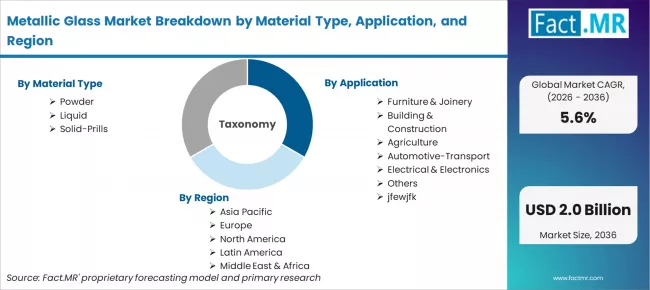
Metallic Glass Market Breakdown By Material Type, Application, And Region | Source: Fact.MR
| Metric | Value |
|---|---|
| Quantitative Units | USD 1.16 billion to USD 2.00 billion, at a CAGR of 5.6% |
| Market Definition | Metallic glass, also known as amorphous metal, is a solid metallic alloy with a disordered, non-crystalline atomic structure produced by rapid cooling of molten alloy at rates exceeding 1,000 degrees Celsius per second. This amorphous structure imparts properties not achievable in crystalline metals: twice the elastic limit of steel, high hardness (500 to 600 HV), excellent corrosion resistance, and near-perfect surface finish from casting. |
| Material Type Segmentation | Bulk Metallic Glass, Sheet/Thin Film, Others |
| Application Segmentation | Electronics, Medical Devices, Sports/Consumer Goods, Aerospace/Defense |
| Regions Covered | North America, Latin America, Europe, East Asia, South Asia, Oceania, Middle East & Africa |
| Countries Covered | India, China, USA, Germany, Brazil, Europe, and 40 plus countries |
| Key Companies Profiled | Liquidmetal Technologies Inc., Heraeus Holding GmbH, Materion Corporation, Hitachi Metals Ltd., Vitreloy Technologies LLC, Glassimetal Technology Inc., Dongguan Yihao Metal Materials Co., Ltd., Amorphous Technologies International, Exmet AB, Inductotherm Group, NanoAmor Inc., China Amorphous Alloy Co., Ltd., Advanced Science Materials LLC, LAM Research Corporation, EonCoat LLC |
| Forecast Period | 2026 to 2036 |
| Approach | Hybrid top-down and bottom-up methodology reconciling production, trade, and consumption data with primary research validation. |
Source: Fact.MR analysis. Updated Mar 25, 2026
Metallic Glass Market by Segments
-
Material Type:
- Bulk Metallic Glass
- Sheet/Thin Film
- Others
-
Application:
- Electronics
- Medical Devices
- Sports/Consumer Goods
- Aerospace/Defense
-
Region:
- North America
- United States
- Canada
- Mexico
- Latin America
- Brazil
- Chile
- Rest of Latin America
- Western Europe
- Germany
- United Kingdom
- France
- Italy
- Spain
- Nordic
- BENELUX
- Rest of Western Europe
- Eastern Europe
- Russia
- Poland
- Rest of Eastern Europe
- East Asia
- China
- Japan
- South Korea
- South Asia Pacific
- India
- ASEAN
- Australia & New Zealand
- Rest of South Asia Pacific
- Middle East & Africa
- Kingdom of Saudi Arabia
- Other GCC Countries
- Turkey
- South Africa
- Other African Union
- Rest of Middle East & Africa
- North America
Frequently Asked Questions
How large is the demand for Metallic Glass in the global market in 2026?
What will be the market size of Metallic Glass in the global market by 2036?
What is the expected demand growth for Metallic Glass in the global market between 2026 and 2036?
Which Material Type is poised to lead global sales by 2026?
How is the Application segment structured in this report?
What is the growth outlook for India in this report?
What is Metallic Glass and what is it mainly used for?
How does Fact.MR build and validate the Metallic Glass forecast?
Who worked on this report


Preview the report firsthand - request a free sample
Free SampleGet the brochure for pricing and purchase details
Download PDF