Micro Gas Cylinder Market Size, Share, Growth and Forecast (2026 - 2036)

The Micro Gas Cylinder Market is segmented by Gas Type (Carbon dioxide, Nitrogen, Nitrous Oxide, Argon, Gas Mixture, Others); by Volume (Up to 10 ml, 11 to 20 ml, 21 to 40 ml, 41 to 70 ml, 71 to 100 ml, Above 100 ml); by Usability (Reusable, Disposable); by Application (Fire Protection Equipment, Life Saving Equipment, Medical Devices, Sports Equipment, Beverage Carbonation, Research & Analytics); by End User (Medical Device Manufacturers, Beverage System Suppliers, Safety Equipment Producers, Sports Equipment Brands, Laboratory Instrument Firms). Forecast for 2026 to 2036.

Micro Gas Cylinder Market Size, Market Forecast and Outlook by Fact.MR

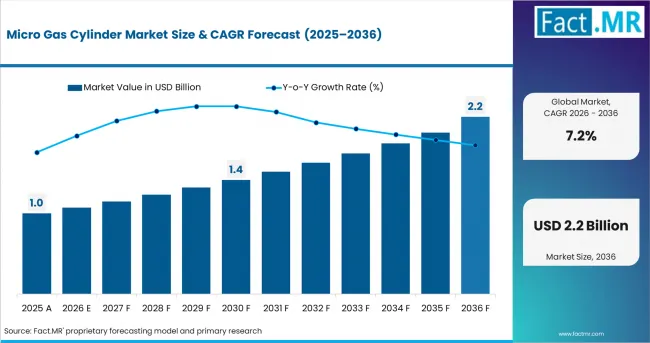
  • The micro gas cylinder market crossed a valuation of USD 1.0 billion in 2025.
  • Demand is estimated to reach USD 1.1 billion in 2026 and is projected to rise to USD 2.2 billion by 2036.
  • The market is forecast to record 7.2% CAGR from 2026 to 2036 as compact devices and controlled gas release applications support demand.
Micro Gas Cylinder Market Value Analysis

Metric Details
Industry Size (2026) USD 1.1 billion
Industry Value (2036) USD 2.2 billion
CAGR (2026 to 2036) 7.2%

Summary of Micro Gas Cylinder Market

  • Demand Drivers in the Market
    • Device Miniaturization: Medical device designers need compact cylinders that release gas reliably. This supports demand for small sealed formats.
    • Beverage Carbonation: Beverage system suppliers need CO₂ cartridges for tabletop and portable dispensing systems. This keeps carbon dioxide cylinders important.
    • Safety Readiness: Lifesaving equipment makers need lightweight pressure sources. Fast gas release supports emergency inflation and rescue use.
  • Key Segments Analyzed
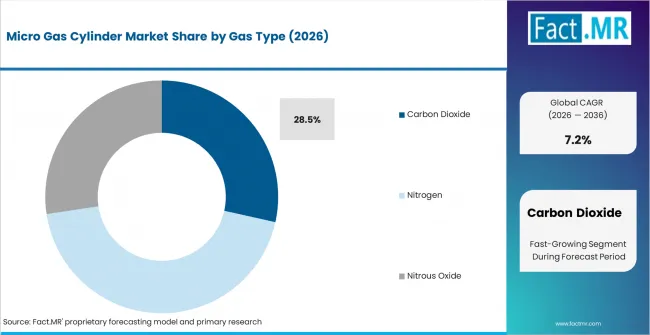
    • By Gas Type: Carbon dioxide micro gas cylinders are projected to record 28.5% share in 2026 as beverage carbonation and safety equipment create repeat demand.
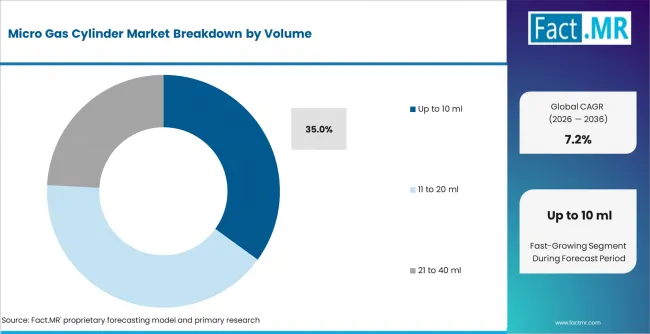
    • By Volume: Up to 10 ml cylinders lead because compact devices need small sealed gas sources. The volume range is estimated to hold 35.0% share in 2026.
    • By Usability: Disposable cylinders are projected to account for 57.0% share in 2026 because single-use cartridges reduce refill handling and contamination risk.
    • By Application: Medical devices lead because portable systems need precise gas release. The application is expected to hold 26.5% share in 2026.
    • By End User: Medical device manufacturers are anticipated to represent 30.0% share in 2026 because drug delivery and portable care systems need reliable miniature gas storage.
    • By Geography: China micro gas cylinder demand is forecast to grow at 7.1% CAGR from 2026 to 2036 as healthcare expansion and compact equipment use increase.
  • Analyst Opinion at Fact.MR
    • Shambhu Nath Jha, Senior Analyst at Fact.MR, notes, “Micro gas cylinders are becoming engineered components inside critical devices. Buyers are less focused on size alone. They want leak control, actuation reliability and compliance proof. Suppliers that validate cylinder behavior inside the final product will gain stronger design-in positions.”
  • Strategic Implications
    • Seal Reliability: Cylinder suppliers need stronger leak testing and shelf-life proof. Weak sealing can cause device failure before use.
    • Application Fit: Device makers should test cylinders under real release conditions. Lab results may not match field use.
    • Compliance Depth: Manufacturers need standards-ready designs and clear documentation. Poor certification support can delay product approvals.

Micro gas cylinders are used in products that need a small sealed gas source. Demand is rising because these cylinders support quick inflation and compact device operation. Safety and compliance remain important because leakage or pressure failure can affect product performance.

China is forecast to grow at 7.1% CAGR from 2026 to 2036 as healthcare expansion and compact equipment demand improve. United States demand is set to rise at 7.0% CAGR through medical devices and clean energy applications. South Korea is projected to record 6.8% CAGR as electronics and portable equipment use expands. Germany follows at 6.7% CAGR through industrial gas systems and safety equipment demand. Japan is likely to post 6.5% CAGR by 2036 as precision devices support smaller gas storage formats.

Segmental Analysis

Micro Gas Cylinder Market Analysis by Gas Type
Micro Gas Cylinder Market Analysis By Gas Type

Carbon dioxide micro gas cylinders are projected to hold 28.5% share in 2026 because CO₂ is widely used for carbonation and controlled gas release. Nitrogen supports inert gas use and device actuation. Nitrous oxide is used in selected medical and food applications. CO₂ leads because it fits beverage systems and selected safety devices. CreamRight stated in January 2026 that CO₂ cartridges should be used only with carbonation tools because gas cartridges are not interchangeable. [1] Wrong gas selection can create pressure mismatch and product performance risk.

  • CO₂ Utility: Carbon dioxide supports carbonation and inflation use. Suppliers gain when cartridge compatibility is clear.
  • Nitrogen Stability: Nitrogen supports inerting and actuation. Device makers use it when clean release matters.
  • Specialty Mixtures: Gas mixtures serve precise applications. Buyers need tighter specifications before qualification.

Micro Gas Cylinder Market Analysis by Volume
Micro Gas Cylinder Market Analysis By Volume

Compact device design supports smaller cylinders because space and weight are limited. The up to 10 ml range is estimated to hold 35.0% share in 2026 as medical and precision devices require small gas sources. Larger cylinders serve beverage and safety equipment that use more gas. Smaller formats lead because they fit tight medical and electronic designs. Oversized cylinders can add weight and make product integration harder.

  • Small Format: Up to 10 ml cylinders support compact device design. Smaller size helps reduce product weight.
  • Mid-Range Use: 21 to 40 ml cylinders fit portable tools and selected safety systems. They balance capacity and handling.
  • Larger Cartridges: Above 100 ml units support higher gas output. They suit applications that need longer release duration.

Micro Gas Cylinder Market Analysis by Usability
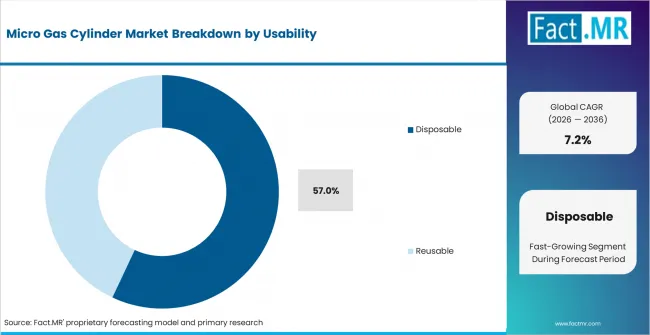
Micro Gas Cylinder Market Analysis By Usability

Disposable cylinders are projected to account for 57.0% share in 2026 because many compact systems need clean and single-use gas sources. Reusable cylinders remain important in applications with controlled refill and inspection. Disposable formats lead because they reduce refill needs and lower contamination risk. BCGA stated in January 2025 that non-refillable cylinders must not be refilled after use and must be disposed of responsibly. [2] This makes compliance important for single-use products. Reusable formats appeal when service access and sustainability goals matter.

  • Single-Use Control: Disposable cylinders reduce refill handling. Medical and safety devices benefit from sealed readiness.
  • Reusable Value: Reusable cylinders lower repeated cartridge waste. They require inspection and safe refill handling.
  • Seal Testing: Usability choice depends on leak behavior. Poor sealing can weaken both disposable and reusable formats.

Micro Gas Cylinder Market Analysis by Application
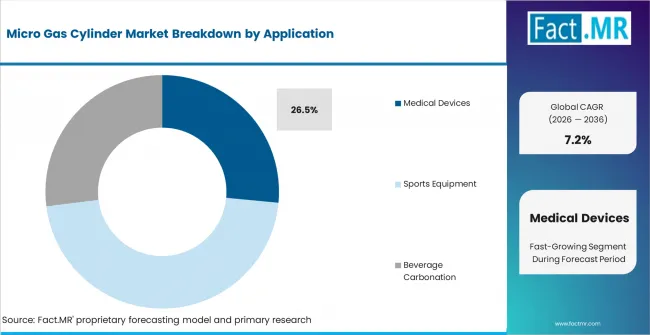
Micro Gas Cylinder Market Analysis By Application

Medical devices lead because portable care systems and drug delivery products need precise gas release. Beverage carbonation remains a large use area for CO₂ cartridges. Fire protection and life-saving equipment use micro cylinders for fast actuation and inflation. Sports equipment uses small gas sources for inflation and compressed-air functions. Medical devices are expected to hold 26.5% share in 2026 because compact medical products need reliable pressure and controlled force. Medical-grade cylinders gain value as safety standards increase. Poor release consistency can affect patient use.

  • Device Actuation: Medical devices need predictable gas release. Unstable output can affect dose or delivery timing.
  • Carbonation Use: Beverage systems need CO₂ cartridges for dispensing. Compatibility and food-grade assurance matter.
  • Rescue Inflation: Life saving equipment uses cylinders for fast inflation. Low weight and release speed define product value.

Micro Gas Cylinder Market Analysis by End User
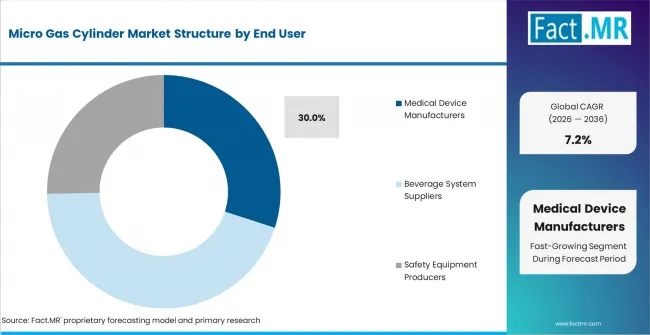
Micro Gas Cylinder Market Analysis By End User

Medical device manufacturers are expected to hold 30.0% share in 2026 because drug delivery and portable care systems need compact gas storage. Beverage system suppliers create steady demand for CO₂ cartridges. Safety equipment producers use cylinders in life jackets and emergency systems. Sports equipment brands use small gas sources for inflation and air-powered products. Medical device manufacturers lead because cylinder performance must be built into the product design early. FDA stated in December 2025 that medical gas manufacturers must follow medical gas-specific CGMP rules under 21 CFR Part 213 from December 18, 2025. [3] Late cylinder selection can cause redesign and validation delays.

  • Medical OEMs: Device manufacturers need validated cylinder integration. Early qualification reduces redesign risk.
  • Beverage Suppliers: Beverage equipment firms need stable CO₂ cartridge supply. Food-contact and compatibility checks matter.
  • Safety Producers: Rescue equipment makers need compact and reliable inflation sources. Failure risk raises qualification burden.

Micro Gas Cylinder Market Drivers, Restraints, and Opportunities
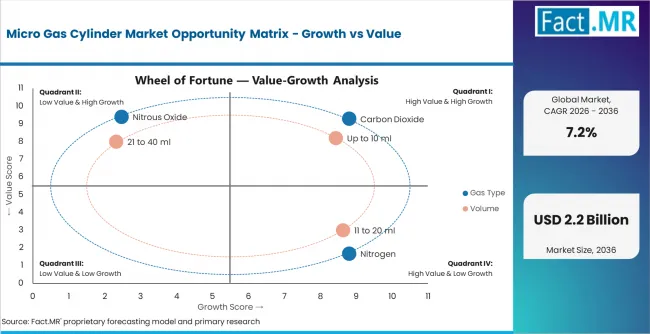
Micro Gas Cylinder Market Opportunity Matrix Growth Vs Value

Compact device use and portable gas storage are the main demand drivers. Micro gas cylinders support controlled pressure in small products where batteries or large tanks may not work well. Demand depends on the pressure needs of each application.

Material cost and regulatory compliance remain the main restraints. Micro cylinders need precise manufacturing and safe sealing. Medical and safety uses require stronger documentation. Custom sizes or special release systems can raise costs.

Opportunities in the Micro Gas Cylinder Market

  • Gas-Powered Drug Delivery: Medical device firms can use compact cylinders for controlled actuation.
  • Beverage Cartridge Expansion: CO₂ cartridges can support countertop carbonation and portable beverage systems.
  • Safety Equipment Integration: Life jackets, rescue systems and fire equipment need compact gas release.

Regional Analysis

Based on regional analysis, the micro gas cylinder market is segmented into North America, Latin America, Western Europe, Eastern Europe, East Asia, South Asia and Pacific, and Middle East and Africa.

Top Country Growth Comparison Micro Gas Cylinder Market Cagr (2026 2036)

Country CAGR
China 7.1%
United States 7.0%
South Korea 6.8%
Germany 6.7%
Japan 6.5%

Source: Fact.MR analysis based on forecast model and primary research.
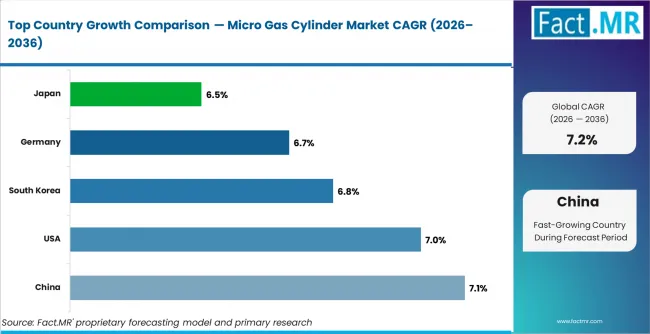
Micro Gas Cylinder Market Cagr Analysis By Country

East Asia Micro Gas Cylinder Market Analysis

East Asia demand comes from electronics and compact gas equipment use. China leads because medical infrastructure expansion and manufacturing scale support cylinder adoption. South Korea adds demand through precision devices and electronics-linked applications. Japan supports high-reliability demand through medical and safety equipment design.

  • China: China is forecast to grow at 7.1% CAGR from 2026 to 2036 as healthcare expansion and compact equipment demand improve. Medical device suppliers need sealed gas cylinders for portable oxygen systems and specialty instruments. Manufacturing scale supports local supply development. Device makers will prefer suppliers that can meet pressure and certification requirements without delaying device launch.
  • South Korea: Electronics and precision equipment production support micro gas cylinder demand in South Korea. Device makers need small gas sources with predictable release behavior. Micro gas cylinder demand in South Korea is forecast to grow at 6.8% CAGR from 2026 to 2036. Suppliers with tight tolerance control and application support can gain better access. Quality matters more than basic cartridge supply.
  • Japan: Compact device makers support micro gas cylinder demand in Japan. Medical and emergency equipment applications need safe and reliable gas release. The market is forecast to grow at 6.5% CAGR over the study period. Product developers will prefer cylinders with documented leak control and validated release systems. Suppliers with strong technical support can protect premium demand.

North America Micro Gas Cylinder Market Analysis
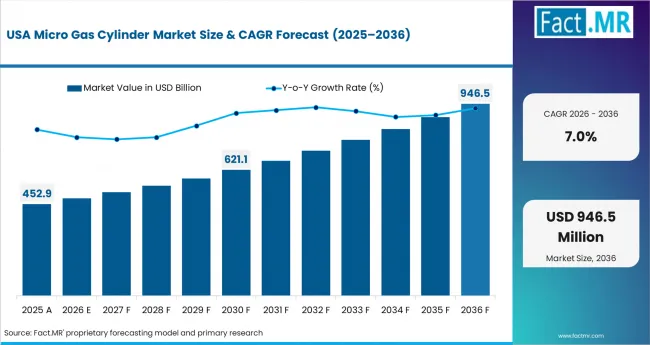
Micro Gas Cylinder Market Country Value Analysis

North America demand is supported by medical device innovation and safety equipment requirements. The United States leads because device companies and industrial gas users need reliable miniature cylinders. Regulatory expectations and product liability risk keep supplier qualification important. Demand will favor cylinders with strong documentation and proven shelf life.

  • United States: Medical devices and emergency equipment support micro gas cylinder demand in the United States. The market is forecast to grow at 7.0% CAGR over the forecast period. Clean energy applications add demand through compact gas storage needs. Suppliers with medical-grade documentation and application testing can gain better design-in opportunities.

Western Europe Micro Gas Cylinder Market Analysis
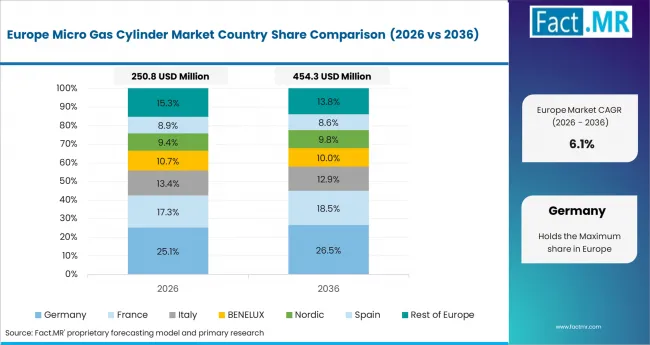
Micro Gas Cylinder Market Europe Country Market Share Analysis, 2026 & 2036

Western Europe demand comes from safety standards and medical gas compliance. Germany leads regional demand because industrial gas systems and safety equipment producers require consistent cylinder performance. European buyers tend to place strong weight on standards conformity and supplier traceability.

  • Germany: Germany is forecast to grow at 6.7% CAGR from 2026 to 2036 through industrial gas systems and safety equipment demand. Equipment makers need small cylinders that meet strict design and testing rules. Suppliers with quality control and documented testing can gain better demand from German OEMs.

Competitive Aligners for Market Players
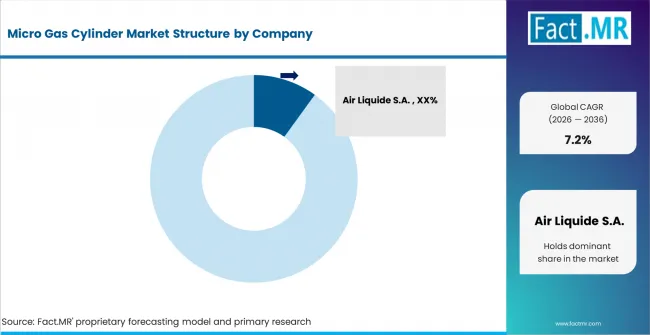
Micro Gas Cylinder Market Analysis By Company

The micro gas cylinder market includes precision cylinder manufacturers and application-specific component firms. Air Liquide S.A. supports demand through gas supply and cylinder solutions. Luxfer Gas Cylinders provides lightweight gas cylinders for medical and industrial use. Worthington Enterprises, Inc. supplies pressure cylinders and portable gas storage products. MOSA Industrial Corporation supports high-pressure cylinder technology for mobility and clean energy applications. ISi GmbH provides steel cylinders for industrial and specialty gas use.

Supplier strength through 2036 will depend on qualification depth. Medical device firms need proof of leak control. Beverage system suppliers require stable cartridge compatibility. Safety equipment producers need fast release and reliable storage. Companies with precise manufacturing and clear compliance documents can protect repeat demand.

Key Players in Micro Gas Cylinder Market

  • Air Liquide S.A.
  • Luxfer Gas Cylinders
  • Worthington Enterprises, Inc.
  • MOSA Industrial Corporation
  • ISi GmbH

Bibliography

  • [1] CreamRight. (2026, January 13). N₂O vs. N₂ vs. CO₂ cartridges: What’s the difference and when to use each.
  • [2] British Compressed Gases Association. (2025, January 1). Cylinder recovery and disposal.
  • [3] Food and Drug Administration. (2025, December 1). Medical gases-current good manufacturing practice; draft guidance for industry; availability. Federal Register.
  • [4] Pipeline and Hazardous Materials Safety Administration. (2024, June 6). Hazardous materials: Request for feedback on tare weight marking policy for cylinders. U.S. Department of Transportation.

This Report Addresses

  • Strategic intelligence on micro gas cylinder demand across medical devices and beverage systems.
  • Growth opportunity mapping across China and the United States plus Germany and India.
  • Segment analysis by gas type, volume, usability, application and end user.
  • Regional outlook covering compact gas storage, medical device use and safety equipment demand.
  • Competitive analysis of Air Liquide S.A., Luxfer Gas Cylinders, Worthington Enterprises, Inc., MOSA Industrial Corporation, ISi GmbH.
  • Product assessment covering carbon dioxide cylinders, up to 10 ml formats and disposable cylinders.
  • Market forecast built from Fact.MR’s baseline model with a revised 2026 to 2036 CAGR.
  • Primary interviews, supplier checks and gas cylinder standards review support validation.

Micro Gas Cylinder Market Definition

The micro gas cylinder market covers small gas-filled cylinders used to store and release gases in compact systems. The scope includes carbon dioxide and specialty gas mixtures. These cylinders serve medical devices and safety systems. The market differs from industrial gas cylinders because size and controlled release define product value.

Micro Gas Cylinder Market Inclusions

The scope includes refillable and disposable micro gas cylinders used in portable equipment. Cylinders up to 10 ml and above 100 ml are counted. Applications in fire protection and beverage carbonation are included. Cylinders sold with safety caps and release systems are covered if the cylinder remains the primary gas storage component.

Micro Gas Cylinder Market Exclusions

The scope excludes large industrial gas cylinders used for bulk storage. LPG cooking cylinders and vehicle fuel tanks are outside scope. Aerosol cans are excluded unless they use a distinct micro cylinder as a gas source. Gas regulators are excluded when sold without cylinders. Laboratory gas systems are excluded if they use central supply rather than compact cylinder formats.

Micro Gas Cylinder Market Research Methodology

  • Primary Research
    • Primary research includes interviews with medical device design heads and gas cartridge procurement managers. Beverage equipment suppliers were reviewed for CO₂ cartridge needs. Safety equipment producers were checked for pressure and certification requirements.
  • Desk Research
    • Desk research reviewed gas cylinder standards and medical gas compliance sources. Company product pages supported cylinder type validation. Hydrogen storage and safety references helped review emerging compact gas storage use cases.
  • Market-Sizing and Forecasting
    • Forecasting uses gas type demand and volume range adoption. Usability estimates reflect disposable cartridge use and refillable system adoption. Application demand is linked to medical devices and sports products.
  • Data Validation and Update Cycle
    • Forecasts were validated through supplier checks and safety standard review. Regional assumptions were reviewed with healthcare expansion and compact equipment demand. Company evidence supported competitive positioning and product scope.

Scope of the Report

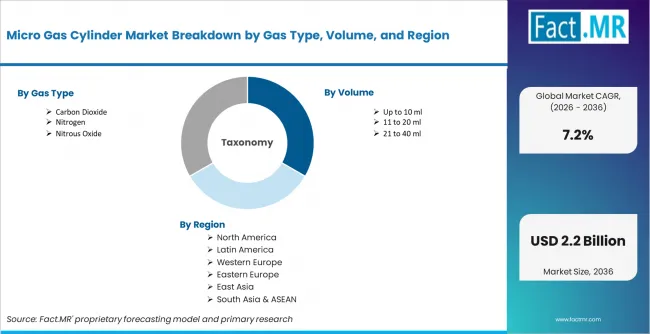
Micro Gas Cylinder Market Breakdown By Gas Type, Volume, And Region

Attribute Details
Quantitative Units USD 1.1 billion in 2026 to USD 2.2 billion by 2036 at 7.2% CAGR
Market Definition Small gas-filled cylinders used to store and release compressed or liquefied gases in compact systems.
Gas Type Carbon dioxide, Nitrogen, Nitrous Oxide, Argon, Gas Mixture, Others
Volume Up to 10 ml, 11 to 20 ml, 21 to 40 ml, 41 to 70 ml, 71 to 100 ml, Above 100 ml
Usability Reusable, Disposable
Application Fire Protection Equipment, Life Saving Equipment, Medical Devices, Sports Equipment, Beverage Carbonation, Research & Analytics
End User Medical Device Manufacturers, Beverage System Suppliers, Safety Equipment Producers, Sports Equipment Brands, Laboratory Instrument Firms
Regions Covered North America, Latin America, Western Europe, Eastern Europe, East Asia, South Asia and Pacific, Middle East and Africa
Countries Covered China, United States, South Korea, Germany, Japan, India, United Kingdom
Key Companies Profiled Air Liquide S.A., Luxfer Gas Cylinders, Worthington Enterprises, Inc., MOSA Industrial Corporation, ISi GmbH
Forecast Period 2026 to 2036
Approach Hybrid top-down and bottom-up model using gas type demand, volume range adoption, application use and supplier validation.

Micro Gas Cylinder Market Analysis by Segments

  • By Gas Type:

    • Carbon dioxide
    • Nitrogen
    • Nitrous Oxide
    • Argon
    • Gas Mixture
    • Others
  • By Volume:

    • Up to 10 ml
    • 11 to 20 ml
    • 21 to 40 ml
    • 41 to 70 ml
    • 71 to 100 ml
    • Above 100 ml
  • By Usability:

    • Reusable
    • Disposable
  • By Application:

    • Fire Protection Equipment
    • Life Saving Equipment
    • Medical Devices
    • Sports Equipment
    • Beverage Carbonation
    • Research & Analytics
  • By End User:

    • Medical Device Manufacturers
    • Beverage System Suppliers
    • Safety Equipment Producers
    • Laboratory Instrument Firms
  • Region:

    • North America
      • United States
      • Canada
    • Western Europe
      • Germany
      • United Kingdom
      • France
      • Italy
      • East Asia
      • China
      • Japan
      • South Korea
    • South Asia and Pacific
      • India
      • Australia
      • ASEAN
      • Latin America
      • Brazil
      • Mexico
    • Middle East and Africa
      • GCC Countries
      • South Africa

- Frequently Asked Questions -

How large is the micro gas cylinder market in 2025?

The micro gas cylinder market was valued at USD 1.0 billion in 2025.

What is the expected value of the micro gas cylinder market in 2026?

The micro gas cylinder market is estimated to reach USD 1.1 billion in 2026.

What is the forecast value of the micro gas cylinder market by 2036?

The micro gas cylinder market is forecast to reach USD 2.2 billion by 2036 as compact gas storage demand expands.

What CAGR is projected for the micro gas cylinder market from 2026 to 2036?

Fact.MR forecast projects 7.20% CAGR for the micro gas cylinder market from 2026 to 2036.

Which gas type leads the micro gas cylinder market?

Carbon dioxide leads with 28.5% share in 2026 because beverage carbonation and safety equipment create repeat demand.

Why do carbon dioxide micro gas cylinders lead demand?

Carbon dioxide cylinders lead because CO₂ supports carbonation, inflation and selected safety applications.

Which volume range leads the micro gas cylinder market?

Up to 10 ml cylinders lead with 35.0% share in 2026 because compact devices need smaller gas sources.

Which usability type leads the micro gas cylinder market?

Disposable cylinders lead with 57.0% share in 2026 because sealed single-use formats reduce refill handling and contamination risk.

Which application leads the micro gas cylinder market?

Medical devices lead with 26.5% share in 2026 because portable systems need precise gas release.

Which end user leads the micro gas cylinder market?

Medical device manufacturers lead with 30.0% share in 2026 because drug delivery and portable care systems need miniature gas storage.

Which country grows fastest in the micro gas cylinder market?

China is forecast to grow fastest at 7.1% CAGR from 2026 to 2036.

Why is the United States important in the micro gas cylinder market?

The United States is important because medical devices and clean energy applications support compact gas storage demand.

Why does South Korea support micro gas cylinder demand?

South Korea supports demand through precision devices and electronics-linked applications.

Why does Germany support micro gas cylinder demand?

Germany supports demand through industrial gas systems and safety equipment production.

Why does India support micro gas cylinder demand?

India supports demand through medical device growth and beverage dispensing applications.

What drives micro gas cylinder market demand?

Device miniaturization, beverage carbonation and safety equipment demand drive micro gas cylinder use.

What restrains micro gas cylinder market demand?

Material cost and regulatory compliance restrain adoption because cylinders require precision manufacturing and safety documentation.

How do micro gas cylinders support medical devices?

Micro gas cylinders support device actuation and portable gas delivery in compact medical systems.

How do micro gas cylinders support beverage carbonation?

Micro gas cylinders supply CO₂ for carbonation and dispensing in small beverage systems.

What is included in the micro gas cylinder market scope?

The scope includes small cylinders for carbon dioxide, nitrogen, nitrous oxide, argon and gas mixtures.

What is excluded from the micro gas cylinder market scope?

Large industrial cylinders, LPG cooking cylinders and central gas supply systems are excluded.

How does Fact.MR forecast micro gas cylinder demand?

Fact.MR forecasts demand using gas type demand, volume range adoption, application use and supplier validation.

Table of Content

  1. Executive Summary
    • Global Market Outlook
    • Demand to side Trends
    • Supply to side Trends
    • Technology Roadmap Analysis
    • Analysis and Recommendations
  2. Market Overview
    • Market Coverage / Taxonomy
    • Market Definition / Scope / Limitations
  3. Research Methodology
    • Chapter Orientation
    • Analytical Lens and Working Hypotheses
      • Market Structure, Signals, and Trend Drivers
      • Benchmarking and Cross-market Comparability
      • Market Sizing, Forecasting, and Opportunity Mapping
    • Research Design and Evidence Framework
      • Desk Research Programme (Secondary Evidence)
        • Company Annual and Sustainability Reports
        • Peer-reviewed Journals and Academic Literature
        • Corporate Websites, Product Literature, and Technical Notes
        • Earnings Decks and Investor Briefings
        • Statutory Filings and Regulatory Disclosures
        • Technical White Papers and Standards Notes
        • Trade Journals, Industry Magazines, and Analyst Briefs
        • Conference Proceedings, Webinars, and Seminar Materials
        • Government Statistics Portals and Public Data Releases
        • Press Releases and Reputable Media Coverage
        • Specialist Newsletters and Curated Briefings
        • Sector Databases and Reference Repositories
        • Fact.MR Internal Proprietary Databases and Historical Market Datasets
        • Subscription Datasets and Paid Sources
        • Social Channels, Communities, and Digital Listening Inputs
        • Additional Desk Sources
      • Expert Input and Fieldwork (Primary Evidence)
        • Primary Modes
          • Qualitative Interviews and Expert Elicitation
          • Quantitative Surveys and Structured Data Capture
          • Blended Approach
        • Why Primary Evidence is Used
        • Field Techniques
          • Interviews
          • Surveys
          • Focus Groups
          • Observational and In-context Research
          • Social and Community Interactions
        • Stakeholder Universe Engaged
          • C-suite Leaders
          • Board Members
          • Presidents and Vice Presidents
          • R&D and Innovation Heads
          • Technical Specialists
          • Domain Subject-matter Experts
          • Scientists
          • Physicians and Other Healthcare Professionals
        • Governance, Ethics, and Data Stewardship
          • Research Ethics
          • Data Integrity and Handling
      • Tooling, Models, and Reference Databases
    • Data Engineering and Model Build
      • Data Acquisition and Ingestion
      • Cleaning, Normalisation, and Verification
      • Synthesis, Triangulation, and Analysis
    • Quality Assurance and Audit Trail
  4. Market Background
    • Market Dynamics
      • Drivers
      • Restraints
      • Opportunity
      • Trends
    • Scenario Forecast
      • Demand in Optimistic Scenario
      • Demand in Likely Scenario
      • Demand in Conservative Scenario
    • Opportunity Map Analysis
    • Product Life Cycle Analysis
    • Supply Chain Analysis
    • Investment Feasibility Matrix
    • Value Chain Analysis
    • PESTLE and Porter’s Analysis
    • Regulatory Landscape
    • Regional Parent Market Outlook
    • Production and Consumption Statistics
    • Import and Export Statistics
  5. Global Market Analysis 2021 to 2025 and Forecast, 2026 to 2036
    • Historical Market Size Value (USD Million) Analysis, 2021 to 2025
    • Current and Future Market Size Value (USD Million) Projections, 2026 to 2036
      • Y to o to Y Growth Trend Analysis
      • Absolute $ Opportunity Analysis
  6. Global Market Pricing Analysis 2021 to 2025 and Forecast 2026 to 2036
  7. Global Market Analysis 2021 to 2025 and Forecast 2026 to 2036, By Gas Type
    • Introduction / Key Findings
    • Historical Market Size Value (USD Million) Analysis By Gas Type , 2021 to 2025
    • Current and Future Market Size Value (USD Million) Analysis and Forecast By Gas Type , 2026 to 2036
      • Carbon Dioxide
      • Nitrogen
      • Nitrous Oxide
    • Y to o to Y Growth Trend Analysis By Gas Type , 2021 to 2025
    • Absolute $ Opportunity Analysis By Gas Type , 2026 to 2036
  8. Global Market Analysis 2021 to 2025 and Forecast 2026 to 2036, By Volume
    • Introduction / Key Findings
    • Historical Market Size Value (USD Million) Analysis By Volume, 2021 to 2025
    • Current and Future Market Size Value (USD Million) Analysis and Forecast By Volume, 2026 to 2036
      • Up to 10 ml
      • 11 to 20 ml
      • 21 to 40 ml
    • Y to o to Y Growth Trend Analysis By Volume, 2021 to 2025
    • Absolute $ Opportunity Analysis By Volume, 2026 to 2036
  9. Global Market Analysis 2021 to 2025 and Forecast 2026 to 2036, By Usability
    • Introduction / Key Findings
    • Historical Market Size Value (USD Million) Analysis By Usability, 2021 to 2025
    • Current and Future Market Size Value (USD Million) Analysis and Forecast By Usability, 2026 to 2036
      • Disposable
      • Reusable
    • Y to o to Y Growth Trend Analysis By Usability, 2021 to 2025
    • Absolute $ Opportunity Analysis By Usability, 2026 to 2036
  10. Global Market Analysis 2021 to 2025 and Forecast 2026 to 2036, By Application
    • Introduction / Key Findings
    • Historical Market Size Value (USD Million) Analysis By Application, 2021 to 2025
    • Current and Future Market Size Value (USD Million) Analysis and Forecast By Application, 2026 to 2036
      • Medical Devices
      • Sports Equipment
      • Beverage Carbonation
    • Y to o to Y Growth Trend Analysis By Application, 2021 to 2025
    • Absolute $ Opportunity Analysis By Application, 2026 to 2036
  11. Global Market Analysis 2021 to 2025 and Forecast 2026 to 2036, By End User
    • Introduction / Key Findings
    • Historical Market Size Value (USD Million) Analysis By End User, 2021 to 2025
    • Current and Future Market Size Value (USD Million) Analysis and Forecast By End User, 2026 to 2036
      • Medical Device Manufacturers
      • Beverage System Suppliers
      • Safety Equipment Producers
    • Y to o to Y Growth Trend Analysis By End User, 2021 to 2025
    • Absolute $ Opportunity Analysis By End User, 2026 to 2036
  12. Global Market Analysis 2021 to 2025 and Forecast 2026 to 2036, By Region
    • Introduction
    • Historical Market Size Value (USD Million) Analysis By Region, 2021 to 2025
    • Current Market Size Value (USD Million) Analysis and Forecast By Region, 2026 to 2036
      • North America
      • Latin America
      • Western Europe
      • Eastern Europe
      • East Asia
      • South Asia and Pacific
      • Middle East & Africa
    • Market Attractiveness Analysis By Region
  13. North America Market Analysis 2021 to 2025 and Forecast 2026 to 2036, By Country
    • Historical Market Size Value (USD Million) Trend Analysis By Market Taxonomy, 2021 to 2025
    • Market Size Value (USD Million) Forecast By Market Taxonomy, 2026 to 2036
      • By Country
        • USA
        • Canada
        • Mexico
      • By Gas Type
      • By Volume
      • By Usability
      • By Application
      • By End User
    • Market Attractiveness Analysis
      • By Country
      • By Gas Type
      • By Volume
      • By Usability
      • By Application
      • By End User
    • Key Takeaways
  14. Latin America Market Analysis 2021 to 2025 and Forecast 2026 to 2036, By Country
    • Historical Market Size Value (USD Million) Trend Analysis By Market Taxonomy, 2021 to 2025
    • Market Size Value (USD Million) Forecast By Market Taxonomy, 2026 to 2036
      • By Country
        • Brazil
        • Chile
        • Rest of Latin America
      • By Gas Type
      • By Volume
      • By Usability
      • By Application
      • By End User
    • Market Attractiveness Analysis
      • By Country
      • By Gas Type
      • By Volume
      • By Usability
      • By Application
      • By End User
    • Key Takeaways
  15. Western Europe Market Analysis 2021 to 2025 and Forecast 2026 to 2036, By Country
    • Historical Market Size Value (USD Million) Trend Analysis By Market Taxonomy, 2021 to 2025
    • Market Size Value (USD Million) Forecast By Market Taxonomy, 2026 to 2036
      • By Country
        • Germany
        • UK
        • Italy
        • Spain
        • France
        • Nordic
        • BENELUX
        • Rest of Western Europe
      • By Gas Type
      • By Volume
      • By Usability
      • By Application
      • By End User
    • Market Attractiveness Analysis
      • By Country
      • By Gas Type
      • By Volume
      • By Usability
      • By Application
      • By End User
    • Key Takeaways
  16. Eastern Europe Market Analysis 2021 to 2025 and Forecast 2026 to 2036, By Country
    • Historical Market Size Value (USD Million) Trend Analysis By Market Taxonomy, 2021 to 2025
    • Market Size Value (USD Million) Forecast By Market Taxonomy, 2026 to 2036
      • By Country
        • Russia
        • Poland
        • Hungary
        • Balkan & Baltic
        • Rest of Eastern Europe
      • By Gas Type
      • By Volume
      • By Usability
      • By Application
      • By End User
    • Market Attractiveness Analysis
      • By Country
      • By Gas Type
      • By Volume
      • By Usability
      • By Application
      • By End User
    • Key Takeaways
  17. East Asia Market Analysis 2021 to 2025 and Forecast 2026 to 2036, By Country
    • Historical Market Size Value (USD Million) Trend Analysis By Market Taxonomy, 2021 to 2025
    • Market Size Value (USD Million) Forecast By Market Taxonomy, 2026 to 2036
      • By Country
        • China
        • Japan
        • South Korea
      • By Gas Type
      • By Volume
      • By Usability
      • By Application
      • By End User
    • Market Attractiveness Analysis
      • By Country
      • By Gas Type
      • By Volume
      • By Usability
      • By Application
      • By End User
    • Key Takeaways
  18. South Asia and Pacific Market Analysis 2021 to 2025 and Forecast 2026 to 2036, By Country
    • Historical Market Size Value (USD Million) Trend Analysis By Market Taxonomy, 2021 to 2025
    • Market Size Value (USD Million) Forecast By Market Taxonomy, 2026 to 2036
      • By Country
        • India
        • ASEAN
        • Australia & New Zealand
        • Rest of South Asia and Pacific
      • By Gas Type
      • By Volume
      • By Usability
      • By Application
      • By End User
    • Market Attractiveness Analysis
      • By Country
      • By Gas Type
      • By Volume
      • By Usability
      • By Application
      • By End User
    • Key Takeaways
  19. Middle East & Africa Market Analysis 2021 to 2025 and Forecast 2026 to 2036, By Country
    • Historical Market Size Value (USD Million) Trend Analysis By Market Taxonomy, 2021 to 2025
    • Market Size Value (USD Million) Forecast By Market Taxonomy, 2026 to 2036
      • By Country
        • Kingdom of Saudi Arabia
        • Other GCC Countries
        • Turkiye
        • South Africa
        • Other African Union
        • Rest of Middle East & Africa
      • By Gas Type
      • By Volume
      • By Usability
      • By Application
      • By End User
    • Market Attractiveness Analysis
      • By Country
      • By Gas Type
      • By Volume
      • By Usability
      • By Application
      • By End User
    • Key Takeaways
  20. Key Countries Market Analysis
    • USA
      • Pricing Analysis
      • Market Share Analysis, 2025
        • By Gas Type
        • By Volume
        • By Usability
        • By Application
        • By End User
    • Canada
      • Pricing Analysis
      • Market Share Analysis, 2025
        • By Gas Type
        • By Volume
        • By Usability
        • By Application
        • By End User
    • Mexico
      • Pricing Analysis
      • Market Share Analysis, 2025
        • By Gas Type
        • By Volume
        • By Usability
        • By Application
        • By End User
    • Brazil
      • Pricing Analysis
      • Market Share Analysis, 2025
        • By Gas Type
        • By Volume
        • By Usability
        • By Application
        • By End User
    • Chile
      • Pricing Analysis
      • Market Share Analysis, 2025
        • By Gas Type
        • By Volume
        • By Usability
        • By Application
        • By End User
    • Germany
      • Pricing Analysis
      • Market Share Analysis, 2025
        • By Gas Type
        • By Volume
        • By Usability
        • By Application
        • By End User
    • UK
      • Pricing Analysis
      • Market Share Analysis, 2025
        • By Gas Type
        • By Volume
        • By Usability
        • By Application
        • By End User
    • Italy
      • Pricing Analysis
      • Market Share Analysis, 2025
        • By Gas Type
        • By Volume
        • By Usability
        • By Application
        • By End User
    • Spain
      • Pricing Analysis
      • Market Share Analysis, 2025
        • By Gas Type
        • By Volume
        • By Usability
        • By Application
        • By End User
    • France
      • Pricing Analysis
      • Market Share Analysis, 2025
        • By Gas Type
        • By Volume
        • By Usability
        • By Application
        • By End User
    • India
      • Pricing Analysis
      • Market Share Analysis, 2025
        • By Gas Type
        • By Volume
        • By Usability
        • By Application
        • By End User
    • ASEAN
      • Pricing Analysis
      • Market Share Analysis, 2025
        • By Gas Type
        • By Volume
        • By Usability
        • By Application
        • By End User
    • Australia & New Zealand
      • Pricing Analysis
      • Market Share Analysis, 2025
        • By Gas Type
        • By Volume
        • By Usability
        • By Application
        • By End User
    • China
      • Pricing Analysis
      • Market Share Analysis, 2025
        • By Gas Type
        • By Volume
        • By Usability
        • By Application
        • By End User
    • Japan
      • Pricing Analysis
      • Market Share Analysis, 2025
        • By Gas Type
        • By Volume
        • By Usability
        • By Application
        • By End User
    • South Korea
      • Pricing Analysis
      • Market Share Analysis, 2025
        • By Gas Type
        • By Volume
        • By Usability
        • By Application
        • By End User
    • Russia
      • Pricing Analysis
      • Market Share Analysis, 2025
        • By Gas Type
        • By Volume
        • By Usability
        • By Application
        • By End User
    • Poland
      • Pricing Analysis
      • Market Share Analysis, 2025
        • By Gas Type
        • By Volume
        • By Usability
        • By Application
        • By End User
    • Hungary
      • Pricing Analysis
      • Market Share Analysis, 2025
        • By Gas Type
        • By Volume
        • By Usability
        • By Application
        • By End User
    • Kingdom of Saudi Arabia
      • Pricing Analysis
      • Market Share Analysis, 2025
        • By Gas Type
        • By Volume
        • By Usability
        • By Application
        • By End User
    • Turkiye
      • Pricing Analysis
      • Market Share Analysis, 2025
        • By Gas Type
        • By Volume
        • By Usability
        • By Application
        • By End User
    • South Africa
      • Pricing Analysis
      • Market Share Analysis, 2025
        • By Gas Type
        • By Volume
        • By Usability
        • By Application
        • By End User
  21. Market Structure Analysis
    • Competition Dashboard
    • Competition Benchmarking
    • Market Share Analysis of Top Players
      • By Regional
      • By Gas Type
      • By Volume
      • By Usability
      • By Application
      • By End User
  22. Competition Analysis
    • Competition Deep Dive
      • Air Liquide S.A.
        • Overview
        • Product Portfolio
        • Profitability by Market Segments (Product/Age /Sales Channel/Region)
        • Sales Footprint
        • Strategy Overview
          • Marketing Strategy
          • Product Strategy
          • Channel Strategy
      • Luxfer Gas Cylinders
      • Worthington Enterprises, Inc.
      • MOSA Industrial Corporation
      • ISi GmbH
  23. Assumptions & Acronyms Used

List Of Table

  • Table 1: Global Market Value (USD Million) Forecast by Region, 2021 to 2036
  • Table 2: Global Market Value (USD Million) Forecast by Gas Type, 2021 to 2036
  • Table 3: Global Market Value (USD Million) Forecast by Volume, 2021 to 2036
  • Table 4: Global Market Value (USD Million) Forecast by Usability, 2021 to 2036
  • Table 5: Global Market Value (USD Million) Forecast by Application, 2021 to 2036
  • Table 6: Global Market Value (USD Million) Forecast by End User, 2021 to 2036
  • Table 7: North America Market Value (USD Million) Forecast by Country, 2021 to 2036
  • Table 8: North America Market Value (USD Million) Forecast by Gas Type, 2021 to 2036
  • Table 9: North America Market Value (USD Million) Forecast by Volume, 2021 to 2036
  • Table 10: North America Market Value (USD Million) Forecast by Usability, 2021 to 2036
  • Table 11: North America Market Value (USD Million) Forecast by Application, 2021 to 2036
  • Table 12: North America Market Value (USD Million) Forecast by End User, 2021 to 2036
  • Table 13: Latin America Market Value (USD Million) Forecast by Country, 2021 to 2036
  • Table 14: Latin America Market Value (USD Million) Forecast by Gas Type, 2021 to 2036
  • Table 15: Latin America Market Value (USD Million) Forecast by Volume, 2021 to 2036
  • Table 16: Latin America Market Value (USD Million) Forecast by Usability, 2021 to 2036
  • Table 17: Latin America Market Value (USD Million) Forecast by Application, 2021 to 2036
  • Table 18: Latin America Market Value (USD Million) Forecast by End User, 2021 to 2036
  • Table 19: Western Europe Market Value (USD Million) Forecast by Country, 2021 to 2036
  • Table 20: Western Europe Market Value (USD Million) Forecast by Gas Type, 2021 to 2036
  • Table 21: Western Europe Market Value (USD Million) Forecast by Volume, 2021 to 2036
  • Table 22: Western Europe Market Value (USD Million) Forecast by Usability, 2021 to 2036
  • Table 23: Western Europe Market Value (USD Million) Forecast by Application, 2021 to 2036
  • Table 24: Western Europe Market Value (USD Million) Forecast by End User, 2021 to 2036
  • Table 25: Eastern Europe Market Value (USD Million) Forecast by Country, 2021 to 2036
  • Table 26: Eastern Europe Market Value (USD Million) Forecast by Gas Type, 2021 to 2036
  • Table 27: Eastern Europe Market Value (USD Million) Forecast by Volume, 2021 to 2036
  • Table 28: Eastern Europe Market Value (USD Million) Forecast by Usability, 2021 to 2036
  • Table 29: Eastern Europe Market Value (USD Million) Forecast by Application, 2021 to 2036
  • Table 30: Eastern Europe Market Value (USD Million) Forecast by End User, 2021 to 2036
  • Table 31: East Asia Market Value (USD Million) Forecast by Country, 2021 to 2036
  • Table 32: East Asia Market Value (USD Million) Forecast by Gas Type, 2021 to 2036
  • Table 33: East Asia Market Value (USD Million) Forecast by Volume, 2021 to 2036
  • Table 34: East Asia Market Value (USD Million) Forecast by Usability, 2021 to 2036
  • Table 35: East Asia Market Value (USD Million) Forecast by Application, 2021 to 2036
  • Table 36: East Asia Market Value (USD Million) Forecast by End User, 2021 to 2036
  • Table 37: South Asia and Pacific Market Value (USD Million) Forecast by Country, 2021 to 2036
  • Table 38: South Asia and Pacific Market Value (USD Million) Forecast by Gas Type, 2021 to 2036
  • Table 39: South Asia and Pacific Market Value (USD Million) Forecast by Volume, 2021 to 2036
  • Table 40: South Asia and Pacific Market Value (USD Million) Forecast by Usability, 2021 to 2036
  • Table 41: South Asia and Pacific Market Value (USD Million) Forecast by Application, 2021 to 2036
  • Table 42: South Asia and Pacific Market Value (USD Million) Forecast by End User, 2021 to 2036
  • Table 43: Middle East & Africa Market Value (USD Million) Forecast by Country, 2021 to 2036
  • Table 44: Middle East & Africa Market Value (USD Million) Forecast by Gas Type, 2021 to 2036
  • Table 45: Middle East & Africa Market Value (USD Million) Forecast by Volume, 2021 to 2036
  • Table 46: Middle East & Africa Market Value (USD Million) Forecast by Usability, 2021 to 2036
  • Table 47: Middle East & Africa Market Value (USD Million) Forecast by Application, 2021 to 2036
  • Table 48: Middle East & Africa Market Value (USD Million) Forecast by End User, 2021 to 2036

List Of Figures

  • Figure 1: Global Market Pricing Analysis
  • Figure 2: Global Market Value (USD Million) Forecast 2021-2036
  • Figure 3: Global Market Value Share and BPS Analysis by Gas Type, 2026 and 2036
  • Figure 4: Global Market Y-o-Y Growth Comparison by Gas Type, 2026 to 2036
  • Figure 5: Global Market Attractiveness Analysis by Gas Type
  • Figure 6: Global Market Value Share and BPS Analysis by Volume, 2026 and 2036
  • Figure 7: Global Market Y-o-Y Growth Comparison by Volume, 2026 to 2036
  • Figure 8: Global Market Attractiveness Analysis by Volume
  • Figure 9: Global Market Value Share and BPS Analysis by Usability, 2026 and 2036
  • Figure 10: Global Market Y-o-Y Growth Comparison by Usability, 2026 to 2036
  • Figure 11: Global Market Attractiveness Analysis by Usability
  • Figure 12: Global Market Value Share and BPS Analysis by Application, 2026 and 2036
  • Figure 13: Global Market Y-o-Y Growth Comparison by Application, 2026 to 2036
  • Figure 14: Global Market Attractiveness Analysis by Application
  • Figure 15: Global Market Value Share and BPS Analysis by End User, 2026 and 2036
  • Figure 16: Global Market Y-o-Y Growth Comparison by End User, 2026 to 2036
  • Figure 17: Global Market Attractiveness Analysis by End User
  • Figure 18: Global Market Value (USD Million) Share and BPS Analysis by Region, 2026 and 2036
  • Figure 19: Global Market Y-o-Y Growth Comparison by Region, 2026 to 2036
  • Figure 20: Global Market Attractiveness Analysis by Region
  • Figure 21: North America Market Incremental Dollar Opportunity, 2026 to 2036
  • Figure 22: Latin America Market Incremental Dollar Opportunity, 2026 to 2036
  • Figure 23: Western Europe Market Incremental Dollar Opportunity, 2026 to 2036
  • Figure 24: Eastern Europe Market Incremental Dollar Opportunity, 2026 to 2036
  • Figure 25: East Asia Market Incremental Dollar Opportunity, 2026 to 2036
  • Figure 26: South Asia and Pacific Market Incremental Dollar Opportunity, 2026 to 2036
  • Figure 27: Middle East & Africa Market Incremental Dollar Opportunity, 2026 to 2036
  • Figure 28: North America Market Value Share and BPS Analysis by Country, 2026 and 2036
  • Figure 29: North America Market Value Share and BPS Analysis by Gas Type, 2026 and 2036
  • Figure 30: North America Market Y-o-Y Growth Comparison by Gas Type, 2026 to 2036
  • Figure 31: North America Market Attractiveness Analysis by Gas Type
  • Figure 32: North America Market Value Share and BPS Analysis by Volume, 2026 and 2036
  • Figure 33: North America Market Y-o-Y Growth Comparison by Volume, 2026 to 2036
  • Figure 34: North America Market Attractiveness Analysis by Volume
  • Figure 35: North America Market Value Share and BPS Analysis by Usability, 2026 and 2036
  • Figure 36: North America Market Y-o-Y Growth Comparison by Usability, 2026 to 2036
  • Figure 37: North America Market Attractiveness Analysis by Usability
  • Figure 38: North America Market Value Share and BPS Analysis by Application, 2026 and 2036
  • Figure 39: North America Market Y-o-Y Growth Comparison by Application, 2026 to 2036
  • Figure 40: North America Market Attractiveness Analysis by Application
  • Figure 41: North America Market Value Share and BPS Analysis by End User, 2026 and 2036
  • Figure 42: North America Market Y-o-Y Growth Comparison by End User, 2026 to 2036
  • Figure 43: North America Market Attractiveness Analysis by End User
  • Figure 44: Latin America Market Value Share and BPS Analysis by Country, 2026 and 2036
  • Figure 45: Latin America Market Value Share and BPS Analysis by Gas Type, 2026 and 2036
  • Figure 46: Latin America Market Y-o-Y Growth Comparison by Gas Type, 2026 to 2036
  • Figure 47: Latin America Market Attractiveness Analysis by Gas Type
  • Figure 48: Latin America Market Value Share and BPS Analysis by Volume, 2026 and 2036
  • Figure 49: Latin America Market Y-o-Y Growth Comparison by Volume, 2026 to 2036
  • Figure 50: Latin America Market Attractiveness Analysis by Volume
  • Figure 51: Latin America Market Value Share and BPS Analysis by Usability, 2026 and 2036
  • Figure 52: Latin America Market Y-o-Y Growth Comparison by Usability, 2026 to 2036
  • Figure 53: Latin America Market Attractiveness Analysis by Usability
  • Figure 54: Latin America Market Value Share and BPS Analysis by Application, 2026 and 2036
  • Figure 55: Latin America Market Y-o-Y Growth Comparison by Application, 2026 to 2036
  • Figure 56: Latin America Market Attractiveness Analysis by Application
  • Figure 57: Latin America Market Value Share and BPS Analysis by End User, 2026 and 2036
  • Figure 58: Latin America Market Y-o-Y Growth Comparison by End User, 2026 to 2036
  • Figure 59: Latin America Market Attractiveness Analysis by End User
  • Figure 60: Western Europe Market Value Share and BPS Analysis by Country, 2026 and 2036
  • Figure 61: Western Europe Market Value Share and BPS Analysis by Gas Type, 2026 and 2036
  • Figure 62: Western Europe Market Y-o-Y Growth Comparison by Gas Type, 2026 to 2036
  • Figure 63: Western Europe Market Attractiveness Analysis by Gas Type
  • Figure 64: Western Europe Market Value Share and BPS Analysis by Volume, 2026 and 2036
  • Figure 65: Western Europe Market Y-o-Y Growth Comparison by Volume, 2026 to 2036
  • Figure 66: Western Europe Market Attractiveness Analysis by Volume
  • Figure 67: Western Europe Market Value Share and BPS Analysis by Usability, 2026 and 2036
  • Figure 68: Western Europe Market Y-o-Y Growth Comparison by Usability, 2026 to 2036
  • Figure 69: Western Europe Market Attractiveness Analysis by Usability
  • Figure 70: Western Europe Market Value Share and BPS Analysis by Application, 2026 and 2036
  • Figure 71: Western Europe Market Y-o-Y Growth Comparison by Application, 2026 to 2036
  • Figure 72: Western Europe Market Attractiveness Analysis by Application
  • Figure 73: Western Europe Market Value Share and BPS Analysis by End User, 2026 and 2036
  • Figure 74: Western Europe Market Y-o-Y Growth Comparison by End User, 2026 to 2036
  • Figure 75: Western Europe Market Attractiveness Analysis by End User
  • Figure 76: Eastern Europe Market Value Share and BPS Analysis by Country, 2026 and 2036
  • Figure 77: Eastern Europe Market Value Share and BPS Analysis by Gas Type, 2026 and 2036
  • Figure 78: Eastern Europe Market Y-o-Y Growth Comparison by Gas Type, 2026 to 2036
  • Figure 79: Eastern Europe Market Attractiveness Analysis by Gas Type
  • Figure 80: Eastern Europe Market Value Share and BPS Analysis by Volume, 2026 and 2036
  • Figure 81: Eastern Europe Market Y-o-Y Growth Comparison by Volume, 2026 to 2036
  • Figure 82: Eastern Europe Market Attractiveness Analysis by Volume
  • Figure 83: Eastern Europe Market Value Share and BPS Analysis by Usability, 2026 and 2036
  • Figure 84: Eastern Europe Market Y-o-Y Growth Comparison by Usability, 2026 to 2036
  • Figure 85: Eastern Europe Market Attractiveness Analysis by Usability
  • Figure 86: Eastern Europe Market Value Share and BPS Analysis by Application, 2026 and 2036
  • Figure 87: Eastern Europe Market Y-o-Y Growth Comparison by Application, 2026 to 2036
  • Figure 88: Eastern Europe Market Attractiveness Analysis by Application
  • Figure 89: Eastern Europe Market Value Share and BPS Analysis by End User, 2026 and 2036
  • Figure 90: Eastern Europe Market Y-o-Y Growth Comparison by End User, 2026 to 2036
  • Figure 91: Eastern Europe Market Attractiveness Analysis by End User
  • Figure 92: East Asia Market Value Share and BPS Analysis by Country, 2026 and 2036
  • Figure 93: East Asia Market Value Share and BPS Analysis by Gas Type, 2026 and 2036
  • Figure 94: East Asia Market Y-o-Y Growth Comparison by Gas Type, 2026 to 2036
  • Figure 95: East Asia Market Attractiveness Analysis by Gas Type
  • Figure 96: East Asia Market Value Share and BPS Analysis by Volume, 2026 and 2036
  • Figure 97: East Asia Market Y-o-Y Growth Comparison by Volume, 2026 to 2036
  • Figure 98: East Asia Market Attractiveness Analysis by Volume
  • Figure 99: East Asia Market Value Share and BPS Analysis by Usability, 2026 and 2036
  • Figure 100: East Asia Market Y-o-Y Growth Comparison by Usability, 2026 to 2036
  • Figure 101: East Asia Market Attractiveness Analysis by Usability
  • Figure 102: East Asia Market Value Share and BPS Analysis by Application, 2026 and 2036
  • Figure 103: East Asia Market Y-o-Y Growth Comparison by Application, 2026 to 2036
  • Figure 104: East Asia Market Attractiveness Analysis by Application
  • Figure 105: East Asia Market Value Share and BPS Analysis by End User, 2026 and 2036
  • Figure 106: East Asia Market Y-o-Y Growth Comparison by End User, 2026 to 2036
  • Figure 107: East Asia Market Attractiveness Analysis by End User
  • Figure 108: South Asia and Pacific Market Value Share and BPS Analysis by Country, 2026 and 2036
  • Figure 109: South Asia and Pacific Market Value Share and BPS Analysis by Gas Type, 2026 and 2036
  • Figure 110: South Asia and Pacific Market Y-o-Y Growth Comparison by Gas Type, 2026 to 2036
  • Figure 111: South Asia and Pacific Market Attractiveness Analysis by Gas Type
  • Figure 112: South Asia and Pacific Market Value Share and BPS Analysis by Volume, 2026 and 2036
  • Figure 113: South Asia and Pacific Market Y-o-Y Growth Comparison by Volume, 2026 to 2036
  • Figure 114: South Asia and Pacific Market Attractiveness Analysis by Volume
  • Figure 115: South Asia and Pacific Market Value Share and BPS Analysis by Usability, 2026 and 2036
  • Figure 116: South Asia and Pacific Market Y-o-Y Growth Comparison by Usability, 2026 to 2036
  • Figure 117: South Asia and Pacific Market Attractiveness Analysis by Usability
  • Figure 118: South Asia and Pacific Market Value Share and BPS Analysis by Application, 2026 and 2036
  • Figure 119: South Asia and Pacific Market Y-o-Y Growth Comparison by Application, 2026 to 2036
  • Figure 120: South Asia and Pacific Market Attractiveness Analysis by Application
  • Figure 121: South Asia and Pacific Market Value Share and BPS Analysis by End User, 2026 and 2036
  • Figure 122: South Asia and Pacific Market Y-o-Y Growth Comparison by End User, 2026 to 2036
  • Figure 123: South Asia and Pacific Market Attractiveness Analysis by End User
  • Figure 124: Middle East & Africa Market Value Share and BPS Analysis by Country, 2026 and 2036
  • Figure 125: Middle East & Africa Market Value Share and BPS Analysis by Gas Type, 2026 and 2036
  • Figure 126: Middle East & Africa Market Y-o-Y Growth Comparison by Gas Type, 2026 to 2036
  • Figure 127: Middle East & Africa Market Attractiveness Analysis by Gas Type
  • Figure 128: Middle East & Africa Market Value Share and BPS Analysis by Volume, 2026 and 2036
  • Figure 129: Middle East & Africa Market Y-o-Y Growth Comparison by Volume, 2026 to 2036
  • Figure 130: Middle East & Africa Market Attractiveness Analysis by Volume
  • Figure 131: Middle East & Africa Market Value Share and BPS Analysis by Usability, 2026 and 2036
  • Figure 132: Middle East & Africa Market Y-o-Y Growth Comparison by Usability, 2026 to 2036
  • Figure 133: Middle East & Africa Market Attractiveness Analysis by Usability
  • Figure 134: Middle East & Africa Market Value Share and BPS Analysis by Application, 2026 and 2036
  • Figure 135: Middle East & Africa Market Y-o-Y Growth Comparison by Application, 2026 to 2036
  • Figure 136: Middle East & Africa Market Attractiveness Analysis by Application
  • Figure 137: Middle East & Africa Market Value Share and BPS Analysis by End User, 2026 and 2036
  • Figure 138: Middle East & Africa Market Y-o-Y Growth Comparison by End User, 2026 to 2036
  • Figure 139: Middle East & Africa Market Attractiveness Analysis by End User
  • Figure 140: Global Market - Tier Structure Analysis
  • Figure 141: Global Market - Company Share Analysis

Micro Gas Cylinder Market

Buy Report Now