- Market Value (2025): USD 6.05 Bn
- Estimated Value (2026): USD 6.39 Bn
- Forecast Value (2036): USD 11.1 Bn
- CAGR (2026-2036): 5.7%
What is the Microwave Network Equipment Market forecast to be worth by 2036?
USD 6.4 billion in 2026 to USD 11.1 billion by 2036 at a 5.7% CAGR.
- Fact.MR estimates that the microwave network equipment market reached USD 6.05 billion in 2025.
- Revenue is projected to increase from USD 6.39 billion in 2026 to USD 11.1 billion by 2036.
- The market is forecast to grow at a 5.7% CAGR from 2026 to 2036 as network owners refresh transport capacity and improve link availability.
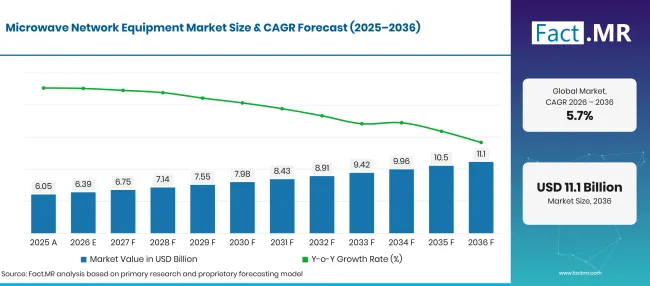
Microwave Network Equipment Market Forecast Global | Source: Fact.MR
| Year | Basis | Market Value (USD billion) |
|---|---|---|
| 2025 | Actual | 6.05 |
| 2026 | Estimate | 6.4 |
| 2036 | Forecast | 11.1 |
| CAGR 2026 to 2036 | Forecast period | 5.7% |
Source: Fact.MR analysis. Updated Oct 31, 2026
What are the defining numbers behind Microwave Network Equipment Market growth?
The market is forecast to gain USD 4.7 billion between 2026 and 2036.
- Demand Drivers in the Market
- Mobile operators need to connect more radio sites and increase capacity where existing links carry heavier traffic. The International Telecommunication Union estimated about 3 billion 5G subscriptions worldwide in 2025 [1].
- Link planners increasingly weigh capacity against tower loading and energy use. Ericsson announced in May 2026 that Cellnex had become the lead customer for its MINI-LINK 6356 high-power E-band radio, with an initial rollout in Poland [2]. The deployment illustrates operators testing higher-capacity wireless transport alongside network automation.
- A microwave link can provide a connection between fixed sites when laying fibre would involve difficult terrain or lengthy construction. Engineers still need to assess the available radio path, antenna size, hop length and spectrum licences before selecting equipment.
- Government and other public-sector networks use fixed radio connections to maintain service between important locations. A separate microwave route may improve resilience, although engineers must also plan for interference, weather effects and power availability at both ends.
- Key Segments Analyzed
- By Component: Antennas are expected to account for 32.8% of the 2026 market as link performance depends on gain, alignment and suitable mounting.
- By Frequency Band: C Band is expected to represent 26.3% of 2026 revenue, reflecting its use in links planned for dependable propagation over suitable distances.
- By Application: Telecommunications is expected to represent 48.5% in 2026 as mobile network operators purchase transport equipment for site connections.
- By End-User: Telecom Operators are projected to account for 42.7% of 2026 revenue as they manage network upgrades and site-level transport.
- Analyst Opinion at Fact.MR
- Shambhu Nath Jha, Principal Consultant at Fact.MR, states, “Microwave transport is useful when fibre construction is expensive or difficult to schedule. Buyers usually compare the required link availability with the total cost of installing and operating the connection. Suppliers can support repeat business by helping network teams plan frequencies, antenna alignment and software monitoring across several sites.”
- Strategic Implications
- Network operators should compare full link costs, including tower work and licensing, before selecting a radio platform.
- Equipment manufacturers should make capacity upgrades and remote monitoring straightforward for field engineering teams.
- Infrastructure owners should check antenna loads and available space when planning higher-frequency backhaul links.
- Government network managers should assess route diversity and service continuity before approving critical fixed wireless connections.
Germany is projected to record a 7.0% CAGR through 2036 as network operators modernize transport links. Japan follows at 6.5%, while the USA is estimated at 6.1%. The UK is forecast at 5.7%, and Brazil is projected to post 4.4%. Each market differs in site density, frequency allocation and the cost of extending fibre to remote locations.
How does the Microwave Network Equipment Market break down by segment?
Antennas are estimated at 32.8%; C Band at 26.3%; Telecommunications at 48.5%; Telecom Operators at 42.7%.
Which Component leads equipment spending?
Antennas account for 32.8% of 2026 value.
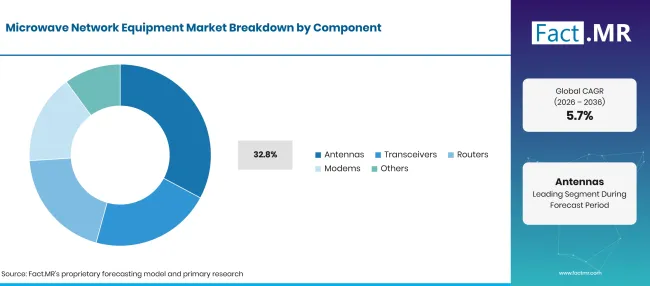
Microwave Network Equipment Market Breakdown Component | Source: Fact.MR
| Component | Share (2026) |
|---|---|
| Antennas (Leading segment) | 32.8% |
| Other segments combined | 67.2% |
| Total | 100.0% |
Source: Fact.MR analysis. Updated Oct 31, 2026
Antennas shape microwave path performance because they focus energy between fixed endpoints. Engineers choose an antenna after checking link length and required availability, then assess tower loading and alignment. Transceivers handle radio transmission and reception, while modems process signals and routers direct traffic into the wider network. The balance between these components changes with network architecture.
How does Frequency Band shape deployment?
C Band represents 26.3% of the 2026 market.
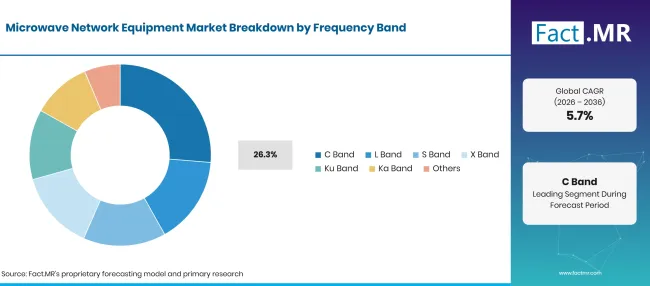
Microwave Network Equipment Market Breakdown Frequency Band | Source: Fact.MR
| Frequency Band | Share (2026) |
|---|---|
| C Band (Leading segment) | 26.3% |
| Other segments combined | 73.7% |
| Total | 100.0% |
Source: Fact.MR analysis. Updated Oct 31, 2026
C Band is suited to selected microwave applications where spectrum assignments and the desired radio path make it practical. L Band and S Band serve different propagation and allocation needs. X Band is relevant to certain specialized systems, while Ku Band and Ka Band support higher-frequency applications under their respective technical limits. Buyers consider rain effects and antenna dimensions alongside regulatory permissions. According to Ofcom’s September 2025 update, 390 fixed links in the 26 GHz band were subject to revocation as of September 2, 2025 [3].
What supports Telecommunications as an Application?
Telecommunications represents 48.5% of 2026 demand.
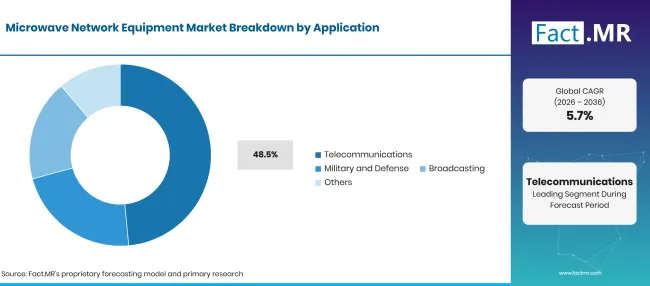
Microwave Network Equipment Market Breakdown Application | Source: Fact.MR
| Application | Share (2026) |
|---|---|
| Telecommunications (Leading segment) | 48.5% |
| Other segments combined | 51.5% |
| Total | 100.0% |
Source: Fact.MR analysis. Updated Oct 31, 2026
Telecommunications spending covers microwave transport between cell sites and aggregation points. A network team may use a wireless link as the permanent connection or as an alternative route for resilience. Military and Defense systems have different security and continuity requirements. Broadband and other fixed-site services also need backhaul, but their economics depend on local deployment conditions. The ITU estimated mobile broadband traffic at 1.5 zettabytes worldwide in 2025 [4].
Which End-User group accounts for the largest share?
Telecom Operators capture 42.7% in 2026.
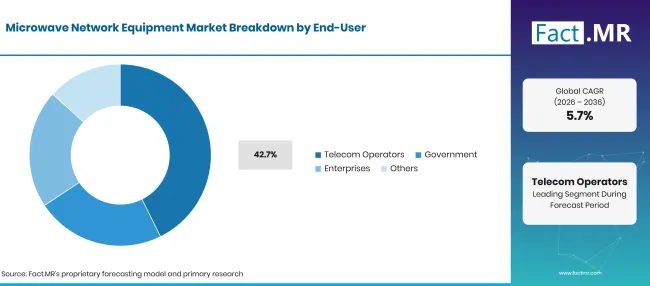
Microwave Network Equipment Market Breakdown End User | Source: Fact.MR
| End-User | Share (2026) |
|---|---|
| Telecom Operators (Leading segment) | 42.7% |
| Other segments combined | 57.3% |
| Total | 100.0% |
Source: Fact.MR analysis. Updated Oct 31, 2026
Telecom operators evaluate radio links across many sites, so spare parts compatibility and centralized monitoring influence equipment choice. Government buyers often focus on service continuity and long operating lives. Enterprises may purchase links between buildings or remote facilities when the route is suitable. A broadcaster typically needs stable delivery to its transmission sites. Licensing and available tower space vary by purchaser, making maintenance access part of total cost.
What is accelerating Microwave Network Equipment Market adoption, and what is holding it back?
Transport capacity requirements encourage network upgrades, while spectrum coordination and difficult installation conditions can slow individual projects.
Drivers Impact Analysis
| DRIVER | (~) % IMPACT ON CAGR | GEOGRAPHIC RELEVANCE | IMPACT TIMELINE |
|---|---|---|---|
| Higher-capacity mobile backhaul | +1.0% | Global | Medium term (2–4 years) |
| Wireless routes for hard-to-reach sites | +0.8% | Brazil, USA | Medium term (2–4 years) |
| Replacement of installed radio links | +0.7% | Europe, Japan | Short term (<= 2 years) |
| Resilient alternative transport routes | +0.5% | Global | Medium term (2–4 years) |
| Remote performance monitoring | +0.4% | Operator networks | Long term (>= 4 years) |
Source: Fact.MR analysis. Updated Oct 31, 2026
Opportunity Impact Analysis
| OPPORTUNITY | (~) % IMPACT ON CAGR | GEOGRAPHIC RELEVANCE | IMPACT TIMELINE |
|---|---|---|---|
| High-capacity E-band transport | +0.8% | Europe, Asia | Medium term (2–4 years) |
| Long-distance radio upgrades | +0.6% | Rural networks | Medium term (2–4 years) |
| Private fixed networks | +0.5% | Industrial and public sites | Long term (>= 4 years) |
| Software-assisted link management | +0.4% | Global | Medium term (2–4 years) |
Source: Fact.MR analysis. Updated Oct 31, 2026
Restraints Impact Analysis
| RESTRAINT | (~) % IMPACT ON CAGR | GEOGRAPHIC RELEVANCE | IMPACT TIMELINE |
|---|---|---|---|
| Spectrum coordination requirements | -0.8% | Country-specific | Short term (<= 2 years) |
| Tower space and installation access | -0.6% | Dense sites | Medium term (2–4 years) |
| Weather-related link design | -0.5% | High-frequency routes | Long term (>= 4 years) |
| Fibre competition on feasible routes | -0.4% | Urban networks | Long term (>= 4 years) |
Source: Fact.MR analysis. Updated Oct 31, 2026
Which countries are scaling the Microwave Network Equipment Market through 2036?
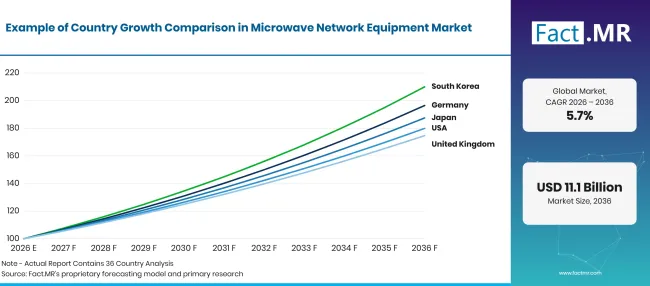
Microwave Network Equipment Market Growth Index | Source: Fact.MR
| Country | CAGR (2026 to 2036) |
|---|---|
| Germany | 7.0% |
| Japan | 6.5% |
| USA | 6.0% |
| UK | 5.7% |
| Brazil | 4.4% |
Source: Fact.MR analysis. Updated Oct 31, 2026
What supports Germany’s microwave network upgrades?
Germany’s cellular network upgrade plans shape demand for fixed microwave links between transport nodes and radio sites.
In December 2025, the Bundesnetzagentur reported that around 95% of Germany’s land area had 5G coverage in October 2025 [5]. Microwave specialists are expected to find more replacement opportunities where existing towers can carry new antennas and network owners require greater transport capacity.
How is Japan developing microwave transport?
Japan’s network engineers weigh site reliability and the practical limits of rooftop space when replacing microwave equipment.
NTT DOCOMO reported in its fiscal 2025 network improvement programme that it had increased the national number of 5G base stations by a factor of 1.2 by March 2026 [6].
What is shaping United States purchases?
United States network owners use microwave equipment to connect radio locations where an existing tower route offers a practical link between fixed endpoints.
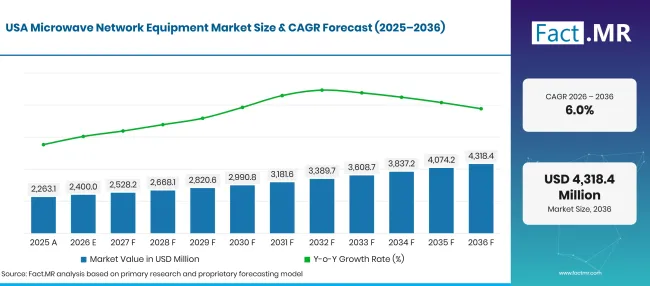
Microwave Network Equipment Market Forecast Usa | Source: Fact.MR
The Federal Communications Commission reported in its 2026 communications report that approximately 95% of Americans lived in areas with modeled 5G-NR coverage of at least 35/3 Mbps in June 2025 [7].
How is the United Kingdom planning fixed wireless links?
United Kingdom network owners continue to review microwave transmission equipment as mobile data use changes and existing links approach capacity limits.
Ofcom reported in November 2025 that monthly mobile data traffic reached 1,257 petabytes after increasing 18% over the previous year [8].
What influences Brazil’s equipment decisions?
Brazilian telecom operators serve communities across large areas where the distance between network sites influences the selection of a transmission link.
The Ministry of Communications reported in October 2026 that Brazil had 69.8 million 5G connections following an increase of 30.7% over twelve months [9].
Who leads the Microwave Network Equipment Market?
Microwave equipment suppliers compete on link capacity, frequency coverage and the maintenance requirements of multi-site radio networks. Ericsson sells MINI-LINK transport products, while Nokia offers Wavence microwave radio systems.
Huawei and ZTE provide wireless transport within wider telecom infrastructure portfolios. Ceragon and Aviat focus on microwave transport platforms, and Intracom Telecom develops wireless backhaul equipment. Cambium Networks addresses fixed wireless applications.
SIAE Microelettronica also has microwave transport technology and product heritage. Each supplier should be evaluated against the exact frequency, application and local sales availability relevant to a planned network.
Which companies are the key providers?
The companies profiled are Huawei Technologies Co., Ltd.; Nokia Corporation; Ericsson; ZTE Corporation; Intracom Telecom; Cambium Networks; Ceragon Networks Ltd.; SIAE Microelettronica S.p.A.; and Aviat Networks, Inc.
- Huawei Technologies Co., Ltd.
- Nokia Corporation
- Ericsson
- ZTE Corporation
- Intracom Telecom
- Cambium Networks
- Ceragon Networks Ltd.
- SIAE Microelettronica S.p.A.
- Aviat Networks, Inc.
Bibliography
- [1] International Telecommunication Union. (2025, November 17). Global number of Internet users increases, but disparities deepen key digital divides.
- [2] Ericsson. (2026, May 21). Cellnex becomes lead customer for Ericsson’s high-power MINI-LINK 6356 E-band radio.
- [3] Ofcom. (2025, September 11). Enabling mmWave spectrum for new uses.
- [4] International Telecommunication Union. (2025, October 15). Internet traffic: Facts and Figures 2025.
- [5] Bundesnetzagentur. (2025, December 15). Bundesnetzagentur publishes latest figures from mobile communications monitoring.
- [6] NTT DOCOMO. (n.d.). 2025 [FY2025 DOCOMO network improvement programme].
- [7] Federal Communications Commission. (2026, August 14). 2026 Section 706 report (FCC 26-55).
- [8] Ofcom. (2025, November 19). Brits devour data at record levels as mobile networks race to improve 5G.
- [9] Ministério das Comunicações. (2026, October 26). Acessos ao 5G crescem 30,7% em um ano e já somam 69,8 milhões no Brasil.
This Report Answers
- The report explains how microwave radios and antennas support fixed-site connections without a continuous fibre route.
- Component analysis compares antennas with radio units and associated network equipment.
- Frequency analysis outlines why planned band use affects link capacity and practical distance.
- Country analysis reviews transport requirements and regulatory conditions in five national markets.
- Competitive analysis profiles telecom systems vendors and specialized microwave suppliers.
What does the Microwave Network Equipment Market cover?
The market covers microwave radio hardware and supporting network equipment used to carry communications between fixed locations. It considers network backhaul and selected fixed connections for public and private users. Revenue is measured for equipment, separate from the operation of a communications service.
What is included in the scope?
Antennas, transceivers, routers and modems are included where they form part of a microwave network equipment sale.
Equipment for telecommunications and specialized fixed links falls within the coverage. The assessment considers frequency bands and purchasing groups that influence product selection.
What is excluded from the scope?
Fibre cables and civil construction are outside the equipment boundary.
Retail mobile subscriptions, spectrum licence charges and recurring service revenue are excluded. Consumer Wi-Fi equipment is also outside the core definition unless it forms part of a relevant fixed microwave network system.
How Was the Analysis Built?
The analysis draws on 120+ sources, 35+ company portfolios, 25+ countries, and more than 20 industry interviews.
- Primary Research: Primary research includes discussions with manufacturers, service providers, technology developers, distributors, end users, and subject-matter experts. These conversations examine purchasing priorities, product adoption, operational challenges, approval requirements, competitive positioning, and the factors that influence wider market acceptance.
- Desk Research: Desk research covers government statistics, regulatory publications, company filings, trade data, technical studies, industry associations, standards, public policy, and other authoritative sources. Every source used in the analysis is documented in the bibliography.
- Market Sizing and Forecasting: Market estimates combine historical performance, demand indicators, pricing and volume trends, segment shares, company participation, country-level growth, adoption patterns, investment activity, and barriers to market expansion.
- Data Validation and Update Cycle: Findings are validated by comparing primary interviews with public data, company activity, regulatory changes, trade patterns, and industry developments. Regular updates review new product launches, capacity changes, partnerships, approvals, and shifts in commercial adoption.
Segmentation
What is the report’s scope and coverage?
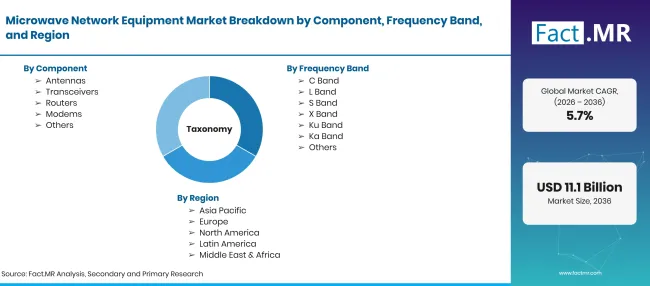
Microwave Network Equipment Market Taxonomy | Source: Fact.MR
| Attribute | Details |
|---|---|
| Quantitative Units | USD billion |
| Market Definition | Microwave radio equipment and supporting components for terrestrial fixed wireless networking and transport. |
| Component | Antennas; Transceivers; Routers; Modems; Others |
| Frequency Band | C Band; L Band; S Band; X Band; Ku Band; Ka Band; Others |
| Application | Telecommunications; Military and Defense; Broadcasting; Others |
| End-User | Telecom Operators; Government; Enterprises; Others |
| Regions Covered | North America; Latin America; Western Europe; Eastern Europe; East Asia; South Asia & Pacific; Middle East & Africa |
| Countries Covered | Germany; Japan; USA; UK; Brazil |
| Companies Profiled | Huawei Technologies Co., Ltd.; Nokia Corporation; Ericsson; ZTE Corporation; Intracom Telecom; Cambium Networks; Ceragon Networks Ltd.; SIAE Microelettronica S.p.A.; and Aviat Networks, Inc. |
| Forecast Period | 2026 to 2036 |
| Approach | Analysis of network deployment conditions, regulator publications and official equipment portfolios. |
Source: Fact.MR analysis. Updated Oct 31, 2026
How is the market segmented?
-
By Component
- Antennas
- Transceivers
- Routers
- Modems
- Others
-
By Frequency Band
- C Band
- L Band
- S Band
- X Band
- Ku Band
- Ka Band
- Others
-
By Application
- Telecommunications
- Military and Defense
- Broadcasting
- Others
-
By End-User
- Telecom Operators
- Government
- Enterprises
- Others
-
By Region
- North America
- Latin America
- Western Europe
- Eastern Europe
- East Asia
- South Asia & Pacific
- Middle East & Africa
Frequently Asked Questions
How big is the microwave network equipment market in 2026?
What is the CAGR of the microwave network equipment market?
Which component leads the market?
Which application accounts for the largest share?
Who are the main companies in the microwave network equipment market?
Who worked on this report


Preview the report firsthand - request a free sample
Free SampleGet the brochure for pricing and purchase details
Download PDF