- Estimated Value(2026): 720 Mn
- Forecast Value (2036): 1207 Mn
- CAGR (2026 - 2036): 5.3%
Mill Rejects Handling System Market Forecast Outlook 2026 to 2036
The mill rejects handling system market is expected to reach USD 720 million in 2026 and grow to USD 1,207 million by 2036, with a CAGR of 5.3%.
Key Takeaways from Mill Rejects Handling System Market
- Mill Rejects Handling System Market Value (2026): USD 720 million
- Mill Rejects Handling System Market Forecast Value (2036): USD 1,207 million
- Mill Rejects Handling System Market Forecast CAGR (2026-2036): 5.3%
- Leading Segment in Mill Rejects Handling System Market: Coal-Fired Power Plants (61%)
- Key Growth Region in Mill Rejects Handling System Market: Asia Pacific
- Key Players in Mill Rejects Handling System Market: Babcock & Wilcox, Macawber Engineering, AUMUND Group, FLSmidth & Co. A/S, TAKRAF Group, Beumer Group GmbH & Co. KG, ANDRITZ AG, Thermax Limited, Bharat Heavy Electricals Limited (BHEL)
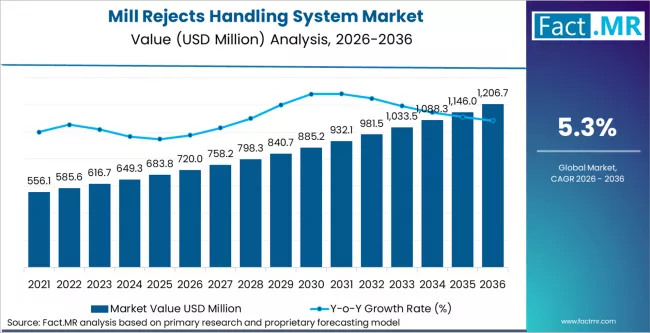
Mill Rejects Handling System Market Market Value Analysis | Source: Fact.MR
Procurement decisions in this market are influenced by factors such as risk aversion, vendor lock-in, and switching costs. Buyers often prioritize reliability and long-term performance, leading to a preference for established vendors with a proven track record. Vendor lock-in can result from the integration of complex systems and the high costs associated with switching suppliers. As a result, buyers tend to be more cautious, considering not only initial costs but also ongoing maintenance and support commitments.
Over time, procurement priorities are likely to focus on securing value through stable, long-term relationships with trusted suppliers, making it challenging for new entrants to disrupt established market dynamics. High switching costs further solidify these long-term vendor relationships.
Mill Rejects Handling System Market
| Metric | Value |
|---|---|
| Estimated Value in (2026E) | USD 720 million |
| Forecast Value in (2036F) | USD 1,207 million |
| Forecast CAGR (2026 to 2036) | 5.3% |
Source: Fact.MR analysis. Updated Feb 11, 2026
Category
| Category | Sub-Segment |
|---|---|
| By System Type | Hydraulic/Pneumatic Conveying; Mechanical Conveyors; Mill Reject Collection Hoppers; Other |
| By Plant Type | Coal-Fired Power Plants; Cement Plants (Coal Mills); Steel & Captive Power; Other |
| By Capacity | Up to 5 TPH; 5-15 TPH; Above 15 TPH; Other |
| By Sales Channel | EPC/Project Direct; Direct OEM Sales; Industrial Distributors; Other |
| Region | North America; Europe; Asia Pacific; Latin America; Middle East & Africa |
Source: Fact.MR analysis. Updated Feb 11, 2026
Segmental Analysis
What is Driving the Dominance of Coal-Fired Power Plants in the Mill Rejects Handling System Market?
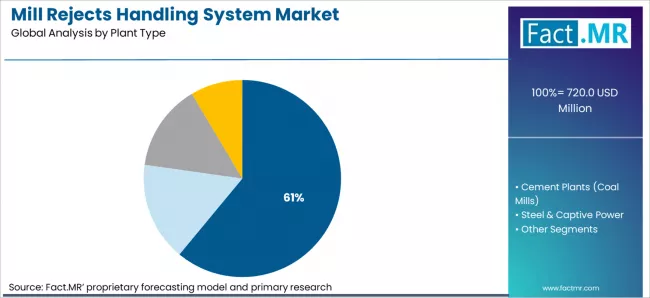
Mill Rejects Handling System Market Analysis By Plant Type | Source: Fact.MR
Coal-Fired Power Plants lead the mill rejects handling system market with 61% of the market share in 2026. This is primarily due to the extensive use of coal as a fuel source in power generation worldwide, particularly in regions that rely on coal-fired plants for energy production. Mill rejects handling systems are essential in these plants to manage and dispose of non-combustible materials and ash residues, ensuring efficient and environmentally responsible operation of the plant.
What is the Role of 5-15 TPH Capacity in the Mill Rejects Handling System Market?
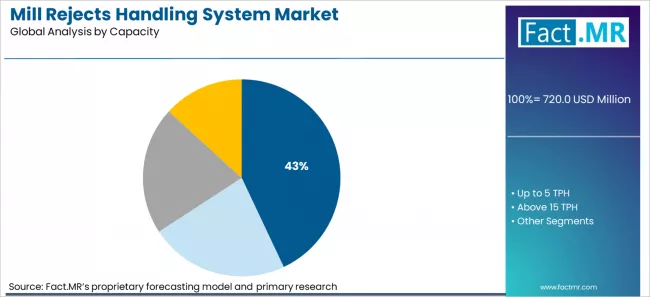
Mill Rejects Handling System Market Analysis By Capacity | Source: Fact.MR
5-15 TPH (tons per hour) capacity systems account for 43% of the market share in 2026. This capacity range is ideal for mid-sized coal-fired power plants and other industrial applications where moderate volumes of mill rejects need to be processed and handled efficiently. Systems in this capacity range offer a balance between operational efficiency and cost-effectiveness, making them a preferred choice for plants with intermediate reject volumes. These systems are commonly used in various regions to support the ongoing operation of coal-fired power plants, helping them maintain compliance with environmental standards.
What are the Drivers, Restraints, and Key Trends in the Mill Rejects Handling System Market?
Demand for mill rejects handling systems is shaped by requirements to manage waste and off‑spec material generated in steelmaking, cold and hot rolling, and finishing operations. Plant engineers specify conveyors, balers, shredders, and sorting units that remove scale, edge trim, and defective strip efficiently while reducing manual handling and improving safety. Procurement teams prioritize systems that integrate with existing material flows, offer robust performance under high throughput, and support housekeeping and recycling goals. Higher capital and operating costs constrain adoption in facilities with limited budgets, and variability in reject types and volumes affects equipment selection and configuration. Key trends include expansion of automated sorting and segregation technologies that improve material recovery and downstream recycling, and development of modular, scalable systems that support phased implementation and ease of maintenance across diverse mill layouts.
Analysis of the Mill Rejects Handling System Market by Key Country
| Country | CAGR (2026-2036) |
|---|---|
| India | 6.4% |
| Indonesia | 6.0% |
| Vietnam | 5.6% |
| South Africa | 5.2% |
| Mexico | 4.9% |
| Brazil | 4.7% |
| USA | 2.6% |
| Germany | 1.9% |
Source: Fact.MR analysis. Updated Feb 11, 2026
The report covers an in-depth analysis of 40+ countries; top-performing countries are highlighted below.
What is Driving the Strong Growth of the Mill Rejects Handling System Market in India?
The mill rejects handling system market in India is expanding at 6.4%, driven by the country’s rapidly growing industrial and manufacturing sectors. As the power and cement industries continue to expand, there is a heightened need for efficient waste management systems. Government initiatives aimed at improving energy infrastructure and environmental sustainability contribute to this rising demand. Additionally, as India increases its focus on sustainability, the adoption of efficient mill rejects handling systems has become more critical, boosting the market's expansion.
How is the Mill Rejects Handling System Market Evolving in Indonesia?
The mill rejects handling system market in Indonesia is growing at 6.0%, largely due to the expanding industrial base, particularly in power generation and cement. As Indonesia’s energy and manufacturing sectors continue to grow, the need for effective mill rejects management increases. The government's focus on energy efficiency and sustainable waste management is driving the adoption of these systems. With industries aiming for better resource optimization, the demand for advanced waste handling solutions is expected to continue growing steadily.
What is Fueling the Demand for Mill Rejects Handling Systems in Vietnam?
The mill rejects handling system market in Vietnam is expanding at 5.6%, driven by the rapid growth of its industrial sectors. Key industries such as cement production, power generation, and manufacturing generate significant amounts of waste, creating the need for efficient filtration and waste handling technologies. The Vietnamese government's initiatives to enhance industrial sustainability and environmental regulations contribute to the rising demand for these systems. Additionally, as the country improves its infrastructure, the adoption of mill rejects handling systems is set to grow further.
Why is the South African Mill Rejects Handling System Market Growing?
The mill rejects handling system market in South Africa is growing at 5.2%, supported by the country’s growing power generation, cement, and manufacturing sectors. With the increasing focus on sustainability in industrial operations, the demand for advanced mill rejects handling systems has been on the rise. South Africa’s investment in infrastructure development, alongside the need to meet environmental standards, is contributing to this growth. As industries demand more efficient and eco-friendly waste management solutions, the market for mill rejects handling systems in South Africa is gaining momentum.
How is Mexico’s Mill Rejects Handling System Market Evolving?
The mill rejects handling system market in Mexico is expanding at a rate of 4.9%, driven by the country’s industrial growth, particularly in the power and cement industries. As these sectors continue to develop, the demand for efficient and environmentally-friendly waste handling systems increases. Government efforts to improve energy efficiency and waste management practices further fuel market growth. The rise of sustainable practices in the manufacturing sector and Mexico’s role in the broader North American market are also contributing to the increasing adoption of mill rejects handling systems.
What Factors are Driving the Mill Rejects Handling System Market in Brazil?
The mill rejects handling system market in Brazil is growing at 4.7%, supported by the expansion of the energy and manufacturing sectors. The country’s large-scale power generation and cement industries produce significant volumes of waste, leading to higher demand for efficient waste handling systems. With a strong emphasis on sustainability and regulatory compliance, Brazil’s industries are increasingly adopting these systems to manage mill rejects effectively. The ongoing industrial growth and environmental initiatives further contribute to the steady rise of this market in Brazil.
Why is the Mill Rejects Handling System Market Growing in the USA?
The USA mill rejects handling system market is growing at 2.6%, driven by ongoing efforts to modernize and improve the efficiency of the country’s aging power infrastructure. The power generation and cement sectors continue to generate mill rejects, which increases the demand for advanced handling systems. Although the market growth is slower compared to emerging markets, regulatory requirements for sustainable waste management and the need to extend the lifespan of transformers and equipment in power plants continue to drive demand for mill rejects handling systems.
How is the Mill Rejects Handling System Market Performing in Germany?
The mill rejects handling system market in Germany is growing at 1.9%, reflecting slower expansion compared to emerging markets. However, the country’s well-established industrial base and commitment to sustainable manufacturing contribute to steady demand for advanced waste management systems. In Germany, the demand for mill rejects handling systems is supported by environmental regulations and the need for efficient waste disposal in power generation and cement industries. Although market growth is modest, Germany’s leadership in environmental technologies ensures continued adoption of effective waste management solutions.
How Are Key Players Competing in the Mill Rejects Handling System Market?
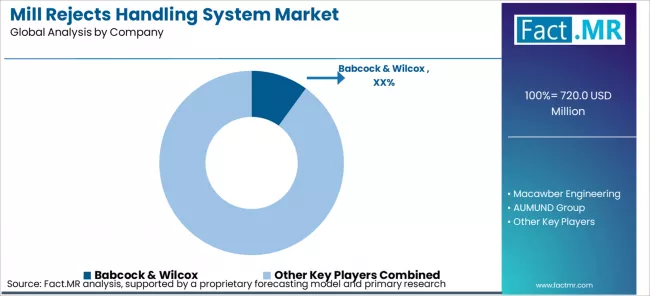
Mill Rejects Handling System Market Analysis By Company | Source: Fact.MR
In the mill rejects handling system market, Babcock & Wilcox focuses on innovative, energy-efficient technologies for managing and transporting mill rejects in power plants. Macawber Engineering is known for pneumatic conveying systems that handle bulk materials, including mill rejects, with precision and reliability. AUMUND Group offers advanced conveyor systems designed to ensure efficient handling of mill rejects in cement and power industries. FLSmidth & Co. A/S leads with automated handling solutions that focus on minimizing operational downtime and ensuring smooth flow in material management. TAKRAF Group delivers tailored solutions for handling mill rejects and other materials in bulk for mining and processing industries. Beumer Group GmbH & Co. KG specializes in innovative conveying systems, reducing operational costs and enhancing material handling efficiency. ANDRITZ AG provides high-performance reject handling systems, integrating advanced material flow technology. Thermax Limited integrates sustainable energy solutions with reject handling systems, emphasizing environmental efficiency. Bharat Heavy Electricals Limited (BHEL) focuses on energy-efficient, cost-effective systems for handling mill rejects in large-scale power plants.
Recent Industry Developments
- Patent (Aug 29, 2023): Automated mill rejects handling and sorting system with conveying, segregation, and discharge mechanisms to reduce manual intervention in milling plants.
https://patents.google.com/patent/US20230214416A1/en - Patent (Mar 5, 2024): Mill rejects collection and recycling apparatus using vibration screens and pneumatic transfer to recover reusable material from rejects.
https://patents.google.com/patent/EP4473002A1/en - Product Update (2025): Jas Enterprises expanded its mill rejects handling systems with automated conveyor and suction-based reject removal integrated with PLC/SCADA controls.
https://jasent.in/collections/mill-rejects-handling-systems
Key Players of the Mill Rejects Handling System Market
- Babcock & Wilcox
- Macawber Engineering
- AUMUND Group
- FLSmidth & Co. A/S
- TAKRAF Group
- Beumer Group GmbH & Co. KG
- ANDRITZ AG
- Thermax Limited
- Bharat Heavy Electricals Limited (BHEL)
Bibliographies
- Central Electricity Authority. (2024). Guidelines for operation and maintenance of coal handling plants and mill reject systems in thermal power stations. Government of India.
- U.S. Department of Energy. (2024). Best practices in coal plant maintenance, material handling, and rejects management. DOE Fossil Energy Program.
- Electric Power Research Institute. (2023). Pulverizer performance, rejects generation, and pneumatic conveying solutions in coal-fired plants. EPRI.
- International Energy Agency. (2024). Coal plant efficiency, material losses, and waste handling practices. IEA Clean Coal Centre.
- CIGRE. (2024). Material handling and auxiliary systems reliability in thermal generation plants. CIGRE Technical Brochure.
Segmentation
Scope of the Report
| Items | Values |
|---|---|
| Quantitative Units (2026) | USD 720 Million |
| By System Type | Hydraulic/Pneumatic Conveying, Mechanical Conveyors, Mill Reject Collection Hoppers, Other |
| By Plant Type | Coal-Fired Power Plants, Cement Plants (Coal Mills), Steel & Captive Power, Other |
| By Capacity | Up to 5 TPH, 5-15 TPH, Above 15 TPH, Other |
| By Sales Channel | EPC/Project Direct, Direct OEM Sales, Industrial Distributors, Other |
| Regions Covered | North America, Europe, Asia Pacific, Latin America, Middle East & Africa |
| Countries Covered | United States, Canada, Mexico, Germany, United Kingdom, France, Japan, South Korea, China, India, Brazil, and other countries |
| Key Companies Profiled | Babcock & Wilcox, Macawber Engineering, AUMUND Group, FLSmidth & Co. A/S, TAKRAF Group, Beumer Group GmbH & Co. KG, ANDRITZ AG, Thermax Limited, Bharat Heavy Electricals Limited (BHEL) |
| Additional Attributes | Dollar revenue by system type, plant type, capacity, sales channel, and region; regional demand trends, competitive landscape, technological advancements in mill rejects handling systems, operational performance optimization initiatives, and product development strategies |
Source: Fact.MR analysis. Updated Feb 11, 2026
Mill Rejects Handling System Market Key Segments
-
By System Type
- Hydraulic/Pneumatic Conveying
- Mechanical Conveyors
- Mill Reject Collection Hoppers
- Other
-
By Plant Type
- Coal-Fired Power Plants
- Cement Plants (Coal Mills)
- Steel & Captive Power
- Other
-
By Capacity
- Up to 5 TPH
- 5-15 TPH
- Above 15 TPH
- Other
-
By Sales Channel
- EPC/Project Direct
- Direct OEM Sales
- Industrial Distributors
- Other
-
Region
- North America
- USA
- Canada
- Mexico
- Europe
- Germany
- UK
- France
- Italy
- Spain
- Nordic Countries
- BENELUX
- Rest of Europe
- Asia Pacific
- China
- Japan
- South Korea
- India
- Australia
- Rest of Asia Pacific
- Latin America
- Brazil
- Argentina
- Rest of Latin America
- Middle East and Africa
- Kingdom of Saudi Arabia
- United Arab Emirates
- South Africa
- Rest of Middle East and Africa
- Other Regions
- Oceania
- Central Asia
- Other Markets
- North America
Frequently Asked Questions
What is the projected market size for mill rejects handling systems in 2026?
What value is expected for mill rejects handling systems in 2036?
At what rate will the mill rejects handling system market progress from 2026 to 2036?
Which plant type dominates demand and what share does it hold?
Which region is expected to experience the fastest growth and what rate is it projected at?
Who are the major players in the mill rejects handling system market?
Who worked on this report


Preview the report firsthand - request a free sample
Free SampleGet the brochure for pricing and purchase details
Download PDF