- Base Value(2025): 1.5 Bn
- Estimated Value(2026): 1.6 Bn
- Forecast Value (2036): 2.6 Bn
- CAGR (2026 - 2036): 5.1%
Minimally Invasive Spine Technologies Market Forecast 2026 to 2036
In 2025, the minimally invasive spine technologies market was valued at USD 1.5 billion. Based on Fact MR analysis, demand for minimally invasive spine technologies is estimated to grow to USD 1.6 billion in 2026 and USD 2.6 billion by 2036. FMR projects a CAGR of 5.1% during the forecast period.
The absolute dollar growth from 2026 to 2036 is USD 1 billion. This growth is driven by the increasing adoption of minimally invasive spine surgeries, which offer benefits such as reduced recovery time, smaller incisions, and fewer complications compared to traditional spine surgeries. Additionally, the rising prevalence of spine-related disorders, aging populations, and advancements in surgical technologies are further supporting market expansion. However, challenges such as the high cost of advanced technologies and the need for skilled surgeons may affect the growth rate in certain regions.
As Eric Wichems, President and Chief Executive Officer of Vertos Medical, noted regarding minimally invasive spine procedures and patient outcomes, ‘Allowing patients to get back to what matters most to them is what matters most to us.’
China leads with a CAGR of 6.9%, driven by rapid healthcare infrastructure development and increasing demand for advanced medical technologies. India follows with 6.4%, fueled by rising healthcare investments and the growing need for efficient spine treatments. Germany grows at 5.9%, supported by a strong healthcare system and increasing adoption of minimally invasive technologies. France grows at 5.4%, benefiting from a rising focus on advanced spine surgeries. The UK shows growth at 4.8%, with steady demand for minimally invasive spine technologies driven by improving healthcare access and surgical outcomes.
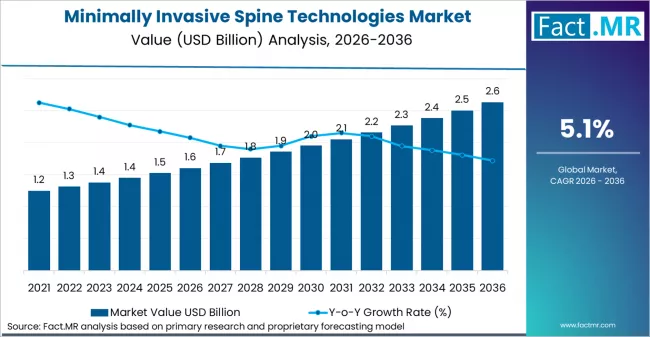
Minimally Invasive Spine Technologies Market Market Value Analysis | Source: Fact.MR
Minimally Invasive Spine Technologies Market
| Metric | Value |
|---|---|
| Estimated Value in (2026E) | USD 1.6 billion |
| Forecast Value in (2036F) | USD 2.6 billion |
| Forecast CAGR (2026 to 2036) | 5.1% |
Source: Fact.MR analysis. Updated Mar 5, 2026
Minimally Invasive Spine Technologies Market Definition
The minimally invasive spine technologies market involves the development, manufacture, and sale of surgical technologies (such as endoscopic systems, percutaneous instruments, navigation platforms, and implants) used to perform spine procedures through smaller incisions, reducing tissue disruption and recovery time.
Market Inclusions
This report covers global and regional market sizes for minimally invasive spine technologies across a defined forecast period, including technology types (endoscopic, robotic assistance, navigation), procedure categories (decompression, fusion, disc replacement), and end‑use settings (hospitals, ambulatory surgical centres).
Market Exclusions
The scope excludes traditional open spine surgery tools, general surgical instruments not specific to minimally invasive spine procedures, and rehabilitation or physical therapy devices unrelated to surgical intervention.
Research Methodology
- Primary Research: Interviews were conducted with spine surgeons, technology developers, and hospital procurement specialists.
- Desk Research: Data was sourced from clinical publications, healthcare industry reports, and regulatory filings.
- Market‑Sizing and Forecasting: A hybrid model combining top‑down procedural demand forecasts with bottom‑up device adoption and revenue data was used.
- Data Validation and Update Cycle: Findings were validated through expert review and aligned with recent procedure volume, production, and sales statistics.
Summary of the Minimally Invasive Spine Technologies Market
- Market Definition
- The Minimally Invasive Spine Technologies Market encompasses surgical technologies and procedures used for spine-related disorders such as degenerative disc disease, herniated discs, and spinal deformities. These technologies, including endoscopic systems, percutaneous instruments, and robotic assistance, facilitate spine surgeries through smaller incisions, resulting in reduced tissue disruption and faster recovery times.
- Demand Drivers
- Increased Adoption of Minimally Invasive Surgeries: Minimally invasive procedures offer benefits such as smaller incisions, faster recovery, and fewer complications compared to traditional spine surgeries, driving demand for these technologies.
- Rising Prevalence of Spine Disorders: The growing prevalence of spine-related issues due to aging populations and sedentary lifestyles is increasing the demand for spine treatments and procedures.
- Technological Advancements: Continuous improvements in surgical instruments and robotic assistance are contributing to the efficiency and precision of minimally invasive spine surgeries, further boosting market growth.
- Key Segments Analyzed
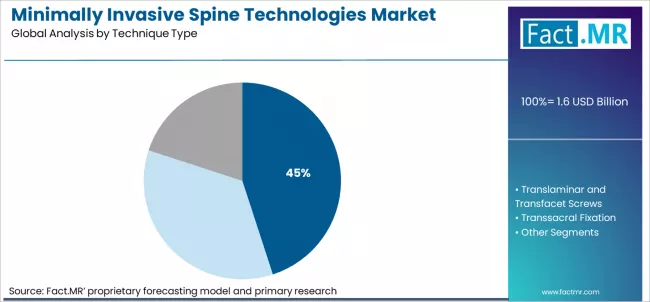
- Technique Type: Percutaneous pedicle screw-rod fixation is expected to capture 45% of the market share by 2026 due to its widespread use in stabilizing the spine with minimal tissue disruption.
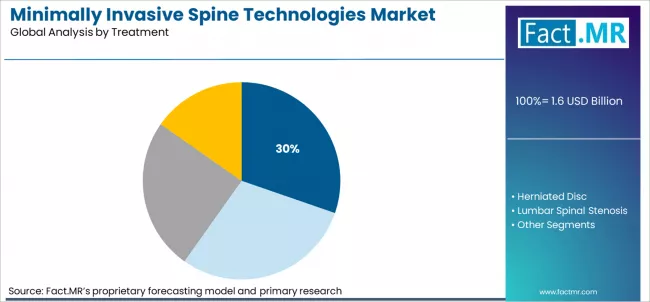
- Treatment: Degenerative disc disease is projected to dominate the treatment segment, accounting for 30.3% of the market share by 2026, driven by its high prevalence and demand for non-invasive solutions.
- Geography: China leads the market with a 6.9% CAGR, supported by rapid healthcare infrastructure development and increasing demand for advanced spine treatments.
- Analyst Opinion at Fact MR
- Shambhu Nath Jha, Principal Consultant at Fact MR, highlighted, "The increasing shift towards minimally invasive spine surgeries, combined with the rising global demand for more efficient and patient-friendly solutions, is accelerating the growth of this market."
- Strategic Implications/Executive Takeaways
- Investment in Advanced Technologies: Companies should invest in advanced surgical technologies like robotic systems and percutaneous instruments to meet the rising demand for minimally invasive spine surgeries.
- Expansion in Emerging Markets: The demand for minimally invasive spine technologies is expected to grow significantly in countries like China and India due to expanding healthcare infrastructure and rising patient awareness.
- Focus on Patient-Centered Outcomes: As the market grows, there is a greater emphasis on improving patient outcomes, which will drive further advancements in surgical techniques and technologies.
- Methodology
- Primary Research: Interviews with spine surgeons, technology developers, and hospital procurement specialists.
- Desk Research: Data sourced from clinical publications, healthcare industry reports, and regulatory filings.
- Market Sizing & Forecasting: A hybrid model combining top-down procedure demand forecasts with bottom-up device adoption and revenue data was used for market growth estimation.
Segmental Analysis
Minimally Invasive Spine Technologies Market Analysis by Technique Type
Minimally Invasive Spine Technologies Market Analysis By Technique Type | Source: Fact.MR
- Market Overview: Percutaneous pedicle screw-rod fixation is expected to hold 45% of the market share by 2026. This technique is a widely used minimally invasive method for stabilizing the spine in patients with spinal deformities or injuries. It involves inserting screws and rods through small incisions, minimizing muscle and tissue disruption.
- Demand Drivers:
- Minimally Invasive Nature: The growing preference for minimally invasive procedures in spine surgery drives the demand for techniques like percutaneous pedicle screw-rod fixation. These procedures offer benefits such as smaller incisions, faster recovery, and reduced hospital stays, making them attractive to both patients and healthcare providers.
- Increased Spinal Disorders Prevalence: The rising prevalence of spinal disorders, including degenerative diseases and fractures, increases the demand for effective and less invasive spinal stabilization techniques. Percutaneous pedicle screw-rod fixation is particularly effective for these conditions, contributing to its strong market presence.
- Improved Surgical Outcomes: This technique offers precise placement of screws with minimal soft tissue damage, leading to better surgical outcomes and fewer complications. These advantages are boosting its adoption in the minimally invasive spine technologies market.
Minimally Invasive Spine Technologies Market Analysis by Treatment
Minimally Invasive Spine Technologies Market Analysis By Treatment | Source: Fact.MR
- Market Overview: Degenerative disc disease is projected to capture 30.3% of the market share by 2026. Degenerative disc disease is one of the most common causes of back pain and is a major driver for the adoption of minimally invasive spine technologies, as these treatments offer effective solutions with reduced recovery time.
- Demand Drivers:
- Aging Population: As the global population ages, the prevalence of degenerative disc disease increases, leading to a higher demand for minimally invasive spine treatments. These procedures are particularly beneficial for older patients who may be more susceptible to complications from traditional surgery.
- Effective Management of Back Pain: Minimally invasive treatments offer effective pain relief for patients with degenerative disc disease, which drives their adoption. Techniques like percutaneous pedicle screw-rod fixation and others help stabilize the spine and reduce pain, improving the patient's quality of life.
- Preference for Non-Invasive Solutions: Patients increasingly prefer treatments that involve less trauma to the body and quicker recovery times. Minimally invasive spine technologies cater to this demand by offering effective solutions with fewer risks and complications compared to traditional open spine surgery.
Minimally Invasive Spine Technologies Market Drivers, Restraints, and Opportunities
FMR analysts observe that the minimally invasive spine technologies (MIST) market is a growth‑aligned segment driven by the increasing prevalence of spinal disorders, aging populations, and the shift towards less invasive surgeries. Historically, open spine surgeries dominated, but as minimally invasive procedures offer reduced recovery times and complications, demand has grown for endoscopes, percutaneous systems, and robotics. The 2026 market valuation reflects the growing adoption of these technologies across hospitals and outpatient centers.
While traditional open surgeries remain common in complex cases, advanced MIST solutions are gaining share, driven by better patient outcomes. These higher‑cost technologies contribute to market growth as overall procedure volumes increase.
- Patient Outcomes Demand: Surgeons adopt MIST to minimize tissue damage and shorten recovery times compared to traditional surgeries.
- Regulatory Standards: Clinical guidelines and safety standards promote the adoption of certified minimally invasive technologies.
- Regional Trends: In North America and Europe, higher uptake of MIST is driven by strong healthcare infrastructure, while Asia‑Pacific shows rapid growth with expanding surgical access.
Regional Analysis
The market analysis covers key global regions, including East Asia, South Asia, Western Europe, and North America. It is segmented geographically, with specific market dynamics for each region. The full report provides a detailed market attractiveness analysis.
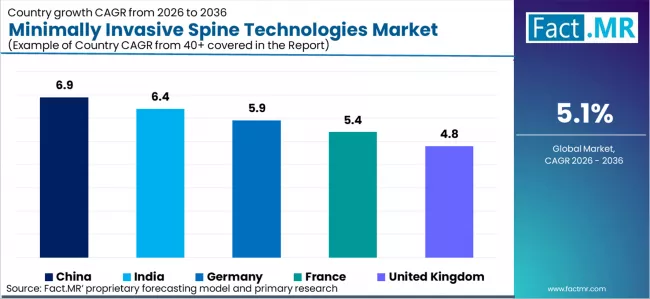
Minimally Invasive Spine Technologies Market Cagr Analysis By Country | Source: Fact.MR
| Country | CAGR (2026-2036) |
|---|---|
| China | 6.9% |
| India | 6.4% |
| Germany | 5.9% |
| France | 5.4% |
| United Kingdom | 4.8% |
Source: Fact.MR analysis. Updated Mar 5, 2026
Source: Fact MR (FMR) analysis, based on proprietary forecasting model and primary research.
East Asia:
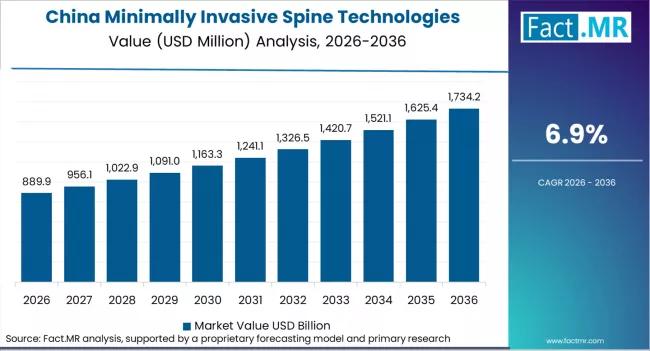
Minimally Invasive Spine Technologies Market Country Value Analysis | Source: Fact.MR
In East Asia, China is the leading market for minimally invasive spine technologies, driven by increasing healthcare infrastructure, rising demand for advanced spinal treatments, and technological advancements in minimally invasive procedures.
- China: Demand for minimally invasive spine technologies in China is projected to rise at 6.9% CAGR through 2036. China’s growing healthcare sector, rising aging population, and increasing adoption of minimally invasive spine procedures continue to support market growth.
South Asia:
In South Asia, India is a key market for minimally invasive spine technologies, supported by increasing investments in healthcare infrastructure, growing awareness of spinal disorders, and rising demand for advanced surgical technologies.
- India: Demand for minimally invasive spine technologies in India is projected to rise at 6.4% CAGR through 2036. India’s expanding healthcare industry, increasing focus on spinal health, and growing adoption of minimally invasive techniques contribute to steady market growth.
Western Europe:
In Western Europe, Germany, France, and the United Kingdom are important markets for minimally invasive spine technologies, driven by high healthcare standards, technological advancements, and increasing demand for advanced spinal treatments.
- Germany: Demand for minimally invasive spine technologies in Germany is projected to rise at 5.9% CAGR through 2036. Germany’s advanced healthcare infrastructure, growing demand for minimally invasive spine surgeries, and increasing adoption of high-tech spinal implants continue to drive market growth.
- France: Demand for minimally invasive spine technologies in France is projected to rise at 5.4% CAGR through 2036. France’s strong healthcare system, increasing demand for advanced spinal treatments, and rising focus on minimally invasive surgical methods continue to support market demand.
- United Kingdom: Demand for minimally invasive spine technologies in the UK is projected to rise at 4.8% CAGR through 2036. The UK’s increasing spinal surgeries market and growing preference for minimally invasive surgical techniques continue to drive steady market growth.
Fact MR's analysis of the Minimally Invasive Spine Technologies Market in East Asia, South Asia, Western Europe consists of country-wise assessments that include China, India, Germany, France, and the United Kingdom. Readers can find detailed trends, regulatory updates, and company-specific investments shaping the market’s growth in these countries.
What is the Competitive Structure and Buyer Behavior in the Minimally Invasive Spine Technologies Market?
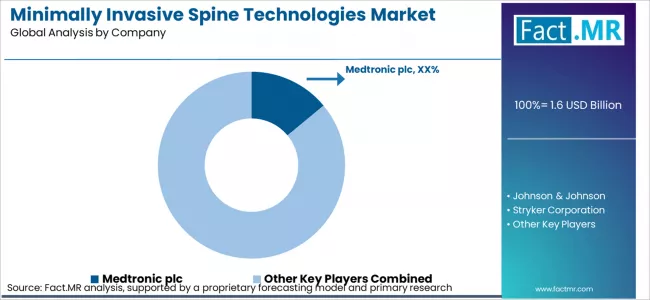
Minimally Invasive Spine Technologies Market Analysis By Company | Source: Fact.MR
The minimally invasive spine technologies market is moderately concentrated, with major players like Medtronic plc, Johnson & Johnson, Stryker Corporation, Zimmer Biomet Holdings, Inc., and NuVasive, Inc. dominating a significant share. Product differentiation, driven by technological innovation and clinical outcomes, is the primary competitive factor. Companies with strong R&D, integrated supply chains, and global distribution networks have structural advantages, enabling them to scale efficiently and offer comprehensive service support. Large hospitals and healthcare systems hold significant buyer leverage, often negotiating terms across multiple suppliers and qualifying vendors based on clinical standards. To manage supplier dependency, these buyers diversify their sources and standardize specifications, limiting individual suppliers' pricing power. As a result, competition focuses more on value, product performance, and support services than on pricing alone.
Recent Industry Developments
- FDA Clearance of Medtronic’s Stealth AXiS™ System: In February 2026, Medtronic received FDA clearance for its Stealth AXiS™ surgical system, the first platform to fully integrate planning, navigation, and robotics into a single unit. This system introduces LiveAlign™ segmental tracking, an industry-first capability that allows surgeons to visualize real-time anatomical movement and patient alignment without repeated X-ray imaging.
- Strategic Pivot: J&J’s Potential $20B DePuy Synthes Sale: In a major market shakeup, Johnson & Johnson is reportedly exploring an outright sale of its DePuy Synthes orthopedics unit for over $20 billion, pivoting from its original 2025 spinoff plan. While J&J remains a leader in the segment, this move signals a broader corporate shift toward high-growth oncology and cardiovascular sectors, potentially allowing DePuy to become the world’s largest pure-play spine and orthopedics company.
- Scaling of Unilateral Biportal Endoscopy (UBE): The 2026 clinical landscape is heavily prioritizing Unilateral Biportal Endoscopy (UBE). This technique uses two small incisions-one for the endoscope and one for surgical tools-allowing for a wider range of motion and better visualization than traditional single-portal systems. It is rapidly becoming the preferred MIS method for complex decompression and fusion in high-volume Asian and European centers
Key Players of the Minimally Invasive Spine Technologies Market
- Medtronic plc
- Johnson & Johnson
- Stryker Corporation
- Zimmer Biomet Holdings, Inc.
- NuVasive, Inc.
Report Scope
| Metric | Value |
|---|---|
| Quantitative Units | USD 1.6 billion (2026) to USD 2.6 billion (2036), at a CAGR of 5.1% |
| Market Definition | The Minimally Invasive Spine Technologies Market includes devices and procedures used in minimally invasive surgeries for spine-related issues such as degenerative disc disease, herniated disc, and spinal deformities. |
| By Technique Type | Percutaneous Pedicle Screw-Rod Fixation, Translaminar and Transfacet Screws, Transsacral Fixation, Cervical Fixation |
| By Treatment | Degenerative Disc Disease, Herniated Disc, Lumbar Spinal Stenosis, Spinal Deformities such as Scoliosis, Spinal Infections and Instability, Spinal Tumors, Vertebral Compression Fractures |
| By End-User | Hospitals, Orthopedic Clinics, Ambulatory Surgical Centers |
| Regions Covered | North America, Latin America, Europe, East Asia, South Asia, Oceania, Middle East and Africa |
| Countries Covered | United States, Canada, Mexico, Brazil, Argentina, Germany, France, United Kingdom, Italy, Spain, China, India, Japan, South Korea, Indonesia, Australia, and 40+ countries |
| Key Companies Profiled | Medtronic plc, Johnson & Johnson, Stryker Corporation, Zimmer Biomet Holdings, Inc., NuVasive, Inc. |
| Forecast Period | 2026 to 2036 |
| Approach | Hybrid top-down and bottom-up market modeling validated through primary interviews with manufacturers and supported by trade data benchmarking and market research. |
Source: Fact.MR analysis. Updated Mar 5, 2026
Bibliographies
- Johnson & Johnson. (2023). Innovations in minimally invasive spine surgery and spinal care technologies. Johnson & Johnson.
- Medtronic plc. (2023). Advancements in minimally invasive spine technologies for spinal stabilization and care. Medtronic plc.
- NuVasive, Inc. (2023). Minimally invasive techniques in spine surgery for better patient outcomes. NuVasive, Inc.
- Stryker Corporation. (2023). Revolutionizing spine care with minimally invasive technologies for spinal correction. Stryker Corporation.
- Zimmer Biomet Holdings, Inc. (2023). Minimally invasive solutions for spine stabilization and correction procedures. Zimmer Biomet Holdings, Inc.
- Fintool. (2026, February 19). Johnson & Johnson explores a $20 billion sale of DePuy Synthes orthopedics unit [Industry update]. Fintool.
- Medtronic. (2026, February 13). FDA clearance for Stealth AXiS™ integrated spine robotics platform [Press release]. Medtronic.
- WCMISST. (2026, March). 9th World Congress of Minimally Invasive Spine Surgery & Techniques [Conference proceedings]. WCMISST.
This report addresses:
- Market intelligence enabling comprehensive assessment of leading countries and product segments across the Minimally Invasive Spine Technologies Market globally.
- Market volume (sales units) estimates and 10-year revenue forecasts from 2026 to 2036, validated through manufacturer shipment data, channel partner surveys, and country-level demand modeling.
- Growth opportunity mapping across technique types (Percutaneous Pedicle Screw-Rod Fixation, Translaminar and Transfacet Screws, Transsacral Fixation, Cervical Fixation), treatments (Degenerative Disc Disease, Herniated Disc, Lumbar Spinal Stenosis, Spinal Deformities, Spinal Infections and Instability, Spinal Tumors, Vertebral Compression Fractures), and end-user industries (Hospitals, Orthopedic Clinics, Ambulatory Surgical Centers).
- Segment and regional revenue forecasts by technique type, treatment, end-user industry, and geography across 40+ countries.
- Competition strategy analysis covering dealer network structure, recent developments, product portfolio, USPs, and market share analysis.
- Product and regulatory compliance tracking aligned with surgical standards, healthcare facility requirements, and medical equipment certifications.
- Regulatory impact analysis addressing clinical guidelines, safety standards, and healthcare infrastructure regulations across key markets.
- Report delivery in PDF, Excel, PowerPoint, and interactive dashboard formats for executive, procurement, and operational planning use.
Segmentation
Minimally Invasive Spine Technologies Market Key Segments
-
Technique Type :
- Percutaneous Pedicle Screw-Rod Fixation
- Translaminar and Transfacet Screws
- Transsacral Fixation
- Cervical Fixation
-
Treatment :
- Degenerative Disc Disease
- Herniated Disc
- Lumbar Spinal Stenosis
- Spinal Deformities such as Scoliosis
- Spinal Infections and Instability
- Spinal Tumors
- Vertebral Compression Fractures
-
End-Use Industry :
- Hospitals
- Orthopedic Clinics
- Ambulatory Surgical Centers
-
Region :
- North America
- USA
- Canada
- Mexico
- Europe
- Germany
- UK
- France
- Italy
- Spain
- Nordic Countries
- BENELUX
- Rest of Europe
- Asia Pacific
- China
- Japan
- South Korea
- India
- Australia
- Rest of Asia Pacific
- Latin America
- Brazil
- Argentina
- Rest of Latin America
- Middle East and Africa
- Kingdom of Saudi Arabia
- United Arab Emirates
- South Africa
- Rest of Middle East and Africa
- Other Regions
- Oceania
- Central Asia
- Other Markets
- North America
Frequently Asked Questions
How large is the demand for Minimally Invasive Spine Technologies in the global market in 2026?
What will be the market size of Minimally Invasive Spine Technologies in the global market by 2036?
What is the expected demand growth for Minimally Invasive Spine Technologies in the global market between 2026 and 2036?
Which technique type is expected to dominate the market?
Which region is expected to show the highest growth rate for Minimally Invasive Spine Technologies?
How significant is the growth outlook for India in this market?
What is the growth outlook for Germany in the Minimally Invasive Spine Technologies market?
What is the growth forecast for France in the Minimally Invasive Spine Technologies market?
What is the growth forecast for the United Kingdom in the Minimally Invasive Spine Technologies market?
Which company is identified as a leading player in the Minimally Invasive Spine Technologies market?
What are Minimally Invasive Spine Technologies used for?
What does the Minimally Invasive Spine Technologies market include in this report?
How is the market forecast developed in this report?
What is meant by the Minimally Invasive Spine Technologies market in this report?
Who worked on this report


Preview the report firsthand - request a free sample
Free SampleGet the brochure for pricing and purchase details
Download PDF