- Market Value (2025): USD 1.1 Bn
- Estimated Value (2026): USD 1.3 Bn
- Forecast Value (2036): USD 3.8 Bn
- CAGR (2026-2036): 11.3%
What is the Non-Invasive Diagnostic Tests Market forecast to be worth by 2036?
USD 1.3 billion in 2026 to USD 3.8 billion by 2036, at 11.3% CAGR.
- The non-invasive diagnostic tests market crossed a valuation of USD 1.1 billion in 2025 across imaging and laboratory channels that use lower-burden sampling.
- Demand is projected to increase from USD 1.3 billion in 2026 to USD 3.8 billion by 2036 as care settings use lower-burden testing inside defined clinical pathways.
- The market is forecast to record an 11.3% CAGR from 2026 to 2036.
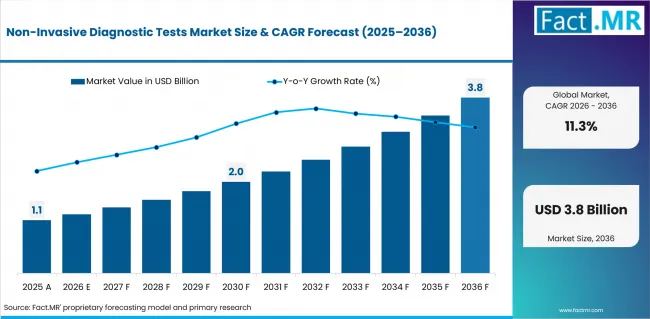
Non Invasive Diagnostic Tests Market Value Analysis | Source: Fact.MR
What are the defining numbers behind Non-Invasive Diagnostic Tests Market growth?
USD 2.5 billion absolute opportunity by 2036, led by Imaging Diagnostics and Next-Generation Sequencing (NGS) alongside Oncology applications.
- Demand Drivers in the Market
- Health systems look for tests that reduce tissue removal when a simpler result can answer a clear medical question and guide the next step.
- Diagnostic laboratories often work with very small amounts of material in blood, saliva or urine. Liquid biopsy and cfDNA testing depend on careful handling so weak signals are not lost.
- Radiology departments use AI-supported review and image-sharing tools to manage rising scan numbers and reduce delays in reporting.
- Hospitals benefit from tests that track cancer and long-term diseases over time. This allows repeated checks without sending every patient for an invasive procedure.
- Key Segments Analyzed
- By Test Type: Imaging Diagnostics is projected to hold 25.0% share in 2026 supported by the use of CT, MRI and ultrasound in hospital assessment without tissue removal.
- By Technology: Next-Generation Sequencing (NGS) is expected to account for 25.0% share in 2026 owing to its ability to read multiple variants from limited clinical samples within one workflow.
- By Application: Oncology is anticipated to represent 25.0% share in 2026 due to the use of non-invasive testing across triage, biomarker selection, treatment monitoring and recurrence assessment.
- By End User: Hospitals are estimated to capture 30.0% share in 2026 attributable to their ability to connect imaging systems and clinical laboratories with specialist care and treatment planning.
- Analyst Opinion at Fact.MR
- Shambhu Nath Jha, Senior Analyst at Fact.MR, states, “Non-invasive testing gains clinical value only when it answers a clear diagnostic question and leads to a defined next step. Adoption is expected to favor tests that fit funded care pathways and provide results that doctors can act on without delay. Providers that connect testing with specialist review and follow-up are likely to gain wider use.”
- Strategic Implications
- Test developers set clear limits before launch so doctors know when a result can guide care and when another test is still required.
- Laboratories record how small a signal the test can detect and how often disease may be missed before using the method across more hospitals.
- Hospitals link easier tests with scans, biopsy, counseling and treatment so a positive result leads to a clear next step.
- Radiology and molecular teams follow the same reporting rules because AI findings and genetic results both require proper follow-up.
In March 2025, Siemens Healthineers received FDA clearance for its Naeotom Alpha class of photon-counting CT scanners. The clearance is relevant because photon-counting CT is an imaging route that supports non-invasive diagnostic assessment inside hospitals.
Germany is projected to record a 15.5% CAGR from 2026 to 2036 driven by university hospitals and specialist laboratories. Brazil is expected to post a 14.4% CAGR by 2036 supported by screening needs and referral capacity. The USA is anticipated to record a 13.2% CAGR through 2036 as AI imaging and molecular diagnostics remain concentrated in large health systems. South Korea is estimated to post a 12.1% CAGR from 2026 to 2036 due to connected hospitals and remote monitoring channels. The United Kingdom is forecast to record a 10.9% CAGR by 2036, while Japan is projected to record a 9.8% CAGR over the same period.
How does the Non-Invasive Diagnostic Tests Market break down by segment?
Imaging Diagnostics leads at 25.0% by Test Type, Next-Generation Sequencing (NGS) leads at 25.0% by Technology in 2026.
Why does Imaging Diagnostics lead Test Type?
Imaging Diagnostics holds 25.0% share in 2026.
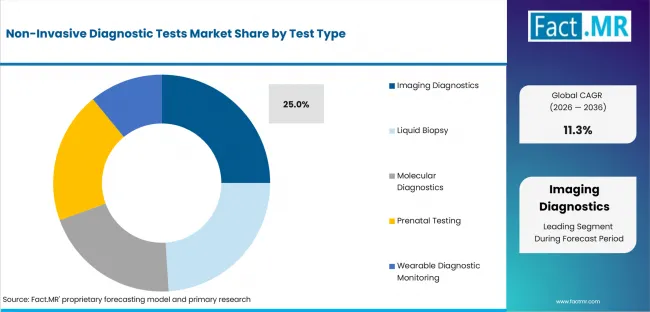
Non Invasive Diagnostic Tests Market Analysis By Test Type | Source: Fact.MR
CT, MRI and ultrasound already form part of everyday hospital diagnosis, which gives Imaging Diagnostics a strong base. Liquid Biopsy supports cancer testing through blood samples and can help track treatment response or possible return of disease. Molecular Diagnostics and Prenatal Testing work best in clearly defined cases with reliable samples and follow-up care. Wearable Diagnostic Monitoring still requires firm medical rules before doctors can treat its readings as a diagnosis.
Why does Next-Generation Sequencing (NGS) lead Technology?
Next-Generation Sequencing (NGS) accounts for 25.0% share in 2026.
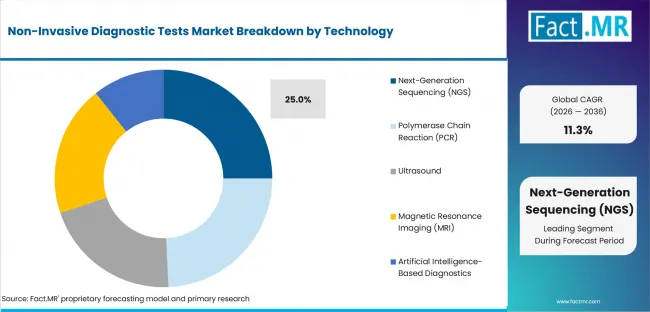
Non Invasive Diagnostic Tests Market Analysis By Technology | Source: Fact.MR
NGS allows laboratories to examine many genetic changes from a small patient sample in one test. PCR has a more focused role and gives fast confirmation when doctors already know what signal they are checking. Ultrasound and MRI remain important where trained staff can review the images. AI-Based Diagnostics require clear reporting rules and regular checks after the software enters use.
Why does Oncology lead Application?
Oncology represents 25.0% share in 2026.
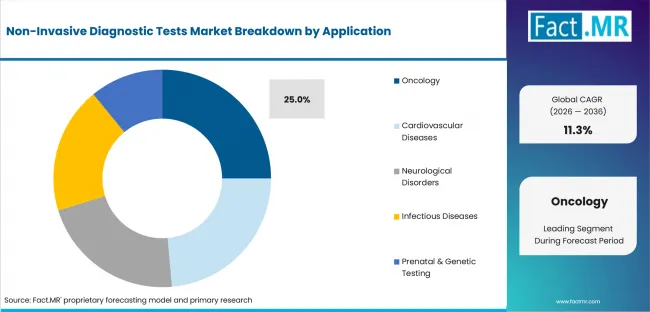
Non Invasive Diagnostic Tests Market Analysis By Application | Source: Fact.MR
Cancer care uses non-invasive tests at several points, from early review and treatment choice to follow-up and checks for returning disease. Cardiovascular Diseases and Neurological Disorders rely more heavily on scans and careful reading of body signals. Infectious Diseases often use blood or swab samples for quick detection. Prenatal & Genetic Testing also avoids invasive collection where counseling and confirmation are available.
Why do Hospitals lead End User demand?
Hospitals capture 30.0% share in 2026.
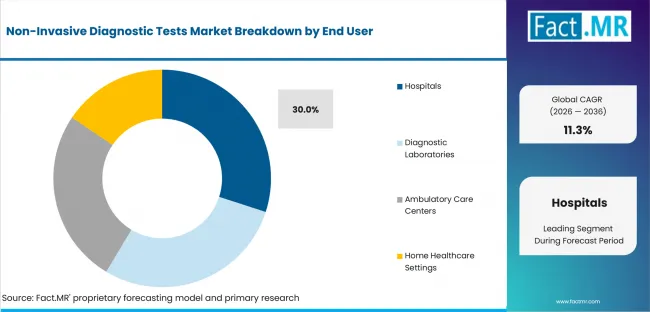
Non Invasive Diagnostic Tests Market Analysis By End User | Source: Fact.MR
Hospitals bring imaging systems, laboratories, specialist doctors and treatment services into one care setting. Diagnostic Laboratories handle blood-based and molecular tests that require careful sample preparation. Ambulatory Care Centers may take on simpler tests and follow-up work outside large hospitals. Home Healthcare Settings are expected to grow where sample collection can be supervised and results can be reviewed remotely.
What is accelerating Non-Invasive Diagnostic Tests Market adoption, and what is holding it back?
Procedure avoidance is anticipated to drive growth, while regulatory burden and incomplete follow-up pathways restrain adoption.
Drivers Impact Analysis
| DRIVER | (~) % IMPACT ON CAGR | GEOGRAPHIC RELEVANCE | IMPACT TIMELINE |
|---|---|---|---|
| Non-invasive alternative to tissue removal | +1.8% | Germany and other university-hospital systems | Long term (>=4 years) |
| Decentralized and rapid diagnostic platforms | +1.4% | South Korea and Japan | Medium term (2-4 years) |
| Liquid biopsy and cfDNA-based oncology testing | +1.1% | USA | Short term (<=2 years) |
| AI-assisted imaging and signal interpretation | +0.8% | U.K. and Germany | Medium term (2-4 years) |
| Public-health screening and priority-condition programs | +0.6% | Brazil | Long term (>=4 years) |
Source: Fact.MR analysis. Updated Jul 21, 2026
- Procedure avoidance: Clinicians look for tests that replace a specific invasive step. The result still needs a confirmation route that the hospital or laboratory has already funded.
- Decentralized testing: Staff and sample quality rules need to be defined before rollout. WHO stated in December 2024 that six in vitro diagnostic assessment sessions would take place in 2025 for dossiers and change requests.
- Liquid biopsy and AI imaging: Oncology assays need evidence that the result changes treatment or surveillance. FDA reported in January 2025 that it had authorized more than 1,000 AI-enabled devices through established premarket pathways.
- Public-health screening: Broad screening demand supports lower-burden tests when referral and treatment funding are aligned. Brazil shows the strongest fit where access pressure remains high across regional care networks.
Opportunity Impact Analysis
| OPPORTUNITY | (~) % IMPACT ON CAGR | GEOGRAPHIC RELEVANCE | IMPACT TIMELINE |
|---|---|---|---|
| Wearable-driven continuous monitoring | +0.9% | Japan and South Korea | Medium term (2-4 years) |
| Cross-border health-data interoperability | +0.7% | Germany and U.K. | Medium term (2-4 years) |
| Decentralized point-of-care and home testing expansion | +0.6% | Brazil and South Korea | Long term (>=4 years) |
| Multimodal pathway bundling | +0.5% | USA and Germany | Medium term (2-4 years) |
Source: Fact.MR analysis. Updated Jul 21, 2026
- Wearable monitoring: Clinicians use recurring signals for deterioration and recovery when the device has a defined diagnostic use case and review process.
- Interoperability: European adoption is expected to improve where imaging archives and diagnostic reports move across care settings without slowing the decision path.
- Point-of-care expansion: Ambulatory and home-linked testing is expected to widen access when supervised collection and remote review are built into the service.
- Multimodal bundling: Hospitals combine imaging, molecular tests and clinical records when the pathway makes one result useful to the next care step.
Restraints Impact Analysis
| RESTRAINT | (~) % IMPACT ON CAGR | GEOGRAPHIC RELEVANCE | IMPACT TIMELINE |
|---|---|---|---|
| Rising regulatory and quality-system burden for laboratory-developed tests | -0.9% | USA | Short term (<=2 years) |
| Incomplete confirmation and treatment pathway | -0.6% | Global | Medium term (2-4 years) |
| Cost of false reassurance from low-abundance signals | -0.5% | Oncology-led markets | Long term (>=4 years) |
| AI-interpretation oversight and cybersecurity requirements | -0.4% | USA and Europe | Medium term (2-4 years) |
Source: Fact.MR analysis. Updated Jul 21, 2026
- Regulatory change: FDA updated its Laboratory Developed Tests page in September 2025 after the March 2025 vacatur of the May 2024 LDT final rule. The update keeps oversight conditions visible for U.S. laboratories.
- Follow-up capacity: A low-burden result has limited value when imaging slots and biopsy capacity are not ready with counseling access or treatment funding.
- False reassurance risk: Low-abundance signals are sometimes missed when the sample does not carry enough material for a confident result. Laboratories need sensitivity evidence before broad rollout.
- AI oversight: Imaging software needs lifecycle documentation and cybersecurity review because diagnostic support tools affect clinical reporting decisions.
Which countries are scaling Non-Invasive Diagnostic Tests Market fastest?
The global growth rate combines countries that are expanding at different speeds. Germany, Brazil, the USA and South Korea grow faster than the worldwide 11.3% CAGR. The U.K. and Japan grow more slowly. Other countries in the full study help bring these different rates into one global average. The six markets shown are examples and do not cover the full geographic picture.
- The main difference comes from how each health system uses non-invasive testing. Countries with similar growth rates may depend on different tests, care settings and follow-up steps.
- Germany builds demand through university hospitals and specialist laboratories that can bring imaging, NGS and follow-up testing together. Brazil relies more on wider access to screening and strong referral services across public and private care. Easier tests have greater value when a positive result can move quickly into treatment.
- The USA benefits from large health systems that use AI-supported imaging with molecular tests. South Korea follows a hospital-based model. Connected hospitals can share images, review patients from a distance and order molecular tests through the same network.
- The U.K. follows NHS testing routes that require clear proof that a test improves medical decisions. Japan focuses more on repeat checks for an aging population. Use is likely to grow where hospitals and home-care services can share results while doctors remain in control.
Country opportunities can therefore differ even when the growth rates are close. Imaging access, laboratory services, insurance coverage, remote review and follow-up testing all affect how quickly non-invasive tests become part of routine care. The full report covers North America, Latin America, Western Europe, Eastern Europe, East Asia, South Asia and Pacific, and the Middle East and Africa.
.webp "Example Country Growth Comparison Of Non Invasive Diagnostic Tests Market (1)")
Example Country Growth Comparison Of Non Invasive Diagnostic Tests Market (1) | Source: Fact.MR
| COUNTRY | CAGR |
|---|---|
| Germany | 15.5% |
| Brazil | 14.4% |
| USA | 13.2% |
| South Korea | 12.1% |
| U.K. | 10.9% |
| Japan | 9.8% |
Source: Fact.MR analysis. Updated Jul 21, 2026
What is driving Germany’s growth through 2036?
15.5% CAGR, driven by university-hospital and specialist-laboratory capacity.
Germany’s 15.5% CAGR comes from university hospitals and specialist laboratories that bring imaging, molecular test results and follow-up care into one process. The country’s health digitalization plan also supports better data sharing between care providers. This gives non-invasive tests a clearer path from the first result to specialist review and treatment planning.
How is Brazil scaling Non-Invasive Diagnostic Tests demand?
14.4% CAGR, supported by wider screening access and regional referral needs.
Brazil is expanding access across a large public health system that serves many remote areas. The SUS telehealth plan connects patients with specialists without requiring travel to a major hospital. National remote-diagnosis networks also support the review of retinal images and heart tests from other locations. These services support a 14.4% CAGR through 2036 by making simpler testing easier to use outside large cities.
What supports the USA outlook?
13.2% CAGR, driven by AI-enabled imaging and molecular diagnostics adoption.
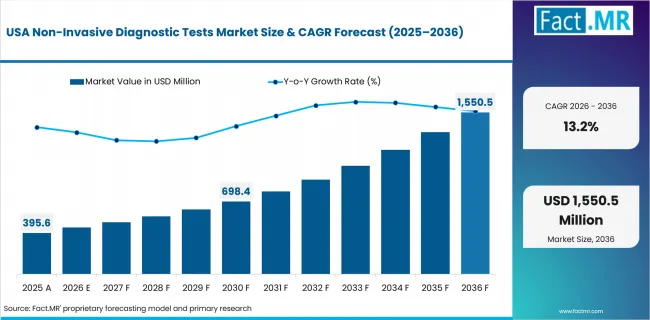
Non Invasive Diagnostic Tests Market Country Value Analysis | Source: Fact.MR
The USA’s 13.2% CAGR is linked to the growing use of approved AI tools for imaging and diagnosis. The FDA keeps a public list of authorized AI medical devices and has issued guidance on testing, record keeping and checks after launch. This gives hospitals a clear route for using image-review software while requiring companies to show that the tools remain safe and accurate over time.
What underpins South Korea’s growth?
12.1% CAGR, led by connected hospitals and remote diagnostic channels.
South Korea’s 12.1% CAGR reflects national testing programs that connect diagnosis with insured medical care. In 2025, the Korea Disease Control and Prevention Agency increased its rare-disease support program from 1,248 to 1,314 diseases. Patient capacity also rose from 410 to 800. This central testing system supports wider use of molecular tests and follow-up services that require specialist review.
How is the U.K. developing Non-Invasive Diagnostic Tests demand?
10.9% CAGR, driven by community diagnostic capacity and evidence-led NHS pathways.
The U.K. is moving more routine testing away from major hospitals through Community Diagnostic Centres. NHS England reported that these centers completed 6.8 million additional tests in 2024/25. These included CT scans, ultrasound, X-rays and laboratory tests. Bringing services closer to patients supports a 10.9% CAGR through 2036 by adding testing capacity without sending every case to a large hospital.
How does Japan perform in the market?
9.8% CAGR, backed by aging-related monitoring and home-linked care.
Japan’s 9.8% CAGR is linked to repeated health checks for an aging population and the growth of home care. Sensors, remote review and non-invasive tools can help doctors follow long-term conditions between hospital visits. Wider use is likely to remain careful because home readings still require clear medical responsibility and a set follow-up step when results change.
Who leads the Non-Invasive Diagnostic Tests Market?
Roche and Abbott lead broad diagnostics coverage, while Siemens Healthineers and GE HealthCare strengthen imaging-led non-invasive diagnostic pathways.
Roche and Abbott provide a wide range of tests for hospitals and laboratories. Siemens Healthineers and GE HealthCare supply imaging systems, while Philips adds software for radiology work. Competition among these companies depends on proven results, hospital reach and how well their products fit into daily testing.
Thermo Fisher Scientific and QIAGEN provide NGS and PCR tools for laboratories using cfDNA in cancer testing. Hologic focuses on women’s health, while Bio-Rad Laboratories and Danaher supply molecular testing products.
Which companies are the key providers?
F. Hoffmann-La Roche Ltd. and Abbott Laboratories are key providers. Siemens Healthineers, GE HealthCare and Philips are also profiled. Thermo Fisher Scientific, QIAGEN, Hologic, Bio-Rad Laboratories and Danaher complete the company set.
- F. Hoffmann-La Roche Ltd.
- Abbott Laboratories
- Siemens Healthineers AG
- GE HealthCare Technologies Inc.
- Koninklijke Philips N.V.
- Thermo Fisher Scientific Inc.
- QIAGEN N.V.
- Hologic, Inc.
- Danaher
- Bio-Rad Laboratories, Inc.
Bibliography
- F. Hoffmann-La Roche Ltd. (2025, January 31). Roche receives FDA approval for the first companion diagnostic to identify patients with HER2-ultralow metastatic breast cancer eligible for ENHERTU.
- Koninklijke Philips N.V. (2025, February 6). Philips at #ECR2025: New AI-enabled systems, intelligent software, and imaging cloud services streamline radiology workflows, advance clinical insights.
- QIAGEN N.V. (2025, June 18). QIAGEN and GENCURIX announce QIAcuity Digital PCR IVD assay development partnership.
- U.S. Food and Drug Administration. (2025, January 6). FDA issues comprehensive draft guidance for developers of artificial intelligence-enabled medical devices.
- Siemens Healthineers. (2025, March 10). Siemens Healthineers receives FDA clearance for Naeotom Alpha class of photon-counting computed tomography scanners.
This Report Addresses
- The report provides strategic intelligence on Non-Invasive Diagnostic Tests across Test Type and Technology choices that shape clinical and laboratory adoption.
- Segment analysis covers Imaging Diagnostics and Next-Generation Sequencing (NGS) as the share within the 2026 market.
- Regional outlook evaluates Germany and Brazil alongside the USA and South Korea while the U.K., Japan and broader regional markets complete the growth comparison.
- Competitive analysis profiles Roche and Abbott alongside imaging, molecular diagnostics and laboratory tool providers covered in the company section.
- Use-case assessment covers Oncology and Hospitals with cardiovascular and neurological pathways alongside infectious-disease and prenatal pathways in the segmentation framework.
What does the Non-Invasive Diagnostic Tests Market cover?
Imaging Diagnostics and Liquid Biopsy alongside Molecular Diagnostics and Wearable Diagnostic Monitoring used to support clinical decisions without tissue removal or invasive access.
The Non-Invasive Diagnostic Tests Market covers diagnostic approaches that collect clinically useful information with lower patient burden. Coverage includes image-based diagnosis, blood-based oncology testing, molecular assays, prenatal testing and remote monitoring when the result supports a defined clinical decision.
The market differs from general wellness testing because commercial value depends on clinical utility, accuracy and follow-up pathways. General consumer wellness signals remain outside the boundary unless they are used as part of a diagnostic workflow.
What is included in the scope?
Non-invasive diagnostic workflows used in hospitals and diagnostic laboratories with ambulatory care centers and home healthcare settings.
The scope includes Imaging Diagnostics and Liquid Biopsy alongside Molecular Diagnostics, Prenatal Testing and Wearable Diagnostic Monitoring. Technology coverage includes NGS and PCR with Ultrasound, MRI and AI-Based Diagnostics. Applications include Oncology, Cardiovascular Diseases, Neurological Disorders, Infectious Diseases and Prenatal & Genetic Testing when the output supports clinical assessment or monitoring.
What is excluded from the scope?
General wellness devices, invasive biopsy-only procedures and laboratory services without a non-invasive diagnostic use case are outside the scope.
The scope excludes tests that require invasive tissue removal as the primary diagnostic route. It also excludes consumer fitness trackers and wellness applications unless the device, assay or workflow is positioned for a defined diagnostic decision inside a care pathway.
How Was the Analysis Built?
The analysis draws on 120+ sources, 35+ company portfolios, 25+ countries, and more than 20 industry interviews.
- Primary Research: Primary research includes discussions with manufacturers, service providers, technology developers, distributors, end users, procurement teams, and subject-matter experts. These conversations examine purchasing priorities, product adoption, operational challenges, approval requirements, competitive positioning, and the factors that influence wider market acceptance.
- Desk Research: Desk research covers government statistics, regulatory publications, company filings, trade data, technical studies, industry associations, standards, public policy, and other authoritative sources. Every source used in the analysis is documented in the bibliography.
- Market Sizing and Forecasting: Market estimates combine historical performance, demand indicators, pricing and volume trends, segment shares, company participation, country-level growth, adoption patterns, investment activity, and barriers to market expansion.
- Data Validation and Update Cycle: Findings are validated by comparing primary interviews with public data, company activity, regulatory changes, trade patterns, and industry developments. Regular updates review new product launches, capacity changes, partnerships, approvals, procurement trends, and shifts in commercial adoption.
Segmentation
What is the report’s scope and coverage?
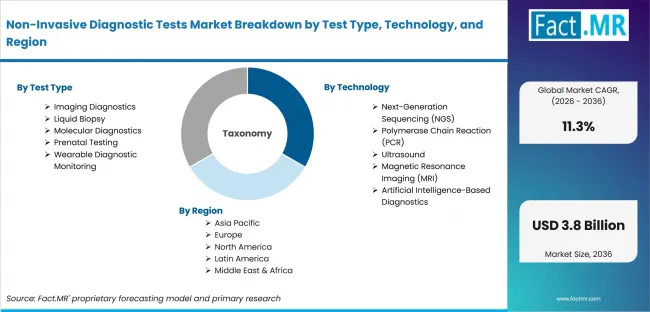
Non Invasive Diagnostic Tests Market Breakdown By Test Type, Technology, And Region | Source: Fact.MR
| Attribute | Details |
|---|---|
| Quantitative Units | USD Billion in 2026 to USD Billion by 2036 at CAGR |
| Market Definition | Diagnostic tests that gather clinically useful information without tissue removal or invasive access across imaging, molecular, liquid-biopsy and monitoring pathways |
| Test Type | Imaging Diagnostics; Liquid Biopsy; Molecular Diagnostics; Prenatal Testing; Wearable Diagnostic Monitoring |
| Technology | Next-Generation Sequencing (NGS); Polymerase Chain Reaction (PCR); Ultrasound; Magnetic Resonance Imaging (MRI); Artificial Intelligence-Based Diagnostics |
| Application | Oncology; Cardiovascular Diseases; Neurological Disorders; Infectious Diseases; Prenatal & Genetic Testing |
| End User | Hospitals; Diagnostic Laboratories; Ambulatory Care Centers; Home Healthcare Settings |
| Regions Covered | North America; Latin America; Western Europe; Eastern Europe; East Asia; South Asia and Pacific; Middle East and Africa |
| Countries Covered | Germany; Brazil; USA; South Korea; U.K.; Japan |
| Key Companies Profiled | Roche; Abbott; Siemens Healthineers; GE HealthCare; Philips; Thermo Fisher Scientific; QIAGEN; Hologic; Bio-Rad Laboratories; Danaher |
| Forecast Period | 2026 to 2036 |
| Approach | Hybrid top-down and bottom-up approach using diagnostic infrastructure, installed imaging base, laboratory workflow evidence, segment shares, country pathways and company participation |
Source: Fact.MR analysis. Updated Jul 21, 2026
How is the market segmented?
-
By Test Type:
- Imaging Diagnostics
- Liquid Biopsy
- Molecular Diagnostics
- Prenatal Testing
- Wearable Diagnostic Monitoring
-
By Technology:
- Next-Generation Sequencing (NGS)
- Polymerase Chain Reaction (PCR)
- Ultrasound
- Magnetic Resonance Imaging (MRI)
- Artificial Intelligence-Based Diagnostics
-
By Application:
- Oncology
- Cardiovascular Diseases
- Neurological Disorders
- Infectious Diseases
- Prenatal & Genetic Testing
-
By End User:
- Hospitals
- Diagnostic Laboratories
- Ambulatory Care Centers
- Home Healthcare Settings
-
By Region:
- North America
- USA
- Canada
- Latin America
- Brazil
- Mexico
- Western Europe
- Germany
- U.K.
- France
- Italy
- Spain
- Eastern Europe
- Poland
- Russia
- East Asia
- China
- Japan
- South Korea
- South Asia and Pacific
- India
- ASEAN
- Australia and New Zealand
- Middle East & Africa
- GCC Countries
- South Africa
- North America
Frequently Asked Questions
Which Test Type leads the Non-Invasive Diagnostic Tests Market?
Which Technology leads the Non-Invasive Diagnostic Tests Market?
Which Application leads the Non-Invasive Diagnostic Tests Market?
Which End User leads the Non-Invasive Diagnostic Tests Market?
Which country records the highest CAGR in the Non-Invasive Diagnostic Tests Market?
What is the primary driver in the Non-Invasive Diagnostic Tests Market?
What is the main restraint in the Non-Invasive Diagnostic Tests Market?
Who worked on this report


Preview the report firsthand - request a free sample
Free SampleGet the brochure for pricing and purchase details
Download PDF