Mining Tailings Water-Soluble Flocculants Market

Mining Tailings Water-Soluble Flocculants Market Size and Share Forecast Outlook 2026 to 2036

Mining tailings water-soluble flocculants market is projected to grow from USD 0.5 billion in 2026 to USD 1.2 billion by 2036, at a CAGR of 9.8%. Polyacrylamide (PAM) will dominate with a 38.0% market share, while gold tailings will lead the tailings type segment with a 22.0% share.

Mining Tailings Water-Soluble Flocculants Market Forecast and Outlook 2026 to 2036

The global market for mining tailings water-soluble flocculants is projected to grow from USD 0.48 billion in 2026 to USD 1.23 billion by 2036, advancing at a 9.8% CAGR. This steady growth is anchored in the non-negotiable imperative for the global mining industry to achieve water security, ensure tailings dam stability, and comply with increasingly stringent environmental regulations.

Key Takeaways from the Mining Tailings Water-Soluble Flocculants Market
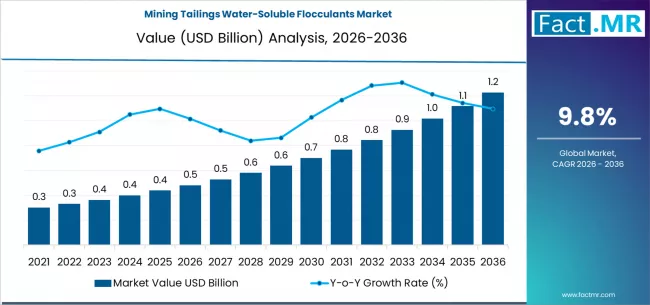
  • Market Value for 2026: USD 0.48 Billion
  • Market Value for 2036: USD 1.23 Billion
  • Forecast CAGR (2026-2036): 9.8%
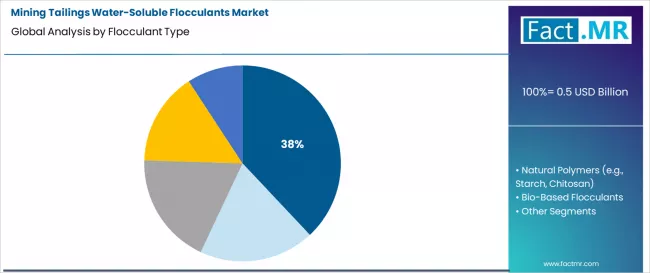
  • Leading Flocculant Type Segment (2026): Polyacrylamide (PAM) (38%)
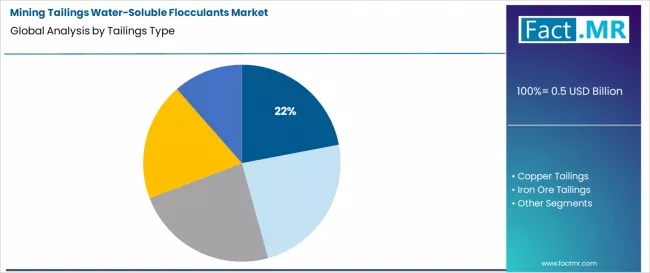
  • Leading Tailings Type Segment (2026): Gold Tailings (22%)
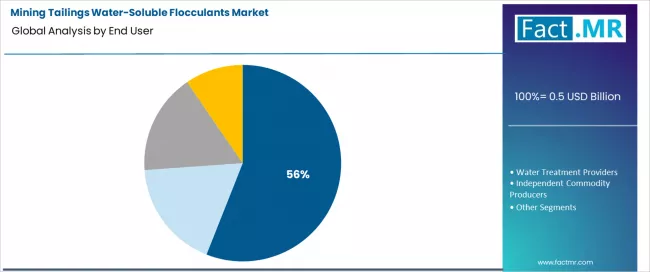
  • Leading End User Segment (2026): Mining Operators (56%)
  • Key Growth Countries: India (11.30% CAGR), China (10.70% CAGR), Australia (9.50% CAGR), Canada (9.10% CAGR), USA (8.90% CAGR)
  • Key Players in the Market: SNF Group, BASF SE, Kemira Oyj, Archer Daniels Midland (ADM), Solvay SA

Mining Tailings Water Soluble Flocculants Market Market Value Analysis

The market is evolving from a focus on simple dewatering efficiency to a demand for solutions that deliver superior performance under variable ore conditions, reduce overall water and energy consumption, and minimize the environmental footprint of the chemicals themselves. India’s 11.30% CAGR highlights the rapid expansion and modernization of its mining sector, where new projects are incorporating advanced tailings management from inception.

This market’s trajectory is defined by the dual challenge of improving operational economics through better water recycling while simultaneously meeting stakeholder demands for safer, more sustainable mine waste management practices, positioning high-performance flocculants as a key lever for responsible resource extraction.

Metric

Metric Value
Market Value (2026) USD 0.48 Billion
Market Forecast Value (2036) USD 1.23 Billion
Forecast CAGR (2026-2036) 9.8%

Category

Category Segments
Flocculant Type Polyacrylamide (PAM), Natural Polymers (e.g., Starch, Chitosan), Bio-Based Flocculants, Anionic Copolymers, Others
Tailings Type Gold Tailings, Copper Tailings, Iron Ore Tailings, Coal & Energy Minerals, Others
End User Mining Operators, Water Treatment Providers, Independent Commodity Producers, Specialty Chemical Distributors
Region North America, Latin America, Western Europe, Eastern Europe, East Asia, South Asia & Pacific, MEA

Segmental Analysis

By Flocculant Type, Which Chemistry Remains the Unrivalled Performance Workhorse?
Mining Tailings Water Soluble Flocculants Market Analysis By Flocculant Type

Polyacrylamide-based flocculants maintain a dominant 38% share. Their leadership is attributed to their unparalleled versatility and efficacy. Through precise control of molecular weight and ionic charge, PAM formulations can be tailored to the specific mineralogy, pH, and ionic strength of virtually any tailings stream.

This ability to create custom solutions that maximize settling rates and sediment density, thereby recovering more process water and creating more stable tailings deposits, ensures PAM’s continued role as the foundational technology in modern tailings management.

By Tailings Type, Which Ore Presents Distinctive Dewatering Challenges?
Mining Tailings Water Soluble Flocculants Market Analysis By Tailings Type

Gold tailings represent a significant segment at 22%. The processing of gold ores, often involving cyanide or other reagents, creates tailings with complex chemistries that can inhibit flocculation.

The fine particle size distribution common in gold tailings demands highly efficient flocculants to achieve clarity in recycled water. The high value of the recovered water and the critical importance of tailings stability for these operations drive continuous optimization and investment in advanced flocculant solutions specifically engineered for this sector.

By End User, Who is the Primary Driver of Specification and Innovation?
Mining Tailings Water Soluble Flocculants Market Analysis By End User

Mining operators are the principal end-users, accounting for 56% of the market. Their direct operational responsibility for tailings management, water balance, and regulatory compliance makes them the ultimate decision-makers.

They drive innovation by demanding flocculants that not only perform but also integrate seamlessly into their specific process flows, reduce total cost of operation through lower dosages or energy savings, and align with corporate sustainability targets. Their in-house expertise and large-volume purchasing power shape product development and competitive dynamics.

Factor

Factor Category Brief Description
Water Scarcity & Recycling Mandates Driver Intensifying water stress in mining regions forces operators to maximize water recovery from tailings, increasing reliance on high-efficiency flocculants.
High Cost & Performance Variability of Novel Formulations Restraint Developing and scaling new bio-based or tailored flocculants is costly, and their performance can be inconsistent across different ore types and sites.
Development of Ore-Specific & Smart Flocculants Opportunity Creating flocculants tailored to specific mineralogies or that react to process changes can command premium pricing and secure long-term site contracts.
Rise of Contract Dewatering & Chemical Management Trend Growth of specialized service providers who manage the entire dewatering process, shifting the purchasing decision from product to performance outcome.

Analysis of the Mining Tailings Water-Soluble Flocculants Market by Key Countries
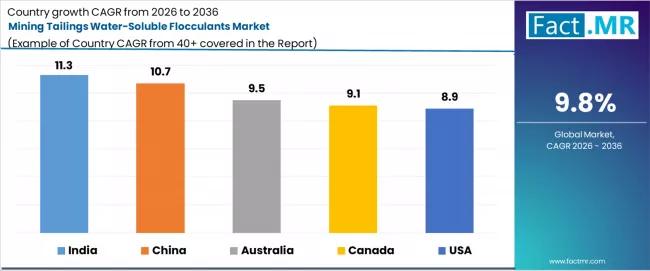
Mining Tailings Water Soluble Flocculants Market Cagr Analysis By Country

Country CAGR (2026-2036)
India 11.30%
China 10.70%
Australia 9.50%
Canada 9.10%
USA 8.90%

How is India's Mining Sector Expansion and Environmental Focus Driving Growth?

India's leading 11.30% CAGR is fueled by major government initiatives to increase domestic mineral production, which involves opening new mines and modernizing old ones. New projects are required to implement advanced tailings management systems with high water-recycle rates from the start.

This greenfield demand, combined with increasing enforcement of environmental norms around effluent quality and tailings pond safety, creates a strong pull for effective flocculation technologies and expertise.

What is the Impact of China's Dominance in Mining and Domestic Chemical Production?

China's 10.70% growth stems from its position as the world's largest miner of multiple metals. The scale of its tailings generation is immense, driving continuous consumption. Domestic flocculant producers benefit from integrated supply chains and government support, allowing them to cater to the vast local market with cost-competitive products.

The focus is on supplying the volume and basic performance required for large-scale operations, while also investing in more advanced products for specific, high-value applications.

Why is Australia's Leadership in Dry Stack Tailings and Innovation a Key Factor?

Global leadership in adopting dry stack tailings technology, which requires exceptional dewatering to achieve a paste or cake consistency, underpins Australia’s 9.50% CAGR. This creates a premium market for high-performance flocculants.

Australian mining companies and research bodies are at the forefront of testing and specifying novel, efficient formulations, making the country a critical proving ground for innovation and best practice in sustainable tailings management.

How is Canada's Stringent Regulatory Environment and Arctic Mining Shaping Demand?

Canada's 9.10% growth occurs within a context of rigorous environmental assessment processes and cold-climate mining challenges. Flocculants must perform reliably in low-temperature processes and meet strict toxicity standards for discharge.

The market demands robust technical data and environmental product profiles, favoring suppliers with strong R&D capabilities who can provide solutions for complex, sensitive projects in remote locations.

What Role does the USA's Focus on Critical Minerals and Legacy Site Management Play?
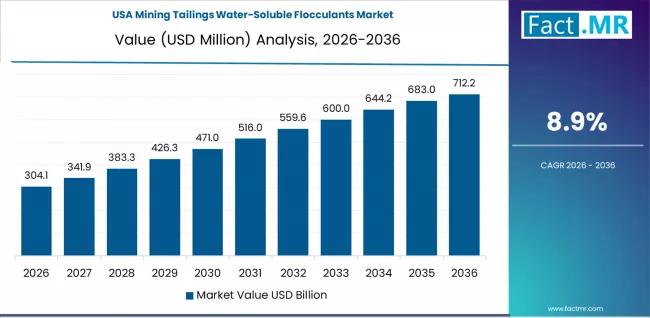
Mining Tailings Water Soluble Flocculants Market Country Value Analysis

The USA's 8.90% growth is driven by its push to develop domestic sources of critical minerals and the ongoing need to manage water and tailings at legacy mining sites. New critical mineral projects emphasize sustainable design, including advanced water treatment. Remediation of historical sites often involves water treatment from tailings facilities, creating a steady demand for flocculants in both new build and environmental cleanup contexts.

Competitive Landscape of the Mining Tailings Water-Soluble Flocculants Market
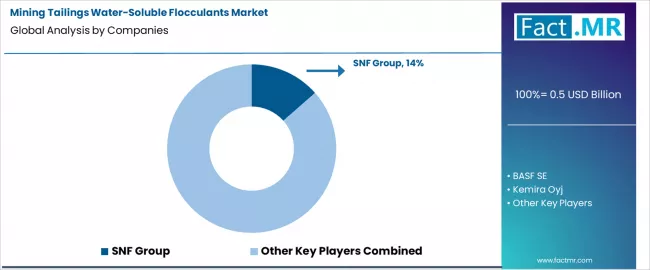
Mining Tailings Water Soluble Flocculants Market Analysis By Company

The competitive landscape is consolidated among a few global specialty chemical giants with extensive product portfolios and deep application expertise. Competition is intense and revolves around providing comprehensive technical service and site-specific formulation support, rather than just selling a commodity chemical.

Success is built on long-term relationships with major mining houses, demonstrated through on-site trials that prove reductions in total cost of operation via lower dosage, better water clarity, or increased throughput. The ability to maintain a global supply network and provide rapid technical support to remote mine sites is a significant barrier to entry for smaller players.

Strategic Recommendation Rationale for Key Players
Invest in Sustainable Product Lines Develop and prominently market bio-based or low-toxicity flocculants to align with mining ESG goals and pre-empt future regulatory restrictions on traditional polymers.
Develop Digital Service Bundles Move beyond chemical supply to offer integrated digital solutions (sensors, AI-driven dosing control) that optimize performance and provide measurable ROI on water recovery and tailings density.
Forge Strategic Alliances with EPCs Partner with engineering firms that design new processing plants to have flocculant systems specified at the design phase, locking in long-term supply contracts for new greenfield projects.
Focus on Regional Application Expertise Establish strong technical teams in high-growth regions (e.g., India, Latin America) to provide hyper-local formulation support that addresses specific regional ore types and water chemistry challenges.

Key Players in the Mining Tailings Water-Soluble Flocculants Market

  • SNF Group
  • BASF SE
  • Kemira Oyj
  • Archer Daniels Midland (ADM)
  • Solvay SA

Scope of Report

Items Values
Quantitative Units USD Billion
Flocculant Type Polyacrylamide (PAM), Natural Polymers, Bio-Based Flocculants, Anionic Copolymers, Others
Tailings Type Gold Tailings, Copper Tailings, Iron Ore Tailings, Coal & Energy Minerals, Others
End User Mining Operators, Water Treatment Providers, Independent Commodity Producers, Specialty Chemical Distributors
Key Countries India, China, Australia, Canada, USA
Key Companies SNF Group, BASF SE, Kemira Oyj, Archer Daniels Midland (ADM), Solvay SA
Additional Analysis Flocculant performance benchmarking across different ore mineralogies; life cycle assessment of bio-based vs. synthetic flocculants; analysis of residue (acrylamide monomer) in treated water and tailings; impact of process water salinity and pH on flocculant selection and dosage; total cost of ownership models incorporating chemical, energy, and water savings; regulatory trends regarding chemical use in tailings facilities and discharge standards.

Market by Segments

  • Flocculant Type :

    • Polyacrylamide (PAM)
    • Natural Polymers
    • Bio-Based Flocculants
    • Anionic Copolymers
    • Others
  • Tailings Type :

    • Gold Tailings
    • Copper Tailings
    • Iron Ore Tailings
    • Coal & Energy Minerals
    • Others
  • End User :

    • Mining Operators
    • Water Treatment Providers
    • Independent Commodity Producers
    • Specialty Chemical Distributors
  • Region :

    • North America
      • USA
      • Canada
    • Latin America
      • Brazil
      • Chile
      • Argentina
      • Rest of Latin America
    • Western Europe
      • Germany
      • France
      • Italy
      • Spain
      • UK
      • BENELUX
      • Rest of Western Europe
    • Eastern Europe
      • Russia
      • Poland
      • Czech Republic
      • Rest of Eastern Europe
    • East Asia
      • China
      • Japan
      • South Korea
      • Rest of East Asia
    • South Asia & Pacific
      • India
      • Australia
      • ASEAN
      • Rest of South Asia & Pacific
    • MEA
      • South Africa
      • GCC Countries
      • Turkiye
      • Rest of MEA

References

  • Global Tailings Review. 2023. Global Industry Standard on Tailings Management. GTR.
  • International Council on Mining and Metals. 2024. Water Stewardship in Mining: A Reference Guide. ICMM.
  • Kesimal, A., & Ofori, P. 2023. Flocculants and their role in tailings management and water recovery. Minerals Engineering Journal.
  • Mudd, G. M., & Boger, D. V. 2024. The ever-growing case for paste and thickened tailings- towards more sustainable waste management. International Journal of Mining, Reclamation and Environment.
  • Owen, J. R., & Kemp, D. 2023. Tailings facility failures and corporate engineering: A forensic analysis. The Extractive Industries and Society.
  • Ruan, D., & Fourie, A. 2024. Advances in tailings dewatering: From thickening to filtration. Canadian Geotechnical Journal.
  • Wang, C., & Harbottle, D. 2023. Polymer-based flocculants and their application in mineral processing. Current Opinion in Colloid & Interface Science.

Table of Content

  1. Executive Summary
    • Global Market Outlook
    • Demand to side Trends
    • Supply to side Trends
    • Technology Roadmap Analysis
    • Analysis and Recommendations
  2. Market Overview
    • Market Coverage / Taxonomy
    • Market Definition / Scope / Limitations
  3. Market Background
    • Market Dynamics
      • Drivers
      • Restraints
      • Opportunity
      • Trends
    • Scenario Forecast
      • Demand in Optimistic Scenario
      • Demand in Likely Scenario
      • Demand in Conservative Scenario
    • Opportunity Map Analysis
    • Product Life Cycle Analysis
    • Supply Chain Analysis
    • Investment Feasibility Matrix
    • Value Chain Analysis
    • PESTLE and Porter’s Analysis
    • Regulatory Landscape
    • Regional Parent Market Outlook
    • Production and Consumption Statistics
    • Import and Export Statistics
  4. Global Market Analysis 2021 to 2025 and Forecast, 2026 to 2036
    • Historical Market Size Value (USD Million) Analysis, 2021 to 2025
    • Current and Future Market Size Value (USD Million) Projections, 2026 to 2036
      • Y to o to Y Growth Trend Analysis
      • Absolute $ Opportunity Analysis
  5. Global Market Pricing Analysis 2021 to 2025 and Forecast 2026 to 2036
  6. Global Market Analysis 2021 to 2025 and Forecast 2026 to 2036, By Flocculant Type
    • Introduction / Key Findings
    • Historical Market Size Value (USD Million) Analysis By Flocculant Type, 2021 to 2025
    • Current and Future Market Size Value (USD Million) Analysis and Forecast By Flocculant Type, 2026 to 2036
      • Polyacrylamide (PAM)
      • Natural Polymers (e.g., Starch, Chitosan)
      • Bio-Based Flocculants
      • Anionic Copolymers
      • Others
    • Y to o to Y Growth Trend Analysis By Flocculant Type, 2021 to 2025
    • Absolute $ Opportunity Analysis By Flocculant Type, 2026 to 2036
  7. Global Market Analysis 2021 to 2025 and Forecast 2026 to 2036, By Tailings Type
    • Introduction / Key Findings
    • Historical Market Size Value (USD Million) Analysis By Tailings Type, 2021 to 2025
    • Current and Future Market Size Value (USD Million) Analysis and Forecast By Tailings Type, 2026 to 2036
      • Gold Tailings
      • Copper Tailings
      • Iron Ore Tailings
      • Coal & Energy Minerals
      • Others
    • Y to o to Y Growth Trend Analysis By Tailings Type, 2021 to 2025
    • Absolute $ Opportunity Analysis By Tailings Type, 2026 to 2036
  8. Global Market Analysis 2021 to 2025 and Forecast 2026 to 2036, By End User
    • Introduction / Key Findings
    • Historical Market Size Value (USD Million) Analysis By End User, 2021 to 2025
    • Current and Future Market Size Value (USD Million) Analysis and Forecast By End User, 2026 to 2036
      • Mining Operators
      • Water Treatment Providers
      • Independent Commodity Producers
      • Specialty Chemical Distributors
    • Y to o to Y Growth Trend Analysis By End User, 2021 to 2025
    • Absolute $ Opportunity Analysis By End User, 2026 to 2036
  9. Global Market Analysis 2021 to 2025 and Forecast 2026 to 2036, By Region
    • Introduction
    • Historical Market Size Value (USD Million) Analysis By Region, 2021 to 2025
    • Current Market Size Value (USD Million) Analysis and Forecast By Region, 2026 to 2036
      • North America
      • Latin America
      • Western Europe
      • Eastern Europe
      • East Asia
      • South Asia and Pacific
      • Middle East & Africa
    • Market Attractiveness Analysis By Region
  10. North America Market Analysis 2021 to 2025 and Forecast 2026 to 2036, By Country
    • Historical Market Size Value (USD Million) Trend Analysis By Market Taxonomy, 2021 to 2025
    • Market Size Value (USD Million) Forecast By Market Taxonomy, 2026 to 2036
      • By Country
        • USA
        • Canada
        • Mexico
      • By Flocculant Type
      • By Tailings Type
      • By End User
    • Market Attractiveness Analysis
      • By Country
      • By Flocculant Type
      • By Tailings Type
      • By End User
    • Key Takeaways
  11. Latin America Market Analysis 2021 to 2025 and Forecast 2026 to 2036, By Country
    • Historical Market Size Value (USD Million) Trend Analysis By Market Taxonomy, 2021 to 2025
    • Market Size Value (USD Million) Forecast By Market Taxonomy, 2026 to 2036
      • By Country
        • Brazil
        • Chile
        • Rest of Latin America
      • By Flocculant Type
      • By Tailings Type
      • By End User
    • Market Attractiveness Analysis
      • By Country
      • By Flocculant Type
      • By Tailings Type
      • By End User
    • Key Takeaways
  12. Western Europe Market Analysis 2021 to 2025 and Forecast 2026 to 2036, By Country
    • Historical Market Size Value (USD Million) Trend Analysis By Market Taxonomy, 2021 to 2025
    • Market Size Value (USD Million) Forecast By Market Taxonomy, 2026 to 2036
      • By Country
        • Germany
        • UK
        • Italy
        • Spain
        • France
        • Nordic
        • BENELUX
        • Rest of Western Europe
      • By Flocculant Type
      • By Tailings Type
      • By End User
    • Market Attractiveness Analysis
      • By Country
      • By Flocculant Type
      • By Tailings Type
      • By End User
    • Key Takeaways
  13. Eastern Europe Market Analysis 2021 to 2025 and Forecast 2026 to 2036, By Country
    • Historical Market Size Value (USD Million) Trend Analysis By Market Taxonomy, 2021 to 2025
    • Market Size Value (USD Million) Forecast By Market Taxonomy, 2026 to 2036
      • By Country
        • Russia
        • Poland
        • Hungary
        • Balkan & Baltic
        • Rest of Eastern Europe
      • By Flocculant Type
      • By Tailings Type
      • By End User
    • Market Attractiveness Analysis
      • By Country
      • By Flocculant Type
      • By Tailings Type
      • By End User
    • Key Takeaways
  14. East Asia Market Analysis 2021 to 2025 and Forecast 2026 to 2036, By Country
    • Historical Market Size Value (USD Million) Trend Analysis By Market Taxonomy, 2021 to 2025
    • Market Size Value (USD Million) Forecast By Market Taxonomy, 2026 to 2036
      • By Country
        • China
        • Japan
        • South Korea
      • By Flocculant Type
      • By Tailings Type
      • By End User
    • Market Attractiveness Analysis
      • By Country
      • By Flocculant Type
      • By Tailings Type
      • By End User
    • Key Takeaways
  15. South Asia and Pacific Market Analysis 2021 to 2025 and Forecast 2026 to 2036, By Country
    • Historical Market Size Value (USD Million) Trend Analysis By Market Taxonomy, 2021 to 2025
    • Market Size Value (USD Million) Forecast By Market Taxonomy, 2026 to 2036
      • By Country
        • India
        • ASEAN
        • Australia & New Zealand
        • Rest of South Asia and Pacific
      • By Flocculant Type
      • By Tailings Type
      • By End User
    • Market Attractiveness Analysis
      • By Country
      • By Flocculant Type
      • By Tailings Type
      • By End User
    • Key Takeaways
  16. Middle East & Africa Market Analysis 2021 to 2025 and Forecast 2026 to 2036, By Country
    • Historical Market Size Value (USD Million) Trend Analysis By Market Taxonomy, 2021 to 2025
    • Market Size Value (USD Million) Forecast By Market Taxonomy, 2026 to 2036
      • By Country
        • Kingdom of Saudi Arabia
        • Other GCC Countries
        • Turkiye
        • South Africa
        • Other African Union
        • Rest of Middle East & Africa
      • By Flocculant Type
      • By Tailings Type
      • By End User
    • Market Attractiveness Analysis
      • By Country
      • By Flocculant Type
      • By Tailings Type
      • By End User
    • Key Takeaways
  17. Key Countries Market Analysis
    • USA
      • Pricing Analysis
      • Market Share Analysis, 2025
        • By Flocculant Type
        • By Tailings Type
        • By End User
    • Canada
      • Pricing Analysis
      • Market Share Analysis, 2025
        • By Flocculant Type
        • By Tailings Type
        • By End User
    • Mexico
      • Pricing Analysis
      • Market Share Analysis, 2025
        • By Flocculant Type
        • By Tailings Type
        • By End User
    • Brazil
      • Pricing Analysis
      • Market Share Analysis, 2025
        • By Flocculant Type
        • By Tailings Type
        • By End User
    • Chile
      • Pricing Analysis
      • Market Share Analysis, 2025
        • By Flocculant Type
        • By Tailings Type
        • By End User
    • Germany
      • Pricing Analysis
      • Market Share Analysis, 2025
        • By Flocculant Type
        • By Tailings Type
        • By End User
    • UK
      • Pricing Analysis
      • Market Share Analysis, 2025
        • By Flocculant Type
        • By Tailings Type
        • By End User
    • Italy
      • Pricing Analysis
      • Market Share Analysis, 2025
        • By Flocculant Type
        • By Tailings Type
        • By End User
    • Spain
      • Pricing Analysis
      • Market Share Analysis, 2025
        • By Flocculant Type
        • By Tailings Type
        • By End User
    • France
      • Pricing Analysis
      • Market Share Analysis, 2025
        • By Flocculant Type
        • By Tailings Type
        • By End User
    • India
      • Pricing Analysis
      • Market Share Analysis, 2025
        • By Flocculant Type
        • By Tailings Type
        • By End User
    • ASEAN
      • Pricing Analysis
      • Market Share Analysis, 2025
        • By Flocculant Type
        • By Tailings Type
        • By End User
    • Australia & New Zealand
      • Pricing Analysis
      • Market Share Analysis, 2025
        • By Flocculant Type
        • By Tailings Type
        • By End User
    • China
      • Pricing Analysis
      • Market Share Analysis, 2025
        • By Flocculant Type
        • By Tailings Type
        • By End User
    • Japan
      • Pricing Analysis
      • Market Share Analysis, 2025
        • By Flocculant Type
        • By Tailings Type
        • By End User
    • South Korea
      • Pricing Analysis
      • Market Share Analysis, 2025
        • By Flocculant Type
        • By Tailings Type
        • By End User
    • Russia
      • Pricing Analysis
      • Market Share Analysis, 2025
        • By Flocculant Type
        • By Tailings Type
        • By End User
    • Poland
      • Pricing Analysis
      • Market Share Analysis, 2025
        • By Flocculant Type
        • By Tailings Type
        • By End User
    • Hungary
      • Pricing Analysis
      • Market Share Analysis, 2025
        • By Flocculant Type
        • By Tailings Type
        • By End User
    • Kingdom of Saudi Arabia
      • Pricing Analysis
      • Market Share Analysis, 2025
        • By Flocculant Type
        • By Tailings Type
        • By End User
    • Turkiye
      • Pricing Analysis
      • Market Share Analysis, 2025
        • By Flocculant Type
        • By Tailings Type
        • By End User
    • South Africa
      • Pricing Analysis
      • Market Share Analysis, 2025
        • By Flocculant Type
        • By Tailings Type
        • By End User
  18. Market Structure Analysis
    • Competition Dashboard
    • Competition Benchmarking
    • Market Share Analysis of Top Players
      • By Regional
      • By Flocculant Type
      • By Tailings Type
      • By End User
  19. Competition Analysis
    • Competition Deep Dive
      • SNF Group
        • Overview
        • Product Portfolio
        • Profitability by Market Segments (Product/Age /Sales Channel/Region)
        • Sales Footprint
        • Strategy Overview
          • Marketing Strategy
          • Product Strategy
          • Channel Strategy
      • BASF SE
      • Kemira Oyj
      • Archer Daniels Midland (ADM)
      • Solvay SA
      • Others
  20. Assumptions & Acronyms Used
  21. Research Methodology

List Of Table

  • Table 1: Global Market Value (USD Million) Forecast by Region, 2021 to 2036
  • Table 2: Global Market Value (USD Million) Forecast by Flocculant Type, 2021 to 2036
  • Table 3: Global Market Value (USD Million) Forecast by Tailings Type, 2021 to 2036
  • Table 4: Global Market Value (USD Million) Forecast by End User, 2021 to 2036
  • Table 5: North America Market Value (USD Million) Forecast by Country, 2021 to 2036
  • Table 6: North America Market Value (USD Million) Forecast by Flocculant Type, 2021 to 2036
  • Table 7: North America Market Value (USD Million) Forecast by Tailings Type, 2021 to 2036
  • Table 8: North America Market Value (USD Million) Forecast by End User, 2021 to 2036
  • Table 9: Latin America Market Value (USD Million) Forecast by Country, 2021 to 2036
  • Table 10: Latin America Market Value (USD Million) Forecast by Flocculant Type, 2021 to 2036
  • Table 11: Latin America Market Value (USD Million) Forecast by Tailings Type, 2021 to 2036
  • Table 12: Latin America Market Value (USD Million) Forecast by End User, 2021 to 2036
  • Table 13: Western Europe Market Value (USD Million) Forecast by Country, 2021 to 2036
  • Table 14: Western Europe Market Value (USD Million) Forecast by Flocculant Type, 2021 to 2036
  • Table 15: Western Europe Market Value (USD Million) Forecast by Tailings Type, 2021 to 2036
  • Table 16: Western Europe Market Value (USD Million) Forecast by End User, 2021 to 2036
  • Table 17: Eastern Europe Market Value (USD Million) Forecast by Country, 2021 to 2036
  • Table 18: Eastern Europe Market Value (USD Million) Forecast by Flocculant Type, 2021 to 2036
  • Table 19: Eastern Europe Market Value (USD Million) Forecast by Tailings Type, 2021 to 2036
  • Table 20: Eastern Europe Market Value (USD Million) Forecast by End User, 2021 to 2036
  • Table 21: East Asia Market Value (USD Million) Forecast by Country, 2021 to 2036
  • Table 22: East Asia Market Value (USD Million) Forecast by Flocculant Type, 2021 to 2036
  • Table 23: East Asia Market Value (USD Million) Forecast by Tailings Type, 2021 to 2036
  • Table 24: East Asia Market Value (USD Million) Forecast by End User, 2021 to 2036
  • Table 25: South Asia and Pacific Market Value (USD Million) Forecast by Country, 2021 to 2036
  • Table 26: South Asia and Pacific Market Value (USD Million) Forecast by Flocculant Type, 2021 to 2036
  • Table 27: South Asia and Pacific Market Value (USD Million) Forecast by Tailings Type, 2021 to 2036
  • Table 28: South Asia and Pacific Market Value (USD Million) Forecast by End User, 2021 to 2036
  • Table 29: Middle East & Africa Market Value (USD Million) Forecast by Country, 2021 to 2036
  • Table 30: Middle East & Africa Market Value (USD Million) Forecast by Flocculant Type, 2021 to 2036
  • Table 31: Middle East & Africa Market Value (USD Million) Forecast by Tailings Type, 2021 to 2036
  • Table 32: Middle East & Africa Market Value (USD Million) Forecast by End User, 2021 to 2036

List Of Figures

  • Figure 1: Global Market Pricing Analysis
  • Figure 2: Global Market Value (USD Million) Forecast 2021 to 2036
  • Figure 3: Global Market Value Share and BPS Analysis by Flocculant Type, 2026 and 2036
  • Figure 4: Global Market Y to o to Y Growth Comparison by Flocculant Type, 2026 to 2036
  • Figure 5: Global Market Attractiveness Analysis by Flocculant Type
  • Figure 6: Global Market Value Share and BPS Analysis by Tailings Type, 2026 and 2036
  • Figure 7: Global Market Y to o to Y Growth Comparison by Tailings Type, 2026 to 2036
  • Figure 8: Global Market Attractiveness Analysis by Tailings Type
  • Figure 9: Global Market Value Share and BPS Analysis by End User, 2026 and 2036
  • Figure 10: Global Market Y to o to Y Growth Comparison by End User, 2026 to 2036
  • Figure 11: Global Market Attractiveness Analysis by End User
  • Figure 12: Global Market Value (USD Million) Share and BPS Analysis by Region, 2026 and 2036
  • Figure 13: Global Market Y to o to Y Growth Comparison by Region, 2026 to 2036
  • Figure 14: Global Market Attractiveness Analysis by Region
  • Figure 15: North America Market Incremental Dollar Opportunity, 2026 to 2036
  • Figure 16: Latin America Market Incremental Dollar Opportunity, 2026 to 2036
  • Figure 17: Western Europe Market Incremental Dollar Opportunity, 2026 to 2036
  • Figure 18: Eastern Europe Market Incremental Dollar Opportunity, 2026 to 2036
  • Figure 19: East Asia Market Incremental Dollar Opportunity, 2026 to 2036
  • Figure 20: South Asia and Pacific Market Incremental Dollar Opportunity, 2026 to 2036
  • Figure 21: Middle East & Africa Market Incremental Dollar Opportunity, 2026 to 2036
  • Figure 22: North America Market Value Share and BPS Analysis by Country, 2026 and 2036
  • Figure 23: North America Market Value Share and BPS Analysis by Flocculant Type, 2026 and 2036
  • Figure 24: North America Market Y to o to Y Growth Comparison by Flocculant Type, 2026 to 2036
  • Figure 25: North America Market Attractiveness Analysis by Flocculant Type
  • Figure 26: North America Market Value Share and BPS Analysis by Tailings Type, 2026 and 2036
  • Figure 27: North America Market Y to o to Y Growth Comparison by Tailings Type, 2026 to 2036
  • Figure 28: North America Market Attractiveness Analysis by Tailings Type
  • Figure 29: North America Market Value Share and BPS Analysis by End User, 2026 and 2036
  • Figure 30: North America Market Y to o to Y Growth Comparison by End User, 2026 to 2036
  • Figure 31: North America Market Attractiveness Analysis by End User
  • Figure 32: Latin America Market Value Share and BPS Analysis by Country, 2026 and 2036
  • Figure 33: Latin America Market Value Share and BPS Analysis by Flocculant Type, 2026 and 2036
  • Figure 34: Latin America Market Y to o to Y Growth Comparison by Flocculant Type, 2026 to 2036
  • Figure 35: Latin America Market Attractiveness Analysis by Flocculant Type
  • Figure 36: Latin America Market Value Share and BPS Analysis by Tailings Type, 2026 and 2036
  • Figure 37: Latin America Market Y to o to Y Growth Comparison by Tailings Type, 2026 to 2036
  • Figure 38: Latin America Market Attractiveness Analysis by Tailings Type
  • Figure 39: Latin America Market Value Share and BPS Analysis by End User, 2026 and 2036
  • Figure 40: Latin America Market Y to o to Y Growth Comparison by End User, 2026 to 2036
  • Figure 41: Latin America Market Attractiveness Analysis by End User
  • Figure 42: Western Europe Market Value Share and BPS Analysis by Country, 2026 and 2036
  • Figure 43: Western Europe Market Value Share and BPS Analysis by Flocculant Type, 2026 and 2036
  • Figure 44: Western Europe Market Y to o to Y Growth Comparison by Flocculant Type, 2026 to 2036
  • Figure 45: Western Europe Market Attractiveness Analysis by Flocculant Type
  • Figure 46: Western Europe Market Value Share and BPS Analysis by Tailings Type, 2026 and 2036
  • Figure 47: Western Europe Market Y to o to Y Growth Comparison by Tailings Type, 2026 to 2036
  • Figure 48: Western Europe Market Attractiveness Analysis by Tailings Type
  • Figure 49: Western Europe Market Value Share and BPS Analysis by End User, 2026 and 2036
  • Figure 50: Western Europe Market Y to o to Y Growth Comparison by End User, 2026 to 2036
  • Figure 51: Western Europe Market Attractiveness Analysis by End User
  • Figure 52: Eastern Europe Market Value Share and BPS Analysis by Country, 2026 and 2036
  • Figure 53: Eastern Europe Market Value Share and BPS Analysis by Flocculant Type, 2026 and 2036
  • Figure 54: Eastern Europe Market Y to o to Y Growth Comparison by Flocculant Type, 2026 to 2036
  • Figure 55: Eastern Europe Market Attractiveness Analysis by Flocculant Type
  • Figure 56: Eastern Europe Market Value Share and BPS Analysis by Tailings Type, 2026 and 2036
  • Figure 57: Eastern Europe Market Y to o to Y Growth Comparison by Tailings Type, 2026 to 2036
  • Figure 58: Eastern Europe Market Attractiveness Analysis by Tailings Type
  • Figure 59: Eastern Europe Market Value Share and BPS Analysis by End User, 2026 and 2036
  • Figure 60: Eastern Europe Market Y to o to Y Growth Comparison by End User, 2026 to 2036
  • Figure 61: Eastern Europe Market Attractiveness Analysis by End User
  • Figure 62: East Asia Market Value Share and BPS Analysis by Country, 2026 and 2036
  • Figure 63: East Asia Market Value Share and BPS Analysis by Flocculant Type, 2026 and 2036
  • Figure 64: East Asia Market Y to o to Y Growth Comparison by Flocculant Type, 2026 to 2036
  • Figure 65: East Asia Market Attractiveness Analysis by Flocculant Type
  • Figure 66: East Asia Market Value Share and BPS Analysis by Tailings Type, 2026 and 2036
  • Figure 67: East Asia Market Y to o to Y Growth Comparison by Tailings Type, 2026 to 2036
  • Figure 68: East Asia Market Attractiveness Analysis by Tailings Type
  • Figure 69: East Asia Market Value Share and BPS Analysis by End User, 2026 and 2036
  • Figure 70: East Asia Market Y to o to Y Growth Comparison by End User, 2026 to 2036
  • Figure 71: East Asia Market Attractiveness Analysis by End User
  • Figure 72: South Asia and Pacific Market Value Share and BPS Analysis by Country, 2026 and 2036
  • Figure 73: South Asia and Pacific Market Value Share and BPS Analysis by Flocculant Type, 2026 and 2036
  • Figure 74: South Asia and Pacific Market Y to o to Y Growth Comparison by Flocculant Type, 2026 to 2036
  • Figure 75: South Asia and Pacific Market Attractiveness Analysis by Flocculant Type
  • Figure 76: South Asia and Pacific Market Value Share and BPS Analysis by Tailings Type, 2026 and 2036
  • Figure 77: South Asia and Pacific Market Y to o to Y Growth Comparison by Tailings Type, 2026 to 2036
  • Figure 78: South Asia and Pacific Market Attractiveness Analysis by Tailings Type
  • Figure 79: South Asia and Pacific Market Value Share and BPS Analysis by End User, 2026 and 2036
  • Figure 80: South Asia and Pacific Market Y to o to Y Growth Comparison by End User, 2026 to 2036
  • Figure 81: South Asia and Pacific Market Attractiveness Analysis by End User
  • Figure 82: Middle East & Africa Market Value Share and BPS Analysis by Country, 2026 and 2036
  • Figure 83: Middle East & Africa Market Value Share and BPS Analysis by Flocculant Type, 2026 and 2036
  • Figure 84: Middle East & Africa Market Y to o to Y Growth Comparison by Flocculant Type, 2026 to 2036
  • Figure 85: Middle East & Africa Market Attractiveness Analysis by Flocculant Type
  • Figure 86: Middle East & Africa Market Value Share and BPS Analysis by Tailings Type, 2026 and 2036
  • Figure 87: Middle East & Africa Market Y to o to Y Growth Comparison by Tailings Type, 2026 to 2036
  • Figure 88: Middle East & Africa Market Attractiveness Analysis by Tailings Type
  • Figure 89: Middle East & Africa Market Value Share and BPS Analysis by End User, 2026 and 2036
  • Figure 90: Middle East & Africa Market Y to o to Y Growth Comparison by End User, 2026 to 2036
  • Figure 91: Middle East & Africa Market Attractiveness Analysis by End User
  • Figure 92: Global Market - Tier Structure Analysis
  • Figure 93: Global Market - Company Share Analysis

- FAQs -

How big is the mining tailings water-soluble flocculants market in 2026?

The global mining tailings water-soluble flocculants market is estimated to be valued at USD 0.5 billion in 2026.

What will be the size of mining tailings water-soluble flocculants market in 2036?

The market size for the mining tailings water-soluble flocculants market is projected to reach USD 1.2 billion by 2036.

How much will be the mining tailings water-soluble flocculants market growth between 2026 and 2036?

The mining tailings water-soluble flocculants market is expected to grow at a 9.8% CAGR between 2026 and 2036.

What are the key product types in the mining tailings water-soluble flocculants market?

The key product types in mining tailings water-soluble flocculants market are polyacrylamide (pam), natural polymers (e.g., starch, chitosan), bio-based flocculants, anionic copolymers and others.

Which tailings type segment to contribute significant share in the mining tailings water-soluble flocculants market in 2026?

In terms of tailings type, gold tailings segment to command 22.0% share in the mining tailings water-soluble flocculants market in 2026.

Mining Tailings Water-Soluble Flocculants Market