Advanced Flocculants for Wastewater Treatment Market
Advanced Flocculants for Wastewater Treatment Market Size and Share Forecast Outlook 2026 to 2036
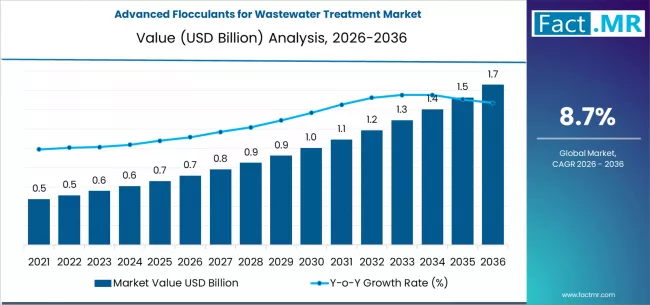
Advanced flocculants for wastewater treatment market is projected to grow from USD 0.7 billion in 2026 to USD 1.7 billion by 2036, at a CAGR of 8.7%. Synthetic Polymer Flocculants (PAM, PAC, etc.) will dominate with a 38.0% market share, while municipal wastewater treatment will lead the end-use industry segment with a 34.0% share.
Advanced Flocculants for Wastewater Treatment Market Forecast and Outlook 2026 to 2036
The global market for advanced flocculants in wastewater treatment is projected to reach USD 1.66 billion by 2036. The market is valued at USD 0.72 billion in 2026 and is set to rise at a CAGR of 8.7% during the assessment period.
Key Takeaways from the Advanced Flocculants for Wastewater Treatment Market
- Market Value for 2026: USD 0.72 Billion
- Market Value for 2036: USD 1.66 Billion
- Forecast CAGR (2026-2036): 8.7%
- Leading Flocculant Type Share (2026): Synthetic Polymer Flocculants (PAM, PAC, etc.) (38%)
- Leading End-Use Industry Share (2026): Municipal Wastewater Treatment (34%)
- Leading Treatment Stage Share (2026): Primary Sedimentation & Clarification (36%)
- Key Players in the Market: Kemira Oyj., SNF Floerger, BASF SE, Solenis, Ecolab Inc.
By flocculant type, synthetic polymer flocculants hold a leading 38% share. The end-use industry for municipal wastewater treatment represents the dominant application at 34%. Primary sedimentation and clarification is the foremost treatment stage, accounting for a 36% share.
This growth is driven by increasingly stringent global effluent quality standards and the need for cost-effective, high-efficiency solid-liquid separation processes. Advanced flocculants enhance the removal of suspended solids, organic matter, and specific contaminants, enabling treatment plants to achieve compliance and improve operational economics.
These advanced formulations are critical for optimizing clarification, thickening, and dewatering processes across diverse industries. Their development focuses on improved performance, lower dosage requirements, and reduced environmental impact compared to conventional products, addressing the core challenges of modern water and sludge management.
Advanced Flocculants for Wastewater Treatment Market
| Metric | Value |
|---|---|
| Market Value (2026) | USD 0.72 Billion |
| Market Forecast Value (2036) | USD 1.66 Billion |
| Forecast CAGR (2026-2036) | 8.7% |
Category
| Category | Segments |
|---|---|
| Flocculant Type | Synthetic Polymer Flocculants (PAM, PAC, etc.), Bio-Based/Biopolymer Flocculants (Chitosan, Starch, etc.), Inorganic/Metal Salt Flocculants, Hybrid & Nano-Enhanced Flocculants |
| End-Use Industry | Municipal Wastewater Treatment, Industrial Effluents (Chemicals, Textiles, Pharma), Mining & Mineral Processing, Oil & Gas/Petrochemical, Food & Beverage, Pulp & Paper |
| Treatment Stage | Primary Sedimentation & Clarification, Sludge Dewatering & Thickening, Tertiary & Advanced Treatment, Pre-Treatment of Industrial Streams |
| Region | North America, Latin America, Western Europe, Eastern Europe, East Asia, South Asia & Pacific, MEA |
Segmental Analysis
By Flocculant Type, Which Segment Commands the Largest Market Share?
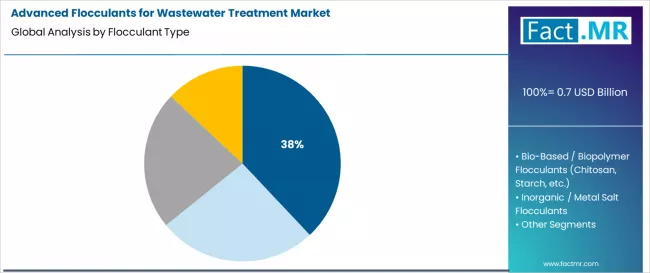
Synthetic polymer flocculants, including polyacrylamide (PAM) and polyaluminum chloride (PAC), lead the segment with a 38% share. Their dominance is attributed to their high efficiency, versatility, and controllable molecular weight and charge density.
These polymers can be engineered for specific wastewater chemistries and contaminants, delivering superior floc size, settling speed, and clarity compared to traditional salts. Their effectiveness in reducing sludge volume also lowers overall disposal costs, solidifying their position as the workhorse chemistry in both municipal and industrial applications.
By End-Use Industry, Which Sector Generates the Most Consistent Demand?
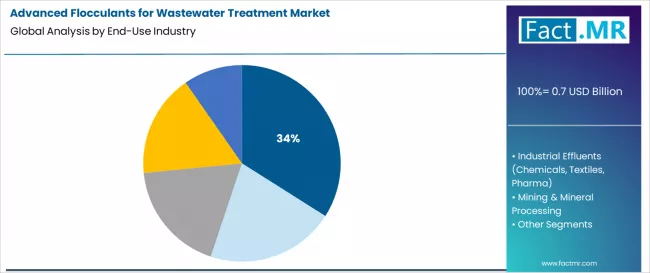
Municipal wastewater treatment represents the largest end-use industry with a 34% share. The consistent, high-volume flow from urban centers, coupled with non-negotiable regulatory discharge permits, creates a stable, large-scale market.
Municipal plants continuously require advanced flocculants to ensure efficient primary clarification, enhance biological treatment, and manage the massive volumes of sludge generated, making this sector the foundational driver of volume demand.
By Treatment Stage, Where is Flocculant Performance Most Critical for Process Efficiency?
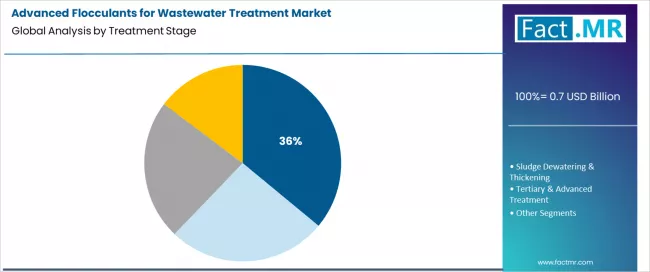
Primary sedimentation and clarification is the leading treatment stage with a 36% share. This first major solid-liquid separation step sets the performance baseline for the entire treatment train.
Effective flocculation here directly reduces the organic load on downstream biological processes, minimizes sludge production, and protects sensitive equipment. The choice and optimization of flocculant at this stage have a disproportionate impact on plant capacity, operational cost, and final effluent quality, concentrating demand and technical focus.
What are the Drivers, Restraints, and Key Trends of the Advanced Flocculants for Wastewater Treatment Market?
The primary market driver is the global tightening of wastewater discharge regulations, particularly for suspended solids, phosphorus, and heavy metals. Advanced flocculants are a critical tool for cost-effective compliance. Water scarcity and the push for water reuse also drive demand for high-performance tertiary treatment, where advanced flocculants play a key role. The need to reduce sludge handling and disposal costs further incentivizes the adoption of more efficient products.
A significant market restraint is the sensitivity of advanced synthetic polymers to process conditions like pH, ionic strength, and mixing energy, which can affect performance and require skilled operation. The higher unit cost of advanced bio-based or nano-enhanced flocculants can be a barrier, despite potential lifecycle benefits. Concerns about the environmental fate of certain synthetic polymer residues may also influence regulatory and purchasing decisions in some regions.
Key trends include the rapid development of bio-based and biodegradable flocculants derived from chitosan, starch, or microbial sources to improve sustainability profiles. There is growing innovation in smart or responsive flocculants whose properties change with pH or temperature for targeted contaminant removal. The market is also moving toward integrated digital dosing systems that use real-time sensors to optimize flocculant addition, minimizing waste and ensuring consistent performance.
Analysis of the Advanced Flocculants for Wastewater Treatment Market by Key Countries
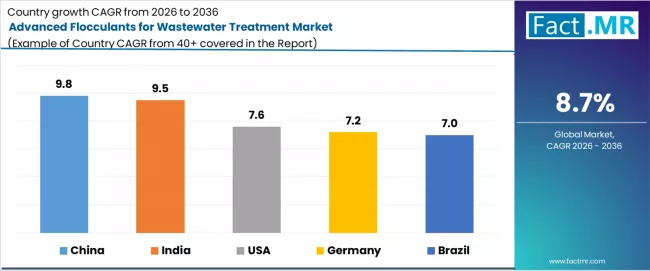
| Country | CAGR (2026-2036) |
|---|---|
| China | 9.80% |
| India | 9.50% |
| USA | 7.60% |
| Germany | 7.20% |
| Brazil | 7.00% |
How do China's Stringent Environmental Policies Drive Demand for Advanced Flocculants?
China's leading CAGR of 9.80% is fueled by its continued enforcement of the "Water Ten Plan" and strict discharge standards for industrial and municipal sectors. The ongoing construction and upgrading of thousands of wastewater treatment plants, alongside a focus on reducing sludge volumes, creates massive, sustained demand for high-efficiency, advanced flocculant chemistries to meet regulatory targets.
What is the Impact of India's Massive Wastewater Infrastructure Development on the Market?
National missions to achieve universal wastewater treatment and clean river systems underpin India’s 9.50% growth. The rapid rollout of new sewage treatment plants (STPs) and common effluent treatment plants (CETPs), combined with increasing industrial regulation, is propelling the adoption of advanced flocculants over basic chemicals to ensure plant performance and compliance in a cost-sensitive market.
How is the USA's Focus on Upgrading Aging Infrastructure Influencing the Market?
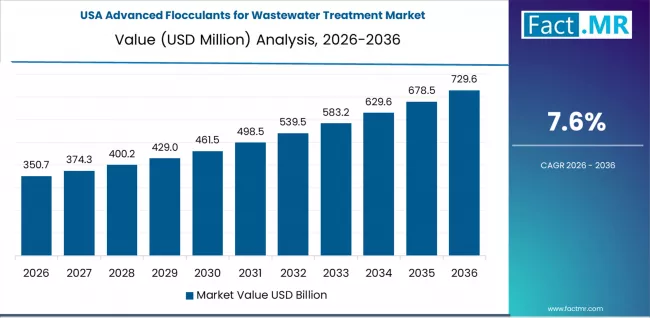
The USA's 7.60% growth is supported by significant investments in modernizing municipal water infrastructure. Regulatory pressures under the Clean Water Act, coupled with a need to improve energy efficiency and reduce sludge handling costs at existing facilities, drive the replacement of conventional chemicals with advanced, performance-optimized flocculants.
Why is Germany a Key Market for High-Performance and Sustainable Flocculants?
Germany's 7.20% CAGR reflects its stringent EU-derived wastewater standards and strong emphasis on process efficiency and sustainability. German operators seek flocculants that deliver maximum performance at minimal dosage, reducing chemical consumption and sludge production. This creates a sophisticated market for advanced synthetic and bio-based products backed by rigorous technical data.
What Role does Brazil's Industrial and Sanitation Expansion Play?
Brazil's 7.00% growth is anchored in the expansion of its mining, oil & gas, and agri-food industries, which generate complex wastewater streams. Concurrently, urban sanitation projects are scaling up. This dual demand from both industrial and municipal sectors drives the need for specialized advanced flocculants capable of handling diverse and challenging effluents.
Competitive Landscape of the Advanced Flocculants for Wastewater Treatment Market
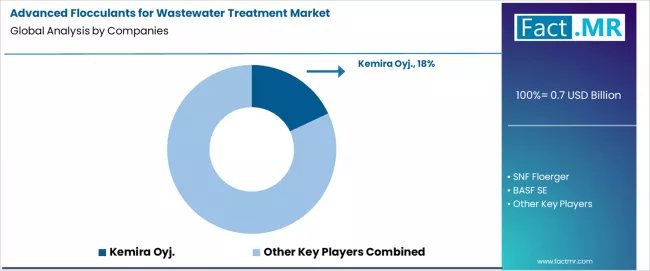
Global specialty chemical companies with deep expertise in water treatment chemistry characterize the competitive landscape. Leaders like Kemira, SNF, and BASF compete on the strength of their extensive polymer science portfolios, application-specific formulations, and global technical service networks. Competition centers on providing tailored solutions for specific industrial waste streams, demonstrating total cost of ownership advantages, and offering digital tools for precise dosing control. A key differentiator is the ability to provide a complete chemical management program, including on-site monitoring and optimization services.
Key Players in the Advanced Flocculants for Wastewater Treatment Market
- Kemira Oyj.
- SNF Floerger
- BASF SE
- Solenis
- Ecolab Inc.
Scope of Report
| Items | Values |
|---|---|
| Quantitative Units | USD Billion |
| Flocculant Type | Synthetic Polymers, Bio-Based/Biopolymers, Inorganic Salts, Hybrid & Nano-Enhanced |
| End-Use Industry | Municipal, Industrial (Chemical, Textile, Pharma), Mining, Oil & Gas, F&B, Pulp & Paper |
| Treatment Stage | Primary Clarification, Sludge Dewatering, Tertiary Treatment, Industrial Pre-Treatment |
| Key Countries | China, India, USA, Germany, Brazil |
| Key Companies | Kemira Oyj., SNF Floerger, BASF SE, Solenis, Ecolab Inc. |
| Additional Analysis | Analysis of polymer chemistry (cationic, anionic, non-ionic); performance testing for specific contaminants; sludge volume reduction efficiency; regulatory landscape for polymer use and residues; supply chain for key raw materials (acrylonitrile, natural polymers). |
Market by Segments
-
Flocculant Type :
- Synthetic Polymer Flocculants (PAM, PAC, etc.)
- Bio-Based/Biopolymer Flocculants (Chitosan, Starch, etc.)
- Inorganic/Metal Salt Flocculants
- Hybrid & Nano-Enhanced Flocculants
-
End-Use Industry :
- Municipal Wastewater Treatment
- Industrial Effluents (Chemicals, Textiles, Pharma)
- Mining & Mineral Processing
- Oil & Gas/Petrochemical
- Food & Beverage, Pulp & Paper
-
Treatment Stage :
- Primary Sedimentation & Clarification
- Sludge Dewatering & Thickening
- Tertiary & Advanced Treatment
- Pre-Treatment of Industrial Streams
-
Region :
-
North America
- USA
- Canada
-
Latin America
- Brazil
- Mexico
- Argentina
- Rest of Latin America
-
Western Europe
- Germany
- UK
- France
- Spain
- Italy
- BENELUX
- Rest of Western Europe
-
Eastern Europe
- Russia
- Poland
- Czech Republic
- Rest of Eastern Europe
-
East Asia
- China
- Japan
- South Korea
- Rest of East Asia
-
South Asia & Pacific
- India
- ASEAN
- Australia
- Rest of South Asia & Pacific
-
MEA
- Saudi Arabia
- UAE
- Turkiye
- Rest of MEA
-
Table of Content
- Executive Summary
- Global Market Outlook
- Demand to side Trends
- Supply to side Trends
- Technology Roadmap Analysis
- Analysis and Recommendations
- Market Overview
- Market Coverage / Taxonomy
- Market Definition / Scope / Limitations
- Market Background
- Market Dynamics
- Drivers
- Restraints
- Opportunity
- Trends
- Scenario Forecast
- Demand in Optimistic Scenario
- Demand in Likely Scenario
- Demand in Conservative Scenario
- Opportunity Map Analysis
- Product Life Cycle Analysis
- Supply Chain Analysis
- Investment Feasibility Matrix
- Value Chain Analysis
- PESTLE and Porter’s Analysis
- Regulatory Landscape
- Regional Parent Market Outlook
- Production and Consumption Statistics
- Import and Export Statistics
- Market Dynamics
- Global Market Analysis 2021 to 2025 and Forecast, 2026 to 2036
- Historical Market Size Value (USD Million) Analysis, 2021 to 2025
- Current and Future Market Size Value (USD Million) Projections, 2026 to 2036
- Y to o to Y Growth Trend Analysis
- Absolute $ Opportunity Analysis
- Global Market Pricing Analysis 2021 to 2025 and Forecast 2026 to 2036
- Global Market Analysis 2021 to 2025 and Forecast 2026 to 2036, By Flocculant Type
- Introduction / Key Findings
- Historical Market Size Value (USD Million) Analysis By Flocculant Type, 2021 to 2025
- Current and Future Market Size Value (USD Million) Analysis and Forecast By Flocculant Type, 2026 to 2036
- Synthetic Polymer Flocculants (PAM, PAC, etc.)
- Bio-Based / Biopolymer Flocculants (Chitosan, Starch, etc.)
- Inorganic / Metal Salt Flocculants
- Hybrid & Nano-Enhanced Flocculants
- Synthetic Polymer Flocculants (PAM, PAC, etc.)
- Y to o to Y Growth Trend Analysis By Flocculant Type, 2021 to 2025
- Absolute $ Opportunity Analysis By Flocculant Type, 2026 to 2036
- Global Market Analysis 2021 to 2025 and Forecast 2026 to 2036, By End-Use Industry
- Introduction / Key Findings
- Historical Market Size Value (USD Million) Analysis By End-Use Industry, 2021 to 2025
- Current and Future Market Size Value (USD Million) Analysis and Forecast By End-Use Industry, 2026 to 2036
- Municipal Wastewater Treatment
- Industrial Effluents (Chemicals, Textiles, Pharma)
- Mining & Mineral Processing
- Oil & Gas / Petrochemical
- Food & Beverage, Pulp & Paper
- Municipal Wastewater Treatment
- Y to o to Y Growth Trend Analysis By End-Use Industry, 2021 to 2025
- Absolute $ Opportunity Analysis By End-Use Industry, 2026 to 2036
- Global Market Analysis 2021 to 2025 and Forecast 2026 to 2036, By Treatment Stage
- Introduction / Key Findings
- Historical Market Size Value (USD Million) Analysis By Treatment Stage, 2021 to 2025
- Current and Future Market Size Value (USD Million) Analysis and Forecast By Treatment Stage, 2026 to 2036
- Primary Sedimentation & Clarification
- Sludge Dewatering & Thickening
- Tertiary & Advanced Treatment
- Pre-Treatment of Industrial Streams
- Primary Sedimentation & Clarification
- Y to o to Y Growth Trend Analysis By Treatment Stage, 2021 to 2025
- Absolute $ Opportunity Analysis By Treatment Stage, 2026 to 2036
- Global Market Analysis 2021 to 2025 and Forecast 2026 to 2036, By Region
- Introduction
- Historical Market Size Value (USD Million) Analysis By Region, 2021 to 2025
- Current Market Size Value (USD Million) Analysis and Forecast By Region, 2026 to 2036
- North America
- Latin America
- Western Europe
- Eastern Europe
- East Asia
- South Asia and Pacific
- Middle East & Africa
- Market Attractiveness Analysis By Region
- North America Market Analysis 2021 to 2025 and Forecast 2026 to 2036, By Country
- Historical Market Size Value (USD Million) Trend Analysis By Market Taxonomy, 2021 to 2025
- Market Size Value (USD Million) Forecast By Market Taxonomy, 2026 to 2036
- By Country
- USA
- Canada
- Mexico
- By Flocculant Type
- By End-Use Industry
- By Treatment Stage
- By Country
- Market Attractiveness Analysis
- By Country
- By Flocculant Type
- By End-Use Industry
- By Treatment Stage
- Key Takeaways
- Latin America Market Analysis 2021 to 2025 and Forecast 2026 to 2036, By Country
- Historical Market Size Value (USD Million) Trend Analysis By Market Taxonomy, 2021 to 2025
- Market Size Value (USD Million) Forecast By Market Taxonomy, 2026 to 2036
- By Country
- Brazil
- Chile
- Rest of Latin America
- By Flocculant Type
- By End-Use Industry
- By Treatment Stage
- By Country
- Market Attractiveness Analysis
- By Country
- By Flocculant Type
- By End-Use Industry
- By Treatment Stage
- Key Takeaways
- Western Europe Market Analysis 2021 to 2025 and Forecast 2026 to 2036, By Country
- Historical Market Size Value (USD Million) Trend Analysis By Market Taxonomy, 2021 to 2025
- Market Size Value (USD Million) Forecast By Market Taxonomy, 2026 to 2036
- By Country
- Germany
- UK
- Italy
- Spain
- France
- Nordic
- BENELUX
- Rest of Western Europe
- By Flocculant Type
- By End-Use Industry
- By Treatment Stage
- By Country
- Market Attractiveness Analysis
- By Country
- By Flocculant Type
- By End-Use Industry
- By Treatment Stage
- Key Takeaways
- Eastern Europe Market Analysis 2021 to 2025 and Forecast 2026 to 2036, By Country
- Historical Market Size Value (USD Million) Trend Analysis By Market Taxonomy, 2021 to 2025
- Market Size Value (USD Million) Forecast By Market Taxonomy, 2026 to 2036
- By Country
- Russia
- Poland
- Hungary
- Balkan & Baltic
- Rest of Eastern Europe
- By Flocculant Type
- By End-Use Industry
- By Treatment Stage
- By Country
- Market Attractiveness Analysis
- By Country
- By Flocculant Type
- By End-Use Industry
- By Treatment Stage
- Key Takeaways
- East Asia Market Analysis 2021 to 2025 and Forecast 2026 to 2036, By Country
- Historical Market Size Value (USD Million) Trend Analysis By Market Taxonomy, 2021 to 2025
- Market Size Value (USD Million) Forecast By Market Taxonomy, 2026 to 2036
- By Country
- China
- Japan
- South Korea
- By Flocculant Type
- By End-Use Industry
- By Treatment Stage
- By Country
- Market Attractiveness Analysis
- By Country
- By Flocculant Type
- By End-Use Industry
- By Treatment Stage
- Key Takeaways
- South Asia and Pacific Market Analysis 2021 to 2025 and Forecast 2026 to 2036, By Country
- Historical Market Size Value (USD Million) Trend Analysis By Market Taxonomy, 2021 to 2025
- Market Size Value (USD Million) Forecast By Market Taxonomy, 2026 to 2036
- By Country
- India
- ASEAN
- Australia & New Zealand
- Rest of South Asia and Pacific
- By Flocculant Type
- By End-Use Industry
- By Treatment Stage
- By Country
- Market Attractiveness Analysis
- By Country
- By Flocculant Type
- By End-Use Industry
- By Treatment Stage
- Key Takeaways
- Middle East & Africa Market Analysis 2021 to 2025 and Forecast 2026 to 2036, By Country
- Historical Market Size Value (USD Million) Trend Analysis By Market Taxonomy, 2021 to 2025
- Market Size Value (USD Million) Forecast By Market Taxonomy, 2026 to 2036
- By Country
- Kingdom of Saudi Arabia
- Other GCC Countries
- Turkiye
- South Africa
- Other African Union
- Rest of Middle East & Africa
- By Flocculant Type
- By End-Use Industry
- By Treatment Stage
- By Country
- Market Attractiveness Analysis
- By Country
- By Flocculant Type
- By End-Use Industry
- By Treatment Stage
- Key Takeaways
- Key Countries Market Analysis
- USA
- Pricing Analysis
- Market Share Analysis, 2025
- By Flocculant Type
- By End-Use Industry
- By Treatment Stage
- Canada
- Pricing Analysis
- Market Share Analysis, 2025
- By Flocculant Type
- By End-Use Industry
- By Treatment Stage
- Mexico
- Pricing Analysis
- Market Share Analysis, 2025
- By Flocculant Type
- By End-Use Industry
- By Treatment Stage
- Brazil
- Pricing Analysis
- Market Share Analysis, 2025
- By Flocculant Type
- By End-Use Industry
- By Treatment Stage
- Chile
- Pricing Analysis
- Market Share Analysis, 2025
- By Flocculant Type
- By End-Use Industry
- By Treatment Stage
- Germany
- Pricing Analysis
- Market Share Analysis, 2025
- By Flocculant Type
- By End-Use Industry
- By Treatment Stage
- UK
- Pricing Analysis
- Market Share Analysis, 2025
- By Flocculant Type
- By End-Use Industry
- By Treatment Stage
- Italy
- Pricing Analysis
- Market Share Analysis, 2025
- By Flocculant Type
- By End-Use Industry
- By Treatment Stage
- Spain
- Pricing Analysis
- Market Share Analysis, 2025
- By Flocculant Type
- By End-Use Industry
- By Treatment Stage
- France
- Pricing Analysis
- Market Share Analysis, 2025
- By Flocculant Type
- By End-Use Industry
- By Treatment Stage
- India
- Pricing Analysis
- Market Share Analysis, 2025
- By Flocculant Type
- By End-Use Industry
- By Treatment Stage
- ASEAN
- Pricing Analysis
- Market Share Analysis, 2025
- By Flocculant Type
- By End-Use Industry
- By Treatment Stage
- Australia & New Zealand
- Pricing Analysis
- Market Share Analysis, 2025
- By Flocculant Type
- By End-Use Industry
- By Treatment Stage
- China
- Pricing Analysis
- Market Share Analysis, 2025
- By Flocculant Type
- By End-Use Industry
- By Treatment Stage
- Japan
- Pricing Analysis
- Market Share Analysis, 2025
- By Flocculant Type
- By End-Use Industry
- By Treatment Stage
- South Korea
- Pricing Analysis
- Market Share Analysis, 2025
- By Flocculant Type
- By End-Use Industry
- By Treatment Stage
- Russia
- Pricing Analysis
- Market Share Analysis, 2025
- By Flocculant Type
- By End-Use Industry
- By Treatment Stage
- Poland
- Pricing Analysis
- Market Share Analysis, 2025
- By Flocculant Type
- By End-Use Industry
- By Treatment Stage
- Hungary
- Pricing Analysis
- Market Share Analysis, 2025
- By Flocculant Type
- By End-Use Industry
- By Treatment Stage
- Kingdom of Saudi Arabia
- Pricing Analysis
- Market Share Analysis, 2025
- By Flocculant Type
- By End-Use Industry
- By Treatment Stage
- Turkiye
- Pricing Analysis
- Market Share Analysis, 2025
- By Flocculant Type
- By End-Use Industry
- By Treatment Stage
- South Africa
- Pricing Analysis
- Market Share Analysis, 2025
- By Flocculant Type
- By End-Use Industry
- By Treatment Stage
- USA
- Market Structure Analysis
- Competition Dashboard
- Competition Benchmarking
- Market Share Analysis of Top Players
- By Regional
- By Flocculant Type
- By End-Use Industry
- By Treatment Stage
- Competition Analysis
- Competition Deep Dive
- Kemira Oyj.
- Overview
- Product Portfolio
- Profitability by Market Segments (Product/Age /Sales Channel/Region)
- Sales Footprint
- Strategy Overview
- Marketing Strategy
- Product Strategy
- Channel Strategy
- SNF Floerger
- BASF SE
- Solenis
- Ecolab Inc.
- Kemira Oyj.
- Competition Deep Dive
- Assumptions & Acronyms Used
- Research Methodology
List Of Table
- Table 1: Global Market Value (USD Million) Forecast by Region, 2021 to 2036
- Table 2: Global Market Value (USD Million) Forecast by Flocculant Type, 2021 to 2036
- Table 3: Global Market Value (USD Million) Forecast by End-Use Industry, 2021 to 2036
- Table 4: Global Market Value (USD Million) Forecast by Treatment Stage, 2021 to 2036
- Table 5: North America Market Value (USD Million) Forecast by Country, 2021 to 2036
- Table 6: North America Market Value (USD Million) Forecast by Flocculant Type, 2021 to 2036
- Table 7: North America Market Value (USD Million) Forecast by End-Use Industry, 2021 to 2036
- Table 8: North America Market Value (USD Million) Forecast by Treatment Stage, 2021 to 2036
- Table 9: Latin America Market Value (USD Million) Forecast by Country, 2021 to 2036
- Table 10: Latin America Market Value (USD Million) Forecast by Flocculant Type, 2021 to 2036
- Table 11: Latin America Market Value (USD Million) Forecast by End-Use Industry, 2021 to 2036
- Table 12: Latin America Market Value (USD Million) Forecast by Treatment Stage, 2021 to 2036
- Table 13: Western Europe Market Value (USD Million) Forecast by Country, 2021 to 2036
- Table 14: Western Europe Market Value (USD Million) Forecast by Flocculant Type, 2021 to 2036
- Table 15: Western Europe Market Value (USD Million) Forecast by End-Use Industry, 2021 to 2036
- Table 16: Western Europe Market Value (USD Million) Forecast by Treatment Stage, 2021 to 2036
- Table 17: Eastern Europe Market Value (USD Million) Forecast by Country, 2021 to 2036
- Table 18: Eastern Europe Market Value (USD Million) Forecast by Flocculant Type, 2021 to 2036
- Table 19: Eastern Europe Market Value (USD Million) Forecast by End-Use Industry, 2021 to 2036
- Table 20: Eastern Europe Market Value (USD Million) Forecast by Treatment Stage, 2021 to 2036
- Table 21: East Asia Market Value (USD Million) Forecast by Country, 2021 to 2036
- Table 22: East Asia Market Value (USD Million) Forecast by Flocculant Type, 2021 to 2036
- Table 23: East Asia Market Value (USD Million) Forecast by End-Use Industry, 2021 to 2036
- Table 24: East Asia Market Value (USD Million) Forecast by Treatment Stage, 2021 to 2036
- Table 25: South Asia and Pacific Market Value (USD Million) Forecast by Country, 2021 to 2036
- Table 26: South Asia and Pacific Market Value (USD Million) Forecast by Flocculant Type, 2021 to 2036
- Table 27: South Asia and Pacific Market Value (USD Million) Forecast by End-Use Industry, 2021 to 2036
- Table 28: South Asia and Pacific Market Value (USD Million) Forecast by Treatment Stage, 2021 to 2036
- Table 29: Middle East & Africa Market Value (USD Million) Forecast by Country, 2021 to 2036
- Table 30: Middle East & Africa Market Value (USD Million) Forecast by Flocculant Type, 2021 to 2036
- Table 31: Middle East & Africa Market Value (USD Million) Forecast by End-Use Industry, 2021 to 2036
- Table 32: Middle East & Africa Market Value (USD Million) Forecast by Treatment Stage, 2021 to 2036
List Of Figures
- Figure 1: Global Market Pricing Analysis
- Figure 2: Global Market Value (USD Million) Forecast 2021 to 2036
- Figure 3: Global Market Value Share and BPS Analysis by Flocculant Type, 2026 and 2036
- Figure 4: Global Market Y to o to Y Growth Comparison by Flocculant Type, 2026 to 2036
- Figure 5: Global Market Attractiveness Analysis by Flocculant Type
- Figure 6: Global Market Value Share and BPS Analysis by End-Use Industry, 2026 and 2036
- Figure 7: Global Market Y to o to Y Growth Comparison by End-Use Industry, 2026 to 2036
- Figure 8: Global Market Attractiveness Analysis by End-Use Industry
- Figure 9: Global Market Value Share and BPS Analysis by Treatment Stage, 2026 and 2036
- Figure 10: Global Market Y to o to Y Growth Comparison by Treatment Stage, 2026 to 2036
- Figure 11: Global Market Attractiveness Analysis by Treatment Stage
- Figure 12: Global Market Value (USD Million) Share and BPS Analysis by Region, 2026 and 2036
- Figure 13: Global Market Y to o to Y Growth Comparison by Region, 2026 to 2036
- Figure 14: Global Market Attractiveness Analysis by Region
- Figure 15: North America Market Incremental Dollar Opportunity, 2026 to 2036
- Figure 16: Latin America Market Incremental Dollar Opportunity, 2026 to 2036
- Figure 17: Western Europe Market Incremental Dollar Opportunity, 2026 to 2036
- Figure 18: Eastern Europe Market Incremental Dollar Opportunity, 2026 to 2036
- Figure 19: East Asia Market Incremental Dollar Opportunity, 2026 to 2036
- Figure 20: South Asia and Pacific Market Incremental Dollar Opportunity, 2026 to 2036
- Figure 21: Middle East & Africa Market Incremental Dollar Opportunity, 2026 to 2036
- Figure 22: North America Market Value Share and BPS Analysis by Country, 2026 and 2036
- Figure 23: North America Market Value Share and BPS Analysis by Flocculant Type, 2026 and 2036
- Figure 24: North America Market Y to o to Y Growth Comparison by Flocculant Type, 2026 to 2036
- Figure 25: North America Market Attractiveness Analysis by Flocculant Type
- Figure 26: North America Market Value Share and BPS Analysis by End-Use Industry, 2026 and 2036
- Figure 27: North America Market Y to o to Y Growth Comparison by End-Use Industry, 2026 to 2036
- Figure 28: North America Market Attractiveness Analysis by End-Use Industry
- Figure 29: North America Market Value Share and BPS Analysis by Treatment Stage, 2026 and 2036
- Figure 30: North America Market Y to o to Y Growth Comparison by Treatment Stage, 2026 to 2036
- Figure 31: North America Market Attractiveness Analysis by Treatment Stage
- Figure 32: Latin America Market Value Share and BPS Analysis by Country, 2026 and 2036
- Figure 33: Latin America Market Value Share and BPS Analysis by Flocculant Type, 2026 and 2036
- Figure 34: Latin America Market Y to o to Y Growth Comparison by Flocculant Type, 2026 to 2036
- Figure 35: Latin America Market Attractiveness Analysis by Flocculant Type
- Figure 36: Latin America Market Value Share and BPS Analysis by End-Use Industry, 2026 and 2036
- Figure 37: Latin America Market Y to o to Y Growth Comparison by End-Use Industry, 2026 to 2036
- Figure 38: Latin America Market Attractiveness Analysis by End-Use Industry
- Figure 39: Latin America Market Value Share and BPS Analysis by Treatment Stage, 2026 and 2036
- Figure 40: Latin America Market Y to o to Y Growth Comparison by Treatment Stage, 2026 to 2036
- Figure 41: Latin America Market Attractiveness Analysis by Treatment Stage
- Figure 42: Western Europe Market Value Share and BPS Analysis by Country, 2026 and 2036
- Figure 43: Western Europe Market Value Share and BPS Analysis by Flocculant Type, 2026 and 2036
- Figure 44: Western Europe Market Y to o to Y Growth Comparison by Flocculant Type, 2026 to 2036
- Figure 45: Western Europe Market Attractiveness Analysis by Flocculant Type
- Figure 46: Western Europe Market Value Share and BPS Analysis by End-Use Industry, 2026 and 2036
- Figure 47: Western Europe Market Y to o to Y Growth Comparison by End-Use Industry, 2026 to 2036
- Figure 48: Western Europe Market Attractiveness Analysis by End-Use Industry
- Figure 49: Western Europe Market Value Share and BPS Analysis by Treatment Stage, 2026 and 2036
- Figure 50: Western Europe Market Y to o to Y Growth Comparison by Treatment Stage, 2026 to 2036
- Figure 51: Western Europe Market Attractiveness Analysis by Treatment Stage
- Figure 52: Eastern Europe Market Value Share and BPS Analysis by Country, 2026 and 2036
- Figure 53: Eastern Europe Market Value Share and BPS Analysis by Flocculant Type, 2026 and 2036
- Figure 54: Eastern Europe Market Y to o to Y Growth Comparison by Flocculant Type, 2026 to 2036
- Figure 55: Eastern Europe Market Attractiveness Analysis by Flocculant Type
- Figure 56: Eastern Europe Market Value Share and BPS Analysis by End-Use Industry, 2026 and 2036
- Figure 57: Eastern Europe Market Y to o to Y Growth Comparison by End-Use Industry, 2026 to 2036
- Figure 58: Eastern Europe Market Attractiveness Analysis by End-Use Industry
- Figure 59: Eastern Europe Market Value Share and BPS Analysis by Treatment Stage, 2026 and 2036
- Figure 60: Eastern Europe Market Y to o to Y Growth Comparison by Treatment Stage, 2026 to 2036
- Figure 61: Eastern Europe Market Attractiveness Analysis by Treatment Stage
- Figure 62: East Asia Market Value Share and BPS Analysis by Country, 2026 and 2036
- Figure 63: East Asia Market Value Share and BPS Analysis by Flocculant Type, 2026 and 2036
- Figure 64: East Asia Market Y to o to Y Growth Comparison by Flocculant Type, 2026 to 2036
- Figure 65: East Asia Market Attractiveness Analysis by Flocculant Type
- Figure 66: East Asia Market Value Share and BPS Analysis by End-Use Industry, 2026 and 2036
- Figure 67: East Asia Market Y to o to Y Growth Comparison by End-Use Industry, 2026 to 2036
- Figure 68: East Asia Market Attractiveness Analysis by End-Use Industry
- Figure 69: East Asia Market Value Share and BPS Analysis by Treatment Stage, 2026 and 2036
- Figure 70: East Asia Market Y to o to Y Growth Comparison by Treatment Stage, 2026 to 2036
- Figure 71: East Asia Market Attractiveness Analysis by Treatment Stage
- Figure 72: South Asia and Pacific Market Value Share and BPS Analysis by Country, 2026 and 2036
- Figure 73: South Asia and Pacific Market Value Share and BPS Analysis by Flocculant Type, 2026 and 2036
- Figure 74: South Asia and Pacific Market Y to o to Y Growth Comparison by Flocculant Type, 2026 to 2036
- Figure 75: South Asia and Pacific Market Attractiveness Analysis by Flocculant Type
- Figure 76: South Asia and Pacific Market Value Share and BPS Analysis by End-Use Industry, 2026 and 2036
- Figure 77: South Asia and Pacific Market Y to o to Y Growth Comparison by End-Use Industry, 2026 to 2036
- Figure 78: South Asia and Pacific Market Attractiveness Analysis by End-Use Industry
- Figure 79: South Asia and Pacific Market Value Share and BPS Analysis by Treatment Stage, 2026 and 2036
- Figure 80: South Asia and Pacific Market Y to o to Y Growth Comparison by Treatment Stage, 2026 to 2036
- Figure 81: South Asia and Pacific Market Attractiveness Analysis by Treatment Stage
- Figure 82: Middle East & Africa Market Value Share and BPS Analysis by Country, 2026 and 2036
- Figure 83: Middle East & Africa Market Value Share and BPS Analysis by Flocculant Type, 2026 and 2036
- Figure 84: Middle East & Africa Market Y to o to Y Growth Comparison by Flocculant Type, 2026 to 2036
- Figure 85: Middle East & Africa Market Attractiveness Analysis by Flocculant Type
- Figure 86: Middle East & Africa Market Value Share and BPS Analysis by End-Use Industry, 2026 and 2036
- Figure 87: Middle East & Africa Market Y to o to Y Growth Comparison by End-Use Industry, 2026 to 2036
- Figure 88: Middle East & Africa Market Attractiveness Analysis by End-Use Industry
- Figure 89: Middle East & Africa Market Value Share and BPS Analysis by Treatment Stage, 2026 and 2036
- Figure 90: Middle East & Africa Market Y to o to Y Growth Comparison by Treatment Stage, 2026 to 2036
- Figure 91: Middle East & Africa Market Attractiveness Analysis by Treatment Stage
- Figure 92: Global Market - Tier Structure Analysis
- Figure 93: Global Market - Company Share Analysis
- FAQs -
How big is the advanced flocculants for wastewater treatment market in 2026?
The global advanced flocculants for wastewater treatment market is estimated to be valued at USD 0.7 billion in 2026.
What will be the size of advanced flocculants for wastewater treatment market in 2036?
The market size for the advanced flocculants for wastewater treatment market is projected to reach USD 1.7 billion by 2036.
How much will be the advanced flocculants for wastewater treatment market growth between 2026 and 2036?
The advanced flocculants for wastewater treatment market is expected to grow at a 8.7% CAGR between 2026 and 2036.
What are the key product types in the advanced flocculants for wastewater treatment market?
The key product types in advanced flocculants for wastewater treatment market are synthetic polymer flocculants (pam, pac, etc.), bio-based / biopolymer flocculants (chitosan, starch, etc.), inorganic / metal salt flocculants and hybrid & nano-enhanced flocculants.
Which end-use industry segment to contribute significant share in the advanced flocculants for wastewater treatment market in 2026?
In terms of end-use industry, municipal wastewater treatment segment to command 34.0% share in the advanced flocculants for wastewater treatment market in 2026.