- Market Value (2025): USD 4.2 Bn
- Estimated Value (2026): USD 4.6 Bn
- Forecast Value (2036): USD 13.2 Bn
- CAGR (2026-2036): 11.1%
What is the Moisture-Barrier Molded Fiber Market forecast to be worth by 2036?
USD 4.6 billion in 2026 to USD 13.2 billion by 2036 at an 11.1% CAGR.
- The Moisture-Barrier Molded Fiber Market crossed a valuation of USD 4.2 billion in 2025.
- Demand is projected to increase from USD 4.6 billion in 2026 to USD 13.2 billion by 2036.
- The market is forecast to record an 11.1% CAGR from 2026 to 2036 as hot-meal, delivery and fresh-food users move toward molded fiber with dependable moisture and grease control.
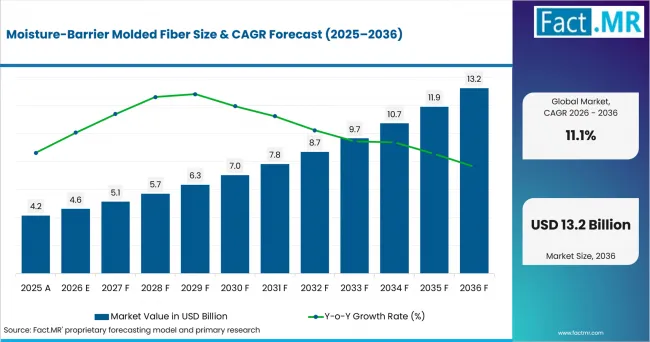
Moisture Barrier Molded Fiber Value Analysis | Source: Fact.MR
What are the defining numbers behind Moisture-Barrier Molded Fiber Market growth?
An absolute opportunity of USD 8.6 billion is expected between 2026 and 2036. Bagasse feedstock and trays are central to the modeled expansion alongside hot-meal applications.
- Demand Drivers in the Market
- U.S. food-away-from-home spending provides a direct measure of the foodservice base.
- Prepared-food brands need trays that tolerate chilled storage and reheating. Barrier selection must align with forming strength and closure fit.
- Institutional kitchens need bowls and plates that limit leaks during service. Grease resistance is relevant for oily or sauced meals.
- Fresh-food packers need fiber structures that balance moisture management with ventilation across the intended storage period.
- Key Segments Analyzed
- By Fiber Feedstock: Bagasse is expected to hold 31.0% share in 2026 because it supports molded-fiber forming for trays, bowls and food containers while giving converters a non-wood fiber option.
- By Performance Treatment: Grease resistant is projected to account for 29.0% share in 2026 as hot meals and prepared foods require surfaces that control oil penetration during serving and transport.
- By Format: Trays are anticipated to capture 36.0% share in 2026 due to their broad use in prepared foods, fresh foods and portioned meals where rigidity and stackability affect handling.
- By Application: Hot meals are estimated to represent 34.0% share in 2026 owing to direct exposure to steam, sauces and oils that makes barrier performance visible during use.
- Analyst Opinion at Fact.MR
- Shambhu Nath Jha is Principal Consultant at Fact.MR, states: “Barrier performance is the commercial test that separates basic molded fiber from foodservice-grade packaging. The market is expected to reward suppliers that connect forming control with application-specific barrier systems. Stronger positions are likely where converters combine reliable food-contact performance with clear recovery guidance.”
- Strategic Implications
- Converters should validate moisture and grease performance against the actual food profile.
- Foodservice brands should align fiber geometry with sealing, stacking and delivery requirements.
- Fiber producers should document feedstock consistency because it affects forming and barrier coverage.
- Packaging developers should align barrier chemistry with the finished pack’s recovery route. The European Commission reported in August 2026 that the Packaging and Packaging Waste Regulation applies from 12 August 2026 across the EU.
China is projected to record 11.5% CAGR through 2036 as catering and express-delivery activity provide demand context for high packaging throughput. The USA is estimated at 11.0% as restaurant spending and changes in PFAS food-contact authorization status influence material choices. Japan is also forecast at 11.0%, with household consumption providing the directly sourced demand indicator. Germany is anticipated at 10.8% as foodservice turnover and EU packaging requirements influence designs. France is projected at 10.3% as restaurant spending and restrictions on plastic cooking, reheating and serving containers in specified collective-catering settings support substitution.
How does the Moisture-Barrier Molded Fiber Market break down by segment?
Trays are projected to lead Format at 36.0% share in 2026; Hot meals lead Application at 34.0% share.
Which Fiber Feedstock leads?
Bagasse is expected to hold 31.0% share in 2026.
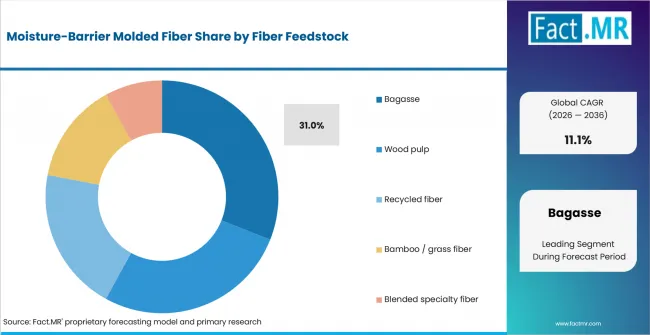
Moisture Barrier Molded Fiber Analysis By Fiber Feedstock | Source: Fact.MR
Bagasse leads because it forms rigid foodservice shapes while providing a non-wood fiber option. Wood pulp offers established furnish control, while recycled and specialty fibers serve designs needing different strength or surface properties.
Adjacent formats such as bamboo fiber trays and waste-fibre trays show how feedstock choice changes stiffness, surface feel and moisture response across molded products. Feedstock selection is therefore tied to the barrier system and forming process as well as fiber origin.
What leads the Performance Treatment segment?
Grease resistant is projected to account for 29.0% share in 2026.
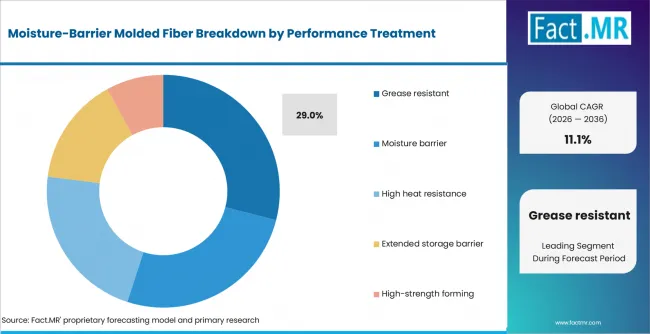
Moisture Barrier Molded Fiber Analysis By Performance Treatment | Source: Fact.MR
Moisture barriers address wet foods. High-heat treatments support reheating while extended-storage systems suit chilled packs held longer before use.
Material developers serving compostable foodservice coatings must balance barrier function with the disposal route claimed for the finished article. The FDA’s January 2025 action on PFAS food-contact notifications also raises the value of clearly documented grease-resistant chemistries for paper and paperboard food packaging.
How does Format shape demand?
Trays are anticipated to lead with 36.0% share in 2026.
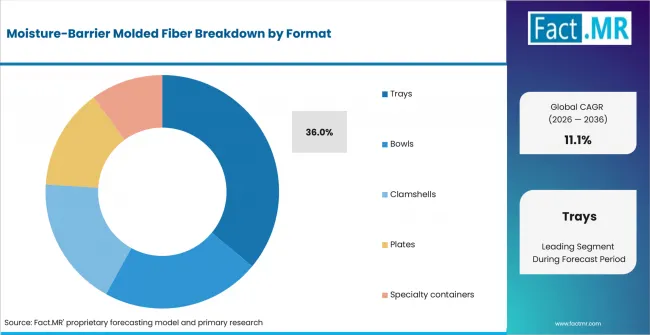
Moisture Barrier Molded Fiber Analysis By Format | Source: Fact.MR
Bowls suit liquid-rich meals and clamshells support takeaway service. Specialty containers address applications requiring non-standard shapes or closures.
The wider paper trays and molded pulp buffers categories illustrate the importance of forming precision and load distribution. For food uses, the additional barrier requirement makes surface treatment and edge integrity central to tray performance.
What supports Hot meals within Application?
Hot meals are estimated to represent 34.0% share in 2026.
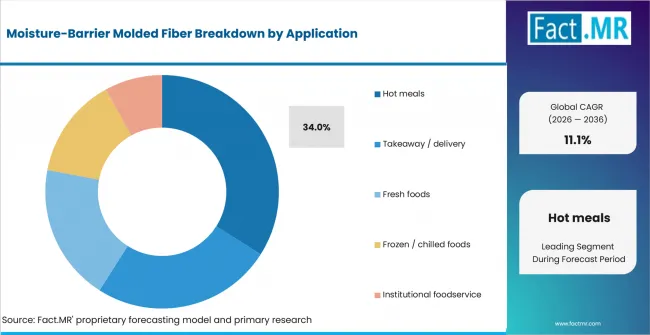
Moisture Barrier Molded Fiber Analysis By Application | Source: Fact.MR
Delivery adds holding time. Fresh and chilled foods place more emphasis on condensation control with ventilation and low-temperature barrier stability.
Demand also overlaps with home-compostable food serviceware and broader sustainable food packaging where material substitution is evaluated against real food-contact and handling requirements. The application decision therefore starts with food condition and service time before disposal claims are considered.
What is accelerating Moisture-Barrier Molded Fiber Market adoption, and what is holding it back?
Foodservice substitution and barrier improvements support adoption; coating qualification and end-of-life complexity restrain it.
Drivers Impact Analysis
| DRIVER | (~) % IMPACT ON CAGR |
GEOGRAPHIC RELEVANCE |
IMPACT TIMELINE |
|---|---|---|---|
| Foodservice shift toward fiber formats | +1.7% | North America, Europe, East Asia | Short term (<= 2 years) |
| Higher barrier performance in molded fiber | +1.4% | Global | Medium term (2-4 years) |
| Plastic-reduction rules in foodservice | +1.1% | Europe, selected Asia markets | Medium term (2-4 years) |
| Delivery and prepared-meal packaging demand | +0.9% | Global | Long term (>= 4 years) |
Opportunity Impact Analysis
| OPPORTUNITY | (~) % IMPACT ON CAGR |
GEOGRAPHIC RELEVANCE |
IMPACT TIMELINE |
|---|---|---|---|
| PFAS-free grease barrier systems | +1.2% | North America, Europe | Short term (<= 2 years) |
| Chilled and frozen meal formats | +0.9% | North America, Europe, Japan | Medium term (2-4 years) |
| Bagasse and specialty fiber optimization | +0.7% | Asia, Americas | Medium term (2-4 years) |
Restraints Impact Analysis
| RESTRAINT | (~) % IMPACT ON CAGR |
GEOGRAPHIC RELEVANCE |
IMPACT TIMELINE |
|---|---|---|---|
| Barrier chemistry qualification burden | -0.8% | Global | Short term (<= 2 years) |
| Coating and fiber end-of-life compatibility | -0.6% | Europe, North America | Medium term (2-4 years) |
| Moisture-related strength loss | -0.5% | Global | Medium term (2-4 years) |
Which countries are scaling the Moisture-Barrier Molded Fiber Market through 2036?
- China leads the displayed country range at 11.5% CAGR as catering activity and express-delivery activity provide demand context for high packaging throughput across urban channels.
- The USA and Japan each record 11.0% CAGR. Their demand mechanisms differ across restaurant spending and household consumption patterns with food-contact requirements shaping format selection.
- Germany follows at 10.8% CAGR as foodservice turnover and EU packaging requirements shape material and barrier choices.
- France records 10.3% CAGR as restaurant and accommodation spending remains more than 20% above 2019 levels while French law restricts plastic cooking, reheating and serving containers in specified collective-catering settings.
Comparable growth rates create different entry conditions because molded-fiber performance is tested against local foodservice habits and recovery systems. Full report coverage spans seven major regions worldwide.
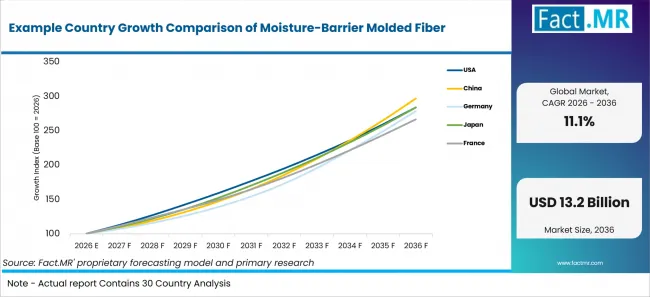
Example Country Growth Comparison Of Moisture Barrier Molded Fiber | Source: Fact.MR
| Country | CAGR (2026-2036) |
|---|---|
| United States | 11.0% |
| China | 11.5% |
| Germany | 10.8% |
| Japan | 11.0% |
| France | 10.3% |
What supports USA adoption?
11.0% CAGR, backed by food-away-from-home spending and food-contact barrier requirements.
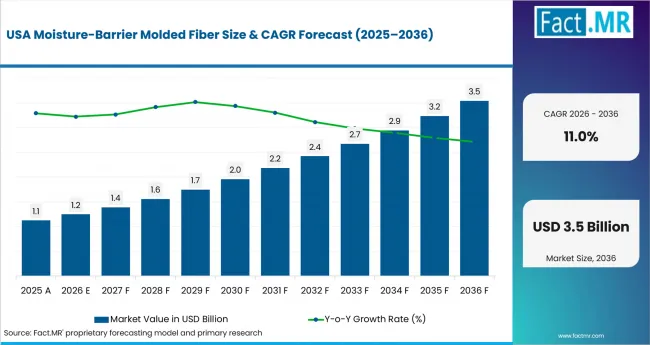
Moisture Barrier Molded Fiber Country Value Analysis | Source: Fact.MR
U.S. restaurant and takeaway demand gives moisture-barrier molded fiber a large foodservice base. USDA Economic Research Service reported that food-away-from-home spending reached USD 1.41 trillion in 2025 and represented 56.3% of total food expenditures. Demand favors trays and clamshells with reliable grease resistance, coating coverage, rim stability and food-contact documentation.
How is China scaling demand?
11.5% CAGR, led by catering activity and high-throughput urban foodservice channels.
China’s large catering base supports demand for molded-fiber trays, bowls and clamshells used across takeaway and prepared-food applications. The National Bureau of Statistics of China reported that catering income reached CNY 5,798.2 billion in 2025, up 3.2% year over year. Suppliers benefit where forming consistency and barrier performance support high-volume foodservice operations.
What supports Germany’s adoption?
10.8% CAGR, supported by restaurant activity and EU packaging requirements.
Germany’s molded-fiber outlook is tied to foodservice demand and packaging compliance. Destatis reported a nominal turnover index of 133.0 for restaurants and mobile food-service activities in December 2025, with 2015 equal to 100. Demand favors fiber formats combining dimensional stability, grease resistance and moisture protection, supported by precise forming and reliable rim control.
How does Japan perform?
11.0% CAGR, driven by household spending and convenience-oriented prepared-food formats.
Japan’s established convenience-food culture supports molded-fiber packaging for ready meals, takeaway dishes and portioned foodservice applications. The Statistics Bureau of Japan reported average monthly consumption expenditure of JPY 314,001 for two-or-more-person households in 2025, a nominal increase of 4.6%. Suppliers benefit where barrier performance and pack stability match prepared-food handling needs.
What is supporting France’s growth?
10.3% CAGR, shaped by restaurant spending and plastic-reduction measures in foodservice.
France combines active restaurant demand with restrictions affecting plastic foodservice containers in specified collective-catering settings. INSEE reported that spending on restaurants and accommodation services in 2025 was more than 20% above 2019. Molded-fiber suppliers can benefit where moisture barriers, grease resistance and forming quality support prepared meals, takeaway service and suitable recovery routes.
Who leads the Moisture-Barrier Molded Fiber Market?
Huhtamaki remains active in molded-fiber packaging through its Foodservice Packaging and Fiber Packaging businesses. Its Foodservice Packaging segment provides paperboard and molded-fiber packaging solutions for fresh food and drinks, while its Fiber Packaging segment supplies molded-fiber egg cartons, egg trays, fruit packaging, cup carriers and bottle dividers. Huhtamaki’s 2025 annual report also confirms continued investment in Fiber Packaging capacity. Its molded-fiber portfolio gives the company exposure to foodservice and fresh-food applications where packaging functionality, product protection and compatibility with established food-handling requirements remain important.
Novolex carries the former Pactiv Evergreen business following completion of the combination on April 1, 2025. Novolex stated that the transaction brought Pactiv Evergreen into its existing business under the Novolex brand and created a broader food, beverage and specialty-packaging platform with expanded manufacturing and product capabilities. Genpak remains active in molded-fiber foodservice packaging through its Harvest® Fiber portfolio. Current Harvest Fiber hinged containers are made from molded fiber, are microwaveable and are specified for hot and cold food applications, including restaurant, grocery and takeout or delivery uses.
Which companies are the key providers?
Key companies include Huhtamaki; Novolex (Pactiv Evergreen); Sabert; Genpak; CKF; and Stora Enso.
- Huhtamaki
- Novolex (Pactiv Evergreen)
- Sabert
- Genpak
- CKF
- Stora Enso
Bibliography
- Zeballos, E., & Sinclair, W. (2026, June 11). Total U.S. food spending reached $2.51 trillion in 2025. U.S. Department of Agriculture, Economic Research Service.
- U.S. Food and Drug Administration. (2025, January 3). FDA determines authorization for 35 food contact notifications related to PFAS are no longer effective.
- European Commission, Directorate-General for Environment. (2026, August 11). New EU packaging rules start to apply, including restrictions on PFAS in food-contact packaging.
- National Bureau of Statistics of China. (2026, January 20). Total retail sales of consumer goods in December 2025.
- Statistics Bureau, Ministry of Internal Affairs and Communications. (2026, February 6). 2025 yearly average.
- Beretti, P.-A., & Pereira, É. (2026, June 16). Household consumption in 2025: Household consumption slowed despite a sharp deceleration in prices. Insee Première, (2110).
- Novolex. (2025, April 1). Novolex and Pactiv Evergreen Inc. complete combination, creating a leading manufacturer in food, beverage and specialty packaging.
- Sabert Corporation. (2025, April 30). Sabert Corporation 2024 sustainability report showcases innovation-driven progress in sustainable foodservice packaging solutions.
This Report Answers
- The report covers feedstock and treatment together with format and application. It also assesses the performance conditions shaping foodservice use.
- Segment analysis identifies the leading subsegments and explains how barrier performance affects molded-fiber formats.
- Country analysis compares five markets using official demand, regulation and packaging-system evidence.
- Competitive analysis reviews current providers and accounts for the 2025 Novolex-Pactiv Evergreen combination.
What does the Moisture-Barrier Molded Fiber Market cover?
The Moisture-Barrier Molded Fiber Market covers molded-fiber food packaging designed to resist water and grease while supporting heat exposure. It includes trays and bowls together with clamshells and plates. Specialty containers are included across the listed fiber feedstocks. The boundary aligns with adjacent next-generation paper-based and fiber-based packaging where molded trays are assessed as converted fiber formats. Higher-specification applications overlap with high-performance molded fiber where barrier treatments form part of the converted container.
The assessment overlaps with sustainable packaging and paper packaging materials. Pulp molding machinery also influences commercial adoption where forming technology affects container quality and throughput.
What is included in the scope?
The scope includes food-contact molded fiber with the listed barrier and forming treatments. Coverage spans hot meals and delivery together with fresh foods and chilled foods. Institutional foodservice is included.
It includes molded articles where coatings, fiber formulation or forming create the required barrier. Company coverage focuses on providers with current molded-fiber foodservice activity.
What is excluded from the scope?
The scope excludes non-molded paperboard cartons and protective pulp used outside food packaging. Plastic-only containers and standalone barrier chemicals are outside the molded-fiber system boundary.
Paper cups, flexible wraps and corrugated cases remain outside the core boundary. The competitive review uses company participation without company-share estimates.
How Was the Analysis Built?
The analysis draws on 120+ sources, 35+ company portfolios, 25+ countries, and more than 20 industry interviews.
- Primary Research: Primary research includes discussions with manufacturers, service providers, technology developers, distributors, end users, and subject-matter experts. These conversations examine purchasing priorities, product adoption, operational challenges, approval requirements, competitive positioning, and the factors that influence wider market acceptance.
- Desk Research: Desk research covers government statistics, regulatory publications, company filings, trade data, technical studies, industry associations, standards, public policy, and other authoritative sources. Every source used in the analysis is documented in the bibliography.
- Market Sizing and Forecasting: Market estimates combine historical performance, demand indicators, pricing and volume trends, segment shares, company participation, country-level growth, adoption patterns, investment activity, and barriers to market expansion.
- Data Validation and Update Cycle: Findings are validated by comparing primary interviews with public data, company activity, regulatory changes, trade patterns, and industry developments. Regular updates review new product launches, capacity changes, partnerships, approvals, and shifts in commercial adoption.
What is the report’s scope and coverage?
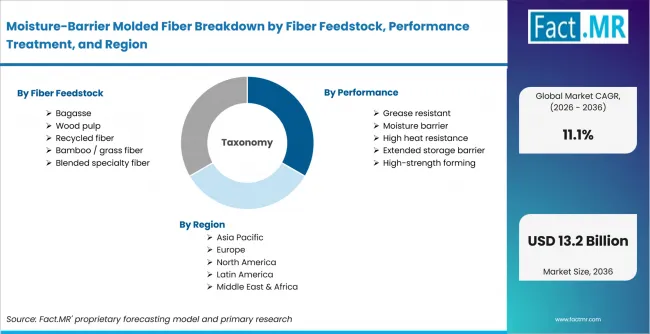
Moisture Barrier Molded Fiber Breakdown By Fiber Feedstock, Performance Treatment, And Region | Source: Fact.MR
| Attribute | Details |
|---|---|
| Quantitative Units | USD billion |
| Market Definition | Molded-fiber food and service packaging engineered with moisture, grease, heat or related barrier performance for trays, bowls, clamshells, plates and specialty containers. |
| Fiber Feedstock | Bagasse; Wood pulp; Recycled fiber; Bamboo / grass fiber; Blended specialty fiber |
| Performance Treatment | Grease resistant; Moisture barrier; High heat resistance; Extended storage barrier; High-strength forming |
| Format | Trays; Bowls; Clamshells; Plates; Specialty containers |
| Application | Hot meals; Takeaway / delivery; Fresh foods; Frozen / chilled foods; Institutional foodservice |
| Regions Covered | North America; Latin America; Western Europe; Eastern Europe; East Asia; South Asia & Pacific; Middle East & Africa |
| Countries Covered | United States; China; Germany; Japan; France |
| Key Companies Profiled | Huhtamaki; Novolex (Pactiv Evergreen); Sabert; Genpak; CKF; Stora Enso |
| Forecast Period | 2026 to 2036 |
| Approach | Hybrid top-down and bottom-up assessment using foodservice demand, molded-fiber format use, barrier-treatment requirements, country conditions and provider portfolio review. |
How is the market segmented?
-
By Fiber Feedstock
- Bagasse
- Wood pulp
- Recycled fiber
- Bamboo / grass fiber
- Blended specialty fiber
-
By Performance Treatment
- Grease resistant
- Moisture barrier
- High heat resistance
- Extended storage barrier
- High-strength forming
-
By Format
- Trays
- Bowls
- Clamshells
- Plates
- Specialty containers
-
By Application
- Hot meals
- Takeaway / delivery
- Fresh foods
- Frozen / chilled foods
- Institutional foodservice
-
By Region
- North America
- Latin America
- Western Europe
- Eastern Europe
- East Asia
- South Asia & Pacific
- Middle East & Africa