- Market Value (2025): USD 5.8 Bn
- Estimated Value (2026): USD 6.2 Bn
- Forecast Value (2036): USD 12.0 Bn
- CAGR (2026-2036): 6.8%
What is the Fiber Cement Rainscreen Panels Market forecast to be worth by 2036?
USD 6.2 billion in 2026 to USD 12.0 billion by 2036, at 6.8% CAGR.
- The fiber cement rainscreen panels market reached USD 5.8 billion in 2025 as façade projects combined appearance with thermal, fire, and moisture-management requirements.
- Demand is projected to increase from USD 6.2 billion in 2026 to USD 12.0 billion by 2036.
- The market is forecast to record a 6.8% CAGR from 2026 to 2036 as new construction and exterior renovation programs adopt more documented cladding assemblies.
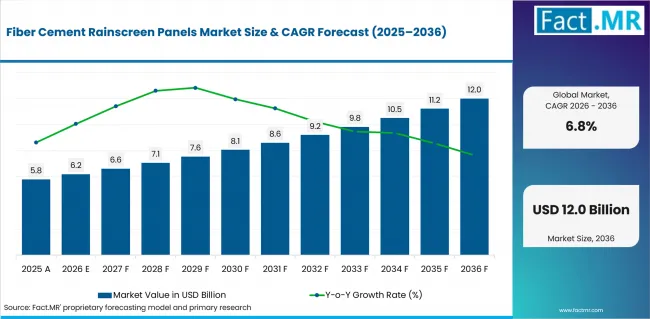
Fiber Cement Rainscreen Panels Market Value Analysis | Source: Fact.MR
What are the defining numbers behind Fiber Cement Rainscreen Panels Market growth?
USD 6.2 billion absolute opportunity by 2036, led by High-density Fiber Cement Panels, Commercial Buildings; and Ventilated Rainscreen Systems.
- Demand Drivers in the Market
- Architects and façade consultants need exterior wall assemblies that coordinate drainage, ventilation, continuous insulation; fire performance; and finish quality within one project detail.
- Commercial and institutional owners favor cladding systems that can retain appearance, permit localized panel replacement, and limit maintenance disruption across large elevations.
- Renovation programs create demand where aging façades must improve thermal performance or resolve moisture and fire concerns while buildings remain partly occupied.
- Contractors and distributors need reliable panel batches, compatible rails and fixings, installation guidance; and local technical support to convert specifications into completed work.
- Key Segments Analyzed
- By Product: High-density Fiber Cement Panels are projected to hold 44.0% share in 2026 because dimensional stability, edge quality, and factory-finish consistency support visible architectural elevations. Assembly qualification remains relevant to the cladding and building panels markets.
- By Application: Commercial Buildings are expected to account for 42.0% share in 2026 as office, retail, and hospitality projects concentrate large façade areas under professional specification and tender processes.
- By Installation System: Ventilated Rainscreen Systems are anticipated to capture 57.0% share in 2026 by separating the outer panel from thermal and weather-control layers through a drained cavity.
- By End Use: New Construction is forecast to represent 61.0% share in 2026 because wall geometry, support systems, insulation; and cavity barriers can be coordinated before installation begins.
- By Distribution Channel: Direct Sales are estimated to hold 46.0% share in 2026 as project teams require manufacturer submittals, technical review, finish control; and delivery sequencing.
- Analyst Opinion at Fact.MR
- Shambhu Nath Jha, Principal Consultant at Fact.MR, states: “Fiber cement panel demand is won at the wall-assembly level. A supplier that cannot document fixing geometry; cavity barriers; subframes; fire performance; moisture management; and field-cutting controls will struggle to convert an architectural specification into repeat orders. Retrofit packages and local technical support will matter as much as finish range.”
- Strategic Implications
- Panel manufacturers should publish tested assembly information that connects the panel with subframes, insulation, membranes; cavity barriers; fasteners; joints; and opening details.
- Architects and façade consultants should resolve support spacing, cavity depth, movement joints; and interface responsibilities before tender to reduce late substitutions and redesign.
- Contractors should price survey tolerances, bracket and rail adjustment, field-cutting controls; access; sequencing; and replacement procedures rather than comparing panel cost alone. Envelope-performance requirements also affect the structural insulated panels and prefabricated panels markets.
- Distributors should maintain finish and batch traceability, compatible accessory availability, and project-level delivery support for regional installers and contractors.
How does the Fiber Cement Rainscreen Panels Market break down by segment?
High-density Fiber Cement Panels lead at 44.0%, Commercial Buildings lead at 42.0%, and Ventilated Rainscreen Systems lead at 57.0%.
Why do High-density Fiber Cement Panels lead Product?
High-density Fiber Cement Panels hold 44.0% share in 2026.
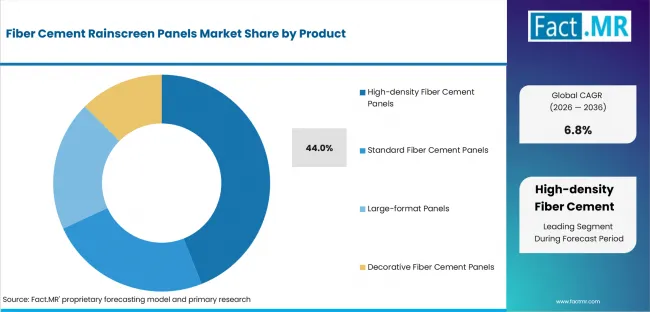
Fiber Cement Rainscreen Panels Market Analysis By Product | Source: Fact.MR
High-density panels lead because large architectural elevations expose small variations in flatness, edge quality, drilling; finish; and joint alignment. Their strength-to-thickness profile supports precision-cut formats and reliable mechanical fixing while factory coatings or through-colored constructions reduce dependence on site finishing. Smooth; textured; and through-colored alternatives remain important because architects use surface character to differentiate elevations without changing the core cladding system.
Why do Commercial Buildings lead Application?
Commercial Buildings hold 42.0% share in 2026.
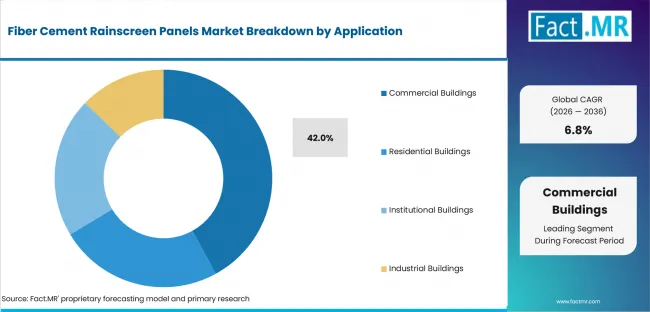
Fiber Cement Rainscreen Panels Market Analysis By Application | Source: Fact.MR
Commercial projects concentrate large façade areas under coordinated design, tender, and submittal processes. Office owners focus on appearance; maintenance planning; thermal upgrades; and tenant disruption. Retail buildings place greater weight on brand identity and replacement speed; while hospitality projects require finish consistency at entrances and other highly visible zones. These requirements favor suppliers that can support design decisions before procurement begins.
Why do Ventilated Rainscreen Systems lead Installation System?
Ventilated Rainscreen Systems hold 57.0% share in 2026.
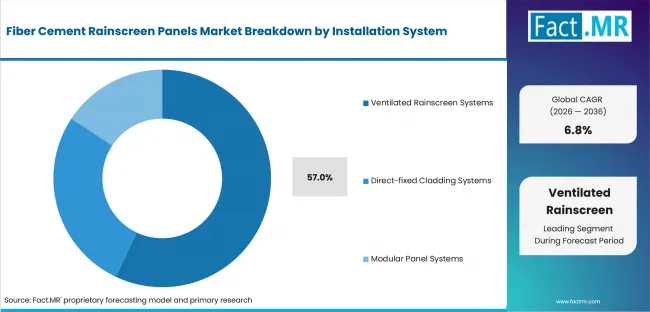
Fiber Cement Rainscreen Panels Market Analysis By Installation System | Source: Fact.MR
A ventilated assembly places the fiber cement panel outside the weather-resistive and thermal layers, leaving a drained cavity that manages incidental moisture and supports continuous insulation. Rails, brackets; and clips allow installers to correct substrate variation and replace damaged panels later. Visible fixing systems offer straightforward inspection and installation; concealed fixing systems serve premium appearance requirements; and adjustable support systems become more valuable where existing walls are uneven.
Why does New Construction lead End Use?
New Construction holds 61.0% share in 2026.
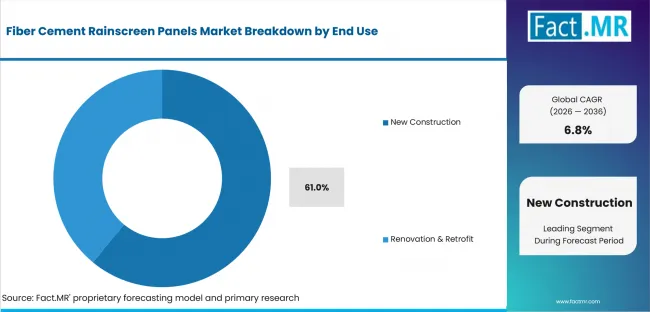
Fiber Cement Rainscreen Panels Market Analysis By End Use | Source: Fact.MR
New construction leads because the wall build-up can be designed around the panel system from the outset. Structural support, insulation thickness, cavity barriers; openings; movement joints; and access can be coordinated before fabrication. Commercial; residential; and infrastructure projects still create distinct buying paths; but each becomes easier to execute when the design team assigns responsibility for the full exterior-wall interface early.
Why does Direct Sales lead Distribution Channel?
Direct Sales hold 46.0% share in 2026.
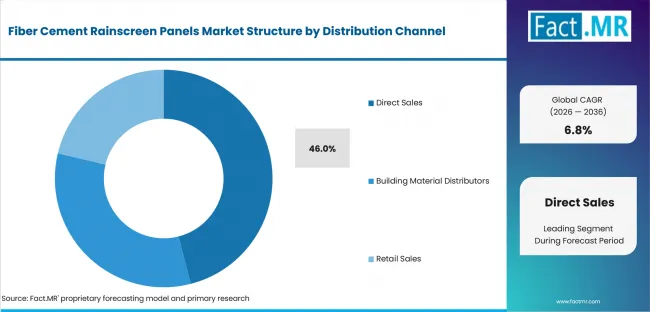
Fiber Cement Rainscreen Panels Market Analysis By Distribution Channel | Source: Fact.MR
Direct sales fit specification-led façade work because manufacturers are asked to review layouts, fixing zones, substrates; finishes; quantities; and delivery sequences before order release. Project-based supply remains important when specialist distributors coordinate accessories and local logistics. OEM contracts and builder partnerships support repeat programs; but they still depend on clear technical ownership when project conditions depart from a standard detail.
What is accelerating Fiber Cement Rainscreen Panels Market adoption, and what is holding it back?
Tighter envelope-performance requirements support demand, installed-system complexity restrains conversion, and renovation-ready packages create the clearest expansion opportunity.
Drivers Impact Analysis
- Tighter envelope-performance requirements: Regulators and building owners increasingly treat the external wall as a connected performance system rather than a decorative skin. Energy-efficiency policy, fire documentation, moisture control; and maintenance planning push project teams toward ventilated overcladding and continuous insulation. Fiber cement gains consideration where a durable panel can be combined with a clearly defined support and cavity design.
| DRIVER | QUALITATIVE RELEVANCE | GEOGRAPHIC RELEVANCE | IMPACT TIMELINE |
|---|---|---|---|
| Tighter envelope-performance requirements | High | USA | 2026 to 2036 |
Source: Fact.MR analysis. Updated Aug 3, 2026
Opportunity Impact Analysis
- Renovation-ready façade packages: Aging offices, housing blocks, schools; and public buildings need exterior upgrades that can improve thermal performance or address moisture and fire concerns without a full rebuild. Suppliers can reduce project risk by providing survey guidance; adjustable supports; opening details; replacement logic; and delivery sequences suited to occupied buildings. The commercial opportunity sits in the package and technical service; not only in panel volume.
| OPPORTUNITY | QUALITATIVE RELEVANCE | GEOGRAPHIC RELEVANCE | IMPACT TIMELINE |
|---|---|---|---|
| Renovation-ready façade packages | High | USA | 2026 to 2036 |
Source: Fact.MR analysis. Updated Aug 3, 2026
Restraints Impact Analysis
- Installed-system complexity: Ventilated façades add rails, brackets, anchors; cavity barriers; flashings; membranes; insulation interfaces; surveys; and access planning beyond the panel itself. Approval can stall when responsibility is divided across several suppliers or when tested evidence does not match the proposed build-up. Field cutting also requires controlled work practices because fiber cement can release respirable crystalline silica. Installer and contractor needs connect this demand with the exterior insulation and finish system and building insulation material markets.
| RESTRAINT | QUALITATIVE RELEVANCE | GEOGRAPHIC RELEVANCE | IMPACT TIMELINE |
|---|---|---|---|
| Installed-system complexity | High | USA | 2026 to 2036 |
Source: Fact.MR analysis. Updated Aug 3, 2026
Which countries are scaling Fiber Cement Rainscreen Panels Market fastest?
UK 7.4%, USA 7.1%, Germany 6.8%; France 6.5%; and Japan 6.2% through 2036.
Regional analysis covers North America, Latin America, Western Europe; Eastern Europe; East Asia; South Asia and Pacific; and the Middle East and Africa.
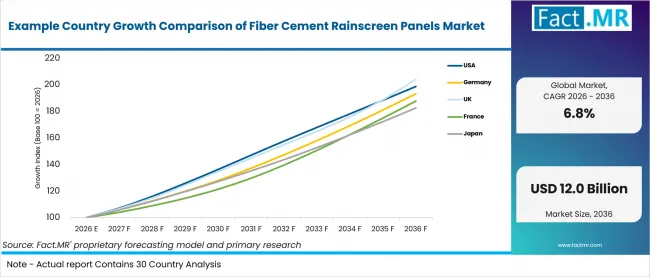
Example Country Growth Comparison Of Fiber Cement Rainscreen Panels Market | Source: Fact.MR
| COUNTRY | CAGR, 2026 to 2036 |
|---|---|
| USA | 7.1% |
| Germany | 6.8% |
| UK | 7.4% |
| France | 6.5% |
| Japan | 6.2% |
Source: Fact.MR analysis. Updated Aug 3, 2026
What is shaping USA's outlook through 2036?
7.1% CAGR through 2036, supported by specification-led construction and regional façade supply networks.
Architects, façade consultants, general contractors; and specialist installers in the USA typically qualify panels through project submittals and local code pathways. Manufacturers must support wind; fire; water; attachment; and finish questions while distributors manage regional fulfillment. The U.S. Census Bureau construction-spending series provides an operating reference for the building pipeline; but conversion still depends on project-specific approval and installer access.
What is shaping Germany's outlook through 2036?
6.8% CAGR through 2036, driven by energy-performance requirements and detailed façade engineering.
German procurement places strong weight on energy performance, fire classification, environmental declarations; fixings; and compatible subframes. The Building Energy Act keeps envelope performance central to new-build and renovation decisions. Suppliers that provide complete technical files and support detailed junctions are better positioned than vendors offering panels without system coordination.
What is shaping the UK's outlook through 2036?
7.4% CAGR through 2036, supported by external-wall remediation and stricter documentation requirements.
UK buyers increasingly require traceable fire classifications, cavity-barrier coordination, installation records; and clear responsibility across designers; contractors; and product suppliers. The higher listed growth rate reflects the volume of façade review and remediation work as well as new construction. Progress can be slow where existing-wall surveys; approvals; access; and resident disruption are not resolved early.
What is shaping France's outlook through 2036?
6.5% CAGR through 2036, shaped by energy, lifecycle-carbon; and architectural requirements.
French projects combine design approval with RE2020 energy and environmental requirements, particularly in residential, office; and public buildings. Environmental documentation therefore influences product shortlisting alongside finish; fixing; fire behavior; and maintenance. Manufacturers with clear declarations and local façade-system support can reduce the burden on design teams and contractors.
What is shaping Japan's outlook through 2036?
6.2% CAGR through 2036, supported by precise manufacturing and careful moisture, seismic; wind; and fire detailing.
Japanese façade decisions place strong emphasis on manufacturing consistency, tested joints, water management; and local acceptance of support details. Long supplier relationships and controlled design changes favor companies that can sustain finish availability and provide local technical response. Growth is steadier than in the UK or USA because qualification discipline limits abrupt material substitution.
Who leads the Fiber Cement Rainscreen Panels Market?
Swisspearl Group, James Hardie Industries plc, Etex Group; and Nichiha Corporation anchor the market through architectural ranges and project support.
Competition is organized around more than panel manufacturing. Swisspearl Group, Etex Group, Equitone; and Cembrit Holding A/S are associated with European architectural façade platforms and specification support. James Hardie Industries plc and Nichiha Corporation compete through integrated exterior systems; finish ranges; and contractor guidance. SCG Building Materials; CSR Limited; Allura USA; and Mahaphant Fibre-Cement Public Company Limited add regional manufacturing and channel reach.
Recent actions show why assembly evidence matters. James Hardie Building Products announced wider North American availability for Hardie Architectural Panel from mid-2025. Nichiha USA, ClarkDietrich, and TRUFAST Walls completed NFPA 285-25 testing on an integrated wall assembly with a ventilated cavity and continuous insulation in November 2025. Saint-Gobain completed its acquisition of CSR Limited in July 2024; expanding its construction-materials presence in Australia. These actions strengthen access and system credibility. Renovation activity also influences the insulation and siding markets.
Which companies are the key providers?
Swisspearl Group and James Hardie Industries plc are leading companies in the market.
- Swisspearl Group
- James Hardie Industries plc
- Etex Group
- Nichiha Corporation
- SCG Building Materials
- CSR Limited
- Allura USA
- Equitone
- Cembrit Holding A/S
- Mahaphant Fibre-Cement Public Company Limited
Bibliography
- U.S. Census Bureau. (2026, July 1). Monthly Construction Spending, May 2026.
- Federal Ministry of Justice and Federal Office of Justice, Germany. (2020, August 8; current text amended July 2026). Gebäudeenergiegesetz (Building Energy Act).
- UK Department for Levelling Up, Housing and Communities. (2022, June 1). Fire Safety Guidance Strengthened for New High-rise Homes.
- French Ministry for Ecological Transition. (2025, September 23). Réglementation environnementale RE2020.
- Japan Ministry of Land, Infrastructure, Transport and Tourism. (2024, July 31). Free Publication of Texts on the Revised Building Standards Act and Building Energy Efficiency Act.
This Report Addresses
- What is the Fiber Cement Rainscreen Panels Market worth in 2026, and what value is forecast for 2036?
- Which envelope, installation, documentation; and maintenance requirements shape demand?
- Why do High-density Fiber Cement Panels and Ventilated Rainscreen Systems hold their leading positions?
- How do country growth rates and procurement conditions differ across the profiled markets?
- Which companies are profiled, and what determines competitive credibility?
- What market boundary, segmentation, evidence base; and methodology support the assessment?
What does the Fiber Cement Rainscreen Panels Market cover?
Exterior fiber cement panels sold for rainscreen and façade-cladding applications within the defined Product, Application, Installation System; End Use; Distribution Channel; and regional structure.
The market covers revenue from fiber cement panels whose commercial purpose is to form the exterior layer of a rainscreen or façade-cladding assembly. Coverage includes high-density panels and the stated smooth, textured, and through-colored product options used across commercial buildings and other defined projects. The commercial value assessed is the panel revenue rather than the value of the entire wall or building.
The market differs from general fiber cement siding and board categories because the purchase is tied to a designed rainscreen or façade-cladding use. Project teams normally evaluate panel format, finish, fixing; cavity geometry; subframe compatibility; and replacement access together; even though the revenue boundary remains limited to the panel.
What is included in the scope?
Fiber cement rainscreen panels used in ventilated, visible-fixing, concealed-fixing; and adjustable-support façade systems.
The scope includes High-density Fiber Cement Panels, Smooth Finish Panels, Textured Finish Panels; and Through-colored Panels. It covers Commercial Buildings; Office Buildings; Retail Buildings; and Hospitality Buildings within the approved application structure. New Construction; Commercial Projects; Residential Projects; and Infrastructure Projects are included across Direct Sales; Project-based Supply; OEM Contracts; and Builder Partnerships.
What is excluded from the scope?
Subframes, insulation, membranes; installation labor; full façade contracting; and substitute cladding materials are outside the revenue boundary.
The scope excludes brackets, rails, anchors; cavity barriers; insulation; membranes; flashings; installation labor; and complete façade-contracting revenue. Finished-building value is excluded. Fiber cement siding or boards sold outside the defined rainscreen-panel use are also excluded; together with metal; ceramic; high-pressure laminate; stone; glass; and other substitute cladding materials.
How was the analysis built?
Primary research, official construction and regulatory sources, company evidence; project indicators; and cross-checks support the assessment.
- Primary Research
- Fact.MR gathers perspectives from fiber cement panel manufacturers, façade-system suppliers, distributors; architects; façade consultants; contractors; installers; developers; building owners; procurement teams; and subject-matter specialists.
- Desk Research
- The review covers government construction statistics, building and energy regulations, fire-safety guidance; standards and code reports; company filings; annual reports; product documentation; installation manuals; official newsrooms; and public project evidence.
- Market-Sizing and Forecasting
- The model reconciles supplier and channel revenue indicators with construction activity, façade area and project mix, panel adoption by application; installation-system penetration; new-build and retrofit demand; price and product mix; regional code conditions; and company capacity. Material approval conditions remain important to the vinyl siding and building product markets.
- Data Validation and Update Cycle
- Findings are checked across independent source types for scope consistency, numerical reconciliation, causal plausibility; company relevance; and country-specific purchasing conditions. Regulatory and company updates are reviewed to test whether the forecast assumptions remain valid.
Segmentation
What is the report’s scope and coverage?
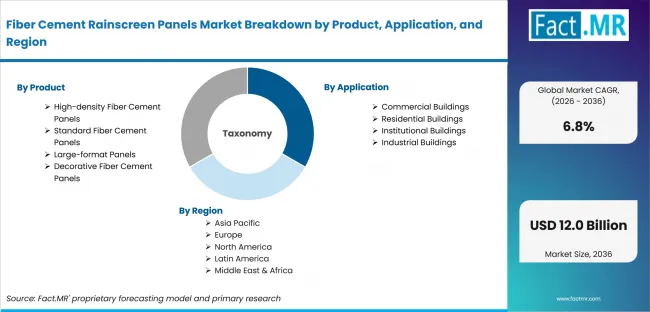
Fiber Cement Rainscreen Panels Market Breakdown By Product, Application, And Region | Source: Fact.MR
| Attribute | Details |
|---|---|
| Quantitative Units | USD 5.8 Billion in 2025; USD 6.2 Billion in 2026; USD 12.0 Billion by 2036 at 6.8% CAGR |
| Market Definition | Revenue from fiber cement panels sold for exterior rainscreen and façade-cladding applications within the defined segmentation universe. |
| Product | High-density Fiber Cement Panels; Smooth Finish Panels; Textured Finish Panels; Through-colored Panels |
| Application | Commercial Buildings; Office Buildings; Retail Buildings; Hospitality Buildings |
| Installation System | Ventilated Rainscreen Systems; Visible Fixing Systems; Concealed Fixing Systems; Adjustable Support Systems |
| End Use | New Construction; Commercial Projects; Residential Projects; Infrastructure Projects |
| Distribution Channel | Direct Sales; Project-based Supply; OEM Contracts; Builder Partnerships |
| Regions Covered | North America; Latin America; Western Europe; Eastern Europe; East Asia; South Asia and Pacific; Middle East and Africa |
| Countries Covered | USA; Germany; UK; France; Japan; and more than twenty-five additional countries in the full report |
| Key Companies Profiled | Swisspearl Group; James Hardie Industries plc; Etex Group; Nichiha Corporation; SCG Building Materials; CSR Limited; Allura USA; Equitone; Cembrit Holding A/S; Mahaphant Fibre-Cement Public Company Limited |
| Forecast Period | 2026 to 2036 |
| Approach | Fact.MR applies a hybrid bottom-up and top-down approach that reconciles panel supplier revenue, project demand, channel activity; construction indicators; and segment adoption within the defined revenue boundary. |
Source: Fact.MR analysis. Updated Aug 3, 2026
How is the market segmented?
-
By Product
- High-density Fiber Cement Panels
- Smooth Finish Panels
- Textured Finish Panels
- Through-colored Panels
- Standard Fiber Cement Panels
- Painted Panels
- Primed Panels
- Factory-coated Panels
- Large-format Panels
- Architectural Panels
- Façade Cladding Panels
- Curtain Wall Panels
- Decorative Fiber Cement Panels
- Wood Grain Panels
- Stone Finish Panels
- Custom Pattern Panels
- High-density Fiber Cement Panels
-
By Application
- Commercial Buildings
- Office Buildings
- Retail Buildings
- Hospitality Buildings
- Residential Buildings
- Multi-family Housing
- High-rise Apartments
- Luxury Residences
- Institutional Buildings
- Educational Buildings
- Healthcare Buildings
- Government Buildings
- Industrial Buildings
- Logistics Facilities
- Manufacturing Plants
- Warehouses
- Commercial Buildings
-
By Installation System
- Ventilated Rainscreen Systems
- Visible Fixing Systems
- Concealed Fixing Systems
- Adjustable Support Systems
- Direct-fixed Cladding Systems
- Mechanical Fixing
- Adhesive Fixing
- Hybrid Fixing Systems
- Modular Panel Systems
- Prefabricated Modules
- Custom Modular Panels
- Unitized Façade Systems
- Ventilated Rainscreen Systems
-
By End Use
- New Construction
- Commercial Projects
- Residential Projects
- Infrastructure Projects
- Renovation & Retrofit
- Building Refurbishment
- Façade Replacement
- Energy-efficient Upgrades
- New Construction
-
By Distribution Channel
- Direct Sales
- Project-based Supply
- OEM Contracts
- Builder Partnerships
- Building Material Distributors
- National Distributors
- Regional Dealers
- Specialty Suppliers
- Retail Sales
- Home Improvement Stores
- Construction Retailers
- Online B2B Platforms
- Direct Sales
-
By Region
- North America
- Latin America
- Western Europe
- Eastern Europe
- East Asia
- South Asia and Pacific
- Middle East and Africa
- USA
- Germany
- UK
- France
- Japan
- More than twenty-five additional countries in the full report
- North America
Who worked on this report


Preview the report firsthand - request a free sample
Free SampleGet the brochure for pricing and purchase details
Download PDF