- Market Value (2025): USD 256.0 Mn
- Estimated Value (2026): USD 320.0 Mn
- Forecast Value (2036): USD 2980.0 Mn
- CAGR (2026-2036): 25.0%
What is the Mycelium Meat Fibers Market forecast to be worth by 2036?
USD 320.0 million in 2026 to USD 2,980.0 million by 2036 at a 25.0% CAGR.
- The mycelium meat fibers market reached USD 256.0 million in 2025.
- Demand is projected to increase from USD 320.0 million in 2026 to USD 2980.0 million by 2036.
- The market is forecast to record a 25.0% CAGR from 2026 to 2036 as branded food makers and foodservice manufacturers use fermentation-derived fibers to improve texture in meat alternatives.
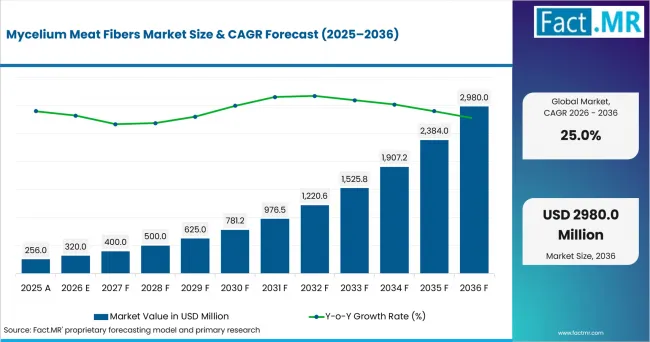
Mycelium Meat Fibers Market Value Analysis | Source: Fact.MR
What are the defining numbers behind Mycelium Meat Fibers Market growth?
An absolute opportunity of USD 2,660.0 million is expected between 2026 and 2036.
- Demand Drivers in the Market
- Branded food makers need fibrous structures that survive cooking because whole-cut slabs must deliver visible strands and a clean bite.
- Foodservice manufacturers need formats that fit sandwiches, bowls and prepared meals, so shredded fibers and minced bases support menu testing without changing kitchen flow.
- Retail category teams need protein alternatives that answer price-sensitive meat occasions. USDA ERS reported inflation-adjusted U.S. food spending of USD 2.51 trillion in 2025, expressed in 2025 dollars; on a nominal basis, food-away-from-home accounted for 56.3% of total food expenditures.
- Ingredient buyers need clear regulatory documentation. FDA GRN 1117 identifies The Better Meat Co. as the notifier for Neurospora crassa mycelial biomass, lists intended uses in meat, poultry, seafood and dairy alternatives, and records FDA’s “no questions” response.
- Key Segments Analyzed
- By Production Route: Solid-state fermentation is expected to hold 38.0% share in 2026 because it allows structured mycelium growth for fibrous formats.
- By Product Format: Whole-cut slabs are projected to account for 33.0% share in 2026 owing to product teams seeking steak, cutlet and fillet formats with visible texture.
- By Fungal Source: Ascomycete mycelium is anticipated to capture 45.0% share in 2026 due to strain familiarity, controlled biomass growth and food-use documentation.
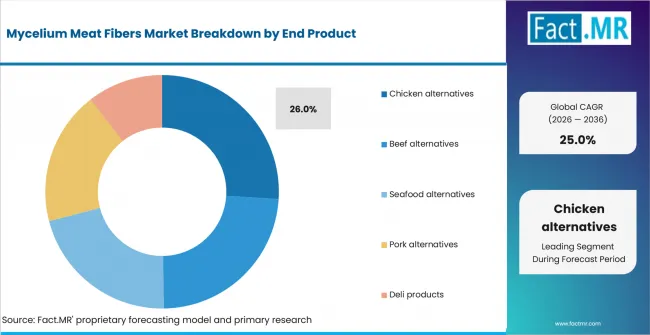
- By End Product: Chicken alternatives are estimated to represent 26.0% share in 2026 as neutral flavor and high chicken consumption make the format easier to position.
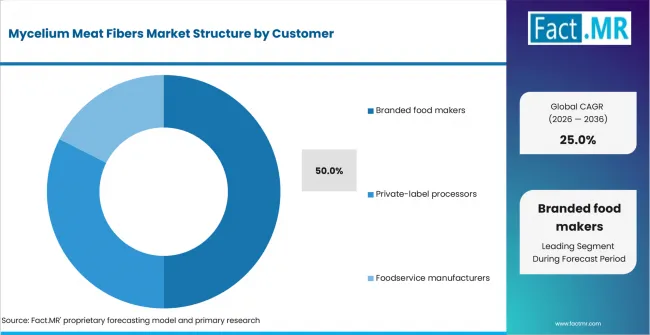
- By Customer: Branded food makers are forecast to hold 50.0% share in 2026 since brand owners control packaging claims, launches and retail communication.
- Analyst Opinion at Fact.MR
- Shambhu Nath Jha, Principal Consultant at Fact.MR, states, “Mycelium meat fibers are being judged on bite first and fermentation cost second. Adoption is expected to advance where suppliers can document strain identity, process stability and cooking behavior. The best positioned companies combine sensory proof, clean-label declarations and reliable ingredient supply.”
- Strategic Implications
- Ingredient suppliers should document fiber length, hydration behavior and cooking yield so processors can compare mycelium fibers with soy, pea and animal-meat inclusions.
- Brand owners should test chicken and deli products early because these formats can hide color variation while still showing texture benefits.
- Foodservice teams should qualify mycelium fibers through batch cooking, holding-time trials and reheating tests before menu rollout.
- Private-label processors should align claims with each country’s novel food or ingredient status before scaling cross-border retail programs.
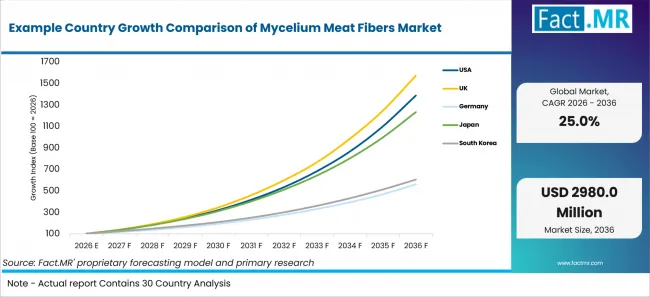
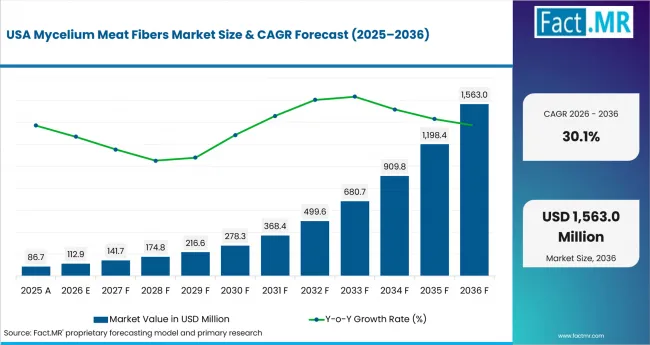
The UK is expected to post 31.8% CAGR through 2036, supported by food innovation policy and established mycoprotein familiarity. The USA is projected to record 30.1% CAGR as domestic brands connect mycelium fibers with chicken and foodservice occasions. Japan is anticipated to advance at 28.6% CAGR due to fermentation familiarity and food-security pressure. South Korea is estimated to reach 19.8% CAGR as green-bio and smart-farming programs improve support infrastructure. Germany is forecast to register 18.9% CAGR as alternative-protein programs move from legumes toward broader protein sources, including fungi.
How does the Mycelium Meat Fibers Market break down by segment?
Solid-state fermentation leads Production Route at 38.0%; branded food makers lead Customer at 50.0% share.
Which Production Route dominates?
Solid-state fermentation holds 38.0% share in 2026.
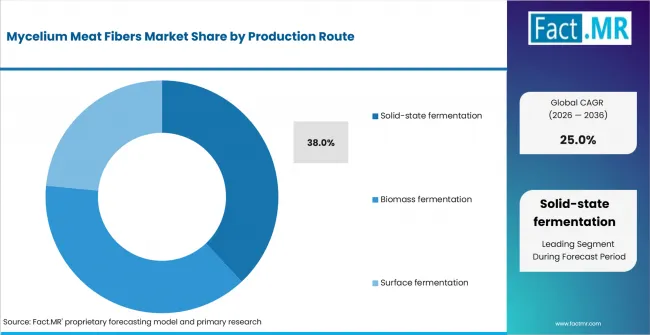
Mycelium Meat Fibers Market Analysis By Production Route | Source: Fact.MR
Solid-state fermentation leads because it allows mycelium to form physical networks that product developers can convert into slabs or cutlets. The route is suited to structure-led applications where the protein must look and chew more like meat than a powder or isolate.
What leads the Product Format segment?
Whole-cut slabs lead with 33.0% share in 2026.
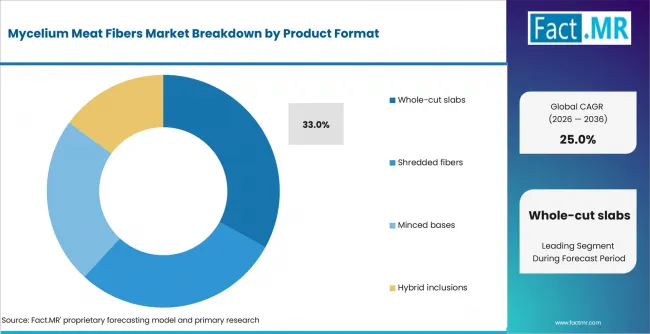
Mycelium Meat Fibers Market Analysis By Product Format | Source: Fact.MR
Whole-cut slabs lead because the value of mycelium fibers is easiest to see in steak, chicken breast and fillet-style products. These formats also give branded food makers room to differentiate beyond burgers and mince.
How does Fungal Source shape demand?
Ascomycete mycelium accounts for 45.0% share in 2026.
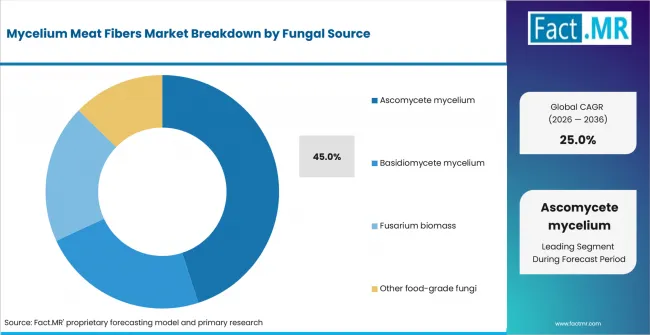
Mycelium Meat Fibers Market Analysis By Fungal Source | Source: Fact.MR
Ascomycete mycelium leads as ingredient developers evaluate strain behavior, biomass yield and neutral flavor. Better documentation around source identity supports regulatory reviews and helps customers protect label claims across markets.
What supports Chicken Alternatives within End Product?
Chicken alternatives represent 26.0% share in 2026.
Mycelium Meat Fibers Market Analysis By End Product | Source: Fact.MR
Chicken alternatives lead because the flavor target is milder than beef and the cooking occasions are broad. Cutlets, nuggets and shredded chicken analogues also fit retail frozen aisles and quick-service menus.
Which Customer segment leads adoption?
Branded food makers hold 50.0% share in 2026.
Mycelium Meat Fibers Market Analysis By Customer | Source: Fact.MR
Branded food makers lead because they control the consumer promise. They also have the incentive to pay for distinctive texture where it improves repeat purchase and avoids direct comparison with lower-cost plant-protein formats.
What is accelerating Mycelium Meat Fibers Market adoption, and what is holding it back?
Demand is expected to rise through texture-led meat alternatives, while adoption is constrained by scale cost and regulatory review.
Drivers Impact Analysis
| DRIVER | (~) % IMPACT ON CAGR | GEOGRAPHIC RELEVANCE | IMPACT TIMELINE |
|---|---|---|---|
| Whole-cut texture parity in chicken and deli products | +2.4% | North America, Western Europe | Short term (<= 2 years) |
| Foodservice testing of clean-label mycelium inclusions | +1.8% | USA, UK, Japan | Medium term (2-4 years) |
| Fermentation capacity and documented strain control | +1.5% | Global | Medium term (2-4 years) |
| Alternative-protein policy support and food-security planning | +1.0% | UK, Japan, South Korea, Germany | Long term (>= 4 years) |
- Whole-cut texture parity: Product teams use mycelium fibers when they need visible strands and chew that conventional plant isolates struggle to create.
- Foodservice testing: Documented mycelial biomass from Neurospora crassa gives processors a clearer basis for testing hydrated fibers in familiar meat-alternative formats.
- Fermentation capacity: Stable strain control and repeatable biomass growth lower qualification risk for brands that need consistent color, bite and flavor.
- Policy support: GOV.UK listed precision and biomass fermentation among food technologies likely to reach UK markets between 2025 and 2035, with both placed among Tier 1 technologies requiring near-term regulatory attention.
Opportunity Impact Analysis
| OPPORTUNITY | (~) % IMPACT ON CAGR | GEOGRAPHIC RELEVANCE | IMPACT TIMELINE |
|---|---|---|---|
| Hybrid meat products using mycelium for yield and nutrition | +1.2% | USA, UK | Short term (<= 2 years) |
| Seafood and deli products that need fibrous bite | +0.9% | Japan, Germany | Medium term (2-4 years) |
| Private-label launches once cost and supply improve | +0.7% | Western Europe, North America | Long term (>= 4 years) |
- Hybrid meat products: FDA GRN 1117 lists The Better Meat Co.’s Neurospora crassa mycelial biomass for use as an ingredient and protein source in meat, poultry and seafood, in addition to meat-alternative products.
- Seafood and deli products: Fibrous structures support salmon-style and sliced applications where shape, color and bite influence acceptance.
- Private-label launches: Retail processors are expected to move once ingredient supply becomes steadier and cost-in-use is easier to defend.
Restraints Impact Analysis
| RESTRAINT | (~) % IMPACT ON CAGR | GEOGRAPHIC RELEVANCE | IMPACT TIMELINE |
|---|---|---|---|
| Fermentation scale-up cost and batch repeatability | -0.8% | Global | Short term (<= 2 years) |
| Novel food and ingredient review requirements | -0.6% | UK, EU, Japan | Medium term (2-4 years) |
| Consumer price sensitivity in meat-alternative aisles | -0.5% | USA, UK, Germany | Medium term (2-4 years) |
- Scale-up cost: Large bioreactors, trays, downstream handling and quality checks raise the burden before mycelium fibers reach mass retail pricing.
- Ingredient review: An FSA and FSS information note states that most precision-fermented ingredients need pre-market authorization in Great Britain, while most biomass-fermentation products would not be considered novel and are covered by general food law, although some go through the novel-food authorization process.
- Price sensitivity: USDA ERS reported that beef and veal prices were 11.8% higher in June 2026 than in June 2025.
Which countries are scaling the Mycelium Meat Fibers Market through 2036?
- The country comparison spans 12.9 percentage points across the forecast period.
- The UK remains 1.7 percentage points above the USA because it combines mycoprotein familiarity with newer fermentation guidance.
- The USA remains 1.5 percentage points above Japan through domestic brand activity and large foodservice spending.
- Japan remains 8.8 percentage points above South Korea as fermentation familiarity supports early consumer testing.
- South Korea remains 0.9 percentage point above Germany through green-bio zones and smart-farming infrastructure.
- Germany closes the displayed range, but official programs are broadening from legumes toward additional protein sources including fungi.
Comparable CAGRs create different entry conditions because food regulation, consumer familiarity, protein policy and fermentation infrastructure vary by country. Full report coverage includes North America, Latin America, Western Europe, Eastern Europe, East Asia, South Asia & Pacific, Middle East & Africa.
Example Country Growth Comparison Of Mycelium Meat Fibers Market | Source: Fact.MR
| Country | CAGR |
|---|---|
| UK | 31.8% |
| USA | 30.1% |
| Japan | 28.6% |
| South Korea | 19.8% |
| Germany | 18.9% |
What supports USA adoption?
30.1% CAGR, supported by foodservice scale and documented mycelium ingredients.
Mycelium Meat Fibers Market Country Value Analysis | Source: Fact.MR
Foodservice manufacturers in the USA have a large testing base for chicken-style mycelium fibers. USDA ERS reported that inflation-adjusted U.S. food-away-from-home spending reached USD 1.41 trillion in 2025, expressed in 2025 dollars.
How is the UK scaling demand?
31.8% CAGR, driven by mycoprotein familiarity and food-innovation guidance.
The UK benefits from consumer familiarity with mycoprotein and regulator guidance on fermentation-derived foods. Defra reported that real-terms UK consumer expenditure on food and alcoholic drinks reached GBP 303.3 billion in 2025 at constant 2023 prices. FSA and FSS also identified biomass fermentation, including mycoprotein, among food technologies expected to be relevant to UK markets during 2025 to 2035 and described the applicable safety and authorization framework.
How does Japan perform?
28.6% CAGR, led by fermentation familiarity and food-security pressure.
MAFF reported on August 7, 2026 that Japan’s fiscal 2025 calorie-based food self-sufficiency ratio was 37%. Suppliers still need taste proof and simple cooking formats for retail and foodservice customers.
What supports South Korea adoption?
19.8% CAGR, supported by green-bio zones and controlled-production infrastructure.
South Korea is building policy support around food technology, microorganisms and controlled production. MAFRA designated seven Green Bio Industry Promotion Zones on December 4, 2025. MAFRA states that the zones are intended to cluster green-bio companies, universities, research institutions and infrastructure for technology verification and certification, while supporting verification, evaluation, certification and commercialization.
What is supporting Germany adoption?
18.9% CAGR, led by meat-substitute manufacturing and protein-policy expansion.
Germany has an established meat-substitute base. Destatis reported in May 2026 that German meat-substitute production value was EUR 632.6 million in 2025, while volume fell 1.2% from 2024. These statistics establish the size and recent movement of Germany’s meat-substitute sector.
Who leads the Mycelium Meat Fibers Market?
Meati Holdings, Inc. has continued the Meati brand and mycelium-based product line following the October 31, 2025 transfer of all Meati assets. The Better Meat Co. is documented in FDA GRN 1117 for Neurospora crassa mycelial biomass. MyForest Foods remains active in fermentation-based food ingredients, while Quorn Foods continues to produce Fusarium venenatum-based mycoprotein. Planetary acquired Libre Foods in June 2025, and Infinite Roots acquired Bosque Foods in May 2026; accordingly, Libre Foods and Bosque Foods should not be treated as standalone independent providers in a current competitive landscape.
The competitive field is shaped by strain control, sensory performance, regulatory documentation and cost-in-use proof. Suppliers that can provide repeatable fiber structure and practical cooking guidance are better positioned with branded food makers and private-label processors.
Which companies are the key providers?
Key companies include Meati Holdings, Inc. (Meati), The Better Meat Co., Quorn Foods, MyForest Foods, Planetary, Infinite Roots.
- Meati Holdings, Inc. (Meati)
- The Better Meat Co.
- Quorn Foods
- MyForest Foods
- Planetary
- Infinite Roots
Bibliography
- Department for Environment, Food & Rural Affairs. (2026, July 29). Food statistics in your pocket.
- Food Standards Agency. (2026, June 25). Top emerging UK food innovations: 2025–2035.
- Grossen, G. (2025, August 21). Per capita availability of red meat and poultry projected higher in 2025 and 2026. U.S. Department of Agriculture, Economic Research Service.
- Government Chemist. (2025, June 16). Quantitative review of sustainable novel food production.
- Infinite Roots. (2026). We've acquired Bosque Foods [LinkedIn post]. LinkedIn.
- Meati Holdings, Inc. (2025, November 11). Meati Holdings announces strategic revival and market expansion.
- Ministry of Agriculture, Food and Rural Affairs. (2025a, February 27). S. Korea's first master plan for promotion of the growth of the smart-farming industry for the years 2025–2029.
- Ministry of Agriculture, Food and Rural Affairs. (2025b, June 17). S. Korea accelerates turning agricultural production into smart farming through smart farming support centres.
- Ministry of Agriculture, Food and Rural Affairs. (2025c, December 4). The ROK creates an innovative ecosystem for the green-bio industry.
- MycoTechnology, Inc. (2026, March 3). MycoTechnology's Honey Truffle Sweet Protein achieves regulatory milestone, enters U.S. market at commercial scale.
- Quorn Foods. (2026, February 17). How is Quorn made?
- Statistisches Bundesamt. (2026, May 18). Nach jahrelangem Anstieg: Fleischersatz-Produktion sinkt 2025 um 1,2 % gegenüber dem Vorjahr.
- U.S. Department of Agriculture, Economic Research Service. (2026, July 24). Food Price Outlook: Summary findings.
- U.S. Food and Drug Administration. (2024, July 9). GRN No. 1117: Mycelial biomass from Neurospora crassa.
This Report Addresses
- The report explains where mycelium meat fibers are used across production route and product format. It also covers fungal source, end product and customer type.
- Segment analysis identifies the leading subsegments and the operational reasons product developers prioritize them.
- Country analysis examines the listed markets and the policy, foodservice and fermentation mechanisms supporting adoption.
- Competitive analysis reviews current companies across mycelium whole cuts, FDA-documented mycelial biomass, mycoprotein platforms and fungal food ingredients.
- Application analysis assesses how bite, hydration, cooking yield and label clarity influence purchase decisions.
What does the Mycelium Meat Fibers Market cover?
The Mycelium Meat Fibers Market covers fungal mycelium used to create meat-like texture in finished foods and ingredient systems.
It includes structured biomass for slabs, shredded fiber systems, minced bases and hybrid inclusions. Coverage of mycelium materials places fungal substrates near food, packaging and biomaterial applications.
What is included in the scope?
The scope includes mycelium fibers supplied to branded food makers, private-label processors and foodservice manufacturers. It includes fungal biomass used in chicken, beef, seafood, pork and deli alternatives.
Coverage of fermented ingredients supports upstream process context for fermentation-led food inputs. The mycoprotein binders link is relevant where fungal proteins provide texture and binding functions.
What is excluded from the scope?
The scope excludes mushroom fruiting bodies sold without meat-fiber positioning, general plant-protein isolates, cultivated meat cells, animal meat processing equipment and fermentation hardware sold without mycelium meat-fiber output. It also excludes raw fungal supplements when they are not positioned for meat-like food texture.
How Was the Analysis Built?
The analysis draws on 120+ sources, 35+ company portfolios, 25+ countries, and more than 20 industry interviews.
- Primary Research: Primary research includes discussions with manufacturers, service providers, technology developers, distributors, end users, procurement teams, and subject-matter experts. These conversations examine purchasing priorities, product adoption, operational challenges, approval requirements, competitive positioning, and the factors that influence wider market acceptance.
- Desk Research: Desk research covers government statistics, regulatory publications, company filings, trade data, technical studies, industry associations, standards, public policy, and other authoritative sources. Every source used in the analysis is documented in the bibliography.
- Market Sizing and Forecasting: Market estimates combine historical performance, demand indicators, pricing and volume trends, segment shares, company participation, country-level growth, adoption patterns, investment activity, and barriers to market expansion.
- Data Validation and Update Cycle: Findings are validated by comparing primary interviews with public data, company activity, regulatory changes, trade patterns, and industry developments. Regular updates review new product launches, capacity changes, partnerships, approvals, procurement trends, and shifts in commercial adoption.
What is the report’s scope and coverage?
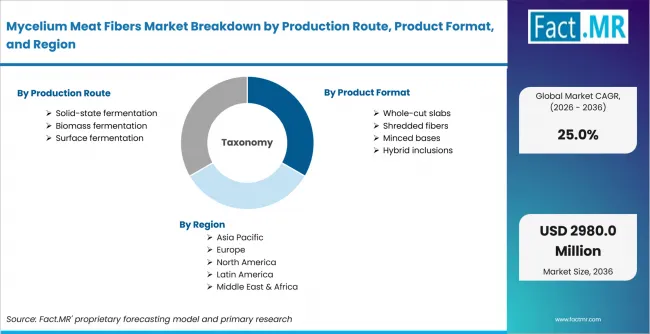
Mycelium Meat Fibers Market Breakdown By Production Route, Product Format, And Region | Source: Fact.MR
| Attribute | Details |
|---|---|
| Quantitative Units | USD million in 2026 to USD million by 2036 at a CAGR |
| Market Definition | Fibrous mycelium-based ingredients and finished meat alternatives produced through fungal fermentation for meat-like texture, including slabs, shredded fibers, minced bases and hybrid inclusions. |
| Production Route | Solid-state fermentation; Biomass fermentation; Surface fermentation |
| Product Format | Whole-cut slabs; Shredded fibers; Minced bases; Hybrid inclusions |
| Fungal Source | Ascomycete mycelium; Basidiomycete mycelium; Fusarium biomass; Other food-grade fungi |
| End Product | Chicken alternatives; Beef alternatives; Seafood alternatives; Pork alternatives; Deli products |
| Customer | Branded food makers; Private-label processors; Foodservice manufacturers |
| Regions Covered | North America; Latin America; Western Europe; Eastern Europe; East Asia; South Asia & Pacific; Middle East & Africa |
| Countries Covered | USA; UK; Germany; Japan; South Korea |
| Companies Profiled | Meati Holdings, Inc. (Meati), The Better Meat Co., Quorn Foods, MyForest Foods, Planetary, Infinite Roots |
| Forecast Period | 2026 to 2036 |
| Approach | Hybrid top-down and bottom-up approach using fermentation route, product format, fungal source, end-product adoption, country growth and provider portfolio review. |
How is the market segmented?
-
By Production Route
- Solid-state fermentation
- Biomass fermentation
- Surface fermentation
-
By Product Format
- Whole-cut slabs
- Shredded fibers
- Minced bases
- Hybrid inclusions
-
By Fungal Source
- Ascomycete mycelium
- Basidiomycete mycelium
- Fusarium biomass
- Other food-grade fungi
-
By End Product
- Chicken alternatives
- Beef alternatives
- Seafood alternatives
- Pork alternatives
- Deli products
-
By Customer
- Branded food makers
- Private-label processors
- Foodservice manufacturers
-
By Region
- North America
- Latin America
- Western Europe
- Eastern Europe
- East Asia
- South Asia & Pacific
- Middle East & Africa