Mycoprotein-Based Chemical Binders Market Forecast and Outlook 2026 to 2036
In 2025, the mycoprotein-based chemical binders market was valued at USD 24 million. Based on Fact.MR analysis, demand for mycoprotein-based chemical binders is estimated to reach USD 28 million in 2026 and USD 145 million by 2036. Fact.MR projects a CAGR of 17.9% during the forecast period. Growth reflects early-stage commercialization of fungal and mycelium-derived binders in applications where bio-based adhesion performance can replace synthetic resins without process redesign.
The market adds approximately USD 121 million in absolute value over the forecast window, signalling scale-up driven expansion rather than incremental replacement. Early-period growth is led by wood bonding applications in interior construction and engineered panels, where fungal protein binders meet strength and curing requirements. Mid-period momentum aligns with insulation and packaging use cases, supported by lightweight composite integration. In later years, value realization is influenced by automotive interior and non-structural components, where binder performance validation enables broader qualification.
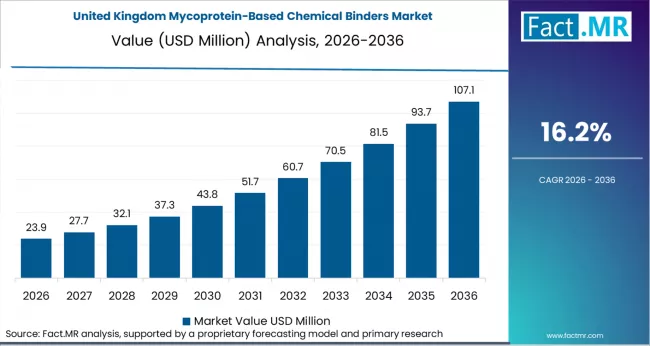
The United Kingdom leads growth at 16.2% CAGR, supported by pilot-to-commercial transition of mycelium materials and public procurement interest. The United States follows at 14.8%, driven by construction material innovation and venture-backed scaling. The Netherlands records 13.5%, reflecting advanced bio-material research and circular building initiatives, while Germany posts 12.2%, constrained by stringent material certification but supported by automotive and construction testing pipelines.
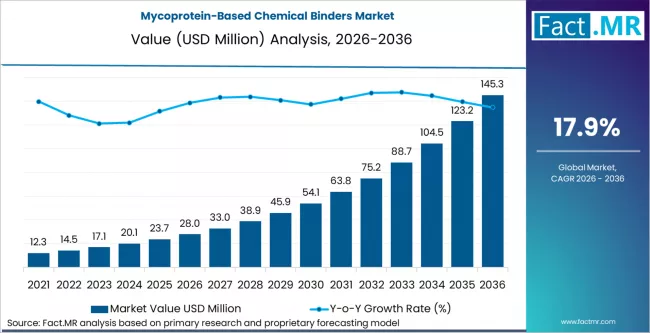
Mycoprotein Based Chemical Binders Market Market Value Analysis | Source: Fact.MR
Mycoprotein Based Chemical Binders Market Definition
The mycoprotein based chemical binders market covers binding agents produced from fungal biomass that are used to hold materials together in industrial and material processing applications. Mycoprotein is derived from controlled fermentation of filamentous fungi and processed to obtain protein rich structures with adhesive and binding properties. These binders are used in applications where biological origin materials are required, such as molded products, composite materials, and specialty industrial formulations. Oversight of microbial fermentation processes and chemical substance safety is governed by frameworks administered by the US Food and Drug Administration and chemical control programs managed by the US Environmental Protection. [1]
Mycoprotein Based Chemical Binders Market Inclusions
The report covers global and regional market size estimates in volume and value terms with a forecast period from 2026 to 2036. Segmentation includes binder form, dry and liquid, production route through fungal fermentation, application across composite materials, molded products, and specialty industrial uses, and end use industries including construction materials, packaging, and industrial manufacturing. The scope also includes regional demand patterns, pricing benchmarks, and international trade flows for bio based binding agents.
Mycoprotein Based Chemical Binders Market Exclusions
The scope excludes food grade mycoprotein products intended for human consumption and animal feed applications. Conventional synthetic binders such as urea formaldehyde, phenolic resins, and epoxy systems are not included. Finished consumer goods, engineered composites sold as end products, and downstream assemblies are excluded. Raw fermentation feedstocks, enzymes, processing equipment, laboratory scale research materials, pilot scale production without commercial output, and contract manufacturing services are also outside the scope.
Mycoprotein Based Chemical Binders Market Research Methodology
- Primary Research: Primary research involved interviews with fermentation technology developers, binder manufacturers, materials engineers, and procurement managers in industrial materials supply chains.
- Desk Research: Desk research used regulatory guidance on microbial products and chemical substances issued by the US Food and Drug Administration and the US Environmental Protection Agency, along with company annual reports and chemical safety filings.
- Market Sizing and Forecasting: Market sizing applied a hybrid top down and bottom up model using reported fermentation capacity, biomass yield assumptions, binder formulation rates, and downstream material consumption indicators.
- Data Validation and Update Cycle: Outputs were cross checked against regulatory registrations, trade statistics, company disclosures, and publicly available chemical production data, with updates applied when verified public sources issue revisions.
Summary of mycoprotein-based chemical binders market
-
Market definition
- The mycoprotein-based chemical binders market covers binding agents derived from fungal biomass and mycelium that are used to bond or stabilize materials in construction, packaging, insulation, and selected industrial composite applications.
-
Demand drivers
- Wood panel and interior construction manufacturers are evaluating fungal protein binders as substitutes for formaldehyde-based resins to meet composite wood emission limits enforced under indoor air quality regulations.
- Packaging and insulation producers are adopting mycelium and fungal protein binders where lightweight composites and fiber-based materials require compatible, low-temperature curing binder systems.
- Expansion of microbial fermentation and bio-manufacturing capacity under government-supported bioeconomy programs is improving supply consistency and scale economics, as outlined.
-
Key segments analyzed
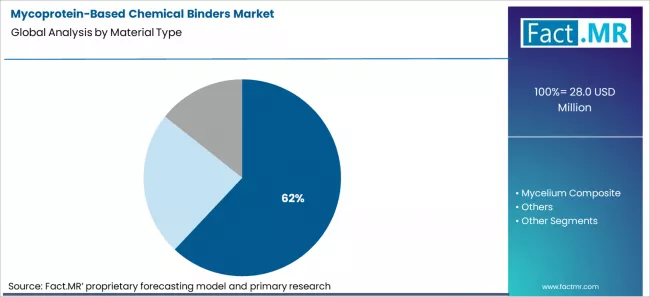
- Material type: Fungal protein-based binders lead with about 62% share due to controlled fermentation enabling uniform binding performance and repeatable formulation quality.
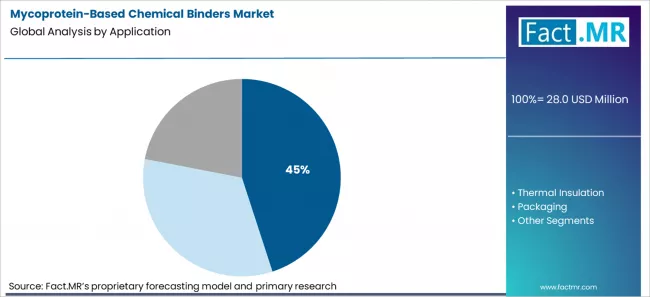
- Application: Wood bonding accounts for roughly 45% share, reflecting demand from engineered panels, interior construction materials, and furniture components.
- Geography: The United Kingdom, United States, Netherlands, and Germany show higher growth linked to pilot-to-commercial transitions, construction material testing pipelines, and biobased materials research ecosystems.
-
Analyst opinion at Fact.MR
- Shambhu Nath Jha, Principal Consultant at Fact.MR, opines, ‘CXOs will find this report useful for understanding how performance validation, manufacturing line compatibility, and certification pathways are governing scale-up of mycoprotein-based chemical binders.’
-
Strategic Implications / Executive Takeaways
- Prioritize binder formulations that match press temperatures, cure times, and strength profiles of existing wood and composite production lines.
- Focus early commercialization on non-structural construction and interior applications with shorter certification timelines.
- Build partnerships with fermentation technology providers to secure consistent fungal biomass supply at commercial scale.
-
Methodology
- Market sizing based on fermentation capacity, biomass yield assumptions, and binder usage rates by application.
- Validation through regulatory references, producer disclosures, and trade data.
- Forecasts developed using reproducible top-down and bottom-up models aligned with verified industrial benchmarks.
Segmental Analysis
Mycoprotein-Based Chemical Binders Market Analysis by Material Type
Mycoprotein Based Chemical Binders Market Analysis By Material Type | Source: Fact.MR
Based on Fact.MR analysis, consumption of fungal protein-based binders is estimated to hold 62% share of the global mycoprotein-based chemical binders market. Fact.MR analysts note that fungal protein formulations lead due to controlled fermentation processes enabling consistent binding performance and scalable production. As per Fact.MR, this material type addresses manufacturer requirements for bio-based adhesive functionality, compatibility with lignocellulosic substrates, and reduced dependence on petrochemical resins in engineered material production across wood panel and composite applications globally today.
- Bio-based innovation support: Government bioeconomy programs encourage development of microbial and fermentation-derived industrial materials. [2]
- Process consistency: Fact.MR analysts note fermentation allows uniform binder composition.
- Material integration: Fungal protein binders can be blended with natural fibers and wood particles.
Mycoprotein-Based Chemical Binders Market Analysis by Application
Mycoprotein Based Chemical Binders Market Analysis By Application | Source: Fact.MR
Based on Fact.MR analysis, consumption of mycoprotein-based binders in wood bonding applications is estimated to hold 45% share of the global market. Fact.MR opines that this application leads due to demand for alternatives to formaldehyde-based resins in panel manufacturing. As per Fact.MR, wood bonding applications address industry needs for lower emission adhesives, compatibility with pressing systems, and alignment with evolving indoor air quality requirements across construction and furniture production sectors globally today.
- Indoor air standards: Emission limits for composite wood products are regulated under national indoor air quality frameworks. [3]
- Panel production: Fact.MR analysts note wood composites represent the largest binder consumption segment.
- Regulatory alignment: Manufacturers seek binder systems compatible with emission compliance targets.
Mycoprotein-Based Chemical Binders Market Drivers, Restraints, And Opportunities
Fact.MR analysis indicates that the mycoprotein-based chemical binders market exists as a bio-derived binder segment within food, feed, and industrial formulation value chains where adhesion, texture, and functional performance are required. As per Fact.MR assessment, mycoprotein-derived binders use protein fractions extracted from filamentous fungal biomass to replace or augment conventional binders such as gluten, starch, or synthetic polymers; commercial adoption is influenced by regulatory frameworks governing food ingredient safety and functional additives, such as inclusion on the U.S. Food and Drug Administration (FDA) food additives list, which defines acceptable uses and labelling for novel binder ingredients in food products [4]. Fact.MR analysts observe that the current market scale reflects selective uptake in segments where protein-based functionality and clean-label positioning align with buyer requirements, rather than broad substitution of established binder chemistries.
Fact.MR is of the opinion that the market is undergoing transitionary dynamics as sustainability criteria and functional performance expectations evolve. Based on Fact.MR assessment, conventional synthetic binder systems and starch-based binders retain large volume use because of cost advantages and historical specification norms, but growth in mycoprotein-based binders occurs where formulation performance, moisture retention, and texture enhancement matter to product developers. Mycoprotein-based chemical binders generally carry higher per-unit pricing because of cultivation, extraction, and processing complexity, which can support realised market value growth even where shipment volumes grow at a measured pace. Fact.MR analysis suggests that this balance between niche adoption and premium pricing defines near-term market behaviour in segments where consumer preference and functional criteria drive specification.
- Regulated food additive criteria: Fact.MR analysts note that regulatory frameworks such as the U.S. Food and Drug Administration (FDA) food additives list govern acceptable uses, safety requirements, and labelling expectations for mycoprotein-derived chemical binders in food applications.
- Functional binder adoption trends: Based on Fact.MR assessment, increasing interest in protein-based binder alternatives supports growth in food and feed formulations where texture, moisture management, and clean-label positioning are specified.
- EU novel food and ingredient frameworks: Fact.MR opines that compliance with European Union novel food and ingredient evaluation requirements influences importer and producer planning for mycoprotein-based binder products in European markets.
Regional Analysis
Based on regional assessment, the mycoprotein based chemical binders sector is analyzed across Europe, North America, and other advanced materials markets, spanning more than 40 countries. Regional performance varies according to adoption of bio-based binders, investment in alternative protein processing technologies, and demand from construction, wood products, and specialty industrial applications. The analysis also presents a comparative market attractiveness evaluation grounded in region-specific demand trends.
Mycoprotein Based Chemical Binders Market CAGR Analysis by Country (2026-2036)
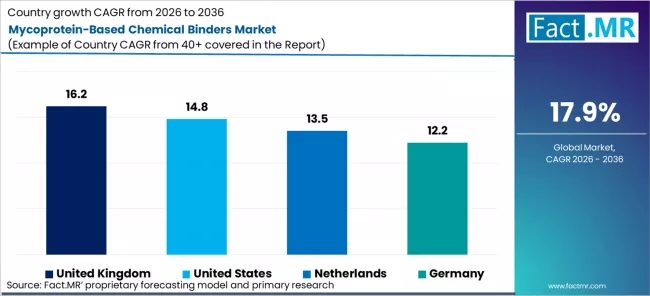
Mycoprotein Based Chemical Binders Market Cagr Analysis By Country | Source: Fact.MR
| Country | CAGR |
|---|---|
| United Kingdom | 16.2% |
| United States | 14.8% |
| Netherlands | 13.5% |
| Germany | 12.2% |
Source: Fact.MR analysis. Updated Feb 23, 2026
Source: Fact.MR analysis, based on proprietary forecasting models and primary research.
Europe Mycoprotein-Based Chemical Binders Market Analysis
Mycoprotein Based Chemical Binders Market Country Value Analysis | Source: Fact.MR
Europe operates as an innovation driven region for mycoprotein based chemical binders supported by strong biotechnology ecosystems and sustainable materials research. Market activity centers on fungal fermentation processes integration into wood composites insulation and packaging applications and collaboration between research institutions and material manufacturers. Adoption is concentrated in the United Kingdom Netherlands and Germany where pilot production and specialty material development align with circular economy programs and industrial decarbonization initiatives across established manufacturing clusters today regionwide.
- United Kingdom: Demand for mycoprotein-based chemical binders in the United Kingdom is projected to rise at 16.2% CAGR through 2036. Activity is supported by biotechnology research programs and pilot production for wood bonding and sustainable material applications, as per Fact.MR.
- Netherlands: Demand for mycoprotein-based chemical binders in the Netherlands is projected to rise at 13.5% CAGR through 2036. Adoption reflects integration of fungal protein technologies into composite and packaging material development projects, according to Fact.MR.
- Germany: Demand for mycoprotein-based chemical binders in Germany is projected to rise at 12.2% CAGR through 2036. Usage is linked to specialty materials research and application within engineered wood and insulation products, as per Fact.MR.
Fact.MR’s analysis of the Mycoprotein-Based Chemical Binders Market in Europe consists of country-wise assessment that includes the United Kingdom, Netherlands, and Germany. Readers can find biotechnology integration trends, pilot production insights, and downstream material application references.
North America Mycoprotein-Based Chemical Binders Market Analysis
North America functions as a commercialization focused region for mycoprotein based chemical binders supported by advanced biotechnology startups and specialty materials manufacturers. Market activity emphasizes fermentation scale up intellectual property development and integration into wood composites packaging and construction materials. Adoption is centered in the United States where producers align with sustainable materials demand and industrial innovation ecosystems. Growth reflects venture investment research partnerships and expansion of bio based binder applications within established manufacturing value chains.
- United States: Demand for mycoprotein-based chemical binders in the United States is projected to rise at 14.8% CAGR through 2036. Adoption is supported by biotechnology commercialization and integration into engineered wood and specialty composite manufacturing, according to Fact.MR.
Fact.MR’s analysis of the Mycoprotein-Based Chemical Binders Market in North America consists of country-wise assessment that includes the United States. Readers can find commercialization pathways, fermentation scaling trends, and application development insights.
Competitive Landscape of Mycoprotein-Based Chemical Binders Market
Mycoprotein Based Chemical Binders Market Analysis By Company | Source: Fact.MR
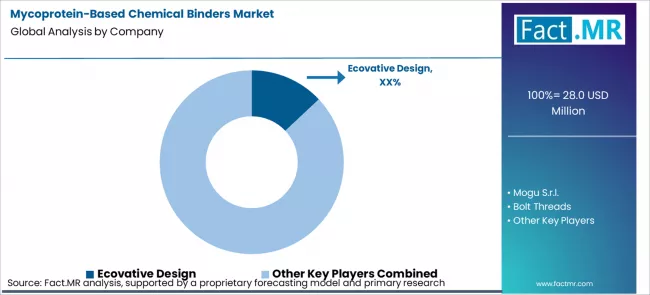
As per Fact.MR analysis, the 2026 mycoprotein-based chemical binders market is defined by validated material performance, feedstock scalability, and regulatory compliance, which determine competitive advantage. Ecovative Design and Mogu S.r.l. lead with proprietary fungal protein formulations and documented binding strength, which strengthens adoption in construction, packaging, and insulation applications. Bolt Threads and Grown.bio focus on scalable mycelium cultivation with validated reproducibility and consistency, which improves process reliability and supports multi-region compliance. Biohm Ltd. emphasizes hybrid binder systems and verified mechanical performance, which increases adoption in modular construction and sustainable product applications. Other smaller players provide specialty formulations with tested biodegradability and material properties, which address niche industrial and consumer applications. Across the market, validated functional performance, scalable production, and adherence to regulatory and sustainability standards create enduring competitive moats, reducing reliance on pricing or isolated innovation claims while ensuring long-term industrial and commercial adoption.
Recent Industry Developments
- Quorn Foods (Marlow Foods): Transition to Vegan Binders: In its 2025/2026 Sustainability and Product Roadmap, Quorn announced a major shift in its manufacturing process to eliminate egg-white binders. By leveraging high-pressure homogenization and specialized freezing techniques, Quorn has successfully enabled mycoprotein’s own chitin-glucan fibers to act as a self-binding matrix, creating "clean-label" vegan products without external chemical binders. [5]
- ENOUGH (Abunda): B2B Scale-Up with Cargill: ENOUGH (formerly 3FBio) has fully commissioned its flagship facility in the Netherlands, integrated with a Cargill refinery. As of early 2026, the company is supplying ABUNDA® mycoprotein as a functional binder to global food manufacturers. This ingredient is being marketed specifically for its ability to provide structural integrity and "whole-muscle" texture in hybrid and plant-based foods. [6]
Key Players in Mycoprotein-Based Chemical Binders Market
- Ecovative Design
- Mogu S.r.l.
- Bolt Threads
- Grown.bio
- Biohm Ltd.
- Others
Bibliography
- [1] U.S. Food and Drug Administration. (2024). Food additive petitions and ingredient approval framework. U.S. Department of Health and Human Services; U.S. Environmental Protection Agency. (2024). Chemical research and microbial product oversight. U.S. Environmental Protection Agency.
- [2] U.S. Department of Energy. (2024). Bioenergy Technologies Office: Industrial biotechnology and bio-based materials. Office of Energy Efficiency and Renewable Energy, U.S. Department of Energy.
- [3] U.S. Environmental Protection Agency. (2024). Formaldehyde emission standards for composite wood products. U.S. Environmental Protection Agency.
- [4] U.S. Food and Drug Administration. (2024). Food additives and ingredients: Safety, use, and labelling requirements. U.S. Department of Health and Human Services.
- [5] Marlow Foods Ltd. (Quorn Foods). (2025). Sustainability and product roadmap: Mycoprotein processing and binding innovation. Quorn Foods.
- [6] ENOUGH B.V. (2026). ABUNDA® mycoprotein production scale-up and Cargill partnership announcement. ENOUGH Official Corporate Communications.
Segmentation
Scope of the Report
| Metric | Value |
|---|---|
| Quantitative Units | USD 28 million (2026) to USD 145 million (2036), CAGR 17.9% |
| Market Definition | The mycoprotein-based chemical binders market covers binding agents derived from fungal biomass, produced via controlled fermentation of filamentous fungi. These binders are used in industrial and material processing applications such as molded products, composites, and specialty industrial formulations. Regulatory oversight is governed by the US FDA and US EPA for microbial fermentation safety and chemical handling. |
| Material Type Segmentation | Fungal Protein-Based, Mycelium Composite, Others |
| Application Segmentation | Wood Bonding, Thermal Insulation, Packaging |
| End-Use Industry Segmentation | Construction, Packaging, Automotive |
| Regions Covered | Asia Pacific, Europe, North America, Latin America, Middle East & Africa |
| Countries Covered | India, China, Japan, South Korea, Indonesia, Australia & New Zealand, ASEAN, Rest of Asia Pacific, Germany, Italy, France, United Kingdom, Spain, Benelux, Nordics, Central & Eastern Europe, Rest of Europe, United States, Canada, Mexico, Brazil, Argentina, Chile, Rest of Latin America, Kingdom of Saudi Arabia, United Arab Emirates, South Africa, Turkey, Rest of Middle East & Africa |
| Key Companies Profiled | Ecovative Design, Mogu S.r.l., Bolt Threads, Grown.bio, Biohm Ltd., Others |
| Forecast Period | 2026 to 2036 |
| Approach | Hybrid top-down and bottom-up modeling validated through interviews with fermentation technology developers, binder manufacturers, materials engineers, and procurement managers. Market sizing supported by fermentation capacity, biomass yield, binder formulation rates, and downstream material consumption. |
Source: Fact.MR analysis. Updated Feb 23, 2026
Mycoprotein-Based Chemical Binders Market Analysis by Segments
-
By Material Type :
- Fungal Protein-Based
- Mycelium Composite
- Others
-
By Application :
- Wood Bonding
- Thermal Insulation
- Packaging
-
By End-Use Industry :
- Construction
- Packaging
- Automotive
-
Region :
- Asia Pacific
- India
- China
- Japan
- South Korea
- Indonesia
- Australia & New Zealand
- ASEAN
- Rest of Asia Pacific
- Europe
- Germany
- Italy
- France
- United Kingdom
- Spain
- Benelux
- Nordics
- Central & Eastern Europe
- Rest of Europe
- North America
- United States
- Canada
- Mexico
- Latin America
- Brazil
- Argentina
- Chile
- Rest of Latin America
- Middle East & Africa
- Kingdom of Saudi Arabia
- United Arab Emirates
- South Africa
- Turkey
- Rest of Middle East & Africa
- Asia Pacific
Frequently Asked Questions
How large is the mycoprotein-based chemical binders market in 2026?
What will the global market size be by 2036?
What is the expected CAGR for the mycoprotein-based chemical binders market during 2026–2036?
How much absolute value is the market expected to add during the forecast window?
What is driving growth in the mycoprotein-based chemical binders market?
Which material type dominates the mycoprotein-based chemical binders market?
Why do fungal protein-based binders lead adoption?
Which application segment accounts for the largest share of demand?
What makes wood bonding the leading application for mycoprotein-based binders?
How important is packaging as a growth application?
What role does thermal insulation play in market expansion?
Which country is expected to grow the fastest in this market?
What factors are supporting rapid growth in the United Kingdom?
How does the United States compare in terms of growth rate?
What is driving adoption in the United States market?
What is the growth outlook for the Netherlands?
How significant is Germany in the mycoprotein-based binders market?
Why is automotive considered a later-stage growth segment?
How do substitution economics influence market adoption?
What are the key priorities for buyers evaluating mycoprotein-based binders?
Who worked on this report


Preview the report firsthand - request a free sample
Free SampleGet the brochure for pricing and purchase details
Download PDF