- Market Value (2025): USD 828.8 Mn
- Estimated Value (2026): USD 920.0 Mn
- Forecast Value (2036): USD 2612.0 Mn
- CAGR (2026-2036): 11.0%
What is the Natural Ester Fluids Market forecast to be worth by 2036?
USD 920.0 million in 2026 to USD 2,612.0 million by 2036 at an 11.0% CAGR.
- The Natural Ester Fluids Market reached USD 828.8 million in 2025.
- Demand is projected to increase from USD 920.0 million in 2026 to USD 2,612.0 million by 2036.
- The market is forecast to record 11.0% CAGR from 2026 to 2036 as utilities, formulators and food processors shift toward ester fluids with clearer application proof.
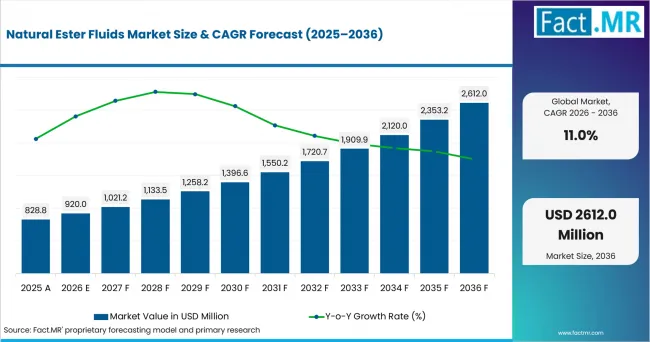
Natural Ester Fluids Market Value Analysis | Source: Fact.MR
What are the defining numbers behind Natural Ester Fluids Market growth?
An absolute opportunity of USD 1,692.0 million is expected between 2026 and 2036.
- Demand Drivers in the Market
- Transformer manufacturers need ester fluids with higher fire points and moisture tolerance because renewable interconnection and substation upgrades place fluid choice inside reliability reviews.
- Personal-care formulators need plant-derived emollients with clear origin documentation, supported by retail ingredient review and export-market compliance checks.
- Food and beverage processors need lubricants that combine equipment protection with food-contact assurance, since contamination control remains a direct audit requirement.
- Industrial plant operators need oxidation control and stable lubricity when equipment works under heat, pressure and longer service intervals.
- Grid spending gives dielectric fluids a clearer replacement route. The International Energy Agency reported in June 2025 that global grid investment reached USD 390 billion in 2024.
- Key Segments Analyzed
- By Product: Plant esters are expected to hold 36.0% share in 2026 because vegetable-oil chemistry fits transformer dielectric fluids and personal-care emollients.
- By Function: Lubricity is projected to account for 38.0% share in 2026, supported by hydraulic oils and food machinery fluids that need reduced friction.
- By Application: Personal care is anticipated to capture 35.0% share in 2026 due to ester use in skin feel, spreading and mildness-focused formulations.
- By Form: Liquid is estimated to represent 47.0% share in 2026 owing to easier dosing, blending and retrofilling across industrial and formulation lines.
- Analyst Opinion at Fact.MR
- Shambhu Nath Jha, Principal Consultant at Fact.MR, states, “Natural ester fluids draw attention where performance approval and environmental preference meet. The market is expected to reward suppliers that document flash point, oxidation stability and feedstock quality without asking operators to redesign every system. Qualification depth is likely to decide supplier selection before broad bio-based language.”
- Strategic Implications
- Fluid suppliers should publish application-specific proof for dielectric strength, oxidation control and lubricity before buyers compare ester grades.
- Utility-focused vendors should connect ester-fluid sales with transformer life-extension, fire-risk reduction and renewable interconnection needs.
- Personal-care ingredient teams should align plant ester grades with sensory testing, allergen documentation and export-market compliance requirements.
- Food-contact lubricant suppliers should keep NSF, ISO and maintenance evidence close to buyer materials so quality teams approve substitutions faster.
The USA is projected to record 12.1% CAGR through 2036, supported by power-grid expansion and plant-oil feedstock depth. Germany is forecast to post 11.6% CAGR through 2036, shaped by transmission approval activity and industrial fluid demand. Japan is expected to advance at 10.8% CAGR through 2036, owing to transformer demand and formulation discipline. France is estimated to hold 10.3% CAGR through 2036, reinforced by RTE investment and personal-care compliance. Brazil is anticipated to reach 9.9% CAGR through 2036, led by transmission auctions and soybean supply strength.
How does the Natural Ester Fluids Market break down by segment?
Liquid leads Form at 47.0% share in 2026; Lubricity leads Function at 38.0% share.
Which Product dominates?
Plant esters are expected to hold 36.0% share in 2026.
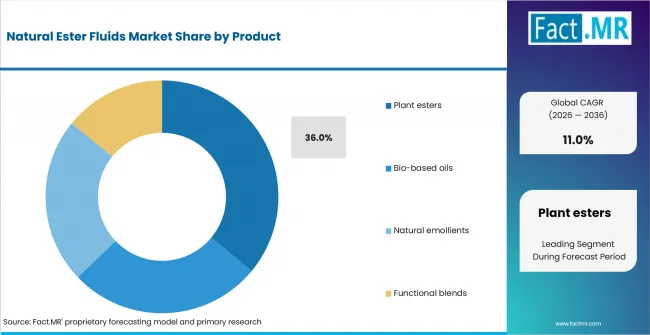
Natural Ester Fluids Market Analysis By Product | Source: Fact.MR
Plant esters lead Product because vegetable-oil feedstocks fit transformer fluids, emollients and specialty oils. Bio-based oils serve renewable-input needs in industrial formulations. Natural emollients support light skin feel. Functional blends address oxidation or thermal targets where a single base fluid does not meet the brief.
What leads the Function segment?
Lubricity is projected to account for 38.0% share in 2026.
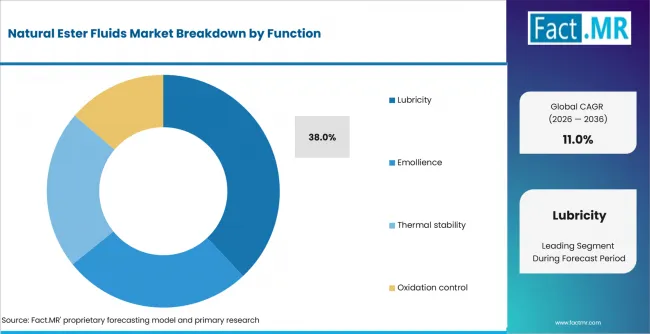
Natural Ester Fluids Market Analysis By Function | Source: Fact.MR
Lubricity leads Function because ester polarity helps create a stable film on metal surfaces. Emollience follows where skin feel sets purchase requirements. Thermal stability supports heat-exposed fluids. Oxidation control protects long service intervals in transformer, gear and specialty industrial systems.
How does Application shape demand?
Personal care is anticipated to capture 35.0% share in 2026.
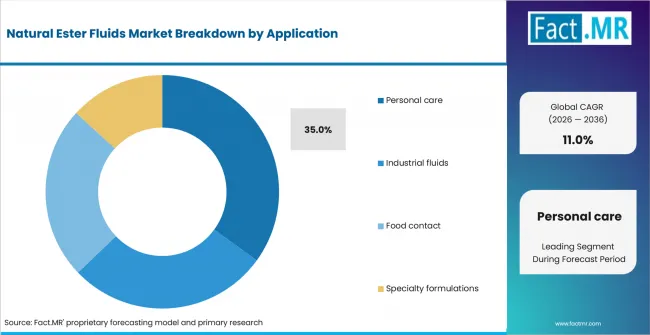
Natural Ester Fluids Market Analysis By Application | Source: Fact.MR
Personal care leads Application as formulators use natural ester fluids for emollience and sensory feel. Industrial fluids rely on lubricity and biodegradability. Food contact uses need audit-ready registration. Specialty formulations use ester chemistry when smaller batches require defined performance and consistent handling.
What supports demand for Liquid within Form?
Liquid is estimated to represent 47.0% share in 2026.
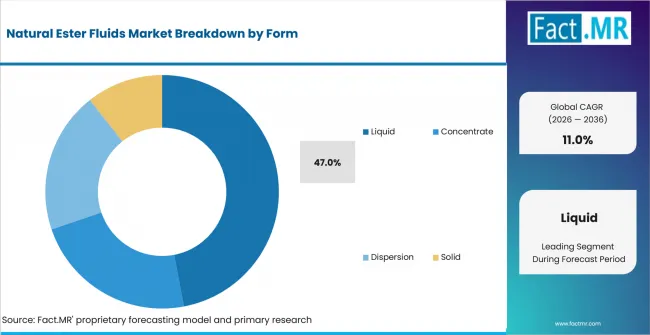
Natural Ester Fluids Market Analysis By Form | Source: Fact.MR
Liquid form leads because operators can meter, pump and blend fluids without extra conversion. Concentrates support controlled dilution where formulators want a narrower active package. Dispersions help compatibility in specialty systems. Solid formats remain more handling-intensive before use.
What is accelerating Natural Ester Fluids Market adoption, and what is holding it back?
Grid fluid replacement drives it; feedstock and qualification limits restrain it.
Drivers Impact Analysis
| DRIVER | (~) % IMPACT ON CAGR | GEOGRAPHIC RELEVANCE | IMPACT TIMELINE |
|---|---|---|---|
| Transformer fire-safety and grid replacement needs | +1.5% | North America, Western Europe, East Asia | Medium term (2-4 years) |
| Bio-based personal-care formulation demand | +1.1% | Western Europe, Japan, USA | Short term (<= 2 years) |
| Food-contact lubricant audit requirements | +0.9% | USA, Germany, France, Japan | Medium term (2-4 years) |
| Industrial equipment lubricity and oxidation needs | +0.7% | Global | Long term (>= 4 years) |
- Transformer fire-safety and grid replacement needs: Natural ester dielectric fluids lower fire-risk concerns in populated or constrained electrical sites. Utilities also weigh insulation life and moisture handling when selecting fluids for new transformers or retrofills. Product evidence therefore needs to address protection, service life and site approval together.
- Bio-based personal-care formulation demand: Brands use ester fluids where plant origin and skin feel must work together. Product developers need consistent odor, color and purity before natural emollients can move into repeat production. Supplier documentation has direct bearing on speed of formulation approval.
- Food-contact lubricant audit requirements: Food processing plants need lubricant systems that support HACCP reviews and equipment uptime. Ester-based synthetic lubricants gain attention where hygiene audits and maintenance teams approve the same fluid family. The sales case depends on registration proof and wear protection.
- Industrial equipment lubricity and oxidation needs: Industrial users adopt ester fluids when lower friction and oxidation stability reduce downtime risk. The value case is clearer where high-temperature service makes mineral-oil replacement easier to justify. Suppliers still need operating evidence by application.
Opportunity Impact Analysis
| OPPORTUNITY | (~) % IMPACT ON CAGR | GEOGRAPHIC RELEVANCE | IMPACT TIMELINE |
|---|---|---|---|
| Natural ester transformer retrofilling | +1.2% | USA, Germany, France, Brazil | Medium term (2-4 years) |
| Premium emollients for skin and hair care | +0.8% | Japan, France, USA | Short term (<= 2 years) |
| Environmentally acceptable industrial lubricants | +0.6% | Germany, France, Brazil | Long term (>= 4 years) |
- Natural ester transformer retrofilling: Retrofilling creates an upgrade path when utilities want better fire safety without replacing the full transformer asset. The opportunity depends on fluid compatibility and moisture control. Verified installation practice is expected to shape buyer confidence.
- Premium emollients for skin and hair care: Ester suppliers can serve formulations that need a light feel and plant-based positioning. Winning grades are expected to combine consistent odor, color and oxidation behavior. Documentation becomes part of the value proposition for export-ready brands.
- Environmentally acceptable industrial lubricants: Marine, hydraulic and outdoor equipment users face stronger scrutiny over fluid leakage. Ester-based fluids gain room when biodegradability, low toxicity and equipment protection are documented together. Application testing remains the route from trial to repeat purchase.
Restraints Impact Analysis
| RESTRAINT | (~) % IMPACT ON CAGR | GEOGRAPHIC RELEVANCE | IMPACT TIMELINE |
|---|---|---|---|
| Plant-oil feedstock price and crop exposure | -0.6% | USA, Brazil, Japan | Short term (<= 2 years) |
| Transformer approval and retrofill validation time | -0.5% | North America, Europe, East Asia | Medium term (2-4 years) |
| Oxidation stability requirements in long service | -0.4% | Global | Long term (>= 4 years) |
- Plant-oil feedstock price and crop exposure: Natural ester production relies on agricultural oils that move with crop output and crushing economics. Procurement teams often keep dual sourcing until supply stability is clear. Price exposure is expected to remain visible in plant ester grades.
- Transformer approval and retrofill validation time: Utilities need evidence on miscibility, water handling and fire classification before changing fluids. Long asset lives slow switching even where the fluid offers operating benefits. Supplier service teams therefore influence adoption as much as chemistry.
- Oxidation stability requirements in long service: Some applications require long drain intervals and high heat resistance. Suppliers must prove oxidation control before ester fluids displace established mineral or synthetic alternatives. Maintenance teams are expected to keep qualification conservative in mission-critical equipment.
Which countries are scaling the Natural Ester Fluids Market through 2036?
- The country comparison spans 2.2 percentage points and forms three practical growth bands across the forecast period.
- The USA remains 0.5 percentage point above Germany through grid expansion and domestic plant-oil supply depth.
- Germany remains 0.8 percentage point above Japan through network approvals and industrial equipment demand.
- Japan remains 0.5 percentage point above France through transformer reliability requirements and disciplined formulation approval.
- France remains 0.4 percentage point above Brazil through RTE investment and premium personal-care formulation needs.
- Brazil closes the displayed range through transmission auctions and soybean supply strength.
Comparable CAGRs create different entry conditions due to grid investment, crop exposure and formulation compliance. Full report coverage includes North America, Latin America, Western Europe, Eastern Europe, East Asia, South Asia & Pacific, Middle East & Africa.
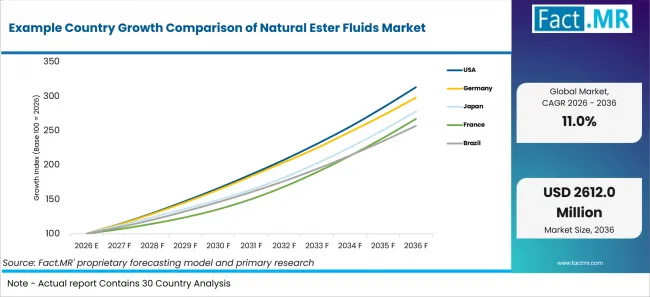
Example Country Growth Comparison Of Natural Ester Fluids Market | Source: Fact.MR
| Country | CAGR |
|---|---|
| United States | 12.1% |
| Germany | 11.6% |
| Japan | 10.8% |
| France | 10.3% |
| Brazil | 9.9% |
What supports USA adoption?
12.1% CAGR, supported by grid additions and domestic oilseed depth.
U.S. utility planners evaluate transformer liquids where fire safety and grid reliability share the same approval path. The USA is projected to record 12.1% CAGR through 2036. The U.S. Energy Information Administration reported in February 2026 that developers and operators planned to add 86 GW of new utility-scale generating capacity in 2026, supporting broader investment in power infrastructure that could create opportunities for transformer dielectric fluids.
How is Germany scaling demand?
11.6% CAGR, driven by grid approvals and industrial lubricant replacement.
Germany’s grid expansion program provides context for high-voltage investment. Germany is forecast to post 11.6% CAGR through 2036. Bundesnetzagentur reported in January 2026 that it approved roughly 2,000 km of power lines under its responsibility in 2025, highlighting the scale of Germany’s grid-expansion activity and providing a broader infrastructure context for potential demand for transformer and dielectric-fluid technologies.
What supports Japan performance?
10.8% CAGR, led by transformer reliability and formulation quality controls.
Japanese users place high weight on documented quality before substituting industrial or formulation fluids. Japan is expected to advance at 10.8% CAGR through 2036. METI reported in April 2026 that Japan’s electricity generation increased 0.4% year over year to 0.9911 petawatt-hours in FY2024, highlighting the scale of the country’s electricity system and providing broad infrastructure context for transformer and dielectric-fluid markets.
What supports France growth?
10.3% CAGR, backed by grid investment and premium formulation demand.
France links natural ester use with grid modernization and higher-value formulation channels. France is estimated to hold 10.3% CAGR through 2036. CRE approved €3.47 billion of RTE investment for 2025 in March 2025, highlighting the scale of France’s transmission-grid investment and providing broader infrastructure context for potential demand for transformer and dielectric-fluid technologies.
How does Brazil develop demand?
9.9% CAGR, driven by transmission auctions and soybean supply strength.
Brazil’s transmission buildout and oilseed base provide market context for natural ester fluids. Brazil is anticipated to reach 9.9% CAGR through 2036. The Ministry of Mines and Energy reported in October 2025 that Transmission Auction No. 4/2025 involved estimated investment of R$5.53 billion, covering 1,081 km of transmission lines and 2,000 MVA of transformation capacity, highlighting the scale of Brazil’s planned transmission infrastructure and providing broader market context for transformer and dielectric-fluid applications.
Who leads the Natural Ester Fluids Market?
Cargill, Incorporated and Shell as leading direct ester-fluid participants; issuer sources confirm their ester-fluid activity.
Cargill, Incorporated is active through FR3 natural ester dielectric fluid for transformer applications. Shell participates through its MIDEL ester transformer-liquid portfolio and broader biodegradable transformer-fluid offerings. In April 2025, Shell announced that MIDEL had joined its transformer-liquid portfolio alongside Shell Diala, complementing the Diala range with natural and synthetic ester transformer liquids.
Which companies are the key providers?
Key companies include Cargill, Incorporated, Shell, Repsol, S.A., and APAR Industries Limited.
- Cargill, Incorporated
- Shell
- Repsol, S.A.
- APAR Industries Limited
Bibliography
- Bundesnetzagentur. (2026, January 2). Energy transition clears crucial hurdle – significant progress in electricity grid expansion in 2025.
- Cargill. (2026, March 23). New Cargill plant triples European supply of FR3® natural ester dielectric fluid as demand grows for bio-based, high performance transformer fluids.
- Commission de régulation de l’énergie. (2025, March 27). La CRE approuve le programme d’investissements de RTE pour l'année 2025, pour un montant de 3,47 milliards d'euros, conforme avec la trajectoire retenue par la CRE dans sa décision sur le tarif d’utilisation des réseaux publics d’électricité (TURPE 7).
- International Energy Agency. (2025, June 5). World Energy Investment 2025.
- Ministry of Economy, Trade and Industry. (2026, April 14). FY2024 Energy Supply and Demand Report (Revised Report).
- Ministério de Minas e Energia. (2025, October 31). Silveira celebra sucesso do Leilão de Transmissão 4/2025 e destaca expansão sustentável da infraestrutura elétrica [Silveira celebrates success of Transmission Auction 4/2025 and highlights sustainable expansion of electricity infrastructure].
- Shell. (2025, April 1). Shell enhances its transformer liquid portfolio, now includes Shell MIDEL.
- U.S. Energy Information Administration. (2026, February 20). New U.S. electric generating capacity expected to reach a record high in 2026.
This Report Answers
- The report explains where natural ester fluids are used across product, function, application and form.
- Segment analysis identifies the 2026 share positions and the operational reasons buyers prioritize them.
- Country analysis examines the listed markets and the grid or formulation mechanisms supporting adoption.
- Competitive analysis reviews the profiled companies across dielectric, industrial and food-contact fluid coverage.
- Application analysis assesses how fire safety, lubricity and emollience influence purchase decisions.
What does the Natural Ester Fluids Market cover?
Plant esters, bio-based oils, natural emollients and functional blends used in fluid applications.
The Natural Ester Fluids Market covers ester-based fluids derived from plant oils or synthetic ester chemistry where the fluid delivers dielectric insulation, lubricity, emollience, thermal stability or oxidation control. The assessment covers use in transformer fluids, industrial lubrication, personal care and food-contact applications.
The market differs from the broader lubricant and specialty fluid category because inclusion depends on ester chemistry and direct functional use. Mineral oils, non-ester synthetic fluids and finished personal-care products remain outside the boundary unless natural ester fluids are a defined input.
What is included in the scope?
Natural ester fluid systems used in transformer, lubricant, personal-care and specialty formulation contexts.
The scope includes plant ester fluids, bio-based oils, natural emollients and functional blends sold into dielectric, lubricant and formulation uses.
Transformer and outdoor-equipment use aligns with biodegradable hydraulic fluids where leakage risk influences base-fluid choice. Personal-care application coverage connects with cosmetic ester ingredients where emollience and origin claims shape formulation decisions.
What is excluded from the scope?
Mineral oils and non-ester finished products are outside the scope.
The scope excludes mineral transformer oils, petroleum hydraulic fluids and finished cosmetics sold without a defined natural ester fluid input. Biofuel feedstocks are also outside coverage when the ester fluid is not sold for lubrication, dielectric, emollience or specialty formulation use.
How Was the Analysis Built?
The analysis draws on 120+ sources, 35+ company portfolios, 25+ countries, and more than 20 industry interviews.
- Primary Research: Primary research includes discussions with manufacturers, service providers, technology developers, distributors, end users, and subject-matter experts. These conversations examine purchasing priorities, product adoption, operational challenges, approval requirements, competitive positioning, and the factors that influence wider market acceptance.
- Desk Research: Desk research covers government statistics, regulatory publications, company filings, trade data, technical studies, industry associations, standards, public policy, and other authoritative sources. Every source used in the analysis is documented in the bibliography.
- Market Sizing and Forecasting: Market estimates combine historical performance, demand indicators, pricing and volume trends, segment shares, company participation, country-level growth, adoption patterns, investment activity, and barriers to market expansion.
- Data Validation and Update Cycle: Findings are validated by comparing primary interviews with public data, company activity, regulatory changes, trade patterns, and industry developments. Regular updates review new product launches, capacity changes, partnerships, approvals, and shifts in commercial adoption.
What is the report’s scope and coverage?
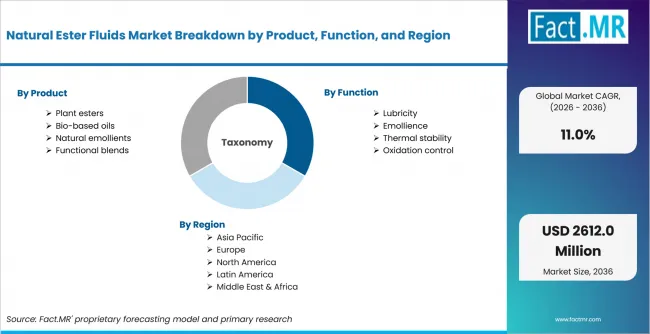
Natural Ester Fluids Market Breakdown By Product, Function, And Region | Source: Fact.MR
| Attribute | Details |
|---|---|
| Quantitative Units | USD million |
| Market Definition | Natural ester fluids used as dielectric fluids, lubricant base fluids, emollients and specialty formulation fluids where plant-origin or ester chemistry supports performance and environmental requirements. |
| Product | Plant esters; Bio-based oils; Natural emollients; Functional blends |
| Function | Lubricity; Emollience; Thermal stability; Oxidation control |
| Application | Personal care; Industrial fluids; Food contact; Specialty formulations |
| Form | Liquid; Concentrate; Dispersion; Solid |
| Regions Covered | North America; Latin America; Western Europe; Eastern Europe; East Asia; South Asia & Pacific; Middle East & Africa |
| Countries Covered | United States; Germany; Japan; France; Brazil |
| Key Companies Profiled | Cargill, Incorporated; Shell; Repsol, S.A.; APAR Industries Limited |
| Forecast Period | 2026 to 2036 |
| Approach | Hybrid top-down and bottom-up approach using transformer-fluid qualification, plant-oil supply, formulation demand, food-contact lubricant use, country adoption and provider portfolio review. |
How is the market segmented?
-
By Product:
- Plant esters
- Bio-based oils
- Natural emollients
- Functional blends
-
By Function:
- Lubricity
- Emollience
- Thermal stability
- Oxidation control
-
By Application:
- Personal care
- Industrial fluids
- Food contact
- Specialty formulations
-
By Form:
- Liquid
- Concentrate
- Dispersion
- Solid
-
By Region:
- North America
- Latin America
- Western Europe
- Eastern Europe
- East Asia
- South Asia & Pacific
- Middle East & Africa