- Base Value(2025): 22.2 Bn
- Estimated Value(2025): 22.2 Bn
- Forecast Value (2035): 34.3 Bn
- CAGR (2025 - 2035): 4.4%
Natural Surfactants Market Forecast and Outlook 2025 to 2035
The global natural surfactants market is projected to grow from USD 22.2 billion in 2025 to approximately USD 34.3 billion by 2035, recording an extraordinary absolute increase of USD 12.1 billion over the forecast period. This translates into a total growth of 54.5%, with the market forecast to expand at a compound annual growth rate (CAGR) of 4.4% between 2025 and 2035.
Quick Stats on Natural Surfactants Market
- Natural Surfactants Market Value (2025): USD 22.2 billion
- Natural Surfactants Market Forecast Value (2035): USD 34.3 billion
- Natural Surfactants Market Forecast CAGR (2025 to 2035): 4.4%
- Leading Product in Natural Surfactants Market: Anionic (41.2%)
- Leading Application in Natural Surfactants Market: Detergents (45.1%)
- Fastest Growing Application: Personal Care (4.6% CAGR)
- Key Growth Regions in Natural Surfactants Market: Asia Pacific, North America, and Europe
- Key Players in Natural Surfactants Market: Croda International Plc, BASF, Evonik Industries AG, Dow, CLARIANT, Kao Corporation, WHEATOLEO, SEPPIC (Air Liquide Healthcare), Indorama Ventures, GALAXY
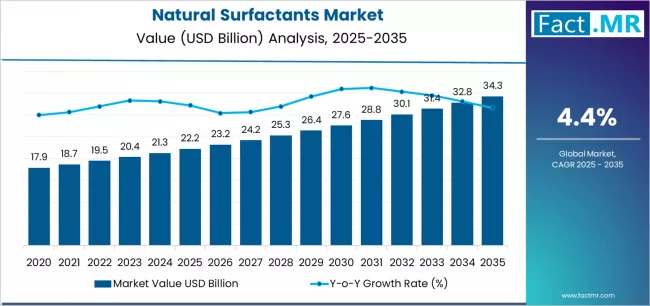
Natural Surfactants Market Market Value Analysis | Source: Fact.MR
The overall market size is expected to grow by over 1.5X during this period, supported by exponential demand for sustainable cleaning solutions, rising adoption of bio-based personal care ingredients, and growing emphasis on environmental safety enhancement and biodegradability optimization across global consumer product operations.
The natural surfactants market is positioned for substantial expansion, driven by increasing recognition of synthetic chemical alternatives importance, growing consumer preference for eco-friendly products with enhanced safety standards, and rising adoption of plant-derived surfactant technologies across detergent and personal care manufacturing facilities globally.
The market demonstrates robust fundamentals supported by expanding green chemistry networks, consumer brand professionals' focus on sustainable ingredient protocols, and rising recognition of natural surfactants as critical formulation components in achieving enhanced environmental compatibility outcomes, skin-friendly characteristics capabilities, and regulatory compliance effectiveness within modern consumer product architectures across diverse household and industrial applications.
Market growth is underpinned by technological innovations in natural surfactant formulations, particularly advanced anionic systems and bio-based nonionic technology integration, which offer enhanced cleaning performance, improved dermatological compatibility, and superior biodegradability with comprehensive sustainability protocols prevalent in contemporary formulation practices.
Consumer product manufacturers increasingly prioritize natural surfactant solutions that deliver optimal balance between cleaning efficacy, environmental responsibility, and cost-effectiveness while adhering to increasingly stringent chemical safety standards and green certification requirements across global consumer markets.
The convergence of sustainable detergent expansion in developed regions, natural personal care growth in conscious consumer economies, and specialized bio-surfactant development in emerging markets creates multifaceted growth opportunities for natural surfactant providers and specialty chemical operators.
The natural surfactants landscape is experiencing transformative changes as formulators adopt sophisticated bio-based systems including plant-derived alkyl polyglucosides, fermentation-produced rhamnolipids, and enzymatically-synthesized surfactant platforms that enable superior environmental compatibility and optimized formulation performance.
These technological advancements are complemented by evolving application capabilities encompassing cold-water effective formulations for energy efficiency, concentrated cleaning systems for packaging reduction, and gentle cleansing technologies that significantly improve skin tolerance and consumer safety.
The integration of circular economy principles and renewable feedstock platforms further enhances sustainability credentials, particularly benefiting zero-waste initiatives and environmentally-conscious consumer brands where natural ingredient usage remains critical.
Between 2025 and 2030, the natural surfactants market is projected to expand from USD 22.2 billion to USD 27.5 billion, demonstrating strong foundational growth driven by global clean beauty movement expansion, increasing adoption of eco-certified cleaning products, and initial deployment of advanced bio-surfactant technologies across household detergent and personal care platforms. This growth phase establishes market infrastructure, validates sustainable ingredient protocols, and creates comprehensive supply networks supporting global consumer product operations.
From 2030 to 2035, the market is forecast to reach USD 34.3 billion, driven by mature natural surfactant penetration, next-generation fermentation-derived formulations requiring sophisticated bioprocessing expertise, and comprehensive integration of circular ingredient systems demanding enhanced renewable sourcing. The growing adoption of plastic-free cleaning initiatives, specialized clean beauty programs, and consumer preference shifts toward transparent ingredient labeling will drive demand for comprehensive natural surfactants with enhanced performance outcomes and seamless green certification integration functionality.
Natural Surfactants Market Key Takeaways
| Metric | Value |
|---|---|
| Estimated Value (2025E) | USD 22.2 billion |
| Forecast Value (2035F) | USD 34.3 billion |
| Forecast CAGR (2025 to 2035) | 4.4% |
Source: Fact.MR analysis. Updated Dec 12, 2025
Why is the Natural Surfactants Market Growing?
Market expansion is being supported by the exponential increase in environmental consciousness and the corresponding need for biodegradable surfactant alternatives in consumer product applications across global household operations. Modern consumer brands are increasingly focused on natural surfactant solutions that can improve environmental footprint, enhance product safety profiles, and optimize sustainability credentials while meeting stringent regulatory requirements. The proven efficacy of natural surfactants in various cleaning and personal care applications makes them an essential component of comprehensive green formulation strategies and sustainable product development programs.
The growing emphasis on clean label movement and ingredient transparency is driving demand for plant-derived natural surfactants that meet stringent performance specifications and safety requirements for consumer applications. Household product manufacturers' preference for biodegradable, skin-friendly ingredients that can ensure consistent cleaning performance is creating opportunities for innovative bio-based formulations and renewable surfactant solutions. The rising influence of environmental regulations such as EPA Safer Choice and consumer preference for natural products is also contributing to increased adoption of certified natural surfactants across different product categories and formulation systems requiring advanced green chemistry technology.
Opportunity Pathways - Natural Surfactants Market
The natural surfactants market represents a transformative growth opportunity, expanding from USD 22.2 billion in 2025 to USD 34.3 billion by 2035 at a 4.4% CAGR. As consumer brands prioritize sustainability optimization, ingredient transparency enhancement, and formulation excellence in complex regulatory environments, natural surfactants have evolved from niche green ingredients to essential formulation components enabling precise cleaning performance, comprehensive environmental compatibility strategies, and safety-first personal care operations across detergent manufacturing platforms and cosmetic applications.
The convergence of clean beauty acceleration, increasing green certification penetration, advanced bio-based technology integration, and stringent chemical safety mandates creates momentum in demand. High-performance anionic formulations offering superior cleaning efficacy, gentle nonionic solutions balancing functionality with dermatological safety, and certified natural surfactants for personal care applications will capture market premiums, while geographic expansion into high-growth Asian consumer markets and emerging sustainable product ecosystems will drive volume leadership. Consumer brand emphasis on environmental innovation and ingredient safety provides structural support.
- Pathway A - Anionic Product Dominance: Leading with 41.2% market share, anionic applications drive primary demand through effective cleaning workflows requiring comprehensive natural surfactants for detergent and industrial cleaning formulations. Plant-derived anionic systems enabling superior foaming characteristics, excellent cleaning performance, and biodegradability compliance command preference from detergent manufacturers requiring stringent environmental specifications and performance standards. Expected revenue pool: USD 9.1-14.1 billion.
- Pathway B - Detergents Application Leadership: Dominating with 45.1% market share through optimal balance of volume requirements and cleaning demands, detergent applications serve most natural surfactant requirements while meeting diverse household and commercial cleaning needs. This application type addresses both laundry detergent requirements and dishwashing formulation expectations, making it the preferred category for consumer goods companies seeking comprehensive sustainable cleaning capabilities. Opportunity: USD 10.0-15.5 billion.
- Pathway C - Asian Market Acceleration: India (5.2% CAGR) and China (4.9% CAGR) lead global growth through rapid industrialization, growing personal care sector expansion, and cleaning product modernization. Strategic partnerships with local consumer goods manufacturers, ingredient localization expertise, and distribution network optimization enable the expansion of natural surfactants in major household product hubs and personal care manufacturing centers. Geographic expansion upside: USD 8.0-12.4 billion.
- Pathway D - Personal Care Application Segment: Personal care applications with 20.4% market share and fastest growth (4.6% CAGR) serve critical clean beauty requirements across diverse cosmetic categories. Optimized gentle cleansing protocols supporting multiple skin types, dermatological safety requirements, and proven natural efficacy maintain accelerating volumes from cosmetic formulators and clean beauty brands. Revenue potential: USD 4.5-7.0 billion.
- Pathway E - Advanced Bio-based Technologies & Fermentation Integration: Companies investing in fermentation-derived biosurfactants, enzymatic synthesis platforms, and renewable feedstock innovations gain competitive advantages through consistent sustainability delivery and performance excellence. Advanced capabilities enabling customized functionality specifications and green certification support capture premium brand partnerships. Technology premium: USD 3.6-5.5 billion.
- Pathway F - Supply Chain Optimization & Certification Excellence: Specialized natural surfactant suppliers, strategic green certification integration, and sustainable sourcing systems create competitive differentiation in consumer markets requiring verified natural credentials. Companies offering guaranteed renewable content, transparent supply chain services, and comprehensive certification support gain preferred supplier status with sustainability-focused consumer brands. Supply chain value: USD 2.9-4.5 billion.
- Pathway G - Emerging Applications & Market Development: Beyond traditional detergent applications, natural surfactants in agrochemicals, food processing aids, and specialized industrial formulations represent growth opportunities. Companies developing new bio-based grades, supporting innovation initiatives, and expanding into adjacent specialty chemical sectors and sustainable ingredient markets capture incremental demand while diversifying revenue streams. Emerging opportunity: USD 2.2-3.4 billion.
Segmental Analysis
The market is segmented by product, application, and region. By product, the market is divided into anionic, nonionic, cationic, and amphoteric. Based on application, the market is categorized into detergents, industrial & institutional cleaning, personal care, oilfield chemicals, and others. Regionally, the market is divided into Asia Pacific, North America, Europe, Latin America, and Middle East & Africa.
Why Does Anionic Product Type Command Market Leadership?
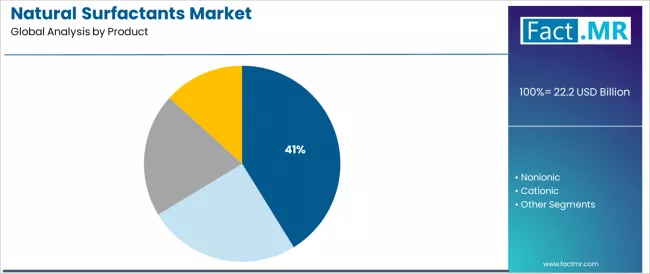
Natural Surfactants Market Analysis By Product | Source: Fact.MR
The anionic product segment is projected to account for 41.2% of the natural surfactants market in 2025, reaffirming its position as the category's dominant surfactant specification. Detergent formulators increasingly recognize the optimal balance of cleaning efficacy and foaming performance offered by anionic natural surfactants for household and industrial applications, particularly in laundry detergent formulations and heavy-duty cleaning environments. This product category addresses both superior cleaning power requirements and biodegradability demands while providing reliable performance outcomes across diverse cleaning operations.
This segment forms the foundation of most detergent formulation protocols and industrial cleaning applications, as it represents the most cleaning-effective and commercially established product category in the natural surfactants industry. Performance validation standards and extensive application experience continue to strengthen confidence in anionic natural surfactant systems among detergent manufacturers and industrial formulators. With increasing recognition of environmental compatibility importance and biodegradability requirements, plant-derived anionic surfactants align with both current cleaning formulation practices and sustainability evolution goals, making them the central growth driver of comprehensive green cleaning strategies across multiple consumer product platforms.
Nonionic surfactants represent 29.0% of product applications, reflecting significant usage in personal care formulations and low-foam cleaning systems requiring gentle cleansing characteristics. Cationic accounts for 16.5% of the segment, driven by fabric softener applications and antimicrobial formulations. Amphoteric represents 13.3% of product types, addressing specialty personal care and baby product applications requiring exceptional mildness and dermatological compatibility across sensitive skin formulations.
How Does Detergents Application Demonstrate Market Dominance?
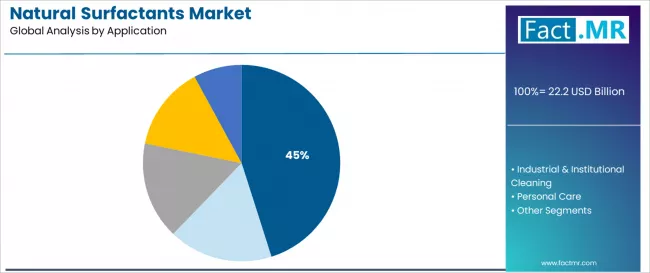
Natural Surfactants Market Analysis By Application | Source: Fact.MR
The detergents application segment is projected to account for 45.1% of the natural surfactants market in 2025, establishing its position as the dominant end-use category. Consumer goods manufacturers increasingly recognize that detergent applications, encompassing laundry detergents, dishwashing liquids, and specialty cleaning formulations, represent the most volume-intensive and cleaning-critical application requiring natural surfactants due to performance demands and environmental regulations. This application addresses both cleaning efficacy requirements and sustainability expectations while providing essential household hygiene capabilities across consumer cleaning operations.
The segment is supported by the continuing nature of global household care product consumption and sustainable cleaning product adoption, driven by environmental awareness, regulatory pressures, and consumer preference shifts necessitating biodegradable cleaning solutions. Additionally, detergent manufacturers are increasingly emphasizing natural surfactant technologies that maintain cleaning performance while improving environmental profiles and reducing aquatic toxicity. As green chemistry advances and eco-labeling programs expand, natural surfactants for detergent applications will continue to serve a crucial role in ensuring cleaning effectiveness and environmental responsibility within the global household care market.
Industrial & institutional cleaning represents 25.3% of application share, reflecting significant usage in commercial cleaning operations and facility maintenance requiring sustainable solutions. Personal care accounts for 20.4% of the segment with fastest growth at 4.6% CAGR, driven by clean beauty movement and natural cosmetic formulation expansion. Oilfield chemicals represent 6.2% of applications, addressing enhanced oil recovery and drilling fluid formulations, while other applications account for 3.0%, encompassing specialized uses including textile processing, agrochemical formulations, and food processing applications requiring natural surfactant functionality.
What Drives Personal Care Application as Fastest Growing Segment?
The personal care application segment is projected to demonstrate the fastest growth with a CAGR of 4.6% through 2035, driven by accelerating clean beauty movement and consumer demand for natural cosmetic ingredients. This application encompasses shampoos, body washes, facial cleansers, and specialty personal care formulations requiring gentle yet effective cleansing with natural, skin-friendly surfactants. The segment benefits from millennial and Gen Z consumer preferences for transparent ingredient labeling, social media influence promoting natural beauty products, and dermatologist recommendations for gentler surfactant systems.
Personal care manufacturers are increasingly reformulating conventional products with natural surfactants to meet clean beauty certifications such as COSMOS, Ecocert, and NATRUE standards. The rising awareness of synthetic surfactant concerns including sulfate sensitivity and microbiome disruption is accelerating adoption of plant-derived alternatives including alkyl polyglucosides, amino acid-based surfactants, and naturally-derived betaines that provide gentle cleansing while maintaining skin barrier integrity and supporting dermatological health.
What are the Drivers, Restraints, and Key Trends of the Natural Surfactants Market?
The natural surfactants market is advancing rapidly due to increasing recognition of environmental sustainability importance and growing demand for biodegradable cleaning solutions across the consumer products sector.
However, the market faces challenges, including higher raw material costs compared to synthetic alternatives, performance limitations in extreme pH or hard water conditions, and supply chain constraints for certain renewable feedstocks. Innovation in fermentation technology and enzymatic synthesis continues to influence product development and market expansion patterns.
Proliferation of Green Certification Programs and Eco-Label Standards
The accelerating adoption of environmental certifications is enabling the development of more credible sustainable products and formulation strategies that can meet stringent verification and transparency requirements.
Consumer brands demand certified natural surfactants for product formulations, including USDA BioPreferred designation, EPA Safer Choice recognition, and EU Ecolabel compliance that are particularly important for achieving market differentiation requirements in competitive consumer categories.
Green certification programs provide access to environmentally-conscious consumer segments that can optimize brand reputation and support premium positioning while maintaining cleaning performance for diverse household applications.
Integration of Circular Economy Principles and Renewable Feedstock Development
Modern consumer product organizations are incorporating advanced technologies such as agricultural waste valorization, algae-based surfactant production, and closed-loop manufacturing interfaces to enhance sustainability performance and resource efficiency.
These systems improve renewable content ratios, enable seamless waste reduction transitions, and provide better alignment between natural surfactants and comprehensive circular economy objectives throughout the product lifecycle.
Advanced renewable feedstock capabilities also enable reduced fossil fuel dependence and early adoption of bio-refinery concepts, supporting proactive climate action and improved environmental outcomes.
Analysis of the Natural Surfactants Market by Key Countries
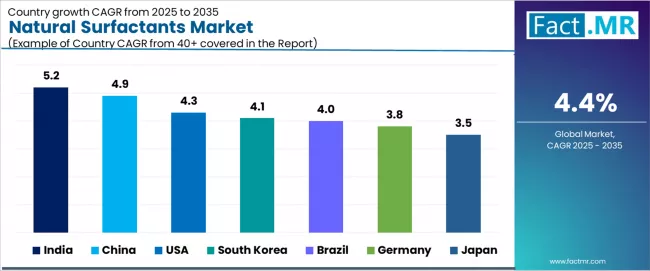
Natural Surfactants Market Cagr Analysis By Country | Source: Fact.MR
| Country | CAGR (2025-2035) |
|---|---|
| India | 5.2% |
| China | 4.9% |
| USA | 4.3% |
| South Korea | 4.1% |
| Brazil | 4.0% |
| Germany | 3.8% |
| Japan | 3.5% |
Source: Fact.MR analysis. Updated Dec 12, 2025
The natural surfactants market is experiencing exceptional growth globally, with India leading at a 5.2% CAGR through 2035, driven by rapid industrialization, growing personal care sector expansion, and increasing cleaning product consumption across major urban regions. China follows at 4.9%, supported by urbanization trends, middle-class expansion driving premium hygiene product demand, and comprehensive environmental regulation implementation. USA records 4.3% growth, benefiting from consumer eco-consciousness and regulatory support through EPA and USDA certification programs. South Korea demonstrates 4.1% growth, emphasizing advanced biotech production capabilities and strong clean-beauty trend adoption.
Brazil shows 4.0% growth, representing growing agrochemical applications and household product adoption. Germany records 3.8% growth, representing strict EU chemical regulations and high clean-label product adoption, while Japan shows 3.5% growth, representing aging population preferences for gentle personal care products and dermatological safety emphasis.
How Does India Demonstrate Exceptional Market Potential with Rapid Industrialization?
Revenue from natural surfactants in India is projected to exhibit exceptional growth with a CAGR of 5.2% through 2035, driven by rapid industrialization processes, growing personal care and cleaning sectors, and increasing consumer purchasing power supporting modern lifestyle product adoption. The country's enormous population and expanding middle class are creating significant opportunities for natural surfactant deployment across both household detergent and personal care segments.
Major international specialty chemical companies and domestic manufacturers are establishing comprehensive production and distribution capabilities to serve the expanding demand for sustainable ingredients across detergent manufacturing, cosmetic formulation, and industrial cleaning operations throughout India's diverse consumer markets.
The Indian government's strategic emphasis on Make in India manufacturing and sustainable chemistry is driving substantial investments in bio-based chemical production and green technology adoption. This policy support, combined with the country's abundant renewable feedstock availability and growing environmental awareness, creates a favorable environment for natural surfactants market development. Indian consumer brands are increasingly focusing on natural ingredient adoption to meet consumer preferences, with plant-derived surfactants representing a key component in this sustainable product capability building.
- Government initiatives supporting sustainable manufacturing and clean production are driving demand for bio-based surfactants across consumer product segments
- Consumer goods capacity expansion and ingredient technology advancement are supporting sophisticated natural surfactant utilization among formulators and brand owners nationwide
- Personal care brands and detergent manufacturers are increasingly recognizing natural ingredient importance in product differentiation, creating new surfactant demand
- Rising consumer awareness and growing middle-class purchasing power are accelerating adoption of premium natural products across categories
What Makes China Demonstrate Market Leadership with Urbanization and Middle-Class Expansion?
Revenue from natural surfactants in China is expanding at a CAGR of 4.9%, supported by massive urbanization trends, rapidly expanding middle-class consumption driving premium hygiene product demand, and comprehensive environmental protection regulations across the country's developing consumer corridors.
The country's enormous consumer market and increasing sophistication of personal care preferences are driving demand for natural surfactants in both household cleaning and cosmetic applications. International ingredient suppliers and domestic specialty chemical producers are establishing bio-based production capacity to serve the growing demand for sustainable surfactants while supporting the country's green development objectives.
China's natural surfactants sector continues to benefit from favorable policies supporting green chemistry development, expanding bio-based manufacturing infrastructure, and growing consumer commitment to environmental responsibility. The country's focus on pollution control and sustainable consumption is creating opportunities for natural surfactant adoption. This development is particularly important for personal care applications, as consumers seek premium natural products to enhance lifestyle quality and environmental consciousness.
- Rising consumer awareness about ingredient safety and expanding domestic bio-based production capabilities are creating opportunities for natural surfactant solutions
- Growing urban consumption patterns and premium product demand are supporting increased utilization of natural ingredients in personal care and cleaning
- Expanding biotechnology capacity and emerging green chemistry standards are driving innovative applications of natural surfactants in consumer formulations
- Ingredient technology advancement is enabling delivery of high-performance natural surfactants, supporting market growth and improving product sustainability
How Does USA Maintain Green Chemistry Leadership with Consumer Eco-Consciousness?
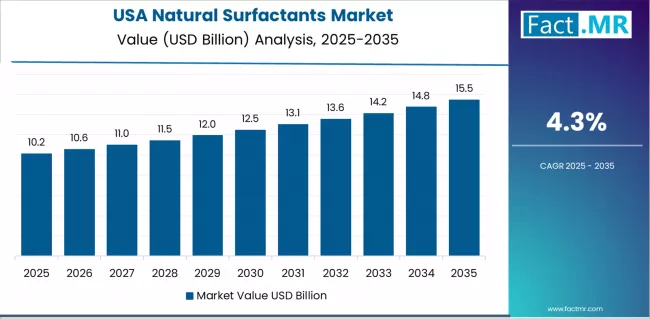
Natural Surfactants Market Country Value Analysis | Source: Fact.MR
The USA's advanced natural surfactants market demonstrates consistent ingredient adoption with a 4.3% CAGR through 2035, driven by strong consumer eco-consciousness, comprehensive regulatory support through EPA Safer Choice and USDA BioPreferred programs, and established green chemistry infrastructure across major consumer goods regions. The country's leadership in sustainable product innovation and environmental certification sustains strong demand for natural surfactants across diverse household care and personal care applications. American consumer brands maintain focus on certified natural ingredients that integrate with established green marketing strategies and consumer transparency expectations.
Market dynamics reflect mature natural surfactant utilization that balances performance requirements with sustainability considerations important to consumer brand standards and regulatory compliance. Advanced specialty chemical market creates opportunities for innovative bio-based surfactant deployment and fermentation technology development.
Strategic Market Considerations:
- Clean beauty and sustainable household care segments maintaining growth with focus on certified natural ingredients and transparent formulation practices
- Consumer environmental preferences and regulatory certification programs supporting continued adoption of bio-based surfactants
- Green chemistry innovation leadership and biotechnology excellence supporting competitive positioning in global specialty chemical markets
- Brand owner preferences emphasizing proven sustainability credentials and comprehensive certification support in natural surfactant applications
What Drives South Korea Market Growth with Advanced Biotech and Clean-Beauty Trend?
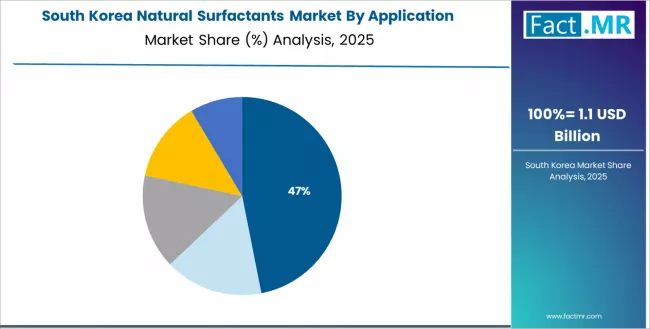
Natural Surfactants Market South Korea Market Share Analysis By Application | Source: Fact.MR
South Korea's expanding natural surfactants market demonstrates accelerating ingredient adoption with a 4.1% CAGR through 2035, driven by advanced biotechnology production capabilities, strong clean-beauty trend leadership, and comprehensive K-beauty innovation across cosmetic formulation regions.
The country's position as a global beauty innovation hub and sophisticated consumer preferences are creating substantial demand for natural surfactants across diverse personal care and cosmetic platforms. South Korean beauty brands are prioritizing natural ingredients that incorporate fermentation technology for optimal skin benefits and clean formulation credentials.
Market dynamics focus on innovative natural surfactants that balance advanced functionality with dermatological safety considerations important to South Korean beauty standards and consumer expectations. Strong biotechnology sector creates opportunities for fermentation-derived surfactant development and specialty ingredient innovation.
Strategic Market Considerations:
- K-beauty and clean cosmetics segments leading growth with focus on fermentation-derived ingredients and innovative natural formulation applications
- Advanced consumer expectations are driving adoption of sophisticated natural surfactants with proven skin benefits
- Biotechnology excellence and beauty innovation leadership supporting competitive positioning in global cosmetics markets
- Formulator preferences emphasizing ingredient innovation and comprehensive efficacy validation in natural surfactant applications
What Drives Brazil Market Growth with Agrochemical and Household Product Adoption?
Brazil's expanding natural surfactants market demonstrates accelerating ingredient adoption with a 4.0% CAGR through 2035, driven by growing agrochemical applications, expanding household product consumption, and comprehensive consumer goods sector development across major regions.
The country's abundant renewable feedstock resources and increasing sustainable product awareness are creating substantial demand for natural surfactants across diverse agricultural and consumer applications. Brazilian manufacturers are prioritizing locally-sourced bio-based ingredients that enable sustainability positioning and cost-effective formulation.
Market dynamics focus on practical natural surfactants that balance performance capabilities with affordability considerations important to Brazilian market economics and agricultural applications. Growing consumer goods sector creates opportunities for ingredient technology adoption and sustainable product innovation.
Strategic Market Considerations:
- Agrochemical and household care segments leading growth with focus on bio-based ingredients and sustainable formulation applications
- Agricultural sector development and consumer goods expansion driving interest in natural surfactant solutions with proven performance benefits
- Renewable feedstock availability supporting competitive positioning in regional natural ingredient markets
- Manufacturer preferences emphasizing practical performance benefits and cost-effectiveness in natural surfactant applications
What Drives Germany’s Market Growth with Strict EU Regulations and Clean-Label Adoption?
Germany's advancing natural surfactants market demonstrates consistent ingredient adoption with a 3.8% CAGR through 2035, driven by strict EU chemical regulations including REACH compliance, high clean-label product adoption, and comprehensive green chemistry standards across consumer goods regions.
The country's leadership in environmental regulation and sustainable product development sustains demand for certified natural surfactants across diverse household care and personal care platforms. German consumer brands maintain focus on compliant natural ingredients that incorporate comprehensive safety assessments and sustainability documentation.
Market dynamics focus on regulatory-compliant natural surfactants that balance advanced performance with environmental considerations important to German consumer standards and EU chemical legislation. Established green chemistry expertise creates stable demand for proven bio-based surfactant technologies and certified ingredient solutions.
Strategic Market Considerations:
- Household care and personal care segments demonstrating focused performance with emphasis on regulatory compliance and clean-label formulation applications
- Stringent chemical regulations maintaining demand for certified natural surfactants with comprehensive safety documentation
- Green chemistry excellence supported by specialty chemical expertise and sustainable manufacturing capabilities
- Formulator preferences emphasizing proven regulatory compliance and comprehensive environmental credentials in natural surfactant applications
What Drives Japan Market Growth with Aging Population and Gentle Product Preferences?
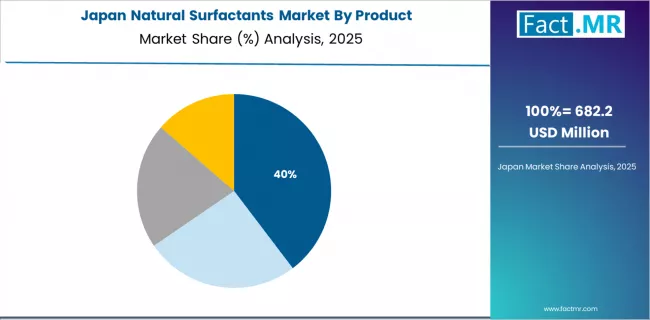
Natural Surfactants Market Japan Market Share Analysis By Product | Source: Fact.MR
Japan's established natural surfactants market demonstrates consistent ingredient adoption with a 3.5% CAGR through 2035, driven by aging population demographics, consumer preference for gentle personal care products, and comprehensive dermatological safety standards across cosmetic formulation regions.
The country's emphasis on skin-friendly formulations and product quality sustains demand for mild natural surfactants across diverse personal care and baby product platforms. Japanese cosmetic brands maintain focus on gentle ingredients that incorporate proven dermatological compatibility for optimal skin tolerance and consumer satisfaction.
Market dynamics focus on mild natural surfactants that balance gentle cleansing capabilities with skin barrier considerations important to Japanese consumer standards and aging skin care requirements. Established dermatological research expertise creates stable demand for proven gentle surfactant technologies and amino acid-based ingredient solutions.
Strategic Market Considerations:
- Personal care and baby product segments demonstrating focused performance with emphasis on dermatological safety and gentle formulation applications
- Aging population demographics maintaining demand for mild natural surfactants with proven skin compatibility
- Cosmetic technology excellence supported by dermatological research expertise and formulation precision capabilities
- Formulator preferences emphasizing proven mildness and comprehensive safety validation in natural surfactant applications
Europe Market Split by Country
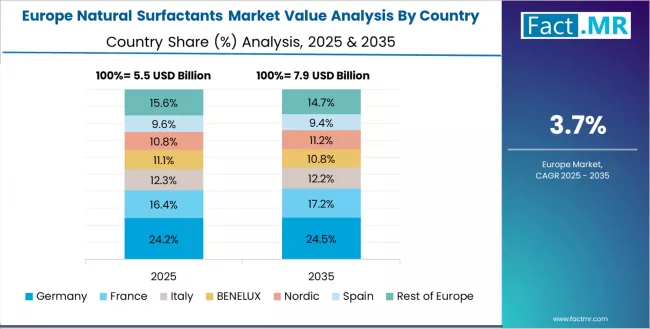
Natural Surfactants Market Europe Country Market Share Analysis, 2025 & 2035 | Source: Fact.MR
The natural surfactants market in Europe is projected to grow from USD 5.8 billion in 2025 to USD 8.6 billion by 2035, registering a CAGR of 4.0% over the forecast period. Germany is expected to maintain its leadership position with a 31.4% market share in 2025, rising to 32.1% by 2035, supported by its strict chemical regulations, comprehensive green chemistry infrastructure, and sustainable formulation excellence throughout major consumer goods facilities and specialty chemical networks.
France follows with a 26.8% share in 2025, projected to reach 27.3% by 2035, driven by cosmetics industry sophistication, natural beauty product demand, and expanding bio-based ingredient adoption serving both domestic and European markets. UK holds a 18.6% share in 2025, expected to increase to 19.1% by 2035, supported by clean-label consumer trends and sustainable household product growth. Italy commands a 13.2% share in 2025, projected to reach 12.7% by 2035, while Spain accounts for 7.8% in 2025, expected to reach 7.2% by 2035.
The rest of Europe region, including Nordic countries with advanced sustainability standards, Eastern European emerging consumer markets, and smaller Western European specialty chemical centers, is anticipated to hold 2.2% in 2025, declining slightly to 1.6% by 2035, attributed to market consolidation toward larger core markets with established natural surfactant infrastructure and formulation expertise.
Competitive Landscape of the Natural Surfactants Market
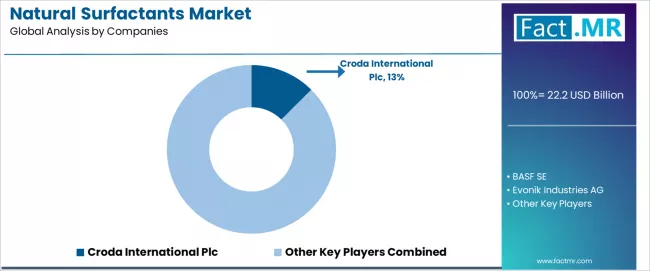
Natural Surfactants Market Analysis By Company | Source: Fact.MR
The natural surfactants market is characterized by intense competition among established specialty chemical companies, bio-based ingredient innovators, and comprehensive sustainable chemistry organizations focused on delivering high-performance, biodegradable, and renewable surfactant solutions.
Companies are investing in fermentation technology development, renewable feedstock sourcing, strategic consumer brand partnerships, and comprehensive sustainability certification initiatives to deliver effective, environmentally-responsible, and economically-viable natural surfactants that meet stringent performance standards and green chemistry specifications. Product innovation, renewable sourcing leadership, and application technical support strategies are central to strengthening product portfolios and market presence.
Croda International Plc leads the market with a 12.5% market share, offering comprehensive natural surfactant solutions with a focus on sustainable oleochemical expertise and advanced bio-based ingredient capabilities for personal care and household applications.
BASF SE provides specialized sustainable chemistry platforms with emphasis on biosurfactant innovation and comprehensive performance solutions across global consumer markets. Evonik Industries AG focuses on specialty surfactant systems and fermentation-derived technologies serving natural product applications. Dow delivers sustainable ingredient solutions with comprehensive application support capabilities.
CLARIANT operates with a focus on bio-based specialty chemicals and renewable surfactant innovations. Kao Corporation provides advanced natural surfactant technologies emphasizing gentle cleansing and dermatological compatibility. WHEATOLEO specializes in wheat-based natural surfactants with comprehensive sustainability credentials.
SEPPIC (Air Liquide Healthcare) delivers natural cosmetic ingredients and specialty surfactants. Indorama Ventures, GALAXY, Stepan Company, and Inolex, Inc. emphasize oleochemical technologies, plant-derived surfactants, and comprehensive natural ingredient solutions, delivering sustainable bio-based innovations and renewable chemistry advancements through dedicated research and development and consumer brand partnership strategies.
Key Players in the Natural Surfactants Market
- Croda International Plc
- BASF SE
- Evonik Industries AG
- Dow
- CLARIANT
- Kao Corporation
- WHEATOLEO
- SEPPIC (Air Liquide Healthcare)
- Indorama Ventures
- GALAXY
- Stepan Company
- Inolex, Inc.
Segmentation
Scope of the Report
| Items | Values |
|---|---|
| Quantitative Units (2025) | USD 22.2 Billion |
| Product | Anionic, Nonionic, Cationic, Amphoteric |
| Application | Detergents, Industrial & Institutional Cleaning, Personal Care, Oilfield Chemicals, Others |
| Regions Covered | Asia Pacific, North America, Europe, Latin America, Middle East & Africa |
| Countries Covered | USA, Germany, UK, Japan, India, China, Brazil, South Korea and 40+ countries |
| Key Companies Profiled | Croda International Plc, BASF, Evonik Industries AG, Dow, CLARIANT, Kao Corporation, WHEATOLEO, SEPPIC (Air Liquide Healthcare), Indorama Ventures, GALAXY, Stepan Company, Inolex, Inc. |
| Additional Attributes | Dollar sales by product, application, regional demand trends, competitive landscape, formulator preferences for specific natural surfactant types, integration with comprehensive sustainable formulation systems, innovations in fermentation technology development, renewable feedstock advancement, and biodegradability performance optimization capabilities |
Source: Fact.MR analysis. Updated Dec 12, 2025
Natural Surfactants Market by Segments
-
Product :
- Anionic
- Nonionic
- Cationic
- Amphoteric
-
Application :
- Detergents
- Industrial & Institutional Cleaning
- Personal Care
- Oilfield Chemicals
- Others
-
Region :
-
Asia Pacific
- China
- India
- Japan
- South Korea
- ASEAN
- Australia & New Zealand
- Rest of Asia Pacific
-
North America
- United States
- Canada
- Mexico
-
Europe
- Germany
- France
- United Kingdom
- Italy
- Spain
- Nordic
- BENELUX
- Rest of Europe
-
Latin America
- Brazil
- Argentina
- Chile
- Rest of Latin America
-
Middle East & Africa
- Kingdom of Saudi Arabia
- Other GCC Countries
- Turkey
- South Africa
- Other African Countries
- Rest of Middle East & Africa
-
Frequently Asked Questions
How big is the natural surfactants market in 2025?
What will be the size of natural surfactants market in 2035?
How much will be the natural surfactants market growth between 2025 and 2035?
What are the key product types in the natural surfactants market?
Which application segment to contribute significant share in the natural surfactants market in 2025?
Who worked on this report


Preview the report firsthand - request a free sample
Free SampleGet the brochure for pricing and purchase details
Download PDF