- Market Value (2025): USD 684.7 Mn
- Estimated Value (2026): USD 760.0 Mn
- Forecast Value (2036): USD 2158.0 Mn
- CAGR (2026-2036): 11.0%
What is the Natural Rheology Modifiers Market forecast to be worth by 2036?
USD 760.0 million in 2026 to USD 2,158.0 million by 2036, at 11.0% CAGR.
- The Natural Rheology Modifiers Market reached USD 684.7 million in 2025.
- Demand is projected to increase from USD 760.0 million in 2026 to USD 2,158.0 million by 2036.
- The market is forecast to record 11.0% CAGR from 2026 to 2036 as food brands, care formulators and coating developers qualify natural modifiers for texture control.
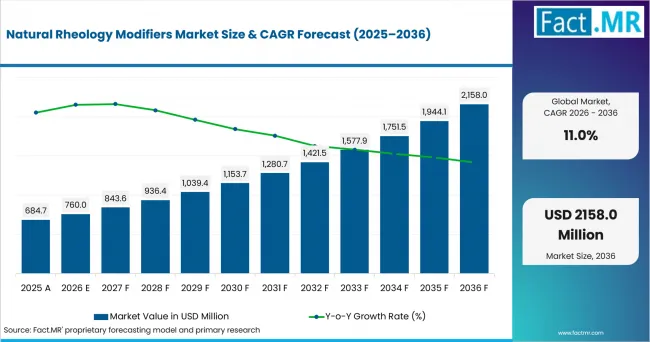
Natural Rheology Modifiers Market Value Analysis | Source: Fact.MR
What are the defining numbers behind Natural Rheology Modifiers Market growth?
USD 1,398.0 million absolute opportunity by 2036, led by low-methoxyl pectin, food grade systems and the USA.
- Demand Drivers in the Market
- Food brands need stable texture in low-sugar recipes, since low-methoxyl pectin gives calcium-set structure without high sugar loading.
- Product development teams need predictable hydration behavior supported by functional blends that reduce trial failures across beverages and sauces.
- Contract manufacturers need food-grade documentation shaped by customer audits and traceability programs for edible formulation approval.
- Plant-based brands need mouthfeel support, reflecting growth in plant-based beverage formats where proteins and fibers interact differently from dairy solids.
- Key Segments Analyzed
- By Product: Low-methoxyl pectin is expected to hold 39.0% share in 2026 due to calcium-set gel behavior in reduced-sugar fruit and dairy-alternative systems.
- By Function: Gelling is projected to account for 37.0% share in 2026 owing to texture demands in fruit preparations and spoonable plant-based products.
- By Application: Dairy alternatives are anticipated to capture 34.0% share in 2026 supported by brands that need suspension and mouthfeel without dairy solids.
- By Grade: Food grade is estimated to represent 44.0% share in 2026 as edible formulations require impurity controls and lot-level specifications.
- Analyst Opinion at Fact.MR
- Shambhu Nath Jha, Principal Consultant at Fact.MR, states, "Natural rheology is becoming a formulation proof point instead of a thickening choice. Brands are expected to weigh gel strength and label fit as low-sugar and plant-based recipes scale. Suppliers that combine pectin chemistry and application testing are better placed to pass customer trials."
- Strategic Implications
- Ingredient suppliers should publish pH, calcium and heat-tolerance data for each modifier family so formulators shorten bench trials.
- Food brands should select modifiers by finished-product behavior, since the same ingredient performs differently in acidic drinks and dairy alternatives.
- Contract manufacturers should align hydration steps and hold times with supplier instructions before moving from pilot batches to plant scale.
- Distributors should maintain traceable grades and substitution guidance when pectin, gum and cellulose sources move with crop conditions.
The USA is expected to record 12.1% CAGR through 2036 supported by processed-food reformulation. Germany is projected to post 11.6% CAGR through specialty ingredient qualification. Japan is anticipated to advance at 10.8% CAGR as shelf-stable foods create texture needs. France is estimated to hold 10.3% CAGR due to organic food recovery. Brazil is forecast to reach 9.9% CAGR as fruit, beverage and sauce systems expand.
How does the Natural Rheology Modifiers Market break down by segment?
Low-methoxyl pectin leads Product at 39.0%; Food grade leads Grade at 44.0%.
Which product holds the largest share?
Low-methoxyl pectin holds 39.0% share in 2026.
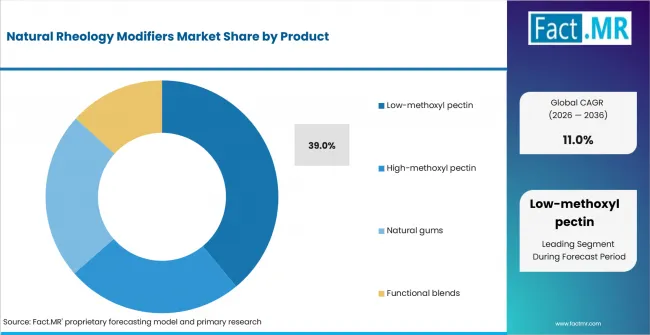
Natural Rheology Modifiers Market Analysis By Product | Source: Fact.MR
Low-methoxyl pectin leads because calcium-controlled gel behavior supports low-sugar systems and fruit preparations. Demand is linked to citrus pectin and fruit pomace pectin ingredients, where raw-material origin influences clarity, gel strength, texture, and taste release consistently in finished products.
What leads the Function segment?
Gelling accounts for 37.0% share in 2026.
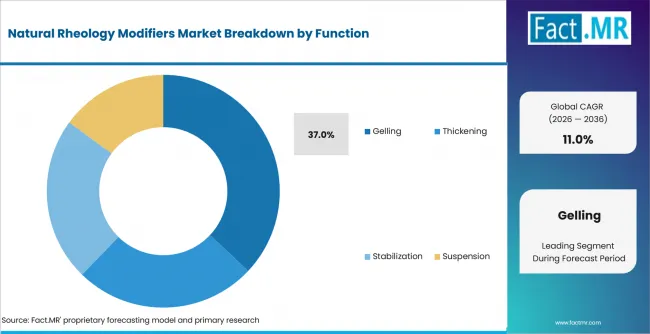
Natural Rheology Modifiers Market Analysis By Function | Source: Fact.MR
Gelling leads because brands need repeatable structure in spoonable desserts, confectionery centers and fruit systems. Natural gelling agents remain central where recipes must hold shape during filling, cooling and distribution.
How does Application shape demand?
Dairy alternatives capture 34.0% share in 2026.
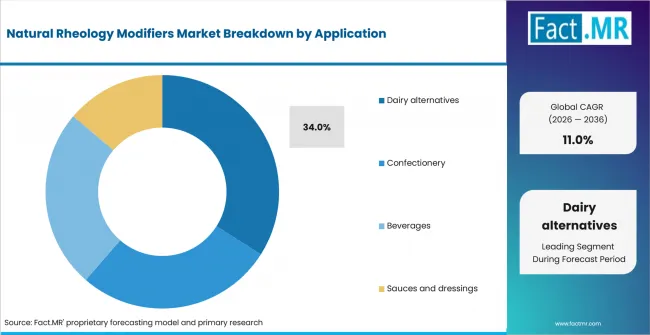
Natural Rheology Modifiers Market Analysis By Application | Source: Fact.MR
Dairy alternatives lead because plant bases often lack the protein and fat structure that dairy systems provide naturally. Formulators use pectin and natural gums to manage separation, mouthfeel and spoonability, while fiber-integrated fat mimetics for dairy alternatives show how texture systems are becoming more specialized.
What supports Food grade within Grade?
Food grade represents 44.0% share in 2026.
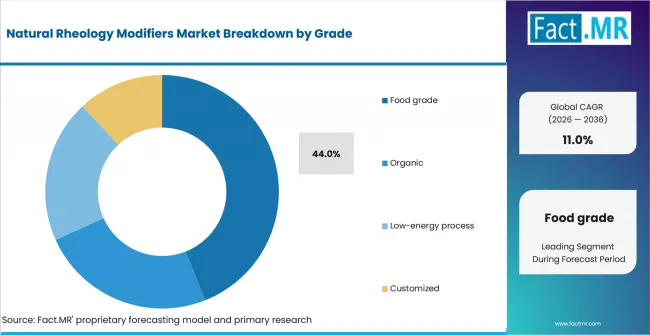
Natural Rheology Modifiers Market Analysis By Grade | Source: Fact.MR
Food grade leads because edible applications require impurity control, allergen review and lot-level documentation. Manufacturers compare natural modifiers against adjacent gum hydrocolloid systems when choosing a supplier for beverages and sauces.
What is accelerating Natural Rheology Modifiers Market adoption, and what is holding it back?
Demand is expected to rise through clean-label formulation and low-sugar texture needs, while cost swings and processing variability constrain adoption.
Drivers Impact Analysis
| DRIVER | (~) % IMPACT ON CAGR | GEOGRAPHIC RELEVANCE | IMPACT TIMELINE |
|---|---|---|---|
| Clean-label texture reformulation | +1.5% | Global | Short term (<= 2 years) |
| Low-sugar and dairy-alternative gel systems | +1.1% | North America, Western Europe | Medium term (2-4 years) |
| Natural gum and pectin sourcing discipline | +0.9% | East Asia, Latin America | Medium term (2-4 years) |
| Food-grade documentation and traceability | +0.6% | Global | Long term (>= 4 years) |
Source: Fact.MR analysis. Updated Aug 28, 2026
- Clean-label texture reformulation: Brands use pectin, cellulose derivatives and natural gums when a product needs viscosity control. Adjacent food stabilizers demand shows how texture claims remain close to product-development decisions.
- Low-sugar and dairy-alternative gel systems: Low-methoxyl pectin supports calcium-set structures where sugar or dairy solids are reduced.
- Natural gum and pectin sourcing discipline: Procurement teams value suppliers that document raw-material origin and functional performance across seasonal input changes.
- Food-grade documentation and traceability: Audit-ready specifications support edible products where ingredient history and lot controls shape approval decisions.
Opportunity Impact Analysis
| OPPORTUNITY | (~) % IMPACT ON CAGR | GEOGRAPHIC RELEVANCE | IMPACT TIMELINE |
|---|---|---|---|
| Low-methoxyl pectin in dairy alternatives | +0.9% | USA, France, Germany | Medium term (2-4 years) |
| Low-energy process modifiers | +0.7% | Global | Long term (>= 4 years) |
| Customized hydrocolloid blends for sauces | +0.5% | Brazil, USA, Japan | Short term (<= 2 years) |
Source: Fact.MR analysis. Updated Aug 28, 2026
- Low-methoxyl pectin in dairy alternatives: Brands use calcium-reactive gel systems to improve spoonability and reduce separation in plant-based desserts.
- Low-energy process modifiers: Cold-processable gums and cellulose systems help plants reduce heating steps where recipes allow lower process intensity. Adjacent food thickening agents show why viscosity control remains a core purchase criterion.
- Customized hydrocolloid blends for sauces: Tailored blends give manufacturers a route to suspension control where acidity and heat exposure vary by recipe. Natural systems such as gum arabic remain part of beverage and emulsion design.
Restraints Impact Analysis
| RESTRAINT | (~) % IMPACT ON CAGR | GEOGRAPHIC RELEVANCE | IMPACT TIMELINE |
|---|---|---|---|
| Citrus peel and gum input cost swings | -0.5% | USA, Brazil, Europe | Short term (<= 2 years) |
| Hydration and batch variability | -0.4% | Global | Medium term (2-4 years) |
| Labelling and certification workload | -0.3% | Japan, EU, USA | Long term (>= 4 years) |
Source: Fact.MR analysis. Updated Aug 28, 2026
- Citrus peel and gum input cost swings: Peel availability affects pectin economics and creates substitution pressure. The issue links directly with citrus peel fibre and pectin sourcing.
- Hydration and batch variability: Natural polymers respond differently to shear, salt and heat, which requires more plant trials before approval.
- Labelling and certification workload: Food-grade, organic and regional label claims add documentation steps that lengthen supplier qualification.
Which countries are scaling the Natural Rheology Modifiers Market through 2036?
- The country comparison spans 2.2 percentage points and forms three practical growth bands across the forecast period.
- The USA remains 0.5 percentage point above Germany due to processed-food reformulation and traceability needs.
- Germany remains 0.8 percentage point above Japan through export-oriented food manufacturing and specialty ingredient qualification.
- Japan remains 0.5 percentage point above France as shelf-stable foods and health products support texture-system trials.
- France remains 0.4 percentage point above Brazil through organic food recovery and dairy-alternative formulation work.
- Brazil closes the displayed range through fruit processing, beverage systems and sauces that still face cost pressure.
Comparable CAGRs create different entry conditions due to processing scale, pectin access, label rules and finished-product texture targets. Full coverage includes North America, Latin America, Western Europe, Eastern Europe, East Asia, South Asia & Pacific, Middle East & Africa.
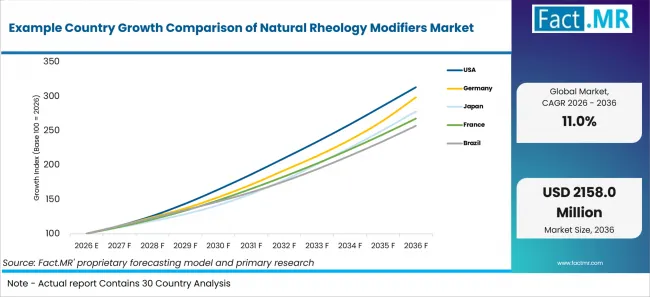
Example Country Growth Comparison Of Natural Rheology Modifiers Market | Source: Fact.MR
| Country | CAGR (2026-2036) |
|---|---|
| USA | 12.1% |
| Germany | 11.6% |
| Japan | 10.8% |
| France | 10.3% |
| Brazil | 9.9% |
Source: Fact.MR analysis. Updated Aug 28, 2026
What supports USA adoption?
12.1% CAGR, supported by processed-food reformulation and traceable food-grade ingredients.
USDA ERS reported in June 2026 that total U.S. food spending reached USD 2.51 trillion in 2025, highlighting the scale of the U.S. food market and providing broad demand context for texture and formulation ingredients used across food applications. Low-methoxyl pectin fits reduced-sugar fruit preparations where calcium-set structure replaces sugar-led gel strength, while natural gums support sauces and dressings that require suspension, pour control and heat stability.
How does Germany scale demand?
11.6% CAGR, supported by dairy alternatives and clean-label ingredient discipline.
USDA FAS reported in March 2026, citing the Federation of German Food and Drink Industries (BVE), that Germany produced an estimated USD 270.1 billion in processed food and beverages in 2024. Low-methoxyl pectin supports fruit preparations and low-sugar dairy alternatives that require controlled gel formation, while natural gums fit beverage and spoonable-product formulations where recognizable thickening systems and stable texture remain important.
How does Japan perform?
10.8% CAGR, supported by shelf-stable foods and export-oriented formulation needs.
USDA FAS reported on April 1, 2026 that Japan’s food processing sector contracted by 3% to USD 174 billion in 2025, while soft drinks, health foods, frozen foods and shelf-stable products recorded growth. High-methoxyl pectin supports fruit fillings and confectionery systems, while food-grade gums help beverage manufacturers manage mouthfeel and suspension in health-positioned and convenience formats.
What supports France's growth?
10.3% CAGR, backed by organic channels and dairy alternative formulation.
USDA FAS reported on April 3, 2026 that France’s agri-food industry includes around 17,000–18,000 companies and generates close to USD 215–225 billion in annual revenue. Low-methoxyl pectin supports fruit layers, plant-based desserts and reduced-sugar systems, while natural gums help beverage and sauce producers maintain stable viscosity and familiar ingredient positioning.
How is Brazil developing demand?
9.9% CAGR, supported by fruit processing scale and beverage applications.
USDA FAS reported in March 2026 that Brazil’s food processing sector generated USD 248 billion in revenue in 2025, highlighting the scale of the country’s food-processing industry and providing broad market context for functional food ingredients. Brazil’s fruit and citrus processing supports demand for gels, fillings and beverage stabilizers, while functional blends help food manufacturers manage texture and heat performance across sauces and ready-to-drink products.
Who leads the Natural Rheology Modifiers Market?
Ashland Inc. is active through cellulosic hydrocolloids used in food, beverage and nutraceutical applications. In October 2025, Ashland Inc. appointed Tilley Distribution as its exclusive U.S. distribution partner for these ingredients, expanding access to cellulose gum and modified cellulose grades used for functions including thickening and stabilization.
Tate & Lyle expanded its portfolio through the combination with CP Kelco, completed in November 2024. CP Kelco adds pectin, speciality gums and other nature-based ingredients, strengthening Tate & Lyle's texturant and mouthfeel capabilities across food and beverage formulations.
BASF SE participates in natural-origin rheology through its broader Verdessence biopolymer portfolio and expanded its natural-based personal-care ingredients in April 2025 with Verdessence Maize, a plant-based styling polymer. Clariant AG participates in rheology modification through Aristoflex SUN, a synthetic polymer introduced in April 2025 to stabilize UV filters and improve the performance and texture of sun-care formulations.
The Lubrizol Corporation and Nouryon provide broader rheology-modifier capabilities across personal care, coatings and water-based systems. In March 2025, Nouryon featured Bermocoll EHM MAX, a hydrophobically modified cellulose ether for architectural paints that the company describes as up to 10% more efficient than comparable rheology modifiers.
Which companies are the key providers?
Key companies include Ashland Inc.; The Lubrizol Corporation; BASF SE; Clariant AG; Tate & Lyle PLC (CP Kelco); and Nouryon.
- Ashland Inc.
- The Lubrizol Corporation
- BASF SE
- Clariant AG
- Tate & Lyle PLC (CP Kelco)
- Nouryon
Bibliography
- Agence BIO. (2025, September). Évaluation de la consommation alimentaire biologique au 1er semestre 2025.
- Ashland Inc. (2025, October 6). Ashland announces new U.S. food and beverage ingredient distributor.
- BASF SE. (2025, April 3). BASF launches natural-based innovations for personal care at in-cosmetics Global 2025.
- Brazilian Institute of Geography and Statistics. (2026, June 12). Influenced by the Food and Beverages group, inflation stands at 0.58% in May. IBGE News Agency.
- Clariant. (2025, April 23). Clariant's new Aristoflex™ SUN for elevated suncare formulations.
- Bundesministerium für Ernährung und Landwirtschaft. (2024, September 24). Deutschland, wie es isst – der BMEL-Ernährungsreport 2024.
- Federal Statistical Office (Destatis). (2026, August 12). Inflation rate at +2.8% in July 2026.
- Ministério da Agricultura e Pecuária. (2026, January 8). Agronegócio brasileiro fecha 2025 com recorde em exportações de US$ 169 bilhões e superávit de US$ 149,07 bilhões [Brazilian agribusiness closes 2025 with record exports of US$169 billion and a US$149.07 billion surplus].
- Institut national de la statistique et des études économiques. (2026, July 10). In June 2026, consumer prices rose by 1.8% year on year.
- Nouryon. (2025, March 25). Nouryon to feature Bermocoll® EHM MAX, a premium performing rheology modifier for architectural paints at the European Coatings Show 2025.
- Tate & Lyle PLC. (2024, November 15). Completion of combination of Tate & Lyle and CP Kelco to create a leading global speciality food and beverage solutions business.
- Zeballos, E., & Sinclair, W. (2026, June 11). Total U.S. food spending reached $2.51 trillion in 2025. U.S. Department of Agriculture, Economic Research Service.
- Weber, C., Simnitt, S., & Wakefield, H. (2026, March 26). Fruit and Tree Nuts Outlook: March 2026 (FTS-384). U.S. Department of Agriculture, Economic Research Service.
- Aoki, S. (2026, April 1). Food processing ingredients annual: Japan (GAIN Report No. JA2026-0012). U.S. Department of Agriculture, Foreign Agricultural Service.
- Journo, L. J. (2026, April 3). Food processing ingredients annual: France (GAIN Report No. FR2026-0003). U.S. Department of Agriculture, Foreign Agricultural Service.
- Loeser, J. (2026, March 30). Food processing ingredients annual: Germany (GAIN Report No. GM2026-0007). U.S. Department of Agriculture, Foreign Agricultural Service.
- Vendemiatti, A., Jr. (2026, March 31). Food processing ingredients annual: Brazil (GAIN Report No. BR2026-0011). U.S. Department of Agriculture, Foreign Agricultural Service.
This Report Addresses
- The report explains natural rheology modifier use across product, function, application and grade. It covers regional and country-level demand conditions.
- Segment analysis identifies the listed subsegments and the formulation reasons buyers prioritize them.
- Country analysis examines the USA, Germany, Japan, France and Brazil with country-specific drivers and adoption restraints.
- Competitive analysis reviews current providers across pectin, natural gums, cellulose chemistry and natural-positioned texture systems.
- Application analysis assesses how gelling, thickening and stabilization influence product trials and supplier qualification.
What does the Natural Rheology Modifiers Market cover?
The Natural Rheology Modifiers Market covers pectin, natural gums, cellulose derivatives and functional blends used to control flow and structure. It includes food-grade systems for beverages and dairy alternatives, plus adjacent care and coating additives where natural polymer behavior shapes viscosity.
The assessment covers low-methoxyl pectin, high-methoxyl pectin, natural gums and functional blends. Related gum systems and pectin streams are used as adjacent indicators.
What is included in the scope?
The scope includes commercial natural rheology modifiers sold as individual ingredients, blends or formulation aids. It covers edible systems and additives tied to viscosity, stabilization or gel formation.
Included applications cover dairy alternatives, confectionery, beverages and sauces or dressings. Grade analysis assesses supplier qualification, process fit and finished-product behavior.
What is excluded from the scope?
Fully synthetic rheology modifiers fall outside the scope when sold without a natural or bio-based positioning. Commodity starches used only as bulk solids and finished food products sold to consumers are outside the scope.
General stabilizer blends are outside the scope without an identified gelling, thickening, suspension or rheology function. Finished formulations are used only as ingredient-demand indicators.
How Was the Analysis Built?
The analysis draws on 120+ sources, 35+ company portfolios, 25+ countries, and more than 20 industry interviews.
- Primary Research: Primary research includes discussions with manufacturers, service providers, technology developers, distributors, end users, and subject-matter experts. These conversations examine purchasing priorities, product adoption, operational challenges, approval requirements, competitive positioning, and the factors that influence wider market acceptance.
- Desk Research: Desk research covers government statistics, regulatory publications, company filings, trade data, technical studies, industry associations, standards, public policy, and other authoritative sources. Every source used in the analysis is documented in the bibliography.
- Market Sizing and Forecasting: Market estimates combine historical performance, demand indicators, pricing and volume trends, segment shares, company participation, country-level growth, adoption patterns, investment activity, and barriers to market expansion.
- Data Validation and Update Cycle: Findings are validated by comparing primary interviews with public data, company activity, regulatory changes, trade patterns, and industry developments. Regular updates review new product launches, capacity changes, partnerships, approvals, and shifts in commercial adoption.
Segmentation
What is the report's scope and coverage?
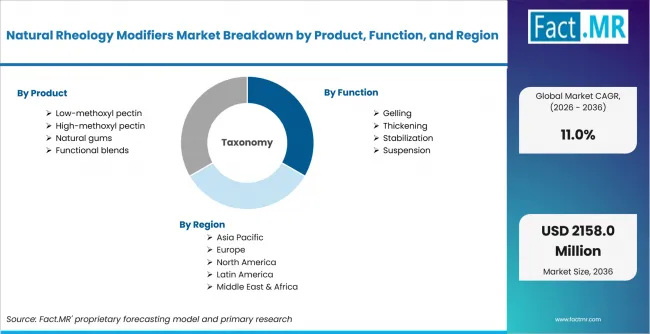
Natural Rheology Modifiers Market Breakdown By Product, Function, And Region | Source: Fact.MR
| Attribute | Details |
|---|---|
| Quantitative Units | USD million |
| Market Definition | Natural polymers and blends used to adjust viscosity, gel strength, suspension and texture in food, beverage, care and water-based formulation systems. |
| Product | Low-methoxyl pectin; High-methoxyl pectin; Natural gums; Functional blends |
| Function | Gelling; Thickening; Stabilization; Suspension |
| Application | Dairy alternatives; Confectionery; Beverages; Sauces and dressings |
| Grade | Food grade; Organic; Low-energy process; Customized |
| Regions Covered | North America; Latin America; Western Europe; Eastern Europe; East Asia; South Asia & Pacific; Middle East & Africa |
| Countries Covered | USA; Germany; Japan; France; Brazil |
| Key Companies Profiled | Ashland Inc.; The Lubrizol Corporation; BASF SE; Clariant AG; CP Kelco; Nouryon |
| Forecast Period | 2026 to 2036 |
| Approach | Hybrid top-down and bottom-up approach using formulation demand, ingredient portfolio review, country processing indicators and application-level validation. |
Source: Fact.MR analysis. Updated Aug 28, 2026
How is the market segmented?
-
By Product:
- Low-methoxyl pectin
- High-methoxyl pectin
- Natural gums
- Functional blends
-
By Function:
- Gelling
- Thickening
- Stabilization
- Suspension
-
By Application:
- Dairy alternatives
- Confectionery
- Beverages
- Sauces and dressings
-
By Grade:
- Food grade
- Organic
- Low-energy process
- Customized
-
By Region:
- North America
- Latin America
- Western Europe
- Eastern Europe
- East Asia
- South Asia & Pacific
- Middle East & Africa
Frequently Asked Questions
How big is the natural rheology modifiers market in 2026?
What is the CAGR of the natural rheology modifiers market from 2026 to 2036?
Which product leads the natural rheology modifiers market?
Which function leads the natural rheology modifiers market?
Who are the leading companies in the natural rheology modifiers market?
Who worked on this report


Preview the report firsthand - request a free sample
Free SampleGet the brochure for pricing and purchase details
Download PDF