- Market Value (2025): USD 710.4 Mn
- Estimated Value (2026): USD 770.8 Mn
- Forecast Value (2036): USD 1742.7 Mn
- CAGR (2026-2036): 8.5%
What is the Next-Generation Masked T-Cell Engager Therapeutics Market forecast to be worth by 2036?
USD 770.8 million in 2026 to USD 1,742.7 million by 2036, at an 8.5% CAGR.
- The market entered 2026 at USD 770.8 million, up from USD 710.4 million in 2025, as protease-cleavable and anti-idiotypic masking chemistries advance from preclinical validation toward early clinical trials.
- Demand is projected to increase from USD 770.8 million in 2026 to USD 1,742.7 million by 2036.
- The market is forecast to record an 8.5% CAGR from 2026 to 2036 as protease- or condition-dependent unmasking inside the tumor microenvironment, cytokine-release management, and solid-tumor trafficking evidence continue to mature.
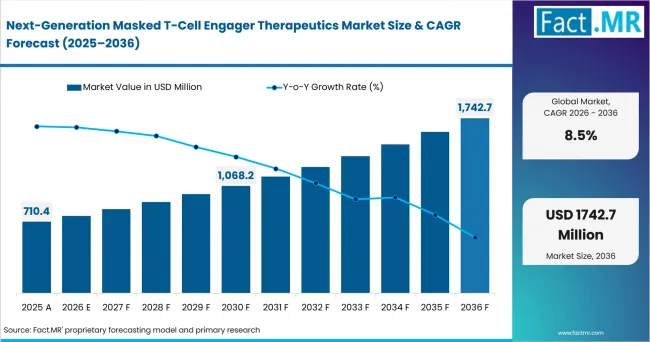
Next Generation Masked T Cell Engager Therapeutics Market Value Analysis | Source: Fact.MR
What are the defining numbers behind Next-Generation Masked T-Cell Engager Therapeutics Market growth?
USD 971.9 million absolute opportunity is expected by 2036.
- Demand Drivers in the Market
- Twelve T-cell engager constructs have already been approved by the FDA and EMA for hematologic malignancies or solid tumors, but an AACR Clinical Cancer Research review notes seven of nine approved bispecifics still require hospitalization for cytokine-release-syndrome management, the specific safety gap masking technology is designed to close.
- Preclinical data on CytomX's dually masked EGFR-CD3 Probody (CI107) recorded a greater than 500-fold reduction in antigen binding and a greater than 15,000-fold reduction in cytotoxic activity in the masked state, while the maximum tolerated dose in cynomolgus monkeys was more than 60-fold higher than the unmasked parental molecule, giving sponsors a quantified therapeutic-window expansion to point to.
- CytomX's CX-904, an EGFR-CD3 Probody therapeutic, is already in a Phase 1 trial (NCT05387265) and has shown early efficacy signals in advanced pancreatic cancer, with 2 of 6 evaluable patients achieving a confirmed partial response and all 6 showing disease control, evidence that masked engagers can clear early clinical hurdles in solid tumors.
- Key Segments Analyzed
- By Therapeutic Type: Masked Bispecific T-Cell Engagers are expected to hold 30.0% share in 2026, supported by growing interest in treatments designed to activate T cells more selectively within the tumor environment.
- By Cancer Type: Solid Tumors are projected to account for 45.0% share in 2026 due to the broad range of tumor indications being studied with targeted immune therapies.
- By Target Antigen: EGFR is anticipated to capture 19.3% share in 2026, reflecting its established role across several solid tumors and its relevance in targeted treatment development.
- By Development Stage: Preclinical programs are estimated to represent 30.0% share in 2026 as many candidates remain under early evaluation for safety, targeting precision, and tumor response.
- By End User: Hospitals are forecast to hold 30.0% share in 2026 through their central role in diagnosis and patient monitoring.
- Analyst Opinion at Fact.MR
- Shambhu Nath Jha, Senior Analyst at Fact.MR, states, that the field will separate developers who can quantify their masking performance from those who can only describe it. A platform that can show, in the same assay panel, how much drug stays masked, how much activates, and how it correlates with target density is in a far stronger licensing position than one relying on a qualitative safety narrative, even if both show comparable preclinical efficacy.
- Strategic Implications
- Validate the unmasking against real patient-tumor protease activity, not just xenograft models, before treating tumor-biology variability as a late-stage problem; a initiate that performs well in mice does not automatically transfer to the more heterogeneous protease activity seen across real tumors.
- Build dose-escalation and cytokine-monitoring capacity in parallel with the masking chemistry itself, since that capacity, not the underlying biology, is what actually determines how quickly the systemic-inactivity-versus-intratumoral-activation trade-off can be tuned in the clinic.
- Characterize antigen density, heterogeneity, and shedding across multiple cohorts before assuming a single-center profile will generalize; expression patterns measured at one site routinely understate what shows up once a program expands.
- Price step-up dosing and cytokine-release management into the commercial model from the start; this per-patient monitoring cost is easy for early pricing assumptions to leave out.
Germany is projected to record the fastest pace at an 11.5% CAGR from 2026 to 2036, supported by its university-hospital base. Brazil is estimated to post a 10.6% CAGR through its large, diverse patient population. The USA is anticipated to advance at a 9.8% CAGR through its dense trial ecosystem. South Korea is forecast to record an 8.9% CAGR through precision-medicine infrastructure. The U.K. is projected at 8.1%, while Japan is estimated to post the slowest pace at a 7.2% CAGR through domestic pharmacokinetic validation requirements.
How does the Next-Generation Masked T-Cell Engager Therapeutics Market break down by segment?
Masked Bispecific T-Cell Engagers are expected to lead Therapeutic Type at 30.0%, and Solid Tumors are projected to lead Cancer Type at 45.0% share in 2026.
Why does Masked Bispecific T-Cell Engagers lead Therapeutic Type?
Masked Bispecific T-Cell Engagers leads the Therapeutic Type segment at 30.0% of 2026 demand.
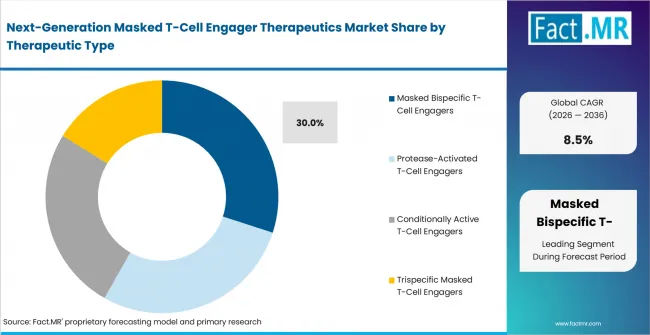
Next Generation Masked T Cell Engager Therapeutics Market Analysis By Therapeutic Type | Source: Fact.MR
The therapeutic type categories are Masked Bispecific T-Cell Engagers, Protease-Activated T-Cell Engagers, Conditionally Active T-Cell Engagers, and Trispecific Masked T-Cell Engagers. Masked bispecifics lead because protease-cleavable mask technology, such as CytomX's Probody platform and the XTEN-based Pro-XTEN/XPAT format published in Nature Cancer, already has preclinical and early clinical validation across multiple targets, while conditionally active designs relying on local pH or hypoxia triggers and trispecific formats remain comparatively earlier in development.
Why does Solid Tumors lead Cancer Type?
Solid Tumors leads the Cancer Type segment at 45.0% of 2026 demand.
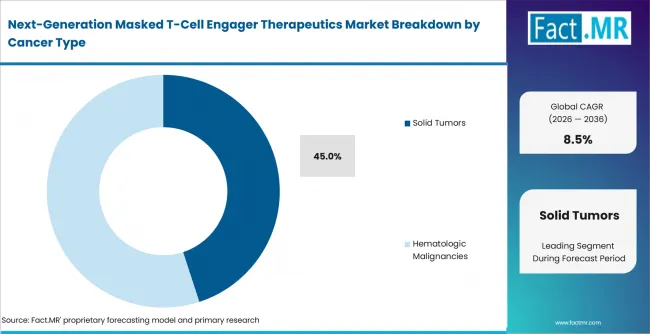
Next Generation Masked T Cell Engager Therapeutics Market Analysis By Cancer Type | Source: Fact.MR
The cancer type categories are Solid Tumors and Hematologic Malignancies. Masking matters far more in solid tumors, where stromal barriers and antigen heterogeneity make an unmasked engager riskier, than in hematologic disease, where target antigens are typically more uniform and accessible; this is precisely the on-target, off-tumor toxicity gap that has limited bispecific TCE use in solid tumors to date.
Why does EGFR lead Target Antigen?
EGFR leads the Target Antigen segment at 19.3% of 2026 demand.
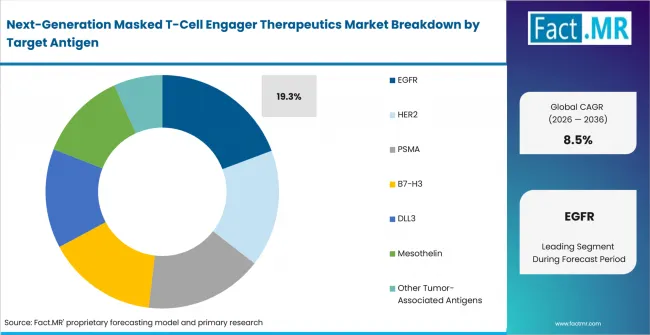
Next Generation Masked T Cell Engager Therapeutics Market Analysis By Target Antigen | Source: Fact.MR
The target antigen categories are EGFR, HER2, PSMA, B7-H3, DLL3, Mesothelin, and Other Tumor-Associated Antigens. EGFR leads, though only narrowly at 19.3%, because it benefits from established diagnostic assays already used in existing therapies and is the target of the most clinically advanced masked constructs, including CytomX's CX-904 and the preclinical CI107 Probody TCB, while newer targets such as DLL3 still need companion diagnostics built out alongside the therapeutic program itself.
Why does Preclinical lead Development Stage?
Preclinical leads the Development Stage segment at 30.0% of 2026 demand.
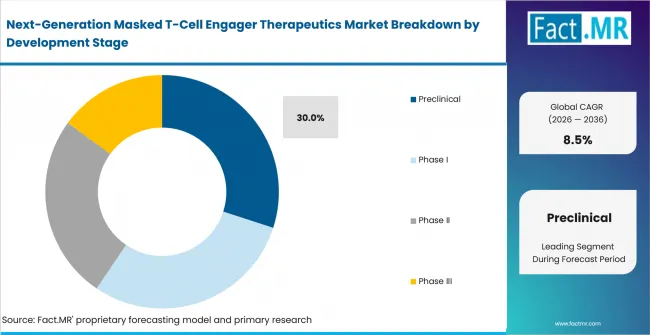
Next Generation Masked T Cell Engager Therapeutics Market Analysis By Development Stage | Source: Fact.MR
The development stage categories are Preclinical, Phase I, Phase II, and Phase III. The current concentration in preclinical work reflects how recently protease-activated and conditionally active masking designs, including calmodulin-based masking clamps published in 2025 that aim to reduce the immunogenicity risk of earlier non-human mask sequences, have matured enough to support a first-in-human dose-escalation study.
Why does Hospitals lead End User?
Hospitals leads the End User segment at 30.0% of 2026 demand.
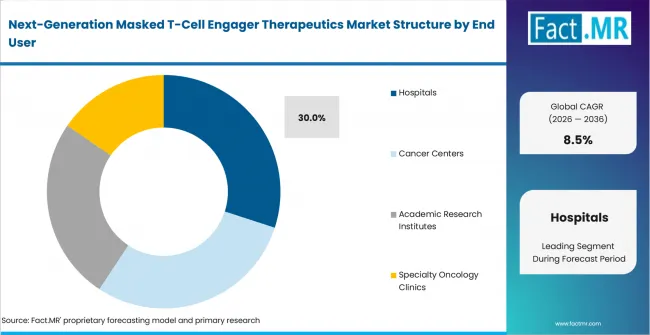
Next Generation Masked T Cell Engager Therapeutics Market Analysis By End User | Source: Fact.MR
The end user categories are Hospitals, Cancer Centers, Academic Research Institutes, and Specialty Oncology Clinics. Hospitals currently carry most step-up dosing and cytokine-release monitoring, since managing CRS, still required for the majority of approved bispecifics per AACR's clinical pharmacology review, is harder to replicate in a standalone specialty clinic than the actual drug administration is.
What is accelerating Next-Generation Masked T-Cell Engager Therapeutics Market adoption, and what is holding it back?
Masking as a safety concept is already well understood; the harder problem is proving it holds up outside a xenograft model. Funding follows developers who can connect protease- or condition-dependent unmasking evidence to the infrastructure needed to manage step-up dosing and cytokine release once a program reaches the clinic.
Drivers Impact Analysis
| DRIVER | (~) % IMPACT ON CAGR | GEOGRAPHIC RELEVANCE | IMPACT TIMELINE |
|---|---|---|---|
| Protease-activated unmasking | +1.3% | Germany and USA | Medium term (2-4 years) |
| Solid tumor pipeline expansion | +1.1% | USA and U.K. | Medium term (2-4 years) |
| Regulatory and academic backing | +0.9% | USA and Germany | Short term (<=2 years) |
| Precision-oncology infrastructure | +0.7% | South Korea and Japan | Medium term (2-4 years) |
| Public-private access expansion | +0.5% | Brazil and Latin America | Long term (>=4 years) |
Source: Fact.MR analysis. Updated Jul 21, 2026
- Protease-activated unmasking: The market's foundational validation point is protease or condition-dependent unmasking inside the tumor microenvironment, the mechanism Germany's leading 11.5% CAGR is interpreted through.
- Solid tumor pipeline expansion: Solid Tumors already account for 45.0% of 2026 demand, and conditional activation addresses antigen density/heterogeneity limitations most pronounced outside blood cancers, the rationale for USA growth.
- Regulatory and academic backing: FDA oncology approval pathways and consensus dose-escalation/safety guidance from AACR/ASCO give sponsors a structured route, concentrated in USA trial infrastructure and Germany's hospital base.
Opportunity Impact Analysis
| OPPORTUNITY | (~) % IMPACT ON CAGR | GEOGRAPHIC RELEVANCE | IMPACT TIMELINE |
|---|---|---|---|
| Target antigen diversification | +0.6% | USA and Germany | Medium term (2-4 years) |
| Trispecific masking platforms | +0.5% | Germany and South Korea | Long term (>=4 years) |
| Clinical-stage pipeline progression | +0.4% | USA and U.K. | Medium term (2-4 years) |
| National health-system rollout | +0.3% | U.K. and Brazil | Long term (>=4 years) |
Source: Fact.MR analysis. Updated Jul 21, 2026
- Target antigen diversification: EGFR leads Target Antigen at only 19.3% of demand, leaving HER2, PSMA, B7-H3, DLL3, and Mesothelin room to expand across USA/Germany specialised centers.
- Trispecific masking platforms: Trispecific Masked T-Cell Engagers stands as a listed therapeutic type still building clinical evidence; preclinical trispecific data already shows improved tumor restriction versus bispecific predecessors in solid-tumor xenograft models.
- Clinical-stage pipeline progression: Preclinical programs lead Development Stage at 30.0%, and as this pipeline advances through trial-dense USA and U.K. networks, later-stage evidence converts more activity into revenue.
Restraints Impact Analysis
| RESTRAINT | (~) % IMPACT ON CAGR | GEOGRAPHIC RELEVANCE | IMPACT TIMELINE |
|---|---|---|---|
| Cytokine-release management burden | -0.7% | Global | Short term (<=2 years) |
| Solid-tumor trafficking barriers | -0.5% | USA and U.K. | Medium term (2-4 years) |
| Systemic activation trade-off | -0.4% | Brazil and mixed public-private markets | Medium term (2-4 years) |
| Immunogenicity and repeat-dosing uncertainty | -0.3% | Japan | Short term (<=2 years) |
Source: Fact.MR analysis. Updated Jul 21, 2026
- Cytokine-release management burden: Seven of nine approved T-cell-engaging bispecifics still require hospitalization for CRS management per AACR's review, combined with hospital readiness for step-up dosing and rapid adverse-event management.
- Solid-tumor trafficking barriers: Developers must prove adequate penetration across heterogeneous solid tumors; antigen density and shedding remain the interpretive lens applied to USA growth.
- Systemic activation trade-off: The core design challenge is widening the therapeutic window without weakening tumour activity, harder to resolve at scale in Brazil's mixed public-private system.
Who leads the Next-Generation Masked T-Cell Engager Therapeutics Market?
This market spans large oncology-focused pharmaceutical companies with in-house bispecific platforms and smaller biotechs that specialise specifically in protease-activated or conditionally masked engager design. CytomX Therapeutics' Probody platform, published across multiple AACR Cancer Research and clinical-trial protocol filings, is among the most clinically advanced masking approaches, while Roche, Genmab, AbbVie, Amgen, and AstraZeneca bring established bispecific manufacturing and regulatory infrastructure. Xencor, BioNTech, Harpoon Therapeutics, and Janux Therapeutics represent the specialist tier building conditional-activation chemistry as a core platform rather than a single asset.
Which companies are the key providers?
Ten developers are tracked in this market, ranging from large-cap pharmaceutical companies with established bispecific franchises to biotechs built specifically around masking and conditional-activation chemistry:
- Janux Therapeutics, Inc.
- Roche Holding AG
- Genmab A/S
- AbbVie Inc.
- Xencor, Inc.
- CytomX Therapeutics, Inc.
- BioNTech SE
- AstraZeneca PLC
Bibliography
- Prodrug-based bispecific antibodies for cancer therapy: advances and future directions. PMC, 2025.
- Trial Watch - bispecific T cell engagers and higher-order multispecific immunotherapeutics. Oncoimmunology / PMC, 2026.
- Conditionally active T cell engagers for the treatment of solid tumors: rationale and clinical development. Expert Opinion on Biological Therapy (Taylor & Francis), 2022.
- A masking clamp for conditional activation of therapeutic antibodies. Frontiers in Immunology, 2025.
- Schellenberger, V. et al. Precision-activated T-cell engagers targeting HER2 or EGFR and CD3 mitigate on-target, off-tumor toxicity for immunotherapy in solid tumors. Nature Cancer, 2023.
- A Probody T Cell-Engaging Bispecific Antibody Targeting EGFR and CD3 Inhibits Colon Cancer Growth with Limited Toxicity. Cancer Research (AACR), 2022.
- Clinical Pharmacology of Cytokine Release Syndrome with T-Cell-Engaging Bispecific Antibodies: Current Insights and Drug Development Strategies. Clinical Cancer Research (AACR), 2025
- ClinicalTrials.gov protocol NCT05387265 — CX-904 Phase 1 study in advanced metastatic solid tumors.
This Report Addresses
- The report provides strategic intelligence on the Next-Generation Masked T-Cell Engager Therapeutics Market across Therapeutic Type and Cancer Type choices that shape development decisions.
- Segment analysis covers Masked Bispecific T-Cell Engagers as the share leader within the 2026 market structure.
- Regional outlook evaluates Germany and Brazil alongside USA and South Korea, while U.K. and Japan complete the growth comparison.
- Competitive analysis profiles CytomX Therapeutics and Janux Therapeutics alongside Roche and Genmab, followed by additional active providers.
- Use-case assessment covers the masking mechanisms and antigen targets that shape adoption across the forecast period.
What does the Next-Generation Masked T-Cell Engager Therapeutics Market cover?
Conditionally active bispecific or multispecific T-cell engagers that are masked in circulation and designed to become active within the tumour microenvironment.
The Next-Generation Masked T-Cell Engager Therapeutics Market covers bispecific and multispecific constructs that pair a tumor-associated-antigen-binding domain with a CD3-binding domain, held inactive in circulation by a protease-cleavable, anti-idiotypic, or chemically reversible mask until reaching the tumor microenvironment. Coverage includes protease-activated Probody-format engagers, conditionally active pH- or hypoxia-triggered designs, and trispecific masked constructs.
The market differs from the broader bispecific T-cell engager and CAR-T therapy sectors because commercial value here comes specifically from the masking/unmasking chemistry that expands the therapeutic index, not from T-cell redirection generally. Unmasked, constitutively active bispecific T-cell engagers already approved for hematologic malignancies, and CAR-T cellular therapies, remain outside this market's boundary.
What is included in the scope?
Included are the masking mechanisms, tumor types, and target antigens that define this conditional-activation category.
The scope includes Therapeutic Type, Cancer Type, Target Antigen, Development Stage, and End User, the recorded country growth estimates, the company set where available, recent non-commercial evidence on protease-activation and masking chemistry, regulatory guidance, and long-term development considerations such as cytokine-release monitoring infrastructure.
What is excluded from the scope?
Unmasked bispecific T-cell engagers, CAR-T cellular therapy, and unrelated oncology equipment remain outside the scope of this market.
Excluded are constitutively active, unmasked bispecific T-cell engagers already marketed for hematologic malignancies, CAR-T and other cellular therapies, general oncology infrastructure and diagnostics not specific to masked-engager administration, and claims that cannot be tied to a current named academic, clinical, or regulatory source.
How Was the Analysis Built?
The analysis draws on peer-reviewed immunology and pharmacology literature, ClinicalTrials.gov protocol documentation, and regulatory review sources.
- Primary evidence base: peer-reviewed masking-platform and protease-activation studies from PMC, Nature Cancer, and AACR journals, cross-checked against ClinicalTrials.gov protocol filings for active masked-engager trials.
- Desk research: FDA oncology approval notifications and AACR/ASCO consensus safety guidance on cytokine-release syndrome. Every source used is documented in the bibliography.
- Market sizing and forecasting: estimates combine segment taxonomy, country-level growth indicators, and development-stage mix across the 2025, 2026 and 2036 reference years.
- Data validation and update cycle: findings are validated by comparing primary academic literature with clinical-trial registry updates and regulatory developments.
Segmentation
What is the report's scope and coverage?
| Attribute | Details |
|---|---|
| 2025 Market Size | USD 710.4 million |
| 2026 Market Size | USD 770.8 million |
| 2036 Market Size | USD 1,742.7 million |
| Forecast CAGR | 8.5% |
| Forecast Period | 2026-2036 |
| Segmentation | Therapeutic Type, Cancer Type, Target Antigen, Development Stage, End User |
| Countries Analyzed | Germany, Brazil, USA, South Korea, U.K., Japan + 30 countries |
| Company Coverage | Janux Therapeutics, Inc., Roche Holding AG, Genmab A/S, AbbVie Inc., Xencor, Inc., CytomX Therapeutics, Inc., BioNTech SE, AstraZeneca PLC |
Source: Fact.MR analysis. Updated Jul 21, 2026
How is the market segmented?
-
By Therapeutic Type:
- Masked Bispecific T-Cell Engagers - 30.0% in 2026
- Protease-Activated T-Cell Engagers
- Conditionally Active T-Cell Engagers
- Trispecific Masked T-Cell Engagers
-
By Cancer Type:
- Solid Tumors - 45.0% in 2026
- Hematologic Malignancies
-
By Target Antigen:
- EGFR - 19.3% in 2026
- HER2
- PSMA
- B7-H3
- DLL3
- Mesothelin
- Other Tumor-Associated Antigens
-
By Development Stage:
- Preclinical - 30.0% in 2026
- Phase I
- Phase II
- Phase III
-
By End User:
- Hospitals - 30.0% in 2026
- Cancer Centers
- Academic Research Institutes
- Specialty Oncology Clinics
-
By Region:
- North America
- Latin America
- Western Europe
- Eastern Europe
- East Asia
- South Asia and Pacific
- Middle East and Africa
Frequently Asked Questions
What exactly is included in the Next-Generation Masked T-Cell Engager Therapeutics Market?
What is the 2026 market size and 2036 outlook?
Why does Masked Bispecific T-Cell Engagers lead Therapeutic Type?
What would cause a developer to prioritize Solid Tumors over Hematologic Malignancies?
What is the central adoption barrier?
Why is Germany the fastest-growing country in this set?
How should evidence be shown to transfer beyond one site?
Who worked on this report


Preview the report firsthand - request a free sample
Free SampleGet the brochure for pricing and purchase details
Download PDF