Night-Active Insect Lure-and-Kill Gel Market

Night-Active Insect Lure-and-Kill Gel Market Size and Share Forecast Outlook 2026 to 2036

Night-active insect lure-and-kill gel market is projected to grow from USD 198.0 million in 2026 to USD 794.1 million by 2036, at a CAGR of 14.9%. Moths & Noctuid Species will dominate with a 38.0% market share, while pheromone-infused gel matrices will lead the lure chemistry type segment with a 41.0% share.

Night-Active Insect Lure-and-Kill Gel Market Forecast and Outlook 2026 to 2036

The global night-active insect lure-and-kill gel market is projected to reach USD 794.08 million by 2036. The market is valued at USD 198.00 million in 2026 and is set to rise at a CAGR of 14.9% during the assessment period. By target insect group, moths & noctuid species hold a leading 38% share. Pheromone-infused gel matrices represent a dominant 41% lure chemistry segment, while spot gel placement accounts for 44% market share.

Key Takeaways from the Night-Active Insect Lure-and-Kill Gel Market

  • Market Value for 2026: USD 198.00 Million
  • Market Value for 2036: USD 794.08 Million
  • Forecast CAGR (2026-2036): 14.9%
  • Leading Target Insect Group Share (2026): Moths & Noctuid Species (38%)
  • Leading Lure Chemistry Type Share (2026): Pheromone-Infused Gel Matrices (41%)
  • Leading Deployment Method Share (2026): Spot Gel Placement (44%)
  • Key Players in the Market: Koppert Biological Systems, Certis Biologicals, Andermatt Group, Marrone Bio Innovations, BioControle DMI
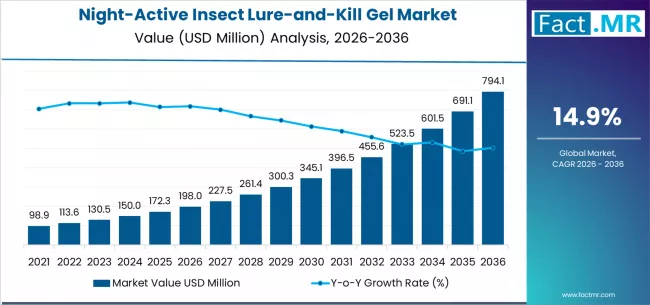
Night Active Insect Lure And Kill Gel Market Market Value Analysis

Important trends center on the evolution from broad-spectrum nighttime sprays to highly targeted, species-specific gel formulations. Research is advancing the integration of multiple attractant modes into a single gel matrix, combining pheromones with food-based volatiles. Deployment is becoming more strategic through the use of mapping software to identify high-pressure zones, and drone-assisted placement is enabling application in difficult-to-access crops.

Regulatory frameworks strongly support this market shift by favoring biocontrol and behavior-modifying solutions over conventional insecticide sprays. Policies that restrict broad-spectrum nighttime spraying to protect pollinators and human health create direct opportunities. Favorable registration pathways for semiochemical-based products in many regions accelerate the commercialization of new gel formulations.

Night-Active Insect Lure-and-Kill Gel Market

Metric Value
Market Value (2026) USD 198.00 Million
Market Forecast Value (2036) USD 794.08 Million
Forecast CAGR (2026-2036) 14.9%

Category

Category Segments
Target Insect Group Moths & Noctuid Species, Night-Active Beetles, Fruit Borers & Cutworms, Night-Foraging Flies, Others
Lure Chemistry Type Pheromone-Infused Gel Matrices, Food-Based Attractant Gels, Plant-Volatile Mimic Blends, UV-Activated Olfactory Enhancers, Others
Deployment Method Spot Gel Placement, Dispenser-Based Gel Stations, Band & Perimeter Application, Precision Drone-Assisted Placement, Others
Region North America, Latin America, Western Europe, Eastern Europe, East Asia, South Asia & Pacific, MEA

Segmental Analysis

By Target Insect Group, Which Pests Drive the Most Significant Economic Damage?
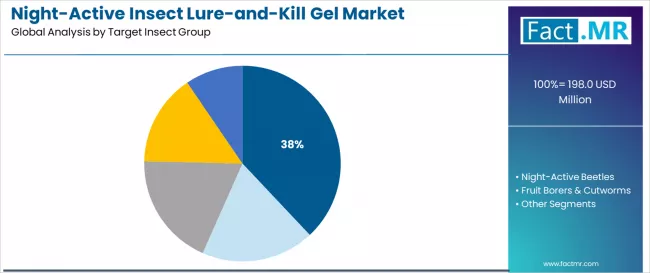
Night Active Insect Lure And Kill Gel Market Analysis By Target Insect Group

Moths and noctuid species lead the segment with a 38% share. This group includes some of the world's most destructive agricultural pests, such as the fall armyworm, corn earworm, and various cutworms. Their nocturnal feeding habits and rapid reproduction make them ideal targets for lure-and-kill strategies. The severe crop losses they inflict across continents create a consistent, high-value demand for effective monitoring and control gels.

By Lure Chemistry, Which Attractant Provides the Highest Species Specificity?
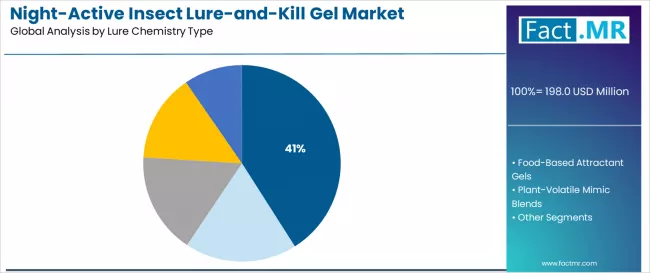
Night Active Insect Lure And Kill Gel Market Analysis By Lure Chemistry Type

Pheromone-infused gel matrices hold the largest share at 41%. Synthetic insect sex pheromones offer unparalleled target specificity, attracting only the male of the target species. This precision minimizes non-target impact and is highly effective for disrupting pest mating cycles. The gel format provides a stable, long-lasting reservoir for these volatile compounds, ensuring sustained release over weeks.

By Deployment Method, Which Strategy Balances Efficacy with Ease of Use?
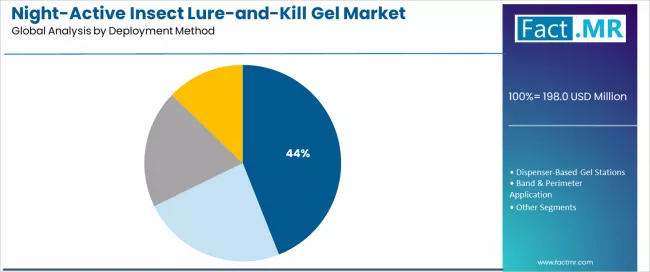
Night Active Insect Lure And Kill Gel Market Analysis By Deployment Method

Spot gel placement commands a 44% share. This method involves applying discrete dots of gel on crop stems, leaves, or posts. It offers a direct, low-tech approach that is easily adopted by growers of all scales. The method places the attractant-and-insecticide combination exactly where pests navigate, ensuring high contact rates while using minimal product per hectare.

What are the Drivers, Restraints, and Key Trends of the Night-Active Insect Lure-and-Kill Gel Market?

Market growth is driven by the urgent need for resistance management tools that do not rely on traditional neurotoxic insecticides. The strong regulatory push towards integrated pest management and the protection of beneficial insects creates a ready market for these selective solutions. The rising economic threshold of damage caused by nocturnal pests in high-value horticulture and row crops justifies the investment.

A key restraint is the limited spectrum of activity for many pheromone-based gels, requiring accurate pest identification and potentially multiple products in a field. Performance can be influenced by extreme weather, which may affect gel longevity and pheromone dispersion. The higher cost per unit compared to broad-spectrum sprays can deter adoption in low-margin crop systems.

Significant trends include the development of "smart gels" that change viscosity or release rate with temperature. Combining attractants with entomopathogenic fungi within the gel matrix creates an infect-and-kill system. The use of drones for precise gel placement in tall crops or dense canopies is improving application efficiency and safety.

Analysis of the Night-Active Insect Lure-and-Kill Gel Market by Key Countries
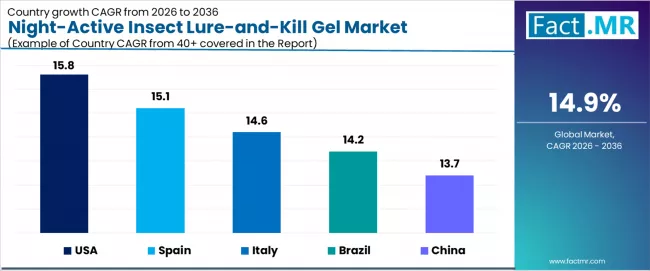
Night Active Insect Lure And Kill Gel Market Cagr Analysis By Country

Country CAGR (2026-2036)
USA 15.80%
Spain 15.10%
Italy 14.60%
Brazil 14.20%
China 13.70%

How Does the USA's High-Value Specialty Crop Sector Drive Adoption?
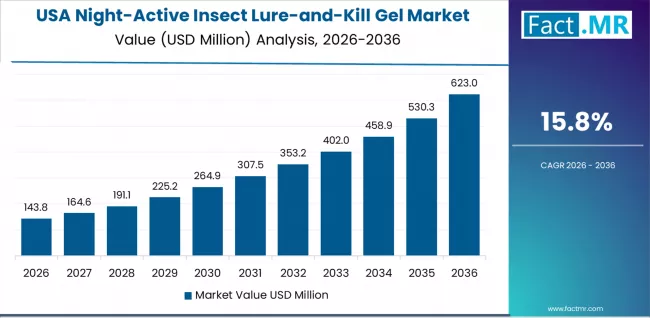
Night Active Insect Lure And Kill Gel Market Country Value Analysis

The USA leads with a 15.80% CAGR, driven by its extensive high-value nut, fruit, and vegetable production where nocturnal pests cause direct quality damage. The high cost of labor for scouting and spraying makes a passive, long-lasting gel system economically attractive. American growers increasingly adopt these gels as a cornerstone of IPM programs to meet residue standards for export and domestic retail markets.

Why are Spain's Vineyards and Orchards Ideal for This Technology?

Spain's 15.10% growth is anchored in its vast vineyard and citrus orchard sectors, which are heavily impacted by night-flying moths like the grape berry moth and fruit borers. The perennial nature of these crops supports investment in multi-year pest suppression strategies. Spanish growers value the gels for reducing insecticide runs in fragile Mediterranean ecosystems and for their compatibility with organic certification.

What Makes Italy's Artisanal Horticulture a Key Market?

Italy's 14.60% CAGR reflects the premium value placed on unblemished produce in its horticulture and wine sectors. Pest damage directly impacts marketability and price. Italian farmers, particularly those in organic or protected designation of origin systems, are early adopters of precision biocontrol tools. Gel stations are commonly deployed in greenhouses and small orchards to protect high-return crops like tomatoes, grapes, and kiwi.

How is Brazil's Large-Scale Agriculture Incorporating IPM Solutions?

Brazil's 14.20% growth is propelled by the expansion of IPM practices in its massive soybean, corn, and cotton fields, targeting pests like armyworms and cutworms. The scale of infestation makes targeted control essential. Gels are used both for monitoring population thresholds and as a direct control tactic in refuge areas or along field edges, reducing the need for blanket insecticide applications.

What Factors Support China's Shift Towards Precision Pest Management?

China's 13.70% growth is supported by government policies promoting green pest control and the modernization of its agricultural sector. The rise of large-scale greenhouse complexes for vegetable and fruit production creates an ideal controlled environment for gel deployment. Domestic research into plant-volatile blends tailored to local pest species is fueling product development and adoption.

Competitive Landscape of the Night-Active Insect Lure-and-Kill Gel Market
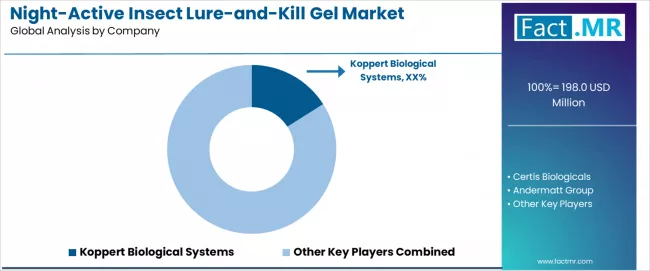
Night Active Insect Lure And Kill Gel Market Analysis By Company

A mix of long-established biocontrol companies and innovative biologicals firms characterizes the market. Leaders like Koppert Biological Systems and Andermatt Group leverage decades of expertise in pheromone science and beneficial insect distribution, offering gels as part of integrated system solutions. Certis Biologicals and Marrone Bio Innovations compete through advanced R&D in novel lure chemistries and fermentation-based attractants.

Specialist firms like BioControle DMI focus on niche pest complexes. Competition centers on the efficacy and longevity of the lure, the environmental stability of the gel carrier, and the breadth of pest species covered by a product portfolio. Success requires not only excellent science but also effective grower education on proper placement and integration with other IPM tactics, supported by strong technical field teams.

Key Players in the Night-Active Insect Lure-and-Kill Gel Market

  • Koppert Biological Systems
  • Certis Biologicals
  • Andermatt Group
  • Marrone Bio Innovations
  • BioControle DMI

Scope of Report

Items Values
Quantitative Units USD Million
Target Insect Group Moths & Noctuid Species, Night-Active Beetles, Fruit Borers & Cutworms, Night-Foraging Flies, Others
Lure Chemistry Type Pheromone-Infused Gel Matrices, Food-Based Attractant Gels, Plant-Volatile Mimic Blends, UV-Activated Olfactory Enhancers, Others
Deployment Method Spot Gel Placement, Dispenser-Based Gel Stations, Band & Perimeter Application, Precision Drone-Assisted Placement, Others
Key Countries USA, Spain, Italy, Brazil, China
Key Companies Koppert Biological Systems, Certis Biologicals, Andermatt Group, Marrone Bio Innovations, BioControle DMI
Additional Analysis Analysis of lure release kinetics under different climatic conditions, field efficacy trial designs, compatibility with beneficial insect releases, and cost-benefit comparisons with insecticide spray programs.

Night-Active Insect Lure-and-Kill Gel Market by Segments

  • Target Insect Group :

    • Moths & Noctuid Species
    • Night-Active Beetles
    • Fruit Borers & Cutworms
    • Night-Foraging Flies
    • Others
  • Lure Chemistry Type :

    • Pheromone-Infused Gel Matrices
    • Food-Based Attractant Gels
    • Plant-Volatile Mimic Blends
    • UV-Activated Olfactory Enhancers
    • Others
  • Deployment Method :

    • Spot Gel Placement
    • Dispenser-Based Gel Stations
    • Band & Perimeter Application
    • Precision Drone-Assisted Placement
    • Others
  • Region :

    • North America

      • USA
      • Canada
    • Latin America

      • Brazil
      • Mexico
      • Argentina
      • Rest of Latin America
    • Western Europe

      • Germany
      • UK
      • France
      • Spain
      • Italy
      • BENELUX
      • Rest of Western Europe
    • Eastern Europe

      • Czech Republic
      • Poland
      • Russia
      • Rest of Eastern Europe
    • East Asia

      • China
      • Japan
      • South Korea
      • Rest of East Asia
    • South Asia & Pacific

      • India
      • Indonesia
      • Australia
      • Rest of South Asia & Pacific
    • MEA

      • GCC Countries
      • Turkiye
      • Saudi Arabia
      • Rest of MEA

Table of Content

  1. Executive Summary
    • Global Market Outlook
    • Demand to side Trends
    • Supply to side Trends
    • Technology Roadmap Analysis
    • Analysis and Recommendations
  2. Market Overview
    • Market Coverage / Taxonomy
    • Market Definition / Scope / Limitations
  3. Market Background
    • Market Dynamics
      • Drivers
      • Restraints
      • Opportunity
      • Trends
    • Scenario Forecast
      • Demand in Optimistic Scenario
      • Demand in Likely Scenario
      • Demand in Conservative Scenario
    • Opportunity Map Analysis
    • Product Life Cycle Analysis
    • Supply Chain Analysis
    • Investment Feasibility Matrix
    • Value Chain Analysis
    • PESTLE and Porter’s Analysis
    • Regulatory Landscape
    • Regional Parent Market Outlook
    • Production and Consumption Statistics
    • Import and Export Statistics
  4. Global Market Analysis 2021 to 2025 and Forecast, 2026 to 2036
    • Historical Market Size Value (USD Million) Analysis, 2021 to 2025
    • Current and Future Market Size Value (USD Million) Projections, 2026 to 2036
      • Y to o to Y Growth Trend Analysis
      • Absolute $ Opportunity Analysis
  5. Global Market Pricing Analysis 2021 to 2025 and Forecast 2026 to 2036
  6. Global Market Analysis 2021 to 2025 and Forecast 2026 to 2036, By Target Insect Group
    • Introduction / Key Findings
    • Historical Market Size Value (USD Million) Analysis By Target Insect Group, 2021 to 2025
    • Current and Future Market Size Value (USD Million) Analysis and Forecast By Target Insect Group, 2026 to 2036
      • Moths & Noctuid Species
      • Night-Active Beetles
      • Fruit Borers & Cutworms
      • Night-Foraging Flies
      • Others
    • Y to o to Y Growth Trend Analysis By Target Insect Group, 2021 to 2025
    • Absolute $ Opportunity Analysis By Target Insect Group, 2026 to 2036
  7. Global Market Analysis 2021 to 2025 and Forecast 2026 to 2036, By Lure Chemistry Type
    • Introduction / Key Findings
    • Historical Market Size Value (USD Million) Analysis By Lure Chemistry Type, 2021 to 2025
    • Current and Future Market Size Value (USD Million) Analysis and Forecast By Lure Chemistry Type, 2026 to 2036
      • Pheromone-Infused Gel Matrices
      • Food-Based Attractant Gels
      • Plant-Volatile Mimic Blends
      • UV-Activated Olfactory Enhancers
      • Others
    • Y to o to Y Growth Trend Analysis By Lure Chemistry Type, 2021 to 2025
    • Absolute $ Opportunity Analysis By Lure Chemistry Type, 2026 to 2036
  8. Global Market Analysis 2021 to 2025 and Forecast 2026 to 2036, By Deployment Method
    • Introduction / Key Findings
    • Historical Market Size Value (USD Million) Analysis By Deployment Method, 2021 to 2025
    • Current and Future Market Size Value (USD Million) Analysis and Forecast By Deployment Method, 2026 to 2036
      • Spot Gel Placement
      • Dispenser-Based Gel Stations
      • Band & Perimeter Application
      • Precision Drone-Assisted Placement
    • Y to o to Y Growth Trend Analysis By Deployment Method, 2021 to 2025
    • Absolute $ Opportunity Analysis By Deployment Method, 2026 to 2036
  9. Global Market Analysis 2021 to 2025 and Forecast 2026 to 2036, By Region
    • Introduction
    • Historical Market Size Value (USD Million) Analysis By Region, 2021 to 2025
    • Current Market Size Value (USD Million) Analysis and Forecast By Region, 2026 to 2036
      • North America
      • Latin America
      • Western Europe
      • Eastern Europe
      • East Asia
      • South Asia and Pacific
      • Middle East & Africa
    • Market Attractiveness Analysis By Region
  10. North America Market Analysis 2021 to 2025 and Forecast 2026 to 2036, By Country
    • Historical Market Size Value (USD Million) Trend Analysis By Market Taxonomy, 2021 to 2025
    • Market Size Value (USD Million) Forecast By Market Taxonomy, 2026 to 2036
      • By Country
        • USA
        • Canada
        • Mexico
      • By Target Insect Group
      • By Lure Chemistry Type
      • By Deployment Method
    • Market Attractiveness Analysis
      • By Country
      • By Target Insect Group
      • By Lure Chemistry Type
      • By Deployment Method
    • Key Takeaways
  11. Latin America Market Analysis 2021 to 2025 and Forecast 2026 to 2036, By Country
    • Historical Market Size Value (USD Million) Trend Analysis By Market Taxonomy, 2021 to 2025
    • Market Size Value (USD Million) Forecast By Market Taxonomy, 2026 to 2036
      • By Country
        • Brazil
        • Chile
        • Rest of Latin America
      • By Target Insect Group
      • By Lure Chemistry Type
      • By Deployment Method
    • Market Attractiveness Analysis
      • By Country
      • By Target Insect Group
      • By Lure Chemistry Type
      • By Deployment Method
    • Key Takeaways
  12. Western Europe Market Analysis 2021 to 2025 and Forecast 2026 to 2036, By Country
    • Historical Market Size Value (USD Million) Trend Analysis By Market Taxonomy, 2021 to 2025
    • Market Size Value (USD Million) Forecast By Market Taxonomy, 2026 to 2036
      • By Country
        • Germany
        • UK
        • Italy
        • Spain
        • France
        • Nordic
        • BENELUX
        • Rest of Western Europe
      • By Target Insect Group
      • By Lure Chemistry Type
      • By Deployment Method
    • Market Attractiveness Analysis
      • By Country
      • By Target Insect Group
      • By Lure Chemistry Type
      • By Deployment Method
    • Key Takeaways
  13. Eastern Europe Market Analysis 2021 to 2025 and Forecast 2026 to 2036, By Country
    • Historical Market Size Value (USD Million) Trend Analysis By Market Taxonomy, 2021 to 2025
    • Market Size Value (USD Million) Forecast By Market Taxonomy, 2026 to 2036
      • By Country
        • Russia
        • Poland
        • Hungary
        • Balkan & Baltic
        • Rest of Eastern Europe
      • By Target Insect Group
      • By Lure Chemistry Type
      • By Deployment Method
    • Market Attractiveness Analysis
      • By Country
      • By Target Insect Group
      • By Lure Chemistry Type
      • By Deployment Method
    • Key Takeaways
  14. East Asia Market Analysis 2021 to 2025 and Forecast 2026 to 2036, By Country
    • Historical Market Size Value (USD Million) Trend Analysis By Market Taxonomy, 2021 to 2025
    • Market Size Value (USD Million) Forecast By Market Taxonomy, 2026 to 2036
      • By Country
        • China
        • Japan
        • South Korea
      • By Target Insect Group
      • By Lure Chemistry Type
      • By Deployment Method
    • Market Attractiveness Analysis
      • By Country
      • By Target Insect Group
      • By Lure Chemistry Type
      • By Deployment Method
    • Key Takeaways
  15. South Asia and Pacific Market Analysis 2021 to 2025 and Forecast 2026 to 2036, By Country
    • Historical Market Size Value (USD Million) Trend Analysis By Market Taxonomy, 2021 to 2025
    • Market Size Value (USD Million) Forecast By Market Taxonomy, 2026 to 2036
      • By Country
        • India
        • ASEAN
        • Australia & New Zealand
        • Rest of South Asia and Pacific
      • By Target Insect Group
      • By Lure Chemistry Type
      • By Deployment Method
    • Market Attractiveness Analysis
      • By Country
      • By Target Insect Group
      • By Lure Chemistry Type
      • By Deployment Method
    • Key Takeaways
  16. Middle East & Africa Market Analysis 2021 to 2025 and Forecast 2026 to 2036, By Country
    • Historical Market Size Value (USD Million) Trend Analysis By Market Taxonomy, 2021 to 2025
    • Market Size Value (USD Million) Forecast By Market Taxonomy, 2026 to 2036
      • By Country
        • Kingdom of Saudi Arabia
        • Other GCC Countries
        • Turkiye
        • South Africa
        • Other African Union
        • Rest of Middle East & Africa
      • By Target Insect Group
      • By Lure Chemistry Type
      • By Deployment Method
    • Market Attractiveness Analysis
      • By Country
      • By Target Insect Group
      • By Lure Chemistry Type
      • By Deployment Method
    • Key Takeaways
  17. Key Countries Market Analysis
    • USA
      • Pricing Analysis
      • Market Share Analysis, 2025
        • By Target Insect Group
        • By Lure Chemistry Type
        • By Deployment Method
    • Canada
      • Pricing Analysis
      • Market Share Analysis, 2025
        • By Target Insect Group
        • By Lure Chemistry Type
        • By Deployment Method
    • Mexico
      • Pricing Analysis
      • Market Share Analysis, 2025
        • By Target Insect Group
        • By Lure Chemistry Type
        • By Deployment Method
    • Brazil
      • Pricing Analysis
      • Market Share Analysis, 2025
        • By Target Insect Group
        • By Lure Chemistry Type
        • By Deployment Method
    • Chile
      • Pricing Analysis
      • Market Share Analysis, 2025
        • By Target Insect Group
        • By Lure Chemistry Type
        • By Deployment Method
    • Germany
      • Pricing Analysis
      • Market Share Analysis, 2025
        • By Target Insect Group
        • By Lure Chemistry Type
        • By Deployment Method
    • UK
      • Pricing Analysis
      • Market Share Analysis, 2025
        • By Target Insect Group
        • By Lure Chemistry Type
        • By Deployment Method
    • Italy
      • Pricing Analysis
      • Market Share Analysis, 2025
        • By Target Insect Group
        • By Lure Chemistry Type
        • By Deployment Method
    • Spain
      • Pricing Analysis
      • Market Share Analysis, 2025
        • By Target Insect Group
        • By Lure Chemistry Type
        • By Deployment Method
    • France
      • Pricing Analysis
      • Market Share Analysis, 2025
        • By Target Insect Group
        • By Lure Chemistry Type
        • By Deployment Method
    • India
      • Pricing Analysis
      • Market Share Analysis, 2025
        • By Target Insect Group
        • By Lure Chemistry Type
        • By Deployment Method
    • ASEAN
      • Pricing Analysis
      • Market Share Analysis, 2025
        • By Target Insect Group
        • By Lure Chemistry Type
        • By Deployment Method
    • Australia & New Zealand
      • Pricing Analysis
      • Market Share Analysis, 2025
        • By Target Insect Group
        • By Lure Chemistry Type
        • By Deployment Method
    • China
      • Pricing Analysis
      • Market Share Analysis, 2025
        • By Target Insect Group
        • By Lure Chemistry Type
        • By Deployment Method
    • Japan
      • Pricing Analysis
      • Market Share Analysis, 2025
        • By Target Insect Group
        • By Lure Chemistry Type
        • By Deployment Method
    • South Korea
      • Pricing Analysis
      • Market Share Analysis, 2025
        • By Target Insect Group
        • By Lure Chemistry Type
        • By Deployment Method
    • Russia
      • Pricing Analysis
      • Market Share Analysis, 2025
        • By Target Insect Group
        • By Lure Chemistry Type
        • By Deployment Method
    • Poland
      • Pricing Analysis
      • Market Share Analysis, 2025
        • By Target Insect Group
        • By Lure Chemistry Type
        • By Deployment Method
    • Hungary
      • Pricing Analysis
      • Market Share Analysis, 2025
        • By Target Insect Group
        • By Lure Chemistry Type
        • By Deployment Method
    • Kingdom of Saudi Arabia
      • Pricing Analysis
      • Market Share Analysis, 2025
        • By Target Insect Group
        • By Lure Chemistry Type
        • By Deployment Method
    • Turkiye
      • Pricing Analysis
      • Market Share Analysis, 2025
        • By Target Insect Group
        • By Lure Chemistry Type
        • By Deployment Method
    • South Africa
      • Pricing Analysis
      • Market Share Analysis, 2025
        • By Target Insect Group
        • By Lure Chemistry Type
        • By Deployment Method
  18. Market Structure Analysis
    • Competition Dashboard
    • Competition Benchmarking
    • Market Share Analysis of Top Players
      • By Regional
      • By Target Insect Group
      • By Lure Chemistry Type
      • By Deployment Method
  19. Competition Analysis
    • Competition Deep Dive
      • Koppert Biological Systems
        • Overview
        • Product Portfolio
        • Profitability by Market Segments (Product/Age /Sales Channel/Region)
        • Sales Footprint
        • Strategy Overview
          • Marketing Strategy
          • Product Strategy
          • Channel Strategy
      • Certis Biologicals
      • Andermatt Group
      • Marrone Bio Innovations
      • BioControle DMI
      • Others
  20. Assumptions & Acronyms Used
  21. Research Methodology

List Of Table

  • Table 1: Global Market Value (USD Million) Forecast by Region, 2021 to 2036
  • Table 2: Global Market Value (USD Million) Forecast by Target Insect Group, 2021 to 2036
  • Table 3: Global Market Value (USD Million) Forecast by Lure Chemistry Type, 2021 to 2036
  • Table 4: Global Market Value (USD Million) Forecast by Deployment Method, 2021 to 2036
  • Table 5: North America Market Value (USD Million) Forecast by Country, 2021 to 2036
  • Table 6: North America Market Value (USD Million) Forecast by Target Insect Group, 2021 to 2036
  • Table 7: North America Market Value (USD Million) Forecast by Lure Chemistry Type, 2021 to 2036
  • Table 8: North America Market Value (USD Million) Forecast by Deployment Method, 2021 to 2036
  • Table 9: Latin America Market Value (USD Million) Forecast by Country, 2021 to 2036
  • Table 10: Latin America Market Value (USD Million) Forecast by Target Insect Group, 2021 to 2036
  • Table 11: Latin America Market Value (USD Million) Forecast by Lure Chemistry Type, 2021 to 2036
  • Table 12: Latin America Market Value (USD Million) Forecast by Deployment Method, 2021 to 2036
  • Table 13: Western Europe Market Value (USD Million) Forecast by Country, 2021 to 2036
  • Table 14: Western Europe Market Value (USD Million) Forecast by Target Insect Group, 2021 to 2036
  • Table 15: Western Europe Market Value (USD Million) Forecast by Lure Chemistry Type, 2021 to 2036
  • Table 16: Western Europe Market Value (USD Million) Forecast by Deployment Method, 2021 to 2036
  • Table 17: Eastern Europe Market Value (USD Million) Forecast by Country, 2021 to 2036
  • Table 18: Eastern Europe Market Value (USD Million) Forecast by Target Insect Group, 2021 to 2036
  • Table 19: Eastern Europe Market Value (USD Million) Forecast by Lure Chemistry Type, 2021 to 2036
  • Table 20: Eastern Europe Market Value (USD Million) Forecast by Deployment Method, 2021 to 2036
  • Table 21: East Asia Market Value (USD Million) Forecast by Country, 2021 to 2036
  • Table 22: East Asia Market Value (USD Million) Forecast by Target Insect Group, 2021 to 2036
  • Table 23: East Asia Market Value (USD Million) Forecast by Lure Chemistry Type, 2021 to 2036
  • Table 24: East Asia Market Value (USD Million) Forecast by Deployment Method, 2021 to 2036
  • Table 25: South Asia and Pacific Market Value (USD Million) Forecast by Country, 2021 to 2036
  • Table 26: South Asia and Pacific Market Value (USD Million) Forecast by Target Insect Group, 2021 to 2036
  • Table 27: South Asia and Pacific Market Value (USD Million) Forecast by Lure Chemistry Type, 2021 to 2036
  • Table 28: South Asia and Pacific Market Value (USD Million) Forecast by Deployment Method, 2021 to 2036
  • Table 29: Middle East & Africa Market Value (USD Million) Forecast by Country, 2021 to 2036
  • Table 30: Middle East & Africa Market Value (USD Million) Forecast by Target Insect Group, 2021 to 2036
  • Table 31: Middle East & Africa Market Value (USD Million) Forecast by Lure Chemistry Type, 2021 to 2036
  • Table 32: Middle East & Africa Market Value (USD Million) Forecast by Deployment Method, 2021 to 2036

List Of Figures

  • Figure 1: Global Market Pricing Analysis
  • Figure 2: Global Market Value (USD Million) Forecast 2021 to 2036
  • Figure 3: Global Market Value Share and BPS Analysis by Target Insect Group, 2026 and 2036
  • Figure 4: Global Market Y to o to Y Growth Comparison by Target Insect Group, 2026 to 2036
  • Figure 5: Global Market Attractiveness Analysis by Target Insect Group
  • Figure 6: Global Market Value Share and BPS Analysis by Lure Chemistry Type, 2026 and 2036
  • Figure 7: Global Market Y to o to Y Growth Comparison by Lure Chemistry Type, 2026 to 2036
  • Figure 8: Global Market Attractiveness Analysis by Lure Chemistry Type
  • Figure 9: Global Market Value Share and BPS Analysis by Deployment Method, 2026 and 2036
  • Figure 10: Global Market Y to o to Y Growth Comparison by Deployment Method, 2026 to 2036
  • Figure 11: Global Market Attractiveness Analysis by Deployment Method
  • Figure 12: Global Market Value (USD Million) Share and BPS Analysis by Region, 2026 and 2036
  • Figure 13: Global Market Y to o to Y Growth Comparison by Region, 2026 to 2036
  • Figure 14: Global Market Attractiveness Analysis by Region
  • Figure 15: North America Market Incremental Dollar Opportunity, 2026 to 2036
  • Figure 16: Latin America Market Incremental Dollar Opportunity, 2026 to 2036
  • Figure 17: Western Europe Market Incremental Dollar Opportunity, 2026 to 2036
  • Figure 18: Eastern Europe Market Incremental Dollar Opportunity, 2026 to 2036
  • Figure 19: East Asia Market Incremental Dollar Opportunity, 2026 to 2036
  • Figure 20: South Asia and Pacific Market Incremental Dollar Opportunity, 2026 to 2036
  • Figure 21: Middle East & Africa Market Incremental Dollar Opportunity, 2026 to 2036
  • Figure 22: North America Market Value Share and BPS Analysis by Country, 2026 and 2036
  • Figure 23: North America Market Value Share and BPS Analysis by Target Insect Group, 2026 and 2036
  • Figure 24: North America Market Y to o to Y Growth Comparison by Target Insect Group, 2026 to 2036
  • Figure 25: North America Market Attractiveness Analysis by Target Insect Group
  • Figure 26: North America Market Value Share and BPS Analysis by Lure Chemistry Type, 2026 and 2036
  • Figure 27: North America Market Y to o to Y Growth Comparison by Lure Chemistry Type, 2026 to 2036
  • Figure 28: North America Market Attractiveness Analysis by Lure Chemistry Type
  • Figure 29: North America Market Value Share and BPS Analysis by Deployment Method, 2026 and 2036
  • Figure 30: North America Market Y to o to Y Growth Comparison by Deployment Method, 2026 to 2036
  • Figure 31: North America Market Attractiveness Analysis by Deployment Method
  • Figure 32: Latin America Market Value Share and BPS Analysis by Country, 2026 and 2036
  • Figure 33: Latin America Market Value Share and BPS Analysis by Target Insect Group, 2026 and 2036
  • Figure 34: Latin America Market Y to o to Y Growth Comparison by Target Insect Group, 2026 to 2036
  • Figure 35: Latin America Market Attractiveness Analysis by Target Insect Group
  • Figure 36: Latin America Market Value Share and BPS Analysis by Lure Chemistry Type, 2026 and 2036
  • Figure 37: Latin America Market Y to o to Y Growth Comparison by Lure Chemistry Type, 2026 to 2036
  • Figure 38: Latin America Market Attractiveness Analysis by Lure Chemistry Type
  • Figure 39: Latin America Market Value Share and BPS Analysis by Deployment Method, 2026 and 2036
  • Figure 40: Latin America Market Y to o to Y Growth Comparison by Deployment Method, 2026 to 2036
  • Figure 41: Latin America Market Attractiveness Analysis by Deployment Method
  • Figure 42: Western Europe Market Value Share and BPS Analysis by Country, 2026 and 2036
  • Figure 43: Western Europe Market Value Share and BPS Analysis by Target Insect Group, 2026 and 2036
  • Figure 44: Western Europe Market Y to o to Y Growth Comparison by Target Insect Group, 2026 to 2036
  • Figure 45: Western Europe Market Attractiveness Analysis by Target Insect Group
  • Figure 46: Western Europe Market Value Share and BPS Analysis by Lure Chemistry Type, 2026 and 2036
  • Figure 47: Western Europe Market Y to o to Y Growth Comparison by Lure Chemistry Type, 2026 to 2036
  • Figure 48: Western Europe Market Attractiveness Analysis by Lure Chemistry Type
  • Figure 49: Western Europe Market Value Share and BPS Analysis by Deployment Method, 2026 and 2036
  • Figure 50: Western Europe Market Y to o to Y Growth Comparison by Deployment Method, 2026 to 2036
  • Figure 51: Western Europe Market Attractiveness Analysis by Deployment Method
  • Figure 52: Eastern Europe Market Value Share and BPS Analysis by Country, 2026 and 2036
  • Figure 53: Eastern Europe Market Value Share and BPS Analysis by Target Insect Group, 2026 and 2036
  • Figure 54: Eastern Europe Market Y to o to Y Growth Comparison by Target Insect Group, 2026 to 2036
  • Figure 55: Eastern Europe Market Attractiveness Analysis by Target Insect Group
  • Figure 56: Eastern Europe Market Value Share and BPS Analysis by Lure Chemistry Type, 2026 and 2036
  • Figure 57: Eastern Europe Market Y to o to Y Growth Comparison by Lure Chemistry Type, 2026 to 2036
  • Figure 58: Eastern Europe Market Attractiveness Analysis by Lure Chemistry Type
  • Figure 59: Eastern Europe Market Value Share and BPS Analysis by Deployment Method, 2026 and 2036
  • Figure 60: Eastern Europe Market Y to o to Y Growth Comparison by Deployment Method, 2026 to 2036
  • Figure 61: Eastern Europe Market Attractiveness Analysis by Deployment Method
  • Figure 62: East Asia Market Value Share and BPS Analysis by Country, 2026 and 2036
  • Figure 63: East Asia Market Value Share and BPS Analysis by Target Insect Group, 2026 and 2036
  • Figure 64: East Asia Market Y to o to Y Growth Comparison by Target Insect Group, 2026 to 2036
  • Figure 65: East Asia Market Attractiveness Analysis by Target Insect Group
  • Figure 66: East Asia Market Value Share and BPS Analysis by Lure Chemistry Type, 2026 and 2036
  • Figure 67: East Asia Market Y to o to Y Growth Comparison by Lure Chemistry Type, 2026 to 2036
  • Figure 68: East Asia Market Attractiveness Analysis by Lure Chemistry Type
  • Figure 69: East Asia Market Value Share and BPS Analysis by Deployment Method, 2026 and 2036
  • Figure 70: East Asia Market Y to o to Y Growth Comparison by Deployment Method, 2026 to 2036
  • Figure 71: East Asia Market Attractiveness Analysis by Deployment Method
  • Figure 72: South Asia and Pacific Market Value Share and BPS Analysis by Country, 2026 and 2036
  • Figure 73: South Asia and Pacific Market Value Share and BPS Analysis by Target Insect Group, 2026 and 2036
  • Figure 74: South Asia and Pacific Market Y to o to Y Growth Comparison by Target Insect Group, 2026 to 2036
  • Figure 75: South Asia and Pacific Market Attractiveness Analysis by Target Insect Group
  • Figure 76: South Asia and Pacific Market Value Share and BPS Analysis by Lure Chemistry Type, 2026 and 2036
  • Figure 77: South Asia and Pacific Market Y to o to Y Growth Comparison by Lure Chemistry Type, 2026 to 2036
  • Figure 78: South Asia and Pacific Market Attractiveness Analysis by Lure Chemistry Type
  • Figure 79: South Asia and Pacific Market Value Share and BPS Analysis by Deployment Method, 2026 and 2036
  • Figure 80: South Asia and Pacific Market Y to o to Y Growth Comparison by Deployment Method, 2026 to 2036
  • Figure 81: South Asia and Pacific Market Attractiveness Analysis by Deployment Method
  • Figure 82: Middle East & Africa Market Value Share and BPS Analysis by Country, 2026 and 2036
  • Figure 83: Middle East & Africa Market Value Share and BPS Analysis by Target Insect Group, 2026 and 2036
  • Figure 84: Middle East & Africa Market Y to o to Y Growth Comparison by Target Insect Group, 2026 to 2036
  • Figure 85: Middle East & Africa Market Attractiveness Analysis by Target Insect Group
  • Figure 86: Middle East & Africa Market Value Share and BPS Analysis by Lure Chemistry Type, 2026 and 2036
  • Figure 87: Middle East & Africa Market Y to o to Y Growth Comparison by Lure Chemistry Type, 2026 to 2036
  • Figure 88: Middle East & Africa Market Attractiveness Analysis by Lure Chemistry Type
  • Figure 89: Middle East & Africa Market Value Share and BPS Analysis by Deployment Method, 2026 and 2036
  • Figure 90: Middle East & Africa Market Y to o to Y Growth Comparison by Deployment Method, 2026 to 2036
  • Figure 91: Middle East & Africa Market Attractiveness Analysis by Deployment Method
  • Figure 92: Global Market - Tier Structure Analysis
  • Figure 93: Global Market - Company Share Analysis

- FAQs -

How big is the night-active insect lure-and-kill gel market in 2026?

The global night-active insect lure-and-kill gel market is estimated to be valued at USD 198.0 million in 2026.

What will be the size of night-active insect lure-and-kill gel market in 2036?

The market size for the night-active insect lure-and-kill gel market is projected to reach USD 794.1 million by 2036.

How much will be the night-active insect lure-and-kill gel market growth between 2026 and 2036?

The night-active insect lure-and-kill gel market is expected to grow at a 14.9% CAGR between 2026 and 2036.

What are the key product types in the night-active insect lure-and-kill gel market?

The key product types in night-active insect lure-and-kill gel market are moths & noctuid species, night-active beetles, fruit borers & cutworms, night-foraging flies and others.

Which lure chemistry type segment to contribute significant share in the night-active insect lure-and-kill gel market in 2026?

In terms of lure chemistry type, pheromone-infused gel matrices segment to command 41.0% share in the night-active insect lure-and-kill gel market in 2026.

Night-Active Insect Lure-and-Kill Gel Market