Urban Turf Insecticides Market

Urban Turf Insecticides Market Size and Share Forecast Outlook 2026 to 2036

Urban turf insecticides market is projected to grow from USD 1.6 billion in 2026 to USD 3.4 billion by 2036, at a CAGR of 8.1%. Grubs & Beetles will dominate with a 33.5% market share, while pyrethroids will lead the insecticide type segment with a 31.8% share.

Urban Turf Insecticides Market Forecast and Outlook 2026 to 2036

The global market for urban turf insecticides is navigating a complex landscape shaped by heightened environmental awareness and regulatory scrutiny, projected to expand from USD 1.57 billion in 2026 to USD 3.42 billion by 2036, advancing at an 8.1% CAGR.

Key Takeaways from the Urban Turf Insecticides Market

  • Market Value for 2026: USD 1.57 Billion
  • Market Value for 2036: USD 3.42 Billion
  • Forecast CAGR (2026-2036): 8.1%
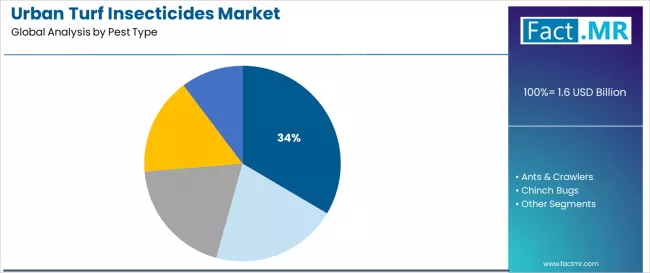
  • Leading Pest Type Segment (2026): Grubs & Beetles (34%)
  • Leading Insecticide Type Segment (2026): Pyrethroids (31.8%)
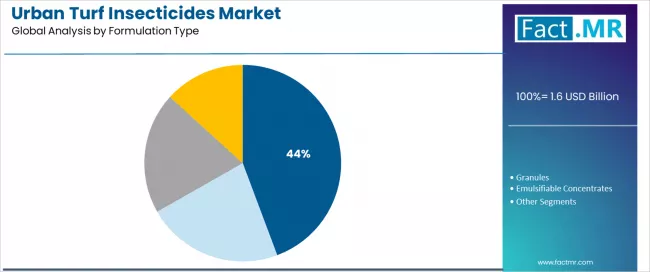
  • Leading Formulation Type Segment (2026): Liquid Formulations (44%)
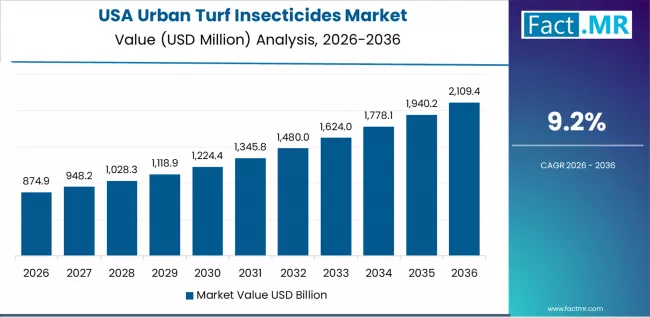
  • Key Growth Countries: USA (9.2% CAGR), Canada (8.4% CAGR), Germany (7.8% CAGR), UK (7.6% CAGR), Japan (7.1% CAGR)
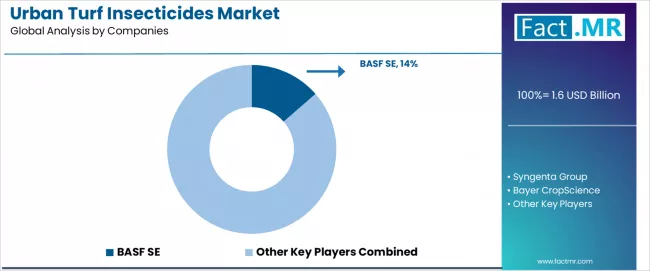
  • Key Players in the Market: BASF SE, Syngenta Group, Bayer CropScience, Corteva Agriscience, FMC Corporation

Urban Turf Insecticides Market Market Value Analysis

This growth reflects a critical transition in the management of lawns, golf courses, and public parks, moving away from broad-spectrum prophylactic treatments toward precision-based, environmentally responsible pest control.

The market's trajectory is defined by the increasing integration of insecticide applications with digital monitoring tools, such as soil sensor networks and drone mapping, which identify pest infestations at the initial stage and within specific zones, enabling targeted interventions that minimize chemical use.

Key trends include the development of sophisticated chemistries with favorable non-target toxicity profiles, including next-generation botanical extracts and microbial insecticides that offer effective control with reduced environmental persistence. There is simultaneously a strong push for formulations designed for low-drift application and enhanced soil binding to protect urban waterways.

The management of insecticide resistance in pervasive pests like white grubs and chinch bugs is driving demand for rotation programs and combination products that incorporate multiple modes of action. This market is evolving to meet the dual demands of maintaining high-quality, functional green spaces in expanding urban areas while adhering to stringent municipal regulations and responding to community expectations for safer, sustainable landscaping practices.

Metric

Metric Value
Market Value (2026) USD 1.57 Billion
Market Forecast Value (2036) USD 3.42 Billion
Forecast CAGR (2026-2036) 8.1%

Category

Category Segments
Pest Type Grubs & Beetles, Ants & Crawlers, Chinch Bugs, Sod Webworms, Others
Insecticide Type Pyrethroids, Neonicotinoids, Organophosphates, Biological Insecticides, Others
Formulation Type Liquid Formulations, Granules, Emulsifiable Concentrates, Others
Region North America, Latin America, Western Europe, Eastern Europe, East Asia, South Asia & Pacific, MEA

Segmental Analysis

By Pest Type, Which Pest Group Demands the Most Targeted Control?

Urban Turf Insecticides Market Analysis By Pest Type

Grubs and beetles hold a leading 34% market share, representing the most economically damaging pest complex for turfgrass. The larval stage of beetles, such as Japanese and June beetles, feeds on grassroots, causing extensive, irreversible damage that necessitates costly sod replacement.

Their subterranean habitat requires insecticides with specific soil activity and persistence, driving demand for both curative and preventive products. The high visibility of damage and significant repair costs ensure consistent investment in control measures by homeowners, turf managers, and municipal authorities.

By Insecticide Type, Which Class Balances Efficacy and Cost?

Urban Turf Insecticides Market Analysis By Insecticide Type

Pyrethroids maintain a significant 31.8% share, favored for their rapid knockdown of surface-feeding insects like ants, chinch bugs, and sod webworms. Their relatively lower mammalian toxicity compared to some older chemistries and cost-effectiveness make them a common choice for perimeter treatments and foliar applications.

While regulatory pressures exist, their utility in integrated pest management programs for quick population suppression sustains their role, especially when used in rotation with other modes of action to mitigate resistance development in pest populations.

By Formulation Type, Which Offers Practical Advantages for Professional Application?

Urban Turf Insecticides Market Analysis By Formulation Type

Liquid formulations lead with a 44% share, prized by professional applicators for their versatility and precision. Liquids can be easily calibrated for broadcast spraying, spot treatments, or chemigation, allowing for customized application based on pest pressure.

They enable even distribution and can be tank-mixed with other products, such as fertilizers or herbicides, improving operational efficiency. This flexibility and the ability to achieve immediate coverage on foliage and thatch cement their preference in the professional lawn care and golf course sectors.

What are the Drivers, Restraints, and Key Trends of the Urban Turf Insecticides Market?

The primary market driver is the expansion and intensification of urban green spaces, including residential lawns, sports fields, and corporate landscapes, where aesthetic and functional quality is highly valued. Increasing pest pressure linked to warmer urban heat islands and the movement of invasive species necessitates active management.

The professional lawn care industry's growth, offering subscription-based services, creates a consistent, commercial demand for effective insecticide solutions. Regulatory mandates in some regions requiring pest management plans for public spaces also structure and sustain professional product use.

A significant market restraint is the growing number of local and state-level regulations restricting or banning the use of certain insecticide classes, particularly neonicotinoids and organophosphates, due to concerns about pollinators, water quality, and human health.

Public skepticism and consumer demand for organic landscaping alternatives pressure traditional chemical use. The development of insecticide resistance in turf pests can also reduce the efficacy and useful lifespan of available products, increasing complexity and cost for end-users.

Key trends include the adoption of smart monitoring with IoT-enabled traps and soil probes that provide data-driven application triggers. There is strong growth in biological insecticides based on beneficial nematodes, fungi, and bacteria that target specific pests with minimal environmental impact.

The development of hybrid products that combine a low-rate synthetic insecticide with a biological agent is gaining traction. Furthermore, granular formulations with improved coating technology for controlled release and reduced dust are being developed to enhance applicator safety and product longevity.

Analysis of the Urban Turf Insecticides Market by Key Countries

Urban Turf Insecticides Market Cagr Analysis By Country

Country CAGR (2026-2036)
USA 9.2%
Canada 8.4%
Germany 7.8%
UK 7.6%
Japan 7.1%

How is the USA's Established Lawn Culture and Regulatory Patchwork Influencing the Market?

Urban Turf Insecticides Market Country Value Analysis

The USA's leading CAGR of 9.2% is driven by its deeply ingrained lawn care culture, a large professional landscaping industry, and significant golf course expenditures. The market is highly segmented, with consumer retail products and professional-grade solutions.

Growth is fueled by demand for products that comply with varying state and municipal regulations, particularly in the Northeast and West Coast, pushing innovation toward reduced-risk chemistries and precision application equipment to maintain efficacy within regulatory constraints.

What is the Impact of Canada's Focus on Urban Green Spaces and Environmental Health?

Canada's 8.4% growth is supported by municipal investments in public parks and sports fields, alongside a professional pest management sector adhering to national and provincial pesticide regulations.

The emphasis on integrated pest management in urban settings creates demand for insecticides that are part of a broader strategy. Products with favorable environmental and toxicological profiles, and those approved for use in sensitive areas, see stronger adoption as cities strive to balance green space maintenance with ecological stewardship.

Why is Germany's Strict Regulatory Environment and Engineering Approach a Key Factor?

Germany's 7.8% CAGR operates under some of Europe's strictest pesticide regulations, which limit the available chemical toolbox for non-agricultural use. This environment drives demand for highly targeted, low-dose professional products and alternative control methods.

The German market is characterized by a preference for engineered solutions, including advanced application technology and biopesticides, with a strong emphasis on operator training and documented justification for any chemical intervention in urban landscapes.

How is the UK's Climate and Amenity Grassland Management Shaping Demand?

The UK's 7.6% growth is influenced by its temperate, often damp climate that fosters pest populations like leatherjackets and chafer grubs, particularly on sports fields and golf courses. The amenity sector demands reliable, effective solutions to protect high-value playing surfaces.

While regulatory pressures exist, the professional market seeks efficacious insecticides that can be used within stewardship guidelines, with a growing interest in biological controls and biostimulants that enhance plant health and resilience as a first line of defense.

What Role Does Japan's Intensive Urban Land Use and Aesthetic Standards Play?

Japan's 7.1% growth occurs in a context of highly manicured urban and suburban landscapes, including golf courses and public gardens, where impeccable appearance is paramount. Space constraints lead to intensive management. The market demands highly effective, discreet solutions with minimal odor and public disruption.

There is significant interest in advanced formulations, such as micro-encapsulated products, that offer prolonged control with a single application, aligning with the precision and efficiency valued in Japanese turf management.

Competitive Landscape of the Urban Turf Insecticides Market

Urban Turf Insecticides Market Analysis By Company

Global agrochemical companies with dedicated professional pest management divisions, competing alongside specialty formulators, define the competitive landscape. Competition centers on developing differentiated products that address specific regulatory challenges in key urban markets, such as reduced-risk status or biopesticide classifications.

Success is increasingly linked to providing comprehensive technical support, including resistance management guidance and integrated pest management planning tools, to professional applicators. Companies are also competing through partnerships with distribution networks that serve the lawn care and golf course industries, ensuring product availability and expert advice at the point of sale.

Key Players in the Urban Turf Insecticides Market

  • BASF SE
  • Syngenta Group
  • Bayer CropScience
  • Corteva Agriscience
  • FMC Corporation

Scope of Report

Items Values
Quantitative Units USD Billion
Pest Type Grubs & Beetles, Ants & Crawlers, Chinch Bugs, Sod Webworms, Others
Insecticide Type Pyrethroids, Neonicotinoids, Organophosphates, Biological Insecticides, Others
Formulation Type Liquid Formulations, Granules, Emulsifiable Concentrates, Others
Key Countries USA, Canada, Germany, UK, Japan
Key Companies BASF SE, Syngenta Group, Bayer CropScience, Corteva Agriscience, FMC Corporation
Additional Analysis Environmental fate and runoff mitigation of turf insecticides; impact on urban soil microbiota and non-target invertebrates; cost-benefit analysis of preventive vs. curative strategies; efficacy and adoption of biological control agents in professional settings; analysis of municipal and HOA pesticide use policies.

Market by Segments

  • Pest Type :

    • Grubs & Beetles
    • Ants & Crawlers
    • Chinch Bugs
    • Sod Webworms
    • Others
  • Insecticide Type :

    • Pyrethroids
    • Neonicotinoids
    • Organophosphates
    • Biological Insecticides
    • Others
  • Formulation Type :

    • Liquid Formulations
    • Granules
    • Emulsifiable Concentrates
    • Others
  • Region :

    • North America

      • USA
      • Canada
    • Latin America

      • Brazil
      • Mexico
      • Argentina
      • Rest of Latin America
    • Western Europe

      • Germany
      • UK
      • France
      • Spain
      • Italy
      • BENELUX
      • Rest of Western Europe
    • Eastern Europe

      • Russia
      • Poland
      • Czech Republic
      • Rest of Eastern Europe
    • East Asia

      • China
      • Japan
      • South Korea
      • Rest of East Asia
    • South Asia & Pacific

      • India
      • ASEAN
      • Australia
      • Rest of South Asia & Pacific
    • MEA

      • Saudi Arabia
      • UAE
      • Turkiye
      • Rest of MEA

References

  • Braman, S. K., & Pendley, A. F. (2023). Efficacy of reduced-risk insecticides for management of key turfgrass insect pests. Journal of Economic Entomology, 116(4), 1123-1131.
  • Cappaert, D. L., & Smitley, D. R. (2024). White grub management in turfgrass: Integrating chemical and biological controls. Applied Turfgrass Science, 21(1), 1-8.
  • Diaz, R., & Held, D. W. (2023). Environmental impacts of urban landscape pest management practices. Urban Ecosystems, 26(5), 1347-1361.
  • Koppenhöfer, A. M., & Wu, S. (2024). Biological control agents in turfgrass integrated pest management. Annual Review of Entomology, 69, 185-203.
  • Larson, J. L., & Potter, D. A. (2023). Comparative risks of lawn-care pesticides to pollinators and human health. Science of the Total Environment, 856(Part 2), 159148.
  • Murrell, E. G., & McCullough, C. T. (2024). Insecticide resistance monitoring and management strategies for chinch bugs in turfgrass. Pest Management Science, 80(2), 456-465.
  • Peterson, C. J., & Horgan, B. P. (2023). Best management practices for insecticide use on golf courses to protect water quality. Crop, Forage & Turfgrass Management, 9(1), e20210.
  • Richmond, D. S., & Grewal, P. S. (2024). Sustainable turfgrass insect pest management: Moving beyond calendar-based sprays. Journal of Integrated Pest Management, 15(1), 12.
  • Watschke, T. L., & Prinster, M. G. (2023). Managing turfgrass insects. In Turfgrass Management (pp. 245-278). John Wiley & Sons.
  • Wu, Y., & Guo, Y. (2024). Public perception and regulatory trends affecting urban pesticide use in North America and Europe. Environmental Science & Policy, 151, 103628.

Table of Content

  1. Executive Summary
    • Global Market Outlook
    • Demand to side Trends
    • Supply to side Trends
    • Technology Roadmap Analysis
    • Analysis and Recommendations
  2. Market Overview
    • Market Coverage / Taxonomy
    • Market Definition / Scope / Limitations
  3. Market Background
    • Market Dynamics
      • Drivers
      • Restraints
      • Opportunity
      • Trends
    • Scenario Forecast
      • Demand in Optimistic Scenario
      • Demand in Likely Scenario
      • Demand in Conservative Scenario
    • Opportunity Map Analysis
    • Product Life Cycle Analysis
    • Supply Chain Analysis
    • Investment Feasibility Matrix
    • Value Chain Analysis
    • PESTLE and Porter’s Analysis
    • Regulatory Landscape
    • Regional Parent Market Outlook
    • Production and Consumption Statistics
    • Import and Export Statistics
  4. Global Market Analysis 2021 to 2025 and Forecast, 2026 to 2036
    • Historical Market Size Value (USD Million) Analysis, 2021 to 2025
    • Current and Future Market Size Value (USD Million) Projections, 2026 to 2036
      • Y to o to Y Growth Trend Analysis
      • Absolute $ Opportunity Analysis
  5. Global Market Pricing Analysis 2021 to 2025 and Forecast 2026 to 2036
  6. Global Market Analysis 2021 to 2025 and Forecast 2026 to 2036, By Pest Type
    • Introduction / Key Findings
    • Historical Market Size Value (USD Million) Analysis By Pest Type, 2021 to 2025
    • Current and Future Market Size Value (USD Million) Analysis and Forecast By Pest Type, 2026 to 2036
      • Grubs & Beetles
      • Ants & Crawlers
      • Chinch Bugs
      • Sod Webworms
      • Others
    • Y to o to Y Growth Trend Analysis By Pest Type, 2021 to 2025
    • Absolute $ Opportunity Analysis By Pest Type, 2026 to 2036
  7. Global Market Analysis 2021 to 2025 and Forecast 2026 to 2036, By Insecticide Type
    • Introduction / Key Findings
    • Historical Market Size Value (USD Million) Analysis By Insecticide Type, 2021 to 2025
    • Current and Future Market Size Value (USD Million) Analysis and Forecast By Insecticide Type, 2026 to 2036
      • Pyrethroids
      • Neonicotinoids
      • Organophosphates
      • Biological Insecticides
      • Others
    • Y to o to Y Growth Trend Analysis By Insecticide Type, 2021 to 2025
    • Absolute $ Opportunity Analysis By Insecticide Type, 2026 to 2036
  8. Global Market Analysis 2021 to 2025 and Forecast 2026 to 2036, By Formulation Type
    • Introduction / Key Findings
    • Historical Market Size Value (USD Million) Analysis By Formulation Type, 2021 to 2025
    • Current and Future Market Size Value (USD Million) Analysis and Forecast By Formulation Type, 2026 to 2036
      • LiquidFormulations
      • Granules
      • Emulsifiable Concentrates
      • Others
    • Y to o to Y Growth Trend Analysis By Formulation Type, 2021 to 2025
    • Absolute $ Opportunity Analysis By Formulation Type, 2026 to 2036
  9. Global Market Analysis 2021 to 2025 and Forecast 2026 to 2036, By Region
    • Introduction
    • Historical Market Size Value (USD Million) Analysis By Region, 2021 to 2025
    • Current Market Size Value (USD Million) Analysis and Forecast By Region, 2026 to 2036
      • North America
      • Latin America
      • Western Europe
      • Eastern Europe
      • East Asia
      • South Asia and Pacific
      • Middle East & Africa
    • Market Attractiveness Analysis By Region
  10. North America Market Analysis 2021 to 2025 and Forecast 2026 to 2036, By Country
    • Historical Market Size Value (USD Million) Trend Analysis By Market Taxonomy, 2021 to 2025
    • Market Size Value (USD Million) Forecast By Market Taxonomy, 2026 to 2036
      • By Country
        • USA
        • Canada
        • Mexico
      • By Pest Type
      • By Insecticide Type
      • By Formulation Type
    • Market Attractiveness Analysis
      • By Country
      • By Pest Type
      • By Insecticide Type
      • By Formulation Type
    • Key Takeaways
  11. Latin America Market Analysis 2021 to 2025 and Forecast 2026 to 2036, By Country
    • Historical Market Size Value (USD Million) Trend Analysis By Market Taxonomy, 2021 to 2025
    • Market Size Value (USD Million) Forecast By Market Taxonomy, 2026 to 2036
      • By Country
        • Brazil
        • Chile
        • Rest of Latin America
      • By Pest Type
      • By Insecticide Type
      • By Formulation Type
    • Market Attractiveness Analysis
      • By Country
      • By Pest Type
      • By Insecticide Type
      • By Formulation Type
    • Key Takeaways
  12. Western Europe Market Analysis 2021 to 2025 and Forecast 2026 to 2036, By Country
    • Historical Market Size Value (USD Million) Trend Analysis By Market Taxonomy, 2021 to 2025
    • Market Size Value (USD Million) Forecast By Market Taxonomy, 2026 to 2036
      • By Country
        • Germany
        • UK
        • Italy
        • Spain
        • France
        • Nordic
        • BENELUX
        • Rest of Western Europe
      • By Pest Type
      • By Insecticide Type
      • By Formulation Type
    • Market Attractiveness Analysis
      • By Country
      • By Pest Type
      • By Insecticide Type
      • By Formulation Type
    • Key Takeaways
  13. Eastern Europe Market Analysis 2021 to 2025 and Forecast 2026 to 2036, By Country
    • Historical Market Size Value (USD Million) Trend Analysis By Market Taxonomy, 2021 to 2025
    • Market Size Value (USD Million) Forecast By Market Taxonomy, 2026 to 2036
      • By Country
        • Russia
        • Poland
        • Hungary
        • Balkan & Baltic
        • Rest of Eastern Europe
      • By Pest Type
      • By Insecticide Type
      • By Formulation Type
    • Market Attractiveness Analysis
      • By Country
      • By Pest Type
      • By Insecticide Type
      • By Formulation Type
    • Key Takeaways
  14. East Asia Market Analysis 2021 to 2025 and Forecast 2026 to 2036, By Country
    • Historical Market Size Value (USD Million) Trend Analysis By Market Taxonomy, 2021 to 2025
    • Market Size Value (USD Million) Forecast By Market Taxonomy, 2026 to 2036
      • By Country
        • China
        • Japan
        • South Korea
      • By Pest Type
      • By Insecticide Type
      • By Formulation Type
    • Market Attractiveness Analysis
      • By Country
      • By Pest Type
      • By Insecticide Type
      • By Formulation Type
    • Key Takeaways
  15. South Asia and Pacific Market Analysis 2021 to 2025 and Forecast 2026 to 2036, By Country
    • Historical Market Size Value (USD Million) Trend Analysis By Market Taxonomy, 2021 to 2025
    • Market Size Value (USD Million) Forecast By Market Taxonomy, 2026 to 2036
      • By Country
        • India
        • ASEAN
        • Australia & New Zealand
        • Rest of South Asia and Pacific
      • By Pest Type
      • By Insecticide Type
      • By Formulation Type
    • Market Attractiveness Analysis
      • By Country
      • By Pest Type
      • By Insecticide Type
      • By Formulation Type
    • Key Takeaways
  16. Middle East & Africa Market Analysis 2021 to 2025 and Forecast 2026 to 2036, By Country
    • Historical Market Size Value (USD Million) Trend Analysis By Market Taxonomy, 2021 to 2025
    • Market Size Value (USD Million) Forecast By Market Taxonomy, 2026 to 2036
      • By Country
        • Kingdom of Saudi Arabia
        • Other GCC Countries
        • Turkiye
        • South Africa
        • Other African Union
        • Rest of Middle East & Africa
      • By Pest Type
      • By Insecticide Type
      • By Formulation Type
    • Market Attractiveness Analysis
      • By Country
      • By Pest Type
      • By Insecticide Type
      • By Formulation Type
    • Key Takeaways
  17. Key Countries Market Analysis
    • USA
      • Pricing Analysis
      • Market Share Analysis, 2025
        • By Pest Type
        • By Insecticide Type
        • By Formulation Type
    • Canada
      • Pricing Analysis
      • Market Share Analysis, 2025
        • By Pest Type
        • By Insecticide Type
        • By Formulation Type
    • Mexico
      • Pricing Analysis
      • Market Share Analysis, 2025
        • By Pest Type
        • By Insecticide Type
        • By Formulation Type
    • Brazil
      • Pricing Analysis
      • Market Share Analysis, 2025
        • By Pest Type
        • By Insecticide Type
        • By Formulation Type
    • Chile
      • Pricing Analysis
      • Market Share Analysis, 2025
        • By Pest Type
        • By Insecticide Type
        • By Formulation Type
    • Germany
      • Pricing Analysis
      • Market Share Analysis, 2025
        • By Pest Type
        • By Insecticide Type
        • By Formulation Type
    • UK
      • Pricing Analysis
      • Market Share Analysis, 2025
        • By Pest Type
        • By Insecticide Type
        • By Formulation Type
    • Italy
      • Pricing Analysis
      • Market Share Analysis, 2025
        • By Pest Type
        • By Insecticide Type
        • By Formulation Type
    • Spain
      • Pricing Analysis
      • Market Share Analysis, 2025
        • By Pest Type
        • By Insecticide Type
        • By Formulation Type
    • France
      • Pricing Analysis
      • Market Share Analysis, 2025
        • By Pest Type
        • By Insecticide Type
        • By Formulation Type
    • India
      • Pricing Analysis
      • Market Share Analysis, 2025
        • By Pest Type
        • By Insecticide Type
        • By Formulation Type
    • ASEAN
      • Pricing Analysis
      • Market Share Analysis, 2025
        • By Pest Type
        • By Insecticide Type
        • By Formulation Type
    • Australia & New Zealand
      • Pricing Analysis
      • Market Share Analysis, 2025
        • By Pest Type
        • By Insecticide Type
        • By Formulation Type
    • China
      • Pricing Analysis
      • Market Share Analysis, 2025
        • By Pest Type
        • By Insecticide Type
        • By Formulation Type
    • Japan
      • Pricing Analysis
      • Market Share Analysis, 2025
        • By Pest Type
        • By Insecticide Type
        • By Formulation Type
    • South Korea
      • Pricing Analysis
      • Market Share Analysis, 2025
        • By Pest Type
        • By Insecticide Type
        • By Formulation Type
    • Russia
      • Pricing Analysis
      • Market Share Analysis, 2025
        • By Pest Type
        • By Insecticide Type
        • By Formulation Type
    • Poland
      • Pricing Analysis
      • Market Share Analysis, 2025
        • By Pest Type
        • By Insecticide Type
        • By Formulation Type
    • Hungary
      • Pricing Analysis
      • Market Share Analysis, 2025
        • By Pest Type
        • By Insecticide Type
        • By Formulation Type
    • Kingdom of Saudi Arabia
      • Pricing Analysis
      • Market Share Analysis, 2025
        • By Pest Type
        • By Insecticide Type
        • By Formulation Type
    • Turkiye
      • Pricing Analysis
      • Market Share Analysis, 2025
        • By Pest Type
        • By Insecticide Type
        • By Formulation Type
    • South Africa
      • Pricing Analysis
      • Market Share Analysis, 2025
        • By Pest Type
        • By Insecticide Type
        • By Formulation Type
  18. Market Structure Analysis
    • Competition Dashboard
    • Competition Benchmarking
    • Market Share Analysis of Top Players
      • By Regional
      • By Pest Type
      • By Insecticide Type
      • By Formulation Type
  19. Competition Analysis
    • Competition Deep Dive
      • BASF SE
        • Overview
        • Product Portfolio
        • Profitability by Market Segments (Product/Age /Sales Channel/Region)
        • Sales Footprint
        • Strategy Overview
          • Marketing Strategy
          • Product Strategy
          • Channel Strategy
      • Syngenta Group
      • Bayer CropScience
      • Corteva Agriscience
      • FMC Corporation
      • Others
  20. Assumptions & Acronyms Used
  21. Research Methodology

List Of Table

  • Table 1: Global Market Value (USD Million) Forecast by Region, 2021 to 2036
  • Table 2: Global Market Value (USD Million) Forecast by Pest Type, 2021 to 2036
  • Table 3: Global Market Value (USD Million) Forecast by Insecticide Type, 2021 to 2036
  • Table 4: Global Market Value (USD Million) Forecast by Formulation Type, 2021 to 2036
  • Table 5: North America Market Value (USD Million) Forecast by Country, 2021 to 2036
  • Table 6: North America Market Value (USD Million) Forecast by Pest Type, 2021 to 2036
  • Table 7: North America Market Value (USD Million) Forecast by Insecticide Type, 2021 to 2036
  • Table 8: North America Market Value (USD Million) Forecast by Formulation Type, 2021 to 2036
  • Table 9: Latin America Market Value (USD Million) Forecast by Country, 2021 to 2036
  • Table 10: Latin America Market Value (USD Million) Forecast by Pest Type, 2021 to 2036
  • Table 11: Latin America Market Value (USD Million) Forecast by Insecticide Type, 2021 to 2036
  • Table 12: Latin America Market Value (USD Million) Forecast by Formulation Type, 2021 to 2036
  • Table 13: Western Europe Market Value (USD Million) Forecast by Country, 2021 to 2036
  • Table 14: Western Europe Market Value (USD Million) Forecast by Pest Type, 2021 to 2036
  • Table 15: Western Europe Market Value (USD Million) Forecast by Insecticide Type, 2021 to 2036
  • Table 16: Western Europe Market Value (USD Million) Forecast by Formulation Type, 2021 to 2036
  • Table 17: Eastern Europe Market Value (USD Million) Forecast by Country, 2021 to 2036
  • Table 18: Eastern Europe Market Value (USD Million) Forecast by Pest Type, 2021 to 2036
  • Table 19: Eastern Europe Market Value (USD Million) Forecast by Insecticide Type, 2021 to 2036
  • Table 20: Eastern Europe Market Value (USD Million) Forecast by Formulation Type, 2021 to 2036
  • Table 21: East Asia Market Value (USD Million) Forecast by Country, 2021 to 2036
  • Table 22: East Asia Market Value (USD Million) Forecast by Pest Type, 2021 to 2036
  • Table 23: East Asia Market Value (USD Million) Forecast by Insecticide Type, 2021 to 2036
  • Table 24: East Asia Market Value (USD Million) Forecast by Formulation Type, 2021 to 2036
  • Table 25: South Asia and Pacific Market Value (USD Million) Forecast by Country, 2021 to 2036
  • Table 26: South Asia and Pacific Market Value (USD Million) Forecast by Pest Type, 2021 to 2036
  • Table 27: South Asia and Pacific Market Value (USD Million) Forecast by Insecticide Type, 2021 to 2036
  • Table 28: South Asia and Pacific Market Value (USD Million) Forecast by Formulation Type, 2021 to 2036
  • Table 29: Middle East & Africa Market Value (USD Million) Forecast by Country, 2021 to 2036
  • Table 30: Middle East & Africa Market Value (USD Million) Forecast by Pest Type, 2021 to 2036
  • Table 31: Middle East & Africa Market Value (USD Million) Forecast by Insecticide Type, 2021 to 2036
  • Table 32: Middle East & Africa Market Value (USD Million) Forecast by Formulation Type, 2021 to 2036

List Of Figures

  • Figure 1: Global Market Pricing Analysis
  • Figure 2: Global Market Value (USD Million) Forecast 2021 to 2036
  • Figure 3: Global Market Value Share and BPS Analysis by Pest Type, 2026 and 2036
  • Figure 4: Global Market Y to o to Y Growth Comparison by Pest Type, 2026 to 2036
  • Figure 5: Global Market Attractiveness Analysis by Pest Type
  • Figure 6: Global Market Value Share and BPS Analysis by Insecticide Type, 2026 and 2036
  • Figure 7: Global Market Y to o to Y Growth Comparison by Insecticide Type, 2026 to 2036
  • Figure 8: Global Market Attractiveness Analysis by Insecticide Type
  • Figure 9: Global Market Value Share and BPS Analysis by Formulation Type, 2026 and 2036
  • Figure 10: Global Market Y to o to Y Growth Comparison by Formulation Type, 2026 to 2036
  • Figure 11: Global Market Attractiveness Analysis by Formulation Type
  • Figure 12: Global Market Value (USD Million) Share and BPS Analysis by Region, 2026 and 2036
  • Figure 13: Global Market Y to o to Y Growth Comparison by Region, 2026 to 2036
  • Figure 14: Global Market Attractiveness Analysis by Region
  • Figure 15: North America Market Incremental Dollar Opportunity, 2026 to 2036
  • Figure 16: Latin America Market Incremental Dollar Opportunity, 2026 to 2036
  • Figure 17: Western Europe Market Incremental Dollar Opportunity, 2026 to 2036
  • Figure 18: Eastern Europe Market Incremental Dollar Opportunity, 2026 to 2036
  • Figure 19: East Asia Market Incremental Dollar Opportunity, 2026 to 2036
  • Figure 20: South Asia and Pacific Market Incremental Dollar Opportunity, 2026 to 2036
  • Figure 21: Middle East & Africa Market Incremental Dollar Opportunity, 2026 to 2036
  • Figure 22: North America Market Value Share and BPS Analysis by Country, 2026 and 2036
  • Figure 23: North America Market Value Share and BPS Analysis by Pest Type, 2026 and 2036
  • Figure 24: North America Market Y to o to Y Growth Comparison by Pest Type, 2026 to 2036
  • Figure 25: North America Market Attractiveness Analysis by Pest Type
  • Figure 26: North America Market Value Share and BPS Analysis by Insecticide Type, 2026 and 2036
  • Figure 27: North America Market Y to o to Y Growth Comparison by Insecticide Type, 2026 to 2036
  • Figure 28: North America Market Attractiveness Analysis by Insecticide Type
  • Figure 29: North America Market Value Share and BPS Analysis by Formulation Type, 2026 and 2036
  • Figure 30: North America Market Y to o to Y Growth Comparison by Formulation Type, 2026 to 2036
  • Figure 31: North America Market Attractiveness Analysis by Formulation Type
  • Figure 32: Latin America Market Value Share and BPS Analysis by Country, 2026 and 2036
  • Figure 33: Latin America Market Value Share and BPS Analysis by Pest Type, 2026 and 2036
  • Figure 34: Latin America Market Y to o to Y Growth Comparison by Pest Type, 2026 to 2036
  • Figure 35: Latin America Market Attractiveness Analysis by Pest Type
  • Figure 36: Latin America Market Value Share and BPS Analysis by Insecticide Type, 2026 and 2036
  • Figure 37: Latin America Market Y to o to Y Growth Comparison by Insecticide Type, 2026 to 2036
  • Figure 38: Latin America Market Attractiveness Analysis by Insecticide Type
  • Figure 39: Latin America Market Value Share and BPS Analysis by Formulation Type, 2026 and 2036
  • Figure 40: Latin America Market Y to o to Y Growth Comparison by Formulation Type, 2026 to 2036
  • Figure 41: Latin America Market Attractiveness Analysis by Formulation Type
  • Figure 42: Western Europe Market Value Share and BPS Analysis by Country, 2026 and 2036
  • Figure 43: Western Europe Market Value Share and BPS Analysis by Pest Type, 2026 and 2036
  • Figure 44: Western Europe Market Y to o to Y Growth Comparison by Pest Type, 2026 to 2036
  • Figure 45: Western Europe Market Attractiveness Analysis by Pest Type
  • Figure 46: Western Europe Market Value Share and BPS Analysis by Insecticide Type, 2026 and 2036
  • Figure 47: Western Europe Market Y to o to Y Growth Comparison by Insecticide Type, 2026 to 2036
  • Figure 48: Western Europe Market Attractiveness Analysis by Insecticide Type
  • Figure 49: Western Europe Market Value Share and BPS Analysis by Formulation Type, 2026 and 2036
  • Figure 50: Western Europe Market Y to o to Y Growth Comparison by Formulation Type, 2026 to 2036
  • Figure 51: Western Europe Market Attractiveness Analysis by Formulation Type
  • Figure 52: Eastern Europe Market Value Share and BPS Analysis by Country, 2026 and 2036
  • Figure 53: Eastern Europe Market Value Share and BPS Analysis by Pest Type, 2026 and 2036
  • Figure 54: Eastern Europe Market Y to o to Y Growth Comparison by Pest Type, 2026 to 2036
  • Figure 55: Eastern Europe Market Attractiveness Analysis by Pest Type
  • Figure 56: Eastern Europe Market Value Share and BPS Analysis by Insecticide Type, 2026 and 2036
  • Figure 57: Eastern Europe Market Y to o to Y Growth Comparison by Insecticide Type, 2026 to 2036
  • Figure 58: Eastern Europe Market Attractiveness Analysis by Insecticide Type
  • Figure 59: Eastern Europe Market Value Share and BPS Analysis by Formulation Type, 2026 and 2036
  • Figure 60: Eastern Europe Market Y to o to Y Growth Comparison by Formulation Type, 2026 to 2036
  • Figure 61: Eastern Europe Market Attractiveness Analysis by Formulation Type
  • Figure 62: East Asia Market Value Share and BPS Analysis by Country, 2026 and 2036
  • Figure 63: East Asia Market Value Share and BPS Analysis by Pest Type, 2026 and 2036
  • Figure 64: East Asia Market Y to o to Y Growth Comparison by Pest Type, 2026 to 2036
  • Figure 65: East Asia Market Attractiveness Analysis by Pest Type
  • Figure 66: East Asia Market Value Share and BPS Analysis by Insecticide Type, 2026 and 2036
  • Figure 67: East Asia Market Y to o to Y Growth Comparison by Insecticide Type, 2026 to 2036
  • Figure 68: East Asia Market Attractiveness Analysis by Insecticide Type
  • Figure 69: East Asia Market Value Share and BPS Analysis by Formulation Type, 2026 and 2036
  • Figure 70: East Asia Market Y to o to Y Growth Comparison by Formulation Type, 2026 to 2036
  • Figure 71: East Asia Market Attractiveness Analysis by Formulation Type
  • Figure 72: South Asia and Pacific Market Value Share and BPS Analysis by Country, 2026 and 2036
  • Figure 73: South Asia and Pacific Market Value Share and BPS Analysis by Pest Type, 2026 and 2036
  • Figure 74: South Asia and Pacific Market Y to o to Y Growth Comparison by Pest Type, 2026 to 2036
  • Figure 75: South Asia and Pacific Market Attractiveness Analysis by Pest Type
  • Figure 76: South Asia and Pacific Market Value Share and BPS Analysis by Insecticide Type, 2026 and 2036
  • Figure 77: South Asia and Pacific Market Y to o to Y Growth Comparison by Insecticide Type, 2026 to 2036
  • Figure 78: South Asia and Pacific Market Attractiveness Analysis by Insecticide Type
  • Figure 79: South Asia and Pacific Market Value Share and BPS Analysis by Formulation Type, 2026 and 2036
  • Figure 80: South Asia and Pacific Market Y to o to Y Growth Comparison by Formulation Type, 2026 to 2036
  • Figure 81: South Asia and Pacific Market Attractiveness Analysis by Formulation Type
  • Figure 82: Middle East & Africa Market Value Share and BPS Analysis by Country, 2026 and 2036
  • Figure 83: Middle East & Africa Market Value Share and BPS Analysis by Pest Type, 2026 and 2036
  • Figure 84: Middle East & Africa Market Y to o to Y Growth Comparison by Pest Type, 2026 to 2036
  • Figure 85: Middle East & Africa Market Attractiveness Analysis by Pest Type
  • Figure 86: Middle East & Africa Market Value Share and BPS Analysis by Insecticide Type, 2026 and 2036
  • Figure 87: Middle East & Africa Market Y to o to Y Growth Comparison by Insecticide Type, 2026 to 2036
  • Figure 88: Middle East & Africa Market Attractiveness Analysis by Insecticide Type
  • Figure 89: Middle East & Africa Market Value Share and BPS Analysis by Formulation Type, 2026 and 2036
  • Figure 90: Middle East & Africa Market Y to o to Y Growth Comparison by Formulation Type, 2026 to 2036
  • Figure 91: Middle East & Africa Market Attractiveness Analysis by Formulation Type
  • Figure 92: Global Market - Tier Structure Analysis
  • Figure 93: Global Market - Company Share Analysis

- FAQs -

How big is the urban turf insecticides market in 2026?

The global urban turf insecticides market is estimated to be valued at USD 1.6 billion in 2026.

What will be the size of urban turf insecticides market in 2036?

The market size for the urban turf insecticides market is projected to reach USD 3.4 billion by 2036.

How much will be the urban turf insecticides market growth between 2026 and 2036?

The urban turf insecticides market is expected to grow at a 8.1% CAGR between 2026 and 2036.

What are the key product types in the urban turf insecticides market?

The key product types in urban turf insecticides market are grubs & beetles, ants & crawlers, chinch bugs, sod webworms and others.

Which insecticide type segment to contribute significant share in the urban turf insecticides market in 2026?

In terms of insecticide type, pyrethroids segment to command 31.8% share in the urban turf insecticides market in 2026.

Urban Turf Insecticides Market