- Base Value(2026): 0.25 Bn
- Estimated Value(2026): 0.2 Bn
- Forecast Value (2036): 1.1 Bn
- CAGR (2026 - 2036): 15.6%
Ultra-Localized Soil Insecticide Micro-Dose Capsule Market Forecast and Outlook 2026 to 2036
The global ultra-localized soil insecticide micro-dose capsule market is projected to reach USD 1.06 billion by 2036. The market is valued at USD 0.25 billion in 2026 and is set to rise at a CAGR of 15.6% during the assessment period. By capsule technology type, biodegradable polymer microcapsules hold a leading 37% share. The target pest segment for soil-dwelling larvae represents a dominant 41% share, while in-furrow application accounts for 46% market share.
Key Takeaways from the Ultra-Localized Soil Insecticide Micro-Dose Capsule Market
- Market Value for 2026: USD 0.25 Billion
- Market Value for 2036: USD 1.06 Billion
- Forecast CAGR (2026-2036): 15.6%
- Leading Capsule Technology Type Share (2026): Biodegradable Polymer Microcapsules (37%)
- Leading Target Pest Type Share (2026): Soil-Dwelling Larvae (41%)
- Leading Application Method Share (2026): In-Furrow Application (46%)
- Key Players in the Market: BASF SE, Bayer CropScience, Syngenta Group, Corteva Agriscience, FMC Corporation
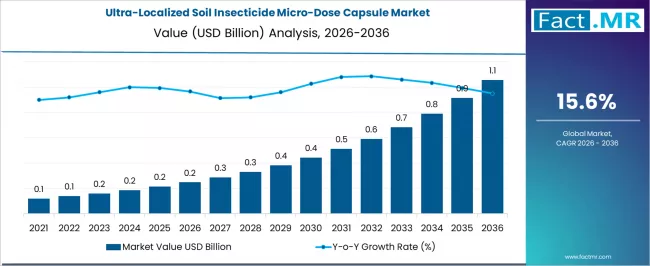
Ultra Localized Soil Insecticide Micro Dose Capsule Market Market Value Analysis | Source: Fact.MR
A defining trend is the transition from broad-spectrum soil drenching to spatially precise, biologically timed insecticide delivery. Innovation focuses on capsule designs that release their payload in response to specific root exudates or pest feeding activity. Integration of these capsules with precision planting equipment is becoming standard, enabling automated, seed-synchronous placement that minimizes active ingredient usage per hectare.
Regulatory frameworks increasingly favor these technologies due to their drastic reduction in overall chemical load and non-target exposure. Policies promoting integrated pest management and lower environmental impact quotients for pesticides create a favorable pathway for micro-dose capsule registration. Regulations limiting broad-area soil insecticides further accelerate the shift to these targeted alternatives.
Ultra-Localized Soil Insecticide Micro-Dose Capsule Market
| Metric | Value |
|---|---|
| Market Value (2026) | USD 0.25 Billion |
| Market Forecast Value (2036) | USD 1.06 Billion |
| Forecast CAGR (2026-2036) | 15.6% |
Source: Fact.MR analysis. Updated Dec 23, 2025
Category
| Category | Segments |
|---|---|
| Capsule Technology Type | Biodegradable Polymer Microcapsules, Controlled-Release Gel Capsules, Clay-Based Encapsulated Granules, Lipid-Matrix Micro-Dose Capsules, Others |
| Target Pest Type | Soil-Dwelling Larvae (Grubs, Wireworms), Root-Feeding Beetles, Termites, Nematode-Associated Insect Complexes, Others |
| Application Method | In-Furrow Application, Seed-Zone Placement, Micro-Granular Spot Application, Precision Planter-Integrated Dosing, Others |
| Region | North America, Latin America, Western Europe, Eastern Europe, East Asia, South Asia & Pacific, MEA |
Source: Fact.MR analysis. Updated Dec 23, 2025
Segmental Analysis
By Capsule Technology, Which System Balances Efficacy with Environmental Responsibility?
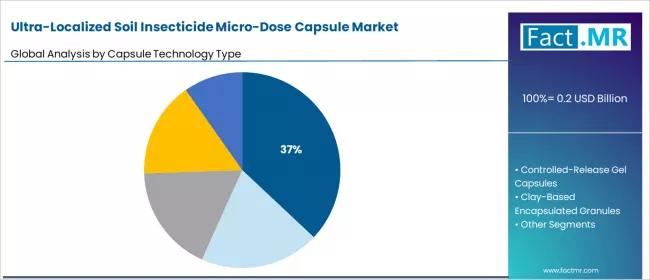
Ultra Localized Soil Insecticide Micro Dose Capsule Market Analysis By Capsule Technology Type | Source: Fact.MR
Biodegradable polymer microcapsules lead the segment with a 37% share. This dominance is attributed to their ability to provide controlled release of the insecticide while breaking down into harmless components after depletion, leaving no persistent plastic residues in the soil. This technology directly addresses regulatory and consumer concerns about microplastic pollution, making it the preferred platform for sustainable product development.
By Target Pest, Which Group Warrants Such Precise Intervention?
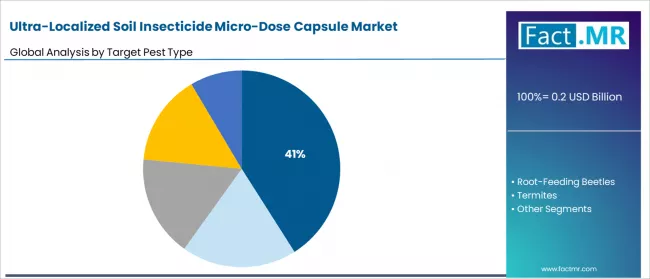
Ultra Localized Soil Insecticide Micro Dose Capsule Market Analysis By Target Pest Type | Source: Fact.MR
Soil-dwelling larvae represent the primary target, holding a 41% share. Pests like corn rootworm larvae and wireworms cause catastrophic, hidden damage to developing roots, and their sporadic distribution makes broadcast treatment economically and environmentally wasteful. Micro-dose capsules placed directly in the root zone deliver insecticide exactly where and when these larvae feed, offering unmatched control efficiency.
By Application Method, Which Technique Aligns Best with Standard Farming Practice?
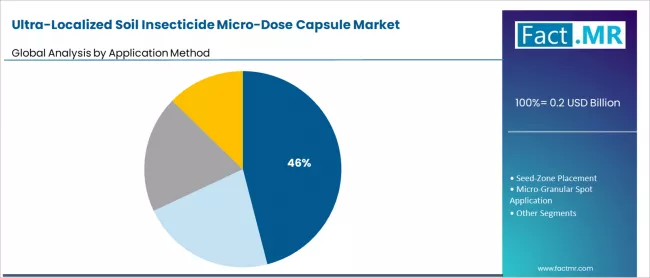
Ultra Localized Soil Insecticide Micro Dose Capsule Market Analysis By Application Method | Source: Fact.MR
In-furrow application commands the largest share at 46%. This method integrates seamlessly with the planting pass, adding minimal operational complexity. It places the capsules in immediate proximity to the seed and developing root system, creating a protective zone exactly where it is needed. This practical compatibility with existing equipment and workflows drives its widespread adoption.
What are the Drivers, Restraints, and Key Trends of the Ultra-Localized Soil Insecticide Micro-Dose Capsule Market?
Market expansion is driven by the critical need to manage insecticide resistance and reduce environmental footprint through precise, low-dose applications. The rising cost of novel insecticide actives makes their efficient, targeted use economically essential. The proliferation of precision planting and variable-rate equipment provides the perfect physical platform for deploying these capsule technologies.
A significant restraint is the higher upfront cost of the encapsulated product compared to conventional formulations. The need for specific application equipment or planter modifications can slow adoption. Demonstrating consistent efficacy across diverse soil types and moisture regimes, given the ultra-localized nature of the protection, requires extensive field validation.
Key trends include the development of "smart" capsules triggered by pest presence. Combination capsules containing both insecticide and beneficial nematodes or fungicides are emerging. There is a growing integration with planting map data, allowing for capsule application only in field zones with historically high pest pressure.
Analysis of the Ultra-Localized Soil Insecticide Micro-Dose Capsule Market by Key Countries
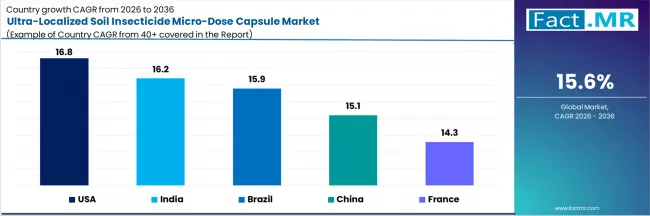
Ultra Localized Soil Insecticide Micro Dose Capsule Market Cagr Analysis By Country | Source: Fact.MR
| Country | CAGR (2026-2036) |
|---|---|
| USA | 16.80% |
| India | 16.20% |
| Brazil | 15.90% |
| China | 15.10% |
| France | 14.30% |
Source: Fact.MR analysis. Updated Dec 23, 2025
How does the USA's Advanced Precision Agriculture Infrastructure Enable Adoption?
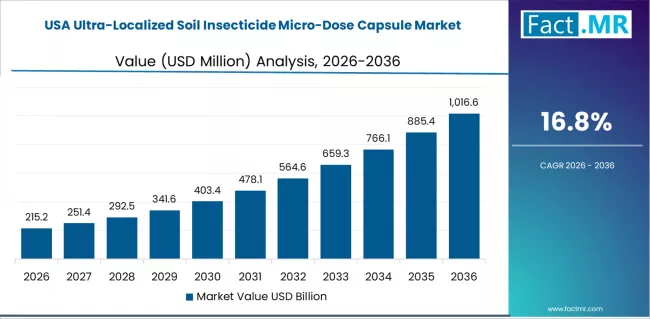
Ultra Localized Soil Insecticide Micro Dose Capsule Market Country Value Analysis | Source: Fact.MR
The USA leads with a 16.80% CAGR, leveraging its widespread adoption of high-tech planters capable of variable-rate, in-furrow application. The severe economic threat of resistant corn rootworm demands next-generation solutions. American farmers, equipped with detailed yield and pest maps, are ready adopters of zone-specific micro-dosing technologies that protect yield while aligning with stewardship programs.
Why is India's Market Growth Tied to Smallholder Scalability?
India's 16.20% growth is notable given its smallholder base. The driver is the severe pest pressure from termites and soil grubs in high-value vegetable and pulse production. The development of low-cost, clay-based granular capsules that can be applied with simple hand-operated planters makes this technology accessible and economically viable for small farms, offering dramatic reductions in insecticide expenditure per acre.
What drives Brazil's High Adoption in Large-Scale Row Crop Systems?
Brazil's 15.90% CAGR is fueled by intense pest pressure in its continuous corn and soybean systems, particularly from voracious soil larvae. The scale of farming makes the efficiency of micro-dosing highly attractive. Brazilian farmers and applicators are early adopters of precision ag technology, readily integrating capsule application into their planting operations to achieve more sustainable pest control on millions of hectares.
How do Chinese Agricultural Policies Support This Technological Shift?
China's 15.10% growth is supported by national policies demanding zero growth in pesticide use and increased agricultural efficiency. Micro-dose capsule technology directly supports these goals by minimizing active ingredient volumes. State-backed research into controlled-release formulations and the modernization of domestic planting equipment create a conducive environment for adopting these precision delivery systems.
What Factors Underpin France's Leadership in Regulated, Sustainable Adoption?
France's 14.30% growth, though the most moderate listed, reflects its role as a regulated early adopter within the EU. Strict regulations on soil and water protection make ultra-localized micro-dosing an appealing solution. French farmers, particularly in maize and sugar beet regions, adopt these technologies to maintain effective pest control against wireworms and beetles while complying with stringent environmental cross-compliance standards.
Competitive Landscape of the Ultra-Localized Soil Insecticide Micro-Dose Capsule Market
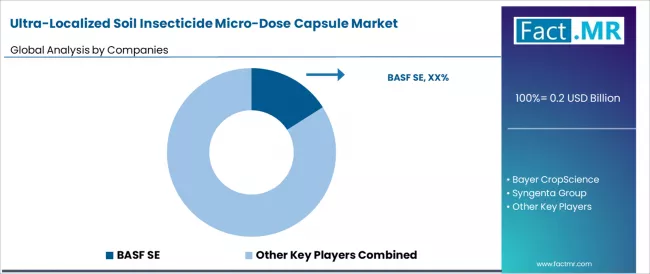
Ultra Localized Soil Insecticide Micro Dose Capsule Market Analysis By Company | Source: Fact.MR
Major agrochemical corporations with robust R&D capabilities in formulation science define the competitive landscape. BASF SE, Bayer CropScience, Syngenta Group, Corteva Agriscience, and FMC Corporation compete by developing proprietary capsule technologies optimized for their key insecticide molecules. Their advantage lies in creating fully integrated systems combining the capsule, the chemical, and recommended application protocols for major row crops.
Competition centers on patent-protected encapsulation methods, controlled-release profiles matched to pest lifecycles, and demonstrable reductions in environmental impact. Success depends not only on insecticide efficacy but also on securing regulatory approvals based on favorable eco-toxicological profiles and forming strategic partnerships with precision planting equipment manufacturers to ensure seamless implementation in the field.
Key Players in the Ultra-Localized Soil Insecticide Micro-Dose Capsule Market
- BASF SE
- Bayer CropScience
- Syngenta Group
- Corteva Agriscience
- FMC Corporation
Segmentation
Scope of Report
| Items | Values |
|---|---|
| Quantitative Units | USD Billion |
| Capsule Technology Type | Biodegradable Polymer Microcapsules, Controlled-Release Gel Capsules, Clay-Based Encapsulated Granules, Lipid-Matrix Micro-Dose Capsules, Others |
| Target Pest Type | Soil-Dwelling Larvae (Grubs, Wireworms), Root-Feeding Beetles, Termites, Nematode-Associated Insect Complexes, Others |
| Application Method | In-Furrow Application, Seed-Zone Placement, Micro-Granular Spot Application, Precision Planter-Integrated Dosing, Others |
| Key Countries | USA, India, Brazil, China, France |
| Key Companies | BASF SE, Bayer CropScience, Syngenta Group, Corteva Agriscience, FMC Corporation |
| Additional Analysis | Analysis of environmental fate and degradation kinetics of capsules, soil type effects on release rates, application technology compatibility and calibration, resistance management implications, and field-scale economic efficiency models. |
Source: Fact.MR analysis. Updated Dec 23, 2025
Ultra-Localized Soil Insecticide Micro-Dose Capsule Market by Segments
-
Capsule Technology Type :
- Biodegradable Polymer Microcapsules
- Controlled-Release Gel Capsules
- Clay-Based Encapsulated Granules
- Lipid-Matrix Micro-Dose Capsules
- Others
-
Target Pest Type :
- Soil-Dwelling Larvae (Grubs, Wireworms)
- Root-Feeding Beetles
- Termites
- Nematode-Associated Insect Complexes
- Others
-
Application Method :
- In-Furrow Application
- Seed-Zone Placement
- Micro-Granular Spot Application
- Precision Planter-Integrated Dosing
- Others
-
Region :
-
North America
- USA
- Canada
-
Latin America
- Brazil
- Mexico
- Argentina
- Rest of Latin America
-
Western Europe
- Germany
- UK
- France
- Spain
- Italy
- BENELUX
- Rest of Western Europe
-
Eastern Europe
- Czech Republic
- Poland
- Russia
- Rest of Eastern Europe
-
East Asia
- China
- Japan
- South Korea
- Rest of East Asia
-
South Asia & Pacific
- India
- Indonesia
- Rest of South Asia & Pacific
-
MEA
- GCC Countries
- Turkiye
- Saudi Arabia
- Rest of MEA
-
Frequently Asked Questions
How big is the ultra-localized soil insecticide micro-dose capsule market in 2026?
What will be the size of ultra-localized soil insecticide micro-dose capsule market in 2036?
How much will be the ultra-localized soil insecticide micro-dose capsule market growth between 2026 and 2036?
What are the key product types in the ultra-localized soil insecticide micro-dose capsule market?
Which target pest type segment to contribute significant share in the ultra-localized soil insecticide micro-dose capsule market in 2026?
Who worked on this report


Preview the report firsthand - request a free sample
Free SampleGet the brochure for pricing and purchase details
Download PDF