Precision Rice Pest Insecticides Market

Precision Rice Pest Insecticides Market Size and Share Forecast Outlook 2026 to 2036

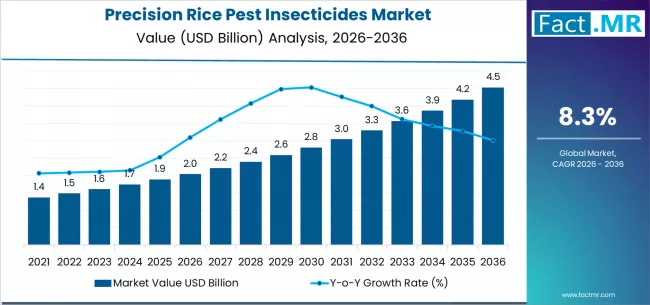
Precision rice pest insecticides market is projected to grow from USD 2.0 billion in 2026 to USD 4.5 billion by 2036, at a CAGR of 8.3%. Stem Borers will dominate with a 31.8% market share, while neonicotinoids will lead the insecticide type segment with a 35.2% share.

Precision Rice Pest Insecticides Market Forecast and Outlook 2026 to 2036

The global market for precision rice pest insecticides is being reshaped by the convergence of food security imperatives and digital farming technologies, projected to expand from USD 2.04 billion in 2026 to USD 4.53 billion by 2036, advancing at an 8.3% CAGR.

Key Takeaways from the Precision Rice Pest Insecticides Market

  • Market Value for 2026: USD 2.04 Billion
  • Market Value for 2036: USD 4.53 Billion
  • Forecast CAGR (2026-2036): 8.3%
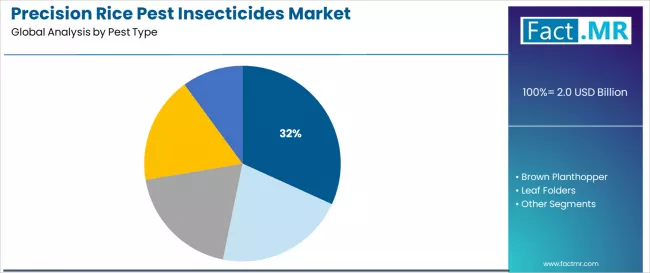
  • Leading Pest Type Segment (2026): Stem Borers (32%)
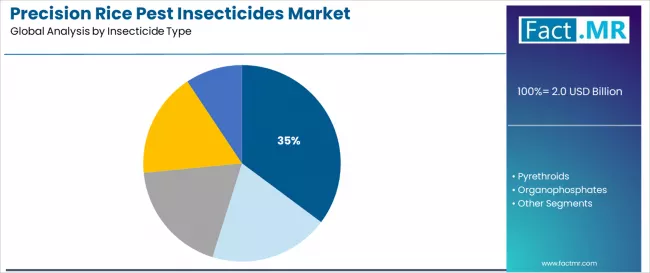
  • Leading Insecticide Type Segment (2026): Neonicotinoids (35.2%)
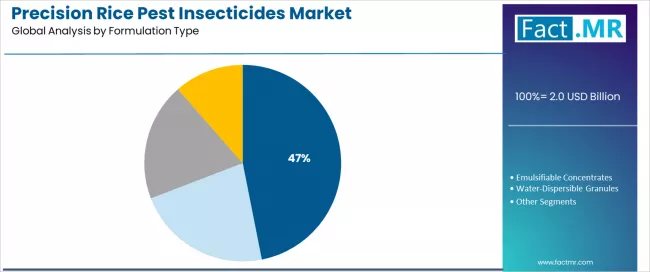
  • Leading Formulation Type Segment (2026): Liquid Formulations (46.90%)
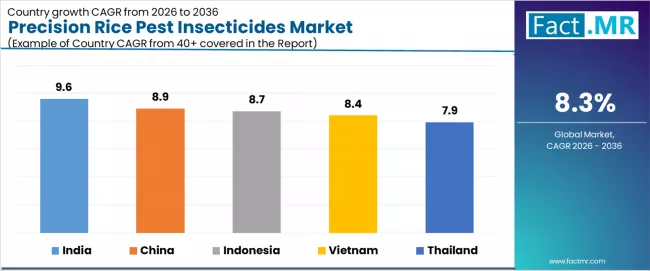
  • Key Growth Countries: India (9.6% CAGR), China (8.9% CAGR), Indonesia (8.7% CAGR), Vietnam (8.4% CAGR), Thailand (7.9% CAGR)
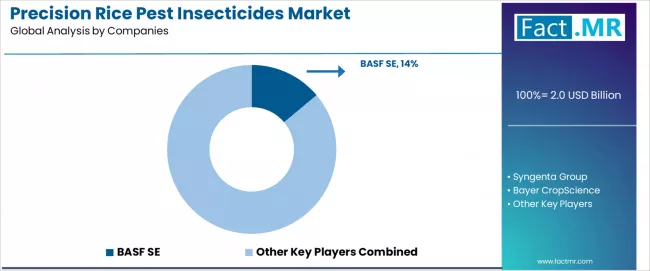
  • Key Players in the Market: BASF SE, Syngenta Group, Bayer CropScience, Corteva Agriscience, FMC Corporation

Precision Rice Pest Insecticides Market Market Value Analysis

Growth is fundamentally tied to the critical need to protect the productivity of the world's most important staple crop against a dynamic spectrum of insect pests, whose outbreaks are increasingly influenced by climatic shifts and intensive cultivation practices.

The market's evolution is characterized by a decisive transition from broad-spectrum, calendar-based spraying to targeted interventions guided by real-time pest monitoring and predictive analytics. Key trends include the integration of insecticide application with drone-based scouting and sensor networks that detect pest hotspots within large paddies, enabling spot treatments that dramatically reduce chemical load and collateral damage to beneficial arthropods.

There is strong development of selective chemistries and novel formulations, such as systemic granules and seed treatments that provide extended protection during critical crop stages with minimal environmental footprint. The management of insecticide resistance, particularly in pests like the brown planthopper, is driving demand for sophisticated rotation schemes and premixes that incorporate multiple modes of action.

This market is becoming a cornerstone of sustainable intensification in rice cultivation, where precision in pest management directly translates to enhanced yield stability, reduced farmer exposure, and improved alignment with stringent maximum residue limit standards for global grain trade.

Metric

Metric Value
Market Value (2026) USD 2.04 Billion
Market Forecast Value (2036) USD 4.53 Billion
Forecast CAGR (2026-2036) 8.3%

Category

Category Segments
Pest Type Stem Borers, Brown Planthopper, Leaf Folders, Rice Water Weevil, Others
Insecticide Type Neonicotinoids, Pyrethroids, Organophosphates, Biologicals (Bt, others), Others
Formulation Type Liquid Formulations, Emulsifiable Concentrates, Water-Dispersible Granules, Others
Region North America, Latin America, Western Europe, Eastern Europe, East Asia, South Asia & Pacific, MEA

Segmental Analysis

By Pest Type, Which Pest Represents the Most Pervasive Threat?

Precision Rice Pest Insecticides Market Analysis By Pest Type

Stem borers hold a leading 32% market share, as they are among the most destructive and widespread pests of rice, causing direct yield loss through dead hearts and whiteheads. Their concealed feeding behavior inside the stem makes them difficult to control, necessitating the use of systemic insecticides with specific timing.

The economic impact of borer damage and their prevalence across diverse rice ecologies from South Asia to Southeast Asia sustains consistent, high demand for targeted control solutions, making this segment a primary focus for insecticide development and application.

By Insecticide Type, Which Class Offers Broad-Spectrum Systemic Control?

Precision Rice Pest Insecticides Market Analysis By Insecticide Type

Neonicotinoids command a 35.2% market share, valued for their systemic action, effectiveness against sucking pests like planthoppers, and versatility as seed treatments, soil applications, or foliar sprays.

Despite regulatory scrutiny in other crops, their use in rice remains significant due to their efficacy against key pests and their role in integrated resistance management programs when used judiciously. Their ability to protect the plant from within provides a critical advantage in the water-intensive paddy environment, where spray coverage can be challenging.

By Formulation Type, Which Provides Operational Flexibility for Farmers?

Precision Rice Pest Insecticides Market Analysis By Formulation Type

Liquid formulations, particularly emulsifiable concentrates (ECs), lead with a 46.90% share. They are favored for their ease of measurement, mixing, and application using a variety of equipment, from knapsack sprayers to power sprayers.

In rice paddies, are easily incorporated into irrigation water or applied as foliar sprays with good spreading ability on waxy rice leaves. This operational simplicity and proven performance under field conditions make them the preferred choice for the vast network of smallholder and commercial rice growers.

What are the Drivers, Restraints, and Key Trends of the Precision Rice Pest Insecticides Market?

The primary market driver is the relentless pressure to increase rice yield and production stability to meet the demands of a growing global population, particularly in Asia. The escalating economic impact of pest outbreaks, exacerbated by climate-induced shifts in pest populations and resistance development, makes effective insecticide use a non-negotiable component of modern rice agronomy.

Government policies in major producing countries that subsidize agrochemicals to ensure food security directly stimulate market growth and farmer adoption of newer, more effective products.

A significant market restraint is the rapid development of insecticide resistance in key pests like the brown planthopper and stem borer, which can render expensive chemistries ineffective within few seasons. Increasing regulatory restrictions on certain insecticide classes, driven by environmental and health concerns, limit the available chemical toolkit.

The high cost of precision application technologies and the technical knowledge required for their use can also be a barrier to widespread adoption among smallholder farmers who dominate rice cultivation.

Key trends include the rapid adoption of drone-based precision spraying, which allows for ultra-low volume application and access to waterlogged fields. There is growing integration of insecticide use with pheromone traps and light traps for monitoring and mass trapping as part of IPM.

The development of RNAi-based and other novel mode-of-action insecticides offers promising tools for resistance management. Digital platforms that provide pest forecasting and treatment thresholds are becoming more accessible, helping to optimize the timing and necessity of insecticide applications.

Analysis of the Precision Rice Pest Insecticides Market by Key Countries

Precision Rice Pest Insecticides Market Cagr Analysis By Country

Country CAGR (2026-2036)
India 9.6%
China 8.9%
Indonesia 8.7%
Vietnam 8.4%
Thailand 7.9%

How is India's Massive Rice Area and Smallholder Dominance Influencing the Market?

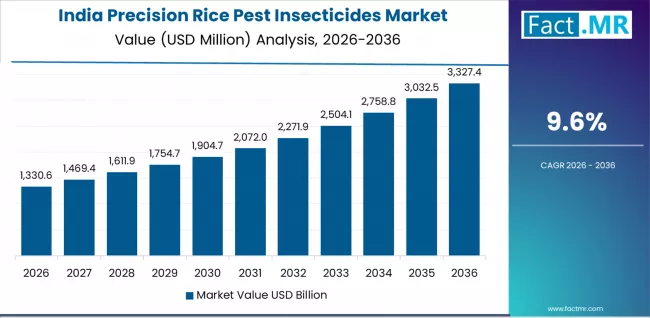
Precision Rice Pest Insecticides Market Country Value Analysis

The enormous rice cultivation area and the government’s push for higher productivity through increased adoption of modern inputs drive India’s leading CAGR of 9.6%. The market is characterized by high volume demand for cost-effective insecticides that are accessible to millions of smallholders.

Resistance issues are pushing demand toward newer chemistries and premixes. Extension services and agro-dealer networks play a crucial role in educating farmers on the precise timing and application of insecticides to combat pests like stem borers and leaf folders.

What is the Impact of China's Modernization of Agriculture and Food Self-Sufficiency Policy?

China's 8.9% growth is underpinned by its focus on modernizing agriculture and maintaining absolute grain self-sufficiency. Large-scale farming operations are increasingly adopting precision agriculture techniques, including targeted pest management.

The government strongly promotes scientifically guided pesticide use to reduce overall volume while improving efficacy. The market demands high-quality, effective products to protect high-yielding hybrid varieties, with significant investment in R&D for biological controls and green chemistry alternatives alongside conventional insecticides.

Why is Indonesia's Archipelagic Geography and Pest Pressure a Key Factor?

Indonesia's 8.7% CAGR is fueled by its vast rice area across thousands of islands, where localized pest pressures can vary significantly. The brown planthopper remains a perennial threat, driving demand for effective insecticides and resistance management strategies.

Government subsidy programs for pesticides and a growing awareness of integrated pest management principles are shaping the market. The need for solutions that are effective in both irrigated and rainfed systems supports demand for a diverse insecticide portfolio.

How is Vietnam's Intensive Cropping and Export-Oriented Production Shaping Demand?

Vietnam's 8.4% growth is linked to its intensive two to three rice crops per year, which creates constant pest pressure and a high frequency of insecticide use. As a major rice exporter, Vietnamese farmers and cooperatives are highly sensitive to MRL standards in import markets, driving demand for insecticides with favorable safety profiles and pre-harvest intervals. The market is moving toward more selective and softer chemistries to preserve natural enemies and ensure compliance with international trade requirements.

What Role Does Thailand's Focus on Quality and Sustainable Farming Play?

Thailand's 7.9% growth occurs within a market increasingly oriented toward producing premium quality rice for export. This focus, along with rising domestic consumer interest in food safety, is driving a shift toward precision application and reduced pesticide use.

Government and private sector initiatives promote Good Agricultural Practices (GAP) that include precise insecticide management. Demand is growing for insecticides that are effective yet align with sustainability certifications, benefiting products with lower toxicity to non-target organisms.

Competitive Landscape of the Precision Rice Pest Insecticides Market

Precision Rice Pest Insecticides Market Analysis By Company

The competitive landscape is dominated by global agrochemical corporations competing with regional players in a high-volume, price-sensitive market. Competition intensifies around the development of innovative formulations such as capsule suspensions, and OD formulations, robust resistance management data, and the provision of integrated digital advisory services.

Success is increasingly tied to educating and training the extensive network of farmers and agro-dealers on precision application techniques and integrated pest management (IPM) principles. Companies are also competing to register products that meet the evolving MRL standards of key rice-importing countries.

Key Players in the Precision Rice Pest Insecticides Market

  • BASF SE
  • Syngenta Group
  • Bayer CropScience
  • Corteva Agriscience
  • FMC Corporation

Scope of Report

Items Values
Quantitative Units USD Billion
Pest Type Stem Borers, Brown Planthopper, Leaf Folders, Rice Water Weevil, Others
Insecticide Type Neonicotinoids, Pyrethroids, Organophosphates, Biologicals (Bt, others), Others
Formulation Type Liquid Formulations, Emulsifiable Concentrates, Water-Dispersible Granules, Others
Key Countries India, China, Indonesia, Vietnam, Thailand
Key Companies BASF SE, Syngenta Group, Bayer CropScience, Corteva Agriscience, FMC Corporation
Additional Analysis Resistance monitoring and management strategies for key rice pests; economic injury levels and action thresholds for precision application; impact of irrigation practices on insecticide efficacy and fate; drift management and bystander exposure in paddy landscapes; comparative analysis of application technologies (drones vs. ground sprayers).

Market by Segments

  • Pest Type :

    • Stem Borers
    • Brown Planthopper
    • Leaf Folders
    • Rice Water Weevil
    • Others
  • Insecticide Type :

    • Neonicotinoids
    • Pyrethroids
    • Organophosphates
    • Biologicals (Bt, others)
    • Others
  • Formulation Type :

    • Liquid Formulations
    • Emulsifiable Concentrates
    • Water-Dispersible Granules
    • Others
  • Region :

    • North America

      • USA
      • Canada
    • Latin America

      • Brazil
      • Mexico
      • Argentina
      • Rest of Latin America
    • Western Europe

      • Germany
      • UK
      • France
      • Spain
      • Italy
      • BENELUX
      • Rest of Western Europe
    • Eastern Europe

      • Russia
      • Poland
      • Czech Republic
      • Rest of Eastern Europe
    • East Asia

      • China
      • Japan
      • South Korea
      • Rest of East Asia
    • South Asia & Pacific

      • India
      • Indonesia
      • Vietnam
      • Thaliand
      • Australia
      • Rest of South Asia & Pacific
    • MEA

      • Saudi Arabia
      • UAE
      • Turkiye
      • Rest of MEA

References

  • Bottrell, D. G., & Schoenly, K. G. (2023). Resurrecting the ghost of green revolution past: The brown planthopper as a recurring threat to intensive rice production. Annual Review of Entomology, 68, 439-459.
  • Heong, K. L., & Hardy, B. (2024). Planthoppers: new threats to the sustainability of intensive rice production systems. International Rice Research Institute.
  • Jahn, G. C., & Barrion, A. T. (2023). Rice insect pests and their natural enemies in Asia. CABI Publishing.
  • Litsinger, J. A., & Hasse, V. (2024). Determining action thresholds for insecticide application against rice leaf folders and stem borers. Crop Protection, 175, 106445.
  • Matsumura, M., & Sanada-Morimura, S. (2023). Recent status of insecticide resistance in the brown planthopper in Asia. Journal of Pesticide Science, 48(2), 45-53.
  • Pathak, M. D., & Khan, Z. R. (2023). Insect pests of rice. International Rice Research Institute.
  • Savary, S., Horgan, F. G., & Willocquet, L. (2024). Protecting rice yields and designing sustainable cropping systems through improved management of insect pests. Field Crops Research, 306, 109215.
  • Shi, Z., & Li, D. (2024). Precision application technology of pesticides in paddy fields: A review of UAV-based spraying. Computers and Electronics in Agriculture, 219, 108793.
  • Way, M. J., & Heong, K. L. (2023). The role of biodiversity in integrated pest management of rice. Bulletin of Entomological Research, 113(1), 1-12.
  • Zhu, P., & Gurr, G. M. (2024). Integrated pest management for rice: Ecological concepts and practical applications. BioControl, 69(2), 127-141.

Table of Content

  1. Executive Summary
    • Global Market Outlook
    • Demand to side Trends
    • Supply to side Trends
    • Technology Roadmap Analysis
    • Analysis and Recommendations
  2. Market Overview
    • Market Coverage / Taxonomy
    • Market Definition / Scope / Limitations
  3. Market Background
    • Market Dynamics
      • Drivers
      • Restraints
      • Opportunity
      • Trends
    • Scenario Forecast
      • Demand in Optimistic Scenario
      • Demand in Likely Scenario
      • Demand in Conservative Scenario
    • Opportunity Map Analysis
    • Product Life Cycle Analysis
    • Supply Chain Analysis
    • Investment Feasibility Matrix
    • Value Chain Analysis
    • PESTLE and Porter’s Analysis
    • Regulatory Landscape
    • Regional Parent Market Outlook
    • Production and Consumption Statistics
    • Import and Export Statistics
  4. Global Market Analysis 2021 to 2025 and Forecast, 2026 to 2036
    • Historical Market Size Value (USD Million) Analysis, 2021 to 2025
    • Current and Future Market Size Value (USD Million) Projections, 2026 to 2036
      • Y to o to Y Growth Trend Analysis
      • Absolute $ Opportunity Analysis
  5. Global Market Pricing Analysis 2021 to 2025 and Forecast 2026 to 2036
  6. Global Market Analysis 2021 to 2025 and Forecast 2026 to 2036, By Pest Type
    • Introduction / Key Findings
    • Historical Market Size Value (USD Million) Analysis By Pest Type, 2021 to 2025
    • Current and Future Market Size Value (USD Million) Analysis and Forecast By Pest Type, 2026 to 2036
      • Stem Borers
      • Brown Planthopper
      • Leaf Folders
      • Rice Water Weevil
      • Others
    • Y to o to Y Growth Trend Analysis By Pest Type, 2021 to 2025
    • Absolute $ Opportunity Analysis By Pest Type, 2026 to 2036
  7. Global Market Analysis 2021 to 2025 and Forecast 2026 to 2036, By Insecticide Type
    • Introduction / Key Findings
    • Historical Market Size Value (USD Million) Analysis By Insecticide Type, 2021 to 2025
    • Current and Future Market Size Value (USD Million) Analysis and Forecast By Insecticide Type, 2026 to 2036
      • Neonicotinoids
      • Pyrethroids
      • Organophosphates
      • Biologicals (Bt, others)
      • Others
    • Y to o to Y Growth Trend Analysis By Insecticide Type, 2021 to 2025
    • Absolute $ Opportunity Analysis By Insecticide Type, 2026 to 2036
  8. Global Market Analysis 2021 to 2025 and Forecast 2026 to 2036, By Formulation Type
    • Introduction / Key Findings
    • Historical Market Size Value (USD Million) Analysis By Formulation Type, 2021 to 2025
    • Current and Future Market Size Value (USD Million) Analysis and Forecast By Formulation Type, 2026 to 2036
      • Liquid Formulations
      • Emulsifiable Concentrates
      • Water-Dispersible Granules
      • Others
    • Y to o to Y Growth Trend Analysis By Formulation Type, 2021 to 2025
    • Absolute $ Opportunity Analysis By Formulation Type, 2026 to 2036
  9. Global Market Analysis 2021 to 2025 and Forecast 2026 to 2036, By Region
    • Introduction
    • Historical Market Size Value (USD Million) Analysis By Region, 2021 to 2025
    • Current Market Size Value (USD Million) Analysis and Forecast By Region, 2026 to 2036
      • North America
      • Latin America
      • Western Europe
      • Eastern Europe
      • East Asia
      • South Asia and Pacific
      • Middle East & Africa
    • Market Attractiveness Analysis By Region
  10. North America Market Analysis 2021 to 2025 and Forecast 2026 to 2036, By Country
    • Historical Market Size Value (USD Million) Trend Analysis By Market Taxonomy, 2021 to 2025
    • Market Size Value (USD Million) Forecast By Market Taxonomy, 2026 to 2036
      • By Country
        • USA
        • Canada
        • Mexico
      • By Pest Type
      • By Insecticide Type
      • By Formulation Type
    • Market Attractiveness Analysis
      • By Country
      • By Pest Type
      • By Insecticide Type
      • By Formulation Type
    • Key Takeaways
  11. Latin America Market Analysis 2021 to 2025 and Forecast 2026 to 2036, By Country
    • Historical Market Size Value (USD Million) Trend Analysis By Market Taxonomy, 2021 to 2025
    • Market Size Value (USD Million) Forecast By Market Taxonomy, 2026 to 2036
      • By Country
        • Brazil
        • Chile
        • Rest of Latin America
      • By Pest Type
      • By Insecticide Type
      • By Formulation Type
    • Market Attractiveness Analysis
      • By Country
      • By Pest Type
      • By Insecticide Type
      • By Formulation Type
    • Key Takeaways
  12. Western Europe Market Analysis 2021 to 2025 and Forecast 2026 to 2036, By Country
    • Historical Market Size Value (USD Million) Trend Analysis By Market Taxonomy, 2021 to 2025
    • Market Size Value (USD Million) Forecast By Market Taxonomy, 2026 to 2036
      • By Country
        • Germany
        • UK
        • Italy
        • Spain
        • France
        • Nordic
        • BENELUX
        • Rest of Western Europe
      • By Pest Type
      • By Insecticide Type
      • By Formulation Type
    • Market Attractiveness Analysis
      • By Country
      • By Pest Type
      • By Insecticide Type
      • By Formulation Type
    • Key Takeaways
  13. Eastern Europe Market Analysis 2021 to 2025 and Forecast 2026 to 2036, By Country
    • Historical Market Size Value (USD Million) Trend Analysis By Market Taxonomy, 2021 to 2025
    • Market Size Value (USD Million) Forecast By Market Taxonomy, 2026 to 2036
      • By Country
        • Russia
        • Poland
        • Hungary
        • Balkan & Baltic
        • Rest of Eastern Europe
      • By Pest Type
      • By Insecticide Type
      • By Formulation Type
    • Market Attractiveness Analysis
      • By Country
      • By Pest Type
      • By Insecticide Type
      • By Formulation Type
    • Key Takeaways
  14. East Asia Market Analysis 2021 to 2025 and Forecast 2026 to 2036, By Country
    • Historical Market Size Value (USD Million) Trend Analysis By Market Taxonomy, 2021 to 2025
    • Market Size Value (USD Million) Forecast By Market Taxonomy, 2026 to 2036
      • By Country
        • China
        • Japan
        • South Korea
      • By Pest Type
      • By Insecticide Type
      • By Formulation Type
    • Market Attractiveness Analysis
      • By Country
      • By Pest Type
      • By Insecticide Type
      • By Formulation Type
    • Key Takeaways
  15. South Asia and Pacific Market Analysis 2021 to 2025 and Forecast 2026 to 2036, By Country
    • Historical Market Size Value (USD Million) Trend Analysis By Market Taxonomy, 2021 to 2025
    • Market Size Value (USD Million) Forecast By Market Taxonomy, 2026 to 2036
      • By Country
        • India
        • ASEAN
        • Australia & New Zealand
        • Rest of South Asia and Pacific
      • By Pest Type
      • By Insecticide Type
      • By Formulation Type
    • Market Attractiveness Analysis
      • By Country
      • By Pest Type
      • By Insecticide Type
      • By Formulation Type
    • Key Takeaways
  16. Middle East & Africa Market Analysis 2021 to 2025 and Forecast 2026 to 2036, By Country
    • Historical Market Size Value (USD Million) Trend Analysis By Market Taxonomy, 2021 to 2025
    • Market Size Value (USD Million) Forecast By Market Taxonomy, 2026 to 2036
      • By Country
        • Kingdom of Saudi Arabia
        • Other GCC Countries
        • Turkiye
        • South Africa
        • Other African Union
        • Rest of Middle East & Africa
      • By Pest Type
      • By Insecticide Type
      • By Formulation Type
    • Market Attractiveness Analysis
      • By Country
      • By Pest Type
      • By Insecticide Type
      • By Formulation Type
    • Key Takeaways
  17. Key Countries Market Analysis
    • USA
      • Pricing Analysis
      • Market Share Analysis, 2025
        • By Pest Type
        • By Insecticide Type
        • By Formulation Type
    • Canada
      • Pricing Analysis
      • Market Share Analysis, 2025
        • By Pest Type
        • By Insecticide Type
        • By Formulation Type
    • Mexico
      • Pricing Analysis
      • Market Share Analysis, 2025
        • By Pest Type
        • By Insecticide Type
        • By Formulation Type
    • Brazil
      • Pricing Analysis
      • Market Share Analysis, 2025
        • By Pest Type
        • By Insecticide Type
        • By Formulation Type
    • Chile
      • Pricing Analysis
      • Market Share Analysis, 2025
        • By Pest Type
        • By Insecticide Type
        • By Formulation Type
    • Germany
      • Pricing Analysis
      • Market Share Analysis, 2025
        • By Pest Type
        • By Insecticide Type
        • By Formulation Type
    • UK
      • Pricing Analysis
      • Market Share Analysis, 2025
        • By Pest Type
        • By Insecticide Type
        • By Formulation Type
    • Italy
      • Pricing Analysis
      • Market Share Analysis, 2025
        • By Pest Type
        • By Insecticide Type
        • By Formulation Type
    • Spain
      • Pricing Analysis
      • Market Share Analysis, 2025
        • By Pest Type
        • By Insecticide Type
        • By Formulation Type
    • France
      • Pricing Analysis
      • Market Share Analysis, 2025
        • By Pest Type
        • By Insecticide Type
        • By Formulation Type
    • India
      • Pricing Analysis
      • Market Share Analysis, 2025
        • By Pest Type
        • By Insecticide Type
        • By Formulation Type
    • ASEAN
      • Pricing Analysis
      • Market Share Analysis, 2025
        • By Pest Type
        • By Insecticide Type
        • By Formulation Type
    • Australia & New Zealand
      • Pricing Analysis
      • Market Share Analysis, 2025
        • By Pest Type
        • By Insecticide Type
        • By Formulation Type
    • China
      • Pricing Analysis
      • Market Share Analysis, 2025
        • By Pest Type
        • By Insecticide Type
        • By Formulation Type
    • Japan
      • Pricing Analysis
      • Market Share Analysis, 2025
        • By Pest Type
        • By Insecticide Type
        • By Formulation Type
    • South Korea
      • Pricing Analysis
      • Market Share Analysis, 2025
        • By Pest Type
        • By Insecticide Type
        • By Formulation Type
    • Russia
      • Pricing Analysis
      • Market Share Analysis, 2025
        • By Pest Type
        • By Insecticide Type
        • By Formulation Type
    • Poland
      • Pricing Analysis
      • Market Share Analysis, 2025
        • By Pest Type
        • By Insecticide Type
        • By Formulation Type
    • Hungary
      • Pricing Analysis
      • Market Share Analysis, 2025
        • By Pest Type
        • By Insecticide Type
        • By Formulation Type
    • Kingdom of Saudi Arabia
      • Pricing Analysis
      • Market Share Analysis, 2025
        • By Pest Type
        • By Insecticide Type
        • By Formulation Type
    • Turkiye
      • Pricing Analysis
      • Market Share Analysis, 2025
        • By Pest Type
        • By Insecticide Type
        • By Formulation Type
    • South Africa
      • Pricing Analysis
      • Market Share Analysis, 2025
        • By Pest Type
        • By Insecticide Type
        • By Formulation Type
  18. Market Structure Analysis
    • Competition Dashboard
    • Competition Benchmarking
    • Market Share Analysis of Top Players
      • By Regional
      • By Pest Type
      • By Insecticide Type
      • By Formulation Type
  19. Competition Analysis
    • Competition Deep Dive
      • BASF SE
        • Overview
        • Product Portfolio
        • Profitability by Market Segments (Product/Age /Sales Channel/Region)
        • Sales Footprint
        • Strategy Overview
          • Marketing Strategy
          • Product Strategy
          • Channel Strategy
      • Syngenta Group
      • Bayer CropScience
      • Corteva Agriscience
      • FMC Corporation
      • Others
  20. Assumptions & Acronyms Used
  21. Research Methodology

List Of Table

  • Table 1: Global Market Value (USD Million) Forecast by Region, 2021 to 2036
  • Table 2: Global Market Value (USD Million) Forecast by Pest Type, 2021 to 2036
  • Table 3: Global Market Value (USD Million) Forecast by Insecticide Type, 2021 to 2036
  • Table 4: Global Market Value (USD Million) Forecast by Formulation Type, 2021 to 2036
  • Table 5: North America Market Value (USD Million) Forecast by Country, 2021 to 2036
  • Table 6: North America Market Value (USD Million) Forecast by Pest Type, 2021 to 2036
  • Table 7: North America Market Value (USD Million) Forecast by Insecticide Type, 2021 to 2036
  • Table 8: North America Market Value (USD Million) Forecast by Formulation Type, 2021 to 2036
  • Table 9: Latin America Market Value (USD Million) Forecast by Country, 2021 to 2036
  • Table 10: Latin America Market Value (USD Million) Forecast by Pest Type, 2021 to 2036
  • Table 11: Latin America Market Value (USD Million) Forecast by Insecticide Type, 2021 to 2036
  • Table 12: Latin America Market Value (USD Million) Forecast by Formulation Type, 2021 to 2036
  • Table 13: Western Europe Market Value (USD Million) Forecast by Country, 2021 to 2036
  • Table 14: Western Europe Market Value (USD Million) Forecast by Pest Type, 2021 to 2036
  • Table 15: Western Europe Market Value (USD Million) Forecast by Insecticide Type, 2021 to 2036
  • Table 16: Western Europe Market Value (USD Million) Forecast by Formulation Type, 2021 to 2036
  • Table 17: Eastern Europe Market Value (USD Million) Forecast by Country, 2021 to 2036
  • Table 18: Eastern Europe Market Value (USD Million) Forecast by Pest Type, 2021 to 2036
  • Table 19: Eastern Europe Market Value (USD Million) Forecast by Insecticide Type, 2021 to 2036
  • Table 20: Eastern Europe Market Value (USD Million) Forecast by Formulation Type, 2021 to 2036
  • Table 21: East Asia Market Value (USD Million) Forecast by Country, 2021 to 2036
  • Table 22: East Asia Market Value (USD Million) Forecast by Pest Type, 2021 to 2036
  • Table 23: East Asia Market Value (USD Million) Forecast by Insecticide Type, 2021 to 2036
  • Table 24: East Asia Market Value (USD Million) Forecast by Formulation Type, 2021 to 2036
  • Table 25: South Asia and Pacific Market Value (USD Million) Forecast by Country, 2021 to 2036
  • Table 26: South Asia and Pacific Market Value (USD Million) Forecast by Pest Type, 2021 to 2036
  • Table 27: South Asia and Pacific Market Value (USD Million) Forecast by Insecticide Type, 2021 to 2036
  • Table 28: South Asia and Pacific Market Value (USD Million) Forecast by Formulation Type, 2021 to 2036
  • Table 29: Middle East & Africa Market Value (USD Million) Forecast by Country, 2021 to 2036
  • Table 30: Middle East & Africa Market Value (USD Million) Forecast by Pest Type, 2021 to 2036
  • Table 31: Middle East & Africa Market Value (USD Million) Forecast by Insecticide Type, 2021 to 2036
  • Table 32: Middle East & Africa Market Value (USD Million) Forecast by Formulation Type, 2021 to 2036

List Of Figures

  • Figure 1: Global Market Pricing Analysis
  • Figure 2: Global Market Value (USD Million) Forecast 2021 to 2036
  • Figure 3: Global Market Value Share and BPS Analysis by Pest Type, 2026 and 2036
  • Figure 4: Global Market Y to o to Y Growth Comparison by Pest Type, 2026 to 2036
  • Figure 5: Global Market Attractiveness Analysis by Pest Type
  • Figure 6: Global Market Value Share and BPS Analysis by Insecticide Type, 2026 and 2036
  • Figure 7: Global Market Y to o to Y Growth Comparison by Insecticide Type, 2026 to 2036
  • Figure 8: Global Market Attractiveness Analysis by Insecticide Type
  • Figure 9: Global Market Value Share and BPS Analysis by Formulation Type, 2026 and 2036
  • Figure 10: Global Market Y to o to Y Growth Comparison by Formulation Type, 2026 to 2036
  • Figure 11: Global Market Attractiveness Analysis by Formulation Type
  • Figure 12: Global Market Value (USD Million) Share and BPS Analysis by Region, 2026 and 2036
  • Figure 13: Global Market Y to o to Y Growth Comparison by Region, 2026 to 2036
  • Figure 14: Global Market Attractiveness Analysis by Region
  • Figure 15: North America Market Incremental Dollar Opportunity, 2026 to 2036
  • Figure 16: Latin America Market Incremental Dollar Opportunity, 2026 to 2036
  • Figure 17: Western Europe Market Incremental Dollar Opportunity, 2026 to 2036
  • Figure 18: Eastern Europe Market Incremental Dollar Opportunity, 2026 to 2036
  • Figure 19: East Asia Market Incremental Dollar Opportunity, 2026 to 2036
  • Figure 20: South Asia and Pacific Market Incremental Dollar Opportunity, 2026 to 2036
  • Figure 21: Middle East & Africa Market Incremental Dollar Opportunity, 2026 to 2036
  • Figure 22: North America Market Value Share and BPS Analysis by Country, 2026 and 2036
  • Figure 23: North America Market Value Share and BPS Analysis by Pest Type, 2026 and 2036
  • Figure 24: North America Market Y to o to Y Growth Comparison by Pest Type, 2026 to 2036
  • Figure 25: North America Market Attractiveness Analysis by Pest Type
  • Figure 26: North America Market Value Share and BPS Analysis by Insecticide Type, 2026 and 2036
  • Figure 27: North America Market Y to o to Y Growth Comparison by Insecticide Type, 2026 to 2036
  • Figure 28: North America Market Attractiveness Analysis by Insecticide Type
  • Figure 29: North America Market Value Share and BPS Analysis by Formulation Type, 2026 and 2036
  • Figure 30: North America Market Y to o to Y Growth Comparison by Formulation Type, 2026 to 2036
  • Figure 31: North America Market Attractiveness Analysis by Formulation Type
  • Figure 32: Latin America Market Value Share and BPS Analysis by Country, 2026 and 2036
  • Figure 33: Latin America Market Value Share and BPS Analysis by Pest Type, 2026 and 2036
  • Figure 34: Latin America Market Y to o to Y Growth Comparison by Pest Type, 2026 to 2036
  • Figure 35: Latin America Market Attractiveness Analysis by Pest Type
  • Figure 36: Latin America Market Value Share and BPS Analysis by Insecticide Type, 2026 and 2036
  • Figure 37: Latin America Market Y to o to Y Growth Comparison by Insecticide Type, 2026 to 2036
  • Figure 38: Latin America Market Attractiveness Analysis by Insecticide Type
  • Figure 39: Latin America Market Value Share and BPS Analysis by Formulation Type, 2026 and 2036
  • Figure 40: Latin America Market Y to o to Y Growth Comparison by Formulation Type, 2026 to 2036
  • Figure 41: Latin America Market Attractiveness Analysis by Formulation Type
  • Figure 42: Western Europe Market Value Share and BPS Analysis by Country, 2026 and 2036
  • Figure 43: Western Europe Market Value Share and BPS Analysis by Pest Type, 2026 and 2036
  • Figure 44: Western Europe Market Y to o to Y Growth Comparison by Pest Type, 2026 to 2036
  • Figure 45: Western Europe Market Attractiveness Analysis by Pest Type
  • Figure 46: Western Europe Market Value Share and BPS Analysis by Insecticide Type, 2026 and 2036
  • Figure 47: Western Europe Market Y to o to Y Growth Comparison by Insecticide Type, 2026 to 2036
  • Figure 48: Western Europe Market Attractiveness Analysis by Insecticide Type
  • Figure 49: Western Europe Market Value Share and BPS Analysis by Formulation Type, 2026 and 2036
  • Figure 50: Western Europe Market Y to o to Y Growth Comparison by Formulation Type, 2026 to 2036
  • Figure 51: Western Europe Market Attractiveness Analysis by Formulation Type
  • Figure 52: Eastern Europe Market Value Share and BPS Analysis by Country, 2026 and 2036
  • Figure 53: Eastern Europe Market Value Share and BPS Analysis by Pest Type, 2026 and 2036
  • Figure 54: Eastern Europe Market Y to o to Y Growth Comparison by Pest Type, 2026 to 2036
  • Figure 55: Eastern Europe Market Attractiveness Analysis by Pest Type
  • Figure 56: Eastern Europe Market Value Share and BPS Analysis by Insecticide Type, 2026 and 2036
  • Figure 57: Eastern Europe Market Y to o to Y Growth Comparison by Insecticide Type, 2026 to 2036
  • Figure 58: Eastern Europe Market Attractiveness Analysis by Insecticide Type
  • Figure 59: Eastern Europe Market Value Share and BPS Analysis by Formulation Type, 2026 and 2036
  • Figure 60: Eastern Europe Market Y to o to Y Growth Comparison by Formulation Type, 2026 to 2036
  • Figure 61: Eastern Europe Market Attractiveness Analysis by Formulation Type
  • Figure 62: East Asia Market Value Share and BPS Analysis by Country, 2026 and 2036
  • Figure 63: East Asia Market Value Share and BPS Analysis by Pest Type, 2026 and 2036
  • Figure 64: East Asia Market Y to o to Y Growth Comparison by Pest Type, 2026 to 2036
  • Figure 65: East Asia Market Attractiveness Analysis by Pest Type
  • Figure 66: East Asia Market Value Share and BPS Analysis by Insecticide Type, 2026 and 2036
  • Figure 67: East Asia Market Y to o to Y Growth Comparison by Insecticide Type, 2026 to 2036
  • Figure 68: East Asia Market Attractiveness Analysis by Insecticide Type
  • Figure 69: East Asia Market Value Share and BPS Analysis by Formulation Type, 2026 and 2036
  • Figure 70: East Asia Market Y to o to Y Growth Comparison by Formulation Type, 2026 to 2036
  • Figure 71: East Asia Market Attractiveness Analysis by Formulation Type
  • Figure 72: South Asia and Pacific Market Value Share and BPS Analysis by Country, 2026 and 2036
  • Figure 73: South Asia and Pacific Market Value Share and BPS Analysis by Pest Type, 2026 and 2036
  • Figure 74: South Asia and Pacific Market Y to o to Y Growth Comparison by Pest Type, 2026 to 2036
  • Figure 75: South Asia and Pacific Market Attractiveness Analysis by Pest Type
  • Figure 76: South Asia and Pacific Market Value Share and BPS Analysis by Insecticide Type, 2026 and 2036
  • Figure 77: South Asia and Pacific Market Y to o to Y Growth Comparison by Insecticide Type, 2026 to 2036
  • Figure 78: South Asia and Pacific Market Attractiveness Analysis by Insecticide Type
  • Figure 79: South Asia and Pacific Market Value Share and BPS Analysis by Formulation Type, 2026 and 2036
  • Figure 80: South Asia and Pacific Market Y to o to Y Growth Comparison by Formulation Type, 2026 to 2036
  • Figure 81: South Asia and Pacific Market Attractiveness Analysis by Formulation Type
  • Figure 82: Middle East & Africa Market Value Share and BPS Analysis by Country, 2026 and 2036
  • Figure 83: Middle East & Africa Market Value Share and BPS Analysis by Pest Type, 2026 and 2036
  • Figure 84: Middle East & Africa Market Y to o to Y Growth Comparison by Pest Type, 2026 to 2036
  • Figure 85: Middle East & Africa Market Attractiveness Analysis by Pest Type
  • Figure 86: Middle East & Africa Market Value Share and BPS Analysis by Insecticide Type, 2026 and 2036
  • Figure 87: Middle East & Africa Market Y to o to Y Growth Comparison by Insecticide Type, 2026 to 2036
  • Figure 88: Middle East & Africa Market Attractiveness Analysis by Insecticide Type
  • Figure 89: Middle East & Africa Market Value Share and BPS Analysis by Formulation Type, 2026 and 2036
  • Figure 90: Middle East & Africa Market Y to o to Y Growth Comparison by Formulation Type, 2026 to 2036
  • Figure 91: Middle East & Africa Market Attractiveness Analysis by Formulation Type
  • Figure 92: Global Market - Tier Structure Analysis
  • Figure 93: Global Market - Company Share Analysis

- FAQs -

How big is the precision rice pest insecticides market in 2026?

The global precision rice pest insecticides market is estimated to be valued at USD 2.0 billion in 2026.

What will be the size of precision rice pest insecticides market in 2036?

The market size for the precision rice pest insecticides market is projected to reach USD 4.5 billion by 2036.

How much will be the precision rice pest insecticides market growth between 2026 and 2036?

The precision rice pest insecticides market is expected to grow at a 8.3% CAGR between 2026 and 2036.

What are the key product types in the precision rice pest insecticides market?

The key product types in precision rice pest insecticides market are stem borers, brown planthopper, leaf folders, rice water weevil and others.

Which insecticide type segment to contribute significant share in the precision rice pest insecticides market in 2026?

In terms of insecticide type, neonicotinoids segment to command 35.2% share in the precision rice pest insecticides market in 2026.
Precision Rice Pest Insecticides Market