- Market Value (2025): USD 3.4 Bn
- Estimated Value (2026): USD 3.6 Bn
- Forecast Value (2036): USD 6.7 Bn
- CAGR (2026-2036): 6.4%
What is the Non-BPA Internal Can Coatings Market forecast to be worth by 2036?
USD 3.6 billion in 2026 to USD 6.7 billion by 2036 at a 6.4% CAGR.
- As per Fact.MR analysis, the Non-BPA Internal Can Coatings Market reached USD 3.4 billion in 2025.
- Demand is projected to increase from USD 3.6 billion in 2026 to USD 6.7 billion by 2036.
- The market is forecast to record a 6.4% CAGR from 2026 to 2036 as can makers approve non-BPA coatings for several metal pack types.
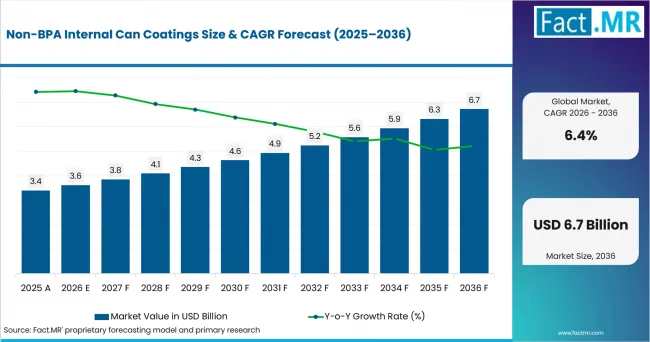
Non Bpa Internal Can Coatings Value Analysis | Source: Fact.MR
What are the defining numbers behind Non-BPA Internal Can Coatings Market growth?
An absolute opportunity of USD 3.1 billion is expected between 2026 and 2036.
- Demand Drivers in the Market
- Food-contact rules give coating suppliers clear dates for product changes. Commission Regulation (EU) 2024/3190 covers varnishes and coatings. Single-use food-contact products made under the earlier BPA rules can be sold in the EU until July 20, 2026 [1].
- High food production keeps metal packaging in use. Food cans need internal coatings that stay stable during filling and heat processing.
- Food cans need coatings that can handle heat and different foods. Similar needs apply to packaging coatings, where chemical protection and food-contact records affect coating choices.
- Aerosol cans and tubes need flexible coatings because the metal changes shape. Aerosol cans need internal coatings that stay in place as the metal is shaped.
- Key Segments Analyzed
- By Coating Chemistry: Polyester holds 34.0% share in 2026 because it is flexible and resists chemicals.
- By Package Type: Beverage cans leads with 31.0% share in 2026 as they need an even inner coating that protects taste.
- By Coating Position: Internal lining is expected to hold a 36.0% share in 2026 because it keeps the product from touching the metal.
- By Performance: Corrosion resistance account for 29.0% share in 2026 since steel and aluminum packs need protection during filling and storage.
- Analyst Opinion at Fact.MR
- Shambhu Nath Jha is Principal Consultant at Fact.MR. He states, “Non-BPA internal can makers check if a new internal coating can move easily or not. The coating needs to work with the product and can-making process. Suppliers need clear food-contact records and good production support.”
- Strategic Implications
- Coating suppliers should provide test results for each pack type. This helps can makers choose coatings for the food or drink inside the pack.
- Can makers should test different coatings because heat and filling conditions can affect each coating differently.
- Brand owners should plan coating changes with product and shelf-life tests. This helps new coatings meet production needs and local rules.
- In July 2025, PPG added three BPA-NI coatings for beverage can ends. These included one coating for high-speed stamping and another for beer cans [2]. This gives can makers more coating choices for can bodies and ends.
The USA is expected to grow at 6.9% CAGR through 2036 due to packaged food production. France follows at 6.9% due to EU food-contact rules. China reaches 6.7% as packaged food sales grow. Germany also records 6.7% due to beverage production and EU rules. Japan reaches 5.6% as household spending supports packaged goods.
How does the Non-BPA Internal Can Coatings Market break down by segment?
Internal lining is projected to lead Coating Position at 36.0% share in 2026, while Polyester leads Coating Chemistry at 34.0% share.
Which Coating Chemistry dominates?
Polyester is projected to hold 34.0% share in 2026.
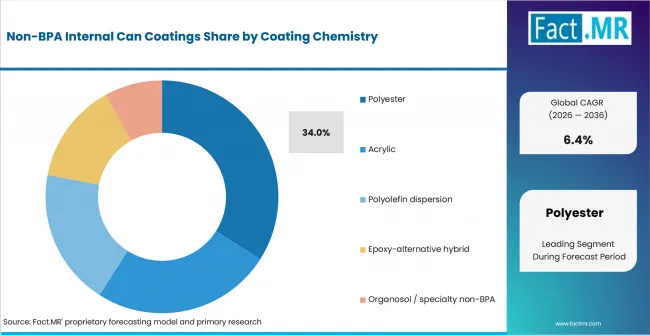
Non Bpa Internal Can Coatings Analysis By Coating Chemistry | Source: Fact.MR
Polyester is expected to lead because it is flexible and works with different foods and drinks. Acrylic is widely used inside beverage cans. Polyolefin coatings are another option for metal packaging. The metal coatings market shows that coating choice depends on the metal and its use.
Different coatings suit different packs. Polyester works well on packs that need to bend during shaping, while acrylic is common inside beverage cans. Food cans need coatings that can handle heat and food contact. Can makers choose the coating based on the filling process and pack shape.
What leads the Package Type segment?
Beverage cans are anticipated to account for 31.0% share in 2026.
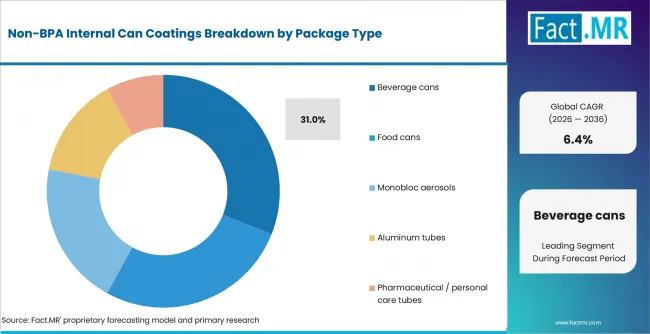
Non Bpa Internal Can Coatings Analysis By Package Type | Source: Fact.MR
Beverage cans are expected to lead because inner coatings protect the drink and the metal. Food cans need coatings that can handle heat. Aerosol cans and aluminum tubes need flexible coatings that stay in place when the metal changes shape. Pharmaceutical and personal-care tubes also need stable inner coatings.
USDA Economic Research Service reported in April 2025 that the U.S. canned vegetable consumer price index increased 1.1% from the first quarter of 2024 to the first quarter of 2025 [3].
How does Coating Position shape demand?
Internal lining is expected to capture 36.0% share in 2026.
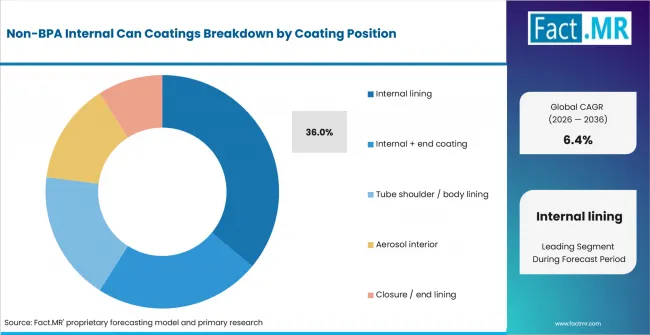
Non Bpa Internal Can Coatings Analysis By Coating Position | Source: Fact.MR
Internal lining is expected to lead because it keeps the product from touching the metal. Can ends and lids also need coatings for protection. Tube coatings need to stay in place when the metal changes shape. Waterborne heat-seal coatings also need to stay even during production.
Can manufacturers check coatings on all areas that touch the product. Coatings on the can body, ends, and lids need to work together during filling and storage.
What supports Corrosion Resistance within Performance?
Corrosion resistance is estimated to represent 29.0% share in 2026.
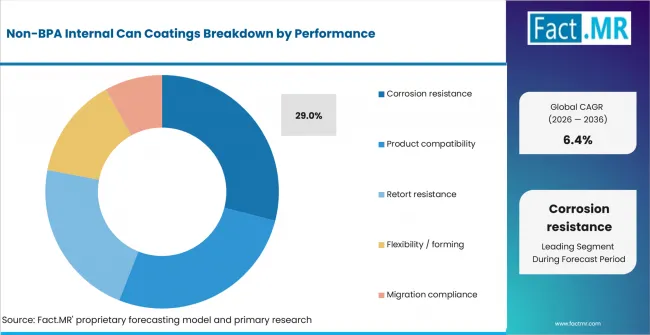
Non Bpa Internal Can Coatings Analysis By Performance | Source: Fact.MR
Corrosion resistance is expected to lead because damaged inner coatings can affect the metal and the packed product. Coatings need to handle acids, oils, and heat. Flexible coatings are also needed for packs that change shape. Paper barrier coatings also keep the product away from the packaging material.
Can makers check coatings with different foods because acidic and dry foods affect them differently. They also test the coating after filling and heat processing before approval.
What is accelerating Non-BPA Internal Can Coatings Market adoption, and what is holding it back?
Food-contact rules and coating changes increase demand, while testing and approval for each pack can slow the change to new coatings.
Drivers Impact Analysis
| DRIVER | (~) % IMPACT ON CAGR | GEOGRAPHIC RELEVANCE | IMPACT TIMELINE |
|---|---|---|---|
| EU food-contact BPA transition | +1.4% | Europe | Short term (<= 2 years) |
| Beverage and food can conversion programs | +1.1% | Global | Medium term (2-4 years) |
| Corrosion and retort performance requirements | +0.8% | Global | Medium term (2-4 years) |
| Expansion of BPA-NI end and closure systems | +0.5% | North America, Europe, East Asia | Long term (>= 4 years) |
Opportunity Impact Analysis
| OPPORTUNITY | (~) % IMPACT ON CAGR | GEOGRAPHIC RELEVANCE | IMPACT TIMELINE |
|---|---|---|---|
| Multi-pack chemistry qualification | +0.7% | Europe, North America | Medium term (2-4 years) |
| Internal coatings for aerosols and aluminum tubes | +0.5% | Global | Long term (>= 4 years) |
| BPA-NI easy-open ends and closures | +0.4% | Global | Short term (<= 2 years) |
Restraints Impact Analysis
| RESTRAINT | (~) % IMPACT ON CAGR | GEOGRAPHIC RELEVANCE | IMPACT TIMELINE |
|---|---|---|---|
| Long pack-test and shelf-life qualification cycles | -0.6% | Global | Short term (<= 2 years) |
| Different chemistry needs by packed product | -0.4% | Global | Medium term (2-4 years) |
| Line conversion and cure-window constraints | -0.3% | North America, Europe, East Asia | Medium term (2-4 years) |
Which countries are scaling the Non-BPA Internal Can Coatings Market through 2036?
- The country comparison spans 1.3 percentage points and forms three practical growth bands across the forecast period.
- The USA and France share the upper growth band at 6.9% CAGR. U.S. demand is supported by packaged-food production, while France is shaped by food consumption and EU coating conversion schedules.
- China and Germany follow at 6.7% CAGR, sitting 0.2 percentage point below the USA and France. Packaged-food sales support demand in China, while beverage production and EU food-contact rules support Germany.
- Japan records 5.6% CAGR, which is 1.1 percentage points below China and Germany. Steady household spending and established packaged-goods channels support demand for internal can coatings.
- The difference between the highest and lowest country growth rates remains 1.3 percentage points, showing a relatively close growth range despite different local demand factors.
Comparable CAGRs can create different market conditions because food-contact rules, packaged-food demand, beverage production, coating qualification needs, and existing can-making systems vary by country. Full report coverage includes North America, Latin America, Western Europe, Eastern Europe, East Asia, South Asia & Pacific, Middle East & Africa.
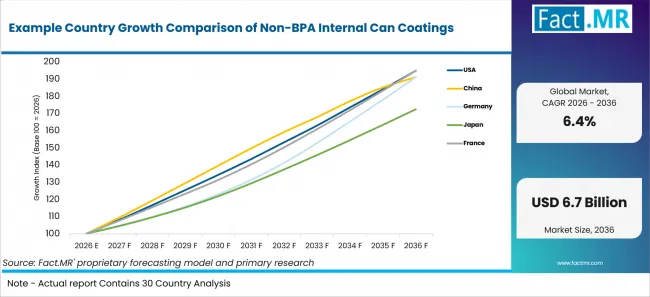
Example Country Growth Comparison Of Non Bpa Internal Can Coatings | Source: Fact.MR
| Country | CAGR (2026-2036) |
|---|---|
| United States | 6.9% |
| France | 6.9% |
| China | 6.7% |
| Germany | 6.7% |
| Japan | 5.6% |
What supports USA adoption?
6.9% CAGR, supported by packaged-food scale and regular can-lining qualification.
U.S. food companies use rigid packaging for many packaged foods. The U.S. Census Bureau reported in September 2026 that fruit and vegetable preserving and specialty food manufacturing recorded USD 94.31 billion in sales, shipments, or revenue in 2024 [4].
How is France developing demand?
6.9% CAGR, shaped by food-consumption scale and EU coating conversion schedules.
French can manufacturers follow EU food-contact rules and supply the local food market. Insee reported in May 2026 that French households spent EUR 192.8 billion on food and non-alcoholic drinks in 2025 [5]. This supports packaging use for preserved foods and drinks.
What supports China adoption?
6.7% CAGR, supported by packaged-food sales and broad beverage demand.
China has a large food market. The National Bureau of Statistics of China reported in January 2026 that retail sales of grain, oil, and food at larger businesses increased 9.3% in 2025 [6]. Higher packaged food sales increase can production.
What is supporting Germany’s adoption?
6.7% CAGR, reinforced by beverage production and EU food-contact compliance work.
Germany has a large beverage market that uses metal cans. Destatis reported in February 2026 that German breweries and beer warehouses sold about 7.8 billion liters of beer in 2025 [7]. Beverage cans need inner coatings that protect the drink and metal during storage.
How does Japan perform?
5.6% CAGR, supported by steady household spending and established packaged-goods channels.
Japan has a large packaged food and drink market that focuses on product quality. The Statistics Bureau of Japan reported in February 2026 that average monthly household spending reached JPY 314,001 in 2025 [8]. Steady consumer spending supports demand for packaged goods, including metal containers.
Who leads the Non-BPA Internal Can Coatings Market?
PPG supplies non-BPA inner coatings for food and beverage cans through Innovel® and Nutrishield®. Sherwin-Williams supplies valPure® coatings for food and beverage cans and ends. In April 2025, the company highlighted its valPure® V70 non-BPA epoxy coating. AkzoNobel supplies Accelshield™ BPAni coatings for beverage can bodies and ends.
In November 2025, AkzoNobel announced plans to introduce its Accelshield™ BPAni range in Brazil at Abralatas 2025. The range includes inner coatings for beverage can bodies and ends.
In April 2026, ACTEGA announced plans to present its metal packaging coatings and related products at METPACK 2026 in May. TOYOCHEM, part of the artience group, also supplies can coatings. In June 2026, the company announced that the “Draft Beer Can,” developed with Asahi Breweries using its can-coating technology, received a 2026 National Invention Award.
Henkel confirmed in 2025 that it sold its global Metal Packaging Coatings business on October 1, 2024. Suppliers offer coatings with different performance, food-contact requirements, and production needs. Buyers compare corrosion protection, heat resistance, and how well the coating works with can-making and filling processes.
Which companies are the key providers?
Key companies include PPG Industries; AkzoNobel; Sherwin-Williams; ACTEGA; and TOYOCHEM, an artience group company.
- PPG Industries
- AkzoNobel
- Sherwin-Williams
- ACTEGA
- TOYOCHEM (artience group)
Bibliography
- [1] European Commission. (2024, December 19). Commission Regulation (EU) 2024/3190 of 19 December 2024 on the use of bisphenol A (BPA) and other bisphenols and bisphenol derivatives with harmonised classification for specific hazardous properties in certain materials and articles intended to come into contact with food, amending Regulation (EU) No 10/2011 and repealing Regulation (EU) 2018/213.
- [2] PPG. (2025, July 21). PPG adds BPA-NI beverage can end coatings to PPG INNOVEL and PPG iSENSE series.
- [3] Davis, W. V., Weber, C., Wakefield, H., & Wechsler, S. J. (2025, April 24). Vegetables and pulses outlook: April 2025 (Report No. VGS-375). U.S. Department of Agriculture, Economic Research Service.
- [4] U.S. Census Bureau. (2026, September 3). Census Bureau releases new Annual Integrated Economic Survey data.
- [5] Institut national de la statistique et des études économiques. (2026, May 29). Consommation effective des ménages par fonction : Données annuelles 1965 et 2025.
- [6] National Bureau of Statistics of China. (2026, January 20). Total retail sales of consumer goods in December 2025.
- [7] Statistisches Bundesamt (Destatis). (2026, February 2). 6,0 % weniger Bier im Jahr 2025 abgesetzt [Beer sales down 6.0% in 2025].
- [8] Statistics Bureau of Japan. (2026, February 6). 2025 yearly average: Family Income and Expenditure Survey.
- [9] AkzoNobel Packaging Coatings. (2025, November 4). AkzoNobel introduces next-generation BPAni coatings to Brazilian beverage market at Abralatas 2025.
- [10] Sherwin-Williams. (2025, April 16). Discovering a new epoxy coating – How valPure® V70 changed the game.
- [11] ACTEGA. (2026, April 2). ACTEGA to showcase next-generation metal packaging solutions at METPACK 2026.
- [12] TOYOCHEM Co., Ltd. (2026, June 29). The “Draft Beer Can” using can coatings, jointly developed by TOYOCHEM and Asahi Breweries, won the 2026 National Invention Award.
- [13] Henkel AG & Co. KGaA. (2025, March 11). Annual report 2024.
This Report Answers
- The report explains where non-BPA internal can coatings are used across coating chemistry, package type, coating position, and performance requirements.
- Segment analysis identifies the leading 2026 subsegments and explains the operating reasons behind polyester, beverage cans, internal lining, and corrosion resistance.
- Country analysis compares the USA, France, China, Germany, and Japan using the listed CAGRs and one current official evidence point for each country.
What does the Non-BPA Internal Can Coatings Market cover?
The market covers protective coatings applied to product-contact surfaces inside beverage and food cans. It includes can ends, closures, aerosols, aluminum bottles, and tubes where the internal film protects metal or packed contents. Related Fact.MR analysis on metal cans helps place these coating systems within the wider rigid-metal packaging chain.
The assessment focuses on coating chemistry and package format. It also reviews where the coating sits inside the package and which performance requirement guides approval. Adjacent compostable heat-seal coatings provide a useful comparison for how functional coatings are qualified around package processing and barrier needs.
What is included in the scope?
The scope includes internal spray and related protective systems where non-BPA chemistry is central to the commercial offer. It covers food-contact use, retort processing, forming performance, corrosion control, product compatibility, and migration review. Beverage can bodies and ends are included alongside food cans, aerosol interiors, and tube linings when the coating serves a direct protective role.
The market also includes supplier support tied directly to coating qualification, such as line trials and food-contact documentation. Wider packaging trends remain adjacent context when they affect rigid metal package use and the need for protective internal films.
What is excluded from the scope?
External decorative coatings fall outside the market boundary when they serve only print appearance or branding. Raw aluminum and steel sheet, can-making machinery, printing inks, and stand-alone sealing compounds sit outside the revenue scope. BPA-based legacy epoxy linings are outside the defined non-BPA market, although their replacement remains relevant when explaining conversion activity.
Coatings used only on paper or board are outside the market boundary. Their process requirements remain adjacent context because both categories depend on stable film formation and controlled application during packaging conversion.
How Was the Analysis Built?
The analysis draws on 120+ sources, 35+ company portfolios, 25+ countries, and more than 20 industry interviews.
- Primary Research: Primary research includes discussions with manufacturers, service providers, technology developers, distributors, end users, and subject-matter experts. These conversations examine purchasing priorities, product adoption, operational challenges, approval requirements, competitive positioning, and the factors that influence wider market acceptance.
- Desk Research: Desk research covers government statistics, regulatory publications, company filings, trade data, technical studies, industry associations, standards, public policy, and other authoritative sources. Every source used in the analysis is documented in the bibliography.
- Market Sizing and Forecasting: Market estimates combine historical performance, demand indicators, pricing and volume trends, segment shares, company participation, country-level growth, adoption patterns, investment activity, and barriers to market expansion.
- Data Validation and Update Cycle: Findings are validated by comparing primary interviews with public data, company activity, regulatory changes, trade patterns, and industry developments. Regular updates review new product launches, capacity changes, partnerships, approvals, and shifts in commercial adoption.
What is the report’s scope and coverage?
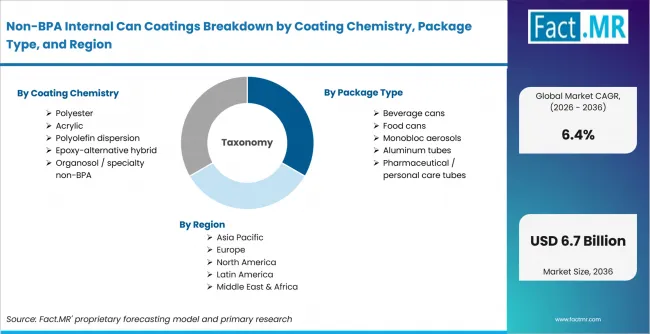
Non Bpa Internal Can Coatings Breakdown By Coating Chemistry, Package Type, And Region | Source: Fact.MR
| Attribute | Details |
|---|---|
| Quantitative Units | USD billion |
| Market Definition | Internal protective coatings for metal cans, can ends, aerosols, aluminum bottles, and tubes using non-BPA coating chemistry. |
| Coating Chemistry | Polyester; Acrylic; Polyolefin dispersion; Epoxy-alternative hybrid; Organosol / specialty non-BPA |
| Package Type | Beverage cans; Food cans; Monobloc aerosols; Aluminum tubes; Pharmaceutical / personal care tubes |
| Coating Position | Internal lining; Internal + end coating; Tube shoulder / body lining; Aerosol interior; Closure / end lining |
| Performance | Corrosion resistance; Product compatibility; Retort resistance; Flexibility / forming; Migration compliance |
| Regions Covered | North America; Latin America; Western Europe; Eastern Europe; East Asia; South Asia & Pacific; Middle East & Africa |
| Countries Covered | United States; France; China; Germany; Japan |
| Key Companies Profiled | PPG Industries; AkzoNobel; Sherwin-Williams; ACTEGA; TOYOCHEM |
| Forecast Period | 2026 to 2036 |
| Approach | Hybrid top-down and bottom-up approach using can applications, coating chemistry mix, country regulation, package-format demand, and active supplier portfolio review. |
How is the market segmented?
-
By Coating Chemistry:
- Polyester
- Acrylic
- Polyolefin dispersion
- Epoxy-alternative hybrid
- Organosol / Specialty Non-BPA
-
By Package Type:
- Beverage cans
- Food cans
- Monobloc aerosols
- Aluminum tubes
- Pharmaceutical / personal care tubes
-
By Coating Position:
- Internal lining
- Internal + End coating
- Tube shoulder / Body lining
- Aerosol interior
- Closure / End lining
-
By Performance:
- Corrosion resistance
- Product compatibility
- Retort resistance
- Flexibility / Forming
- Migration compliance
-
By Region:
- North America
- Latin America
- Western Europe
- Eastern Europe
- East Asia
- South Asia & Pacific
- Middle East & Africa