- Market Value (2025): USD 186.8 Mn
- Estimated Value (2026): USD 205.0 Mn
- Forecast Value (2036): USD 520.0 Mn
- CAGR (2026-2036): 9.8%
What is the Compostable Heat-Seal Coatings Market forecast to be worth by 2036?
USD 205.0 million in 2026 to USD 520.0 million by 2036 at 9.8% CAGR.
- The market surpassed a value of USD 186.8 million in 2025 as packaging companies moved from initial product trials to early commercial supply programs.
- Demand is projected to increase from USD 205.0 million to USD 520.0 million through 2036 as the use of paper-based packaging and certified compostable formats expands across foodservice applications.
- The market is forecast to record 9.8% CAGR as companies look for coatings that reduce plastic use while maintaining sealing performance and food-contact compliance.
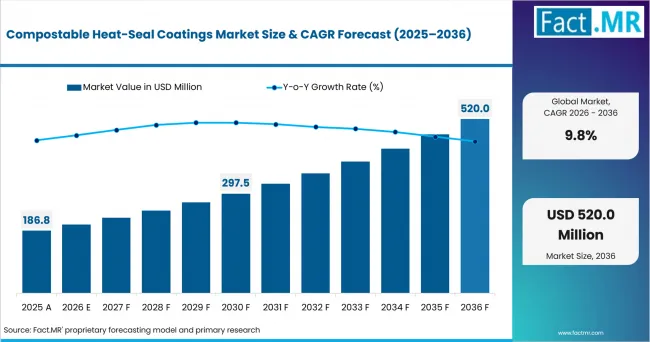
Compostable Heat Seal Coatings Market Value Analysis | Source: Fact.MR
What are the defining numbers behind Compostable Heat-Seal Coatings Market growth?
The USD 315.0 million absolute opportunity by 2036 is led by foodservice packaging.
- Demand Drivers in the Market
- Paper-based packaging is becoming more common as companies look for alternatives to plastic while maintaining good sealing performance.
- PHA-based coatings are being used more often because they fit well with compostable packaging requirements.
- Food wrappers are a major application due to their high usage and growing efforts to reduce plastic packaging.
- Foodservice companies are using compostable coatings to lower plastic content in packaging and support waste reduction programs.
- Key Segments Analyzed
- By Substrate: Paper accounts for 32% share in 2026. It remains the leading substrate because it works well with existing packaging operations and supports efforts to reduce plastic use.
- By Chemistry: PHA-based coatings represent 35% share in 2026. Their use is growing in compostable packaging applications where end-of-life requirements are important.
- By Application: Food wrappers lead with 33% share in 2026. Their high usage and direct contact with food make them a key area for reducing plastic packaging.
- By Certification: Home compostable certification captures a 41% share in 2026. It remains popular because the claim is easy for consumers to understand.
- By End Use: Foodservice contributes 36% share in 2026. Strong use in takeaway meals, quick-service restaurants, and catering supports its leading position.
- Analyst Opinion at Fact.MR
- Shambhu Nath Jha, Senior Analyst at Fact.MR, states, “Compostable coatings are becoming more common in paper-based packaging. They help provide reliable sealing while supporting efforts to reduce plastic use. Companies are more likely to choose products that work well on existing production lines and come with the required compliance documentation.”
- Strategic Implications
- Reliable sealing performance remains an important requirement for paper and paperboard packaging.
- New coatings should be tested against existing packaging materials to ensure they can meet sealing and food-contact requirements under normal use conditions.
- Clear technical documentation and certification records are important when working with large packaging companies.
- China is projected to record a 13.2% CAGR through 2036. India is expected to grow at a 12.2% CAGR during the forecast period. Germany is anticipated to expand at an 11.2% CAGR through 2036. Brazil is forecast to register a 10.2% CAGR over the same period. The United States is expected to post a 9.3% CAGR through 2036.
How does the Compostable Heat-Seal Coatings Market break down by segment?
Paper leads with 32% by substrate segment, while PHA-based holds 35% by chemistry.
Which Substrate dominates?
Paper holds 32% share in 2026.
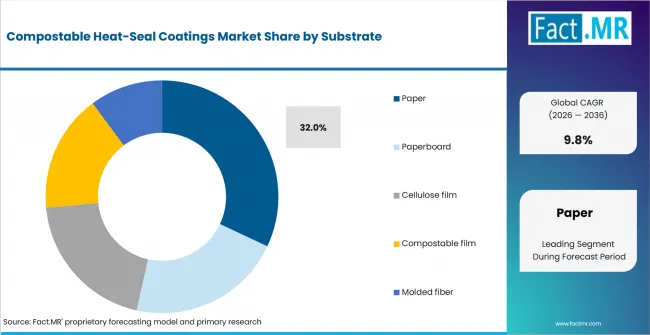
Compostable Heat Seal Coatings Market Analysis By Substrate | Source: Fact.MR
Paper leads because it is widely used across foodservice and bakery. Compostable coatings help improve sealing performance while reducing the need for conventional plastic layers. Paperboard, cellulose film and molded fiber are also used. However, paper remains the preferred choice across many packaging applications.
What leads the Chemistry segment?
PHA-based accounts for 35% share in 2026.
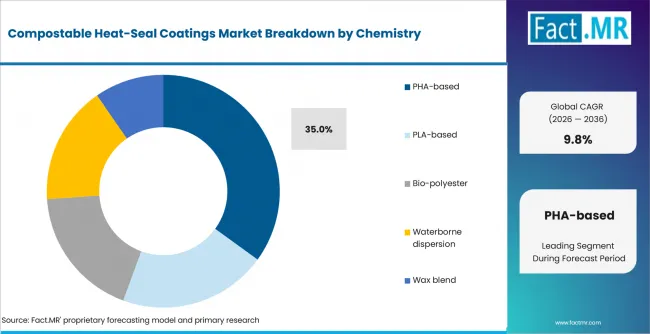
Compostable Heat Seal Coatings Market Analysis By Chemistry | Source: Fact.MR
PHA-based coatings are used in many compostable packaging applications. They are often selected for food packaging formats that require reliable sealing and support compostable packaging requirements. PLA-based coatings, bio-polyester systems, and wax blends continue to serve applications with different performance and cost needs.
How does Application shape demand?
Food wrappers lead with 33% share in 2026.
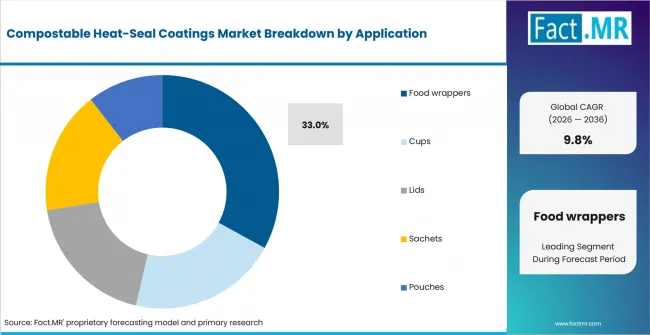
Compostable Heat Seal Coatings Market Analysis By Application | Source: Fact.MR
Food wrappers lead with 33% share in 2026. Their high usage and direct contact with food make them an important application for compostable coatings. A wrapper must perform well during packing and storage. Cups, lids, sachets, and pouches also create demand. Wrappers remain a common format for testing and approving new coating products.
Where is Certification demand strongest?
Home compostable holds 41% share in 2026.
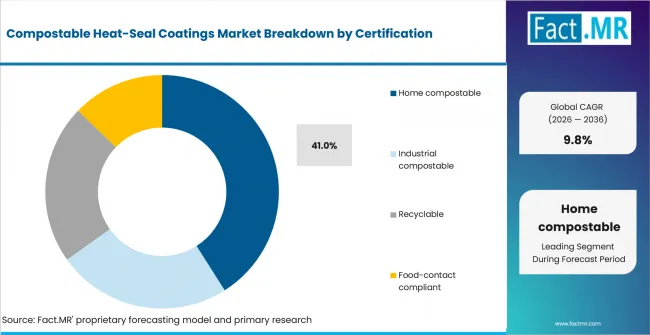
Compostable Heat Seal Coatings Market Analysis By Certification | Source: Fact.MR
Home compostable certification accounts for the largest share of the market. The certification is widely used because it is easy to communicate to consumers and supports packaging claims. Companies must still ensure that coatings perform well during production and sealing.
What supports End Use adoption?
Foodservice accounts for 36% share in 2026.
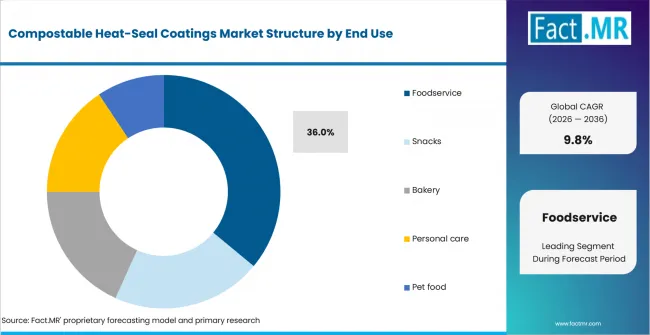
Compostable Heat Seal Coatings Market Analysis By End Use | Source: Fact.MR
Foodservice holds 36% share in 2026. Reliable sealing is important for packaging used in takeaway meals and catering services. The segment also provides opportunities to test new materials in daily operations. Snacks, personal care, and pet food applications create additional demand, although requirements differ across formats.
What is accelerating Compostable Heat-Seal Coatings Market adoption and what is holding it back?
Packaging policy, compostability requirements, and foodservice packaging changes support market growth. Qualification costs and production challenges may slow adoption.
Drivers Impact Analysis
| DRIVER | (~) % IMPACT ON CAGR | GEOGRAPHIC RELEVANCE | IMPACT TIMELINE |
|---|---|---|---|
| Flake quality control in Paper | +0.8% | China and export suppliers | Medium term (2-4 years) |
| Label release testing | +0.6% | Europe and North America | Short term (<= 2 years) |
| Foodservice packaging approval programs | +0.5% | Asia Pacific | Medium term (2-4 years) |
| Local support near label converters | +0.4% | Global | Long term (>= 4 years) |
Source: Fact.MR analysis. Updated Jul 14, 2026
- Flake quality control in paper: Packaging companies want materials that work well with recycling systems. Better-performing coatings can help reduce contamination concerns.
- Label release testing: Packaging materials are tested together before approval. Coatings need to perform well with labels, inks, and other packaging components.
- Foodservice packaging approval programs: Once a coating is approved for a packaging program, it can be used across multiple formats such as wrappers, cups, and lids.
- Local technical support: Local support helps with product testing, problem solving, and documentation. This can help speed up the approval process.
Opportunity Impact Analysis
| OPPORTUNITY | (~) % IMPACT ON CAGR | GEOGRAPHIC RELEVANCE | IMPACT TIMELINE |
|---|---|---|---|
| Grades tuned for Foodservice packaging | +0.5% | Global | Medium term (2-4 years) |
| Application labs for PHA-based | +0.4% | Asia Pacific and Europe | Short term (<= 2 years) |
| Rule-ready documentation | +0.4% | Europe and United Kingdom | Medium term (2-4 years) |
| Local trials | +0.3% | India and Brazil | Long term (>= 4 years) |
Source: Fact.MR analysis. Updated Jul 14, 2026
- Foodservice packaging grades: Companies can create opportunities by developing coatings designed for specific packaging formats such as wrappers and sachets.
- Application labs for PHA-based coatings: Application labs help companies test coating performance under real conditions and can help speed up product approval.
- Rule-ready documentation: Clear documentation is important for food-contact requirements, compostability certifications, packaging claims, and customer reviews.
- Local trials: Local trials help companies understand how coatings perform during normal handling and use. This can increase confidence before wider product adoption.
Restraints Impact Analysis
| RESTRAINT | (~) % IMPACT ON CAGR | GEOGRAPHIC RELEVANCE | IMPACT TIMELINE |
|---|---|---|---|
| Qualification cost | -0.4% | Global processors | Medium term (2-4 years) |
| Fit limits in PHA-based | -0.3% | Global | Short term (<= 2 years) |
| Documentation burden | -0.3% | Europe and North America | Medium term (2-4 years) |
| Scale-up risk | -0.2% | High-volume plants | Long term (>= 4 years) |
Source: Fact.MR analysis. Updated Jul 14, 2026
- Qualification cost: Qualification slows adoption because even small product changes often require testing and approvals.
- Fit limits in PHA-based coatings: PHA-based systems must meet performance and processing requirements. Any limitations can slow product use.
- Documentation burden: Companies need complete documents for approvals and product claims. Missing information can delay decisions.
- Scale-up risk: Products that perform well in testing may not always deliver the same results in large-scale production.
Which countries are scaling Compostable Heat-Seal Coatings Market fastest?
China 13.2%, India 12.2%, Germany 11.2%, Brazil 10.2%, United States 9.3%.
.webp "Top Country Growth Comparison Compostable Heat Seal Coatings Market Cagr (2026 2036)")
Top Country Growth Comparison Compostable Heat Seal Coatings Market Cagr (2026 2036) | Source: Fact.MR
| COUNTRY | CAGR |
|---|---|
| China | 13.2% |
| India | 12.2% |
| Germany | 11.2% |
| Brazil | 10.2% |
| United States | 9.3% |
Source: Fact.MR analysis. Updated Jul 14, 2026
What is driving China's growth through 2036?
13.2% CAGR, supported by packaging production and growing use of paper-based packaging.
China is expected to record a 13.2% CAGR by 2036. The country has a large packaging industry and strong demand from foodservice applications. More companies are using paper-based packaging as an alternative to conventional plastic materials.
How is India scaling demand?
12.2% CAGR, driven by growth in foodservice and takeaway packaging.
India records a 12.2% CAGR through 2036 as foodservice, packaged snacks, and bakery products continue to expand. Demand is also supported by the growing use of paper-based packaging. Companies are looking for coatings that offer reliable sealing at a practical cost. Food wrappers and quick-service packaging are expected to create strong opportunities during the forecast period.
What supports the Germany outlook?
11.2% CAGR, led by foodservice packaging and specialty paper applications.
Germany is forecast to grow at 11.2% CAGR by 2036. The market benefits from strong packaging standards and careful material evaluation processes. New products often go through detailed review before commercial use. Demand is expected to be strongest in applications where companies need certified packaging materials and practical alternatives to plastic-coated paper.
How is Brazil developing demand?
10.2% CAGR, backed by foodservice, bakery, and consumer packaging demand.
Brazil is expected to grow at 10.2% CAGR through 2036 as packaging demand continues to increase across several end-use industries. The market benefits from a large food and beverage sector and growing use of packaging that reduces dependence on conventional plastic materials. Growth may be gradual as cost and infrastructure challenges remain.
What underpins United States's growth?
9.3% CAGR, supported by foodservice packaging redesign and growing use of fiber-based alternatives.
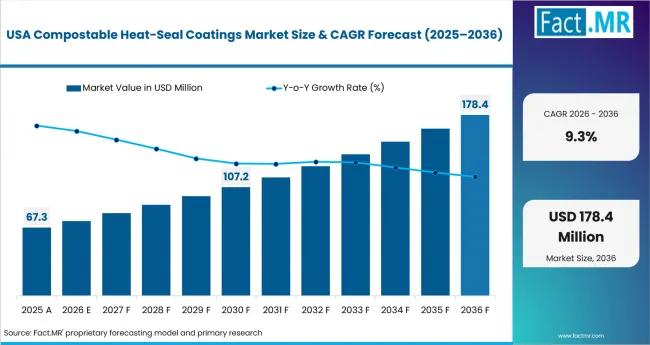
Compostable Heat Seal Coatings Market Country Value Analysis | Source: Fact.MR
The United States records a 9.3% CAGR from 2026 to 2036. Foodservice companies are redesigning packaging to reduce plastic use and increase the use of paper-based materials. Growth varies across the country as composting access and packaging rules differ by location. Documentation and certification remain important when companies evaluate new products. Demand is expected to be strongest in applications where packaging collection systems are already in place.
Who leads the Compostable Heat-Seal Coatings Market?
Solenis and Henkel are key participants in the market. BASF, ACTEGA, Michelman, and Kuraray also have a presence across compostable coating applications.
Solenis and Henkel are active in packaging coating solutions that support sealing performance and food-contact requirements. BASF and ACTEGA continue to serve packaging applications with a range of coating technologies.
Michelman and Kuraray are also part of the market. Competition is supported by seal performance, coating consistency, and compliance documentation. Companies that help customers move from product testing to regular commercial use are likely to be better positioned.
Which companies are the key providers?
Solenis and Henkel are key providers. BASF and ACTEGA are also profiled. Michelman and Kuraray complete the company set.
- Solenis
- Henkel
- BASF
- ACTEGA
- Michelman
- Kuraray
Bibliography
- Association of Plastic Recyclers. (2025). APR design guide overview.
- European Environment Agency. (2025). Biodegradable and compostable plastics.
- European Union. (2025). Regulation (EU) 2025/40 on packaging and packaging waste. EUR-Lex.
- National Bureau of Statistics of China. (2026). Industrial production press release.
- U.S. Department of Energy. (2025). Chemicals value chain decarbonization: Integrated solutions for a complex challenge.
This Report Addresses
- The report provides strategic intelligence on the market across substrate and chemistry choices.
- Regional outlook evaluates China and India with three additional growth countries.
- Competitive analysis profiles Solenis and Henkel followed by the remaining named providers.
- Use-case assessment covers foodservice packaging and adjacent applications in compostable packaging and heat-seal coatings.
- The market outlook considers packaging demand, compostable packaging trends, country growth patterns, activity, and product qualification requirements across key end-use applications.
What does the Compostable Heat-Seal Coatings Market cover?
The market covers paper, PHA-based chemistry, and foodservice packaging used in commercial applications.
It includes coatings used in compostable packaging and heat-seal coating systems. Market demand depends on coating performance, compatibility with packaging materials, and application requirements.
The scope excludes coating products that are not used for heat-sealability, compostability, or the packaging applications covered in this study.
What is included in the scope?
The scope includes compostable coatings that enable heat-sealability on paper, board, and flexible packaging substrates. Coverage spans paper, PHA-based chemistry, and foodservice packaging where customers buy the same function.
The market includes coatings used in wrappers, cups, lids, sachets, pouches, bakery packaging, snack packaging, personal care packaging, and pet food packaging. Only products that continue into regular commercial use after customer approval are included within the scope.
What is excluded from the scope?
Parent products are excluded when they are not sold for the stated role. Equipment-only offerings, converting machinery, packaging substrates without compostable heat-seal functionality, and unrelated coating products are not included in the market.
Commodity materials are also excluded unless they are sold as part of a compostable heat-seal coating system. Conventional plastic laminates, general wax coatings, and products without verified compostable performance fall outside the scope of this study.
How was the analysis built?
120+ sources, 35+ company portfolios, 25+ countries, and 20+ industry interviews.
- Primary Research: Primary research reflects discussions with formulators, buyers, distributors, converters, packaging engineers, and application teams working near compostable packaging and heat-seal coating systems.
- Desk Research: Desk research reviews public policy, technical literature, government data, standards guidance, packaging-waste references, recycling guidance, compostability discussions, and non-commercial safety or regulatory sources.
- Market-Sizing and Forecasting: Forecasting combines starting value, end value, growth rate, segment weight, company presence, country signals, application demand, pricing assumptions, and adoption barriers.
- Data Validation and Update Cycle: Forecast checks compare market activity with public policy, country-level developments, certification requirements, packaging demand, customer approval cycles, and known restraints. The update cycle reviews whether products are moving from trial use to regular commercial supply.
Segmentation
What is the report's scope and coverage?
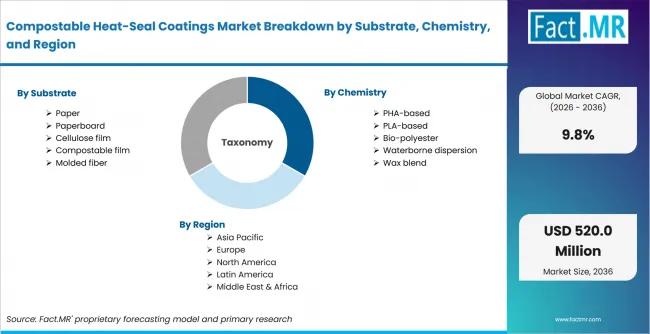
Compostable Heat Seal Coatings Market Breakdown By Substrate, Chemistry, And Region | Source: Fact.MR
| Attribute | Details |
|---|---|
| Quantitative Units | USD Million in 2026 to USD Million by 2036 at CAGR |
| Market Definition | Compostable coatings that enable heat-sealability on paper, board, and flexible packaging substrates. |
| Substrate | Paper, Paperboard, Cellulose film, Compostable film, Molded fiber |
| Chemistry | PHA-based, PLA-based, Bio-polyester, Waterborne dispersion, Wax blend |
| Application | Food wrappers, Cups, Lids, Sachets, Pouches |
| Certification | Home compostable, Industrial compostable, Recyclable, Food-contact compliant |
| End Use | Foodservice, Snacks, Bakery, Personal care, Pet food |
| Regions Covered | North America, Europe, Asia Pacific, Central and South America, Middle East and Africa |
| Countries Covered | China, India, Germany, Brazil, United States |
| Key Companies Profiled | Solenis, Henkel, BASF, ACTEGA, Michelman, Kuraray |
| Forecast Period | 2026 to 2036 |
| Approach | Hybrid top-down and bottom-up approach using compostable packaging, heat-seal coatings, segment shares, country growth, mapping, and technical validation |
Source: Fact.MR analysis. Updated Jul 14, 2026
How is the market segmented?
-
By Substrate:
- Paper
- Paperboard
- Cellulose film
- Compostable film
- Molded fiber
-
By Chemistry:
- PHA-based
- PLA-based
- Bio-polyester
- Waterborne dispersion
- Wax blend
-
By Application:
- Food wrappers
- Cups
- Lids
- Sachets
- Pouches
-
By Certification:
- Home compostable
- Industrial compostable
- Recyclable
- Food-contact compliant
-
By End Use:
- Foodservice
- Snacks
- Bakery
- Personal care
- Pet food
-
By Region:
- North America
- United States
- Canada
- Europe
- Germany
- United Kingdom
- France
- Italy
- Spain
- Asia Pacific
- China
- India
- Japan
- South Korea
- Australia
- Latin America
- Brazil
- Argentina
- Mexico
- Chile
- Middle East & Africa
- UAE
- Saudi Arabia
- South Africa
- North America
Frequently Asked Questions
Which Substrate leads the Compostable Heat-Seal Coatings Market?
Which Application leads the Compostable Heat-Seal Coatings Market?
Which country records the highest CAGR in the Compostable Heat-Seal Coatings Market?
What is the primary driver in the Compostable Heat-Seal Coatings Market?
What is the main restraint in the Compostable Heat-Seal Coatings Market?
Who worked on this report


Preview the report firsthand - request a free sample
Free SampleGet the brochure for pricing and purchase details
Download PDF