Oat Beta Glucan Market

Oat Beta Glucan Market Size and Share Forecast Outlook 2026 to 2036

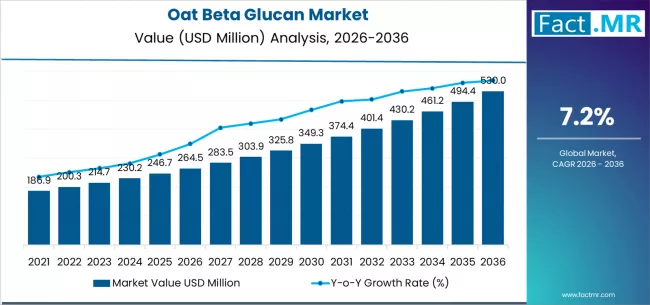
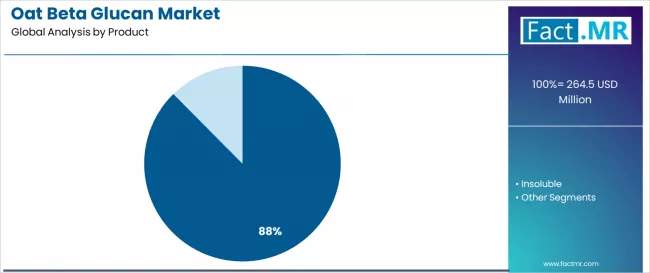
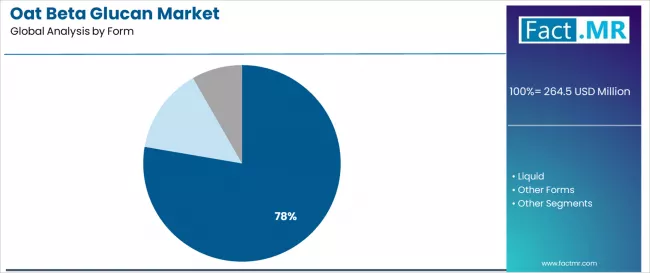
Oat beta glucan market is projected to grow from USD 264.5 million in 2026 to USD 530.0 million by 2036, at a CAGR of 7.2%. Soluble will dominate with a 87.6% market share, while powder will lead the form segment with a 77.7% share.

Oat Beta Glucan Market Forecast and Outlook 2026 to 2036

The global oat beta glucan market is set to grow from USD 264.5 million in 2026 to USD 530.0 million by 2036, advancing at a CAGR of 7.2%. Growth is driven by escalating demand for functional food ingredient validation, expanding health and wellness infrastructure across developed markets, and accelerating cholesterol management requirements among food and pharmaceutical organizations seeking scientifically-backed solutions.

Key Takeaways from Oat Beta Glucan Market

  • Oat Beta Glucan Market Value (2026): USD 264.5 million
  • Oat Beta Glucan Market Forecast Value (2036): USD 530.0 million
  • Oat Beta Glucan Market Forecast CAGR: 7.2%
  • Leading Product in Oat Beta Glucan Market: Soluble (87.6%)
  • Key Growth Regions in Oat Beta Glucan Market: Asia Pacific, North America, and Europe
  • Top Players in Oat Beta Glucan Market: Cargill Incorporated, Kerry Group plc., Tate & Lyle, Lantmännen Biorefineries, Swedish Oat Fiber AB
Oat Beta Glucan Market Market Value Analysis

Oat beta glucan technologies are increasingly recognized as essential ingredients for nutritional practitioners, offering precise cholesterol reduction capabilities, immune support assurance, and comprehensive health benefits characteristics compared to traditional dietary fiber approaches.

Soluble formulations dominate the market, favored in food and beverage environments for their established bioavailability properties, providing viscosity-forming mechanisms, heart health capabilities, and regulatory acceptance across diverse functional food applications and consumer demographics.

Powder form oat beta glucan remains fundamental in ingredient protocols where routine fortification and product development match operational requirements and formulation confidence standards. Soluble product users are advancing among ingredient categories as specialized functional food networks expand and health claim infrastructure increases accessibility in manufacturer-convenient locations with stringent regulatory structures.

Oat Beta Glucan Market

Metric Value
Market Value (2026) USD 264.5 million
Market Forecast (2036) USD 530.0 million
Growth Rate 7.2% CAGR

Category

Category Segments
Product Soluble; Insoluble
Form Powder; Liquid; Other Forms
End Use Personal Care and Cosmetics; Food and Beverage; Pharmaceuticals; Animal Health; Others
Region North America; Europe; Asia Pacific; Latin America; MEA

Segmental Analysis

What drives the Increasing Consumption of Soluble Oat Beta Glucan?
Oat Beta Glucan Market Analysis By Product

Soluble oat beta glucan commands the leading position in the market with an 87.6% market share. Growth is attributed to its superior bioavailability characteristics, including established cholesterol-lowering presence, extensive clinical documentation, and proven health claim pathways that enable manufacturers to achieve predictable functional outcomes across varied food categories and diverse consumer demographics.

The segment benefits from viscosity advantages through gel-forming capability optimization, cholesterol binding without complex delivery systems, and established FDA health claim documentation without requiring extensive regulatory procedures. Advanced extraction technology enables high-purity optimization, molecular weight variation, and solubility customization, where cholesterol reduction and immune support represent critical health requirements.

Which Form of Oat Beta Glucan is the Most Widely Consumed?
Oat Beta Glucan Market Analysis By Form

Powdered oat beta glucan demonstrates format leadership in the oat beta glucan market with a 77.7% share due to widespread processing requirements and established focus on dry blending, stability maintenance, and formulation flexibility that maximizes manufacturing convenience while maintaining consistent ingredient performance characteristics.

Manufacturers and formulators prioritize powder format for processing compatibility, storage stability, and integration with established production workflows that enables coordinated fortification experiences across multiple product protocols.

What Establishes Food & Beverage's Market Leadership in Oat Beta Glucan?
Oat Beta Glucan Market Analysis By End Use

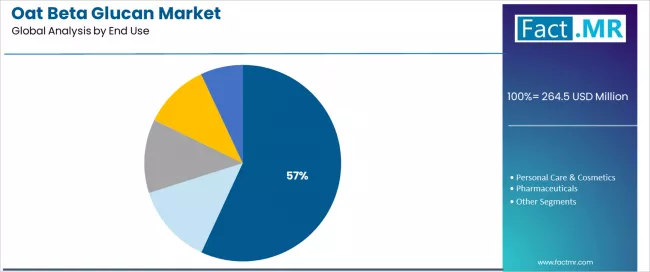
Food & beverage establishes market leadership in the oat beta glucan sector with a 56.9% share due to comprehensive functional food requirements and sustained focus on heart health positioning, cholesterol management claims, and clean label formulation that maximizes consumer appeal while maintaining appropriate nutritional standards.

Manufacturers and product developers prioritize food and beverage applications for health claim accessibility, consumer awareness benefits, and integration with wellness trend requirements that enables coordinated product experiences across multiple category platforms. The sector benefits from substantial regulatory pathway maturity and health claim guideline campaigns that emphasize food-based delivery for functional ingredient applications.

What are the Drivers, Restraints, and Key Trends of the Oat Beta Glucan Market?

The beta glucan market is driven by rising cardiovascular disease prevalence and increasing focus on cholesterol management through preventive nutrition. Growing awareness of heart health is supporting demand for beta glucan as a clinically recognized functional ingredient.

Expansion of functional foods with approved health claims is further accelerating adoption, as manufacturers prioritize science-backed and clean-label ingredients. Rapid growth in plant-based foods and dairy alternatives, particularly oat-based products, is also widening application scope.

Market restraints include high ingredient costs and extraction complexity, which limit use in price-sensitive food categories. Limited consumer awareness and low ingredient recognition create additional challenges, requiring education and clear benefit communication to support broader adoption.

Key trends include strong preference for organic and non-GMO beta glucan, driven by clean-label and sustainability priorities. Another important trend is the shift toward personalized nutrition, where beta glucan is positioned for targeted health benefits, supporting more precise and outcome-focused wellness applications.

Analysis of the Oat Beta Glucan Market by Key Countries
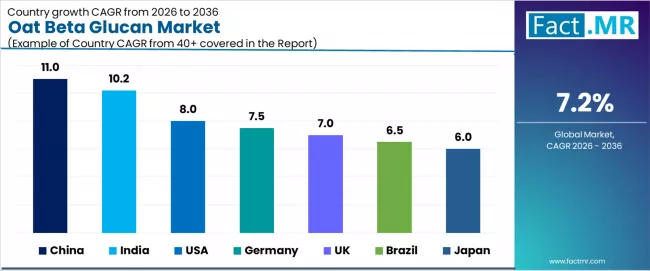
Oat Beta Glucan Market Cagr Analysis By Country

Country CAGR 2026-2036
China 11.0%
India 10.2%
USA 8.0%
Germany 7.5%
UK 7.0%
Brazil 6.5%
Japan 6.0%

Why is China Setting the Pace in Oat Beta Glucan Adoption?

China is emerging as the fastest-growing market for oat beta glucan ingredients, expanding at a CAGR of 11.0% through 2036, as functional foods move steadily into the mainstream. Rising middle-class health awareness, combined with growing concern around cardiovascular risk, is pushing food manufacturers to incorporate scientifically supported fibers into everyday products. Demand is strongest in large urban markets such as Shanghai, Beijing, and Guangzhou, where consumers increasingly expect clear health benefits rather than generic nutrition claims.

Manufacturers are blending imported beta glucan ingredients with locally developed food formats, supported by stronger nutrition education and clearer on-pack communication. This mix of scientific validation and mass-market food integration is what gives China its growth momentum.

How is India Translating Preventive Health Awareness into Nutraceutical Growth?

India’s oat beta glucan market is growing at a CAGR of 10.2%, driven by rising diabetes and cardiovascular prevalence and a rapid shift toward preventive nutrition. Functional foods and supplements are gaining traction not as premium indulgences, but as everyday health tools, especially in metro regions such as Mumbai, Delhi, and Bangalore.

Indian manufacturers tend to prioritise cost-effective formulations that still meet regulatory and efficacy expectations. This balance between affordability and functionality is enabling wider adoption across nutraceuticals, fortified foods, and wellness products aimed at middle-income consumers.

What gives the USA an Edge in Health Claim-Driven Growth?
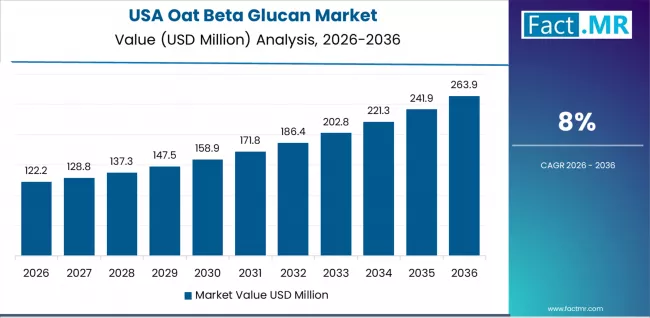
Oat Beta Glucan Market Country Value Analysis

The USA market is expanding at a CAGR of 8.0% shaped less by awareness creation and more by regulatory clarity. FDA-approved heart health and cholesterol-lowering claims give oat beta glucan a level of consumer trust that few functional ingredients enjoy. This has encouraged consistent use across cereals, baked goods, and dietary supplements.

Growth is anchored in established food manufacturing regions, where brands rely on well-documented clinical evidence to support premium positioning. The emphasis here is not novelty, but credibility and repeat consumption.

Why does Germany Lead in Quality-Focused Functional Foods?

Germany’s oat beta glucan market is growing at a CAGR of 7.5%, supported by a strong preference for clean-label, organic, and evidence-based nutrition. Functional foods in Germany tend to succeed when they align with broader values around ingredient transparency, sourcing integrity, and regulatory compliance.

Manufacturers place high importance on certified-organic status, purity documentation, and consistency in functional performance. This makes Germany a quality-driven market rather than a volume-driven one.

How is the UK Embedding Beta Glucan into Everyday Fiber Intake?

The UK market is expanding at a CAGR of 7.0%, driven by national dietary fibre awareness campaigns and steady demand for heart-healthy foods. Oat beta glucan is most commonly integrated into bakery products and breakfast cereals, where consumers already expect fibre enrichment.

Manufacturers focus heavily on compliant health claims and clear nutritional labelling, ensuring alignment with UK and EU guidelines. Growth here is incremental but stable, supported by strong consumer familiarity with oats and cholesterol-related messaging.

Why is Brazil Seeing Momentum through Bakery Fortification?

Brazil is recording a CAGR of 6.5%, with oat beta glucan adoption closely tied to bakery applications. Bread and baked goods remain staple foods, making them natural vehicles for fibre fortification and cholesterol-management positioning.

Producers prioritise ingredients that perform reliably under local processing conditions and remain affordable at scale. As nutrition awareness improves, beta glucan is increasingly seen as a practical upgrade rather than a niche functional add-on.

How is Japan Advancing Beta Glucan Use through Supplements?
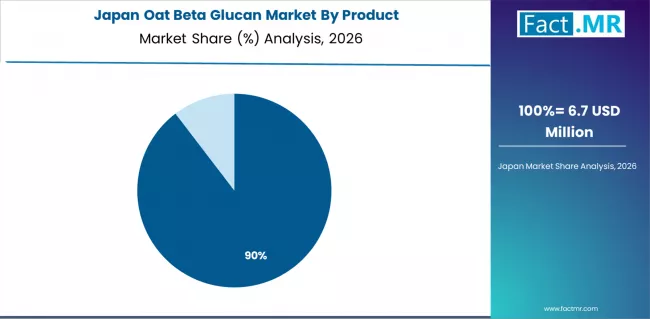
Oat Beta Glucan Market Japan Market Share Analysis By Product

Japan’s market is growing at a CAGR of 6.0%, shaped by an aging population and a long-standing emphasis on evidence-based functional foods. Oat beta glucan adoption is strongest in supplements and regulated functional products, where clinical validation and safety data carry significant weight.

Manufacturers often pursue pharmaceutical-grade specifications and formal approval pathways, reflecting Japan’s cautious but methodical approach to preventive nutrition. Growth is steady, disciplined, and firmly anchored in scientific credibility.

Competitive Landscape of the Oat Beta Glucan Market
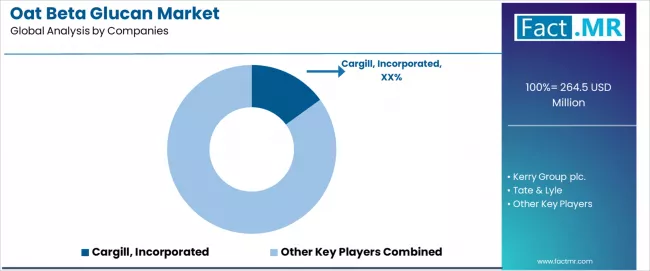
Oat Beta Glucan Market Analysis By Company

The oat beta glucan market is moderately consolidated, with an estimated 30–50 active participants operating across global food ingredient supply chains and regional processing networks. Competition reflects the maturity of functional fiber ingredients, where clinical substantiation, supply reliability, and application support are more decisive than price-led competition.

Cargill, Incorporated holds a leading position, supported by a broad portfolio of oat beta glucan grades, global sourcing capabilities, and strong relationships with food, beverage, and supplement manufacturers. Other established suppliers compete through consistent quality control, molecular weight standardization, and regulatory compliance supporting approved health claims in key markets. Application development expertise and formulation support further differentiate larger players.

Specialty ingredient companies and regional oat processors add competitive pressure through organic-certified products, clean-label positioning, and cost-competitive offerings. Differentiation is increasingly visible in organic grades, high-purity specifications, and pharmaceutical-grade applications. While conventional grades remain dominant in high-volume food uses, premium positioning favors suppliers offering validated health claims, traceable sourcing, and technical support across bakery, cereal, beverage, and nutraceutical formulations.

Key Players in the Oat Beta Glucan Market

  • Cargill, Incorporated
  • Kerry Group plc.
  • Tate & Lyle
  • Lantmännen Biorefineries
  • Swedish Oat Fiber AB
  • COSCIENS BIOPHARMA
  • Oy Karl Fazer Ab
  • Guangzhou Sinocon Food Co., Ltd.
  • L&P Food Ingredient Co., Ltd.
  • Nova Laboratories

Scope of the Report

Items Values
Quantitative Units (2026) USD 264.5 million
Product Soluble, Insoluble
Form Powder, Liquid, Other Forms
End Use Personal Care & Cosmetics, Food and Beverage, Pharmaceuticals, Animal Health, Others
Regions Covered North America, Europe, Asia Pacific, Latin America, MEA
Countries Covered USA, China, India, Germany, UK, France, Brazil, Japan, and 15+ additional countries
Key Companies Profiled Cargill Incorporated, Kerry Group plc., Tate & Lyle, Lantmännen Biorefineries, Swedish Oat Fiber AB, COSCIENS BIOPHARMA
Additional Attributes Dollar sales by product and form categories, regional adoption trends across Asia Pacific, North America, and Europe, competitive landscape with established ingredient corporations and specialized oat processors, manufacturer preferences for Soluble product and health claim validation, integration with food manufacturing facilities and pharmaceutical ingredient organizations, innovations in extraction technologies and organic certification platforms, and development of sophisticated functional ingredient systems with enhanced bioavailability profiles and comprehensive clinical documentation frameworks.

Oat Beta Glucan Market by Segments

  • Product :

    • Soluble
    • Insoluble
  • Form :

    • Powder
    • Liquid
    • Other Forms
  • End Use :

    • Personal Care & Cosmetics
    • Food and Beverage
    • Pharmaceuticals
    • Animal Health
    • Others
  • Region :

    • North America
      • USA
      • Canada
      • Mexico
    • Europe
      • Germany
      • France
      • UK
      • Italy
      • Spain
      • Rest of Europe
    • Asia Pacific
      • India
      • China
      • Japan
      • South Korea
      • ASEAN
      • Australia & New Zealand
      • Rest of Asia Pacific
    • Latin America
      • Brazil
      • Rest of Latin America
    • MEA
      • GCC Countries
      • South Africa
      • Rest of MEA

Table of Content

  1. Executive Summary
    • Global Market Outlook
    • Demand to side Trends
    • Supply to side Trends
    • Technology Roadmap Analysis
    • Analysis and Recommendations
  2. Market Overview
    • Market Coverage / Taxonomy
    • Market Definition / Scope / Limitations
  3. Market Background
    • Market Dynamics
      • Drivers
      • Restraints
      • Opportunity
      • Trends
    • Scenario Forecast
      • Demand in Optimistic Scenario
      • Demand in Likely Scenario
      • Demand in Conservative Scenario
    • Opportunity Map Analysis
    • Product Life Cycle Analysis
    • Supply Chain Analysis
    • Investment Feasibility Matrix
    • Value Chain Analysis
    • PESTLE and Porter’s Analysis
    • Regulatory Landscape
    • Regional Parent Market Outlook
    • Production and Consumption Statistics
    • Import and Export Statistics
  4. Global Market Analysis 2021 to 2025 and Forecast, 2026 to 2036
    • Historical Market Size Value (USD Million) Analysis, 2021 to 2025
    • Current and Future Market Size Value (USD Million) Projections, 2026 to 2036
      • Y to o to Y Growth Trend Analysis
      • Absolute $ Opportunity Analysis
  5. Global Market Pricing Analysis 2021 to 2025 and Forecast 2026 to 2036
  6. Global Market Analysis 2021 to 2025 and Forecast 2026 to 2036, By Product
    • Introduction / Key Findings
    • Historical Market Size Value (USD Million) Analysis By Product, 2021 to 2025
    • Current and Future Market Size Value (USD Million) Analysis and Forecast By Product, 2026 to 2036
      • Soluble
      • Insoluble
    • Y to o to Y Growth Trend Analysis By Product, 2021 to 2025
    • Absolute $ Opportunity Analysis By Product, 2026 to 2036
  7. Global Market Analysis 2021 to 2025 and Forecast 2026 to 2036, By Form
    • Introduction / Key Findings
    • Historical Market Size Value (USD Million) Analysis By Form, 2021 to 2025
    • Current and Future Market Size Value (USD Million) Analysis and Forecast By Form, 2026 to 2036
      • Powder
      • Liquid
      • Other Forms
    • Y to o to Y Growth Trend Analysis By Form, 2021 to 2025
    • Absolute $ Opportunity Analysis By Form, 2026 to 2036
  8. Global Market Analysis 2021 to 2025 and Forecast 2026 to 2036, By End Use
    • Introduction / Key Findings
    • Historical Market Size Value (USD Million) Analysis By End Use, 2021 to 2025
    • Current and Future Market Size Value (USD Million) Analysis and Forecast By End Use, 2026 to 2036
      • Food and Beverage
      • Personal Care & Cosmetics
      • Pharmaceuticals
      • Animal Health
      • Others
    • Y to o to Y Growth Trend Analysis By End Use, 2021 to 2025
    • Absolute $ Opportunity Analysis By End Use, 2026 to 2036
  9. Global Market Analysis 2021 to 2025 and Forecast 2026 to 2036, By Region
    • Introduction
    • Historical Market Size Value (USD Million) Analysis By Region, 2021 to 2025
    • Current Market Size Value (USD Million) Analysis and Forecast By Region, 2026 to 2036
      • North America
      • Latin America
      • Western Europe
      • Eastern Europe
      • East Asia
      • South Asia and Pacific
      • Middle East & Africa
    • Market Attractiveness Analysis By Region
  10. North America Market Analysis 2021 to 2025 and Forecast 2026 to 2036, By Country
    • Historical Market Size Value (USD Million) Trend Analysis By Market Taxonomy, 2021 to 2025
    • Market Size Value (USD Million) Forecast By Market Taxonomy, 2026 to 2036
      • By Country
        • USA
        • Canada
        • Mexico
      • By Product
      • By Form
      • By End Use
    • Market Attractiveness Analysis
      • By Country
      • By Product
      • By Form
      • By End Use
    • Key Takeaways
  11. Latin America Market Analysis 2021 to 2025 and Forecast 2026 to 2036, By Country
    • Historical Market Size Value (USD Million) Trend Analysis By Market Taxonomy, 2021 to 2025
    • Market Size Value (USD Million) Forecast By Market Taxonomy, 2026 to 2036
      • By Country
        • Brazil
        • Chile
        • Rest of Latin America
      • By Product
      • By Form
      • By End Use
    • Market Attractiveness Analysis
      • By Country
      • By Product
      • By Form
      • By End Use
    • Key Takeaways
  12. Western Europe Market Analysis 2021 to 2025 and Forecast 2026 to 2036, By Country
    • Historical Market Size Value (USD Million) Trend Analysis By Market Taxonomy, 2021 to 2025
    • Market Size Value (USD Million) Forecast By Market Taxonomy, 2026 to 2036
      • By Country
        • Germany
        • UK
        • Italy
        • Spain
        • France
        • Nordic
        • BENELUX
        • Rest of Western Europe
      • By Product
      • By Form
      • By End Use
    • Market Attractiveness Analysis
      • By Country
      • By Product
      • By Form
      • By End Use
    • Key Takeaways
  13. Eastern Europe Market Analysis 2021 to 2025 and Forecast 2026 to 2036, By Country
    • Historical Market Size Value (USD Million) Trend Analysis By Market Taxonomy, 2021 to 2025
    • Market Size Value (USD Million) Forecast By Market Taxonomy, 2026 to 2036
      • By Country
        • Russia
        • Poland
        • Hungary
        • Balkan & Baltic
        • Rest of Eastern Europe
      • By Product
      • By Form
      • By End Use
    • Market Attractiveness Analysis
      • By Country
      • By Product
      • By Form
      • By End Use
    • Key Takeaways
  14. East Asia Market Analysis 2021 to 2025 and Forecast 2026 to 2036, By Country
    • Historical Market Size Value (USD Million) Trend Analysis By Market Taxonomy, 2021 to 2025
    • Market Size Value (USD Million) Forecast By Market Taxonomy, 2026 to 2036
      • By Country
        • China
        • Japan
        • South Korea
      • By Product
      • By Form
      • By End Use
    • Market Attractiveness Analysis
      • By Country
      • By Product
      • By Form
      • By End Use
    • Key Takeaways
  15. South Asia and Pacific Market Analysis 2021 to 2025 and Forecast 2026 to 2036, By Country
    • Historical Market Size Value (USD Million) Trend Analysis By Market Taxonomy, 2021 to 2025
    • Market Size Value (USD Million) Forecast By Market Taxonomy, 2026 to 2036
      • By Country
        • India
        • ASEAN
        • Australia & New Zealand
        • Rest of South Asia and Pacific
      • By Product
      • By Form
      • By End Use
    • Market Attractiveness Analysis
      • By Country
      • By Product
      • By Form
      • By End Use
    • Key Takeaways
  16. Middle East & Africa Market Analysis 2021 to 2025 and Forecast 2026 to 2036, By Country
    • Historical Market Size Value (USD Million) Trend Analysis By Market Taxonomy, 2021 to 2025
    • Market Size Value (USD Million) Forecast By Market Taxonomy, 2026 to 2036
      • By Country
        • Kingdom of Saudi Arabia
        • Other GCC Countries
        • Turkiye
        • South Africa
        • Other African Union
        • Rest of Middle East & Africa
      • By Product
      • By Form
      • By End Use
    • Market Attractiveness Analysis
      • By Country
      • By Product
      • By Form
      • By End Use
    • Key Takeaways
  17. Key Countries Market Analysis
    • USA
      • Pricing Analysis
      • Market Share Analysis, 2025
        • By Product
        • By Form
        • By End Use
    • Canada
      • Pricing Analysis
      • Market Share Analysis, 2025
        • By Product
        • By Form
        • By End Use
    • Mexico
      • Pricing Analysis
      • Market Share Analysis, 2025
        • By Product
        • By Form
        • By End Use
    • Brazil
      • Pricing Analysis
      • Market Share Analysis, 2025
        • By Product
        • By Form
        • By End Use
    • Chile
      • Pricing Analysis
      • Market Share Analysis, 2025
        • By Product
        • By Form
        • By End Use
    • Germany
      • Pricing Analysis
      • Market Share Analysis, 2025
        • By Product
        • By Form
        • By End Use
    • UK
      • Pricing Analysis
      • Market Share Analysis, 2025
        • By Product
        • By Form
        • By End Use
    • Italy
      • Pricing Analysis
      • Market Share Analysis, 2025
        • By Product
        • By Form
        • By End Use
    • Spain
      • Pricing Analysis
      • Market Share Analysis, 2025
        • By Product
        • By Form
        • By End Use
    • France
      • Pricing Analysis
      • Market Share Analysis, 2025
        • By Product
        • By Form
        • By End Use
    • India
      • Pricing Analysis
      • Market Share Analysis, 2025
        • By Product
        • By Form
        • By End Use
    • ASEAN
      • Pricing Analysis
      • Market Share Analysis, 2025
        • By Product
        • By Form
        • By End Use
    • Australia & New Zealand
      • Pricing Analysis
      • Market Share Analysis, 2025
        • By Product
        • By Form
        • By End Use
    • China
      • Pricing Analysis
      • Market Share Analysis, 2025
        • By Product
        • By Form
        • By End Use
    • Japan
      • Pricing Analysis
      • Market Share Analysis, 2025
        • By Product
        • By Form
        • By End Use
    • South Korea
      • Pricing Analysis
      • Market Share Analysis, 2025
        • By Product
        • By Form
        • By End Use
    • Russia
      • Pricing Analysis
      • Market Share Analysis, 2025
        • By Product
        • By Form
        • By End Use
    • Poland
      • Pricing Analysis
      • Market Share Analysis, 2025
        • By Product
        • By Form
        • By End Use
    • Hungary
      • Pricing Analysis
      • Market Share Analysis, 2025
        • By Product
        • By Form
        • By End Use
    • Kingdom of Saudi Arabia
      • Pricing Analysis
      • Market Share Analysis, 2025
        • By Product
        • By Form
        • By End Use
    • Turkiye
      • Pricing Analysis
      • Market Share Analysis, 2025
        • By Product
        • By Form
        • By End Use
    • South Africa
      • Pricing Analysis
      • Market Share Analysis, 2025
        • By Product
        • By Form
        • By End Use
  18. Market Structure Analysis
    • Competition Dashboard
    • Competition Benchmarking
    • Market Share Analysis of Top Players
      • By Regional
      • By Product
      • By Form
      • By End Use
  19. Competition Analysis
    • Competition Deep Dive
      • Cargill, Incorporated
        • Overview
        • Product Portfolio
        • Profitability by Market Segments (Product/Age /Sales Channel/Region)
        • Sales Footprint
        • Strategy Overview
          • Marketing Strategy
          • Product Strategy
          • Channel Strategy
      • Kerry Group plc.
      • Tate & Lyle
      • Lantmännen Biorefineries
      • Swedish Oat Fiber AB
      • COSCIENS BIOPHARMA
      • Oy Karl Fazer Ab
      • Guangzhou Sinocon Food Co., Ltd.
      • L&P Food Ingredient Co., Ltd.
      • Nova Laboratories
  20. Assumptions & Acronyms Used
  21. Research Methodology

List Of Table

  • Table 1: Global Market Value (USD Million) Forecast by Region, 2021 to 2036
  • Table 2: Global Market Value (USD Million) Forecast by Product, 2021 to 2036
  • Table 3: Global Market Value (USD Million) Forecast by Form, 2021 to 2036
  • Table 4: Global Market Value (USD Million) Forecast by End Use, 2021 to 2036
  • Table 5: North America Market Value (USD Million) Forecast by Country, 2021 to 2036
  • Table 6: North America Market Value (USD Million) Forecast by Product, 2021 to 2036
  • Table 7: North America Market Value (USD Million) Forecast by Form, 2021 to 2036
  • Table 8: North America Market Value (USD Million) Forecast by End Use, 2021 to 2036
  • Table 9: Latin America Market Value (USD Million) Forecast by Country, 2021 to 2036
  • Table 10: Latin America Market Value (USD Million) Forecast by Product, 2021 to 2036
  • Table 11: Latin America Market Value (USD Million) Forecast by Form, 2021 to 2036
  • Table 12: Latin America Market Value (USD Million) Forecast by End Use, 2021 to 2036
  • Table 13: Western Europe Market Value (USD Million) Forecast by Country, 2021 to 2036
  • Table 14: Western Europe Market Value (USD Million) Forecast by Product, 2021 to 2036
  • Table 15: Western Europe Market Value (USD Million) Forecast by Form, 2021 to 2036
  • Table 16: Western Europe Market Value (USD Million) Forecast by End Use, 2021 to 2036
  • Table 17: Eastern Europe Market Value (USD Million) Forecast by Country, 2021 to 2036
  • Table 18: Eastern Europe Market Value (USD Million) Forecast by Product, 2021 to 2036
  • Table 19: Eastern Europe Market Value (USD Million) Forecast by Form, 2021 to 2036
  • Table 20: Eastern Europe Market Value (USD Million) Forecast by End Use, 2021 to 2036
  • Table 21: East Asia Market Value (USD Million) Forecast by Country, 2021 to 2036
  • Table 22: East Asia Market Value (USD Million) Forecast by Product, 2021 to 2036
  • Table 23: East Asia Market Value (USD Million) Forecast by Form, 2021 to 2036
  • Table 24: East Asia Market Value (USD Million) Forecast by End Use, 2021 to 2036
  • Table 25: South Asia and Pacific Market Value (USD Million) Forecast by Country, 2021 to 2036
  • Table 26: South Asia and Pacific Market Value (USD Million) Forecast by Product, 2021 to 2036
  • Table 27: South Asia and Pacific Market Value (USD Million) Forecast by Form, 2021 to 2036
  • Table 28: South Asia and Pacific Market Value (USD Million) Forecast by End Use, 2021 to 2036
  • Table 29: Middle East & Africa Market Value (USD Million) Forecast by Country, 2021 to 2036
  • Table 30: Middle East & Africa Market Value (USD Million) Forecast by Product, 2021 to 2036
  • Table 31: Middle East & Africa Market Value (USD Million) Forecast by Form, 2021 to 2036
  • Table 32: Middle East & Africa Market Value (USD Million) Forecast by End Use, 2021 to 2036

List Of Figures

  • Figure 1: Global Market Pricing Analysis
  • Figure 2: Global Market Value (USD Million) Forecast 2021 to 2036
  • Figure 3: Global Market Value Share and BPS Analysis by Product, 2026 and 2036
  • Figure 4: Global Market Y to o to Y Growth Comparison by Product, 2026 to 2036
  • Figure 5: Global Market Attractiveness Analysis by Product
  • Figure 6: Global Market Value Share and BPS Analysis by Form, 2026 and 2036
  • Figure 7: Global Market Y to o to Y Growth Comparison by Form, 2026 to 2036
  • Figure 8: Global Market Attractiveness Analysis by Form
  • Figure 9: Global Market Value Share and BPS Analysis by End Use, 2026 and 2036
  • Figure 10: Global Market Y to o to Y Growth Comparison by End Use, 2026 to 2036
  • Figure 11: Global Market Attractiveness Analysis by End Use
  • Figure 12: Global Market Value (USD Million) Share and BPS Analysis by Region, 2026 and 2036
  • Figure 13: Global Market Y to o to Y Growth Comparison by Region, 2026 to 2036
  • Figure 14: Global Market Attractiveness Analysis by Region
  • Figure 15: North America Market Incremental Dollar Opportunity, 2026 to 2036
  • Figure 16: Latin America Market Incremental Dollar Opportunity, 2026 to 2036
  • Figure 17: Western Europe Market Incremental Dollar Opportunity, 2026 to 2036
  • Figure 18: Eastern Europe Market Incremental Dollar Opportunity, 2026 to 2036
  • Figure 19: East Asia Market Incremental Dollar Opportunity, 2026 to 2036
  • Figure 20: South Asia and Pacific Market Incremental Dollar Opportunity, 2026 to 2036
  • Figure 21: Middle East & Africa Market Incremental Dollar Opportunity, 2026 to 2036
  • Figure 22: North America Market Value Share and BPS Analysis by Country, 2026 and 2036
  • Figure 23: North America Market Value Share and BPS Analysis by Product, 2026 and 2036
  • Figure 24: North America Market Y to o to Y Growth Comparison by Product, 2026 to 2036
  • Figure 25: North America Market Attractiveness Analysis by Product
  • Figure 26: North America Market Value Share and BPS Analysis by Form, 2026 and 2036
  • Figure 27: North America Market Y to o to Y Growth Comparison by Form, 2026 to 2036
  • Figure 28: North America Market Attractiveness Analysis by Form
  • Figure 29: North America Market Value Share and BPS Analysis by End Use, 2026 and 2036
  • Figure 30: North America Market Y to o to Y Growth Comparison by End Use, 2026 to 2036
  • Figure 31: North America Market Attractiveness Analysis by End Use
  • Figure 32: Latin America Market Value Share and BPS Analysis by Country, 2026 and 2036
  • Figure 33: Latin America Market Value Share and BPS Analysis by Product, 2026 and 2036
  • Figure 34: Latin America Market Y to o to Y Growth Comparison by Product, 2026 to 2036
  • Figure 35: Latin America Market Attractiveness Analysis by Product
  • Figure 36: Latin America Market Value Share and BPS Analysis by Form, 2026 and 2036
  • Figure 37: Latin America Market Y to o to Y Growth Comparison by Form, 2026 to 2036
  • Figure 38: Latin America Market Attractiveness Analysis by Form
  • Figure 39: Latin America Market Value Share and BPS Analysis by End Use, 2026 and 2036
  • Figure 40: Latin America Market Y to o to Y Growth Comparison by End Use, 2026 to 2036
  • Figure 41: Latin America Market Attractiveness Analysis by End Use
  • Figure 42: Western Europe Market Value Share and BPS Analysis by Country, 2026 and 2036
  • Figure 43: Western Europe Market Value Share and BPS Analysis by Product, 2026 and 2036
  • Figure 44: Western Europe Market Y to o to Y Growth Comparison by Product, 2026 to 2036
  • Figure 45: Western Europe Market Attractiveness Analysis by Product
  • Figure 46: Western Europe Market Value Share and BPS Analysis by Form, 2026 and 2036
  • Figure 47: Western Europe Market Y to o to Y Growth Comparison by Form, 2026 to 2036
  • Figure 48: Western Europe Market Attractiveness Analysis by Form
  • Figure 49: Western Europe Market Value Share and BPS Analysis by End Use, 2026 and 2036
  • Figure 50: Western Europe Market Y to o to Y Growth Comparison by End Use, 2026 to 2036
  • Figure 51: Western Europe Market Attractiveness Analysis by End Use
  • Figure 52: Eastern Europe Market Value Share and BPS Analysis by Country, 2026 and 2036
  • Figure 53: Eastern Europe Market Value Share and BPS Analysis by Product, 2026 and 2036
  • Figure 54: Eastern Europe Market Y to o to Y Growth Comparison by Product, 2026 to 2036
  • Figure 55: Eastern Europe Market Attractiveness Analysis by Product
  • Figure 56: Eastern Europe Market Value Share and BPS Analysis by Form, 2026 and 2036
  • Figure 57: Eastern Europe Market Y to o to Y Growth Comparison by Form, 2026 to 2036
  • Figure 58: Eastern Europe Market Attractiveness Analysis by Form
  • Figure 59: Eastern Europe Market Value Share and BPS Analysis by End Use, 2026 and 2036
  • Figure 60: Eastern Europe Market Y to o to Y Growth Comparison by End Use, 2026 to 2036
  • Figure 61: Eastern Europe Market Attractiveness Analysis by End Use
  • Figure 62: East Asia Market Value Share and BPS Analysis by Country, 2026 and 2036
  • Figure 63: East Asia Market Value Share and BPS Analysis by Product, 2026 and 2036
  • Figure 64: East Asia Market Y to o to Y Growth Comparison by Product, 2026 to 2036
  • Figure 65: East Asia Market Attractiveness Analysis by Product
  • Figure 66: East Asia Market Value Share and BPS Analysis by Form, 2026 and 2036
  • Figure 67: East Asia Market Y to o to Y Growth Comparison by Form, 2026 to 2036
  • Figure 68: East Asia Market Attractiveness Analysis by Form
  • Figure 69: East Asia Market Value Share and BPS Analysis by End Use, 2026 and 2036
  • Figure 70: East Asia Market Y to o to Y Growth Comparison by End Use, 2026 to 2036
  • Figure 71: East Asia Market Attractiveness Analysis by End Use
  • Figure 72: South Asia and Pacific Market Value Share and BPS Analysis by Country, 2026 and 2036
  • Figure 73: South Asia and Pacific Market Value Share and BPS Analysis by Product, 2026 and 2036
  • Figure 74: South Asia and Pacific Market Y to o to Y Growth Comparison by Product, 2026 to 2036
  • Figure 75: South Asia and Pacific Market Attractiveness Analysis by Product
  • Figure 76: South Asia and Pacific Market Value Share and BPS Analysis by Form, 2026 and 2036
  • Figure 77: South Asia and Pacific Market Y to o to Y Growth Comparison by Form, 2026 to 2036
  • Figure 78: South Asia and Pacific Market Attractiveness Analysis by Form
  • Figure 79: South Asia and Pacific Market Value Share and BPS Analysis by End Use, 2026 and 2036
  • Figure 80: South Asia and Pacific Market Y to o to Y Growth Comparison by End Use, 2026 to 2036
  • Figure 81: South Asia and Pacific Market Attractiveness Analysis by End Use
  • Figure 82: Middle East & Africa Market Value Share and BPS Analysis by Country, 2026 and 2036
  • Figure 83: Middle East & Africa Market Value Share and BPS Analysis by Product, 2026 and 2036
  • Figure 84: Middle East & Africa Market Y to o to Y Growth Comparison by Product, 2026 to 2036
  • Figure 85: Middle East & Africa Market Attractiveness Analysis by Product
  • Figure 86: Middle East & Africa Market Value Share and BPS Analysis by Form, 2026 and 2036
  • Figure 87: Middle East & Africa Market Y to o to Y Growth Comparison by Form, 2026 to 2036
  • Figure 88: Middle East & Africa Market Attractiveness Analysis by Form
  • Figure 89: Middle East & Africa Market Value Share and BPS Analysis by End Use, 2026 and 2036
  • Figure 90: Middle East & Africa Market Y to o to Y Growth Comparison by End Use, 2026 to 2036
  • Figure 91: Middle East & Africa Market Attractiveness Analysis by End Use
  • Figure 92: Global Market - Tier Structure Analysis
  • Figure 93: Global Market - Company Share Analysis

- FAQs -

How big is the oat beta glucan market in 2026?

The global oat beta glucan market is estimated to be valued at USD 264.5 million in 2026.

What will be the size of oat beta glucan market in 2036?

The market size for the oat beta glucan market is projected to reach USD 530.0 million by 2036.

How much will be the oat beta glucan market growth between 2026 and 2036?

The oat beta glucan market is expected to grow at a 7.2% CAGR between 2026 and 2036.

What are the key product types in the oat beta glucan market?

The key product types in oat beta glucan market are soluble and insoluble.

Which form segment to contribute significant share in the oat beta glucan market in 2026?

In terms of form, powder segment to command 77.7% share in the oat beta glucan market in 2026.

Oat Beta Glucan Market