- Base Value(2025): 69.4 Mn
- Estimated Value(2026): 73.5 Mn
- Forecast Value (2036): 130.4 Mn
- CAGR (2026 - 2036): 5.9%
Oat Oil Market Analysis and Forecast by Fact.MR
According to Fact.MR estimates, the global oat oil market market was valued at USD 69.4 million in 2025. The market is projected to reach USD 73.5 million in 2026 and is expected to grow to USD 130.4 million by 2036, expanding at a CAGR of 5.9%. Refined Oat Oil is anticipated to account for 36.0% of the product segment in 2026, while Conventional Oats is expected to remain the leading application with around 52.0% share.
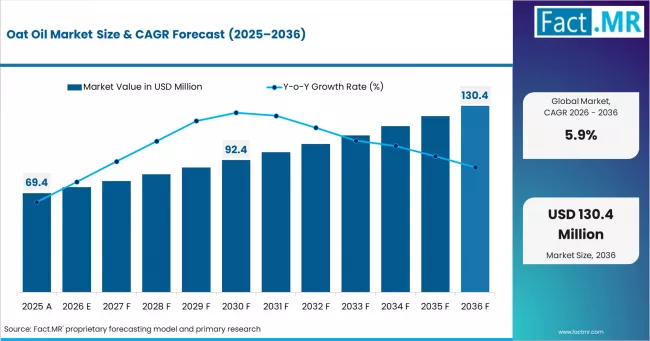
Oat Oil Market Value Analysis | Source: Fact.MR
Summary of Oat Oil Market
- Market Snapshot
- The Oat Oil market was valued at USD 69.4 million in 2025.
- By 2036, the Oat Oil market is expected to be worth USD 130.38 million.
- From 2026 to 2036, the market is projected to expand at a CAGR of 5.9%.
- The market is projected to create an incremental opportunity of USD 56.89 million between 2026 and 2036.
- In 2026, Refined Oat Oil is expected to account for 36% of the product segment, driven by cosmetic-grade and food-grade applications across personal care, functional food, and pharmaceutical formulations.
- India (7.6%) and China (7.5%) are two of the fastest-growing markets in the world.
- Demand and Growth Drivers
- Demand is shaped by expanding use in personal care and cosmetics, where oat oil serves as a natural emollient with skin-soothing, moisturizing, and barrier-repair properties valued in premium skin care, hair care, and body care formulations.
- Growth reflects rising adoption in functional foods and nutraceuticals, where oat lipid extracts provide beta-glucan-enriched oil and ceramide content that aligns with health-conscious consumer demand for functional nutrition.
- Adoption is increasing due to growing formulator preference for plant-derived, clean-label, and sustainable lipid ingredients across personal care, food, and pharmaceutical applications.
- Product and Segment View
- Refined Oat Oil leads the product segment at 36% share in 2026, covering cosmetic-grade and food-grade refined oat oil used in skin care, hair care, and functional food formulations.
- Personal Care and Cosmetics leads the application segment at 42% share in 2026, driven by premium skin care, hair care, and body lotion formulations using oat oil for its emollient and barrier-repair properties.
- Cosmetic Manufacturers account for 38% of end-use demand in 2026, reflecting concentrated procurement by premium skin care brands and mass-market personal care companies.
- Geography and Competitive Outlook
- Asia Pacific leads growth, with India at a 7.6% CAGR and China at 7.5%, driven by expanding personal care manufacturing, growing functional food adoption, and increasing demand for plant-derived cosmetic ingredients.
- Europe contributes steadily with Germany (5.9%), sustained by established personal care and pharmaceutical demand and growing natural ingredient adoption.
- North America grows with the United States (5.8%) and UK (5.2%), driven by clean-label cosmetic and functional food demand. Leading players include Oat Cosmetics, Charkit Chemical, COSCIENS Biopharma, Fazer Mills, and Givaudan.
- Analyst Opinion
- Oat oil occupies a specialist niche in the plant lipid ingredient market, positioned at the intersection of personal care, functional food, and pharmaceutical applications. Its commercial value is anchored by two properties: skin barrier support from natural ceramides and beta-glucan content, and consumer appeal of oat as a clean-label, hypoallergenic, and sustainable ingredient. The market is small but growing steadily, and the competitive landscape is fragmented with no dominant player. Oat Cosmetics has positioned itself as the specialist leader, but larger ingredient firms like Givaudan are building oat lipid capability. The strategic question is whether oat oil remains a specialty niche or scales into mainstream personal care and functional food ingredient supply.
Why is the Oat Oil Market Growing?
- Personal care and cosmetics formulation demand for natural, plant-derived emollients with skin-soothing and barrier-repair properties sustains oat oil adoption in premium and mass-market skin care.
- Functional food and nutraceutical adoption is growing as consumers seek beta-glucan and ceramide-enriched oils for heart health and skin health benefits.
- Clean-label and sustainability trends drive formulator preference for oat-derived lipid ingredients over synthetic alternatives.
Personal care demand is the primary driver. Oat oil provides natural ceramides, antioxidants, and lipid content that support skin barrier function, moisture retention, and soothing properties for sensitive skin. Premium skin care brands and dermatological product lines increasingly specify oat oil as a key functional ingredient.
Functional food adoption is the second driver. Oat lipid extracts containing beta-glucan and natural ceramides are being incorporated into health beverages, nutritional oils, and functional food products aimed at cardiovascular and skin health consumers.
Clean-label preference is the third driver. Formulators across personal care and food industries increasingly prefer plant-derived, minimally processed ingredients over synthetic alternatives, and oat oil aligns with consumer demand for recognizable, natural-origin ingredients.
Segment-wise Analysis of Oat Oil Market
- Refined Oat Oil leads at 36% share in 2026, covering cosmetic-grade and food-grade applications.
- Personal Care and Cosmetics leads applications at 42% share in 2026.
- Cold Press Extraction leads the extraction technology segment at 34% share in 2026.
The market segments across product, source, extraction technology, application, end use, and region. Product coverage includes refined, unrefined, fractionated, kernel, lipid extract, and blended oat oil. Source coverage includes conventional, organic, and specialty oat varieties.
Refined Oat Oil Leads the Product Segment

Oat Oil Market Analysis By Product | Source: Fact.MR
Refined oat oil accounts for 36% of product revenue in 2026, including cosmetic-grade refined oil used in skin care and hair care formulations and food-grade refined oil used in functional food and nutritional products. Refining processes produce a stable, light-colored oil suitable for premium formulations.
Unrefined oat oil and oat lipid extracts represent the second and third product pools. Cold-pressed unrefined oil retains higher nutrient content and serves organic and clean-label formulations. Oat lipid extracts including natural ceramide oil and beta-glucan enriched oil serve specialty pharmaceutical and nutraceutical applications.
Personal Care and Cosmetics Leads the Application Segment
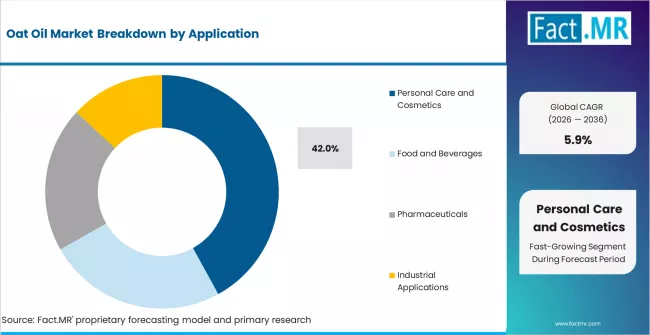
Oat Oil Market Analysis By Application | Source: Fact.MR
Personal care and cosmetics accounts for 42% of application demand in 2026, covering skin care products, hair care products, body lotions, and dermatological formulations. Oat oil is valued for its emollient properties, skin barrier support, and hypoallergenic profile.
Food and beverages, pharmaceuticals, and industrial applications represent additional pools. Functional food applications including health beverages and nutritional oils are growing as consumer interest in oat-based health products expands.
Key Growth Drivers, Constraints, and Market Scope
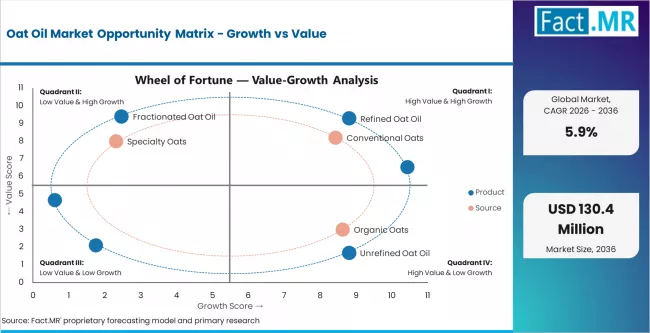
Oat Oil Market Opportunity Matrix Growth Vs Value | Source: Fact.MR
- Personal care demand, functional food adoption, and clean-label trends create structural growth.
- Limited oat oil supply infrastructure, higher cost versus conventional plant oils, and formulator education needs constrain scaling.
- Premium skin care positioning and nutraceutical capsule development represent the highest-value growth opportunities.
The oat oil market is a specialty plant lipid category with growing demand across personal care, functional food, and pharmaceutical applications.
Growth Drivers
Three forces drive growth: expanding personal care formulation demand for natural emollients, growing functional food adoption of beta-glucan and ceramide-enriched oils, and clean-label preference for plant-derived lipid ingredients.
Constraints
Limited oat oil extraction infrastructure constrains supply scaling. Higher cost per liter versus conventional oils like sunflower, olive, and jojoba limits adoption in cost-sensitive formulations. Formulator education on oat oil functionality and differentiated benefits requires supplier investment.
Opportunities
Premium skin care positioning commands the highest value per unit and supports continued growth. Nutraceutical capsule development for skin and cardiovascular health creates new product formats. Expansion into mass-market personal care through private-label adoption broadens the addressable market.
Regional Outlook Across Key Markets
.webp "Top Country Growth Comparison Oat Oil Market Cagr (2026 2036)")
Top Country Growth Comparison Oat Oil Market Cagr (2026 2036) | Source: Fact.MR
- Asia Pacific leads with India (7.6%) and China (7.5%), driven by personal care manufacturing expansion and growing functional food adoption.
- Europe contributes with Germany (5.9%), sustained by established cosmetic and pharmaceutical demand.
- North America grows with the United States (5.8%) and UK (5.2%), driven by clean-label cosmetic demand.
| Country | CAGR (2026-2036) |
|---|---|
| India | 7.6% |
| China | 7.5% |
| Germany | 5.9% |
| United States | 5.8% |
| United Kingdom | 5.2% |
Source: Fact.MR analysis. Updated Apr 27, 2026
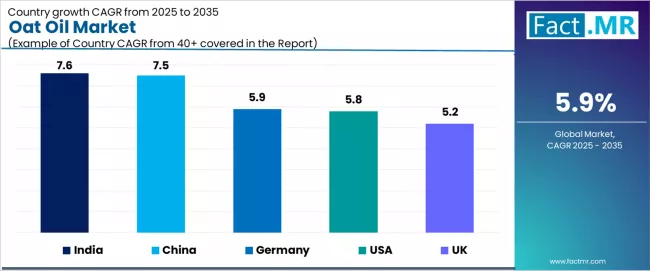
Oat Oil Market Cagr Analysis By Country | Source: Fact.MR
Regional performance reflects personal care manufacturing concentration, functional food market maturity, and natural ingredient adoption trends.
India
India records a 7.6% CAGR through 2036. Expanding personal care manufacturing capacity and growing domestic demand for natural cosmetic ingredients support growth.
- Expanding personal care manufacturing drives demand for plant-derived cosmetic ingredients.
- Growing domestic functional food market supports oat oil adoption.
- Cost-competitive extraction and processing capacity supports production scaling.
China
China records a 7.5% CAGR through 2036. Growing premium personal care demand and expanding functional food manufacturing support oat oil adoption.
- Premium personal care market growth drives demand for natural emollient ingredients.
- Functional food and nutraceutical manufacturing expansion supports oat lipid adoption.
- Domestic extraction and ingredient processing capacity is expanding.
Germany
Germany posts a 5.9% CAGR through 2036. Established personal care and pharmaceutical demand and growing natural ingredient adoption sustain growth.
- Established personal care and pharmaceutical formulation demand sustains oat oil procurement.
- Growing natural and organic ingredient preference supports clean-label positioning.
- Givaudan and other German ingredient firms support domestic supply.
United States
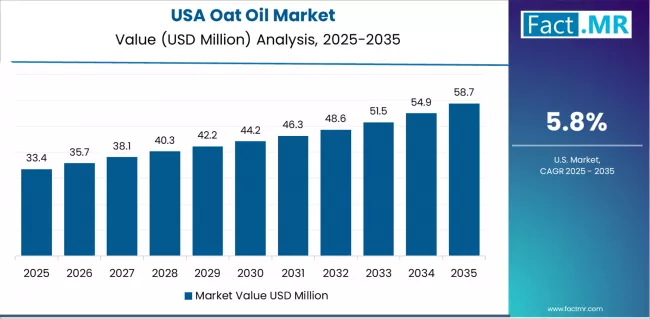
Oat Oil Market Country Value Analysis | Source: Fact.MR
The United States records a 5.8% CAGR through 2036. Clean-label cosmetic and functional food demand support growing oat oil adoption.
- Clean-label personal care demand drives oat oil adoption in premium skin care.
- Functional food and nutraceutical adoption creates additional demand channels.
- Charkit Chemical and other U.S. distributors support domestic supply.
United Kingdom
The United Kingdom records a 5.2% CAGR through 2036, supported by established personal care demand and natural ingredient preference.
- Oat Cosmetics, headquartered in the UK, anchors domestic oat oil specialist supply.
- Established personal care and natural cosmetic demand sustains growth.
- Growing consumer preference for oat-based personal care products supports adoption.
Competitive Benchmarking and Company Positioning
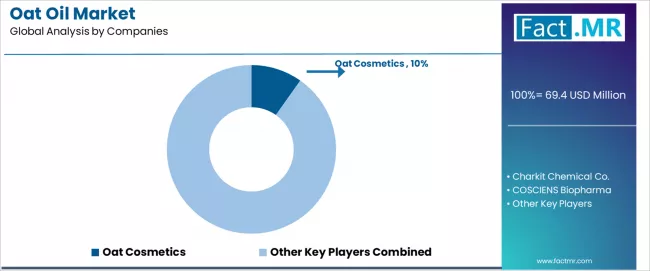
Oat Oil Market Analysis By Company | Source: Fact.MR
- Oat Cosmetics holds an estimated 10% share in 2026, anchored by its specialist position in cosmetic-grade oat oil and oat lipid extracts.
- Charkit Chemical, COSCIENS Biopharma, and Fazer Mills participate through ingredient distribution and oat processing capability.
- Givaudan participates through its broader natural ingredient portfolio and cosmetic fragrance and ingredient supply.
The oat oil market is fragmented with no dominant player. Oat Cosmetics leads as a specialist supplier focused on cosmetic-grade oat oil and oat lipid extracts. The company has built a differentiated position through dedicated oat extraction capability and formulation support for personal care customers.
Charkit Chemical and COSCIENS Biopharma serve as ingredient distributors with oat oil supply. Fazer Mills participates through Finnish oat processing expertise. Givaudan brings broader natural ingredient capability and serves personal care and food customers.
Competitive dynamics favor specialist suppliers with dedicated oat extraction capability and formulation expertise. Larger ingredient companies may enter through acquisition or internal development as the category scales.
Competitive Analysis
Strategic positioning depends on extraction capability, cosmetic formulation expertise, and customer relationships. Oat Cosmetics leads on specialist positioning. Givaudan leads on broader ingredient portfolio integration. The competitive question is whether specialist focus or integrated ingredient supply will capture more value as the category scales.
Benchmarking Table
| Company | Oat Specialization | Extraction Capability | Customer Base | Geographic Reach |
|---|---|---|---|---|
| Oat Cosmetics | Very High | High | Cosmetic Focused | Europe/Global |
| Charkit Chemical | Medium | Low (Distributor) | Broad | North America |
| Givaudan | Low-Medium | Medium | Very Broad | Global |
| Fazer Mills | Medium-High | High | Food/Cosmetic | Europe |
| COSCIENS Biopharma | Medium-High | Medium-High | Pharma/Cosmetic | Europe |
Source: Fact.MR analysis. Updated Apr 27, 2026
Recent Developments
- Oat Cosmetics expanded its oat lipid extract portfolio in 2025, launching new ceramide-enriched oat oil variants for premium skin care formulations.
- Givaudan expanded its natural cosmetic ingredient portfolio in 2025 and 2026, including plant-derived lipid ingredients for personal care applications.
- Fazer Mills expanded oat oil extraction capacity in 2025, serving growing demand from European personal care and functional food manufacturers.
Leading Companies Shaping Oat Oil Market
-
Major Players
- Oat Cosmetics
- Charkit Chemical Co.
- COSCIENS Biopharma
- Fazer Mills
- Givaudan S.A.
-
Emerging Players
- Swedish Oat Fiber AB
- Lantmannen
- Grain Millers
- Richardson International
- Avena Foods
- Naturex (Givaudan)
- Symrise AG
- BASF Care Chemicals
- Croda International
- Ashland Global
Sources and Research References
- World Health Organization (WHO) cosmetic ingredient safety publications
- European Commission CosIng cosmetic ingredient database
- U.S. Food and Drug Administration (FDA) GRAS ingredient listings
- Oat Cosmetics, Givaudan, and Fazer Mills corporate filings and product documentation
- Personal Care Products Council ingredient safety data
- Peer-reviewed journals including International Journal of Cosmetic Science, Journal of the American Oil Chemists' Society, and Food Chemistry
- Primary interviews with cosmetic ingredient suppliers, personal care formulators, and functional food manufacturers
This bibliography is provided for reader reference and is not exhaustive. The full report contains the complete reference list and detailed citations.
Key Questions This Report Addresses
- What is the size of the oat oil market in 2026 and 2036?
- What CAGR is the market expected to record between 2026 and 2036?
- Which product and application segments are projected to lead?
- How is personal care demand shaping oat oil growth?
- Which countries are the fastest-growing markets through 2036?
- Who are the leading companies in oat oil?
- How does Fact.MR estimate and validate the market forecast?
Oat Oil Market Definition
The oat oil market covers lipid extracts derived from oat kernels through cold pressing, solvent extraction, supercritical fluid extraction, and enzyme-assisted extraction processes. The scope includes refined oat oil, unrefined oat oil, fractionated oat oil, oat kernel oil, oat lipid extracts, and blended oat oil products used across personal care, cosmetics, food and beverages, pharmaceuticals, and industrial applications.
Oat Oil Market Inclusions
The market includes cosmetic-grade refined oat oil, food-grade refined oat oil, cold-pressed oat oil, organic unrefined oat oil, light and heavy fraction oat oil, oat kernel oil, natural oat ceramide oil, beta-glucan enriched oil, and blended oat oil products. Applications span skin care, hair care, body care, health beverages, nutritional oils, functional foods, dermatological formulations, and nutraceutical capsules.
Oat Oil Market Exclusions
The market excludes oat milk and oat beverage products, whole oat flour and oat bran, oat-based food products not sold as oil extracts, and general-purpose vegetable oils. Oat fiber, oat starch, and non-lipid oat derivatives fall outside the scope.
Oat Oil Market Research Methodology
- Primary Research: Interviews with cosmetic ingredient suppliers, personal care product formulators, functional food manufacturers, pharmaceutical ingredient procurement leads, and oat oil extraction facility operators.
- Desk Research: Personal care ingredient databases, cosmetic formulation patents, functional food ingredient market reports, and oat lipid chemistry literature.
- Market Sizing: Demand-side model built on personal care formulation volumes, functional food ingredient usage, pharmaceutical formulation demand, average oat oil pricing across grades, and extraction capacity data.
- Data Validation: Triangulated across ingredient supplier revenues, personal care product formulation data, and primary interviews. Sensitivity testing on personal care market growth, functional food adoption, and pricing.
Segmentation
Scope of Analysis
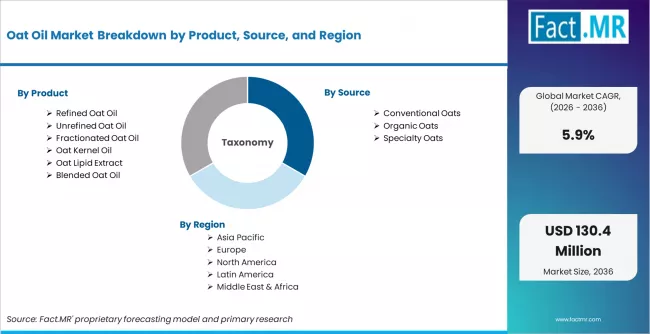
Oat Oil Market Breakdown By Product, Source, And Region | Source: Fact.MR
| Parameter | Details |
|---|---|
| Quantitative Units | USD 73.49 million in 2026 to USD 130.38 million by 2036, at a CAGR of 5.9% |
| Market Definition | Lipid extracts from oat kernels for personal care, cosmetics, food, pharmaceuticals, and industrial applications, including refined, unrefined, fractionated, kernel, lipid extract, and blended oat oil. |
| Regions | North America, Latin America, Europe, East Asia, South Asia and Pacific, Middle East and Africa |
| Countries | India, China, Germany, United States, United Kingdom, and 25+ additional countries |
| Companies | Oat Cosmetics, Charkit Chemical, COSCIENS Biopharma, Fazer Mills, Givaudan |
| Forecast Period | 2026 to 2036 |
| Approach | Demand-side model on personal care formulation volumes, functional food usage, pharmaceutical demand, average pricing, and primary interviews with ingredient suppliers and formulators. |
Source: Fact.MR analysis. Updated Apr 27, 2026
Analysis by Product, Source, Extraction Technology, Application, End Use, and Region
-
Oat Oil Market Market Segmented by Product:
- Refined Oat Oil
- Fully Refined Cosmetic Grade Oat Oil
- Food Grade Refined Oat Oil
- Unrefined Oat Oil
- Cold Pressed Oat Oil
- Organic Unrefined Oat Oil
- Fractionated Oat Oil
- Light Fraction Oat Oil
- Heavy Fraction Oat Oil
- Oat Kernel Oil
- Whole Kernel Extract Oil
- Endosperm Derived Oil
- Oat Lipid Extract
- Natural Oat Ceramide Oil
- Beta Glucan Enriched Oil
- Blended Oat Oil
- Oat and Sunflower Oil Blend
- Oat and Almond Oil Blend
- Refined Oat Oil
-
Oat Oil Market Market Segmented by Source:
- Conventional Oats
- Standard Cultivated Oats
- Industrial Grade Oats
- Organic Oats
- USDA Organic Oats
- Non GMO Organic Oats
- Specialty Oats
- High Lipid Oat Varieties
- Functional Oat Strains
- Conventional Oats
-
Oat Oil Market Market Segmented by Extraction Technology:
- Cold Press Extraction
- Low Temperature Mechanical Pressing
- Expeller Pressing
- Solvent Extraction
- Hexane Based Extraction
- Ethanol Based Extraction
- Supercritical Fluid Extraction
- CO2 Based Extraction
- Enzyme Assisted Extraction
- Bio Catalytic Lipid Release
- Water Enzymatic Extraction
- Cold Press Extraction
-
Oat Oil Market Market Segmented by Application:
- Personal Care and Cosmetics
- Skin Care Products
- Hair Care Products
- Body Lotions and Creams
- Food and Beverages
- Health Beverages
- Nutritional Oils
- Functional Foods
- Pharmaceuticals
- Dermatological Formulations
- Medicinal Ointments
- Nutraceutical Capsules
- Industrial Applications
- Natural Emulsifiers
- Biobased Lubricants
- Personal Care and Cosmetics
-
Oat Oil Market Market Segmented by End Use:
- Cosmetic Manufacturers
- Premium Skin Care Brands
- Mass Market Personal Care Brands
- Food Manufacturers
- Functional Food Producers
- Health Food Brands
- Pharmaceutical Companies
- Dermaceutical Product Manufacturers
- Nutraceutical Supplement Brands
- Industrial Manufacturers
- Biochemical Producers
- Green Chemistry Companies
- Cosmetic Manufacturers
-
Oat Oil Market Market by Region:
- North America
- USA
- Canada
- Mexico
- Latin America
- Brazil
- Chile
- Rest of Latin America
- Western Europe
- Germany
- UK
- Italy
- Spain
- France
- Nordic
- BENELUX
- Rest of Western Europe
- Eastern Europe
- Russia
- Poland
- Hungary
- Balkan & Baltic
- Rest of Eastern Europe
- East Asia
- China
- Japan
- South Korea
- South Asia and Pacific
- India
- ASEAN
- Australia & New Zealand
- Rest of South Asia and Pacific
- Middle East & Africa
- Kingdom of Saudi Arabia
- Other GCC Countries
- Turkiye
- South Africa
- Other African Union
- Rest of Middle East & Africa
- North America
Frequently Asked Questions
How big is the oat oil market in 2026?
What will be the size of the oat oil market in 2036?
How fast is the oat oil market expected to grow?
Which product segment leads the oat oil market?
Which country is the fastest-growing market?
Which is the second-fastest-growing market?
What does the oat oil market include?
How does Fact.MR estimate and validate the market forecast?
Who worked on this report


Preview the report firsthand - request a free sample
Free SampleGet the brochure for pricing and purchase details
Download PDF