- Base Value(2025): 4.2 Bn
- Estimated Value(2026): 4.5 Bn
- Forecast Value (2036): 7.6 Bn
- CAGR (2026 - 2036): 5.4%
Off-Highway Hydraulic Valve Actuator Systems Market Forecast and Outlook by Fact.MR
- The off-highway hydraulic valve actuator systems market was valued at USD 4.2 billion in 2025.
- According to Fact.MR, demand is projected to reach USD 4.5 billion in 2026 and expand to USD 7.6 billion by 2036, reflecting a CAGR of 5.4% during the forecast period.
.webp "Image (9)")
Image (9) | Source: Fact.MR
| Metric | Value |
|---|---|
| Estimated Value in 2026 | USD 4.5 billion |
| Forecast Value in 2036 | USD 7.6 billion |
| Forecast CAGR (2026 to 2036) | 5.4% |
Source: Fact.MR analysis. Updated May 11, 2026
Summary of the Off-Highway Hydraulic Valve Actuator Systems Market
- Market Definition
- The off-highway hydraulic valve actuator systems market includes actuator technologies used to control valve response inside mobile hydraulic systems for construction, agriculture, mining, and material-handling equipment.
- Demand Drivers
- Mobile equipment OEMs are under pressure to improve hydraulic precision without adding excessive complexity or energy loss.
- Machine-control teams increasingly value electronically managed valve response for smoother motion and lower operator effort.
- Buyers prefer actuator systems that support modular valve design, digital control compatibility, and durable field performance.
- Key Segments Analyzed
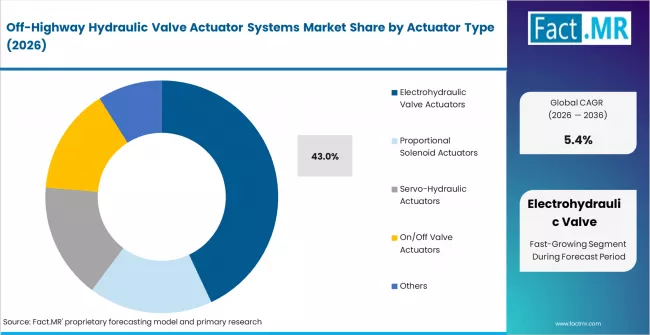
- By Actuator Type: Electrohydraulic Valve Actuators are expected to account for 43.0% share in 2026, supported by stronger integration with proportional and electronically controlled valve systems.
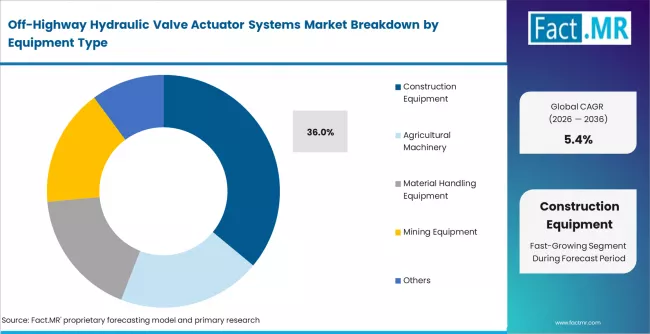
- By Equipment Type: Construction Equipment is projected to hold 36.0% share in 2026 because excavators, loaders, and related machines rely heavily on precise hydraulic motion control.
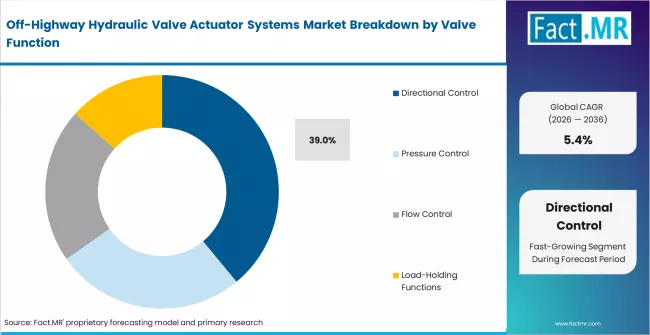
- By Valve Function: Directional Control is expected to capture 39.0% share in 2026 due to its central role in managing working functions and machine movement.
- By Geography, China leads growth with a 6.3% CAGR through 2036, supported by equipment scale and ongoing adoption of more electronically controlled hydraulic platforms.
- Analyst Opinion at Fact.MR
- Shambhu Nath Jha, Senior Analyst at Fact.MR, opines, strongest change in this market is that hydraulic valve actuation is moving from a pure control hardware decision toward a system-response decision. OEMs want more than movement. They want smoothness, efficiency, tunability, and compatibility with electronic control logic. That makes validated electrohydraulic actuator capability more valuable than simple component supply.”
- Strategic Implications
- Suppliers that combine valve-response accuracy, energy efficiency, and control electronics compatibility will be better placed in higher-value machine platforms.
- OEMs need actuator vendors that support machine-level hydraulic tuning and integration rather than component supply alone.
- Aftermarket participants gain more from service reliability and fitment support than from low-price generic substitution.
- Methodology
- Market sizing used off-highway equipment production and hydraulic-control content as baseline anchors.
- Analysis incorporated supplier positioning around proportional valves, electrohydraulic actuators, and mobile machine efficiency.
- Forecasts were checked against mobile-hydraulics design trends and field requirements for harsh operating environments.
The market is expected to create an absolute opportunity of USD 3.1 billion between 2026 and 2036, supported by ongoing modernization across construction, agriculture, and material-handling equipment. Growth remains steady because hydraulic valve actuation in off-highway machinery is no longer evaluated only on basic motion output. Buyers increasingly assess how effectively these systems improve operator control, reduce pressure loss, enhance fuel efficiency, and deliver faster response within electronically managed hydraulic architectures. As machines become more automated and productivity-focused, actuator precision is becoming more valuable. Danfoss positions its PVG proportional valves and PVE electrohydraulic actuators around modularity, precision, and durability for demanding off-highway environments. Bosch Rexroth and HydraForce also highlight electronically controlled and energy-efficient valve solutions for construction, agriculture, and material-handling applications. [1]
China is projected to remain the fastest-growing country, with a CAGR of 6.3% through 2036, followed by India at 6.0% and Brazil at 5.8%. The United States is expected to expand at 5.4%, Germany at 5.1%. Fact.MR views this spread as a reflection of differences in construction and agricultural equipment output, mobile hydraulics localization, and the pace at which OEMs adopt electronically controlled valve platforms and energy-conscious hydraulic system design.
Segmental Analysis
Off-Highway Hydraulic Valve Actuator Systems Market Analysis by Actuator Type
Off Highway Hydraulic Valve Actuator Systems Market Analysis By Actuator Type | Source: Fact.MR
Electrohydraulic valve actuators are expected to hold 43.0% share in 2026. Their lead comes from how effectively they bridge hydraulic power with electronic control. In off-highway machines, the buyer is not selecting an actuator only for valve movement. The buyer is looking for tunable response, smoother handling, lower operator fatigue, and better coordination between hydraulic behavior and electronic controls. Danfoss positions its PVE electrohydraulic actuators as fast, accurate, and intelligent for harsh off-highway conditions, while Bosch Rexroth and HydraForce emphasize electro-proportional and electronically controlled valve solutions for mobile equipment. That combination supports the segment’s lead. [2]
- Response tuning: Better control over valve motion supports smoother machine behavior and more predictable implement performance.
- Electronic compatibility: Electrohydraulic formats fit more naturally into digitally managed machine-control architectures.
- Field durability: Suppliers position these systems for harsh off-highway environments, which supports continued OEM confidence.
Off-Highway Hydraulic Valve Actuator Systems Market Analysis by Equipment Type
Off Highway Hydraulic Valve Actuator Systems Market Analysis By Equipment Type | Source: Fact.MR
Construction equipment continues to lead demand within the off-highway hydraulic valve actuator systems market due to extensive use of mobile hydraulics across excavators, loaders, dozers, and related machinery. In these applications, precise valve actuation directly influences cycle time, controllability, attachment response, and fuel efficiency. Construction equipment is projected to account for 36.0% share in 2026. High machine utilization and demanding duty cycles also increase the need for durable and responsive hydraulic control systems. Bosch Rexroth highlights mobile-machine valve solutions for mini-excavators, loaders, and larger construction equipment, reinforcing the segment’s importance. Danfoss and HydraForce also position their offerings around construction and related mobile equipment categories. [3]
- Hydraulic intensity: Construction machines rely heavily on controlled hydraulic motion for core working functions.
- Efficiency pressure: Valve response and pressure-loss behavior matter because they influence fuel use and machine productivity.
- Control sensitivity: Operators value smoother implement behavior, especially in machines working across variable loads and repetitive cycles.
Off-Highway Hydraulic Valve Actuator Systems Market Analysis by Valve Function
Off Highway Hydraulic Valve Actuator Systems Market Analysis By Valve Function | Source: Fact.MR
Directional control is expected to capture 39.0% share in 2026. Directional valve actuation remains central because it governs how hydraulic flow is routed across machine functions, which makes it one of the most visible control points in mobile equipment performance. HydraForce describes electro-proportional cartridge valves as controlling flow, pressure, direction, or speed of motion, while Danfoss and Bosch Rexroth position proportional and modular valve systems around precision and efficiency in off-highway applications.
- Flow routing: Directional actuation governs how machine functions receive hydraulic energy in real operating conditions.
- Operator feel: Response quality is visible through machine smoothness and handling precision.
- System coordination: Better directional control improves how multiple hydraulic functions share available flow under load. [4]
Off-Highway Hydraulic Valve Actuator Systems Market Drivers, Restraints, and Opportunities
Off Highway Hydraulic Valve Actuator Systems Market Opportunity Matrix Growth Vs Value | Source: Fact.MR
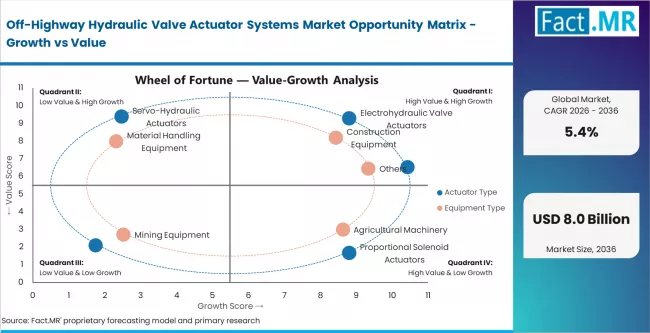
The strongest market driver is the move toward more precise and electronically coordinated hydraulic control in off-highway machinery. OEMs want smoother implement control, better fuel efficiency, and easier integration of digital features such as assistance systems and autoguidance-linked functions. Danfoss, Bosch Rexroth, and HydraForce all position their mobile hydraulic solutions around precision, modularity, and reduced energy loss, which supports the view that actuator value is rising as valve control becomes more sophisticated.
The main restraint is validation and integration complexity. Off-highway hydraulic systems operate under harsh loads, contamination risk, vibration, and wide temperature variation. That means actuator suppliers must satisfy high expectations around durability, control stability, and safety-related hydraulic performance. ISO 4413 remains relevant because it sets general rules and safety requirements for hydraulic fluid power systems and components, which raises the burden on suppliers lacking broad system capability.
Opportunities in the Off-Highway Hydraulic Valve Actuator Systems Market
- Digital hydraulics adoption: Machines with more electronically controlled work functions create room for higher-value actuator systems that support tunable response and smarter hydraulic behavior. Danfoss and Bosch Rexroth both align with this direction.
- Energy-efficient valve platforms: OEMs can reduce hydraulic losses by adopting actuator-compatible proportional and flow-sharing valve architectures. Bosch Rexroth and HydraForce product positioning supports this path.
- Precision agriculture and guidance functions: Agricultural machines using more electronically managed steering and implement control create added demand for robust hydraulic actuation systems. Danfoss’s electrohydraulic steering valve ecosystem reinforces this opportunity.
Regional Analysis
Based on the regional analysis, the Off-Highway Hydraulic Valve Actuator Systems Market is segmented into East Asia, South Asia and Pacific, North America, Europe, Latin America, and Middle East and Africa across 40 plus countries.
.webp "Top Country Growth Comparison Off Highway Hydraulic Valve Actuator Systems Market Cagr (2026 2036)")
Top Country Growth Comparison Off Highway Hydraulic Valve Actuator Systems Market Cagr (2026 2036) | Source: Fact.MR
| Country | CAGR (2026 to 2036) |
|---|---|
| China | 6.3% |
| India | 6.0% |
| Brazil | 5.8% |
| United States | 5.4% |
| Germany | 5.1% |
Source: Fact.MR analysis. Updated May 11, 2026
Source: Fact.MR analysis, based on proprietary forecasting model and primary research
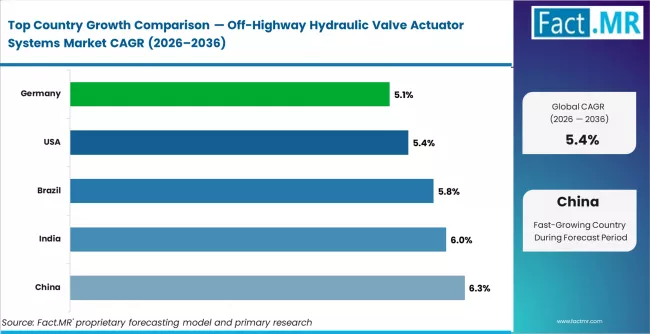
Off Highway Hydraulic Valve Actuator Systems Market Cagr Analysis By Country | Source: Fact.MR
East Asia Off-Highway Hydraulic Valve Actuator Systems Market Analysis
East Asia remains the strongest production and supply base for this market. The region combines large-scale machine manufacturing with strong hydraulic and electrohydraulic component ecosystems.
- China: Strong off-highway equipment production, expanding mobile hydraulics capability, and faster adoption of electronically controlled valve systems support China’s lead. Off-highway hydraulic valve actuator systems demand in China is projected to grow at a CAGR of 6.3% from 2026 to 2036. The country benefits from machine scale and increasing emphasis on more efficient hydraulic control in construction and agricultural equipment.
Fact.MR’s report also covers ASEAN, Australia and New Zealand, and other South Asia and Pacific countries. These markets matter where equipment assembly expands and electronically controlled hydraulics spread beyond premium machine platforms.
South Asia & Pacific Off-Highway Hydraulic Valve Actuator Systems Market Analysis
South Asia & Pacific is an emerging growth region where infrastructure development, farm mechanization, and broader equipment assembly are supporting market expansion. Demand is rising as electronically controlled hydraulics move beyond premium machine platforms into wider product ranges.
- India: India is expected to expand at a 6.0% CAGR by 2036, supported by growing construction machinery demand, agricultural equipment modernization, and increasing investment in domestic manufacturing. OEMs are gradually adopting hydraulic actuator systems that improve efficiency, operator control, and fuel economy. Demand is particularly visible in tractors, excavators, loaders, and utility equipment used across infrastructure and rural sectors.
Fact.MR’s report also includes ASEAN, Australia, and New Zealand, where equipment assembly growth and modernization trends continue to create incremental opportunities.
North America Off-Highway Hydraulic Valve Actuator Systems Market Analysis
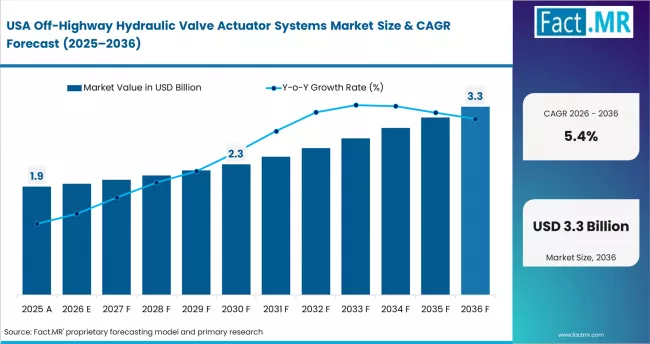
Off Highway Hydraulic Valve Actuator Systems Market Country Value Analysis | Source: Fact.MR
North America is shaped by heavy construction, agriculture, and material-handling equipment demand, along with strong field-service expectations and machine productivity pressure. Hydraulic valve actuation matters in this region because machine operators and fleet owners value reliable response, fuel efficiency, and service continuity. This creates a market where OE design wins remain important while the installed base sustains a meaningful replacement cycle.
- United States: Off-highway hydraulic valve actuator systems demand in the United States is projected to rise at a CAGR of 5.4% over the forecast period. The country supports demand through construction equipment, agricultural machinery, and broader use of productivity-oriented hydraulic upgrades. OEMs and fleet operators place value on actuator systems that improve controllability without compromising durability.
Fact.MR’s report also includes Mexico and the wider North American supply ecosystem. Additional regional value comes from equipment modernization, productivity pressure, and the need for service-grade hydraulic reliability in demanding duty cycles.
Latin America Off-Highway Hydraulic Valve Actuator Systems Market Analysis
Latin America is becoming a relevant market due to agriculture strength, mining activity, and expanding demand for construction equipment. Productivity improvements and equipment durability are especially important in this region, supporting adoption of efficient hydraulic control technologies.
- Brazil: Brazil is projected to grow at a 5.8% CAGR through 2036. Its role is supported by strong agricultural machinery demand, mining equipment usage, and ongoing infrastructure development. OEMs and operators increasingly favor hydraulic actuator systems that improve machine responsiveness, fuel efficiency, and long-term reliability under rugged operating conditions.
Fact.MR’s report also covers additional Latin American countries where off-highway equipment demand is linked to commodity production and public infrastructure cycles.
Europe Off-Highway Hydraulic Valve Actuator Systems Market Analysis
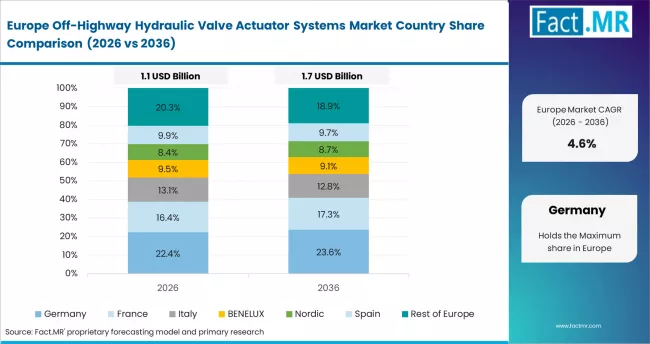
Off Highway Hydraulic Valve Actuator Systems Market Europe Country Market Share Analysis, 2026 & 2036 | Source: Fact.MR
Europe remains a high-discipline market rather than the fastest-growing one. Off-highway OEMs in the region place strong emphasis on efficiency, controllability, and integration with broader machine electronics. Bosch Rexroth’s recent valve messaging around energy efficiency, digitalization, and assistance-readiness supports Europe’s role as a systems-driven hydraulic controls market.
- Germany: Germany is projected to expand at a CAGR of 5.1% through 2036. Its importance comes from engineering intensity, mobile-hydraulics expertise, and the presence of OEMs that value validated electrohydraulic control for construction, material handling, and industrial off-highway equipment.
Fact.MR’s report also covers France, Italy, the United Kingdom, Spain, and the rest of Europe. These markets add commercial depth through established machine-manufacturing capabilities and continued emphasis on efficient hydraulic system design.
Competitive Aligners for Market Players
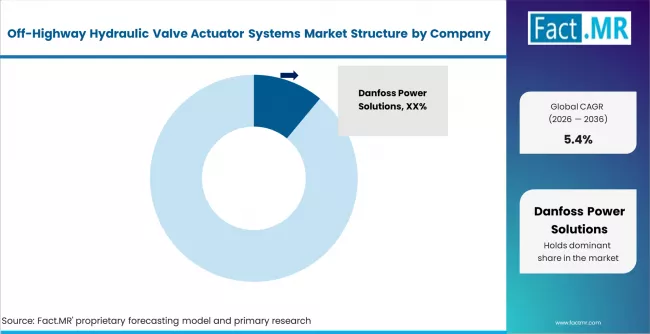
Off Highway Hydraulic Valve Actuator Systems Market Analysis By Company | Source: Fact.MR
The off-highway hydraulic valve actuator systems market is moderately consolidated. Buyers do not choose suppliers only on component cost or basic actuation function. They choose on response accuracy, modularity, energy efficiency, harsh-environment durability, and electronics compatibility. Companies such as Danfoss, Bosch Rexroth, HydraForce, Parker Hannifin, and Eaton remain relevant because they operate close to mobile hydraulics, valve platforms, or off-highway system integration at scale.
Established suppliers hold an advantage because valve actuation is difficult to separate from complete hydraulic-system knowledge. A new entrant may develop a capable actuator, but gaining OEM confidence is more challenging when performance depends on tuning accuracy, field durability, and machine-level hydraulic behavior. Buyers expect suppliers to understand how the actuator interacts with pumps, valves, load cycles, and control systems across demanding operating environments.
Key Players in Off-Highway Hydraulic Valve Actuator Systems Market
- Danfoss Power Solutions
- Bosch Rexroth AG
- HydraForce
- Parker Hannifin Corporation
- Eaton Corporation
- Bucher Hydraulics
- Husco International
- HAWE Hydraulik
- Sun Hydraulics
- Moog Inc.
- Kawasaki Precision Machinery
- Walvoil S.p.A.
Bibliography
- [1] Danfoss Power Solutions. PVG proportional valves. Official product overview.
- [2] Danfoss Power Solutions. PVE electrohydraulic actuators / PVED-CX Series 4 technical information. Product and technical documentation for mobile off-highway applications.
- [3] Bosch Rexroth. Innovative compact hydraulics. Press release on compact, energy-efficient valves for mobile machines, February 24, 2025.
- [4] HydraForce. Electro-proportional valves. Official product overview.
- [5] Bosch Rexroth. LUDV valve platform RS LARGE. Press release on scalable, electrohydraulic valve platform for off-highway vehicles.
This Report Addresses
- Strategic demand outlook for off-highway hydraulic valve actuator systems across mobile hydraulic architectures.
- Market forecast from USD 4.52 billion in 2026 to USD 7.68 billion by 2036.
- The growing role of electrohydraulic and proportional actuation in machine efficiency and control quality.
- The effect of digital machine control and assistance-readiness on hydraulic valve actuation demand.
- OEM versus aftermarket demand patterns in a validation-sensitive mobile hydraulics category.
- Regional differences in machine production, hydraulic supply depth, and control-system sophistication.
- Competitive positioning of suppliers active in valves, electrohydraulic modules, and mobile machine controls.
- Segment analysis by actuator type, equipment type, valve function, sales channel, and geography.
Off-Highway Hydraulic Valve Actuator Systems Market Definition
The market covers actuator systems used to control hydraulic valve behavior in off-highway machines, including electrohydraulic, proportional, servo-hydraulic, and related actuation formats integrated into mobile hydraulic architectures. These systems regulate directional, pressure, flow, and load-management functions inside construction, agricultural, mining, and material-handling equipment. The category is distinct because it focuses on valve actuation and control response inside off-highway hydraulic systems rather than on the full pump, cylinder, motor, or complete hydraulic power unit.
Off-Highway Hydraulic Valve Actuator Systems Market Inclusions
The market includes electrohydraulic valve actuators, proportional valve actuation modules, pilot-control actuation units, cartridge-valve actuation solutions, integrated valve-electronics combinations, and associated control assemblies used in mobile off-highway machinery. Scope covers OEM-installed systems and aftermarket replacements across machines that rely on electronically influenced hydraulic motion control.
Off-Highway Hydraulic Valve Actuator Systems Market Exclusions
The market excludes standalone hydraulic pumps, cylinders, hoses, reservoirs, and unrelated industrial hydraulic actuators not tied to off-highway mobile equipment valve control. It also excludes full autonomous machine systems where hydraulic valve actuation cannot be isolated analytically. The boundary remains limited to valve actuation systems that directly influence hydraulic control behavior in mobile off-highway applications.
Off-Highway Hydraulic Valve Actuator Systems Market Research Methodology
- Primary Research
- Interviews with mobile hydraulics engineers, valve-system designers, construction equipment OEM purchasing managers, agricultural machinery integration teams, and aftermarket hydraulic service specialists.
- Desk Research
- Review of supplier mobile-hydraulics portfolios, proportional-valve platforms, electrohydraulic actuation materials, standards relevant to hydraulic systems, and public technical references from Danfoss, Bosch Rexroth, HydraForce, and Parker. [5]
- Market-Sizing and Forecasting
- Fact.MR used a blended model based on off-highway equipment production, hydraulic control sophistication, valve-actuator content per machine class, electrification and digitalization trends in mobile equipment, and replacement demand in the operating fleet.
- Data Validation and Update Cycle
- Forecasts were cross-checked through supplier product positioning, mobile machine control trends, and standards governing hydraulic system safety and electronic integration in off-highway environments.
Segmentation
Scope of the Report
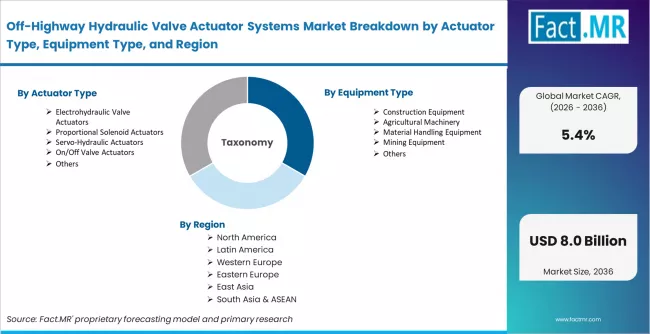
Off Highway Hydraulic Valve Actuator Systems Market Breakdown By Actuator Type, Equipment Type, And Region | Source: Fact.MR
| Attribute | Details |
|---|---|
| Quantitative Units | USD 4.5 billion in 2026 to USD 7.6 billion in 2036, at a CAGR of 5.4% |
| Market Definition | Off-highway hydraulic valve actuator systems that control valve response, flow routing, pressure behavior, and hydraulic function execution in mobile equipment. |
| Actuator Type Segmentation | Electrohydraulic Valve Actuators, Proportional Solenoid Actuators, Servo-Hydraulic Actuators, On/Off Valve Actuators, Others |
| Equipment Type Segmentation | Construction Equipment, Agricultural Machinery, Material Handling Equipment, Mining Equipment, Others |
| Valve Function Segmentation | Directional Control, Pressure Control, Flow Control, Load-Holding Functions |
| Sales Channel Segmentation | OEM, Aftermarket |
| Regions Covered | East Asia, South Asia and Pacific, North America, Europe, Latin America, Middle East and Africa |
| Countries Covered | China, India, Brazil, United States, Germany, Japan, South Korea, and 40+ countries |
| Key Companies Profiled | Danfoss Power Solutions, Bosch Rexroth, HydraForce, Parker Hannifin, Eaton, Bucher Hydraulics, Husco International, HAWE Hydraulik, Sun Hydraulics, Moog, Kawasaki Precision Machinery, Walvoil |
| Forecast Period | 2026 to 2036 |
| Approach | Fact.MR combined primary interviews with mobile hydraulics stakeholders, desk research across supplier product materials and standards relevance, and a forecast model anchored in equipment production, hydraulic-control content, and replacement demand. |
Source: Fact.MR analysis. Updated May 11, 2026
Off-Highway Hydraulic Valve Actuator Systems Market by Segments
-
By Actuator Type:
- Electrohydraulic Valve Actuators
- Proportional Solenoid Actuators
- Servo-Hydraulic Actuators
- On/Off Valve Actuators
- Others
-
By Equipment Type:
- Construction Equipment
- Agricultural Machinery
- Material Handling Equipment
- Mining Equipment
- Others
-
By Valve Function:
- Directional Control
- Pressure Control
- Flow Control
- Load-Holding Functions
-
By Region:
- North America
- United States
- Canada
- Mexico
- Latin America
- Brazil
- Argentina
- Rest of Latin America
- Europe
- Germany
- France
- United Kingdom
- Italy
- Spain
- Rest of Europe
- East Asia
- China
- Japan
- South Korea
- South Asia and Pacific
- India
- ASEAN
- Australia and New Zealand
- Rest of South Asia and Pacific
- Middle East and Africa
- GCC Countries
- South Africa
- Turkey
- Rest of Middle East and Africa
- North America
Frequently Asked Questions
What is the estimated size of the off-highway hydraulic valve actuator systems market in 2026?
How large is the market expected to become by 2036?
What is the forecast CAGR for 2026 to 2036?
Which actuator type leads the market?
Which equipment type dominates demand?
Why does the OEM channel dominate?
Why are electrohydraulic actuators important here?
What is the strongest demand driver?
What is the key restraint?
Which country is growing fastest?
Why is China ahead?
How does India compare?
Why does Brazil rank strongly?
Why does Germany remain important?
How do digital controls affect this market?
Is this a fragmented supplier market?
What do OEM buyers prioritize?
Why does energy efficiency matter in this segment?
Is the aftermarket attractive?
Which companies are most visible in this market?
What is the broader outlook through 2036?
Who worked on this report


Preview the report firsthand - request a free sample
Free SampleGet the brochure for pricing and purchase details
Download PDF