- Base Value(2025): 1.5 Bn
- Estimated Value(2026): 1.7 Bn
- Forecast Value (2036): 4.9 Bn
- CAGR (2026 - 2036): 11.1%
Thermal Imaging Sensor Systems for Night Vision ADAS Market Forecast and Outlook By Fact.MR
- The global thermal imaging sensor systems for night vision ADAS market was valued at USD 1.5 billion in 2025, with Fact.MR estimating it to reach USD 1.7 billion in 2026 and advance to USD 4.9 billion by 2036.
- This reflects a CAGR of 11.1% across the assessment period.
- Absolute dollar opportunity is projected at USD 3.2 billion between 2026 and 2036, indicating sustained expansion supported by both technology adoption and regulatory alignment.
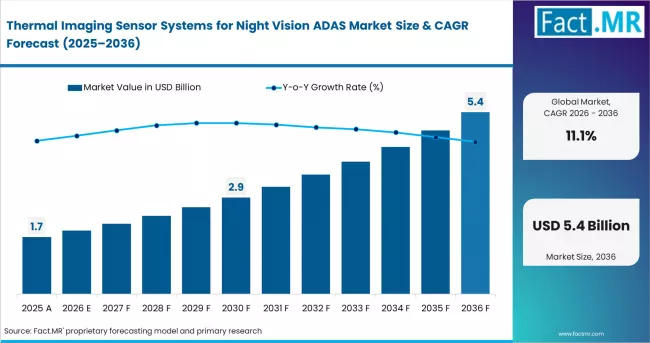
Thermal Imaging Sensor Systems For Night Vision Adas Market Market Value Analysis | Source: Fact.MR
| Metric | Value |
|---|---|
| Estimated Value in 2026 | USD 1.7 billion |
| Forecast Value in 2036 | USD 4.9 billion |
| Forecast CAGR (2026 to 2036) | 11.1% |
Source: Fact.MR analysis. Updated May 8, 2026
Summary of Thermal Imaging Sensor Systems for Night Vision ADAS Market
- Market Definition
- Thermal imaging systems detect heat signatures to improve night-time visibility and enhance ADAS safety functions.
- Demand Drivers
- Increasing focus on pedestrian safety in low-light conditions is driving adoption.
- Premium vehicle manufacturers are integrating thermal sensors to differentiate safety features.
- Expansion of ADAS regulations in Europe and Asia is supporting sensor deployment.
- Key Segments Analyzed
- By Technology: Passive thermal imaging systems are expected to account for 67.0% share in 2026 due to lower complexity and cost advantages.
- By Component: Thermal camera modules are projected to represent 55.0% share in 2026, driven by integration requirements.
- By Geography: China leads growth with 12.8% CAGR, supported by rapid ADAS adoption.
- Analyst Opinion at FACT.MR
- Shambhu Nath Jha, Senior Analyst at Fact.MR, opines, “CXOs will find that thermal imaging remains a niche but strategically important sensor layer, especially in safety-driven premium vehicle platforms. Its ability to detect pedestrians and animals in low-visibility conditions provides a distinct functional advantage over conventional vision systems. While cost constraints limit mass adoption, ongoing advancements in sensor miniaturization and integration are gradually improving commercial viability. Decision-makers should track regulatory alignment and premium segment demand to identify scalable deployment opportunities.”
- Strategic Implications
- Cost reduction remains critical for expanding adoption into mid-segment vehicles. Suppliers are refining design efficiency, scaling production, and optimizing sourcing strategies to lower unit costs while maintaining performance and reliability standards.
- OEM collaboration at early development stages strengthens integration outcomes. Suppliers engaging during vehicle platform design gain better alignment with ADAS architectures, improving system compatibility and increasing the likelihood of long-term sourcing agreements.
- Sensor fusion capability continues to shape investment priorities. Integration with radar and camera systems enhances detection accuracy and system redundancy, making solutions more viable for advanced driver assistance applications across varied driving environments.
- Methodology
- The study combines OEM vehicle production data with sensor shipment estimates to build a grounded demand model. This ensures consistency between automotive output trends and component-level adoption patterns.
- Validation relies on supplier-level inputs, including production capacity, pricing dynamics, and technology deployment strategies. Regulatory benchmarks are incorporated to assess the impact of safety requirements on adoption across key regions.
- Forecasts are adjusted based on pricing trends and evolving adoption curves linked to ADAS penetration. This approach reflects both cost sensitivity in volume segments and increasing integration in higher-end vehicle platforms.
Demand growth remains closely tied to the rise of premium vehicle platforms, where advanced sensing capabilities are becoming standard. Safety regulations across key automotive regions continue to push OEMs toward integrating more reliable detection systems. Improvements in thermal sensor miniaturization are also supporting wider deployment, particularly in applications where space and energy efficiency matter. Cost constraints continue to influence adoption in entry-level segments, though gradual integration into multi-sensor ADAS architectures is improving commercial feasibility over time.
China is expected to maintain a strong growth trajectory, with demand projected to rise at a CAGR of 12.8% through 2036. Expansion is driven by rapid ADAS integration and high domestic electric vehicle production. South Korea follows, recording 12.1% CAGR, supported by close coordination between OEMs and a well-established semiconductor supply base. Germany continues to benefit from its premium vehicle focus, where safety positioning supports steady adoption. The market in the country is projected to grow at 11.6% CAGR. The United States is set to expand at 10.9%, with demand concentrated in higher-end vehicles and safety-focused buyers. Japan records a CAGR of 10.4%, supported by consistent OEM upgrades and emphasis on system reliability.
Drivers, Restraints, and Opportunities
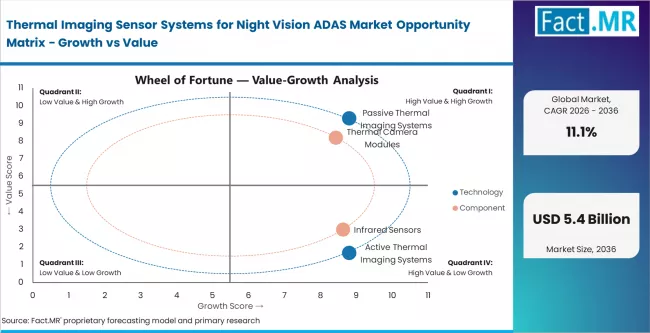
Thermal Imaging Sensor Systems For Night Vision Adas Market Opportunity Matrix Growth Vs Value | Source: Fact.MR
Fact.MR analysis indicates the market is still evolving, positioned between early adoption and broader commercialization. Demand is being shaped more by safety performance requirements than by regulation alone. Night-time accident rates continue to remain high across major automotive regions, reinforcing the need for improved detection capabilities. Despite this, overall market size remains constrained due to limited penetration beyond premium vehicle segments, where cost sensitivity is less restrictive.
Technology preference is shifting toward integrated sensor fusion platforms rather than standalone thermal systems. Conventional camera-based systems continue to dominate in volume due to lower costs, though their performance declines in low-light or adverse conditions. Thermal sensing offers stronger detection capability in such environments but carries a higher cost burden. OEMs are making selective deployment decisions, balancing incremental safety benefits against pricing pressures. Gradual improvements in production scale and component efficiency are helping reduce unit costs, supporting wider adoption over time.
- Safety regulations continue to influence development priorities. Programs such as Euro NCAP are placing greater emphasis on pedestrian detection in low-visibility conditions. OEMs are responding by incorporating thermal sensing technologies to improve safety ratings and compliance outcomes.
- Premium vehicle demand remains a primary growth driver. Automakers in Germany and United States are using thermal systems to differentiate on safety and advanced technology, where buyers are less constrained by cost considerations.
- Expansion across China and South Korea is supported by rising ADAS adoption. Domestic OEMs and local suppliers are focusing on cost optimization, improving accessibility of thermal sensing in mid-tier vehicle categories.
Segment Analysis
Thermal Imaging Sensor Systems Market Analysis by Technology
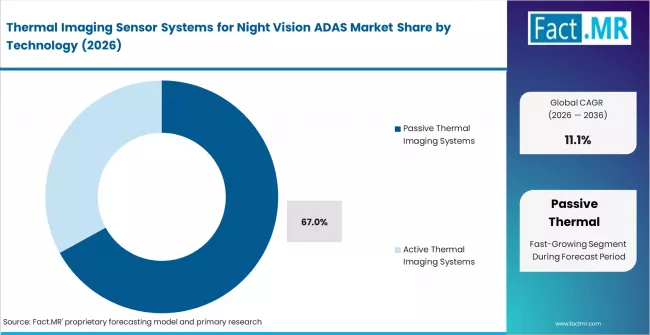
Thermal Imaging Sensor Systems For Night Vision Adas Market Analysis By Technology | Source: Fact.MR
Passive thermal imaging systems are estimated to account for 67.0% share in 2026 in the thermal imaging sensor systems market. Their adoption is driven by lower system complexity, reduced energy consumption, and the absence of external illumination requirements. These systems detect infrared radiation naturally emitted by objects, making them well-suited for automotive environments where reliability and continuous operation are critical. OEMs are prioritizing passive systems as they align better with cost targets and long-term durability expectations in vehicle platforms.
Automotive integration requirements continue to favor technologies that minimize component dependencies and simplify system architecture. Passive systems meet these expectations by reducing the need for additional hardware, which directly lowers failure points and maintenance concerns. This advantage becomes particularly relevant in ADAS applications where consistent performance across varied environmental conditions is essential.
- Product development is advancing toward compact and scalable solutions. Teledyne FLIR introduced compact automotive thermal modules in 2024 designed specifically for ADAS integration [1]. These modules focus on reducing size and improving ease of installation within vehicle systems.
- Technology transition is becoming more visible across the supply base. LYNRED expanded uncooled infrared sensor production to support rising automotive demand [2]. Uncooled sensors eliminate the need for complex cooling mechanisms, improving cost efficiency and operational stability.
- Industry adoption trends indicate a steady replacement of active thermal systems. Passive variants are gaining traction in passenger vehicles due to their simpler architecture and lower cost base, making them more viable for large-scale deployment beyond niche applications.
Thermal Imaging Sensor Systems Market Analysis by Component
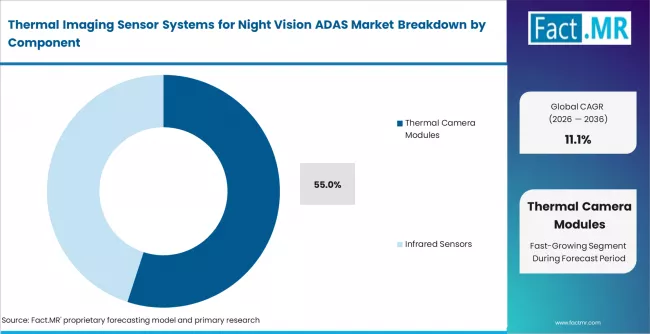
Thermal Imaging Sensor Systems For Night Vision Adas Market Analysis By Component | Source: Fact.MR
Thermal camera modules are expected to represent 55.0% share in 2026. These modules combine sensors, optics, and processing capabilities into a single integrated unit, allowing OEMs to streamline installation and reduce engineering complexity. Demand for modular solutions is increasing as vehicle architectures shift toward standardized electronic systems that support faster integration cycles.
Integrated modules help reduce design fragmentation across vehicle platforms. OEMs benefit from plug-and-play configurations that simplify validation processes and shorten development timelines. This approach also improves consistency in performance, as pre-calibrated modules reduce the need for extensive in-house adjustments.
- Investment activity is reflecting growing demand for scalable production. Valeo expanded its thermal camera manufacturing capacity in 2025 [3]. This expansion supports higher production volumes and aligns with increasing OEM requirements for advanced sensing components.
- Innovation efforts are focused on improving detection accuracy and resolution. ADASKY launched high-resolution LWIR sensors tailored for automotive applications [4]. These sensors enhance object recognition capabilities, particularly in low-visibility conditions.
- Supply chain structures are evolving to support scalability. Increased outsourcing of module assembly allows suppliers to manage cost pressures more effectively while maintaining production flexibility. This shift also enables faster response to fluctuations in OEM demand and program requirements.
Thermal Imaging Sensor Systems Market Analysis by Vehicle Type
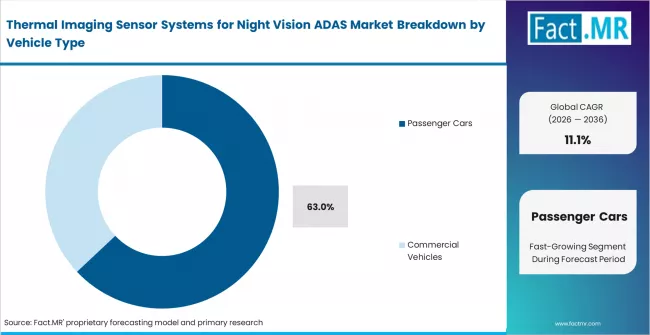
Thermal Imaging Sensor Systems For Night Vision Adas Market Analysis By Vehicle Type | Source: Fact.MR
driver assistance capabilities, enabling OEMs to introduce thermal sensing technologies without immediate cost constraints.
Vehicle manufacturers are integrating thermal imaging into flagship models to strengthen safety positioning and brand perception. These systems improve pedestrian and obstacle detection, particularly in night-time and low-visibility conditions, which aligns with evolving safety expectations.
- OEM adoption is visible among leading automotive brands. BMW and Audi have integrated thermal night vision systems into select high-end models [5]. These implementations highlight the role of thermal sensing as a premium feature.
- Technology integration is advancing toward system-level solutions. Magna developed integrated thermal sensing modules designed to work within broader ADAS frameworks [6]. This approach improves compatibility with other sensors and enhances overall system performance.
- Market expansion into mid-range vehicles is expected as cost structures improve. Declining component costs and advancements in manufacturing efficiency are making thermal sensing more accessible. This shift is likely to support gradual penetration beyond premium segments, increasing overall adoption across passenger vehicle categories.
Regional Analysis
The market is analyzed across North America, Europe, Asia Pacific, Latin America, and Middle East & Africa. Regional demand varies based on vehicle safety regulations, premium vehicle penetration, and ADAS adoption rates. The report includes detailed country-level attractiveness analysis.
.webp "Top Country Growth Comparison Thermal Imaging Sensor Systems For Night Vision Adas Market Cagr (2026 2036)")
Top Country Growth Comparison Thermal Imaging Sensor Systems For Night Vision Adas Market Cagr (2026 2036) | Source: Fact.MR
Regional CAGR Table
| Country | CAGR (2026–2036) |
|---|---|
| China | 12.8% |
| South Korea | 12.1% |
| Germany | 11.6% |
| United States | 10.9% |
| Japan | 10.4% |
Source: Fact.MR analysis. Updated May 8, 2026
Source: Fact.MR (FACTMR) analysis, based on proprietary forecasting model and primary research
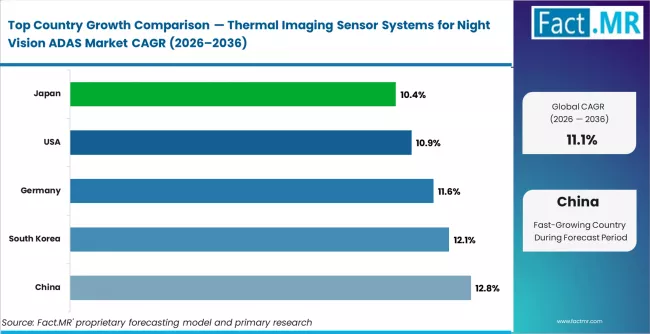
Thermal Imaging Sensor Systems For Night Vision Adas Market Cagr Analysis By Country | Source: Fact.MR
Asia Pacific
Asia Pacific acts as the primary growth engine for thermal imaging systems, supported by strong vehicle production, expanding EV markets, and increasing adoption of ADAS technologies. The region benefits from a combination of government-backed safety initiatives and rapid innovation by domestic OEMs and technology providers.
- China: China leads regional demand, driven by rapid expansion of domestic EV manufacturers and strong policy support for intelligent mobility. The market is projected to grow at a 12.8% CAGR, reflecting accelerated integration of ADAS features across vehicle segments. Government safety programs and smart mobility initiatives introduced in recent years are encouraging the use of advanced sensing technologies, including thermal imaging systems. Domestic companies are strengthening local supply capabilities, allowing OEMs to integrate these systems at scale. Suppliers that align with high-volume production and cost efficiency can benefit from significant growth opportunities.
- South Korea: South Korea follows closely, supported by advanced automotive manufacturing and strong focus on safety innovation. The market is expected to expand at a 12.1% CAGR, driven by OEM efforts to enhance vehicle safety and performance. Automotive manufacturers are integrating thermal systems into higher-end models, supported by investments in semiconductor and sensor technologies. Strong domestic capabilities in electronics and components manufacturing provide a competitive advantage, enabling faster adoption and system integration.
- Japan: Japan contributes a precision-driven approach to the regional market, where adoption is guided by engineering excellence and reliability. The market is projected to grow at a 10.4% CAGR, reflecting steady integration of thermal imaging systems into advanced vehicle platforms. Automakers focus on improving detection accuracy and system efficiency, particularly for night driving and pedestrian safety applications. Demand is supported by the country’s emphasis on quality and long-term performance, with suppliers prioritizing consistency and technological refinement over rapid scale.
Europe
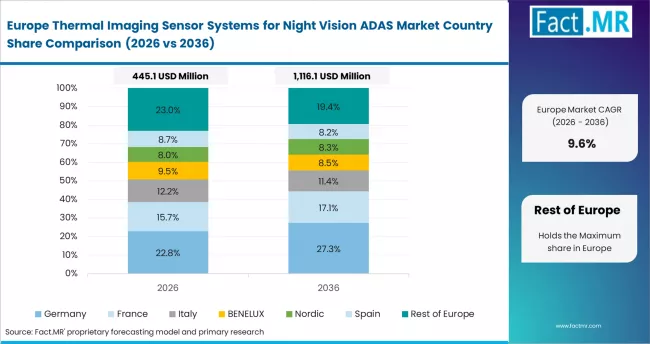
Thermal Imaging Sensor Systems For Night Vision Adas Market Europe Country Market Share Analysis, 2026 & 2036 | Source: Fact.MR
Europe remains the regulatory anchor for the thermal imaging systems market, where safety frameworks and assessment protocols strongly influence adoption. Stringent regulations and testing standards are encouraging automakers to integrate advanced sensing technologies to meet compliance requirements and improve vehicle safety ratings.
- Germany: Germany leads regional demand, supported by its strong automotive manufacturing base and premium vehicle segment. The market is expected to grow at an 11.6% CAGR, reflecting steady expansion driven by regulatory compliance and product differentiation. Premium automotive brands are incorporating thermal imaging systems to enhance safety features, particularly in night driving conditions. Integration is also aligned with pedestrian safety requirements, which are becoming increasingly important under European safety frameworks. Suppliers that meet strict engineering and regulatory standards can secure long-term opportunities in this structured market.
North America
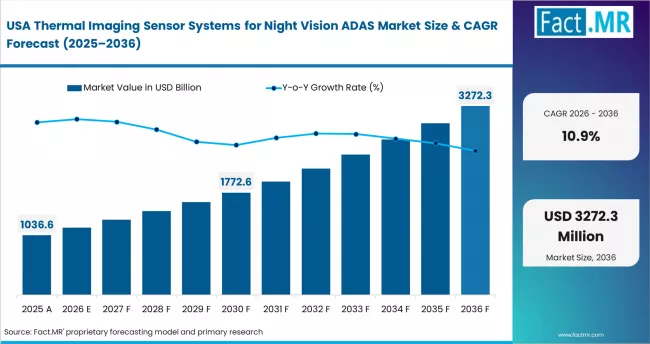
Thermal Imaging Sensor Systems For Night Vision Adas Market Country Value Analysis | Source: Fact.MR
North America represents a stable and technology-driven market where adoption of thermal imaging systems is concentrated in premium vehicles and fleet safety applications. Consumer demand for advanced safety features and increasing awareness of night driving risks are supporting gradual adoption.
- U.S.: The United States leads regional demand, with the market forecast to grow at a 10.9% CAGR. Growth is supported by rising sales of high-end vehicles and increasing integration of ADAS technologies across vehicle platforms. Thermal imaging systems are being adopted to enhance driver visibility and improve safety in low-light conditions. Fleet operators are also exploring these systems to reduce accident risks and improve operational safety. Suppliers that offer reliable and high-performance solutions can maintain a competitive edge in this market.
FACTMR's analysis of thermal imaging sensor systems market consists of country-wise assessment that includes China, South Korea, Germany, United States, and Japan. Readers can find detailed insights on adoption trends, regulatory influence, and OEM strategies shaping demand.
Competitive Aligners for Market Players
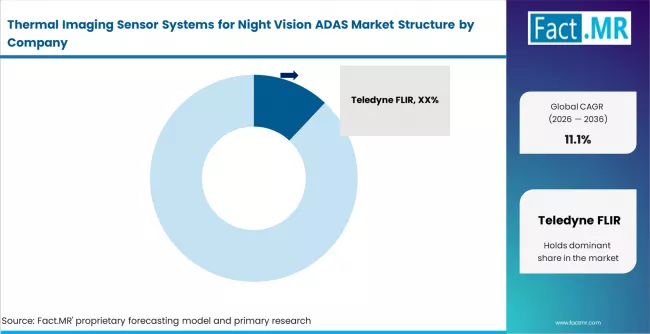
Thermal Imaging Sensor Systems For Night Vision Adas Market Analysis By Company | Source: Fact.MR
The thermal imaging sensor systems market reflects moderate concentration, with participation from established automotive suppliers alongside specialized thermal imaging firms. A limited group of players continues to shape technology direction and maintain close engagement with OEMs. Competitive positioning is driven by consistent performance in real-world conditions, cost efficiency across production cycles, and the ability to integrate seamlessly within broader ADAS architectures.
Larger suppliers benefit from long-standing OEM partnerships and the ability to operate at scale. Companies such as Bosch and Valeo leverage their production infrastructure and system integration expertise to maintain stable program pipelines. Firms with strong semiconductor and imaging capabilities, including Teledyne FLIR, are better positioned to advance sensor performance and support evolving application requirements. Vertical integration across design, manufacturing, and calibration allows these players to manage costs more effectively while improving product consistency and differentiation.
Buyer influence remains strong, particularly among automotive OEMs that control sourcing decisions through structured procurement frameworks. Long qualification cycles and strict validation standards limit frequent supplier changes, favoring established vendors with proven delivery records. Pricing pressure continues to shape negotiations, especially for components targeting mid-range vehicle segments. Suppliers are required to balance performance improvements with cost discipline, as OEMs seek to expand advanced sensing features without significantly increasing vehicle pricing.
Key Players
- Teledyne FLIR
- Valeo
- LYNRED
- ADASKY
- DENSO
- Bosch
- Continental
- Magna
- iRay Technology
- Raytron
Scope of the Report
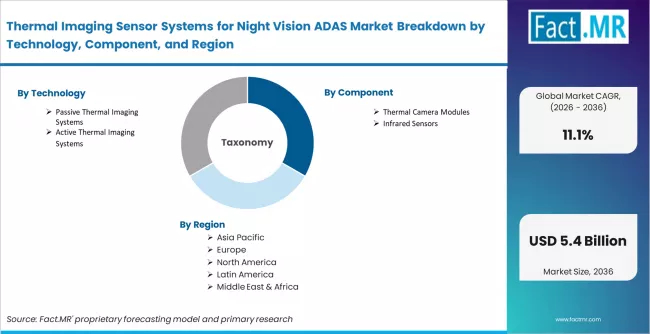
Thermal Imaging Sensor Systems For Night Vision Adas Market Breakdown By Technology, Component, And Region | Source: Fact.MR
| Metric | Value |
|---|---|
| Market Name | Thermal Imaging Sensor Systems for Night Vision ADAS Market |
| Base Year | 2025 |
| Estimated Market Size (2025) | USD 1.5 Billion |
| Projected Market Size (2026) | USD 1.7 Billion |
| Forecast Market Size (2036) | USD 4.9 Billion |
| Forecast Period | 2026 to 2036 |
| CAGR (2026–2036) | 11.1% |
| Study Scope | Global |
| Key Segments Covered | Technology, Component, Vehicle Type, Region |
| Regions Covered | North America, Latin America, Europe, East Asia, South Asia & Pacific, Middle East & Africa |
| Key Countries Covered | China, South Korea, Germany, United States, Japan |
| Research Methodology | Primary interviews, secondary research, and FACTMR proprietary forecasting model |
| Approach | Bottom-up and top-down hybrid model with triangulation from supply-side and demand-side analysis |
| Report Format | PDF, Excel, and PPT |
Source: Fact.MR analysis. Updated May 8, 2026
Thermal Imaging Sensor Systems Market by Segments
-
By Technology
- Passive Thermal Imaging Systems
- Active Thermal Imaging Systems
-
By Component
- Thermal Camera Modules
- Infrared Sensors
- Processing Units
-
By Vehicle Type
- Passenger Cars
- Commercial Vehicles
-
By Region:
- North America
- United States
- Canada
- Mexico
- Latin America
- Brazil
- Argentina
- Chile
- Rest of Latin America
- Western Europe
- Germany
- France
- United Kingdom
- Italy
- Spain
- Nordic Countries
- BENELUX
- Rest of Western Europe
- Eastern Europe
- Russia
- Poland
- Hungary
- Balkan and Baltic
- Rest of Eastern Europe
- East Asia
- China
- Japan
- South Korea
- South Asia and Pacific
- India
- ASEAN
- Australia and New Zealand
- Rest of South Asia and Pacific
- Middle East and Africa
- Kingdom of Saudi Arabia
- Other GCC Countries
- Turkey
- South Africa
- Rest of Middle East and Africa
- North America
Bibliography
- [1] Teledyne FLIR, Automotive Thermal Imaging Solutions Update, 2024
- [2] LYNRED, Infrared Sensor Production Expansion Report, 2024
- [3] Valeo, Thermal Camera Manufacturing Expansion Announcement, 2025
- [4] ADASKY, Automotive LWIR Sensor Launch, 2024
- [5] BMW Group, Night Vision System Integration Report, 2024
- [6] Magna International, ADAS Sensor Integration Strategy, 2025
Thermal Imaging Sensor Systems for Night Vision ADAS Market Definition
Thermal imaging sensor systems for night vision ADAS are electronic sensing systems that detect heat emitted by objects instead of relying on visible light. These systems help vehicles identify pedestrians, animals, and obstacles in dark or low-visibility conditions. They are mainly used in advanced driver assistance systems to improve safety during night driving. The sensors convert thermal radiation into visual images displayed to the driver or processed by onboard software. These systems are primarily used in passenger vehicles, especially premium and safety-focused models.
Thermal Imaging Sensor Systems for Night Vision ADAS Market Inclusions
The report covers global and regional market size, growth forecasts from 2026 to 2036, and detailed segmentation by technology, component, and vehicle type. It includes analysis of passive and active thermal imaging systems, component-level demand, and vehicle adoption trends. The study also evaluates pricing trends, regulatory influences, and supply chain dynamics across major automotive regions.
Thermal Imaging Sensor Systems for Night Vision ADAS Market Exclusions
The scope excludes non-automotive thermal imaging applications such as military surveillance, industrial inspection, and handheld thermal cameras. It does not include general ADAS sensors like radar, lidar, or standard optical cameras unless integrated directly with thermal systems. Downstream software-only vision processing systems are excluded unless bundled with thermal hardware components.
Thermal Imaging Sensor Systems for Night Vision ADAS Market Research Methodology
- Primary Research;Interviews were conducted with automotive OEMs, thermal sensor manufacturers, ADAS system integrators, and safety technology consultants.
- Desk Research;Data sources include automotive safety regulations, company filings, product launches, and industry publications from organizations such as NHTSA, Euro NCAP, and company reports.
- Market-Sizing and Forecasting;A hybrid model combining bottom-up OEM adoption rates and top-down vehicle production data was used.
- Data Validation and Update Cycle:Findings were cross-verified with supplier shipment data, regulatory benchmarks, and annual updates from industry participants.
Frequently Asked Questions
What is the current size of the thermal imaging sensor systems for night vision ADAS market?
What will be the market size of thermal imaging sensor systems for night vision ADAS by 2036?
What is the expected CAGR for the market between 2026 and 2036?
Which technology segment leads the thermal imaging sensor systems market?
Which component segment dominates the market?
Which vehicle type contributes the most to market demand?
Why are thermal imaging systems used in ADAS applications?
What is driving demand for thermal imaging sensors in vehicles?
Which region is expected to grow the fastest in this market?
What factors are limiting widespread adoption of thermal imaging sensors?
How are OEMs incorporating thermal imaging into ADAS platforms?
What role do regulations play in this market?
Are thermal imaging sensors replacing other ADAS sensors?
What opportunities exist for market players?
How is the competitive landscape evolving in this market?
Who worked on this report


Preview the report firsthand - request a free sample
Free SampleGet the brochure for pricing and purchase details
Download PDF