- Base Value(2025): 286.9 Mn
- Estimated Value(2026): 307.4 Mn
- Forecast Value (2036): 553.8 Mn
- CAGR (2026 - 2036): 6.1%
Safety Light Curtains for Hydraulic Press Lines Market Forecast and Outlook By Fact.MR
Valuation of the safety light curtains for hydraulic press lines market stood at USD 286.9 million in 2025. According to Fact MR, demand for safety light curtain systems for hydraulic press protection is expected to reach USD 307.4 million in 2026 and USD 553.8 million by 2036. A CAGR of 6.1% is projected for the forecast timeline.
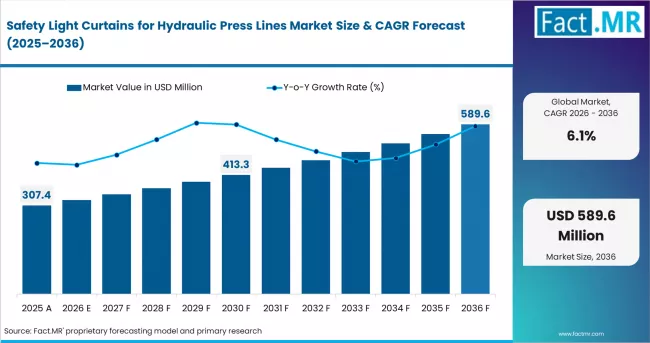
Safety Light Curtains For Hydraulic Press Lines Market Market Value Analysis | Source: Fact.MR
Safety Light Curtains for Hydraulic Press Lines Market
| Metric | Details |
|---|---|
| Industry Size (2026E) | USD 307.4 million |
| Industry Value (2036F) | USD 553.8 million |
| CAGR (2026 to 2036) | 6.1% |
Source: Fact.MR analysis. Updated Apr 20, 2026
Summary of the Safety Light Curtains for Hydraulic Press Lines Market
- Market Definition
- The market comprises production and commercialization of glyphosate based herbicides used for broad spectrum weed control across agricultural crop cultivation, forestry operations, industrial vegetation management, and infrastructure maintenance applications requiring systemic plant growth suppression.
- Demand Drivers
- Continued reliance on broad spectrum herbicides supporting large scale weed management across row crop cultivation systems.
- Increasing adoption of herbicide tolerant crop varieties enabling effective glyphosate based weed suppression.
- Growing use of no till and reduced tillage farming practices supporting chemical weed control dependence.
- Demand for cost efficient herbicide inputs supporting yield stability across commercial agricultural operations.
- Expansion of large acreage mechanized farming supporting compatibility with spray applied liquid formulations.
- Ongoing need for vegetation control across industrial land management and non crop infrastructure areas.
- Key Segments Analyzed
- Crop Type: Corn leads with 38% share supported by extensive herbicide application across row crop cultivation systems.
- Formulation: Liquid formulation dominates with 71% share driven by compatibility with mechanized spraying equipment.
- Application: Agriculture remains the primary use supported by large scale weed control requirements.
- Usage Pattern: Broad spectrum systemic herbicide performance supports continued adoption across conventional farming systems.
- Geography: North America demonstrates stable demand supported by large scale crop production, while Asia Pacific supports supply chain continuity.
- Analyst Opinion at Fact MR
- Shambhu Nath Jha, Principal Consultant, Fact MR, opines, 'In this updated edition of the Glyphosate Market report, demand patterns reflect structural dependence on cost efficient weed control chemistry integrated within herbicide tolerant crop systems. Market participants observe stable consumption patterns supported by large acreage farming efficiency requirements and continued integration of glyphosate formulations across agricultural weed management programs through 2036.'
- Strategic Implications/Executive Takeaways
- Focus on formulation optimization supporting compatibility with precision agricultural spraying equipment.
- Strengthen resistance management strategies supporting long term herbicide efficacy across crop cycles.
- Maintain regulatory compliance capability supporting continued market access across controlled chemical usage environments.
- Expand distribution networks supporting consistent herbicide availability across agricultural supply chains.
- Improve formulation stability supporting effective systemic absorption across plant tissue structures.
- Monitor regulatory developments influencing approval status of glyphosate based active ingredient chemistry.
- Methodology
- Primary interviews conducted with agrochemical manufacturers, distributors, and agricultural input specialists.
- Benchmarked against crop acreage indicators influencing herbicide consumption demand patterns.
- Evaluated utilization across row crops, cereals, oilseeds, and non crop vegetation control applications.
- Hybrid modeling applied combining top down crop protection demand assessment with bottom up herbicide consumption analysis.
- Validation conducted using supplier production data, regulatory approval indicators, and agricultural input usage trends.
- Peer review applied using Fact MR analytical frameworks linking weed management demand with agrochemical supply dynamics.
An increase of USD 246.4 million indicates moderate expansion supported by industrial safety compliance requirements and automation upgrades in metal forming operations. Growth remains steady due to regulatory enforcement of machine safeguarding standards, while constraints persist from retrofit costs, integration complexity with legacy press lines, and capital expenditure prioritization.
China leads with a projected CAGR of 6.8%, supported by expansion of automated metal forming and stamping operations across industrial manufacturing facilities. India follows with a CAGR of 6.6%, driven by increasing integration of machine safety systems across hydraulic press production lines. The United Kingdom records a CAGR of 6.5%, reflecting steady adoption of optoelectronic safeguarding devices across industrial automation environments. Germany shows a CAGR of 6.3%, supported by consistent implementation of safety compliance technologies across precision manufacturing operations. The United States records the slowest growth at 6.1%, reflecting a mature market tied to replacement demand within established industrial machine safeguarding systems.
Segmental Analysis
Safety Light Curtains for Hydraulic Press Lines Market Analysis by Safety Type
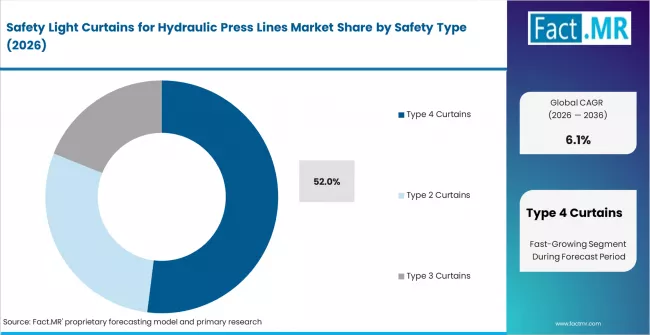
Safety Light Curtains For Hydraulic Press Lines Market Analysis By Safety Type | Source: Fact.MR
- Market Overview: Based on Fact MR assessment, Type 4 light curtains are projected to account for 52% share of the safety light curtains for hydraulic press lines market in 2026. Type 4 safety devices are deployed across high risk machinery environments requiring continuous monitoring of operator access zones through infrared beam interruption detection systems. Hydraulic press lines incorporate safety rated electro sensitive protective equipment aligned with functional safety standards governing prevention of accidental contact with moving press components. System architecture supports rapid response triggering of machine stop mechanisms when safety field intrusion is detected across industrial metal forming operations.
- Demand Drivers:
- Functional Safety Requirements: Type 4 light curtains support compliance with machine safety integrity frameworks requiring high reliability protective sensing performance.
- Hazard Zone Monitoring Parameters: Infrared beam arrays enable detection of operator presence across press access points requiring controlled safety response timing.
- Operational Risk Control Needs: Hydraulic press operators implement safety sensing equipment supporting reduction of injury exposure across automated metal forming workflows.
Safety Light Curtains for Hydraulic Press Lines Market Analysis by Resolution
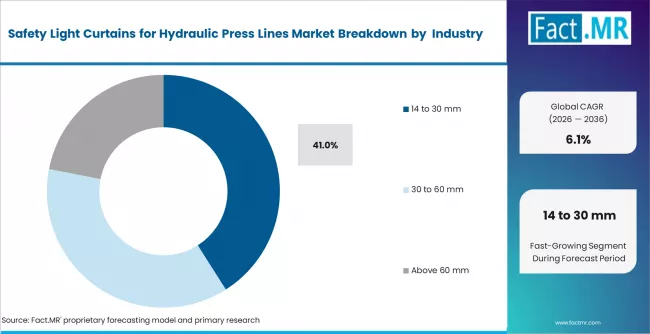
Safety Light Curtains For Hydraulic Press Lines Market Analysis By Resolution | Source: Fact.MR
- Market Overview: Resolution range 14 to 30 mm is estimated to hold 41% share of the safety light curtains for hydraulic press lines market in 2026, supported by requirement for detection of hand and finger intrusion across press access openings requiring defined protective field sensitivity. Optical sensor spacing enables reliable detection of object interruption across protective field dimensions aligned with safety standards applied in industrial press safeguarding systems. Sensor configuration supports integration across compact press line layouts requiring controlled alignment accuracy across machine safety installation environments.
- Demand Drivers:
- Detection Precision Requirements: Resolution range supports identification of hand intrusion across press operation zones requiring defined sensing sensitivity parameters.
- Installation Compatibility Parameters: Sensor spacing supports deployment across press guard openings requiring stable protective field coverage.
Machine Safety Compliance Needs: Resolution configuration aligns with safeguarding standards governing operator protection across hydraulic press production systems.
Key Dynamics
Safety Light Curtains for Hydraulic Press Lines Market Drivers, Restraints, and Opportunities
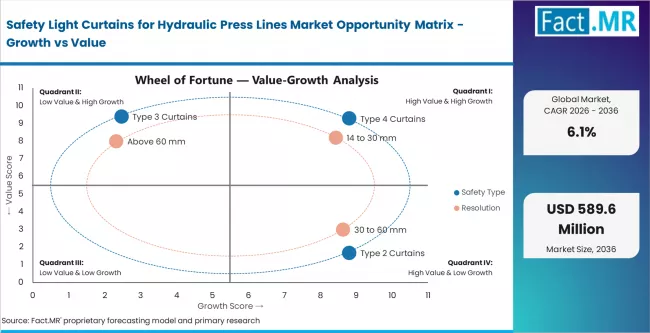
Safety Light Curtains For Hydraulic Press Lines Market Opportunity Matrix Growth Vs Value | Source: Fact.MR
Fact MR analysis indicates historical adoption has been structurally tied to mechanical and hydraulic press automation where operator exposure to point-of-operation hazards required reliable non-contact safeguarding systems. The present market size reflects a mature machine safety segment shaped by regulatory enforcement requiring presence sensing devices on part-revolution presses to reduce workplace injury incidence. Structural demand persists because hydraulic press lines remain widely used in automotive stamping, metal forming, and heavy fabrication environments where physical guarding reduces productivity and increases downtime.
The current structural transition reflects declining reliance on fixed mechanical guards as flexible optical safety systems allow faster tool changeovers and higher throughput in automated press cells. High-performance Type 4 light curtains carry higher per-unit pricing due to redundant circuitry and fail-safe diagnostics, yet reduced downtime losses and lower injury liability exposure support stable value growth despite moderate shipment volumes. Demand growth is strongest in automated press retrofits where legacy safeguarding systems fail to meet current safety distance calculation requirements.
- Machine Safety Compliance: OSHA 29 CFR 1910.217 and ISO 13855 define presence sensing and safety distance requirements, sustaining baseline demand across hydraulic press safeguarding installations.
- Press Line Automation: Automotive and metal fabrication sectors increasingly replace fixed guards with optical sensing barriers that allow higher production throughput without restricting operator accessibility.
Asia Manufacturing Expansion: China, Japan, and South Korea show higher retrofit demand due to expansion of automated stamping lines and robotics-integrated press operations.
Regional Analysis
The Safety Light Curtains for Hydraulic Press Lines Market is assessed across North America, Europe, and Asia Pacific, segmented by country-level demand in metal forming safety systems, machine safeguarding retrofits, press automation integration, and industrial compliance upgrades. Regional demand reflects occupational safety regulation enforcement and modernization of hydraulic press production infrastructure. The full report offers market attractiveness analysis.
.webp "Top Country Growth Comparison Safety Light Curtains For Hydraulic Press Lines Market Cagr (2026 2036)")
Top Country Growth Comparison Safety Light Curtains For Hydraulic Press Lines Market Cagr (2026 2036) | Source: Fact.MR
CAGR Table
| Country | CAGR (2026–2036) |
|---|---|
| China | 6.8% |
| India | 6.6% |
| United Kingdom | 6.5% |
| Germany | 6.3% |
| United States | 6.1% |
Source: Fact.MR analysis. Updated Apr 20, 2026
Source: Fact MR analysis, based on proprietary forecasting model and primary research
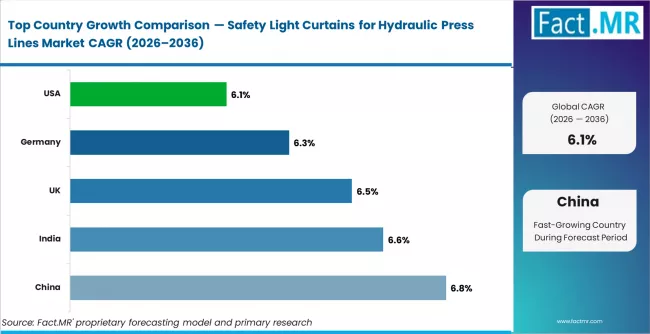
Safety Light Curtains For Hydraulic Press Lines Market Cagr Analysis By Country | Source: Fact.MR
Asia Pacific
Asia Pacific functions as the hydraulic press modernization center, supported by industrial safety compliance enforcement and expansion of automated metal forming production capacity. SICK AG strengthens machine safety sensor positioning. Omron Corporation expands industrial safety control portfolios. Keyence Corporation supports optical safety device integration capability.
- China: China is projected to register 6.8% CAGR in safety light curtains for hydraulic press lines through 2036. Work Safety Law compliance inspection update (Ministry of Emergency Management, March 2024) increases adoption of machine safeguarding technologies. Keyence Corporation expanded safety sensing device supply capability (July 2023).
- India: Adoption of safety light curtains for hydraulic press lines in India is forecast to grow at 6.6% CAGR through 2036. Factories Act occupational safety enforcement update (Ministry of Labour, January 2024) supports installation of machine safety barriers. Omron Corporation expanded industrial safety automation solution availability (May 2023).
Europe
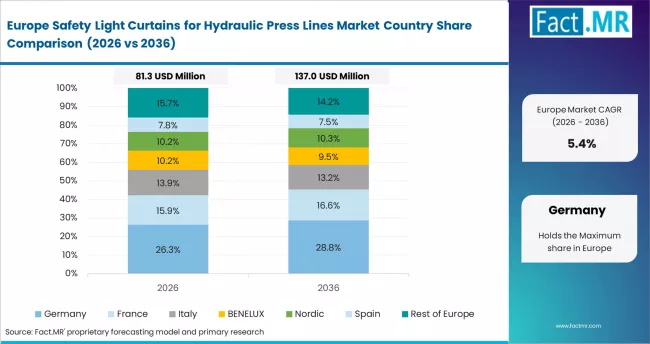
Safety Light Curtains For Hydraulic Press Lines Market Europe Country Market Share Analysis, 2026 & 2036 | Source: Fact.MR
Europe operates as the industrial machine safeguarding compliance benchmark, supported by structured workplace safety directives and harmonized machinery certification frameworks. SICK AG maintains strong presence in optical safety sensing technologies. Pilz GmbH strengthens safety automation engineering capability. Schneider Electric SE supports industrial risk mitigation solutions.
- United Kingdom: Sales of safety light curtains for hydraulic press lines in United Kingdom are expected to expand at 6.5% CAGR through 2036. Provision and Use of Work Equipment Regulations compliance update (HSE, October 2023) supports installation of machine safety light barriers. Pilz GmbH expanded machinery safety engineering services (June 2023).
- Germany: Germany is anticipated to observe 6.3% CAGR in safety light curtains for hydraulic press lines through 2036. Machinery Directive compliance transition toward EU Machinery Regulation (Federal Ministry of Labour, February 2024) supports advanced safeguarding adoption. SICK AG expanded optical safety sensor manufacturing capability (April 2023).
North America
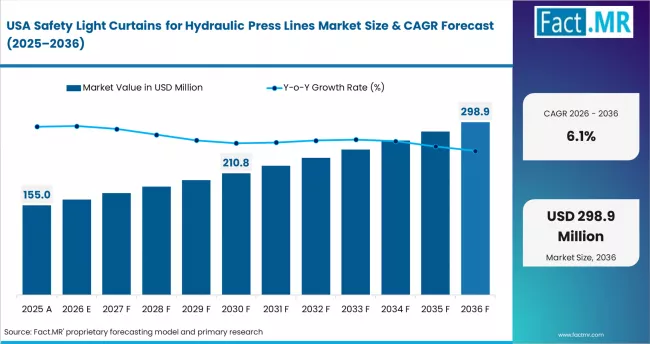
Safety Light Curtains For Hydraulic Press Lines Market Country Value Analysis | Source: Fact.MR
North America represents the mature industrial safety integration environment, supported by established machine safeguarding standards and modernization of legacy press lines. Rockwell Automation Inc. strengthens safety control integration capability. Banner Engineering Corp. expands optoelectronic safety sensing product portfolio. Honeywell International Inc. supports industrial risk reduction solutions.
- United States: Demand for safety light curtains for hydraulic press lines in United States is projected to rise at 6.1% CAGR through 2036. OSHA machine guarding compliance guidance update (September 2023) encourages installation of presence sensing safety devices. Rockwell Automation Inc. expanded safety automation solution integration capability (August 2023).
Fact MR's analysis of safety light curtains for hydraulic press lines market in global regions consists of country-wise assessment that includes China, India, United Kingdom, Germany, and United States. Readers can find industrial safety compliance trends, machine safeguarding adoption patterns, regulatory developments, and competitive positioning across key markets.
Competitive Landscape
Competitive Structure and Buyer Dynamics in the Safety Light Curtains for Hydraulic Press Lines Market
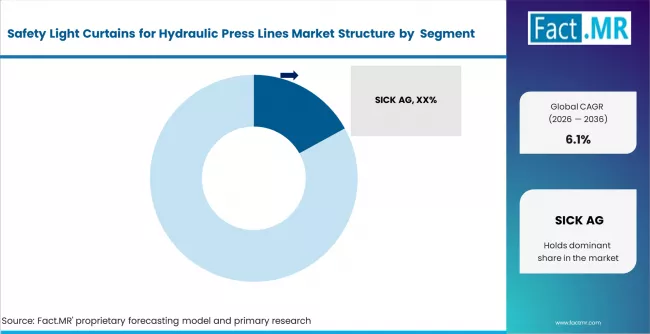
Safety Light Curtains For Hydraulic Press Lines Market Analysis By Company | Source: Fact.MR
The competitive structure of the Safety Light Curtains for Hydraulic Press Lines Market is moderately concentrated, with industrial safety automation manufacturers controlling a significant share of certified machine safeguarding solutions. Companies such as SICK AG, Keyence Corporation, Omron Corporation, Rockwell Automation Inc., Banner Engineering Corp., Pepperl+Fuchs SE, and Pilz GmbH & Co. KG maintain strong positions through established industrial safety portfolios and global distribution networks. Additional participants including Leuze electronic GmbH + Co. KG, Schmersal Group, and Datalogic S.p.A. contribute through optical safety sensors and machine protection technologies designed for press line environments. Competition is primarily influenced by detection accuracy, response time performance, compliance with safety standards, and integration with machine control systems.
Several companies maintain structural advantages through strong expertise in functional safety engineering and established relationships with industrial equipment manufacturers and automation integrators. Firms such as SICK AG, Pilz GmbH & Co. KG, and Rockwell Automation Inc. benefit from extensive safety automation portfolios supporting integrated machine protection systems. Keyence Corporation and Omron Corporation maintain advantages through advanced optical sensing technologies and reliable industrial control integration. Manufacturing companies typically adopt multi supplier safety strategies to reduce dependence on a single sensor provider and ensure regulatory compliance across production lines. Procurement decisions evaluate suppliers based on certification standards, system reliability, and long term technical support, moderating supplier pricing leverage across industrial safety applications.
Key Players of the Safety Light Curtains for Hydraulic Press Lines Market
- SICK AG
- Keyence Corporation
- Omron Corporation
- Rockwell Automation Inc.
- Banner Engineering Corp.
- Pepperl+Fuchs SE
- Leuze electronic GmbH + Co. KG
- Schmersal Group
- Datalogic S.p.A.
- Pilz GmbH & Co. KG
Bibliographies
- [1] Occupational Safety and Health Administration. (2023, September). Safeguarding presses: OSHA 29 CFR 1910.217 guidance update. U.S. Department of Labor.
- [2] International Organization for Standardization. (2023). ISO 13855: Safety of machinery – Positioning of safety zones. ISO.
- [3] Ministry of Emergency Management. (2024, March). Work safety law compliance for machine safeguarding. People’s Republic of China.
- [4] Health and Safety Executive. (2023, October). PUWER regulations: Light curtains for presses. UK HSE.
- [5] Federal Ministry of Labour and Social Affairs. (2024, February). Machinery directive to EU regulation transition: Safety devices. Germany BMAS.
- [6] Ministry of Labour and Employment. (2024, January). Factories Act enforcement: Machine safety barriers. Government of India.
This Report Addresses
- Market size forecasts for 2026 to 2036 based on machine safeguarding adoption across hydraulic press automation environments.
- Opportunity mapping across automotive stamping, metal fabrication, industrial machinery, electronics enclosures, and aerospace component forming operations.
- Segment and regional forecasts covering Type 4, Type 3, and Type 2 safety light curtains across varied resolution configurations.
- Competition assessment based on functional safety certification capability, response time performance, and integration compatibility with press control systems.
- Regulatory review covering OSHA, ISO 13855, and machinery safety compliance standards governing optoelectronic protective devices.
- Report delivery in PDF, Excel, PPT, and dashboard formats for industrial automation engineers, safety compliance teams, and machine integrators.
Supply chain risk assessment covering sensor alignment precision, controller reliability, retrofit complexity across legacy press lines, and certification dependency constraints.
Safety Light Curtains for Hydraulic Press Lines Market Definition
The Safety Light Curtains for Hydraulic Press Lines Market includes optoelectronic safety devices that create an infrared light barrier around press operation zones to detect human presence and immediately stop machine motion, reducing risk of injury during metal forming, stamping, and industrial pressing operations.
Safety Light Curtains for Hydraulic Press Lines Market Inclusions
The report includes global and regional market size estimates, forecast analysis, and segmentation by safety type, resolution level, protection height, integration architecture, application area, end use industry, pricing structure, and compliance with machine safety standards.
Safety Light Curtains for Hydraulic Press Lines Market Exclusions
The scope excludes mechanical guards, pressure sensitive safety mats, laser scanners, machine presses without optical safety devices, and industrial safety systems not designed for presence detection in hydraulic press environments.
Safety Light Curtains for Hydraulic Press Lines Market Research Methodology
- Primary Research: Interviews were conducted with machine safety device manufacturers, press equipment producers, automation integrators, plant safety engineers, and industrial compliance specialists.
- Desk Research: Public sources included industrial safety standards documentation, company technical specifications, machine safeguarding guidelines, and research literature on optoelectronic safety systems.
- Market-Sizing and Forecasting: A hybrid model combining top-down industrial machinery demand evaluation and bottom-up analysis of safety light curtain adoption in press line installations was applied.
- Data Validation and Update Cycle: Outputs were validated through cross comparison of supplier data, expert consultation, and periodic monitoring of industrial safety compliance trends and automation upgrades.
Segmentation
Report Scope
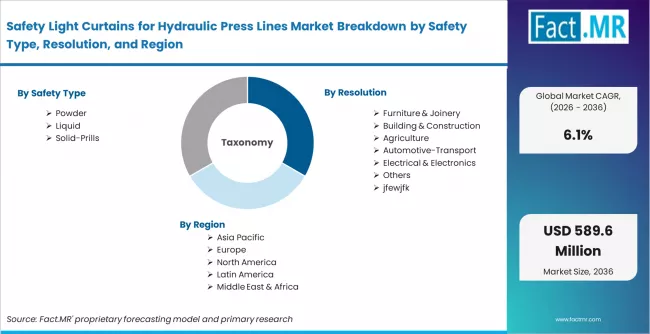
Safety Light Curtains For Hydraulic Press Lines Market Breakdown By Safety Type, Resolution, And Region | Source: Fact.MR
| Metric | Value |
|---|---|
| Quantitative Units | USD 307.4 million (2026) to USD 553.8 million (2036), at a CAGR of 6.1% |
| Market Definition | The safety light curtains for hydraulic press lines market includes optoelectronic protective devices designed to detect operator presence and interrupt machine operation to prevent injury during metal forming, stamping, and industrial pressing operations. |
| Safety Type Segmentation | Type 4 curtains, Type 2 curtains, Type 3 curtains |
| Resolution Segmentation | 14 to 30 mm, 30 to 60 mm, Above 60 mm |
| End Use Industry Segmentation | Automotive stamping, Metal fabrication, Industrial machinery, Electronics enclosures, Aerospace components |
| Regions Covered | North America, Latin America, Europe, East Asia, South Asia, Oceania, Middle East and Africa |
| Countries Covered | United States, Canada, Mexico, Germany, France, United Kingdom, Italy, Spain, Netherlands, Sweden, China, Japan, South Korea, India, Singapore, Australia, United Arab Emirates, Saudi Arabia, and 40+ countries |
| Key Companies Profiled | SICK AG, Keyence Corporation, Omron Corporation, Rockwell Automation Inc., Banner Engineering Corp., Pepperl+Fuchs SE, Leuze electronic GmbH + Co. KG, Schmersal Group, Datalogic S.p.A., Pilz GmbH & Co. KG |
| Forecast Period | 2026 to 2036 |
| Approach | Hybrid top-down and bottom-up market estimation based on industrial safety compliance adoption trends, machine safeguarding demand benchmarking, metal forming equipment deployment analysis, occupational safety regulation impact assessment, and validation through primary interviews with safety equipment manufacturers, automation integrators, and industrial machinery producers. |
Source: Fact.MR analysis. Updated Apr 20, 2026
Safety Light Curtains for Hydraulic Press Lines Market Key Segments
-
Safety Type:
- Type 4 Curtains
- Type 2 Curtains
- Type 3 Curtains
-
Resolution:
- 14 to 30 mm
- 30 to 60 mm
- Above 60 mm
-
End Use Industry:
- Automotive Stamping
- Metal Fabrication
- Industrial Machinery
- Electronics Enclosures
- Aerospace Components
-
Region:
-
North America
- USA
- Canada
- Mexico
- Europe
- Germany
- UK
- France
- Italy
- Spain
- Nordic Countries
- BENELUX
- Rest of Europe
- Asia Pacific
- China
- Japan
- South Korea
- India
- Australia
- Rest of Asia Pacific
- Latin America
- Brazil
- Argentina
- Rest of Latin America
- Middle East and Africa
- Kingdom of Saudi Arabia
- United Arab Emirates
- South Africa
- Rest of Middle East and Africa
- Other Regions
- Oceania
- Central Asia
- Other Markets
-
Frequently Asked Questions
How large is the demand for Safety Light Curtains for Hydraulic Press Lines in the global market in 2026?
What will be the market size of Safety Light Curtains for Hydraulic Press Lines in the global market by 2036?
What is the expected demand growth for Safety Light Curtains for Hydraulic Press Lines in the global market between 2026 and 2036?
Which company is identified as a leading manufacturer in the Safety Light Curtains for Hydraulic Press Lines market?
Which safety type is projected to dominate safety light curtain adoption by 2026?
Why are Type 4 safety light curtains widely used in hydraulic press production lines?
What is driving demand for safety light curtains in China?
What is the growth outlook for the Safety Light Curtains for Hydraulic Press Lines market in China?
Why is India an important market for industrial machine safety systems?
What is the growth outlook for the Safety Light Curtains for Hydraulic Press Lines market in India?
How is demand for safety light curtains evolving in the United Kingdom manufacturing sector?
What is the growth outlook for the Safety Light Curtains for Hydraulic Press Lines market in the United Kingdom?
What is the growth outlook for the Safety Light Curtains for Hydraulic Press Lines market in Germany?
How is the United States positioned in the Safety Light Curtains for Hydraulic Press Lines market?
What is the growth outlook for the Safety Light Curtains for Hydraulic Press Lines market in the United States?
What are safety light curtains and what are they mainly used for in hydraulic press lines?
What does the Safety Light Curtains for Hydraulic Press Lines market include in this report?
What applications are included in the scope of the Safety Light Curtains for Hydraulic Press Lines market?
What is excluded from the scope of the Safety Light Curtains for Hydraulic Press Lines market report?
What does market forecast mean in the Safety Light Curtains for Hydraulic Press Lines market report?
How is the Safety Light Curtains for Hydraulic Press Lines market forecast developed in this report?
What does primary validation indicate in the Safety Light Curtains for Hydraulic Press Lines market analysis?
Who worked on this report


Preview the report firsthand - request a free sample
Free SampleGet the brochure for pricing and purchase details
Download PDF